This all seems completely reasonable, or even conservative. I'm surprised you've had serious resistance on this front and even need to justify this.
Personally I doubt the internet + phone cost will be as valuable as if you gave the money it cost. I think there's potential there, but here in Uganda at least I'm not convinced that subsistance farmers at least are able to leverage the connectivity in the ways they need to reach new markets, access education or healthcare info in helpful ways. But we shall see and its a great test to do.
"Give people more useful information while leaving the decision-making power with them"
I love this approach to charities and I wish more of them follow this principle. Something that made me reluctant on supporting some organizations was the paternalization and loss of agency of people they provoked as a consequence of their way of helping. Yours is genuinely refreshing.
Also 100% agree with the democratization of technology and specifically AI implemented with safety measures. Hope your test gives you good guidance!
Who gets to decide if an AI chatbot is worth the risk?
At GiveDirectly, we are empiricists who trust people. People in poverty tell us they prefer unconditional cash, so we test the best way to deliver it to create lasting impact. When recipients ask for support alongside their cash, we again look at the evidence, test tools that might help, keep what the evidence supports, and drop what it does not. Right now, one of those tools is an AI chatbot.
Summary
🤖 We’re piloting giving families an optional AI chatbot alongside unconditional cash in Malawi and Rwanda.
💬 Recipients have asked for more information and support, and evidence shows this has the potential to increase impact.
🤝 AI chatbots may be a cheaper way to give them access to the information they want without anyone making any decisions for them.
⚠️ Chatbots make mistakes, so we test for failures, audit conversations, encourage recipients to double-check, and route high-risk issues to human support.
📊 The evidence will decide what happens next. If the data show recipients don’t want it or the benefits don’t justify the cost and risk, we’ll stop.
When GiveDirectly first shared that we were giving cash recipients access to an AI chatbot, readers had many questions and even more opinions.
Some were excited to see GiveDirectly embracing new technology. Others raised concerns about bad advice, privacy, and whether AI belonged in a cash program in the first place. Unfortunately, the truth will probably disappoint anyone hoping for a simple answer.
GiveDirectly is built on the simple idea that people living in poverty should have more control over the decisions that affect their lives. In theory, a chatbot could extend that principle and amplify the impact of cash: give people more useful information while leaving the decision-making power with them. In that sense, these pilots are another bet on recipients’ judgment.
In practice, however, research shows that AI has the potential to be both productive and harmful. Studies have found learning gains from AI-powered chatbot tutoring in Ghana, benefits for some Kenyan entrepreneurs but losses for others, worse math performance for Turkish students, and wider risks to users worldwide, including mental health harms, misinformation, and loss of autonomy.
With this in mind, our teams are holding two ideas at once: people living in extreme poverty should not be last in line for technology that could improve their lives; and they should not bear risks we would not accept elsewhere.
That tension is shaping how we run these pilots. Below, we share our takes on some of the questions and concerns we’re hearing so far, and what we’re still figuring out.
❓ What is AI doing in a cash program? Is GiveDirectly just jumping on the AI bandwagon?
💸 Isn’t the whole point of unconditional cash that you don’t give people things they don’t need? Aren’t these pilots the opposite of that?
Cash is still our central offer, and the chatbot is an option attached to it. No one has to use it, and many don’t.
The option exists, in part, because recipients have been asking for support alongside cash for years: what to plant, how to price goods, how to keep a business going. We’ve been testing ways to meet that demand, building on evidence that the right support alongside cash can increase its impact.1 The challenge is providing that support at scale.2
That’s what we’re testing, not committing to AI as a permanent part of our programs.
⚙️ Why not stick to what GiveDirectly already knows works?
In a sense, we are sticking with what we know. Delivering cash has always required some technology, including providing a basic phone for recipients who need one and teaching people to use mobile money. In that way, these pilots build on the digital inclusion already embedded in our programs. Unlike those earlier tools, a chatbot can answer one person’s specific question at the moment they have it.
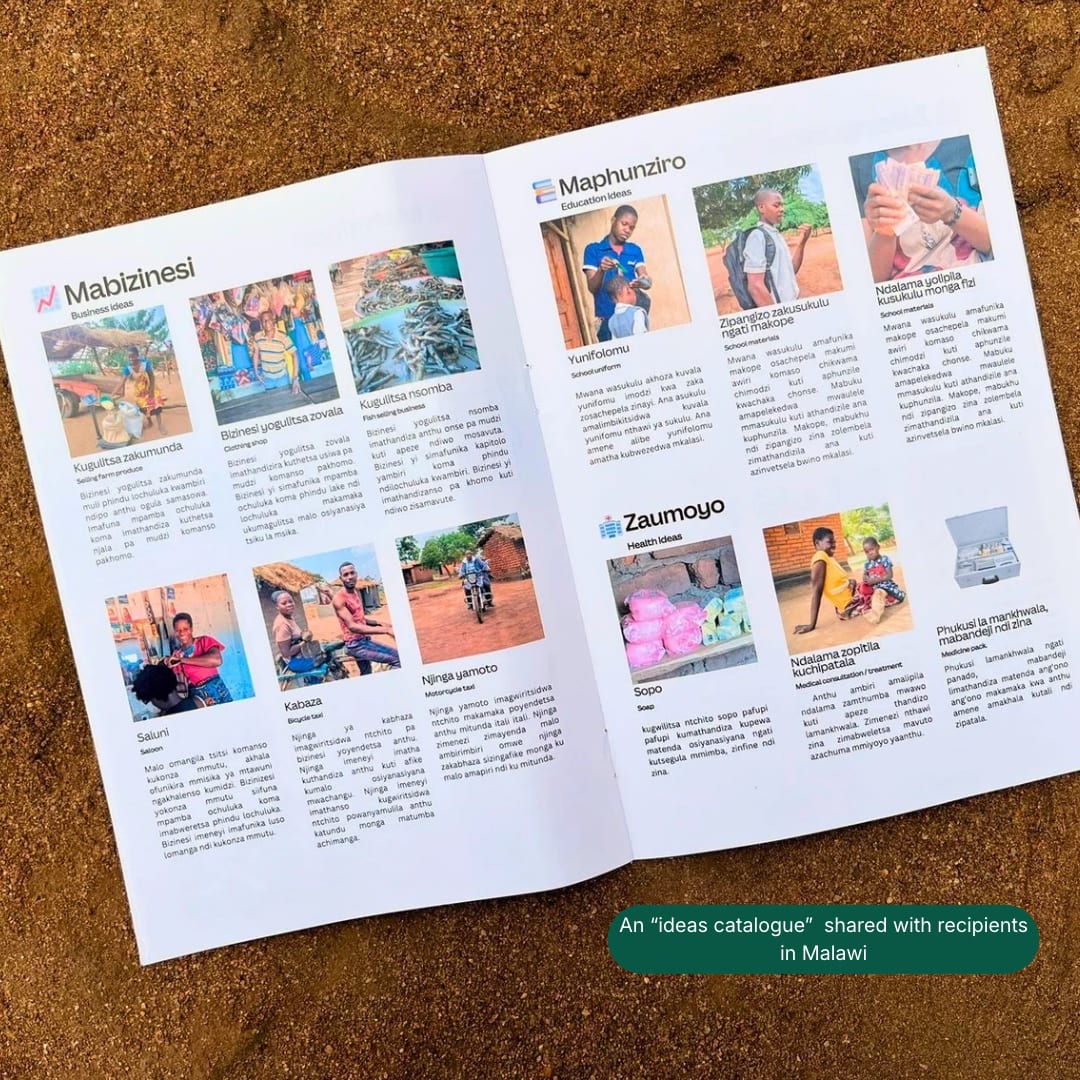
For years, GiveDirectly has tested ways to amplify the impact of cash at low cost, from idea catalogs like this one to voice messages, hotlines, and digital training.
❓ How much choice and privacy do recipients really have?
🙅 Can someone say no without risking their cash transfer?
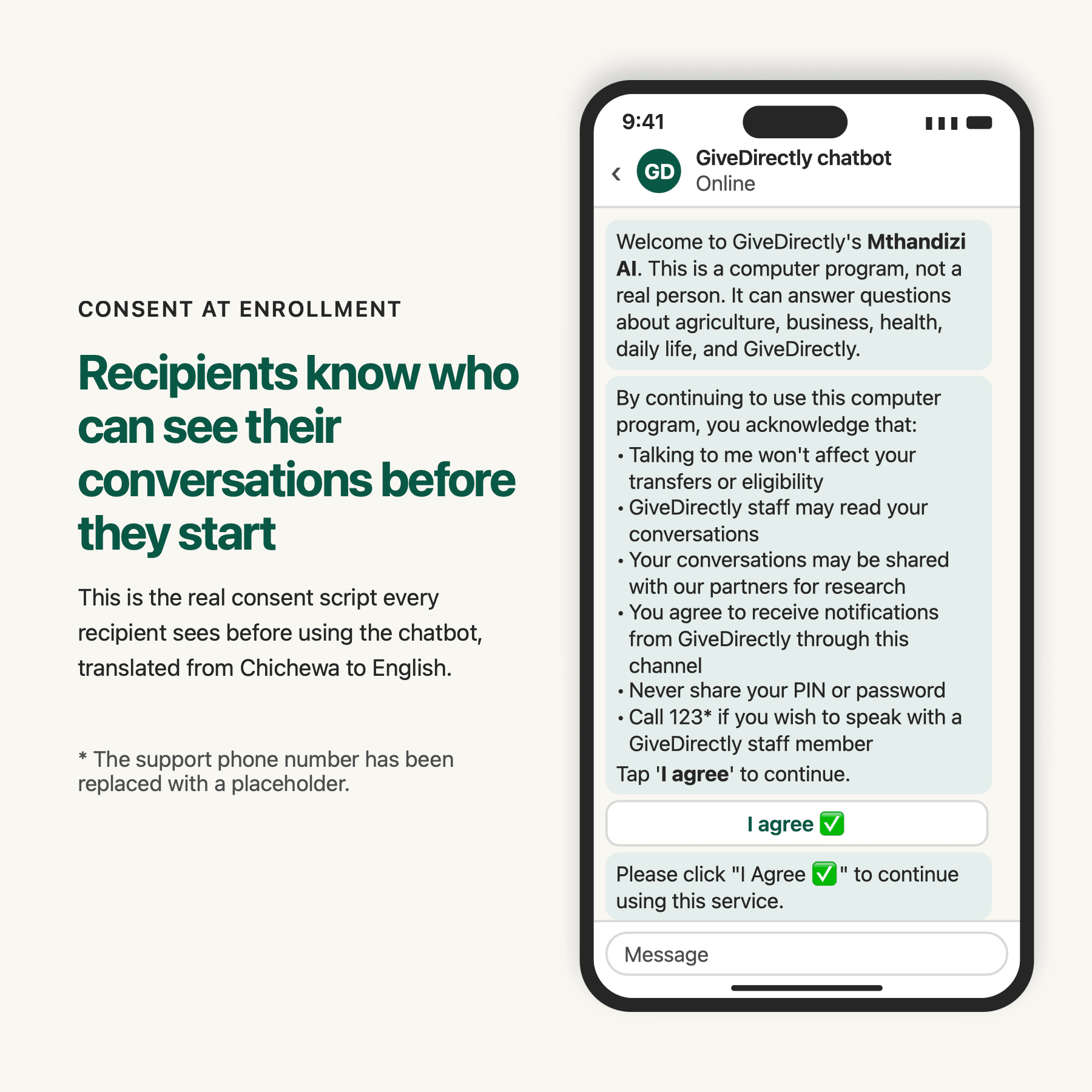
Yes. Participation in the chatbot pilot is entirely optional. Recipients can decide separately whether to join the pilot, attend digital literacy sessions, and share data for research. We explain these options at group onboarding, where they can ask questions, before they make their individual decisions at enrollment and during follow-up surveys.
Recipients can decline at any stage or simply choose not to use the chatbot. About half of recipients in our pilot don’t use it, and they still get their cash, no strings attached.
🧐 Is a conversation really ‘private’ if GiveDirectly staff review it?
Not entirely. GiveDirectly staff review some conversations during the pilot, and recipients are told this before they agree to use the chatbot. Researchers may also review anonymized conversations with recipients’ consent under formal data agreements.
But we don’t share those conversations with recipients’ families, neighbors, or others in their communities, which is what they are more concerned with. That means they can test a business idea or ask a question they might feel uncomfortable asking someone else without the people around them knowing.
This tension isn’t unique to our pilot. Even in wealthier countries, major AI companies may also review users’ chatbot conversations for research and training purposes.
❓ Are you using people in poverty as beta testers for unreliable technology?
🤳 AI makes mistakes. How can it be a reliable source of information for recipients?
It does make mistakes. In fact, we deliberately asked Northwestern researchers to look for failures in our tool. They found several, including:
Quoting local egg prices at roughly one-tenth of the actual price.
Saying chickens provide “milk and eggs.”
Giving inconsistent chick prices and placing named markets in the wrong district.
Producing Chichewa (a Malawian language) that our local staff could not understand, confusing distinct verbs, and using internal GiveDirectly shorthand with recipients.
Even the leading AI chatbots can confidently give false answers, a problem known as “hallucination.” Our pilots face an additional challenge: AI models are trained mostly on data from wealthier, urban settings, not on the communities and languages we work in.
🤔 If the chatbot can be confidently wrong, how are recipients supposed to know when not to trust it?
We tell recipients upfront that the chatbot can be wrong and provide digital literacy coaching, including in-person group training, take-home leaflets, and practice exercises on what the chatbot can and can’t do, to help them recognize when to verify an answer rather than take it at face value.
⚠️ What happens when someone asks the chatbot about something where a wrong answer could cause harm?
For safety issues, such as self-harm or abuse, the chatbot encourages recipients to contact GiveDirectly’s hotline or speak with someone they trust. Operational questions requiring GiveDirectly’s intervention, such as transfer schedules, are similarly directed to our call center.
In early testing, the chatbot didn’t always recognize when to direct someone to a person instead. We’ve since changed its instructions to address those failures.
📵 Why not restrict the chatbot to only answer business, farming, or health questions?
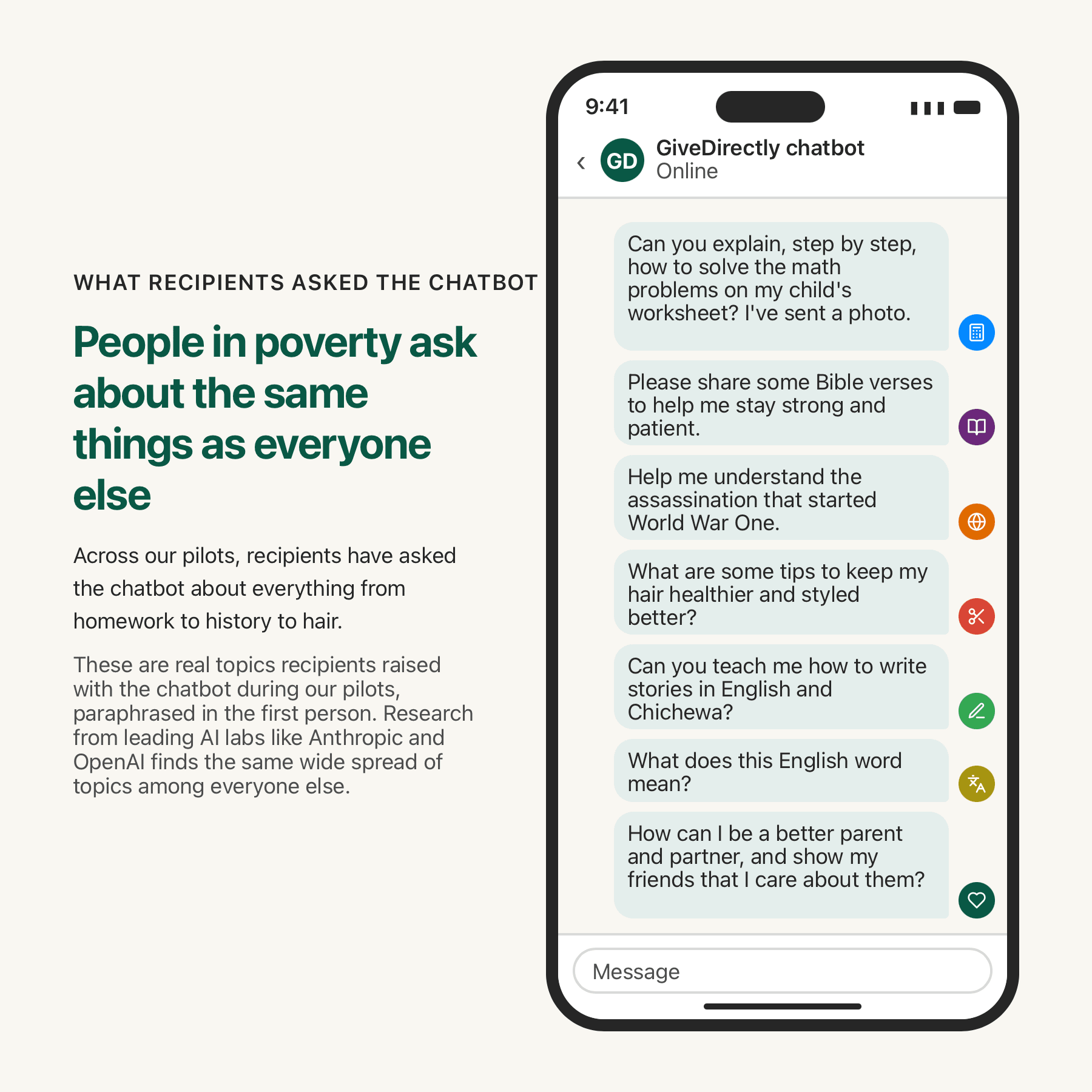
For the same reason we don’t restrict how recipients spend their cash: we don’t want to make decisions on behalf of recipients, including what information they can access. People living in poverty aren’t just farmers or entrepreneurs. They have the same range of interests, questions, and concerns as anyone else.
Restricting the chatbot to a handful of topics would mean deciding for recipients which of their questions are worth answering. We’d rather let them decide, while maintaining safeguards around potentially harmful advice.
❓ Why spend money on AI instead of just giving people more cash?
💰 Couldn’t every dollar spent on the chatbot simply increase someone’s transfer instead?
Yes, and that is the comparison the pilot needs to beat. The chatbot is only worth the expense if it benefits recipients more than adding that money to their cash transfers would.
Some evidence suggests the bar can be cleared: a randomized trial in rural Peru found that an AI-supported digital intervention improved child development at roughly one-fifteenth the cost of traditional home visits.
❓ How will you know if the chatbot is “working”?
📊 What exactly are you testing, and what would success look like?
We want to know two things: whether recipients use the chatbot and whether the additional support we’re testing improves their lives. We’re studying these questions separately.
In Malawi, we’re looking at what it takes for people to use the chatbot, especially those using a smartphone for the first time. We’re studying whether they use it, what they ask, and what challenges they face. We’re also comparing different approaches to digital literacy onboarding, internet access, and chatbot design.
In Rwanda, we’re looking at the impact on recipients’ lives. With researchers from Northwestern University, we’re comparing cash alone with cash plus a smartphone, digital literacy support, and the chatbot. Researchers will track assets, savings, small-business activity, and wellbeing to see whether the added support helps recipients and whether it causes any harm. We expect early results in 2027.
❓ Is GiveDirectly here to spread AI across the world?
🌍 Are you trying to get more people using AI?
Not for its own sake. We’re testing whether access to an AI chatbot can improve the impact of cash transfers.
There is, however, a broader debate about who gets to experiment with technology. Some working on AI in development argue that too little investment in low-income countries could mean missing opportunities to develop new and better ways of delivering essential services. If most LLM experimentation happens in wealthier countries, people in low-income countries may be slower to get tools built around the decisions and constraints they actually face.
📈 Some say that AGI could supercharge growth and lift places out of extreme poverty forever. Should you focus more on that instead of cash transfers?
That’s a much bigger question than our chatbot pilots are designed to answer. Some economists argue that if AGI sharply accelerates growth in rich countries, poorer countries could fall further behind if they adopt it later. But that growth isn’t guaranteed, and some predict that AI could displace workers and widen inequality.
Those are questions about whole economies, while our pilots have a narrower purpose. We don’t need to predict whether AI will transform economies to test whether it can make cash work better for recipients. If access to AI also helps people participate in a broader technological shift, all the better.
The bar for testing AI should be evidence, not paternalism
AI can give information and expertise to people who otherwise may not have access to it. The World Bank argues that low-cost AI could expand access to agricultural advice, health care, and education, while warning that limited evidence, local data, language support, and connectivity could constrain its value. At the same time, official development assistance fell by more than 23% in 2025 and is projected to fall again in 2026, the third consecutive year of decline.
With aid dollars getting scarcer, we should not keep potentially useful and less expensive technology away from people in poverty because we consider them too vulnerable to navigate it. Assuming that they are incapable of handling a tool that much of the rest of the world already uses is its own kind of paternalism. Their circumstances call for more care from us, not less choice for them.
That is what these pilots are for. If the chatbot proves valuable enough to justify its costs and risks, we will have a case to expand it. If not, we won’t continue it. The goal is not to prove that AI belongs in cash programs. It is to give recipients the choice to try it while gathering the evidence to decide whether GiveDirectly should keep offering it.
Cross-posted from my Substack.
Epistemic status: I’ve puzzled over this for a long time but I’m not sure I came to the right answers. I'm sharing this partly because it might help others work on resource allocation, but mostly because some smarter reader might tell me how to do it better.
TL;DR:
* I he...
With the AI windfall, mental health may be taken increasingly seriously by mainstream EA. There’s increasingly room to explore the cause area and answer some of the biggest uncertainties; at the same time, costs of the most effective interventions are continuing to fall. StrongMinds is now treating for ~$35, about a third of GiveWell’s best guess from a few years ago, and is expected to...



This all seems completely reasonable, or even conservative. I'm surprised you've had serious resistance on this front and even need to justify this.
Personally I doubt the internet + phone cost will be as valuable as if you gave the money it cost. I think there's potential there, but here in Uganda at least I'm not convinced that subsistance farmers at least are able to leverage the connectivity in the ways they need to reach new markets, access education or healthcare info in helpful ways. But we shall see and its a great test to do.