This is from Same Page, a blog about EA-org-style management I write with Max Dalton of Forethought.

Too many people in our audience feel uncomfortable with selling themselves.

Fortunately, our audience are also people who might change their orientation in response to an economic concept. Especially if it's one which reframes selling themselves as a way of helping others.

That concept could be 'transaction costs'.


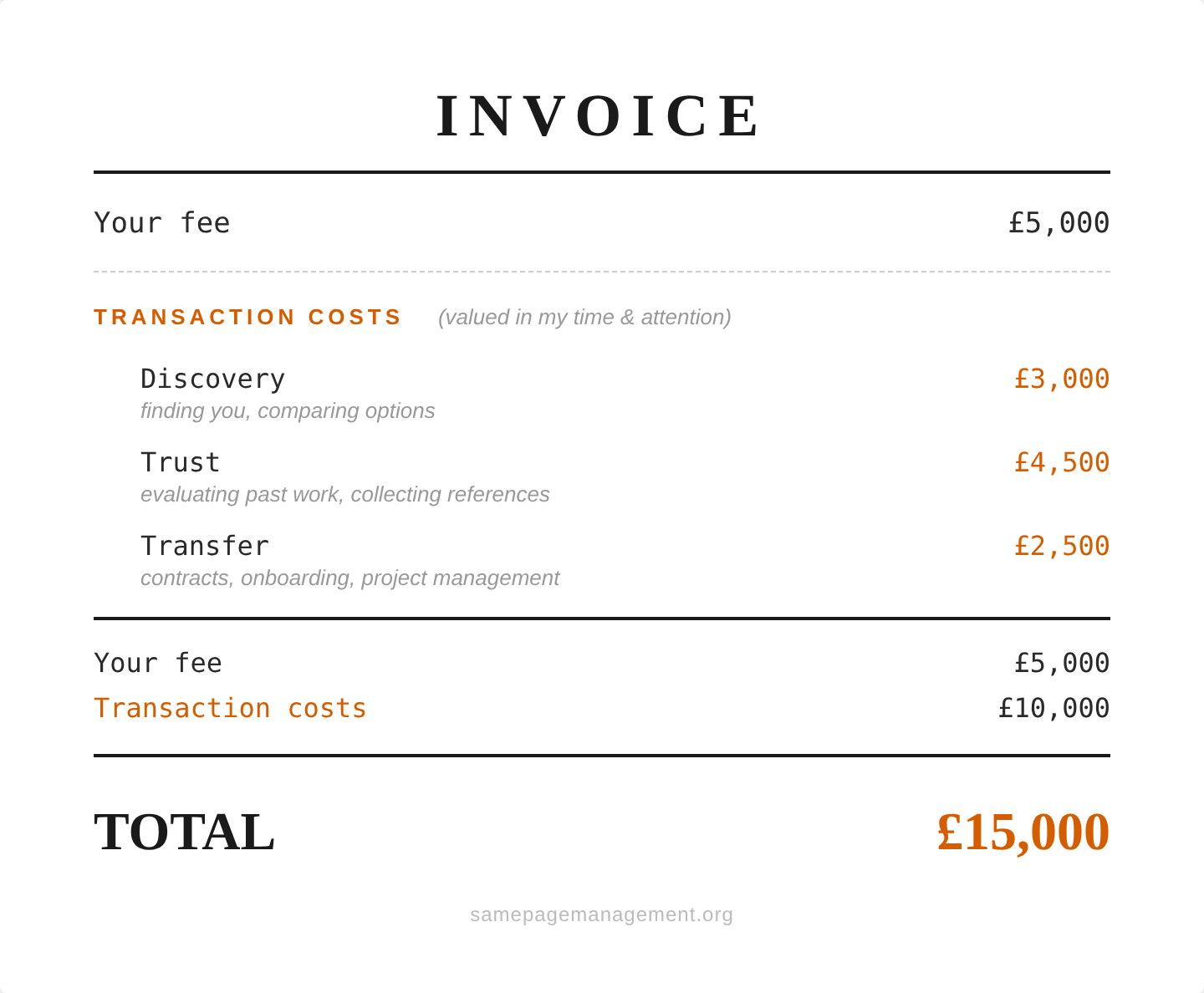
Let's say you're a freelancer and you'd like to support me in my work at 80,000 Hours.

I'll need to pay your fee. But I also need to 'pay' the transaction costs of acquiring your service.

These transaction costs are:

Discovery — I need to notice I have a need and learn that you can meet it.

Trust — I need to be confident you can actually deliver, and that working with you will be a good experience.

Transfer — I need to actually acquire your service: contracts, onboarding, project management.

Accounting for my value of time, the transaction costs I have to 'pay' can easily be the majority of the true cost of working together. So anything you can do to reduce these transaction costs is very helpful to me.

You'll reduce my discovery costs if you market yourself enough that I can find you and learn what you have to offer.

You'll reduce my trust development costs if your writing speaks directly to any concerns I might have. Similarly, my trust development costs will be low if previous clients of yours say 'heck yeah' when I ask if I should work with you. 

(Incidentally, having a trusted brand like this is a route to reducing transaction costs. I think it provides a reason to do a better job for clients than would otherwise be optimal.)

Finally, you reduce my transfer costs by making yourself easy to onboard and manage.

(For practical advice on all of this, read Sammy Cottrell's What They Don't Teach You in Freelancing School.)


Most of our encounters with advertising and salespeople in everyday life are bad. They don't seriously try to account for the negative effects they have on others.[1]

But if you're trying to make the world better and operating in an environment where you care about the effects you're having on others, you could decide to not make your advertising and sales suck.

Your marketing would be helpful and well-targeted, rather than spammy. You could endeavour to give people an accurate picture of what you can do, rather than overselling. 

I suggest doing that.[2]


This basic structure — discovery, trust, transfer — applies to most of the ways you might want to work with others: hiring an employee, getting yourself hired, finding mentors, research collaborations, and customer acquisition.

In any of these cases, you can enable more productive exchange through work that makes it easier for the other side to find you, evaluate you, and work with you.

Think of it as one of the ways you can help others.

  1. ^

    I do kinda think that the negative effects of sales (broadly construed) are pretty bad for society. 

    Salespeople, charity chuggers, and pick-up artists are all interested in converting you to a 'sale' without worrying too much about whether it will be good for you to 'buy' what they're selling. They also don't care much about whether the compensatory actions that people need to take (e.g. being wary of strangers) are bad for everyone's experience of the world. I first moved to a big city when I was 26 and found the adjusting how I orient to strangers pretty jarring, and I think that it's partly due to 'sales'. 

    Also, the people who make ads don't care about you much. They'd like to take your attention (including when you'd prefer that it wasn't taken by them), or change your desires in ways that aren't good for you. 

  2. ^

    Note that the effects here travel beyond a single interaction, as described in Communities of do-gooders should be exceptionally considerate.

12

0
0
1

Reactions

0
0
1

More posts like this

Comments2
Sorted by Click to highlight new comments since:

Thanks for this post! It’s clear, clever, and thought-provoking.

I’d push back on the moralising of salespeople. The reason they don’t necessarily worry about whether it will be ‘good’ for you to buy what they’re selling, and why that’s okay, is because you are the authority on that. Salespeople are not responsible for everyone’s experience of the world or the varying degree of appetite-to-be-sold-to among different people. What you find jarring, others might find refreshing.

In any case, thanks for showing that working with freelancers is often far more cost-effective than hiring an employee, due to reduced discovery costs. I’m all for orgs making quicker decisions to reduce the true cost of engagement from their side; why, you could book a call with me right now if you happened to need a good writer. 

If you don’t book a call, and later discover you needed a good writer after all, you’ll have to pay the discovery costs you just described. So, is the marginal benefit of continuing the search (assuming, for argument's sake, that more time spent tracks linearly to a better result) worth the additional transaction costs of looking beyond this comment?

EA orgs should work with freelancers more often and, moreover, start applying a true cost effectiveness analysis to the way hiring is done. They seem to under-account for the transaction costs they themselves impose. For example, I know of an EA org with a specific policy against screening candidates during EAG, prioritising their remote process instead. A whole room full of potential hires who have already been somewhat screened for alignment, and basically no evidence that their in-house process produces better results for the extra cost. What could the counter-factual impact of those savings be? Small in the big scheme of things, perhaps, but worth considering. 
Thanks Siobhan! 

I do think that people are responsible for any experiences that they cause others to have, and that marketing does sometimes cause many many people a mildly negative experience in order to reach one person who is positively affected by the marketing. We might set that threshold  for where that becomes a bad thing to do differently, but I expect most people would think of e.g. the spam pervading early email as net negative. 

That said, you're right that that others experience ads differently from me, and I don't think that it'd be very useful to push salespeople to be feel more accountable for negative effects they have on others. I added the rant-y footnote on a last minute whim, and on reflection it was probably a bit silly to do so. 

Curated and popular this week
Relevant opportunities
