Comments
Can Bacteriophages Improve the Welfare of Farmed Fish? Early Evidence from African Catfish Aquaculture study

3 min readAug 8
Nigeria is the largest aquaculture producer in Sub-Saharan Africa and the second-largest on the continent behind Egypt. Nigeria has a total domestic output across both wild capture and aquaculture of about 1.4 million metric tons. Nigeria's fishery sector is one of the biggest untapped economic opportunities in Africa.
Disease outbreaks in aquaculture are a very big indicator of poor fish welfare. In aquaculture, diseases rarely happen in a vacuum; a myriad of factors contribute to this, and they include poor water quality, overcrowding, and chronic stress. One of the pathogens we are studying is Aeromonas hydrophila, which can cause serious disease and mortality in farmed fish. It is responsible for Motile Aeromonas Septicemia (MAS), commonly known as hemorrhagic septicemia or red sore disease
The conventional response is often antibiotics. But this creates another problem: Antibiotic use and chemical pollution create serious risks for food safety and nature. Some of the major problems with the use of antibiotics in fish farming are:
We set out to answer the question: Can bacteriophages reduce disease-related suffering in farmed fish while reducing reliance on antibiotics?
This, I think, is an important question, since the goal of animal welfare is to do as much as possible while at the same time improving the welfare of farmed animals. Whether phage therapy increases fish farming depends on how it is used and what effect it has on the industry.
There are three possible scenarios:
This research was conducted at the Centre for Phage Biology and Therapeutics, Jos, Plateau State, Nigeria. Phages for Aeromonas hydrophila were isolated from fish ponds using standard protocols. We conducted a controlled laboratory study to evaluate whether bacteriophage therapy could reduce Aeromonas hydrophila-induced disease in African catfish (Clarias gariepinus). Fish were experimentally infected with A. hydrophila and assigned to treatment and control groups. The treatment group received a bacteriophage preparation targeting A. hydrophila, while the infected control group did not receive phage treatment. Fish were monitored throughout the experiment for survival, disease progression, bacterial burden, and evidence of disease transmission. The study was designed as a proof-of-concept to assess the potential of bacteriophage therapy as a disease-control strategy and its implications for improving the welfare of farmed fish while reducing reliance on antibiotics
The results from our initial laboratory experiment are encouraging, although they should be interpreted as preliminary.
Fish treated with bacteriophages showed 100% survival, compared with approximately 40% survival in the infected untreated control group. We also observed lower bacterial loads and reduced disease spread in the phage-treated fish.
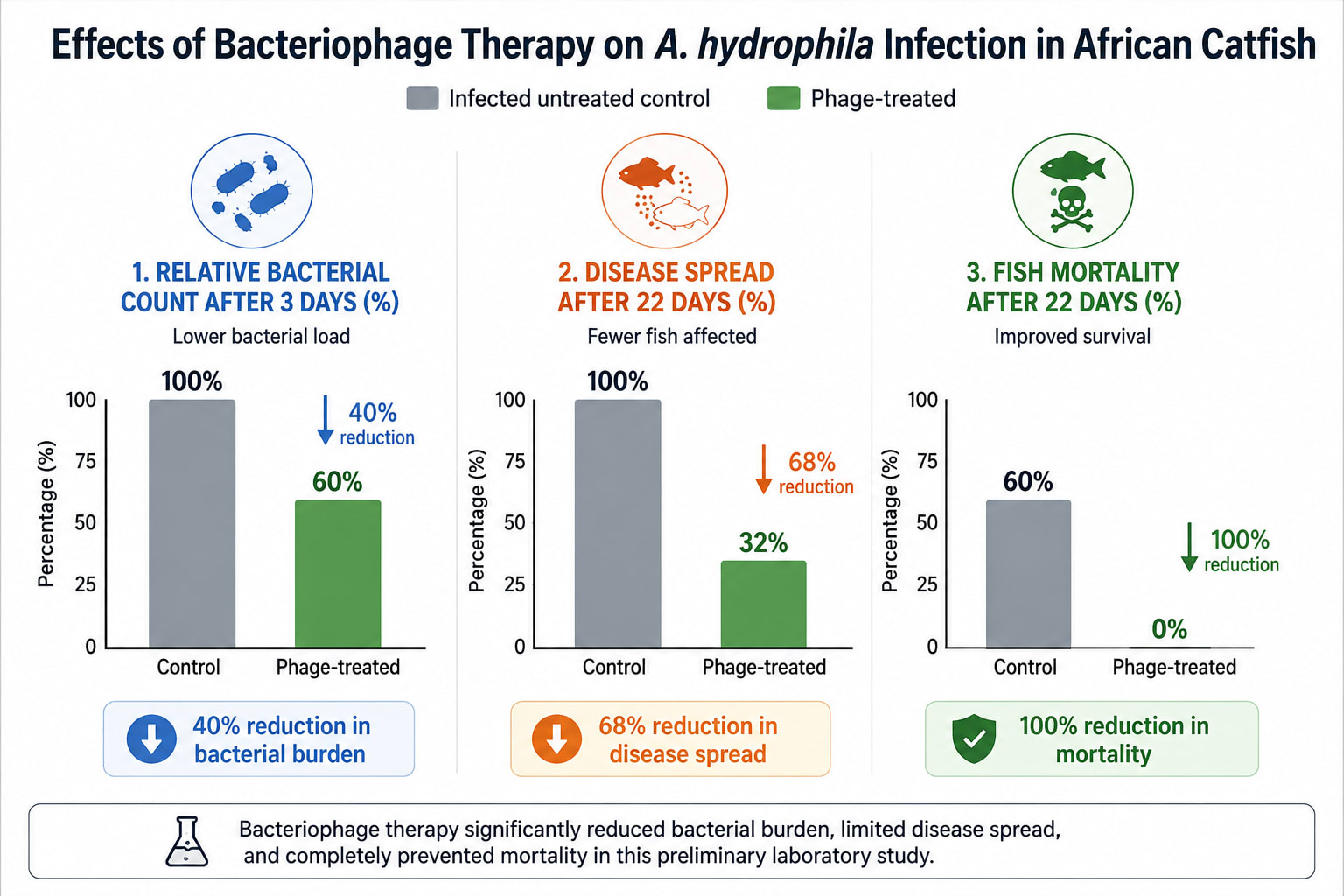
These preliminary findings suggest that bacteriophage therapy may represent more than an alternative to antibiotics. It may offer a practical way to reduce disease-related suffering in farmed fish, one of the largest and arguably most neglected populations in animal agriculture.
This is an initial proof of concept and requires replication, larger trials, and field validation. Phage therapy could become an important addition to the portfolio of interventions aimed at reducing suffering in animals that already exist within food production systems.
I would welcome feedback from the Effective Altruism community on three questions:



Very interesting work. It would be good to look beyond survival and see how the treatment affects the severity and duration of the disease. The question of whether this could also encourage more aquaculture is an interesting one too.
Thank you, very much for your comment and helpful points. I agree that we need to look beyond survival to disease severity and duration to better understand the welfare impact. We are also currently evaluating the most effective way to administer the phages to the fish.