Comments
Diversify your giving under uncertainty: Donate through the CCF
12
TL;DR
Choosing where to give is tough. That’s why we built the Cross-Cause Fund (CCF). It supports high-quality funds in key cause areas and allocates your donation across them using a mathematical model that combines the cost-effectiveness of each option with a range of assumptions about what matters.
As far as we know, this is the most rigorous attempt to prioritize between causes, with transparent modeling that considers multiple moral perspectives, and we recommend using it this Giving Season.
After recent improvements to our approach, the CCF has a new recommended allocation.[1]
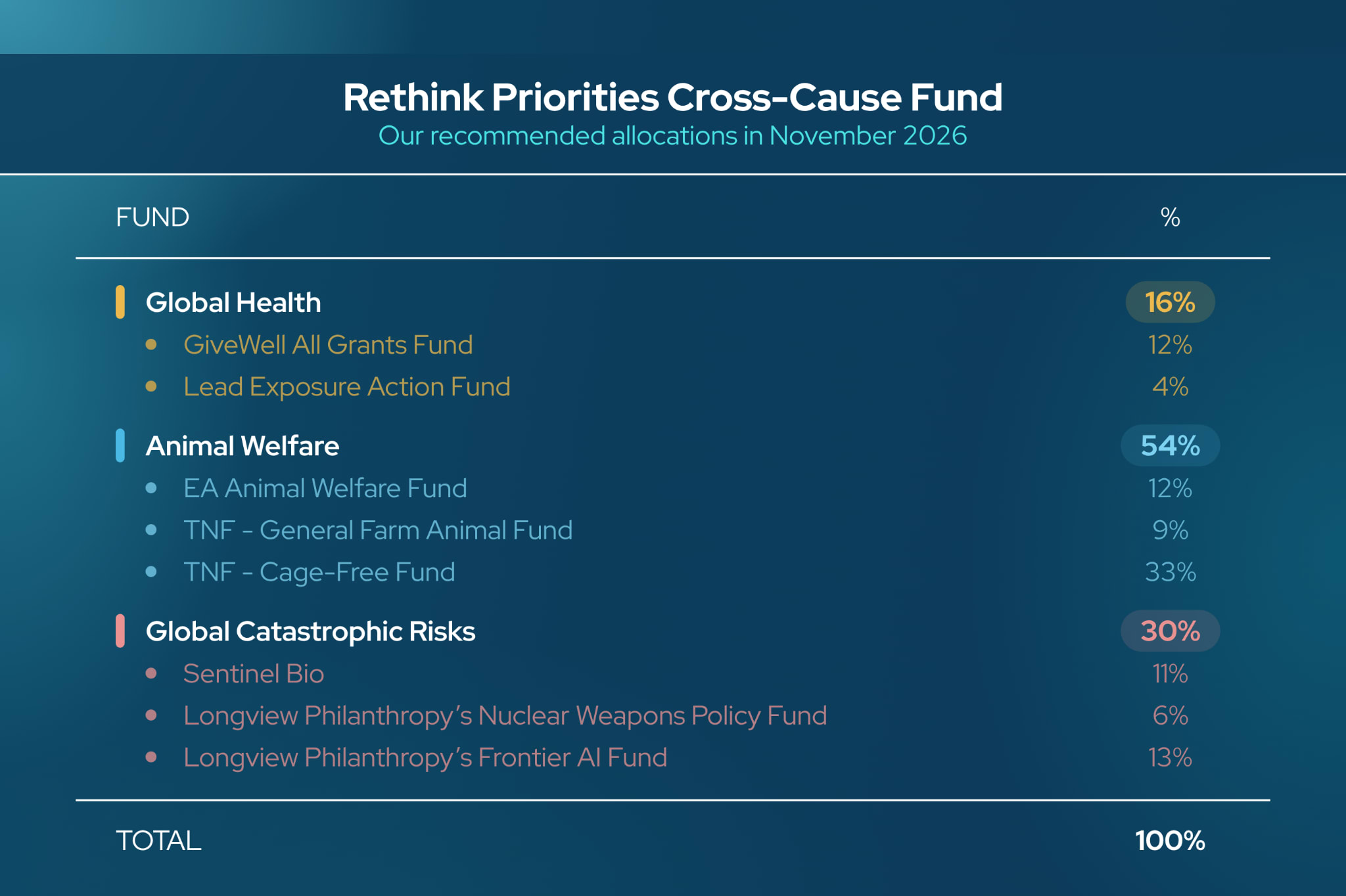
With a surge of EA-aligned funding expected in 2027, now is a great time to show support for this approach. You can give to the CCF today.
For a quick explanation of the CCF and its underlying model, watch our short video.
Giving responsibly is a challenge
If you try to base your giving on available data and logical reasoning, as most of us in the Effective Giving community try to do, deciding where to give can mean tackling three hard problems at once.
First, you must evaluate available opportunities. As a donor, you often lack comprehensive estimates of the impact of additional funding. For example, organizations may not disclose the level of risk that their projects will fail, or how likely those projects are to secure funding. If you do find estimates, it can be difficult to judge how reliable they are.
Second, you have to figure out what views should influence your giving. Philanthropic interventions can differ in scale, in who is helped, and in how uncertain their benefits are. Even with rigorous cost-effectiveness analysis, it is impossible to compare, say, interventions helping humans with those helping chickens without making a comparative judgment about how much humans and animals matter. It’s tempting to ignore the complexity and make a gut-level decision that reflects unspoken (empirical and normative) assumptions about what matters.
Third, we have to combine hard data with assumptions about what matters to reach a final decision. This is especially difficult when we’re uncertain and want to compare opportunities across different causes: it’s unclear how to act when you have competing views of the world or even how to weigh different options.
The Cross-Cause Fund picks up the challenge
We launched the Cross-Cause Fund (CCF) to take on the challenge of prioritization: dividing resources responsibly across cause areas like global health, animal welfare, AI safety, and so on.
It is built on nearly a decade of Rethink Priorities cause-prioritization research, including projects like Moral Weights, CURVE sequence, CRAFT sequence, Portfolio Builder, and Moral Parliament.
The Fund is a giving vehicle driven by the Cross-Cause Model, a tool that builds a giving portfolio based on hard data plus empirical and normative assumptions about what matters. Even if you have uncertainty about key parameters that matter for the decision, the model can recommend an allocation that accounts for that uncertainty.
The model allocates money to philanthropic funds vetted by Rethink Priorities. We look for high-quality funds supporting some of the most effective work in their domains. Right now, these funds span Global Health and Development (GHD), Animal Welfare (AW), and Global Catastrophic Risks (GCRS). We plan to expand the list of cause areas in 2027 (current funds list and areas under consideration can be found on our methodology page).
We collect information about the funds, what they have achieved in the past and what they are likely to do with additional funding. From this, we construct cost-effectiveness analyses of each fund. We also estimate how their marginal cost-effectiveness will decline as they absorb more funding.
This still isn’t enough to compare the funds with each other. Some funds help humans, others help animals. Some have effects in the near term, others only in the far future. Some almost certainly create positive impact, while others have a greater risk of causing harm.
The model can evaluate each fund based on a set of assumptions about moral weights of beneficiaries, risk tolerance, attitudes to the far future, and more. We call a full set of assumptions a worldview. Under a single worldview, there is often one cause area (or even a specific fund) that looks the best on the margin.
But most people aren’t fully confident in one worldview. They might be unsure about far-future effects, or how to weight animals on a moral scale. Fortunately, the Cross-Cause Model can allocate funding according to multiple worldviews, making joint decisions about where to give. In this way, we can represent “worldview uncertainty” — with 20% credence in this perspective, say, 30% credence in that perspective, and so on — and get clear guidance on where to give. Accounting for worldview uncertainty can justify splitting funding across causes since different plausible worldviews may favor different allocations. Our model also considers how funds’ marginal cost-effectiveness declines as they absorb more money, which often makes splitting a more attractive strategy.
Collectively, our researchers have spent thousands of hours reasoning about worldview uncertainty. They understand how subjective assumptions interact and how they can be represented in the model, and we ask each of them to record the range of beliefs they find plausible. As they do so, they are able to draw on Rethink Priorities’ body of research on animal moral weights, risk attitudes and far-future effects.
Using the approach set out in our methodology, we aggregate our researchers’ uncertain beliefs to form “house views”: the set of worldviews we use in the model to determine how the Cross-Cause Fund should allocate money. When you give to the CCF, you’re placing trust in this process of explicitly modeling uncertainty.
You can see the CCF evolving in real time
The Cross-Cause Fund is a live tool. Our team of researchers is constantly improving the underlying model and our input estimates with new information as it becomes available. As we make these changes, the giving strategy of the CCF will evolve.
After recent updates, we have new recommended allocations for the CCF fund portfolio.
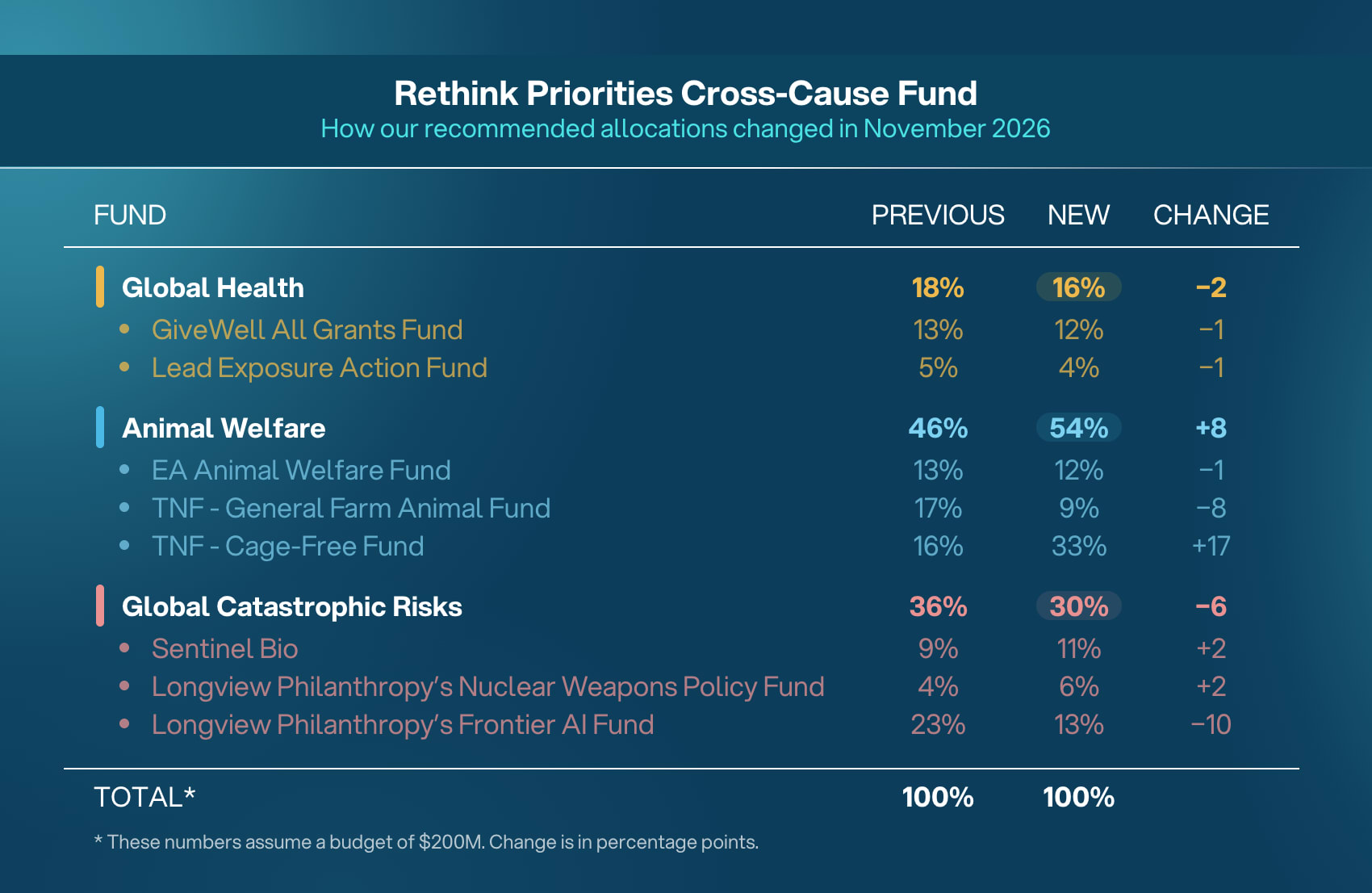
The allocation changes reflect two broader improvements.
Firstly, we updated our house views. They now include a broader range of moral and empirical inputs, and they represent the views of members of the Cross-Cause Fund research team. The new house views take more seriously the possibility that we cannot reliably tell whether the far future effects of our actions are overall good or bad.[2] As a result, allocations to Global Catastrophic Risk (GCR) decreased. The updated house views also have a stronger emphasis on welfare – of both humans and animals – compared to human life. This led to an increase in the allocation to Animal Welfare funds.
Secondly, we removed limits on how much money each fund can absorb. This resulted in a shift to the Cage-Free Fund, and a shift towards Sentinel Bio and Longview’s Nuclear Fund. We now assume that funds have diminishing returns that tend towards, but do not reach, zero.[3]
You can find more details about these updates in the forthcoming forum post and our updates tracker.
Transparency is also a core principle of the CCF. We publish our methodology and all updates and improvements made to the model. We’re clear about where the money goes: here is what we did in the first distribution round. Our M&E team develops systems for deciding which funds to add and how to evaluate them. And we share our plans for improving our approach in the future. Right now, we are working on a “Transparency Hub” which will provide all of this information (and more) in a single place. We’re also working on a shareable version of the code for people to review.
We welcome feedback and scrutiny at fund@rethinkpriorities.org.
Who is this for?
The CCF was built for anyone in the effective giving community who wants more rigor and transparency, in both the assumptions and the data used to make giving decisions. If you’re time-poor, this is a good option as your main giving vehicle, or as part of a varied portfolio. If you prefer a hands-on approach to giving, CCF gives you an opportunity to engage with rigorous, transparent reasoning that is open to feedback.
We also think the CCF will be useful as a hedge if your giving is concentrated in one cause area, or guided by a single advisor. You may be more confident than we are about what matters, yet still reluctant to go all-in on a single worldview. Allocating part of your giving through the CCF allows you to account for uncertainty beyond the assumptions guiding your existing donations.
Why now?
With an expected surge in philanthropic funding, this is a pivotal time for the effective giving movement: decisions made now could influence how resources are allocated between causes in the long run.
Donations made through CCF signal support for a rigorous, transparent approach to cause prioritization. Even small donors have a part to play. Your donation can be a vote of confidence in this methodology.
The CCF is an ongoing project that puts our cause prioritization research into action. It’s certainly not perfect. For now, it only spans three cause areas, and the model has room for improvement. We believe the CCF offers a more rigorous way to navigate incomplete information and differing assumptions about what matters than available alternatives, thanks to systematic analysis and explicit modeling. Giving through the CCF this season puts that approach into practice.
Learn more and give
The Cross-Cause Fund is Rethink Priorities effort to take cause prioritization seriously. Our team has created a rigorous methodology, comparing recipient funds side by side on key cost-effectiveness metrics, and we capture uncertainty about key parameters by aggregating the views of our researchers. Crucially, our model puts the two together — hard data and diverse perspectives — to create a giving portfolio that allocates money across causes. And we are committed to constantly improving our approach and to providing transparency along the way.
Now is a pivotal time to support this way of giving. Your contribution can help this approach gain traction, whether the CCF represents a small part of your giving or the whole of it.
Give to the CCF hereRead more on our website.
Acknowledgements
Thank you to Jim Buhler, M.A. Davis, David Moss, Laura Muresianu, Jonathan Nelson, Carmen van Schoubroeck, and Ula Zarosa for feedback; Ula Zarosa and Francis Priestland for work on the video (made with Claude); and Shane Coburn for editing.
- ^
Assuming a total budget of $200M. Because of diminishing marginal returns, the exact split we’d ideally recommend depends on the total budget the CCF receives and redistributes.
- ^
This may be partly due to one of our model updates: splitting our previous “temporal discount” into different potential motivations for prioritizing one’s near-term impact. This temporal discount used to entangle one’s views on whether we can counterfactually affect the long-term future at all, whether we can tell in which direction, and simply caring less about future beings. We now have separate wash-out discount and cluelessness discount parameters, and have decided to take for granted that the interests of future beings deserve as much considerations as those of present ones, all else equal (see footnote here). This change makes it easier to accurately model one’s views on the cluelessness thesis, specifically.
- ^
We are still not very confident in our methodology for estimating funds’ diminishing marginal returns curves, and plan to improve them in coming months.