Comments
Lucky hires: how AI safety orgs find their COOs (and why that doesn't scale)

11 min readOct 13
Epistemic status: a hypothesis from about fifteen interviews with people involved in hiring, plus our advising data. The program described at the end is partly designed to test it.
I met Claire Boine, the co-founder of Successif, at a workshop where we were both participants. Part of the workshop was peer coaching, and we were paired up to coach each other. Afterward, I offered to continue with weekly calls, as the organization was going through a challenging time.
Four months later, she secured additional funding, and asked me if I wanted to join as COO. We met for a workshop, discussed the terms of working together, and I started without ever going through an interview.
During the months of our calls, Claire had seen how I approach problems and how I handle disagreements, and I had seen the same of her. Since I was advising her and not applying for anything, the stakes were low for both of us and by the time she asked, we had already built a basis of trust.
In my post on lessons from my career, I wrote that most of my significant job opportunities came through weak ties and unexpected connections rather than job applications. For senior hires, I value knowing how someone will perform, because a bad hire at that level affects the whole organization. Having worked with someone before reduces that uncertainty more than a hiring round. I assumed this was different in AI safety, a field full of long application processes for everything from fellowships to jobs.
However, when we started interviewing operations leaders in our field about how they got their roles, I heard similar stories again and again. One leader moved from the operations team of a fiscal sponsor into the organization it supported. They knew at least two others who had taken the same route and suggested we copy it. Sam Smith tracked 27 senior operations searches and found that only seven were filled within six months, about half of them through closed rounds.[1]
I think of these as lucky hires, myself included, though the luck is in the access, not the people. In my case, I had spent years putting myself in situations where luck could find me, and the people we interviewed had done the same. Hiring this way has two problems. It doesn't scale: it depends on which trusted people happen to be available when a role opens, and the people doing hard jobs right now usually aren't. And it skips the comparison: if you hire the person in front of you, you never find out whether someone better was out there.
The COO title can mean very different things. In Second in Command (HBR, May 2006), Nathan Bennett and Stephen Miles describe seven types of COO, from an executor who delivers the strategy day to day to an heir apparent who is being prepared to take over. Their main observation is that the COO role is defined less by the work and more by the relationship to the CEO as a person.
In this post, I mean what they call the "other half" or the "partner." The other half complements the founder's experience and knowledge, while the partner shares the leadership with them. In a young AI safety organization, this is usually the person who helps turn a founder's research or policy idea into an organization, from setting the organization's culture to hiring and implementing good management practices.
The article also says the most important factor in a working CEO-COO pairing is the level of trust between them. This matched my experience with Claire. That trust didn't come only from seeing each other's work. It also came from caring about each other as people and being willing to admit mistakes.
When an organization starts, the founders take on all the roles. This works for some time, but eventually either the work or the founders start to suffer. MATS found that organizations approaching about 20 employees develop a strong need for people who can take on management.[2]
At Successif, we hear this regularly. Over the past 12 months, 18 organizations approached us on their own, looking for a senior operator or COO. In conversations in the Bay Area in September, nine organizations expressed interest in our program, and several said they need to fill such a role soon. The hiring lead of one research organization called it "maybe the most important thing we are currently hiring for."[3]
A good COO also makes many other hires possible. One of the MATS authors estimated that a single manager creates room for 5 to 10 additional hires,[4] and Morgan Matthews of Constellation described it as bringing in someone "who can 10x your org." With Coefficient Giving, which also funds Successif, now focusing on founders,[5] I expect the need to grow, as each new founder will eventually need someone in this role.
This is also why the order of hiring matters. A first leadership hire with strong people-management experience makes every later hire better. And someone who joins early can shape the culture while the organization grows, rather than trying to fix it afterwards.
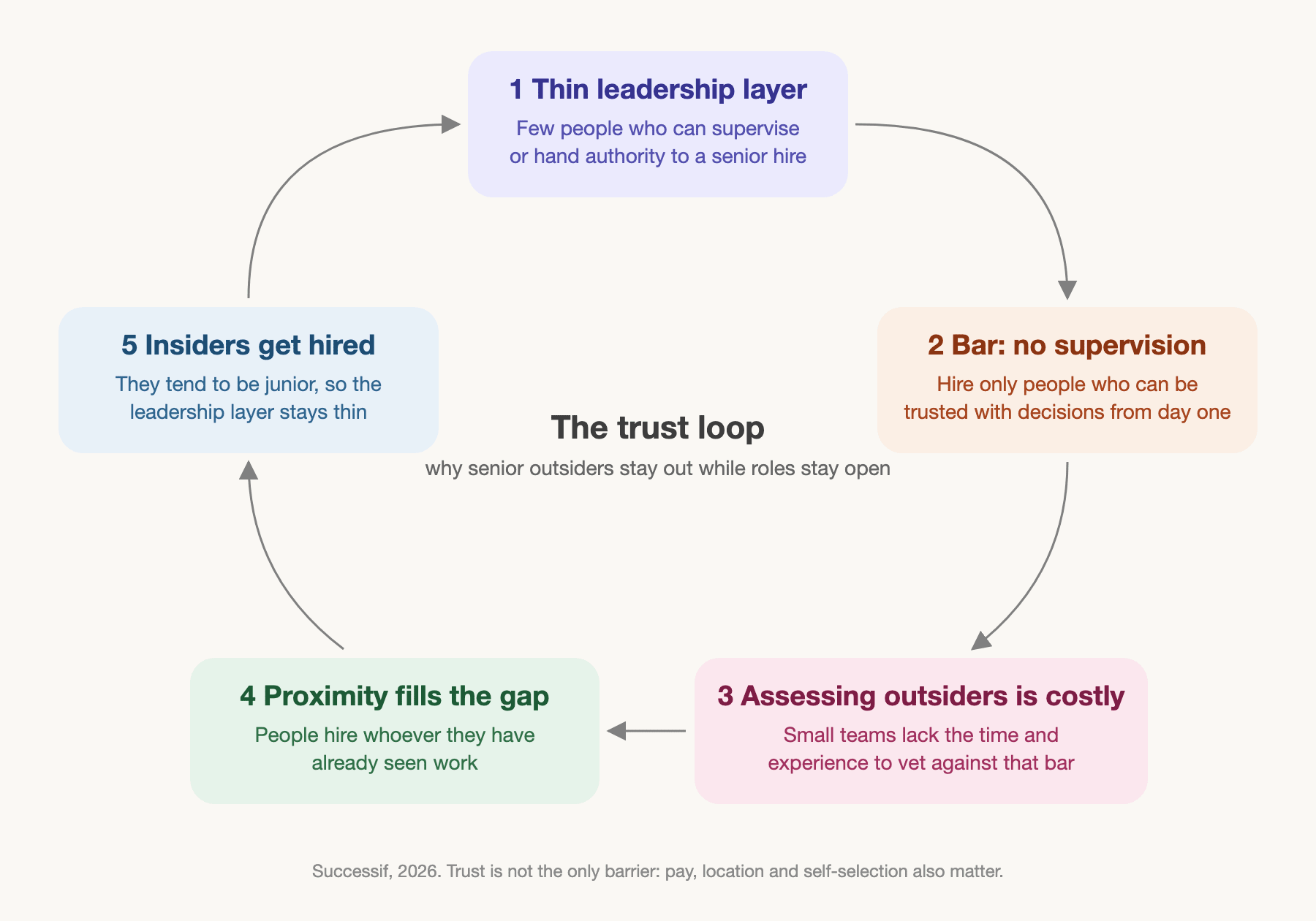
This is an early guess based on about fifteen interviews this summer with people involved in hiring.[6] Earlier interview rounds and our conversations with hiring organizations since then have mostly supported it. It assumes the field keeps growing quickly, so developing leaders from within can't keep up. Trust is not the only barrier to hiring outsiders, and I come back to others at the end, but it is the one we focus on here. We think it works like a loop:
I recognize the first two steps from my first startup, and in hindsight they were a mistake I made. MATS found that hiring managers in the field only hire people who need minimal supervision. But every hire needs management, including senior ones, and "we don't have time" usually means other work was put ahead of developing people. The exception is an organization whose leaders have little leadership experience themselves: it needs someone who can be trusted with leadership responsibilities quickly. That is exactly the hire the loop makes hardest.
None of this makes the people in the loop careless. With the experience they have, hiring someone they already know is an understandable choice. But it isn't a model to copy. When every organization makes the same safe choice, the leadership layer stays thin, and the field never builds the experience it needs to assess and manage senior people.
Organizations can assess outsiders, but it is expensive. If you have never hired a COO, it is hard to know what you need, and it can take several attempts before you find out. Falling back on people you already trust is faster. When we asked a senior staff member at one organization how much community signal matters in their hiring, the answer was "way more than I'm comfortable with."
There is also a demand-side version of this. As Alex Novikau pointed out, hiring a partner means handing over real decision authority, and some founders aren't ready for that yet. It can also feel unnatural for a young founder to hire someone with far more leadership experience than they have, even though that is often exactly the hire the organization needs. A trial can't fix this, which is why our program starts by scoping the role with the founder before matching anyone, and why founders building their first leadership team may want outside support with hiring.[7]
Step 5 explains why the loop doesn't correct itself. It might also explain something we see in our advising: open positions receive hundreds of applications, yet senior searches keep small teams busy for months, and many organizations end up promoting early-career staff instead.
It also explains why both sides of a recent discussion can be right. Organizations really do need senior people, and experienced applicants really are rejected at very high rates; MATS hires about 2% of its operations applicants. The shortage isn't of capable people, it's of ways for organizations to tell which outsiders they can trust.
For some roles, such as grantmaking, knowing the field is crucial. Being a founder's other half is different, as it mostly requires experience in building an organization alongside someone, and this experience transfers. One operations leader we interviewed estimated that about 80% of his commercial experience transferred directly.[8]
Sam Smith started his investigation expecting that senior operators with enough context didn't exist, and changed his mind after about 100 conversations. The harder problem is telling in advance which of them will work out in a specific organization.
Bennett and Miles add a caveat: success as COO in one company says little about success in the next, as the role depends so much on the specific CEO. I agree, and for me, this is an argument for testing the fit with a specific founder rather than judging a CV, and it is why our program starts with a trial project.[9]
Among advisees whose advising has formally ended, operations profiles moved into the field more often than policy or communications profiles.[10] For those who did make the move, the median time from applying to us to starting a new role was about seven to eight months. That time includes everything that slows a move down, such as pay, location and the number of open roles, not only trust.
When we look at what people do during these months, we see a common pattern. As we described in our post on career transitions, one advisee talked to about 100 people before finding a role, and another volunteered for four organizations. Jim Chapman spent more than two years and had around 140 one-on-ones before becoming Operations Director at MATS. In my post on getting into an organization mid-career, I recommended many of these steps myself, and I still think they are good advice.
What this means, however, is that each of these individuals is creating their own chance encounter, one conversation at a time. This works, but it is slow, and only people who can afford a year or more can do it.
When I think about what the time with Claire gave us both, I come up with four things. We asked ourselves whether a program could provide each of them intentionally:
| What the chance encounter provided | What the program provides instead |
|---|---|
| Working together at low stakes before any commitment | A paid trial project, 5+ hours a week for 3 months |
| A reference from someone the leader already trusted | Structured vetting, reference checks and a one-page assessment of each candidate |
| Time for the leader to work out what they actually need | Role scoping with the host organization |
| The newcomer picking up context along the way | A peer group, advising, and input from people who made the same move |
This is the idea behind the Organization Builders Program. It is for people who have built or scaled an organization or team and worked closely with founders. You don't need AI safety experience, but you do need to care about the problem. We look for people who build trust actively and would probably find their way in eventually. The program's aim is to make that take months instead of years.
Each host organization chooses between a paid trial project alongside your current role and its own assessment followed by a direct hire. The first round is small, with up to 10 participants and a handful of organizations. Vetting is run by Impact Ops. Trials are remote. Most host roles are too, though some organizations need people on site, mainly in the Bay Area or London. To be upfront: this is a selective program, and most applicants won't be matched in the first round. Applications close on October 22.
Several programs now help experienced professionals move into the field.[11] Ours focuses on the founder's partner role and on matching each participant with one host organization, and it can be combined with any of them.
We chose 5 hours a week so that people can try this without quitting their job. That's enough to see how someone handles a real problem and how they and the founder work together. It isn't enough to see how they would carry a share of the leadership. One interviewee warned that a small weekly slice only "gets whatever project is stable enough to survive that churn." This is why host organizations can skip the trial and hire directly after their own assessment, and why we will review the format after the first round.
Some organizations do invest in assessing outside candidates well, and outside hires don't always work out. Besides trust, there are other barriers. Sometimes it is pay or location, and many experienced professionals don't see themselves as candidates without guidance.
Our current advising has limits here. Long-term advising calls show us how someone thinks about their career, but not how they work with a founder or under pressure, and one organization told us that our referrals have sometimes been "somewhat miscalibrated." That is part of why we're using a vetting process similar to a hiring round, with a case-based interview and reference checks, followed by a trial period, since three months of real work tells an organization more than a recommendation from us.
My own experience likely biases me, and survivorship bias affects the stories we heard, since we mostly talked to people who made it. The measure I care about most is whether host organizations are able to scale after bringing in a partner COO this way, for example, by hiring more people and taking on more work without the founders becoming the bottleneck. If they also hire more people from outside, that would suggest the loop is starting to break. I would change my mind if organizations express interest but won't commit or pay, if trials don't turn into hires, or if pay turns out to matter more than trust.
I'm also curious whether this matches your experience. If you got into your role through proximity, or found a way in without it, I would like to hear how.
I thank Weronika Żurek, Isabelle Klöck, Adam Tury, Darryl Wright and Morgan Matthews for their work and input, as well as everyone who spoke to us anonymously.
I wrote this post with the help of Claude. I recorded my thoughts, made the decisions on structure, framing, and content, and edited the text, while Claude drafted sections based on my input and our internal research. I checked the claims against their sources.
In the same analysis, only about 110 of about 200 live roles were advertised publicly.
MATS calls these people "Amplifiers": people who can take on people management, project management and research management.
This matches broader data. In 80,000 Hours' survey of organization leaders, senior management and operations roles came out as the most important bottleneck to growth, and of 349 leadership postings across 142 organizations, 52.4% were management and 35.5% operations roles.
The estimate comes from a comment by one of the co-authors on the post, not from the post itself.
In their words: "Founders are the bottleneck, not funding."
Interviewees included talent and operations leads at research and governance organizations. We asked each of them to walk us through a specific recent hire and the evidence they relied on. Two earlier interview rounds, including one at EAG San Francisco in February 2026, informed the same picture.
Adam Tury and I came up with the idea for RAISEimpact, a Successif program that offers fractional people development to AI safety organizations.
This and the fiscal sponsor example come from anonymized interviews with senior operations leaders conducted by Weronika Żurek.
One organization hired a general counsel without community signal, based on a hard work test and a demanding interview, and told us the hire has gone "amazingly well."
Successif advising data, advisees who graduated or closed (n=144 across profiles): 46% of operations profiles moved into the field, compared with 41% for policy and 33% for communications. These figures overstate the overall rate, because they leave out many open cases that have probably gone quiet, so read them as a comparison between profiles rather than a success rate; the gap with policy is small. The seven-to-eight-month median is a combined figure for operations and communications advisees who transitioned.
For example, the Generator Residency, Lateral Workshop, High Impact Professionals and CEA's four-day career pivot course.