Comments

AI Czar attacks EA. (Again.)
Today in this post on X, the U.S. 'AI Czar' David Sacks directly attacked Humans First, an AI safety advocacy organization, by claiming that it's nothing more than 'censorship power play', a shadowy campaign by Effective Altruists to turn the conservative right against the AI industry, and to block technological progress.
He quote-posted this blog by Jordan Schachtel titled 'Built to Deceive: How the Effective Altruist Machine Infiltrated the Conservative Right on AI'.
As an AI Safety advocate, a member of Humans First, an Effective Altruist, and a political conservative, I'm angry about this misrepresentation of AI safety campaign. And I think EAs should fight back harder against senior federal officials smearing our movement.
Any suggestions on how to respond? I don't have time this week to write a detailed rebuttal, but I'd be happy to link and promote anything that others write.
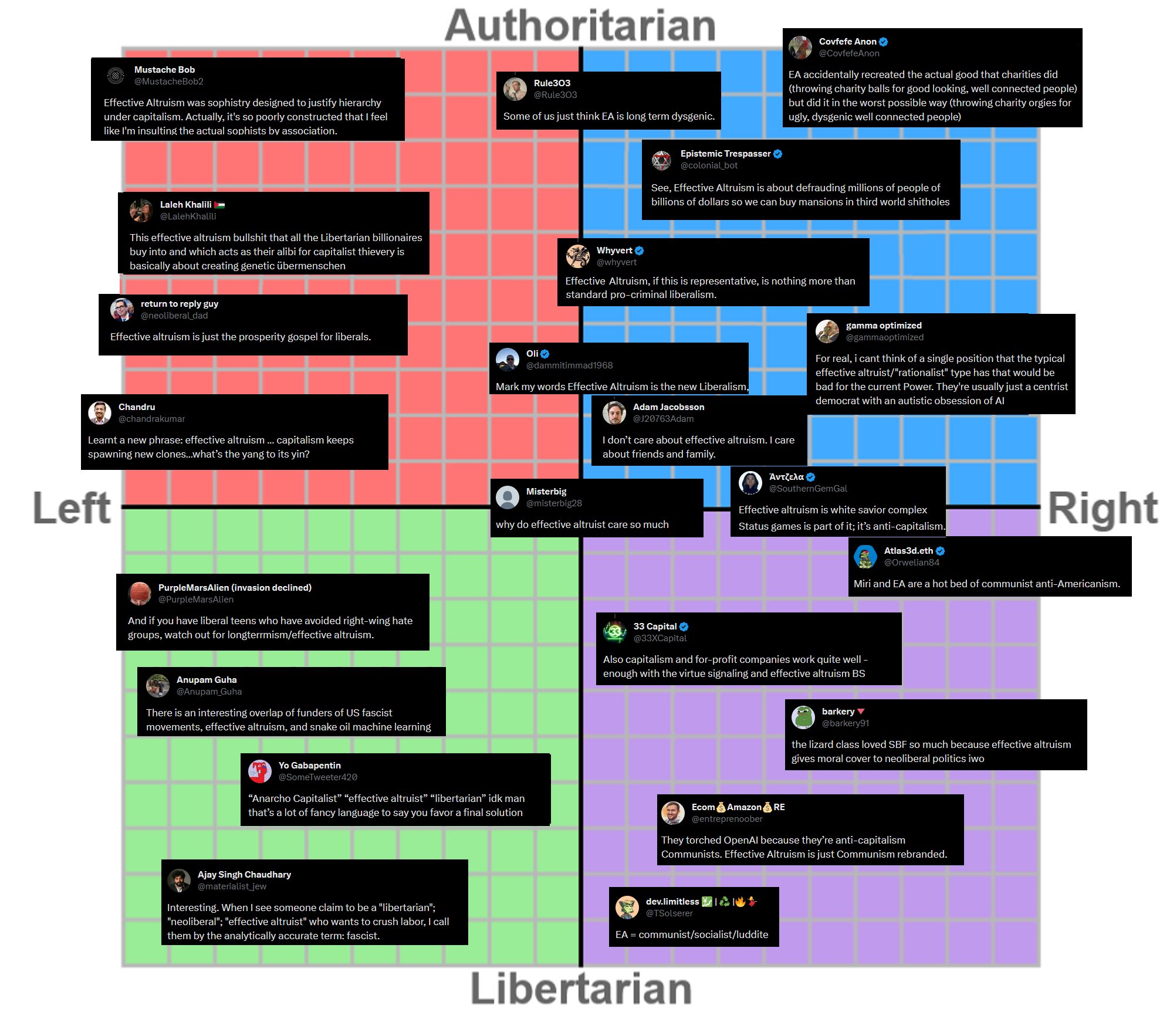

EA is facing its most serious PR crisis in history, and nobody in EA seems to be discussing it or doing anything effective about it. Everyone seems to be carrying on as if this is business as usual.
President Donald Trump, AI Czar David Sacks, and the Department of War have launched a coordinated campaign in the last week to portray EA as treasonous and toxic.
Their campaign motto is 'Americanism, not Effective Altruism'. Tens of thousands of MAGA political influencers are attacking EA (often from positions of total ignorance) on social media platforms such as X, Truth Social, and Facebook. They're also portraying all concerns about catastrophic risks from AI as a 'hoax', a 'psyop', and a CCP influence campaign -- part of a 'Doomer Industrial Complex'.
This is unprecedented. It's far worse than any previous scandal or crisis that EA has faced. Even the SBF/FTX debacle didn't lead to key American leaders and legions of influencers directly attacking EA.
Are we going to do anything about this, or just let the pro-AI accelerationists, in the current White House administration and the Pentagon, trash-talk the movement that we've spent the last 15 years growing and defending?
Just on whether this is the most serious PR crisis in EA history: it might be, but the most accurate measure of salience / interest I have is Wikipedia pageviews, where it seems smaller than the OpenAI board drama, and much smaller than FTX.
https://x.com/bellaforristal/status/2102305645328208316
Also, zoomed out that far it looks to be ongoing / on the rise. But if you look at the last 30 days it's gone down a lot. https://pageviews.wmcloud.org/?range=latest-30&project=en.wikipedia.org&pages=Effective_altruism
Bella -- interesting data; thanks for sharing.
Just to be clear, this is just Wikipedia pageviews?
I suspect they're telling us something about interest in EA, but I don't get the sense that the pro-accelerationist MAGA partisans being riled up against EA by the Trump administration are they kind of guys who are going to read the Wiki entry to make sure their hot takes on EA are evidence-based.
Yeah just Wikipedia pageviews :)
I agree it's an imperfect proxy, and might be systematically wrong because of dynamics you describe. But it's the most accurate proxy I know of!
Bella -- thanks for the clarification. Appreciate it!
See also Google Trends.
Supposedly, people on X generally don't click links. My guess would be that even fewer are searching on Google/Wikipedia. So I don't expect these metrics to be super reliable. They might more closely track "fraction of users engaging deeply" than "size of PR crisis".
Hi Geoffrey, I’m the media relations manager at CEA. Thank you for the time and effort you’re investing to defend and promote effective altruism. The MarComms team at CEA are taking this situation seriously, and we're working hard to meet the moment well. You’re welcome to reach out if you’d find it valuable to know more about what we’re doing. The best email is [email protected] – we will get back to you as soon as we can.
Thanks for the work you're doing Fran!
Hi Fran,
Thanks very much for the info. I'll reach out to the email provided.
Appreciate it! -- G
I definitely not the "worst" PR crisis. The DOW account is a random poster for the Office of the Under Secretary of War for Research and Engineering, not Hegseth.
But I agree that it would be best for Republicans not to be polarized against AI safety. They aren't so far; thanks in part to Speaker Johnson. I suggest not letting random trolls goad us into abandoning courtesy and the presumption of good will. It is counterproductive to respond to much of this stuff, as that imbues it with more seriousness than it deserves.
It's rather patronizing and dismissive to call the President of the US, and the AI czar, 'random trolls'.
They have enormous power to shape public perception. I've followed the discourse on X very closely. Many thousands of influential people who knew nothing about EA until a couple of weeks ago are now repeating the partisan message from POTUS that EA is 'un-American' and a 'degenerate cult' and 'decels' and 'CCP stooges'.
This deserves to be taken seriously, not dismissed. EA has suddenly become infamous, and politically stigmatized, among tens of millions of people who had never heard of it.
Has Trump himself shared the ‘Americanism not effective altruism’ stuff?
Not "random", but I think it's kind of hard to argue that they are not doing a massive amount of trolling, ad hominem, and bad faith.
E.g., https://truthsocial.com/@realDonaldTrump/posts/115398251623299921 for a very small tip of the bizarre iceberg.
To be fair, MAGA is basically the antithesis of all that Effective Altruism stands for, so it would not be surprising that we would be natural enemies and this would eventually happen.
MAGA is about contracting the moral circle of concern to "real Americans". This is literally the opposite direction as EAs wanting to expand the moral circle to animals. MAGA is flagrantly anti-intellectual. A stereotypical example of a MAGA is a gun-loving hunter who shoots animals for sport and brags about being a red-meat eating tough guy.
Like, the socialists disagree with us about the methods (we advocate individual action like charity and career change, while they advocate systemic change) but ultimately we share the ends of equality and wanting a better future. We compete in terms of recruiting for the idealistic altruists in the world. We both tend towards internationalism and some form of the common good for all.
MAGA doesn't share any of that. They harken to past national glory, see the people we donate bednets to as subhuman, see the elites we listen to as inherently untrustworthy, denigrate empathy and glorify egoism, etc. I just don't see why we should expect anything else from them than pure disdain.
In theory, AI x-risk is more important than all of that, and we do have a single common cause in not wanting to be dead, but I see little else we can even attempt to agree on.
This is outrageously partisan, and it exemplifies why EA has alienated so many conservatives. Your description of MAGA people is wildly misinformed and patronizing.
Do you have any MAGA friends? Have you conversed with any intelligent MAGA supporters for more than ten minutes?
Your stereotypes are not going to do us any favors in winning hearts and minds.
If EA portrays MAGA as 'the antithesis of all that EA stands for', then of course the 77 million Americans who voted for Trump are going to act like EA is their sworn enemy.
Well, my mom is a devout fundamentalist Christian who supports Trump, so she could technically be considered MAGA-adjacent (even though we are Canadian). We stopped talking about politics a long time ago because we disagree so completely.
I'm talking about the extremes. There are many more people who have supported Trump in the election than who are full-throated MAGA. I'm not talking about the former. I'm talking about the latter, the people who marched on January 6th and are loud and obnoxious on Twitter and who drown out any reasonable voices that might exist in the movement.
With respect, it still sounds as if your impression of MAGA is based almost entirely on 'mainstream' (i.e. left-learning) news sources, rather than on understanding what MAGA supporters actually value and care about.
My impression of MAGA is from a mixture of talking with my mom at length about what she believes, Facebook convos with friends who are MAGA-sympathetic, reading things like Project 2025 to try to understand what they actually want and believe, reading randos who claim to be MAGA on Twitter as they dogpile and generally act hostile to anything resembling reasonable discourse, and yes mainstream news coverage of things like how Trump is once again threatening to annex my country (Canada).
I will admit it is a mixed bag of sources. If you could provide other sources that show what MAGA supporters actually value and care about to dispell my apparent misunderstandings, sure, I'll look at them too, for the sake of steelmanning and fairness.
Hi Joseph,
Appreciate your genuine curiosity about all this.
Honestly the best introduction to 'national conservatism' that's been highly influential in MAGA circles would be the book 'Conservatism' by political theorist Yoram Hazony. He also organized the National Conservatism (NatCon) conference.
Their YouTube video channel has a lot of relevant content and past talks: https://www.youtube.com/@NationalConservatism
I mentioned my talk at NatCon 2025 in a previous EA Forum post: https://forum.effectivealtruism.org/posts/g44SMGzwKGTYhqSXM/my-talk-on-ai-risks-at-the-national-conservatism-conference
The actual video of my talk is here:
I also know people who are fundamentalist Christians and MAGA-leaning, have argued with them for a long time... and concluded that yes, the mainstream media often straw-mans their perspectives. You can, in fact, oppose dramatic immigration spikes as a policy without viewing immigrants as "subhuman." You can point out the conflict between empathy and justice/rational thought without becoming an egomaniac (see the book "Against Empathy" by Paul Bloom, Yale psychology prof; and the Lindsay Clancy trial where people are somehow empathizing with a child-murderer). The neighborhood MAGA voters I've met did NOT argue their points with the slightest bit of logic or eloquence... but that also doesn't mean their conclusions are wrong, or that they're racists. It just means we have to put in extra effort into steel-manning their takes. Which is often difficult, I struggled with it for a few years!
I would hope that the obnoxious people on Twitter aren't representative of the movement in general, but of course I could always be wrong about this...
Trump tweeting remarks is less of a PR crisis than FTX collapsing was. Trump says wild stuff constantly. Are we actually gonna invade Greenland? Probably not.
It is for sure sad that this is likely going to increase the polarization of AI Safety.
But its not a scandal, and FTX very much was.
If EA is suddenly perceived by the public as a scandal, then it's a scandal. That's how scandals work.
The people or groups being stigmatized by the scandal don't get to decide whether it's a scandal. The public does.
And judging from the replies here, many EAs think we don't even need to fight back, or to correct misunderstandings of EA that have now taken root among tens of millions of people.
I wouldn't use the word "scandal". There is no scandal here, or at least I don't see anything in the Trump attacks that suggests the accusation of a scandal.
But it may be more serious than the FTX situation.
David - to many people, almost every aspect of EA is intrinsically scandalous:
-- the utilitarianism, consequentialism, sentientism
-- the globalism, open borders rhetoric, anti-nationalism
-- the openness to alternative lifestyles and relationship styles
-- etc
Within EA, these all seem perfectly normal. Outside the EA bubble, to a typical suburban family in Arizona or Ohio, they're all scandalously bizarre.
Yeah I largely agree but I don’t think the word “scandal” is appropriate.
I also think the EA ideas are at least familiar to a larger share of the US population — people in big cities who went to college etc. And maybe even utilitarianism would have some traction as a “sensible way of considering what is good or bad.”
Not sure openness to “alternative lifestyles” is core to EA — but I guess irs a fellow traveler for many/most active EAs?
Not sure if it's yet the worst in its history but I agree this is serious.
Based on publicly available info, CEA's marcomms spend in 2025 was about 4% of its total, so roughly $0.8–0.9M. That's about the same in absolute terms as its Communications budget in 2023 ($0.89M). The share has gone up mainly because the rest of the budget shrank. (The two teams may not be scoped identically, so treat this as approximate.)
My 2 cents: I think marcomms should be closer to 10% of spend, maybe 15%. On current numbers that's roughly $2–3M.
I'd take most of it from events. Events were about half of CEA's budget in 2023, the last year with a public breakdown, and they're largely internal-facing. EA is pretty well coordinated as a community. Our comms are not good. I think we could spend a bit less on coordination and a lot more on being understood.
CEA says the constraint is hiring, not money. That may well be true. But EAN brought in comms capacity and got results we're happy with, on a central budget of under €200k. So I'd like to understand more about what's making this hard at CEA's end, and whether there are routes around it, e.g. agencies, contractors, or funding comms capacity in national groups. Asked in the nicest possible way.
James -- this is helpful and interesting.
I agree that marcomms spend for CEA should probably be higher -- but also hopefully spent more effectively on public outreach, not just internal-facing meetings and in-community organization. But I have very little information about what they're doing, or what their strategy is, so my confidence about this is low.
In terms of hiring constraints, one difficulty I sometimes see is a tendency for EA organizations to try to hire young talent from within EA, rather than finding mid-career or more senior talent that's highly EA-aligned, and highly experienced and effective.
Yes, I think any increase in marcomm efforts should be spent on external-facing stuff; not spin, just constantly explaining what we're about so there isn't a comms vacuum and people first hear about EA from EA-aligned orgs, rather than people who dislike EA-aligned orgs.
80k and others have been excellent at this for years. GWWC seem to be getting much better at it. EA Australia as well.
For comparison, 80k has spent around $2–3M a year on marketing since 2022 (roughly 11–16% of its budget), and GWWC around $300k (roughly 13%), with plans to scale to millions. Both figures are from their recent job ads.
On hiring, from what I've heard from speaking to some people at CEA, the difficulty has been finding people who are good at comms and who fully understand EA. Honestly, this feels like letting perfection get in the way of good enough. But I can of course sympathise, hiring is hard, comms is hard, and a mess-up here has big implications.
James -- more good points; I agree.
Especially about perfectionism about EA knowledge & credentials getting in the way of 'good enough' outreach.
I think a lot of comms/PR/marketing/outreach skills generalize quite well across topic domains and cause areas, so it may be more useful for EA orgs to hire excellent comms people who know a bit about EA, than to hire hard-core EA veterans who know only a little bit about comms. A balanced team would be ideal -- but any EA comms team should include at least a couple of people who have done PR outreach for other kinds of organizations, companies, etc.
I think I agree with the assessment, but what proposals have you thought about to stem this tide?
Good question. I think it's very important for EAs (ideally those with more tact and patience on social media than me) to engage on X and other social media platforms to gently by clearly correct all the slanders and misinformation that are being thrown against EA.
In EA, there seems to be a real leadership vacuum on this point. I don't know what the leaders of the big, rich EA groups, funders, and think tanks are doing. But their PR comms people seem to be utterly disengaged, or ineffective, or are following some kind of silent 'wait and see' strategy that is not working.
I'm doing my best to counter some of the more extreme slanders on X. But it feels like a very lonely fight at the moment.
On your original quicktake I don't completely agree. On this one I do. Now is the time for PR Comms people to be workign overtime, and ideally share some of their strategy here (at least on a high level). There should be at least some co-ordination on how to respond here from EA leadership and I agree that is sorely lacking - even if the strategy is not to engage.
Now is the time for EA PR and marketing departments to shine, with AI safety overton window opening up and attacks coming in.
I'd love to pitch in on this somehow. This mostly started as an attack on METR, and after a quick search it looks like most AI safety orgs don't have a mass communications function? Is that accurate, or am I missing something?
I think this is true, with some exceptions (e.g. MIRI)
Agreed. A rapid fire crisis communications team as well.
Nick -- I agree, of course. Absolutely.
Where is Center for Effective Altruism?
Where is 80,000 Hours?
Where is Rethink Priorities?
Where is Coefficient Giving?
Are they all asleep at the wheel? Or just waiting for this to blow over -- while millions of Americans get a negative view of EA locked into their worldview?
Good. I'm trying/will keep trying to do my part with this. I think a lot of EAs, though (perhaps some of the leadership?) actually consider the current turn of events as positive, from a model of the type: this gives us visibility and positions us as anti-Trump/Maga at a time when Republicans will likely lose midterms and possibly the next election cycle; plus, this makes us more visible and attractive to a prospective audience of young, left-inclined people who are a better target audience than people on the right.
Oh no, I think that's a very bad strategy.
EA has tried very hard for 15 years to stay non-partisan, and to remain welcoming to a wide range of political views.
If we abandon that, we'll become just another leftist activist movement, and conservatives will (rightly) see us as their enemies.
It's already bad enough being a conservative member of EA; if EA becomes more overtly hostile to conservatives, it will be abandoning its historical commitment to nonpartisanship.
I agree this moment presents an opportunity for some truth-tracking comms, and I'm sad that the administration isn't into AI safety, but I disagree with your vibe. EAs don't need to "defend" EA on social media. They can just go on doing good. Winning hearts and minds is nice but not super important; I feel unthreatened by the "trash-talk." And the truth is convergent; just doing good is a great way to improve your reputation in the long run.
This seems naive, and inconsistent with EA strategies over the last 15 years, which have focused heavily on 'winning hearts and minds', through community-building, through publishing popular books, through forming campus groups, through doing podcasts and interviews, etc.
We do need to defend EA on social media, because social media is where the public discourse happens, and where impressions of EA are formed among billions of people -- including among politicians, policy experts, donors, experts, and future EA talent.
It's not actually clear that we actually should respond. There's a lot of aura in deciding that attacks are beneath you and you're not going to respond to them.
If we consider direct attacks on EA from the President of the United States to be 'beneath us', EA is not going to last much longer.
IMHO, our movement is far more vulnerable to adverse public opinion, and to political persecution, than people within this EA Forum bubble seem to think.
I wouldn't assume that Trump's attacks will be an ongoing thing. Responding may simply draw more attacks. Honestly, I think we should just brush it off. Maybe his attention moves onto something else next week.
Sure, Trump's attention may move on to other things next week.
But in the meanwhile, his anti-EA messaging has already radicalized many political influencers to attack EA, and those influencers have already led their millions of followers to form very negative views of EA.
The damage to EA's reputation is being done, right now. We can either acknowledge that and do something about it, or we can pretend it isn't happening, or we can stay passive and silent, and hope for the best. I worry that the latter strategy is far from optimal.
And yet on Bluesky I’m getting threads trashing EA as doing the bidding of Elon Musk and big tech, being a cult, and not caring about poor people. (Threads citing this post: https://www.realtimetechpocalypse.com/p/effective-altruism-is-a-dangerous )
Sigh
David -- sure, Émile P. Torres is always going to grinding his anti-EA axe.
But I don't know know how much influence he has -- given that Bluesky only has 10 million monthly active users, compared to X with 560 million MAUs.
Influential in liberal and academic circles I think.
I'm not sure what a reasonable response to this would be. I can see engaging with conservatives and even maybe with people who identify as MAGA.
At the risk of stating the obvious/strawman, I think interacting with the famous tweets and threads coming from Trump and Hegseth seems unlikely to be fruitful.
I think it's only a slight exaggeration to say that Trump basically does not respond to evidence or logic, and they tend to lash out vindictively against criticism. The only approach that seems to reliably get Trump on your side is to give him and his family money or to praise him.
I guess someone could make the case that those latter approaches would be the right way forward, but they have obvious downsides:
But perhaps this is also a straw man. I don't know if anyone here is advocating that AI safety advocates should donate to and praise Trump
David -- I agree that direct replies & rebuttals to Trump, Sacks, etc are unlikely to work.
However, there are many conservative influencers (e.g. Ben Shapiro, Dave Rubin, etc) who really don't know much about EA, who have been nudged to take an anti-EA stance for the moment, but who are smart enough to be persuadable to rethink their views.
I think that's where the leverage is -- the relatively open-minded political influencers with substantial follower counts who are active on X, YouTube, Substack, etc.
@DC made the Declaration of Effective Americanism, https://effectiveamericans.org.
More generally, it might be good to make the case that Americanism and EA aren't in conflict, and for EAs to talk more about their love for America.
Derik -- I like this, and signed it.
I agree that Americanism is (or should be) well-aligned with EA.
tangentially related, but linked you out on a meetup idea for EA SF :) https://luma.com/2vekrkaz
This is definitely not going to help:
https://forum.effectivealtruism.org/posts/yPi9W46rurF7MPfTY/about-the-altruists-the-netflix-series-on-ftx
One thing I notice is that a lot of people are talking about "we" as members of the "EA community", but these people seem to have very different interpretations of what that means. It seems EA has outgrown itself.
At this stage, for me personally, the EA label feels like a liability. Membership to a club that I don't really want to be a part of. I want to be altruistic, effectively. But there are so many other things that seem to have become associated with EA that I really don't want to be.
I appreciate being part of this forum, though, because one characteristic of many EA individuals seems to be "thoughtful". I can't help but think there might be others who lurking around EA that feel the same way.
It's bizarre that MAGA influencers as a whole would hop on the AI acceleration bandwagon. I know some conservative Christians who oppose "having machines think for us" and are super worried about the effect AI is having on literacy and critical thinking. (To say nothing of their outrage at AI-generated church sermons.) Some even see AI risk as fulfillment of apocalyptic prophecy and say things like "I better become a saint before it kills us all." Maybe there is an angle here to appeal to values of human spirituality and agency.
That the executive branch and the military would smear EA, though, is not the least bit surprising...
Thanks for writing this Geoffrey, it seems important.