Summary
Bioethicists influence practices and policies in medicine, science, and public health. However, little is known about bioethicists' views in aggregate. We recently surveyed 824 U.S bioethicists on a wide range of ethical issues, including several issues of interest to the EA community (e.g., compensating organ donors, priority setting, paternalistic regulations, and trade-offs between human and animal welfare, among others). We aimed to contact everyone who presented at the American Society for Bioethics and Humanities Annual Conference in 2021 or 2022 and/or is affiliated with a US bioethics training program. Of the 1,713 people contacted, 824 (48%) completed the survey.
Why should EAs care?
- As Devin Kalish puts it in this nice post: "Bioethics is the field of ethics that focuses on issues like pandemics, human enhancement, AI, global health, animal rights, and environmental ethics. Bioethicists, in short, have basically the same exact interests as us."
- Many EAs don't hold the bioethics community in high regard. Much of this animus seems to stem from EAs' perception that bioethicists have bad takes. (See Devin's post for more on this.) Our survey casts light on bioethicists' views; people can update their opinions accordingly.
What did we find?
Chris Said of Apollo Surveys separately analyzed our data and wrote a blog post summarizing our results:
Primary results
- A large majority (87%) of bioethicists believed that abortion was ethically permissible.
- 82% thought it was permissible to select embryos based on somewhat painful medical conditions, whereas only 22% thought it was permissible to select on non-medical traits like eye color or height.
- 59% thought it was ethically permissible for clinicians to assist patients in ending their own lives.
- 15% of bioethicists thought it was ethically permissible to offer payment in exchange for organs (e.g. kidneys).
Question 1
- Please provide your opinion on whether the following actions are ethically permissible.
- Is abortion ethically permissible?
- Is it ethically permissible to select some embryos over others for gestation on the basis of somewhat painful medical conditions?
- Is it ethically permissible to make trade-offs between human welfare and non-human animal welfare?
- Is it ethically permissible for a clinician to treat a 14-year-old for opioid use disorder without their parents’ knowledge or consent?
- Is it ethically permissible to offer payment in exchange for blood products?
- Is it ethically permissible to subject people to regulation they disagree with, solely for the sake of their own good?
- Is it ethically permissible for clinicians to assist patients in ending their own lives if they request this?
- Is it ethically permissible for a government to allow an individual to access treatments that have not been approved by regulatory agencies, but only risk harming that individual and not others?
- Is it ethically permissible to consider an individual’s past decisions when determining their access to medical resources?
- Is it ethically permissible to select some embryos over others for gestation on the basis of non-medical traits (e.g., eye color, height)?
- Is it ethically permissible to offer payment in exchange for organs (e.g., kidneys)?
- Is it ethically permissible for decisional surrogates to make a medical decision that they believe is in a patient's best interest, even when that decision goes against the patient’s previously stated preferences?
- Is it ethically permissible for a clinician to provide life-saving care to an adult patient who has refused that care and has decision-making capacity?
Results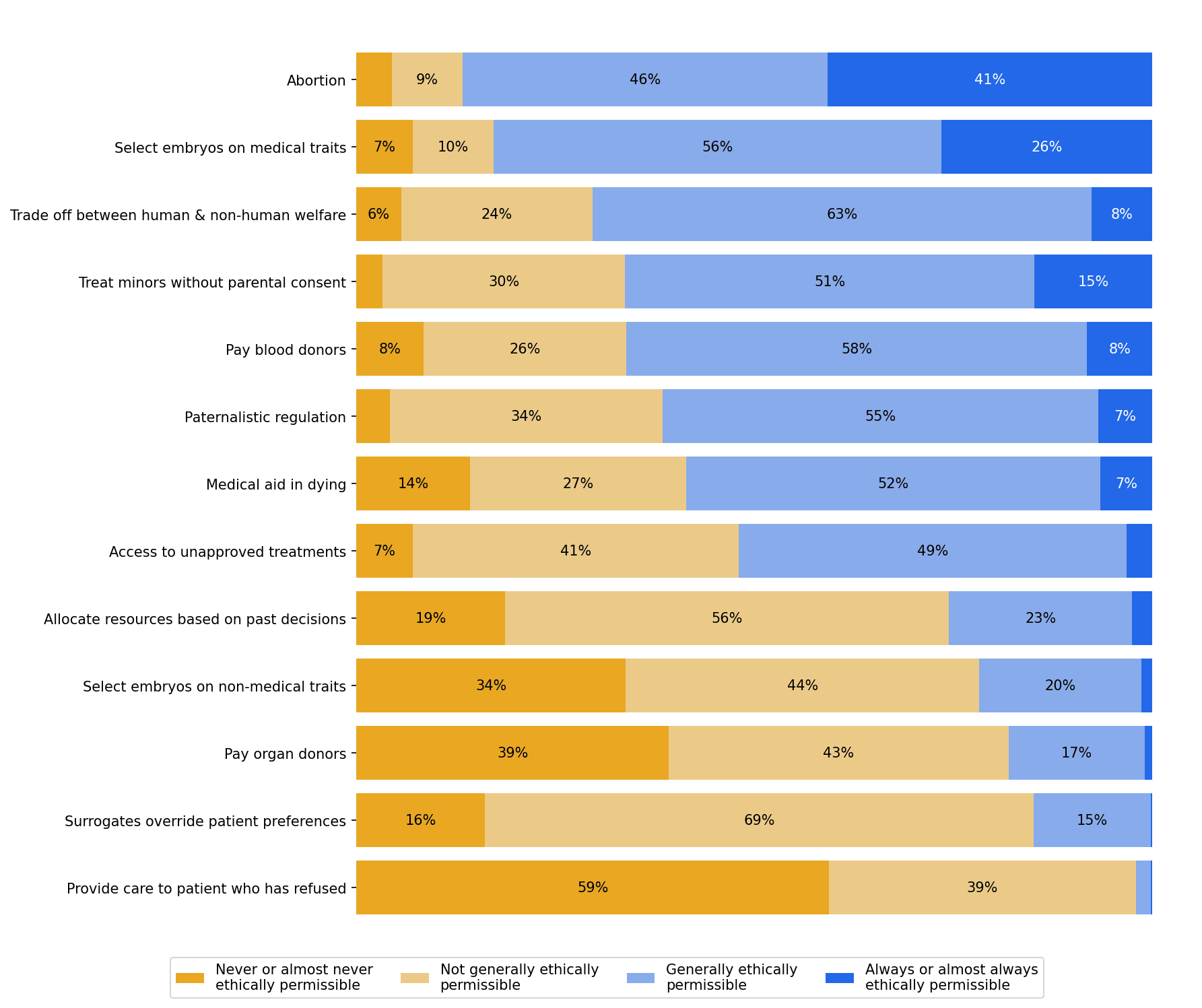
Question 2
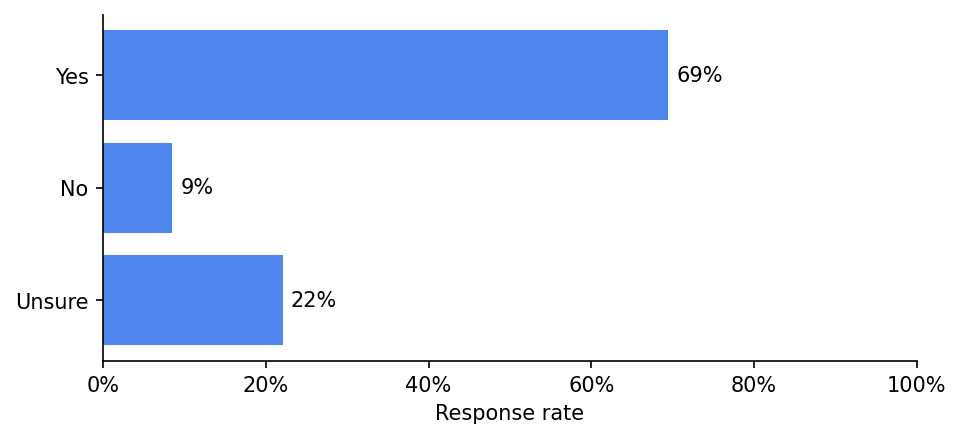
In general, should policymakers consider non-health benefits and harms (like whether expanding access to a service will reduce beneficiaries’ financial risk) when allocating medical resources?
Results
Question 3
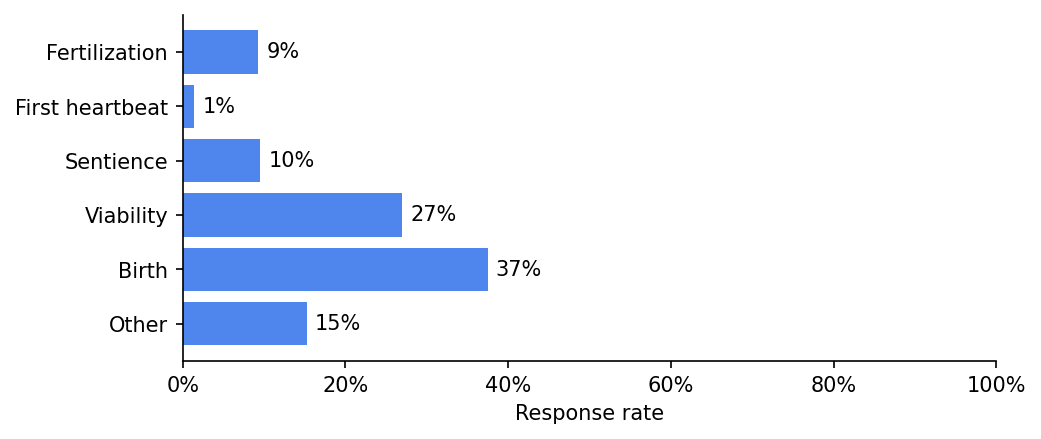
A being becomes a person at...
Results
Question 4
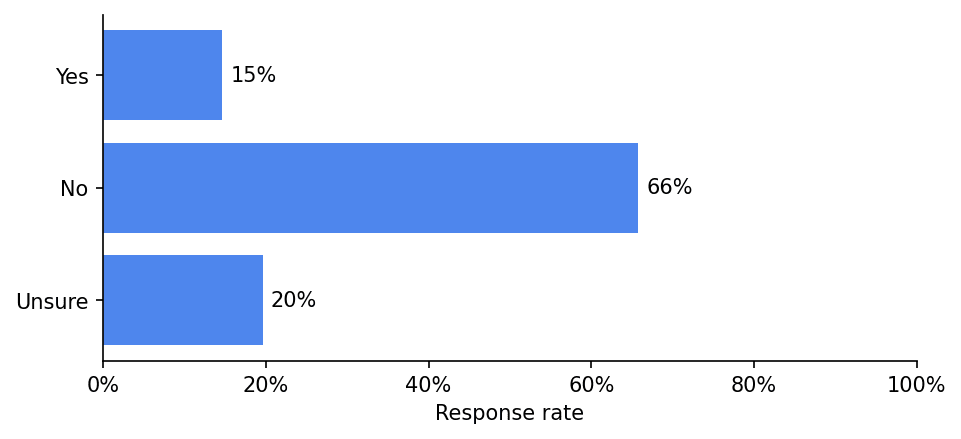
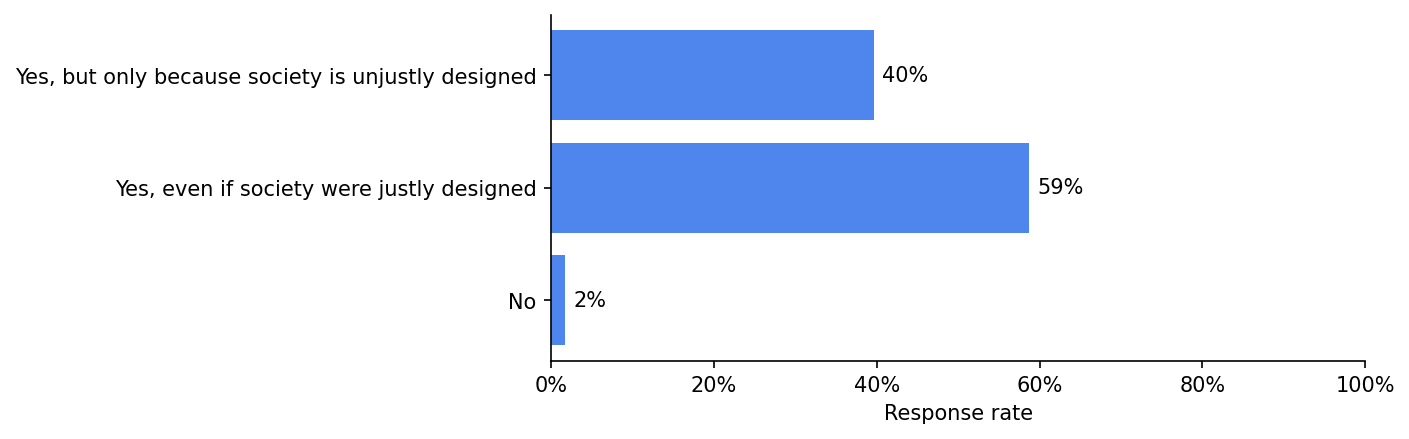
Does the fact that a person's life is expected to be worth living once we bring them into existence give us a moral reason to bring them into existence?
Results
Question 5
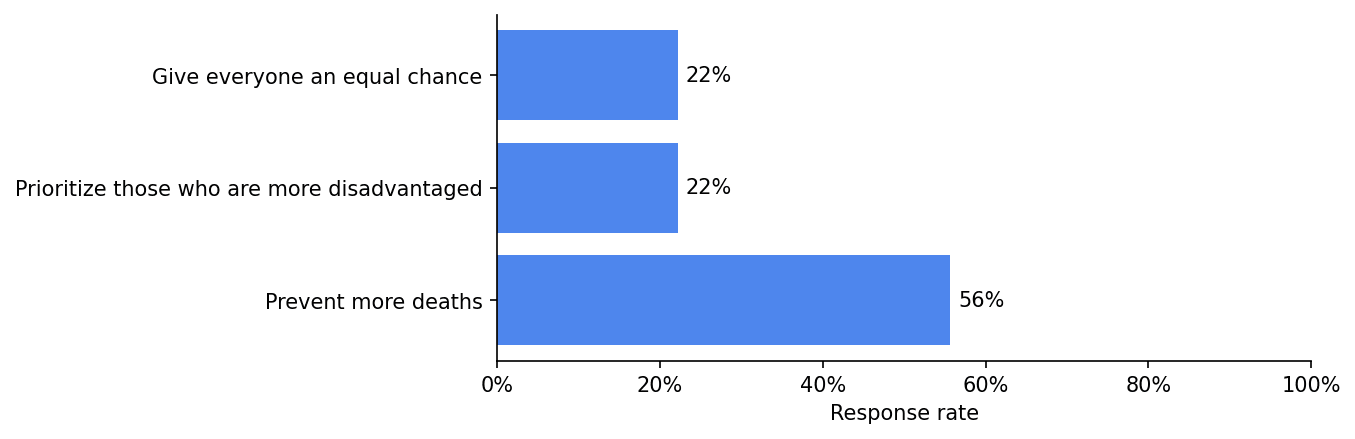
If there are not enough lifesaving resources for everyone at risk of death, we should:
Results
Question 6
Is being unable to see disadvantaging?
Results
Question 7
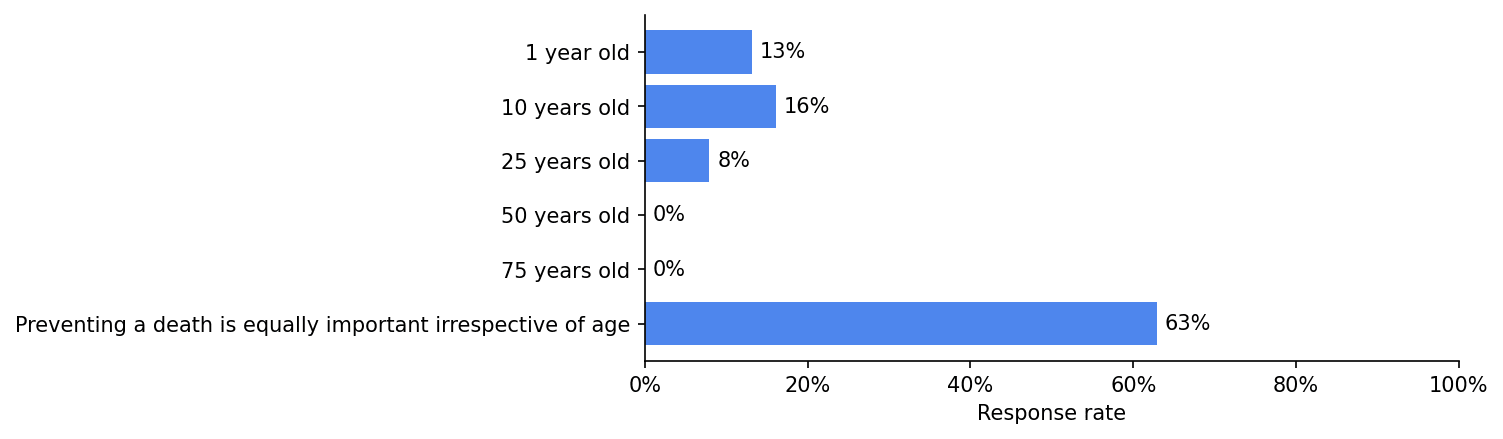
It is most important to prevent someone from dying at which of the following ages:
Results
Some concluding thoughts
- There are more analyses/data in the paper (e.g., comparisons of bioethicists' views to those of the US public; data on bioethicists' backgrounds; analyses of the relationship between bioethicists' normative commitments and their views on specific issues). You can access the paper here. Feel free to reach out if you have trouble accessing it.
- We also surveyed bioethicists about issues related to research ethics (e.g., challenge trials; information hazards). These results will be published separately.
- If you're interested in administering this survey to EAs, please reach out.
- The American Journal of Bioethics will solicit peer commentaries on this paper in the near future. Please consider writing a commentary if you have thoughts. Edit: the link to do so can be accessed here.
- Sophie Gibert (the second author) and I have a podcast, Bio(un)ethical, where we often discuss issues at the intersection of bioethics and EA. If these issues are of interest to you, consider checking it out.


"Preventing a death is equally important irrespective of age" strikes me as a genuinely insane position, although I guess maybe the 63% agreeing with it have something saner in mind that is closer to it than giving an exact age.
No one would be indifferent between extending someone's life by an hour, even a very valuable hour, and extending another person's ordinary life by 30 years. But it's just really strange to endorse that, but not apply the same logic to saving a 20-year old person over a 100-year old person. Does anyone know of any actual arguments people give in favor of it?
As someone who is not a bioethicist but interacts with many through work (though certainly not as many as Leah), I think that this position for many likely derives from a general opposition to treating people differently based on their intrinsic characteristics. In other words, If I know it's bad to be ageist, I might interpret the thought experiment that nudges someone to save a younger life as ageist (I've heard this argument from one person in bioethics before, but, y'know, n=1) and reject the premise of the question. So for that subset of bioethicists it may not be a serious argument in favor of the proposition but rather a strong preference against making moral judgments involving people that touch upon their intrinsic characteristics.
Yeah, it's just transparently stupid stuff like "Each life counts for one and that is why more count for more. For this reason we should give priority to saving as many lives as we can, not as many life-years." (Harris 1987, 'QALYfying the Value of Life'.)
I discuss a bunch of arguments along these lines in my 2016 'Against "Saving Lives"' paper.
My general sense is that academic standards in bioethics are extremely low, and that much of the discipline just serves to launder conventional intuitions to create an appearance of "expert" support.
Speaking only for myself (not coauthors), I agree it's a surprising result! That said, I think their position may be more nuanced than is evidenced by their responses to this question alone, because their responses to a related question are as follows:
I think the apparent discrepancy between respondents' answers to these two similar questions may be partly explained by the fact that people found it difficult to choose between, e.g., a 25-, 10-, and 1-year-old, and so basically treated "equally important" as "unsure." To put this slightly differently, I suspect if we had asked "Is preventing a death equally important irrespective of age?" and had given "yes" and "no" as answer choices, a much larger percentage would have said "no."
Hm, something like this confusion could be boosting numbers, but I do have a professor who holds a position like this (I haven't spoken to her about it, so I don't know her exact justification). I find the position extremely implausible, but my steelman is probably something like this:
It is better to give someone twenty more years of life rather than two more years of life, but it is also better to give someone a million more dollars rather than a thousand.
We don't think, however, that it is right to give preferential treatment to saving a millionaire's life rather than the life of someone living paycheck to paycheck.
We infer from this that when we are making life or death decisions, we typically should not think in terms of deprived additional wellbeing at all, but rather the loss of something basic to autonomy/rights any being with certain minimum properties already has.
There are more details I could go into about theories that are skeptical of a deprivation account of death but this is sort of an attempted gloss of where they might be coming from, I recommend Shelley Kagan's book "Death" for anyone interested in an accessible treatment of this and other nearby issues. Again, I do not endorse this view, I think whatever commonality you find between all deaths, it is still very hard to deny that the deprivation is an additional consideration that is important enough to be decision-relevant. I just want to provide the steelman.
How far are they willing to push it? Is there are much reason to save someone who'll be dead from another cause in five minutes as someone who'll live another 40 years?
I'm not sure, again I haven't really spoken with my professor about this, and agree with Leah that the numbers are likely inflated. On the one hand Some ways of spelling out this position just seem to imply that yes, these deaths are as important to prevent. On the other hand, speaking less generously and more meta-philosophically for the moment, my impression is that people most likely to be comfortable with the age-neutral position in the first place also tend to be the ones willing to weave arbitrarily elaborate networks of moral cruft for themselves in order to avoid biting almost any bullet.