The Global South AI Safety Hackathon, organized by Apart Research together with regional collaborators across Latin America, Africa, and Asia-Pacific, aimed to build local communities capable of producing meaningful AI Safety research outside the traditional hubs of the Global North. For AI Safety México, this matched our own goal: creating a space where students, researchers, engineers, and policy specialists from different backgrounds could work on problems relevant to Mexico and the broader Global South.
Rather than a single venue, we ran two simultaneous in-person hubs, Mérida and Guadalajara, plus remote participants from across the country. This added logistical overhead but let us reach communities that a single-city event would have excluded.
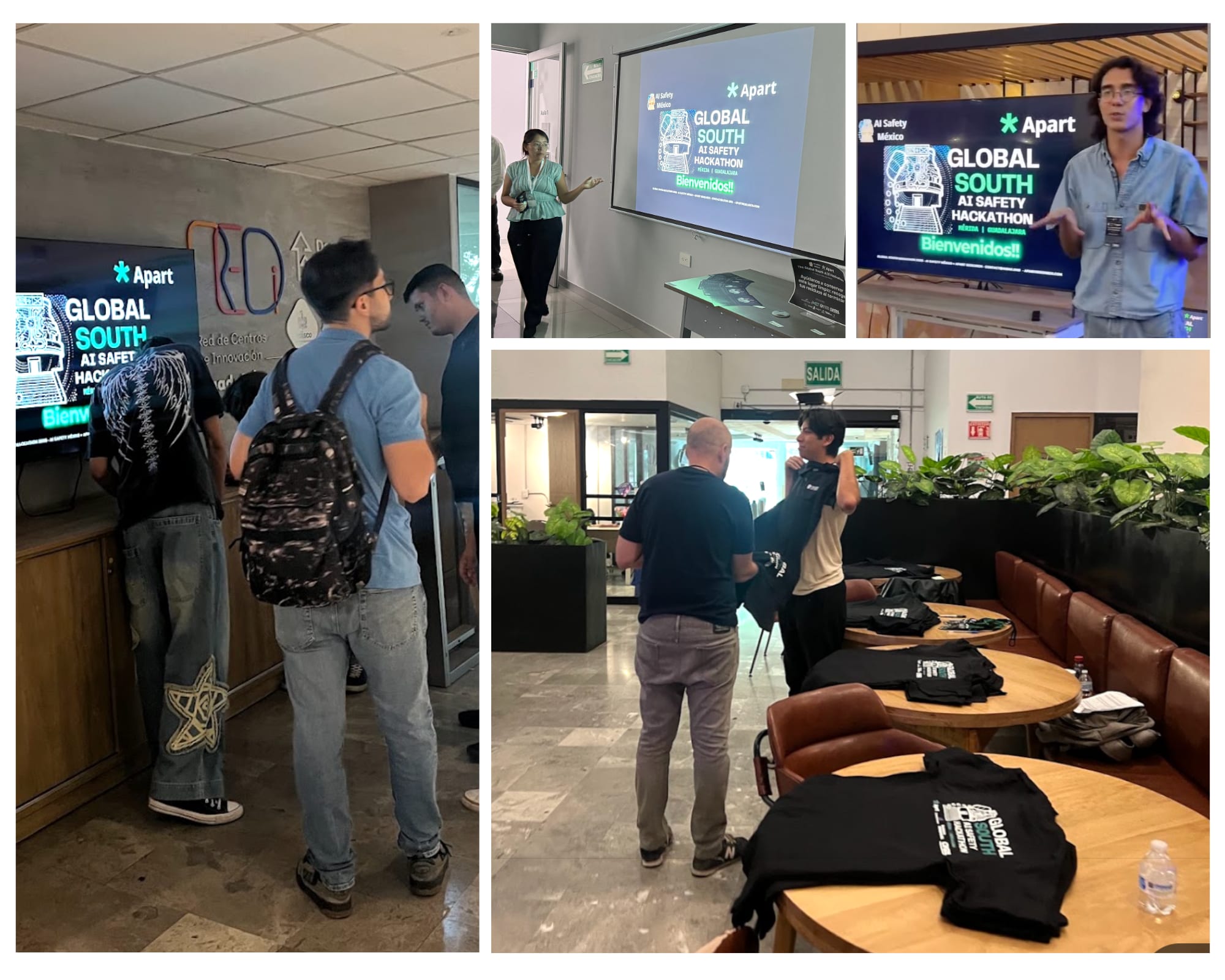
Welcome to the Mexico hubs of the Global South AI Safety hackathon.
Setup: two hubs, three months of preparation, low cost
Organizing the weekend took about three months. Our team split ownership across operations, logistics, marketing, university outreach, participant recruitment, judge/mentor coordination, technical infrastructure, and communications, which let two venues run as one coherent event.
Before the event, we:
Partnered with universities and reached out to researchers and professionals across Mexico.
Recruited judges from CentroGeo, IIMAS, CIMAT, the Government of Jalisco, LawZero, and AI Safety Canada, and mentors with research experience from Universidad Autónoma de Yucatán and Instituto Politécnico Nacional (IPN).
Secured the Guadalajara venue through a Jalisco state innovation center, a connection that emerged directly from our judge/speaker recruitment.
Cost: thanks to free venues from university/government partnerships and a lean model focused mainly on food and logistics, total cost across both hubs was approximately $38,728 MXN (~$596 MXN, ~35 USD) per attendee) over three days.
Defining tracks: local context + global expertise
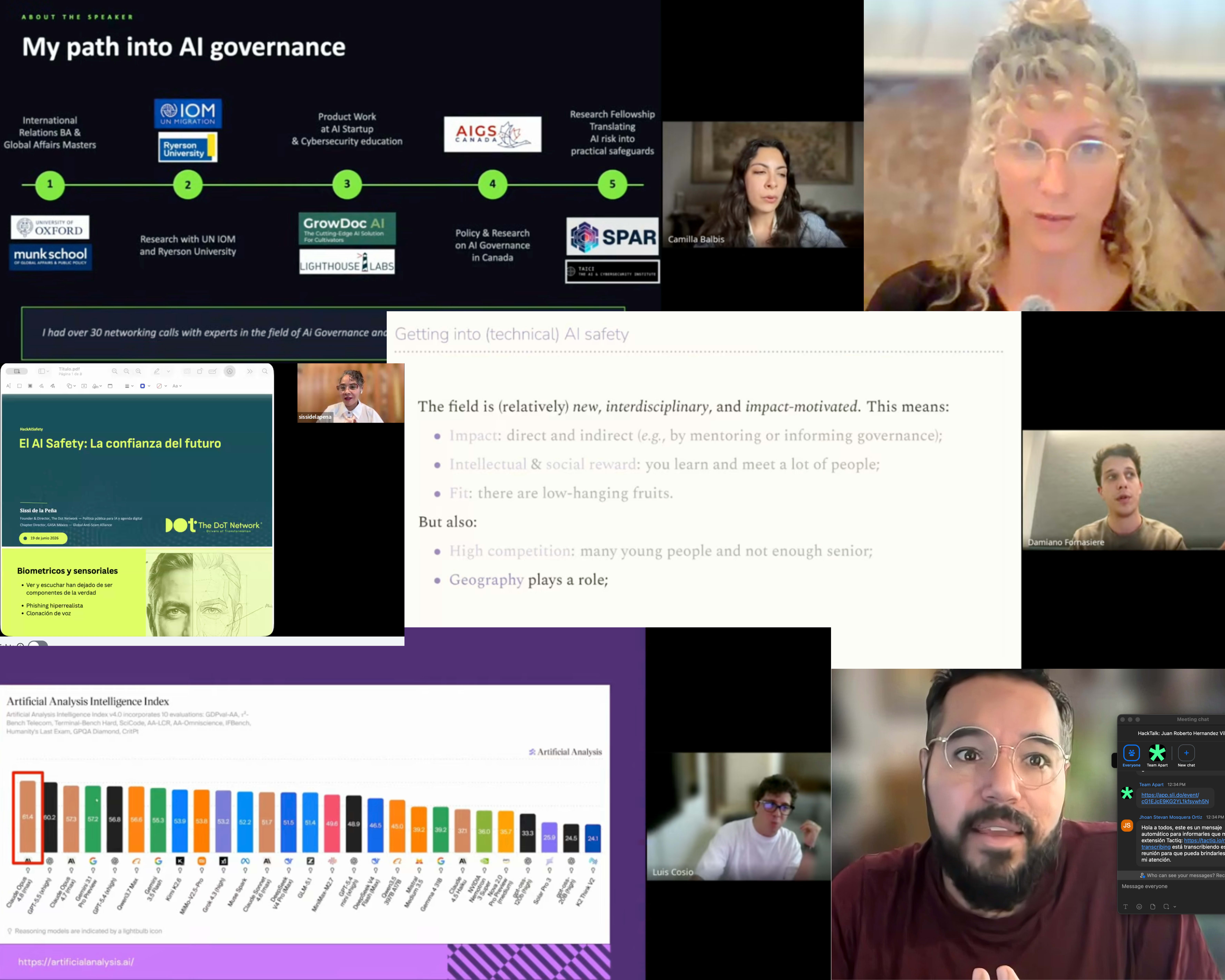
Because the event targeted an entry-level audience, we ran pre-event talks in the months leading up to the hackathon to introduce participants to people already working in AI Safety and to the tracks on offer.
To decide where to focus, we first mapped what AI Safety-related work already existed in Mexico. That mapping showed most existing work concentrated in AI Security and AI Governance, which became our starting point. We then held joint sessions with organizers of other Latin American hubs to define, together, four shared tracks: AI Security, Technical AI Safety, Responsible AI, and AI Governance, each with several sub-areas.
Much of our speaker/mentor network came together through a fairly reproducible pipeline: map what's already happening locally → define locally relevant focus areas → find people genuinely interested in the topic. Many connections came through the BlueDot Impact community, whose members were unusually willing to contribute time.
"Organizing the event became a learning experience of its own. We kept solving challenges we hadn't anticipated, and that made the process both demanding and incredibly rewarding." — Isabel Montalvo, Marketing & Outreach Lead
Some of the talks and pre-talks
The hackathon weekend
The weekend opened with keynote talks introducing participants to AI Safety and the available research tracks. Many attendees were encountering the field for the first time; others already had backgrounds in ML, cybersecurity, public policy, or governance.
On Day 1, we ran a three-hour validation hackathon (supported by Cursor) so participants could rehearse the workflow before the main event. This surfaced an important early finding: many participants arrived with an "industry MVP mindset", expecting to ship a product rather than produce research. Because this came up on day one rather than later, mentors had time to redirect teams toward a research frame.
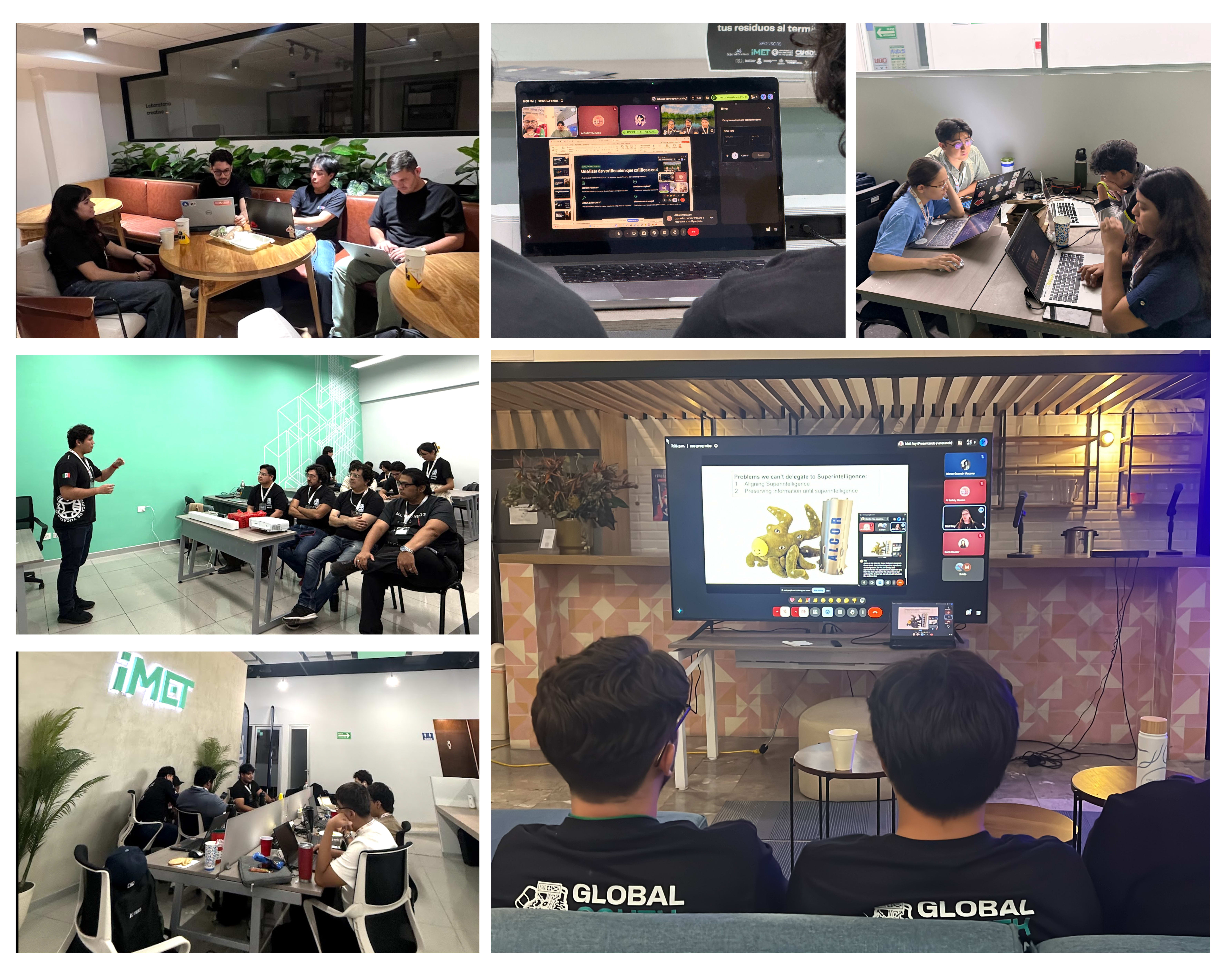
From there, teams refined ideas, got mentor feedback, debated research directions, ran experiments, and iterated, with speakers and judges available throughout.
The event ran on:
· 6 organizers
· 12 speakers
· 12 judges
· 6 mentors
· 6 volunteers
"The most rewarding part was seeing teams transform initial ideas into concrete research questions they could realistically tackle over a weekend." — Ángel Tenorio, Organizer & Mentor
Participation and projects
Of 106 people who registered, 65 attended (61.32% show-up rate), distributed across:
· 44 in Mérida
· 18 in Guadalajara
· 3 online
Participants formed roughly 19 teams and submitted 19 research projects (~3 people per submission). Most came from two partner universities, Universidad Politécnica de Yucatán (UPY) and Universidad de Guadalajara (UDG), and were mostly students or early-career professionals. Only a handful had any prior informal AI Safety exposure, and no participant arrived with prior publications or research experience in AI Safety, a concrete indicator of how early-stage the field still is in Mexico.
Teams worked across:
· AI Security
· Prompt injection and jailbreak defenses
· Agent safety
· Evaluation benchmarks
· Hallucination mitigation
· AI governance and public policy
· Deepfake detection
· Multilingual/regional language safety
· AI deployment auditing
Some projects:
· Slang Bypass: Benchmarking Alignment Failures in Mexican Regional Spanish
· DialectSafe: Bridging the ASR Gap
· HAZE: Adversarial Multi-Agent Scrutiny for Vulnerability Detection
· Filtrum-Safety: LLM-Agnostic RAG for Reducing Legal Hallucinations in Civil-Law Contexts
· YucaSafeBench
· Agentic Surveillance MX
· The AI Deployment Audit Playbook
· The State Is Not Enough
· Cultural Knowledge Gaps in LLMs
· TUP Detection
and several others spanning governance, safety evaluation, and applied AI Security.
Checkpoint with mentors
Results
One submission from the Mexican edition ranked in the global top 20% of all Global South AI Safety Hackathon entries, and four placed in the global top 50% (see epistemic status note above on how this ranking was determined), notable given that almost no one in the cohort had prior AI Safety research experience.
One project, "Protección de la soberanía: un marco empírico de vulnerabilidad y un escudo regulatorio para la IA en una potencia media," was selected to continue through Apart Research's Fellowship program, a concrete path from a weekend project to sustained research.
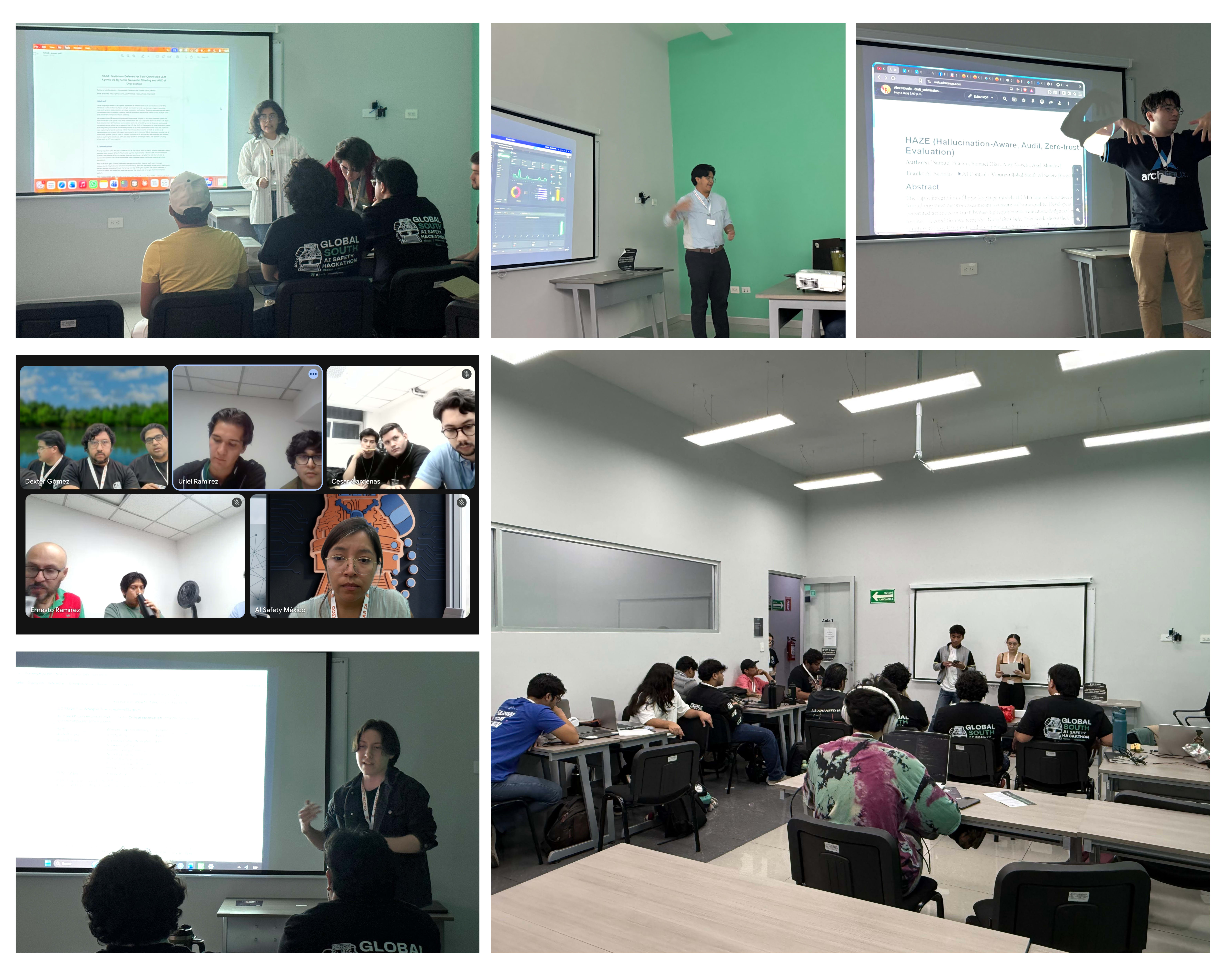
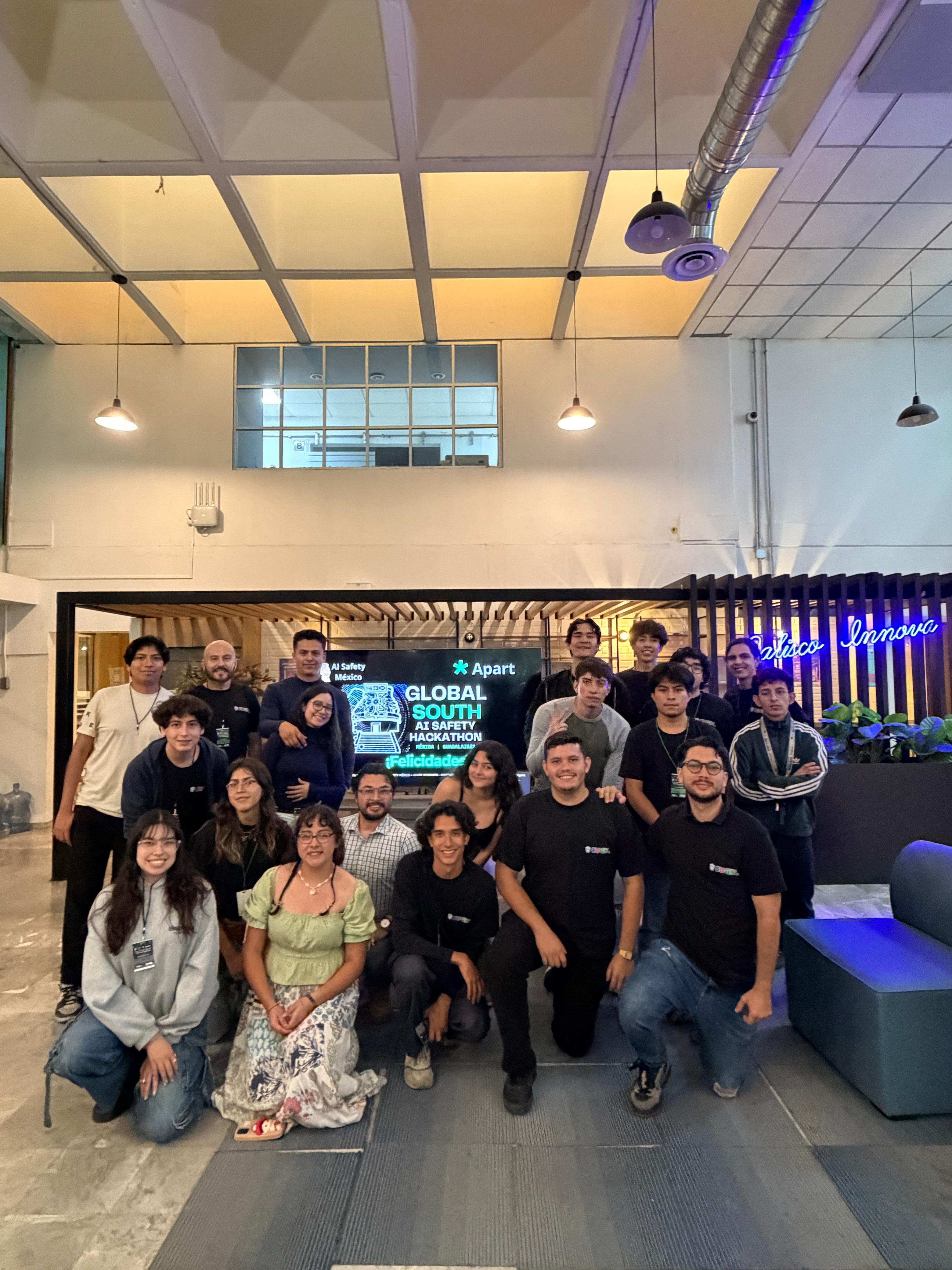
Guadalajara Hub
What participants and mentors said
"I went back to mentoring, and it reminded me exactly why I love it so much. [...] In a single weekend, they understood [interpretability, evaluations, unwanted model behaviors] well enough to build working prototypes, and by the final presentations it was clear they understood the mechanism underneath: they could point to where their solution broke, what assumptions they had made, and what that meant for whoever would use it." — Daniel Hernández, Mentor, Guadalajara hub
"From June 19th to 21st, I had the opportunity to participate in the AI Safety Hackathon organized by Apart and AI Safety México. [...] This experience pushed me to learn, collaborate under pressure, and apply my technical and problem-solving skills in a real-world environment." — William Emanuel, Participant
"One of my main takeaways is that many of the most important AI questions are no longer purely technical, they are relational, educational, cultural, and deeply human. [...] One of the most rewarding parts was seeing the audience build on these ideas, especially around the role that educators, translators, creators, independent researchers, and engaged users can play in shaping a more responsible AI ecosystem." — Amaia Amezaga, Speaker
"Many participants arrived with little or no previous exposure to AI Safety. By the end of the weekend, they were discussing topics like AI control and designing concrete research plans. Seeing that transformation made the effort worthwhile." — Janeth Valdivia, Operations Lead
"The participants' creativity exceeded our expectations." — Dexter Gómez, Organizer
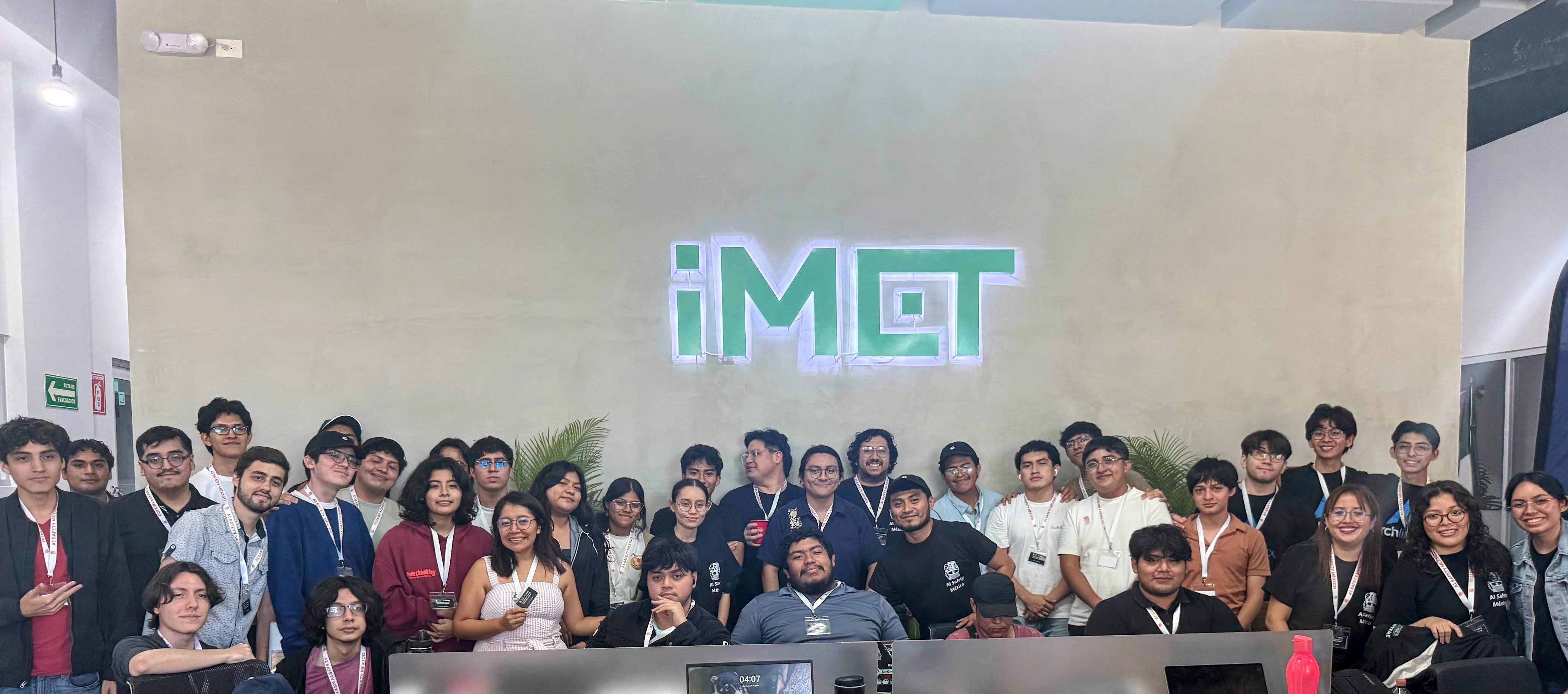
Mérida Hub
Lessons learned
Pre-hackathon educational sessions clearly improved the quality of participant proposals, we'd invest even more here next time.
Mixing technical and non-technical backgrounds produced richer discussions and more creative approaches than a purely technical cohort would have.
Active mentor support throughout the weekend (not just at the start) helped teams keep refining research questions instead of settling for demos.
Running two physical hubs at once requires substantial planning overhead, but it meaningfully broadens participation and strengthens regional communities, we think it was worth the added complexity.
AI Safety is still a nascent field in Mexico: zero participants had prior publications or research experience in the area. We treat this event as much as field infrastructure-building as a hackathon in its own right.
Running the event primarily in Spanish (with full English support available) removed a real participation barrier. Local language and local organizers were a genuine differentiator, not a minor detail.
The lesson we'd emphasize most: meaningful AI Safety work can come from communities that are still developing, provided they get the right environment, mentorship, and collaborative space. Prior experience mattered less than we expected going in.
What's next
A hackathon's value isn't just the weekend's output, it's what participants do afterward. Many attendees came in with little AI Safety exposure, and we're treating this as a starting point rather than an endpoint for them.
This was also the first remote collaboration between two Mexican AI Safety hubs, and it generated concrete institutional interest: research centers including IIMAS, CIMAT, and CentroGeo, along with the Jalisco state government, have engaged with this work since.
"What I hope participants remember most is that they continue developing the ideas they started here, or continue exploring AI Safety more broadly. Many participants are only beginning to discover this field, and hopefully this is the beginning of a much longer journey." — Isabel Montalvo
Acknowledgments
This was the first time we ran two simultaneous hubs while also supporting remote participants, and keeping a consistent experience across both in-person locations plus online was one of the harder logistics problems we solved.
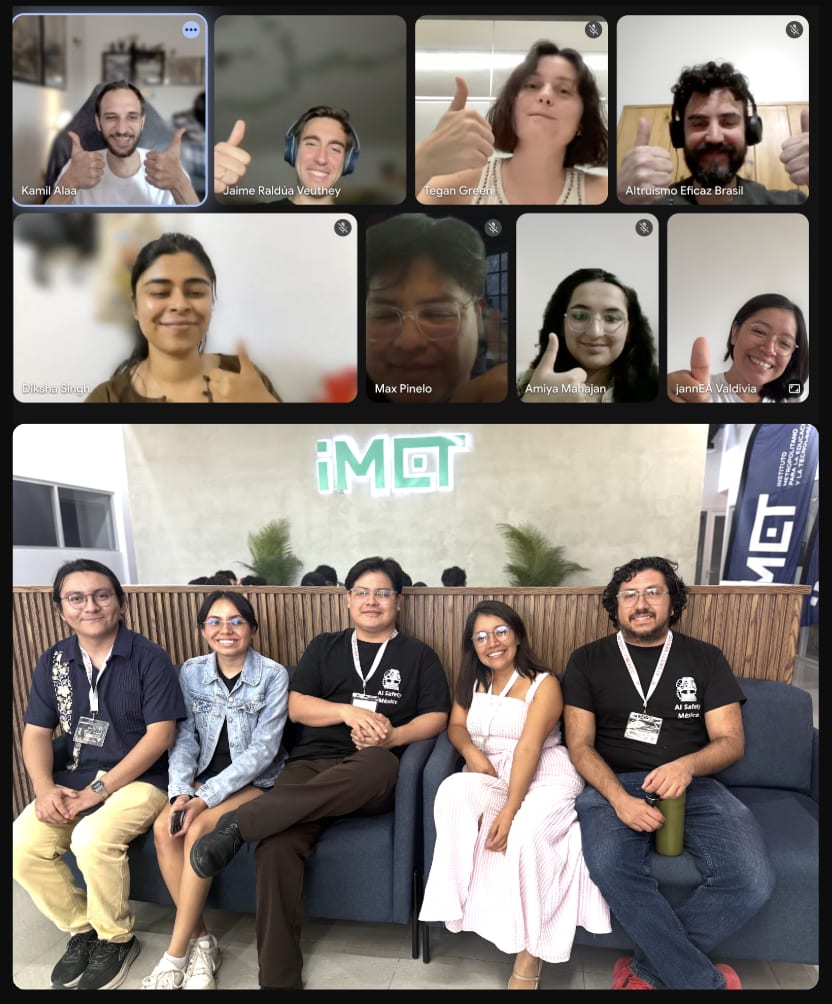
Weekly team meetings and a fully voluntary commitment from the AI Safety México team and collaborators were essential to making this happen. We're grateful to Schmidt Sciences and Apart Research, specifically Jaime and Kamil, for inviting us to bring this initiative to Mexico and supporting us throughout.
We would also like to thank the mentors, speakers, judges, and volunteers who joined this project; it certainly would not have been possible without their help. Thank you for contributing to the AI Safety ecosystem.
We think the results here justify further investment in this space: there is real talent with genuine interest in AI Safety in Mexico, and institutional interest exists alongside it. If you're interested in bringing similar initiatives to Mexico, or collaborating with AI Safety México, we'd like to hear from you.
Headline finding: I audited 17 AI Safety Talent programmes. Zero of 17 have published any comparison group, rejected-applicant follow-up, matched control or randomisation. Not one. Every programme that mentions a counterfactual does it by asking participants to self-report.
Background
At least $70 million...
Just how powerful are large swarms of AI agents? And how do their powers scale as more and more agents are added to the swarm?
We’ve seen two large and extremely capable swarms from OpenAI in the last few months:
* 1,200 agents were being evaluated separately, but found a way to illicitly set up a message board and coordinate as a swarm. In order to cheat on their tests, they developed advanced techniques to prevent their actions being logged by OpenAI and 700 of them launched...
In celebration of still being alive and fighting, we are giving away 1,000 Amazon e-books of “If Anyone Builds It, Everyone Dies”. Feel free to send a copy to yourself, a loved one, or a friend—we need all hands on deck.
Today marks exactly one year since If Anyone Builds It, Everyone Dies: Why Superhuman AI Would Kill Us All, by Eliezer Yudkowsky and Nate Soare...


$35/attendee is an extremely impressive cost. Thanks for doing this and writing it up!