Comments
Hey @NickAllardice if that's interesting to you, I built a detailed model that touches on the absorption capacity of the industry here: https://x.com/PChuzeville/status/2075595916984119317
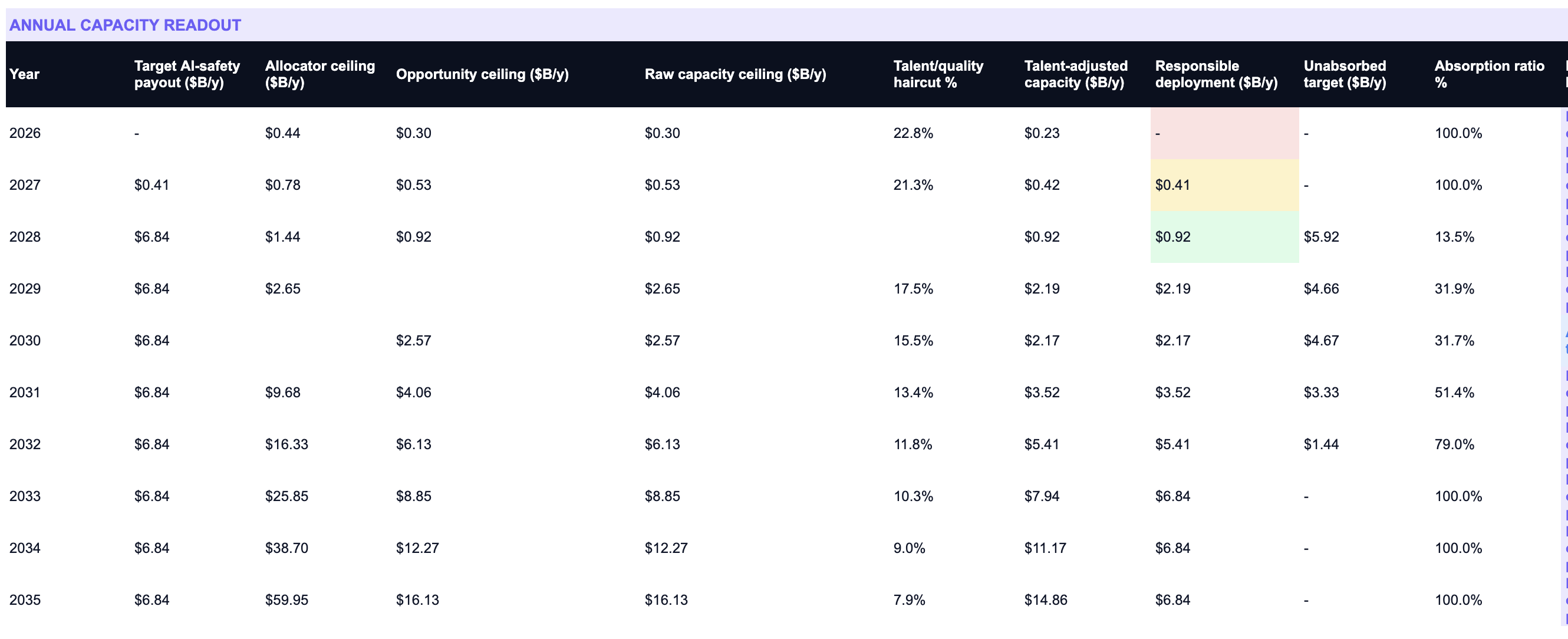
Hey @NickAllardice if that's interesting to you, I built a detailed model that touches on the absorption capacity of the industry here: https://x.com/PChuzeville/status/2075595916984119317
I wrote all the substance of this post myself, then used an LLM to refine its expression <20%.
A historic amount of money may be about to flow toward the world's problems, but right now that money can’t be absorbed at the effectiveness and scale this moment demands. That's an unpopular thing to say from a sector where it’s fashionable to shake your fist at the wealthy for not giving more away.
There are reasons to be sympathetic to this perspective: we know more about how to do good than ever before and there’s more wealth than at any time in human history… and yet the percentage given by the ultra-wealthy hasn’t budged in decades.
But this discourse is damaging and self defeating.
First, giving at an ambitious, sustainable scale will never be unlocked via shaming and scolding.
Second, in the vast majority of cases the social impact sector simply can’t credibly claim to be able to use significantly more money while doing so effectively, efficiently and quickly.
This is “The Absorption Problem”.
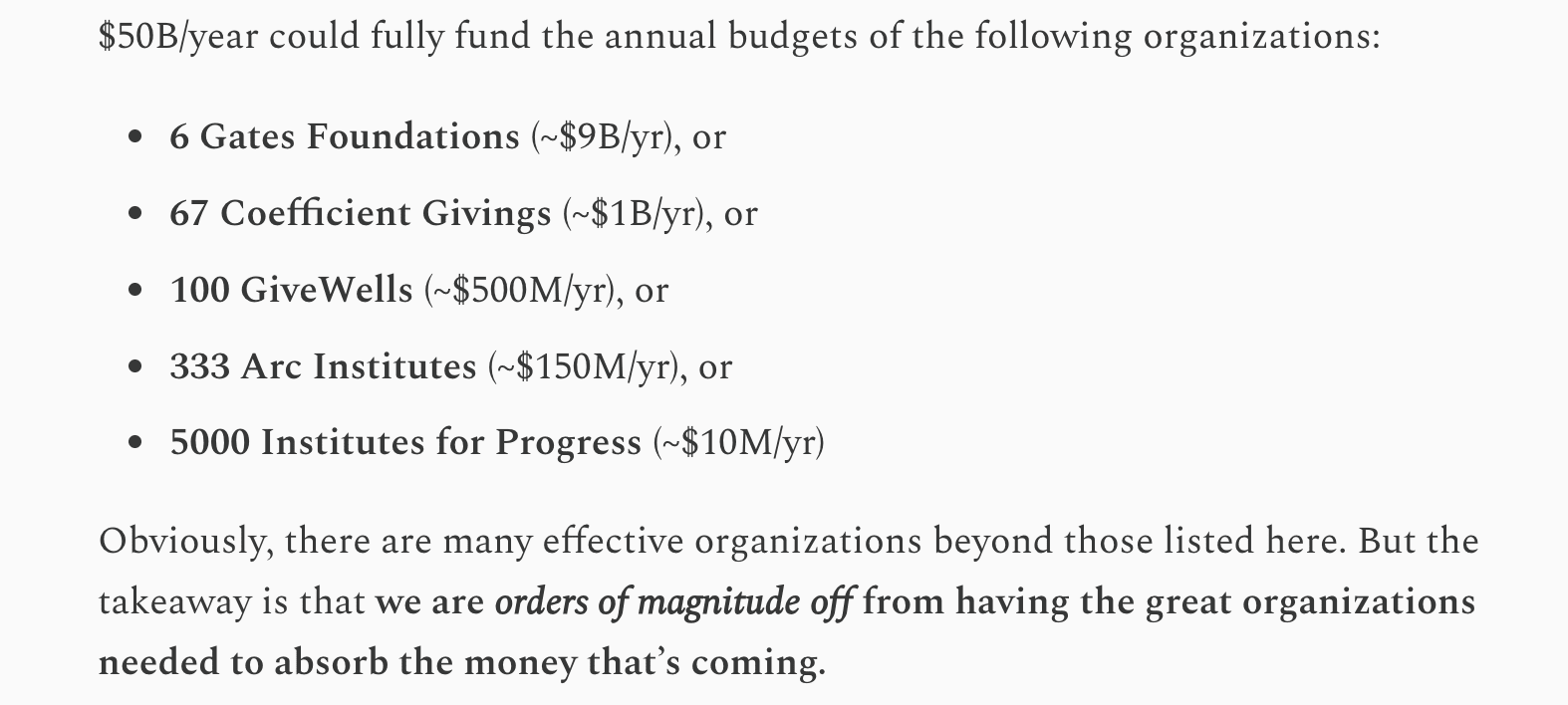
Nan Ransohoff's recent piece on the third wave of American philanthropy illustrates why this matters now: a historic amount of capital may be about to land in a charity sector that isn't built to absorb it – $370B in total philanthropic assets at Anthropic & OpenAI alone, leading to an estimated $50B/year in giving.
From Nan Roansohoff
I’m skeptical that $50B a year will move. The base rate for giving by the ultra-wealthy is about 1.2% of assets a year, many times lower than what Nan forecasts.
That said, I’m having dozens of conversations with people who will be a very large part of this ‘third wave’ of philanthropic capital, and the ambition and urgency I hear is very very real… real enough that I expect giving well above the historical rate. No matter where in that range we land, the absolute amounts will be large, and it’s plausible enough to be worth preparing for now.
And I believe that we - the sector - are woefully underprepared.
Scaling impact that leads to real change for people quickly and successfully is incredibly hard, and poorly understood. I see a lot of naivete amongst leaders, operating organizations and funders - and I want that to change.
I don’t have all of the answers, but as CEO of Change.org (we went from 100k to 100M monthly users while I was there, doing a lot of work on advocacy and political change) and GiveDirectly ($1B+ delivered to people in poverty and crisis around the world) I’ve been part of two of the fastest growing and largest scale social impact organizations of the last 20 years. I’ve underestimated this problem, made many mistakes, failed catastrophically, and sometimes had success.
Below I work through the four reasons scaling impact so often fails: (1) impact that doesn't grow with size, (2) interventions that hit a low ceiling, (3) the hidden cost of moving fast, and (4) organizations that break from growth. Then I offer a framework for assessing the "scalability profile" of any intervention or organization before you put serious effort or money behind it.
When philanthropy fails at scale, almost nobody finds out. A for-profit that scales badly gets told by the market quickly: sluggish revenue, increasing churn… and someone gets fired. Nobody gets told about a nonprofit that fails to scale impact, because the people we serve aren't the people who pay.
The strongest feedback mechanism the sector has built to compensate are randomized controlled trials (RCTs). They’re slow, expensive, hard to run at scale and they won’t work for this moment. It’s years from design to results, measuring a program as it existed several years and one organizational era ago. An organization can triple in size between the baseline survey and the published paper. The gold standard of feedback runs at a fraction of the speed we need right now.
And when researchers have used RCTs to measure scaling itself, the results have been poor. In Kenya, a contract-teacher program was tested in a nationwide experiment in which the identical program was randomly assigned to be run by an NGO or by the government. Run by the NGO, it raised test scores by about 0.18 standard deviations, a solid effect. Run by the government at national scale, the effect was statistically indistinguishable from zero. The implementing organization changed, and the entire effect vanished.
This matters because most nonprofits don't plan to scale themselves; they plan to prove something works and hand it to a ministry that can reach everyone. That handoff is the sector's default theory of change, and the contract-teacher result is the uncomfortable version of where it leads: the intervention survived, the implementer changed, and the effect didn't.
The economist John List calls this the "voltage drop": between 50 and 90 percent of programs lose a substantial share of their measured effect when they scale.
I see the mechanism constantly in development research. A new RCT shows some intervention is twenty or thirty times more cost-effective than anything else, everyone gets excited, and then the replications come in and revert toward the mean. Often the first study site was uniquely fertile ground. Often quality was the founder's personal obsession during the trial, and quality is exactly what's hardest to scale: the result you get when a founder is directly managing every input is not the result you get three years later with thousands of staff and contractors who have no investment in the outcome.
This can get worse at scale, as unintended consequences add very large negative effects. Take microfinance as an example – a philanthropic darling that has scaled massively.
Studies have shown that microfinance has a mostly neutral or occasionally modestly positive effect on people who receive it.
But even if those studies showed more robust results, the commercial industry that philanthropic capital helped catalyze has followed the incentives to their logical conclusion: aggressive growth, extreme interest rates, severe repayment terms, over-indebtedness trapping a meaningful number of extremely poor people further in poverty.
I don’t think we’ll ever know whether the overall effect of micro-finance on the world is net positive or negative.
Political giving, advocacy and corporate campaigning has its own scale-dependent unintended consequences. Over two decades of working on hundreds of political and corporate campaigns, I’ve seen again and again how ambitious deployment of capital often triggers the formation of organized opposition, polarizes neutral bystanders into partisan camps, or enables political opponents to mobilize more of their own money. The only people that win are political consultants and advertisers that will happily take everyone's money.
"Can this absorb money" and "will more money help" are different questions, and the gap between them often widens with scale.
When a startup pitches a venture capitalist, the first question is usually not about the founder or the idea. It's about market size. Most startups get turned down because the problem they're solving is simply too small to plausibly reach $1B+ valuations, no matter how good the product or team is.
Philanthropy almost never asks the question this way, because most of the best giving opportunities in the world have modest market sizes.
The Against Malaria Foundation (AMF) pays for implementing partners to distribute anti-malarial bednets in low-income countries, one of the most rigorously evaluated and cost-effective interventions out there. It deploys roughly $100-150 million a year. The upper bound constraints they face aren’t money or talent. It's the supply of bednet-appropriate geographies… it’s the seasonal windows the malaria transmission cycle dictates… and it’s the manual work of supervised distribution by AMF’s last-mile delivery partners. AMF’s estimate for its global funding gap for bednet distribution is in the hundreds of millions a year, not billions.
This is no knock on AMF or anti-malarial charities: they should be funded to their full capacity. The catch is that full capacity is a real, knowable number, and it is far smaller than the money that could be brought to bear on the world’s most important problems.
The same is true beyond bednets. Graduation programs (the intensive packages of cash, coaching, and asset transfers that move people out of extreme poverty) have some of the strongest evidence in development, but can be expensive and very labor-intensive to run, which caps how fast and how widely they can spread. Childhood vaccination has enormous proven impact, yet the binding constraint is cold chains, clinics, and health workers. In each case the constraints to impact at massive scale are real, knowable, and often not something that money can solve quickly.
Move beyond global health and the ceilings and bottlenecks don't disappear. They just get harder to see. Advocacy causes have ceilings made of talent, organizational bottlenecks, and winnable opportunities rather than goods:
Grantmakers and nonprofits aren't used to assessing the market size and scalability profile of interventions at the level of funding that could be brought to bear soon. Bottom up ‘room for more funding’ analyses are a good starting point, but fundamentally different to proactively searching for or working on interventions and organizations that have ‘credible path to absorbing and deploying $500M+ cost-effectively per annum’.
It’s not surprising these muscles aren’t well developed, most non-profits live in a perpetual state of scarcity. Organizations raising money grant by grant are rewarded for high-confidence impact in the short term, not for the R&D that builds something capable of extraordinary scale. Grantmakers optimizing the marginal dollar look for opportunities they can fund to full capacity before moving to the next item on the list. Neither mindset serves this moment.
The clearest symptom is the sector's addiction to pilots: cheap, low-commitment, and good for a tidy results deck, so we run them by the thousand and scale almost none. We reward starting things, not the slow, expensive work of making a working thing big.
There are just a few dozen nonprofits spending more than $1 billion a year, and that includes hospitals, universities, and donor-advised funds. The very largest implementing charities (Feeding America, Salvation Army, World Vision, MSF, etc.) top out around $2-3 billion in cash spent per year. It’s insane there’s so few non-profits that have achieved that scale, and it has almost always taken many decades (sometimes more than a century!) and wildly diverse portfolios of programs to get there.
By contrast, private equity firms announced roughly $1.7 trillion in deals in 2024 alone, all made up from buyouts of individual companies, each typically decided in months. A single mid-sized one of those deals can exceed the yearly budget of the largest charity on earth. The biggest nonprofits are a rounding error next to what private capital deploys as a matter of routine.
And the donation opportunities with no ceiling are often where absorption and impact come apart completely. You can spend unlimited amounts on political advertising or capital campaigns and feel good for no discernible impact. A museum endowment can absorb any sum you care to name, forever. The world's largest university endowments already hold more than the GDP of most countries. All are marginally better than leaving the money in investments… but not by much.
The money is absorbed frictionlessly because so little is being asked of it. Ease of absorption tells you nothing about impact, and past a point the two are often not related at all.
Suppose you've found an intervention with real headroom; a genuine market, money to spare. You still have to get there, and how quickly you try to get there is its own constraint.
I see the assumption that scaling impact brings more efficiency all the time. Unit costs fall and infrastructure amortizes… so the default mental model of a donor funding growth is economies of scale: bigger will mean cheaper per unit of impact.
At a stable equilibrium that might be true, but for organizations growing fast the opposite is often more true. Speed and cost-effectiveness trade against each other, and the faster you grow, the worse the trade-off.
I think the confusion comes from where people's reference points for scale live: the tech industry, the most documented scaling story of our era. Those stories are misleading twice.
First, software scales in ways field operations don't. When Change.org grew from 20 million to 100 million monthly users in March 2020, the marginal cost of serving those 80m users was close to zero; the product was the same pixels in a new browser.
Compare that to delivering bednets, vaccinations, or graduation programs in rural East Africa. Scaling those means recruiting, training, and supervising thousands of field staff. Every new hire who handles money or data is a new fraud vector. Every new district brings a new local power structure and new ways enrollment can be gamed or coerced. Quality, risk, fraud, and abuse exposure all grow with scale, often faster than scale, and the systems to contain them need to be rebuilt repeatedly.
Second: even software companies scale inefficiently. The strategy that built most of the technology giants has a name: Reid Hoffman's "blitzscaling," or "prioritizing speed over efficiency in the face of uncertainty." A blitzscaling company chooses, on purpose, to be worse at the unit economics today in exchange for being bigger tomorrow. It overspends, undercharges, and runs at a loss, sometimes for a decade. Uber piled up roughly $31.5 billion in operating losses before its first operating profit! Venture capital is, at bottom, a mechanism for financing that deliberate inefficiency long enough for it to pay off.
Nonprofits are punished for the exact strategy.
A charity that ran Uber's early numbers, spending heavily ahead of scale and sacrificing efficiency to build scale, would be flagged by every watchdog, downgraded by every evaluator, and abandoned by donors who read overhead ratios. The sector's capital expects efficiency during the growth phase, which is precisely when efficiency is structurally unavailable. So organizations grow slowly to stay efficient-looking, or grow fast and hide the costs. Neither maximizes impact.
Even with infinite tolerance for inefficiency, many bottlenecks are slow to resolve no matter how much money gets thrown at them. Opening a new country takes GiveDirectly 1-2 years: regulatory approval that often needs ministerial or presidential sign-off, mobile-money registrations, a country director credible to both the government and the people we serve. Fraud monitoring for $5 billion a year of exposure is not a bigger version of the system that handles $250 million; it's a different system that has to exist before the money flows.
We learned the cost of skipping this kind of unglamorous work the hard way. Early on, GiveDirectly was dismissive of government relations. It looked like a circuit of pleasantries: meetings that made everyone feel good and money that could have gone to recipients. We decided to just get on with the job. Then, in Uganda, during a volatile political moment, rumors spread that we were buying votes with our cash distributions. Nobody in government knew who we were. We had no champions, no allies, no one to vouch for us. We were shut down, millions of dollars we were ready to deploy stopped in their tracks, and it took two years to dig out of that hole. We now invest in government relations in every country we operate in. That lesson cost us two years in one country, and it's the kind of lesson you can only learn at the speed the context allows.
GiveDirectly has lived the other side of this trade too. In 2020, COVID hit and GiveDirectly jumped from delivering $40 million a year to ~$250 million… 6x in a year. From the outside it looked like our finest hour, and in some ways it was: that money reached hundreds of thousands of families in the middle of a global emergency, fast, when almost nothing else was moving.
It also nearly broke us. Our team ran at a pace that couldn’t be maintained; heaps burned out. We took operational risks I would not take again. In several places where being unlucky would have been catastrophic we were simply lucky.
Everything so far is a limit on the non-profit sector's ability to absorb, even if every non-profit was perfectly run. But there are no perfect organizations.
This isn't unique to nonprofits. Bain's Chris Zook put the mechanism in one line: "Growth creates complexity, and complexity is the silent killer of growth."
In my experience, the breakage points are many.
Decision rights. As the organization grows, people who used to be in the room for everything start finding out about decisions after they're made, and they experience it as betrayal when it’s actually just inevitable. Nobody warns you, and it arrives with strange emotional force.
The compensating instinct is over-inclusion: more consultation, more stakeholders, more people in more meetings. But when decision rights are fuzzy and everyone is a stakeholder, contested decisions don't get made; they get escalated. Everything ambiguous flows upstairs to the few people with unambiguous authority. Senior leaders become a reactive committee processing a queue of other people's decisions… the org chart looks like you delegated, but your calendar says you didn't.
Coordination. Every new hire doesn't just add one person; they add a relationship with every person already there. Ten people have 45 possible lines of communication. A hundred people have 4,950. This is why adding people to a late project makes it later, and why hiring fast reduces an organization's capacity before it raises it: every new person taxes everyone who already knows how things work.
This is extra bad in most NGOs, which often run matrix structures. This means process and stakeholder management grows faster than headcount and makes ruthless decoupling (fewer people in the path of any given decision) one of the highest-return things a scaling org can do.
Smart heroics are not scalable systems. Every organization scales on manual processes patched with individual heroics, and every one of those has a limit discovered only by exceeding it. The spreadsheet that’s actually the database. The approval process that is actually an email thread between the same four people. The colleague who knows how everything connects, who was your greatest asset at 50 people but your single point of failure at 500.
Quality control. At a small scale, quality is a function of hiring good people and good communication. At large scale, the people haven't gotten worse, but nobody can see the whole anymore, and quality becomes a function of instrumentation: dashboards, sampling, audits, alerts. Without that infrastructure, you end up hiring watchers for the watchers - a quality team overseeing a quality team, growing forever. The transition from "I trust Mary" to "I trust the alerting threshold" feels like an abdication of duty in a mission-driven org, but it is not optional.
Risk. Benchmark data puts serious employee-relations claims (discrimination, harassment, retaliation) at 15 per 1,000 employees per year. At 70 employees, that's a once-a-year event your leadership team handles personally and remembers for a long time. At 1,000 employees, there is always at least one investigation open somewhere. Add in legal threats, safeguarding incidents, and regulatory inquiries across (at least in GiveDirectly’s case) a dozen-plus countries' labor and data laws, and the question stops being whether serious incidents happen. It becomes whether your governance is mature enough to process them as routine. Organizations that haven't built that maturity get derailed by base-rate events: each one feels existential, consumes the leadership team for weeks, and crowds out the actual work.
Culture. For the first 150 or so people, culture transmits by osmosis. Past that point you have to hold it on purpose, against incentives that quietly pull the other way. Most organizations don't. And when that happens, trust thins out between leaders and staff, between departments, and between headquarters and the teams in-country. Sub-cultures form and rub against each other. Politics arrives. The bar drops on both talent and work. And capable people start playing for their own patch rather than the mission, because the two are no longer perfectly aligned. This is the default path, not bad luck, and requires concerted effort and investment to avoid.
Leadership. The skills that matter change dramatically, and not everyone will make the transition at the speed needed. At smaller scale leaders succeed by personally solving the hardest problems, making fast calls with incomplete information, recruiting the first few brilliant generalists, selling the mission one conversation at a time, and being the person who can step into any role when it's on fire.
At large scale different muscles are needed: goal and metric design, capital allocation across bets that can't all win, building incentive systems that scale judgment you can no longer apply personally, recruiting senior talent good enough to be trusted with real autonomy, and org-wide communication to people you'll never meet. Knowing how to maintain the 30,000 foot view, and when and how to zoom in and sweat the details without creating a system that relies on you doing so.
None of these are exotic failures. They are what normal looks like when organizations grow quickly. An organization absorbing a step-change in funding is fighting on all fronts (and others!) at once, while delivering, while hiring, while being watched.
To bring all of this together, every intervention has a scalability profile, and so does the organization that delivers it. The two are scored separately, and the impact you actually get is capped by the weaker of them.
The intervention: can the thing itself scale?
The organization: can this team scale it?
A high scalability profile needs strength in both layers: a large market, economics that hold, few hard speed constraints, results robust to ordinary execution - and an organization mature enough to carry it. A low score on any single factor caps the whole.
One reason I do the work I do at GiveDirectly (disclaimer, discount accordingly) is that direct cash transfers as an intervention have an unusually high scalability profile (though we’re still doing work on the unit economics at truly massive scale, and it’s operationally much harder to scale than most people think). But it also only pays off if we have the readiness to match. We've cleared that bar in some moments, missed it in others and are working hard on it as we speak.
There’s important work ahead for anyone working in this space. Hopefully understanding the absorption problem better will allow us to level up what’s possible and how we navigate the coming years.
First, we need more interventions that have a high scalability profile to begin with. Since those don't appear on their own, that means deliberately funding and executing on the research and development to discover and build them.
Second, we need to understand the profile of what already exists, and where there’s significant upside, invest to make delivery models more robust to speed, more robust to variable execution, and backed by organizations mature enough not to break under the weight.
The first is about expanding the menu. The second is about making the dishes we already have worth ordering at scale. I plan to write about how funders and implementers can do both in the coming weeks.
The world needs more crazy but credible ambition for improving things. We shouldn’t accept a reality in which philanthropic dollars only ever improve things on the margins.
I posted this originally on Linkedin and Substack where I write for a more general audience. I think it's highly relevant for here though, and would welcome thoughts, disagreements, builds and implications.


Here's an idea for a pro-animal campaign that could absorb a lot of money: subsidize vegan food. Make mock meats and other plant based stuff way cheaper, so people are more likely to try it and get used to it and like it.