Comments

The Democratic sweep of key Congressional committee chairs should push frontier AI bills further in Congress.
Originally published on Bill’s Babbles.
On an unusually sunny September morning, Republican Brett Guthrie told the media that the FRONTIER Act would no longer advance in the Congressional session. Guthrie sits as the House Energy Committee Chair. His decision had effectively killed off what the Foundation for American Innovation described as Congress’s Best AI Bill Yet. FRONTIER’s demise was not dissimilar to the 3 other bipartisan efforts to pass strong frontier AI bills.
Guthrie will be replaced this January by a Democratic counterpart, as will all other Congressional committee chairs after a strong midterm showing that flipped both the House and Senate. Frank Pallone (D) will be his presumptive replacement as the chair of the House Energy Committee.
Guthrie’s reluctance towards the mandated federal oversight of private AI labs is likely to be replaced by someone more amenable. Pallone was one of the three Senators who threw their weight last month behind demands to frontier labs for compulsory incident reporting to Congress within 48 hours.
Guthrie’s replacement chair is not dissimilar to other Republican Committee chairs. The Democratic takeover is likely to replace a substantial proportion of committee chairs, who are more sympathetic towards strong AI regulation. Looking at the six committees from the past four bills, at least half of the replacement chairs have already come out strongly for AI regulation.
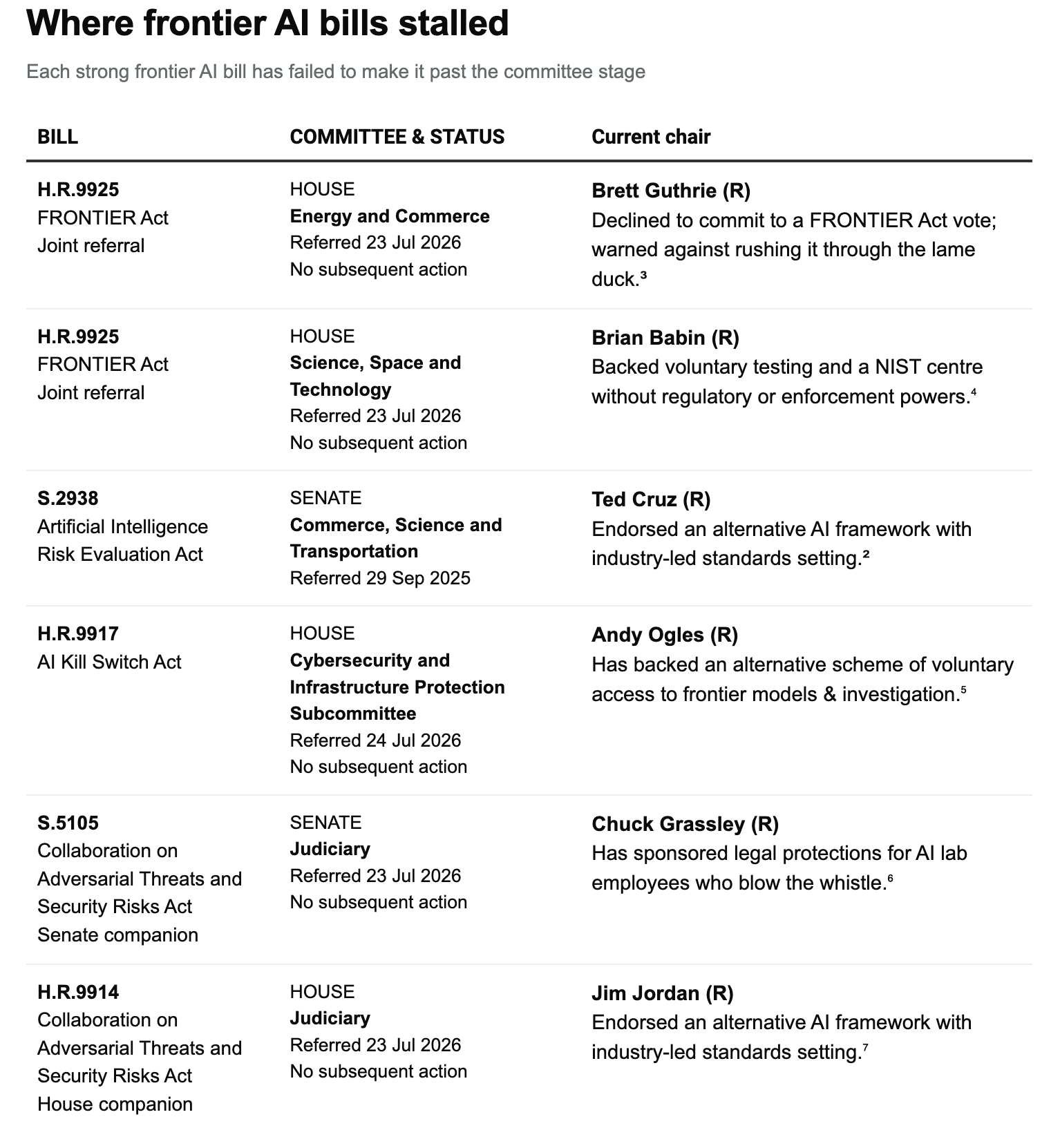
interactive table for where frontier AI bills stalled on Datawrapper
Current Progress With Frontier AI Bills
Strong Frontier AI bills have been advocated for by organisations such as the Foundation for American Innovation (FAI) and the Institute for AI Policy and Strategy. (IAPS) These bills are ‘strong’ in the sense that they transfer substantial monitoring, verification, and safety standards responsibility to the federal government. This reduces frontier labs' ability to self-develop and, potentially, empowers federal agencies to independently halt model development.
For example, the latest FRONTIER bill features independent verification & audits, transparency & incident reporting and a ‘kill switch’ for potentially dangerous AI models.
These powerful proposed mechanisms for the federal government have been met with scepticism from many libertarian-leaning tendencies of the Republican Party, stalling the process early on with committee chairs.
The U.S. congressional system requires bills to pass dedicated committees. With their respective chairs able to dictate how committee time is spent, scepticism about the usage of federal authority in private AI development has become the immediate blocker to frontier AI bills.
Four frontier AI bills introduced into the last two-year Congress session have been stalled at the committee stage. Republican chairs have instead expressed a preference that AI safety concerns be addressed through industry-led, voluntary regulatory architectures.
These industry-led approaches have been rejected so far by the likes of FAI & IAPS as insufficiently comprehensive in addressing the risks posed by powerful AI.
Once the new Congress starts in January with the mid-term’s blue wave, Democrats will take control of committee chair positions. Of the six Democrats likely to replace the committee chairs of frontier AI bills, three have already expressed strong support for mandated federal oversight. Maria Cantwell (D) - the presumptive Senate Commerce chair - is a key indicator of progress on frontier bills. Ahead of the midterms, Cantwell outlined her AI legislative framework, with a promising focus on catastrophic risks.
The Senate Commerce chair's remit is wide-reaching, concerning itself with business amongst States & technology policy. It's likely that any future bill will go through her committee.
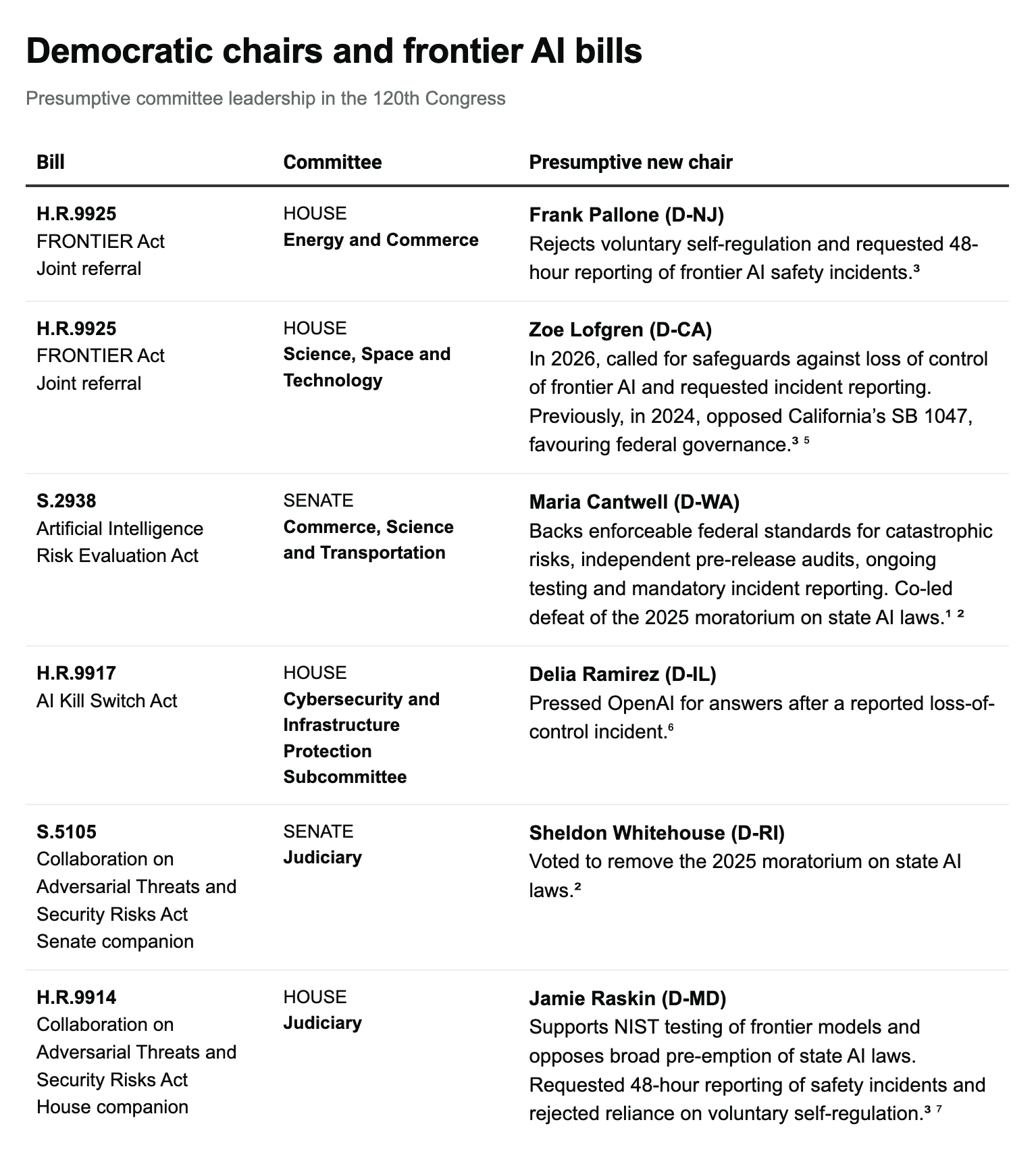
interactive table for Democratic chairs and frontier AI bills on Datawrapper
Remaining blockers
Looking ahead, regulating catastrophic risk from frontier AI will remain a political football. It's unclear how much Democrats will prioritise it relative to other policy areas.
In particular, many Democrats will be focusing on defining the party’s identity and core messages: ‘affordability ’ and restoring ‘public trust’. How AI risks are prioritised over the next two years is yet to be seen. Democrats will especially be looking for their next political leader to set the agenda as the presidential primaries start next summer.
Outside the party, the Democrats will need to continue passing AI safety legislation with the influence of other stakeholders. A coalition of four Republican Senators is needed to pass bills, given the Senate’s filibuster mechanism.
A bigger challenge is the current executive, whose approval is usually needed for bills to be enacted into law. The White House has expressed strong opposition to federal legislative oversight of private AI labs.
Congress has two options to override a veto, neither of which is particularly preferable. A two-thirds majority in both chambers to override a presidential veto appears improbable. The alternative option of passing frontier AI clauses into the National Defence Authorisation Act (NDAA) would likely water down its provisions. The NDAA is a ‘must-pass’ bill for the President, as it authorises the standing army for the Department of Defense and such, and is unlikely to be vetoed. Frontier AI clauses would likely be among many interests vying to be included in the NDAA.
Negotiations with the executive to avoid a veto are the only other alternative, with substantial change in political will from the White House, though some already seem to be working on it.
What Does New Committee Chairs Mean?
The senior Republicans currently chairing Committee positions have made Congress a non-actor for frontier AI bills over the last two years.
This is despite a number of Republican congressmen sponsoring strong AI regulation, most notably Sen. Hawley. (R).
The Democratic mid-term wave has unblocked the most immediate major blocker for current frontier AI legislative progress. While substantial, there’s more work ahead. The White House's cooperation is still needed, and the Democrats are prioritising the issue amid a busy Congressional session. If Congress passes something in the next two years, the midterms will almost certainly be one of several key pivots.
Want future takes on the AI policy football? Follow me on X.
Email me at writingrequests [at symbol] proton dot me