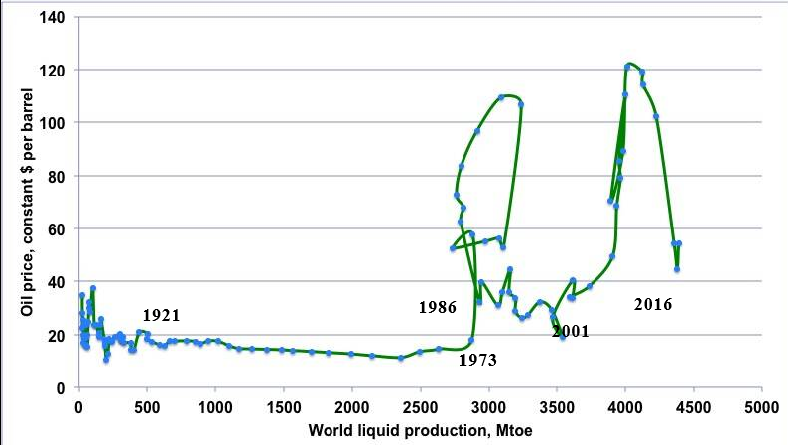
I think a deeper look at several of these points shows that it's not as bad as it seems.
1) It is already quite possible to make solar cells and batteries without any particularly rare metals [1], and some solar cells can be constructed either from films with active areas only nanometers thick (meaning only a few million tons are required to coat the world in them) or entirely out of organic components [2]. Similarly, while the most commercially viable batteries at present may involve somewhat scarce metals like lithium, it's possible to make them out of most substances, including iron, which is the 4th most abundant element on earth, as well as storing energy in compressed air or capturing hydrogen from water. When materials get scarce, technology is directed to solve these problems; there is not a physics-based limit on human energy consumption at anything near our current level.
2) Energy use per person has been falling in many developed nations for some time as GDP per capita rises, and energy use per person globally has not been rising that fast (about 12% over the last 4 decades) [3], whereas GDP per capita at PPP has > doubled. So, assuming that population stagnates as currently predicted and computational advances continue to deliver about as many efficiency savings as they cost in energy, I see no reason to assume an ever-increasing energy requirement. Obviously an AI explosion could unsettle this, but is not inevitable. The flipside of this, as you comment yourself, is that stagnant energy supply places some sort of limit on the development rate of AI in its current architecture, although historically energy requirements for compute have halved every few years, so not necessarily a very strong limit. As compute takes over more of the economy, it's even possible to argue that we expect the energy requirements of many sectors of it to decrease at this rate.
3) How exactly one transitions to largely renewable (carbon-neutral) future is an extensive area of research, but it is safe to say that there are a huge variety of plausible ways to do this, many of them allowing for moderate growth in total energy use. For instance, here is total energy use under the IPCC IMP emissions scenarios, all constructed by different socioeconomic modellers and but the first two leading to under 2C of warming [4 and figure below].

[2] https://onlinelibrary.wiley.com/doi/full/10.1002/ente.201402153
[3]
[4] https://www.ipcc.ch/report/ar6/wg3/downloads/report/IPCC_AR6_WGIII_Chapter_03.pdf
Hi! Thanks for taking the time to answer. Did you look at the full version? It should provide an answer to the points you are making (this here is just a summary without much data). I really tried to do a deeper dive there.
[1] https://www.fortunebusinessinsights.com/industry-reports/organic-solar-cell-market-101555
[2] https://www.alliedmarketresearch.com/thin-film-solar-cell-market
[3] https://www.volvotrucks.com/en-en/trucks/alternative-fuels/electric-trucks.html
[4] https://cen.acs.org/environment/green-chemistry/steel-hydrogen-low-co2-startups/99/i22
[5] https://newatlas.com/aircraft/airbus-a380-biofuel-first-flight/
[6] https://yearbook.enerdata.net/total-energy/world-energy-intensity-gdp-data.html
[7] https://www.nowpublishers.com/article/Details/IRERE-0121
[8] https://link.springer.com/article/10.1007/s41247-021-00090-x
[9] https://www.cnbc.com/2021/11/17/samsung-panasonic-and-tesla-embracing-cobalt-free-batteries-.html
These are very good points you're making, thanks for the thoughtful answer.
I think we're getting closer to an agreement. I would be more tempted if your thesis were "energy will become much more expensive at some times of day/year, as will certain minerals, and this will depress GDP compared to naive expectations." It's not obvious to me that low energy storage does more than require heavy industry to relocate to more consistent climes and/or stop for a few days each year, which would depress GDP but hardly to the level of existential threat.
[1] https://www.sciencedirect.com/science/article/pii/S0306261922002501#b0170 for hydrogen, https://www.pik-potsdam.de/en/institute/departments/activities/land-use-modelling/magpie for land use models
Yes, we may get closer to an agreement on several points. My thesis is close to how you formulated it, although it's more of "I think energy will get more and more expensive overall [or at least less affordable], and it should reduce overall GDP for a long period".
The issue of storage is not just that energy will be less available at time of the year, it's that there is a serious risk of blackout and/or the grid straight up crashing down (but we'd go for blackouts first). Blackouts would impact many things that depend on electricity: communications, refrigeration, ATMs, hospitals, most factories and microchips production... Relocation is possible but 1/ Relocating entire industries takes time, and costs money and energy 2/ Living in remote sunny locations (where few people are) needs a good transport system (for food and water) - and these are areas most exposed to climate change.
Getting closer, anyway. Maybe we will have to
We already know how to solve the blackouts problem via dedicated generation (or storage) for high-impact sectors. In a renewable economy, very large amounts of energy are available very cheaply at certain times, so for instance a factory with a 1-day battery that can produce at night before sunny days is able to work nearly as efficiently as they do now. You aren't actually relocating very much of the economy (only very heavy industry) and this constantly relocates towards incidentally-sunnier countries anyway for labor-cost reasons.
Then again, thanks for these points, it's interesting to exchange with you.
For storage, I agree that what you describe could be an option if batteries continue to get much cheaper and better. However, getting 1 night of batteries for factories would still be more energy-costly compared to what we do today (because of 60%-80% round-trip efficiency, the need for building overcapacity, additional mineral extraction, and the energy cost making batteries). So we'd have to use more energy to do the same thing. I agree that the "net energy we get back" would still be net positive, but the reason I mention the energy cost of green technology is because of the EROI (Energy Returned on Energy Invested), that has to be high (10-12) to sustain a complex civilization.
Yes, I think our exchange has been fruitful and thought-provoking.
Battery-wise: I think this is why I focus on energy cost variability rather than absolute energy cost, energy may well have a negative cost at some times but very large at others. The analyses of the effects of these are different.
Civilisation requires a large energy surplus, but I don't see any reason to assume that the EROI specifically needs to be any value above 1. If I change the unit of the solar cell (let's say EROI 10) to a solar-powered solar cell factory (EROI = 100 because the first 10x is all reinvested) then that same physical system suddenly passes your test. I don't see what research you were citing here in the first place, but suspect it still suffers this problem.
I'm curious, what would make you consider an option "we do not manage to do an energy transition" as a possible scenario?
For the EROI, this is more complicated than that (which I why I didn't talked much about it in the main post). I have written two section on it in the additional doc: why what matters for societies is the "energy surplus" and "what is the minimal EROI of society" (I just updated it to explain why you need 3:1 for transportation). But a basic answer is that your argument would work if you could make an infinite supply of solar panels. However, there are limits in the number of panels we can do: number of workers available, financial investment, number of adequate locations at a cheap enough price, materials for the panels and batteries, money that can be invested to expand the electric grid... So the panels we do make in these limited quantities must be good enough to power the rest of society - or it would be barely worth the investement.
PS: I just came across you April post - loved it! I really had a good laugh here :)
Three scenarios where we do not make a green transition:
Firstly, we are structurally prevented by government forces, for instance, in many countries there is difficulty in obtaining planning permission to get renewables in place, or have perverse tax incentives (gas cheaper than electricity for instance) that make the transition difficult. Both of these are currently happening in the UK, but not enough to resist the pull of renewables completely!
Secondly, energy demand takes off so quickly (perhaps due to AI) that we expand green power without reducing FF, until the sort of problem you indicate occurs.
Third, something disrupts the global supply chain that renewables currently depend on.
However all of these seem likely to be self-limiting because if the situation really got that pressing, you'd assume governments and society would adapt to fix them unless there's a bad actor or civilizational collapse.
Yes, I agree there are practical problems with basing society on 1.1 EROI solar cells. A lot of this discussion is really "how can we work out the actual EROI from the quoted EROI only looking at a bit of the system". Infrastructural costs should definitely be included in these analyses, however I think they're also quite hard to estimate because you need to know how long your infrastructure will last both from degradation and from being made irrelevant.
Thanks!
Sorry for the long wait! I was on a vacation. The points you put forward are important, if think all three scenarios you point out could happen, especially combined. To rephrase what you said, there are:
"However all of these seem likely to be self-limiting because if the situation really got that pressing, you'd assume governments and society would adapt to fix them unless there's a bad actor or civilizational collapse"
I think this is where we have probably a different view on things. "Fixing the situation" requires several components, some of them being international cooperation for trade and goods, trust in the future (for investment) and a long-term vision (for making the right technological choices). These elements are in decline, at least in the US or Europe. Not for China though, as you said, but I'd argue it is an outlier.
If, say, France had to transition in a hurry toward renewables within the next 10 years, it would be entirely dependent of China, on which >80% of the solar panels manufacturing depends. Or on Chile or Australia for copper or lithium. It doesn't have the resources to do that locally. Building locally a lot of infrastructure requires a lot of money and competent workers - and these limits are already slowing down the buildup and maintenance of French nuclear plants. Acquiring the resources abroad relies on a working banking system, Euro not being devaluated, and China not deciding to greatly increase the prices of metals or windmills. We can assume none of this will happen, of course, but this is a real risk.
For EROI, I agree that I'd really like calculations of the "actual EROI", encompassing all the societal and polotical structures required for extracting energy, and taking all the infrastructure into account. As you said, it's devilishly hard to calculate.
In the meantime, what I'm basing myself on is that most of the past societies had quite a high EROI (>10), including hunter-gatherers and agrarian societies (source, page 42). This surplus would allow for the many things a society needs (taking care of children and the ederly, providing for non-productive elites and administration and armies). So it's uncertain we can really go below that, especially as we are a much more complex society.
Even if we disagree on the possibility of a continued energy descent, I think we can agree that an energy transition, especially sudden, would have a wide range of political, social, economic and geopolitical consequences. The continuation of "business as usual" is rather uncertain under these prospects, and I think this neglected by forecasters and EA models of the future.
Yes, I've also been busy and I think the conversation is getting hard to follow and delivering diminishing returns. But to address a few points:
I think we are mostly in agreement that these scenarios are both bad and plausible, but disagree about the badness and plausibility. However on the second point, the paper you quote is simply not providing enough evidence of its point. Potentially 40 or so years of constant consumption would pass this test, but you should not assume that consumption of energy or resources is constant per GDP, as it simply hasn't been in recent history. The growth in energy consumption the last few decades seems to have been linear rather than exponenetial, but forcing it into exponential form gives an average 1.7% average growth this century https://ourworldindata.org/grapher/global-energy-substitution. Material consumption of, e.g. cement seems to have flatlined recently (as it is mostly done in China), and is also not exponential for any real stretch of time https://www.bbc.com/news/science-environment-46455844.
I don't know very much about supply chain disruption, but I definitely don't feel you've demonstrated that they can persist for many years. There's quite a strong financial incentive to sort them out and most of the disruptions I can think of seem either based on sanctions or to resolve in around a year. I'd be interested to see any historic examples you have. My historic counter-example would be guano, a slowly-renewing natural resource that was required agriculturally and at risk of depletion, but saved by the invention of the Haber process https://www.atlasobscura.com/articles/when-the-western-world-ran-on-guano.
While I agree that France would struggle to go renewable all on its own, I am sure it can go renewable without the aid of any single other continent, given the diverse range of ways of building renewables. I don't really see a situation where Europe would be cut off from all continents even if perhaps a few countries would put up trade barriers. As we see with oil from Russia going to India now, every time you impose a trade barrier, the price of the goods shifts and to tempt other countries to participate in trade.
Analyses of the cost comparison of electric trucks are still crude, but do exist already. The possibly-biased-electric ICCT concludes that in many European cities we may be at price parity (due to existing subsidies) under reasonable assumptions about electricity and diesel prices https://theicct.org/wp-content/uploads/2022/06/tco-battery-diesel-delivery-trucks-jun2022.pdf. While battery swapping isn't yet a thing, it probably will be soon for large trucking firms, which eliminates the charging problem. I don't understand why the lidar data needs to be stored, most of the work can be done locally and you can overwrite it minute-by-minute, can't you?
I don't really know what to think about this banking problem, it feels like it can be treaded as a separate issue to the materials problem in a digital economy though.
I think the result shows the Cherp paper is over-keen to lock in often temporary bottlenecks. This doesn't mean that growth will never slow, but casts significant doubt on our ability to predict it. It's worth separating out actual generation (weather-dependent) from capacity with wind, which has still risen by 2.5% for the last two years https://www.statista.com/statistics/421797/tracking-wind-power-in-germany/. That isn't great but is hardly stagnation! Solar has been doing better and it looks like it will be up more this year https://www.pv-magazine.com/2022/08/01/germany-deployed-3-2-gw-of-pv-in-first-half-of-2022/.
I think the emerging technologies (electric trucks etc) have extremely high (but variable) growth rates because they have such low current penetration. But the combination means that we can't estimate the long-term trends very well. Cherp's technique, quite wisely, doesn't even try.
I fundamentally don't think that the energy economics of a solarpunk post-scarcity future will necessarily have much in common with pre-agrarian society. We are not primarily talking about the EROI of food production here, which would dominate this consideration.
We do indeed agree on your final points. I definitely don't look towards a business-as-usual future! More work developing other futures is very valuable. I just think it's important to be clear when you're discussing a worst-case scenario verses a likely scenario, and to realise that society has a lot of self-repair mechanisms that toy models miss out.
Oh, great to hear from you ! How have you been doing ?
Here are my answers to these points. I must admit that yeah, we have a different view on things - which is good as I learn a lot of stuff -, but I feel like I could explain better the extent of our predicament.
I have found this podcast episode which should explain why I am still worried about all of that, and deeply worried. Now, it has exagerations on a number of points, and some of the data isn't the most recent, I absolutely agree, but damn, overall I really have trouble seeing how to solve all the issues she points out.
Now for the individual points:
Thanks for pointing out the limits in Cherp et al. It's useful to know that, energy production is still going up to some extent - not fast enough, but still up.
Energy consumption going up. You are right that we probably won't consume as much energy and materials in the next ∼30 years as we did in the past 10,000 - that was indeed an exageration, sorry. But the overall amount of energy consumed is still going up, which is a problem.
For me, the risk of supply chains breaking down isn't that it lasts for several years. It's that such a breakdown would itself have terrible consequences even for a short period - and transforming deeply society.
The examples I have are Cuba and North Korea, following the collapse of the Soviet Union, where half the oil supply was suddenly being cut, with different results I detail in post 2 (and hundreds of thousands dead in North Korea). But compared to rich countries, these two still had a much higher share of the population doing some kind of farming and food production, and were more autonomous for basic needs. So our current situation, with most of the population in Europe and North America being incapable of providing their own needs and depending on continuous long-distance transportation, is rather unprecedented.
Although there are other examples of collapse in the world, like Lebanon, Syria, Venezuela, or more recently Sri Lanka. So I wouldn't rule that out.
I have similar worries about the banking problem, because it's one pathway to supply chain disruption (and I don't see it as a really separate issue, given the strong relationship between energy and economic growth). By itself it is worrying.
I am not saying all of that is unavoidable. I don't think it is, because as you said there are self-repair mechanisms that could be able to avoid the worst outcomes in many regions. But the possibility is, in my eyes, likely enough to warrant building some lifeboats, just in case.
I've been quite stressed, for reasons other than lack of materials! How about you?
I'm not particularly impressed by the podcast. It seems to lack any imagination in working out how to decarbonise the construction of renewable energy itself, which is not generally regarded as a fundamental problem (as opposed to being slightly expensive to transition).
I encountered this twitter thread which I think explains better than I did why EROI isn't that useful: https://mobile.twitter.com/AukeHoekstra/status/1341730308060831744
Exponential energy consumption increase cannot be delivered for long, by any means. But renewable power can easily sustain a doubling of current power consumption.
We have a diesel crunch at the moment in Europe, meaning we are eating into our stockpiles, however all countries still have more than 61 days of consumption or import stockpiled, so considerably more than a week! Some states are less than the 90 days of imports required though. We would see factories shut down due to cost long before we started killing off food transport, so in practice this would last longer.
Agree that the rollout of electric vehicles will be expensive and will take time. But I hope that we will also reduce the number of cars required by carsharing, which autonomous vehicles makes easier. As we transition to renewable power, the prices of fossil fuels stabilises as demand is reduced. This makes greening harder, but diffuses the problem you foresee with food distribution.
5Tb an hour of data doesn't seem like that much, particularly after Moore's law kicks in! A fully renewable grid well realistically require some fossil backup for the next few decades while we get hydrogen sorted. However there price of this should also stabilise, as above.
I guess I'm unclear what the lifeboats you suggest are. I agree that on the margin more people should stockpile food, and possibly more in general. I don't know that it's true that stockpiling, say, copper or lithium is likely to be a wise investment: probably the market is already aware of the needs for these in the future, and to make an appreciable price signal to mine more would be very expensive. There are government stockpiles of quite a few things in developed nations; while developing nations should also stockpile more I am an ideal world, it's not clear how high a priority that is compared to tackling current, definite problems.
Ah, sorry to hear you've been stressed. The FTX debacle doesn't arrange things (I myself have a 6-months in indefinite hold because of that).
I'm not particularly impressed by the podcast. It seems to lack any imagination in working out how to decarbonise the construction of renewable energy itself, which is not generally regarded as a fundamental problem (as opposed to being slightly expensive to transition).
I'm kind of disappointed that you handwave all the information in this podcast with a "lack of imagination".
I feel a bit like if I'd been told "don't worry, everything will sort itself out". Well, what if it doesn't ? I'm not asking for a scenario in which everything turns to be fine because this or this technology exists. I know it's a possibility. I'm wondering if things will really turn out that way.
I read the book Life after fossil fuels and it felt to me that she really tried to take a look at the solutions proposed, in more depth than almost anyone I've seen. Anything you can think of is probably on her website Energy skeptic, but it's more of a mess (and of course, pessimistic, but that shouldn't come as a surprise).
But even if we somehow find a solution to replace almost all our fossil-based industrial system by something powered by intermittent electricity (the biggest 'if' in any sentence), I am still worrying over several points :
Time constraints
Question 1 : How long do you think it will take to do the switch from <1% to 70% renewable, for these infrastructure I talked about ?
Question 2: In the meantime, wouldn't these constraints risk putting a limit on economic growth for quite an extended period ?
About your other points:
I'm sorry your situation has deteriorated from the FTX scandal, that must be very difficult. A lot of people have it much worse than me!
I don't see this as an argument between "everything will turn out fine" and "things will end badly", but "things will go badly for very specific reasons to do with materials accessibility" and "materials accessibility is not the limiting factor". I consider something a lack of imagination where every aspect of the solution exists, but for cost reasons we don't currently combine them in most supply chains. Entirely electrified car factories already exist https://www.hyundai.news/eu/articles/press-releases/gone-green-hyundais-first-factory-powered-by-100-percent-renewable-energy.html. I haven't read Alice Friedmann's book, but her website seems replete with the time-lacking EROI error that we discussed above, as well as an inability to see that our current production chain is not the only way we can go about manufacturing things (for instance, there are plenty of sulfur sources appart from oil, it's just we currently exploit a byproduct of oil manufacture). I think I'm still waiting for historic examples where a material shortage has resulted in anything more than temporary economic slowdown and protests against corrupt regimes. The gilet jaunes protests are the closest I can think of, which hasn't come close to civilisation-threatening. Maybe if there were a clearer pipeline from this to fascism.
Coal is a plentiful resource, and in the worst-case energy crunch, would be used as a substitute for oil and gas. We see some of this happening in electricity in Europe at the moment. You can make a near-kerosene product out of coal, which with some lubricating materials should be adaptable for diesel use in extremis https://www.technologyreview.com/2006/04/19/39349/clean-diesel-from-coal/. This would be environmentally devastating and somewhat expensive, but not really more civilisation-threatening than climate change in general. The general point, that models need to account for a huge range of ways we can substitute one material for another, is the fundamental weakness of this argument.
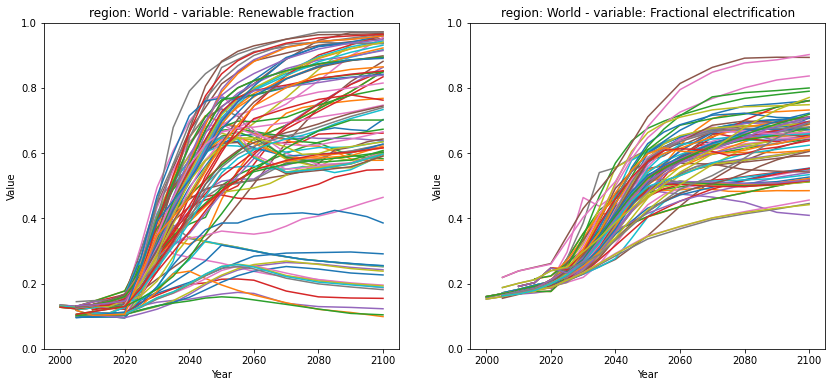
q1) There are an number of studies showing that replacing the a very large fraction of the grid with variable energy is achievable with current technology, some are summarised in this metastudy https://www.nature.com/articles/s41560-020-00695-4. Notably all of these studies suggest a lower cost than the current wholesale cost of electricity in Europe! The pace at which this can be done is a normal subject for the IAMs that you so distrust, which at least in some models is done before 2050, though it's very inconsistent - many scenarios aiming for 1.5C that never reach 70% electrification. They usually reach more than 70% renewable though, soon after 2040. I may have mislead you above with my focus on electrification; several areas of society are projected to remain liquid-based (if biofuel/hydrogen) for some time in a lot of IAMs, though I'm personally skeptical about this. I've plotted the fraction of energy from renewable sources and the fraction of energy use from electricity in the AR6 database of scenarios classified as C1 (low overshoot of 1.5C) below.
The question normally is whether society will accept the costs of bringing about change at the necessary speed, but since in your scenarios the cost of FFs is much higher than most IAMs assume, the answer is basically "yes, though not through free choice". The fact that we restrict FF use because of lack of availability rather than a carbon tax shouldn't make a big difference to the difficulty of decarbonising.
q2) Yes, I think a lower rate of growth is likely than in an ideal world without material/oil constraints. But it's not clear that growth is negative, nor that slower growth, particularly in developed nations, is that bad. Would high resource costs trigger civilizational collapse? Even with higher fuel prices, the declining fraction of wealth spent on food has a ways to go before we reach anything comparable to, say, the 1950s, so I find it hard to see a mechanism for anything dramatic. While energy is used in making food, it's not the dominant factor, and over long time periods we see the correlation between oil price and food price is not that strong https://ourworldindata.org/food-prices. Economically unfortunate, sure, but not an extinction risk.
Other than specific problems with lithium and copper, it's not clear to me that we have a problem with total material lack, simply that we don't recycle enough or make use of agricultural waste. More effort would go towards plastic recycling if the price point of oil were higher. Similarly there is a plentiful supply of plant-food minerals that are currently pumped from rocks to our faeces to the sea.
Backups to provide food in the event of a protracted energy crash is an interesting question. As above, I don't expect anything like a 1:1 relation from the cost of energy, but in combination with climate variability and geopolitical factors it's possible to envisage a real crunch on availability. I feel like the solutions are very dependent on how long we want to do this for and what fraction of the world needs to be sustained this way. But the discussion of various forms of permaculture and nutrient-recycling, while interesting, should probably be handled elsewhere (and by people who know more about it than I do). Generally, working on better recycling does seem like an under-utilised EA cause area that would solve a number of these problems, and is probably cheaper to begin sooner rather than later. I don't think I need to agree with very many of your above points to agree with this as the process is energy-saving and also protects the environment/enables more agriculture by avoiding mining.
You may be glad to note that on several occasions when writing my responses I have had cause to exclaim "he's less wrong than I thought!" I think this is all anyone can really ask for in an internet argument.
Hi !
It's a period with a lot of uncertainties but don't worry, I can manage. Many people have it worse, indeed, and are more in need of help.
I am working on a post (well, probably in several parts) that aims to address the usual counterpoints to the problem of energy depletion: https://docs.google.com/document/d/1l-VI5gR-xGaUL95tvNgZ_BsXFB-aUQOtlug9zC-sn3M/edit#
Since you are good at challenging my position, maybe you could find some mistakes that would help improve the post. I talk about substitution and coal and transition scenarios and and whether adaptation is possible.
"I consider something a lack of imagination where every aspect of the solution exists, but for cost reasons we don't currently combine them in most supply chains."
For me, the core issue is scale. Every individual aspect of the solution might exist, and can work in a small system, but does that mean it can scale up to what our industrial society requires? Or worse, to the ever-increasing requirements of economic growth?
There are other ways of manufacturing things, yes. But there are also constraints of time and investment: right now, for materials this is the main constraint, since a mine takes on average 16 years to go from exploration to production. Several organizations, like the World Bank, the IEA, the IMF, McKinsey and Company and Eurometaux have all issued reports warning of this growing problem.
" Entirely electrified car factories already exist"
Ah, I had not seen that, good point. Plus, they seemed to have done a lot of efficiency.
Does the materials that are used in the factory (metals, plastics) have been produced with renewables as well ? I haven't seen that info in the article.
"I think I'm still waiting for historic examples where a material shortage has resulted in anything more than temporary economic slowdown and protests against corrupt regimes. The gilet jaunes protests are the closest I can think of, which hasn't come close to civilisation-threatening. Maybe if there were a clearer pipeline from this to fascism."
It's hard to pinpoint for historical examples at the global level, since a feature of our current civilization is interconnectedness. Every time a material shortage arised somewhere, it was possible to compensate with the production somewhere else (especially for oil). This means that in the last 70 years we haven't really tested yet a situation where oil is lacking everywhere, over an extended period.
Still, there are some analysts asserting that oil depletion in Syria and Venezuela were a serious factor in the collapse of these states. Of course, the economy of these states was highly reliant on oil, so a peak had more of a local impact. But I suppose one could make the case that our global economy is also extremely dependent on oil and fossil fuels at large, given the tight relationship between energy and GDP, so the analogy would hold out.
As for a pipeline to fascism, it seems pretty straightforward: declining revenues, rising inequalities (as is happening right now as well), loss of trust in institutions, increasing polarization (boosted by mass media and social networks)…
A crucial factor would be rising food prices, especially, as you said, since geopolitcial factors and climate change would weigh in. The Our World in data article is interesting and shows there's some margin - but it seems to leave out natural gas. Maximo Torero, chief economist of the UN FAO, told Bloomberg TV that unaffordable fertilizer prices (due to soaring natural gas prices) could reduce global grain production by up to 40% in the next planting season.
"The fact that we restrict FF use because of lack of availability rather than a carbon tax shouldn't make a big difference to the difficulty of decarbonising."
Well, the big difference is that the transition should take place at a moment where the energy required to build and transport windmills and solar panels would be much more expensive, and the economic system would be in a crisis meaning a lot more volatility.
"Yes, I think a lower rate of growth is likely than in an ideal world without material/oil constraints."
I wouldn't think that our current focus on growth is "ideal" - since it doesn't add much happiness beyond a certain threshold and goes hand in hand with environmental degradation. I definitely think that it's possible to live well with less energy, especially in rich countries where, and that we should have aimed for a reasonable level of consumption. As you said, there's some margin before getting to threatening food prices (then again, rich countries) - which is why I'm more worried by sudden interruptions there.
"But it's not clear that growth is negative, nor that slower growth, particularly in developed nations, is that bad. Would high resource costs trigger civilizational collapse?"
This is the reason I'm worried: high resource costs would, in all likelihood, mean a decline in economic growth. However, our entire economic system depends on the economy growing, and I fear an unplanned degrowth can go pretty poorly.
Our complex economy is based on investment. The reason people invest is that they think that they will be getting more in the future, not less - and this requires growth. If the economy declines, why invest if there's less trust that you'll profit from that?
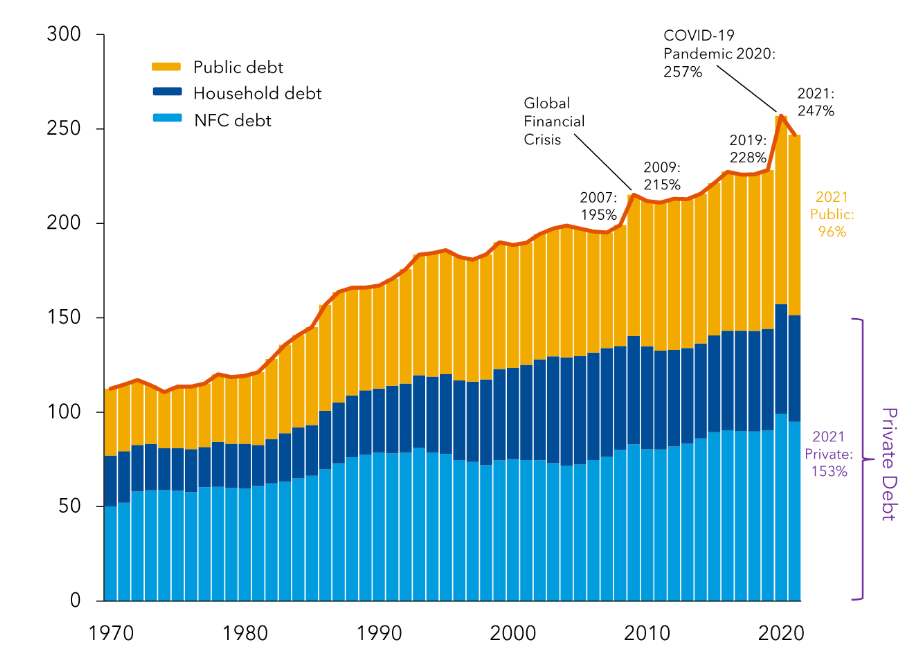
Debt is doubling every 7-8 years, while the economy doubles every 20-25 years. This is unsustainable, and at some point this will to a realization that a large part of our debt will not be repaid - especially if there is a recession. This will inevitably lead to a "correction" - the form of which is unsure. One scenario could be a "run on the bank", which could by itself lead to a massive economic crisis, the bankruptcy of many actors, and big supply chain disruption.
Of course, there's no guarantee things will end up this way, but it's a possible pathway. The economy has gotten back from milder shocks, but the strength of future economic shocks is expected to get bigger and bigger in the future (especially if we add environmental damage ), so we can't assume everything will sort itself out.
This would lead to questions for which there's no clear answer (as said in Post 2). In the past, there was a feedback loop with more growth leading to more energy extraction leading to more growth: what happens if this goes into reverse? Will investment hold up for natural gas and oil extraction? If trust in the monetary system is lost, how will trade over countries take place? Will country with a monetary system? To pursue economic growth at all costs, won't some nations resort to wars over resources ?
Another problem is that the amount of interest would keep growing in the economy. In practice, it acts as a wealth pump, allowing loaners to get a larger and larger share of the economy unless the economy is growing. In this case, this would drive inequality (and social unrest) to unprecedented levels.
Moreover, our shared objective, as a society, is growth - having more purchasing power. If this stops being the case, what can replace this shared objective? Nationalism? Promoting your in-group at the expense of others? A focus on the local network of people that live around you?
This is why I think the end of economic growth is a big deal: it changes everything. There are of course scenarios where things end up being ok (well, depends for who) but there's no guarantee we'll end up in these scenarios - especially since this would lead us into the realm of "unthought futures", so different we have trouble imagining them.
"You may be glad to note that on several occasions when writing my responses I have had cause to exclaim "he's less wrong than I thought!" I think this is all anyone can really ask for in an internet argument. "
Glad you're thinking this way! I also find the exchange very interesting, and it lead me to change my position on several points. This is how I can progress, and I should thank you for that.
On your new document: I think I generally nod along to the peak oil and efficiency stuff. The renewables section is unconvincing, as you might imagine from our discussion above. You are right that there are a bunch of problems with IAMs making simplifications, but you don't demonstrate that any of the factors they are missing would seriously change the results of them. It's good to see that some of your arguments have grown more nuanced, but it also makes reviewing it more complicated and I don't really have the time to debug the report in detail. I'm somewhat (pleasantly?) surprised that at the end of this all you're suggesting that energy depletion might be good for reducing extinction risk though, I don't know to what extent that flips the whole of this conversation - maybe you are actually the optimistic one!
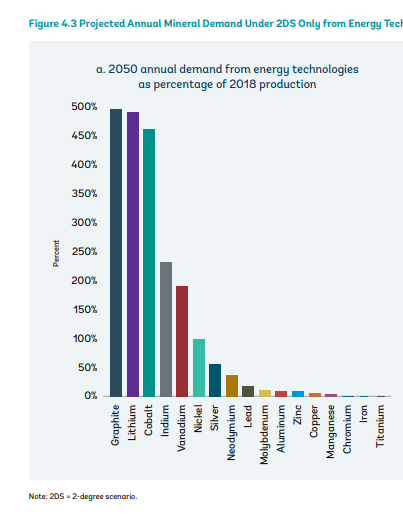
These studies show that mineral requirements for clean energy grow rapidly. But they don't show that the requirements are actually that high in most cases, as they state the ratios "for energy technology". Currently we don't use a lot of minerals in energy provision, so a quadrupling of that amount sounds dramatic but doesn't represent a particularly large global consumption increase. Quote from the IEA: "There is no shortage of resources. Economically viable reserves have been
growing despite continued production growth... However, declining ore quality poses multiple challenges for extraction and
processing costs, emissions and waste volumes." So the problem is still one of energy, rather than actual availability, which is why power is more important than minerals. So really the minerals question is still a renewables question.
Of the minerals shown here to require more than 100% of their current levels in 2050, only lithium would not be fairly easy to replace or produce for a small efficiency penalty (graphite is just carbon, indium is used in solar cells but can be replaced with graphene https://www.azonano.com/article.aspx?ArticleID=3942, cobalt & vanadium are used in batteries and and all have known substitutions). There's some good stuff in this twitter thread, although it doesn't have citations for everything it needs.

The historic examples you give are of the resource curse; societies becoming dependent on extracting commodities. I'm looking for examples of societies falling because they can't buy commodities. E.g. I might have expected the increase in guano price to have created a food shortage and thus civilisational collapse, but as far as I know we didn't see that; similarly, the rise in fertiliser prices you mention don't seem to have had a rise in fascism so far - indeed, the elections so far since the invasion started have gone better for the left than might be expected.
I reiterate that debt economics aren't my field, but I'm skeptical that they provide a barrier comparable to physics. There is clearly a secular trend towards rising debt, but I think you're overestimating it; this IMF graph of global debt-to-gdp only grows at 1%/year from 2000-2018. 
I feel like the majority of people I know don't really have personal finance growth as their primary objective in life, and I don't see how our society does either - it's almost an accident of economics at this point.
I hope that virtualisation and renewable power means we can happily all bring on the great stagnation!
Hi !
Thanks for the answer, sorry I didn't reply earlier. I started working on another project for EA France, aiming to identify impactful charities working in France, so I had much less time to spend on the topic of energy depletion. I didn't want to do a rushed answer, but didn't find the time to dig into the topic once again... you know how it goes.
So instead, I'll just publish an update on my thinking on the topic (while keeping in minf that I have found several important articles that I have to read).
So far, I've updated more positively on renewables - their improvement is indeed faster than just about anyone had anticipated (which makes papers obsolete as soon as they're a few years old, and therefore makes it very difficult to get properly informed on the subject).
Several articles I've read have indeed made me update on them. There were several elements where I had underestimated adaptability. The EROI of renewables is indeed correct.
I have a higher probability of an energy transition "from the top", where we maintain energy growth (which isn't necessarily good news, given that the more energy we have, the greater our capacity to destroy our environment and generate existential risks).
Your link about the Twitter thread exposing the limits to the GTK report was indeed interesting. I also found an article here that showed several other limits.
I'm talking less and less about a 2050 timeframe (which is what most of the litterature talks about). However, I'm more worried about what short-term disruptions could imply.
Indeed, my worries are more about the fact that limits on fossil fuels are probably short-term : and that time constraints could prove significant. Going from a system where almost all trucks, or cement making, or steel making, or fertilizers, or hydrogen, or plastics (etc.) are dependent on fossil fuels, to a system where >50% of these are not fossil... this is going to take time, and I'm worried about what would happen during this time.
Same goes for storage : batteries are improving... but it seems that we're a long way from the deployment speed required for seasonal storage in order to have a stabilized grid.
As a French Energy expert stated (prominent member of EDF) :
"The RTE report clearly shows that energy mixes with a high proportion of renewable energies can only be achieved with a very significant drop in consumption [...]. I admit that this reduction must be significant enough to involve much more than a simple technical improvement in process efficiency. Even so, why deprive ourselves of what at least makes it possible to reduce the pain, or even avoid widespread chaos?"
It's the "chaos" scenario that worries me.
I feel like the majority of people I know don't really have personal finance growth as their primary objective in life, and I don't see how our society does either - it's almost an accident of economics at this point.
It seems pretty clear to me that growth is the main goal of our society - and that it stopping would have far reaching consequences. As I said, a society where everyone's share of the pie is growing is very different than one where everybody is competing to secure access to declining resources - the degree of trust is not the same. Especially when some wealthy people in society have the ability to agregate more and more resources, as is currently happening.
The importance of financial growth is exemplified by the fact that "degrowthers" have besically no traction on a political level, despite clear evidence on their side of a strong correlation between environmental impact and growth.
The more I look at it, the more the global economy appears to be working like a Ponzi scheme - requring an ever growing amount of capital and energy and resources to keep everyone's trust in the fact that everyone's investments will be paid out later. At some point, it has to stop. The question is : how do you end a Ponzi scheme in a smooth way?
Still, the future is full of weird stuff, so we'll see. I've had less time to keep an eye on these subjects recently - I've got several interesting papers to look at (and I'll check your point on minerals and debt). I'll update then.
"So let’s imagine an EROI [for solar panels] of 2:1. That would mean that, to simplify, half of our society's resources go toward producing energy. Let's say this means that, roughly, 50% of people are working in the energy sector (directly or indirectly), which is already huge."
I'll probably finish reading/ skimming your longer document in a bit, but there is a clear mistake in this sentence, and I think if you consider it for long enough, you will realize it severely and perhaps fatally undercuts the entire argument you are making.
If solar panels had an EROI of 2 to 1, and all our energy came from solar panels, you then need to make two solar panels for every single one that you are using for net energy generation. This doubles the cost of using solar panels from what it would be with an infinite EROI, which doubles the amount of resources (excluding returns and costs of scale effects) required to make enough solar panels to run our civilization on. So if with infinite EROI you needed to make say 1 quadrillion kilowatt hours worth of solar panels to run your civilization, now you need to make 2 quadrillion kilowatt hours worth, since half of them will be used up in the process of making the rest.
The point is, this says nothing about whether 50 percent of society's resources are being used to make these solar panels, or 1 percent, because that depends on how hard it is to make solar panels.
If it is very easy to make and deploy solar panels, any positive rate of return on EROI is fine, while of it is extremely expensive and hard to make them, we can't transition even of the EROI is infinite.
I'm not sure I'm following through. What is infinite EROI? That would mean for every unit of energy invested, you get infinite EROI. That doesn't seem physically possible.
I'll try to reformulate, then. With an EROI of 2:1, that means that for every solar panel invested, I get 2 solar panels: one that will be used to provide electricity for society, another that will be used to make other solar panels. So yeah, for every solar panel that produces electricity, you need to build another solar panel. EROI 2:1 -> 50% of energy left for the rest. I think we agree on that so far.
(of course, this wouldn't work in the real world, since the payoff of solar panels takes 20 years, it's very long, while you need the energy to build the panel quickly. They also wouldn't provide the high heat required to smelt metals, without switching to hydrogen with an energy loss. And the EROI doesn't take into account making the infrastructure and providing the needs of workers: food, clothes, heat. But let's suppose this works this way.)
Why am I saying that 50% of the resources of society would be used for making solar panels? This is a huge simplification, of course, but this follows the section of the doc that adresses investment and EROI (quote here, but I advise starting from there):
A useful approximation I found is that when energy prices reach about 10%, a recession ensues. I feel this is the limit we should keep in mind for how high energy prices can go. This is close to Fizaine and Court 2016, who say that the US economy cannot afford to allocate more than 11% of its GDP to energy expenditures in order to have a positive growth rate. In other words, this is a societal EROI of 11:1 (society invests 1 unit of energy and receives 10 units left for the rest, which translates roughly to 10% of GDP going to energy).
This is the last sentence that makes me think that a global EROI of 2:1 means 50% of GDP going to energy (so about 50% of resources and workers).
Of course, these stats are mostly from fossil fuels, so if solar were easier to make, the relationship would change. I'd argue, however, that fossil fuels are on average easier to produce than solar - for instance, there are more jobs in the clean energy sector than in fossil fuels, despite renewables making a much smaller share of the total. They also need less resources - electric cars and batteries need much more metals.
So I think the overal simplification still stands. This is why I equate a 2:1 EROI as needing half of society's resources .
So you are doing useful work by identifying a serious potential problem and trying to get the rest of us to take it seriously. As a neural circuit in the global brain it is a good thing that the Peak Oil movement exists.
I'm not quite sure how to approach this because you are making a conceptual mistake with this argument and I want you to actually see what it is. And I think this is a case where there is a clear truth of the matter that we can both get to and agree on.
But since there was also an argument you had in the comments on your google doc with someone pointing out the same thing I am here, it is clear that there is something about this issue that is hard for your mind to jump to seeing. At the same time it is perhaps is a bit hard for me to explain it, since my mind immediately sees it intuitively.
First I am making a narrow point.
If my point is correct, it is still totally possible that peak oil is the correct model.
I am begging you, try to just pay attention to the point, and decide if you think it is correct, and only afterwards ask if it has any broader implications.
The purpose of my arguing here, is to help you improve your economic model on this single point, and not to change your broader point of view.
With that long preface, my simple point is this: The EROI is not enough to tell you what portion of civilization's real resources go to energy production. You need more information.
An EROI of 2:1 is not enough to tell you if the energy system requires 1 percent of GDP or 10 times the world's total GDP. You need more information than just the EROI.
I think you already know this, since you were trying to point at evidence from historical recessions and economic performance to figure out what the economic impact of changes in EROI would be, since just saying EROI of 2:1 does not actually say '50%', the 50% comes from using additional information to figure out the economic impact of that number.
To establish that EROI alone does not tell you anything about the percent of GDP that goes to it, I am now going to describe a fake, fictional, toy model of a world. This is not the real world. This is a model. But this sort of model is useful for understanding constraints that exist in the actual real world. Telling me that the extreme cases in this fake, fictional, not real world are in fact fake is not an argument against what I'm saying. What I am trying to establish is that we need at least three parameters to figure out what portion of real resources go to energy production.
EROI is only one of them . I am not saying anything about what the actual value of the other parameter is here, just that any positive EROI is consistent with any GDP % depending on what the other parameters are.
In the following argument, we are going to assume the stated EROI includes all energy costs that are physically necessary to produce energy producing equipment. So it includes the costs of roads, the machines to build the roads, the machines to maintain the roads, and the machines used to build the machines. Otherwise it isn't the actual EROI.
So to start, what we want to figure out is what part of GDP is required to produce electricity.
A start point could be this equation:
Cost of energy system = Amount of energy producing equipment required * resource cost to make each unit of energy producing equipment
Where does EROI come into the cost of the energy system? It isn't yet here. Let's try breaking down one of the terms:
Amount of energy producing equipment required = produced total energy / energy produced per unit of equipment.
A further break down of the equation
Produced total energy = Produced net energy + Produced waste energy
Now EROI is the ratio of total energy to waste energy (EROI = total energy/ total waste energy). So an EROI of 2:1 imples that for every two units of energy produced, there will be 1 unit of waste energy produced and one unit of net energy.
So inserting this into the equation after doing a bit of algebra to get rid of waste energy we get that:
1 = net energy/ total energy + 1/EROI = net energy/ total energy + 1/2 ==>
1/2 = net energy /total energy ==> total energy / 2 = net energy ==> 2*net energy = total energy.
So now that we've incorporated EROI into this term in the equation, we can go back to the orignal equation:
In the case of an EROI of 2 is:
Cost of energy system = 2* net energy produced / energy produced per unit of equipment * cost per unit of equipment.
What is the information that we do not have at this point?
We don't know how much net energy is produced -- that is still a parameter. We don't know how much equipment we need to make that amount of energy. And we don't know how much the equipment costs.
What we do know is that an EROI of 2 means that we need twice as many pieces of equipment as we would need with an obviously impossible infinite EROI (if EROI is infinite, then there is no waste energy term, so net energy = total energy). But that is all the EROI tells us.
This is the end of the section that I actually care about you understanding and agreeing with. The rest of it is arguing, not trying to correct a clear mistake. I do think it is interesting and relevant so I'll leave it.
I did some googling, and it seems that the total consumption of all sources of energy in the world is around 150 million gigawatt hours a year. Some other googling says that 370 watts of installed solar capacity in California or Arizona produces around 2.5 kilowatt hours of energy per day on average. Lets assume the average efficiency of solar panels is somewhat lower than that, and 370 watts installed will produce 2 kilowatt hours in the average location they are actually used.
So if we had an EROI of 2, to get 150 million gigawatt hours of energy per year, we'd need to produce a total of 300 million gigawatt hours of energy per year. This could then be done with 150,000 gigawatts of installed solar capacity. This would probably require 1/500 of the world's surface to be covered with solar panels. So now we know how much equipment is needed to replace the current global energy system with solar. Or one part of it at least, since there is also the storage systems and conversions systems.
Would doing this require 50 percent of the world's gdp?
The answer is: It still depends on how much the solar panels cost.
Currently it seems that utility scale solar has a price of around 1 dollar/ watt installed. At that price this would be a 150 trillion dollar investment, assume the panels only last twenty years on average, and you have this system costing 7.5 trillion usd a year to maintain. That is less than 10% of global GDP, and I seriously doubt that pumped hydro storage systems and the need to figure out some way to get high temperature metallurgy and jet fuel are going to get you a vastly highly levelized cost.
Suppose we run out of key metals, and the substitutes are equally expensive, and then the solar panels cost way more than they do now, and we end up having to use concentrated solar for 5x as much money as current photovoltaics (conentrated solar does not depend upon any exotic metals that there is any chance we will run low on, aluminum and steel are sufficient). Then this costs 5 dollars per watt, it turns into a 750 trillion investment, and costs thirty five trillion a year to maintain, and around 1/3 of global gdp -- that would be pretty bad.
Or we have way better general automation and techniques, the production cost curve continues to go down, and we have lots of cheap solar panels, and they only cost .20 cents per installed watt -- and then you have the whole thing accomplished for 30 trillion dollars, and the system globally doesn't take more money than the US defence department.
If solar panels end up at 100 dollars per watt due to resources running out, it would be impossible to support the current energy consumption with an investment of 100% of gdp. etc, etc.
All of this goes back to the point: You need to know the cost, not the EROI. If the cost is small, doubling it doesn't matter. If the cost is big, you already are in trouble before you double it.
But saying '50%' due to EROI of 2 is nonsense. EROI only increases or decreases the amount of resources needed to get a given amount of net energy, it doesn't tell you anything about what percent of society's total resources are needed to produce that amount of net energy.
I happen to chance upon this discussion while browsing around, and decided to create an account to reply to this discussion because it is a topic of great interest to me.
I think the main reaon why you believe that Corentin's argument on EROI affecting percent of GDP required to maintain energy production is a conceptual mistake, is because you have assumed that cost of production (of energy producing equipment) is not linked to energy use.
However, the basis of the EROI argument stems from biophysical economics, and is based on the key assumption that the vast majority of economic activity and economic value are in fact embodiement of energy. One may or may not choose to agree with this assumption, but if you do take this assumption to be true, then Corentin's point that for e.g. a 2:1 EROI needs roughly half of society's resources is correct.
So in the simple equation that you described:
let:
Then,
Because we assume that economic cost of production of anything is directly related to energy, then , where is some factor describing the economic cost in terms of energy.
Substituting it in the energy cost equation, we get
is exactly the definition of EROI of the energy producing equipment, and thus .
Furthermore, with the same key assumption, the total economic output, in other words GDP can be also be expressed in terms of total energy produced or demanded by the economy, i.e. .
We finally obtain that:
If the scaling factor and between economic cost and energy is roughly similar for the particular case of energy producing equipment, and for the general case across the whole economy, then EROI approximately determines the proportion of the cost of operating and maintaining the energy system against GDP.
The key assumption put forward by the biophysical economists has been argued both through first principles and empirically (well explored in this textbook of energy and biophysical economics[1]).
Hall, C. A., & Klitgaard, K. A. (2011). Energy and the Wealth of Nations. New York: Springer.
Thank you for this !
I had trouble putting this into mathematical terms, so this is helpful.
I'm trying to read more stuff about EROI in order to explain it better. It's a good concept but if we have a disagreement about how to use it, then it's really hard to agree on something.
I hope you managed to find some interesting stuff in this post ! Feel free to share it if you found it useful.
Thank you for your excellent posts summarizing multiple sources of information across domains of energy and material limits of human development, ecological economics etc. I am still reading through your in depth 3-parts works as I speak, and I am finding many useful sources of information for my further reading.
Hi, thanks for the thougful response. You spent quite some time to put things down clearly, and I appreciate that.
I think i can accept your conclusion, for the most part. Saying "a EROI of 2:1 means half your resources go to energy production" is indeed a big simplification on my part, which is based on several simplifications I have made and didn't detail :
These are indeed huge simplifications I made in my head, but I can get why you don't see them as valid. I unfortunately didn't really understand your algebra bit - I am not very good at reasoning with equations, it doesn't really "click" with the way my brain works. But I understand your overall point.
So ok, let's drop the assumption that a 2:1 EROI requires half of society's resources. I indeed don't really know the exact percentage. This wasn't really my main point, so I removed references to this assumption in the full doc.
However, what empirical data seems to indicate is that society still requires a high EROI to function. As said in another comment :
In the meantime, what I'm basing myself on is that most of the past societies had quite a high EROI (>10), including hunter-gatherers and agrarian societies (source, page 42). This surplus would allow for the many things a society needs (taking care of children and the ederly, providing for non-productive elites and administration and armies). So it's uncertain we can really go below that, especially as we are a much more complex society.
For instance, according to this paper, you'd need a minimum of a 3:1 EROI to have transportation, when you take into account its energy needs (making and maintaining roads and trucks). An even higher EROI would be required if we add the needs for food, education, administration, healthcare and stuff like that. I made some changes to the section on EROI in the full document The great energy descent - Full Version, including how the 3:1 measure was calculated, you may find that interesting.
Of course, it may be theoretically possible that a complex society can work out with a EROI<10 or less. I'm not saying it's cannot happen. I just think that it's risky to make this assumption, since the historical record seems to point out that having a high energy surplus was needed in most societies.
On your second section : I do find the calculations interesting. This is well structured.
However, estimating future prices is notoriously tricky. As you put forward, on the short term prices have been decreasing in a quite impressive way, so in this time scale, and for electricity, it should go down.
I could see many reasons, however, that prices will not do that forever, and solar panels could get less affordable in the future. For instance, your calculation does not include:
I personally do not attempt to calculate prices (as seen with oil prices, it's really hard), but it sounds likely to me that it will be more expensive than today. This doesn't mean solar is useless - it's just that I have trouble seeing how it can be cheap enough to support an "infinite growth" economy.
You may be interested on this paper:
https://www.sciencedirect.com/science/article/pii/S0301421513006447
It explores the question of whether EROI correlates with several quality of life metrics.
Section "5.1. The concept of minimum EROI" covers your debate with Corentin about what is the lowest EROI for a complex society.
It doesn't really defend the concept of minimum EROI as a thing that actually makes sense. My whole point is that minumum EROI of creating the seperate pieces of an energy system makes no concept.
A very bad EROI where the components are extremely cheap in terms of other resources is fine, a very high EROI where the components are extremely expensive in terms of other recources can't be used.
Imagine a completely automated robot that is building solar panels in space, and beaming the excess energy to earth. It doesn't matter to us right now if it used 1 (ie an EROI of 100 to 1) percent of the energy to maintain the system, or 99 percent (an EROI of 1.01 to 1), because it isn't using any terrestial resources.
On its own, minimum EROI is a nonsense phrase. It only makes sense once you've specified the whole technological package and environmental context.
You have an equation with multiple terms in it. EROI is only one term, and sufficiently large changes in the other terms can compensate for changes in EROI.
Oh, ok, I get a bit better what you're saying. (yeah, it's tough arguing on EROI, people usually have very different views on it).
I agree that the cost of unit equipement matters a lot too.
However, I'd argue that these costs are increasing when EROI is declining. The simple reason is that you need more stuff to do the same thing. This is not a 100% correlation of course, the cost of labor matters too, but there's a general trend, I think.
For oil with 50:1 EROI at the Ghawar field in Saudi Arabia, you just had to put a drill in place and get the oil. Shale oil, in the other hand, with an EROI between 5 and 10, requires complex chemical compounds, horizontal drilling, hundreds of trucks transporting water, and a lot of financial investment. If the EROI of shale oil was 50:1, then you'd get back 10 times more oil, so it'd be much cheaper, you'd need less materials, and you'd have more resources to power the rest of the economy.
Since there is a strong coupling between GDP and material use and resource use (at a global level), it would make sense that an increasing material and energetic cost translates to an increased financial cost.
There can be improvements of course - like solar panels getting a higher EROI and being much cheaper at the same time.
Now, let's take the automated robot that sent solar energy back to Earth (a purely theoretical prospect with not relevance to the problem of energy depletion as will exist for the next decades, of course). With an EROI of 1.01:1 instead of 100:1, then it would need to depoly 10 000 more solar panels for the same thing. You'd need 10 000 times more solar panels, so 10 000 more materials, more rockets, more robots to build these, more factories, more maintenance... Not talking about the fact that all the computing stuff would require specialty metals that are in a finite amount.
Also, the process would be 10 000 times longer, which is of great importance.
So I have a hard time seeing how this wouldn't multiply the price by at least several orders of magnitude.
The main point about EROI, and I don't think we disagree on this, is that the raw amount of produced energy that needs to be put in is only one factor. You also need to know how much human labor has to be put in, and how much physical stuff has to be put in.
I'd note a lot of the complaints here that in a bad EROI environment with needing to build more stuff, you are also running out of key metals is double counting. The reason that the EROI is 2 to 1 in that scenario, instead of 10 to 1 is because we've run out of the easy sources of those metals, so pointing out that the metals are also hard to acquire in that context doesn't say anything new.
"Since there is a strong coupling between GDP and material use and resource use (at a global level), it would make sense that an increasing material and energetic cost translates to an increased financial cost. "
I don't know if I really want to dig into this very deeply, since it involves a familiarity with economics that you clearly don't have, but theings like this claim, and the '99 percent correlation between energy use and gdp growth' simply do not mean what you think they mean.
For example, you might get a correlation that is nearly as strong between gdp growth and fast food purchases, or clothes purchases, or home improvement purchases, or almost anything except for medical and government spending.
That is what a recession literally is: It is when people buy less of stuff that can be cut back on easily. And booms are when people buy more of that stuff. You are going to find extremely high correlations between gdp growth and any variable consumption good if you are looking for that, but it is meaningless in terms of saying what is causally important for allowing continued economic growth.
In a similar way that recessions usually follow very high energy prices (which is causal), does not actually mean that the economy cannot deal with energy taking up that big of a proportion of total resources without going into a permanent recession. It means that if in a given year everyone has to spend way more money on energy, they won't have as much money left to spend on everything else they want, so they will buy less of it, so the economy will enter a recession.
But if the energy prices stayed high, this would be a one time thing, where improvements in productivity through out the economy would allow higher profits and wages again, and thus with the fixed high energy price, they would be able to purchase more non energy things in year two of high energy prices than in year one -- ie the economy would be growing.
Having ten percent of the economy go to a sector simply doesn't mean the other sectors can't keep increasing total output per capita over time. For example, in most countries the health care sector has been becoming bigger and bigger relative to the total economy over time. In the US it is around 20 percent of the economy now, while it was 7 or 8 percent (I think) in the 80s. Despite this, the non health care sectors have consitently been getting bigger at the same time. Of course the giant allocation of resources to health care does cause bad things, and we are poorer than we would be if all health care happened by magic and didn't cost anything, and it possibly has crowded out capital investments that would have led to growth elsewhere, and thus we are poorer in dynamic terms in addition to static terms due to health care costs. But it has not, and will not, cause a permanent recession (ie the rest of the economy makes fewer things per person each year until at the limit nothing is ever made) if it gets sufficiently big.
You also need to know how much human labor has to be put in, and how much physical stuff has to be put in.
Ok, I can agree with that.
It's just that today, human muscles are such a small part of the labor produced (one barrel of oil = 4.5 years of manual labor, after conversion losses) that I didn't though of including it.
For the metals, I understand that it's extraction is already in the theoretical 2:1 figure. I just mentioned them to point out that we don't really know how energy costly it is to get specialty metals of electronics in a "sustainable" way (from either extremely abundant ores or from common ground). My personal impression on the topic is that, except for iron and aluminium and maybe a few others (rare earths, ironically?), getting stuff like indium, tellurium or molybdenum from common ground (for electronics) would be so ridiculously expensive that we'd give up before that.
For example, you might get a correlation that is nearly as strong between gdp growth and fast food purchases, or clothes purchases, or home improvement purchases, or almost anything except for medical and government spending.
I agree here that just using the energy/GDP correlation is not enough. This is why I tried to make a section listing the scientific papers that study this correlation, and conclude that it is more serious than, say, the relationship between GDP and tomatoes.
Here is one account that you might find of interest:
“While the classical economists Adam Smith and David Ricardo generally thought that it was human labor that was the principal generator of wealth, natural resources, in particular land, still played a major role as a source of value and as a constraint to unlimited economic growth. Later Karl Marx, while still seeing human labor as the source of value, removed this constraint by referring to the evolution of the ‘means of production’ (that is, technology) that only depended on (principally unlimited) human ingenuity.”
“In the twentieth century, the explanation of wealth left natural resources behind and focused on capital and labor only (see production functions by Cobb and Douglas, 1928 and Solow, 1956). As in mathematical calculations there remained a large ‘residual’, this was attributed to technological innovation [the Solow residual] (that could not, however, be properly measured). Authors like Cleveland et al. (1984a), Cleveland (1991), Ayres and Warr (2005) and Hall and Klitgaard (2012), in contrast, attributed this residual to energy (or exergy) input into the economy and were able to provide convincing empirical evidence. Unexplained residuals disappeared.”
So we are not dealing with a random commodity here. We are dealing with a factor of production.
If we look at a biophysical standpoint, the economy is the production of goods and services. Energy is what allows to produce these goods and services (and the food/transport/housing of the workers). It seems unlikely that we can produce ever more and more goods and services using less and less energy. Maybe for a short period as we use the lowest-hanging appels, but not in a sustained way.
The historical record seems to indicate that less energy and more GDP at a global level is a very strong departing of the current trend, and unlikely to happen. Maybe not impossible (for how long?), but we shouldn't assume this as he default scenario.
Of course, it's possible to decouple GDP from producing goods and services. This may be what the finance sector is doing, generating money (8% of US GDP) while not contributing much to the well-being of society. I'd be tempted to see something similar with healthcare in the US - it has quite a reputation for being extremely expensive compared to what you get for the same price in Europe. I'm tempted to ask, is growing GDP any use if it doesn't contribute to society ?
I agree with the example of the robot in the space. There the EROI doesn’t matter so much. Until we have this solution in place, we would have to analyze the whole technological package and environmental context, as you very well said.
I would be very interested to know what your assumptions about this whole technological package and environmental context are, especially when it comes to a fast transition to replace a declining amount of energy from fossil sources. Have you ever done this exercise for your country or the world? I would love to see the results.
I very much liked to read all the 4 posts (this one and the 3 more in-depth ones) about energy descent that you wrote for us on the Forum.
I also read all the content on your additional document. That document shows a very thoughtful writing with a lot of background study and sintetization.
I vehemently recommend to individual EAs that they consider seriously the arguments and conclusions made by Corentin Biteau. The risk of not considering his arguments with intelectual curiosity and time for thinking is that you will lose out on a good oportunity to further your knowledge and insights about the world we live in.
Plus, I'm not an "authority" in EA but if you like the scientific principle of precaution you will most likely like to read it I believe.
Before drawing fast conclusions on the topic of energy descent, I recommend reading all his posts and the complete additional document. Reading everything before commenting would be intelectually ideal and fair. It equally shows intelectual humility and curiosity.
You may not like to read what I'm going to say but while some (a lot of?) individual EAs were and are wasting time and energy being techno-optimists, Corentin Biteau was spending his time and energy on being a techno-realist. And a brilliant one for that matter.
In matters of energy Corentin Biteau may be the most brilliant EA addressing the energy topic in the EA movement right know. He will keep being it if more EAs don't show up for this serious conversation about energy and try to reason better than him about this topic.
I conclude my comment by saying that there is a before and a after after Corentin Biteau started to post about energy descent on this Forum. EA is now more rich with him.
Hi, Corentin.
I'm not sure I can give your work the attention that it deserves There are a few authors (eg, Richard Heinberg) that were on a reading list from 2008 that I still have not finished.
I wanted to offer a conclusion I have reached about humans and resource limits.
Lets consider briefly, our oceans. Our ocean health is in decline, and loss of it as a carbon sink in combination with loss of its biodiversity could destroy civilization. I don't offer that as an argument, just an assertion.
To do our best to protect the oceans, we should end:
From what I've studied so far, the more impactful changes are at the top of that list[1].
EDIT: I added in drilling and mining. Drilling has a history of polluting oceans, and I am just beginning to learn about ocean mining. I suspect that both might be important for human survival in future, particularly if humans implement a conservation-oriented energy use policy.
Obviously, we need EAA (essential amino acid) and EFA (essential fatty acid) sources, and seafood serve as both. Replacing EFA's could be tricky. In the meantime, developed countries should bear the brunt of the losses from ending ocean fishing and farming. That won't happen and if other trends continue, the ocean's biomass will decline or zero-out this century.
Let's pretend you have reason to agree with me, and the ocean is going to lose its biomass. No ocean biomass, no ocean carbon sink, no seafood. That's a harsh resource limit whose knock-on effects are hard to foresee. It could mean human extinction, depending on what just that one cause means for terrestrial ecology.
Whenever human preferences collide with a resource limit, humans deny the limit or overcome it but externalize some harmful consequences.
We ship our garbage overseas, dump our crap in the ocean, and deplete or damage resources for later generations (including oil and gas). We do not rein in our population growth deliberately. We do not avoid externalizing harmful consequences, we embrace externalizing. We have triggered a 6th great extinction, ourselves. Humans are a risk to other living creatures on the planet, not a benefit.
For any particular resource (such as the ocean) that civilization depends on and that we confront as a limit, we can ask:
Human societies do not competently:
Until we can perform those actions, we will continue to either externalize harmful consequences of our own growth or inadvertently threaten to destroy our own civilization.
That was all. Looking at our ecological system through the lens of resources is what I offered here, but I think my conclusion applies to how we manage fossil fuels, our energy consumption, our freshwater use, etc.
though a major toxics spill from the wrong ship could seriously impact biodiversity in one event. I would say end all shipping, but that might not make sense, in context. OTOH, that depends on how far along we are in locked-in GHG rises and sea-level rise in 10-20 years. If bad coastal weather or rising sea levels affect shipping docks, and shipping bottlenecks, global shipping fails anyway.
Thanks for the answer. I absolutely agree with you ! Especially this point :
Whenever human preferences collide with a resource limit, humans deny the limit or overcome it but externalize some harmful consequences.
Of course, this applies particularly well to our current growth-based civilisation - many other human societies knew that ecological overshoot could prove deadly so they developed values that allowed better to stay within limits.
And I absolutely agree with your point. For most topics on ecology, there are thresholds upon which we trigger catastrophes : climate change, energy depletion, resource depletion, biodiversity loss, destruction of marine life, deforestation, water depletion, pollution... The threshold may be close for some causes, and far away for others, but this is not the main : in a society whose impact continues to grow as fast as possible, we inevitably cross this threshold at some point.
This is why our current civilisation is not sustainable.
We may try to solve one problem separately (say climate), but then we increase the damage caused in another area (more mining and resource depletion for renewables).
Our ocean health is in decline, and loss of it as a carbon sink in combination with loss of its biodiversity could destroy civilization.
I'm interested by this sentence. Do you have a few link on this topic ? I'd tend to agree but I haven't stumbled on high quality sources yet for that statement.
Hi, Corentin
As far as the statement, "Our ocean health is in decline, and loss of it as a carbon sink in combination with loss of its biodiversity could destroy civilization."
You can attribute it to me though I think it's uncontroversial in its current form[1].
Interpreted as meant, it has parts:
The statement you quoted does not say that the ocean's health will decline precipitously. I say that elsewhere.
I think beliefs 1, 2, and 3 are not that controversial but I can constrain them or give them nuance if that's really necessary. Belief 4 is speculative which is why I wrote "could.[3]"
I have not read any source that says human pressure on the ocean has locked-in the destruction of ocean ecosystems, and only one source suggesting that within a short period of time, it could. That said, what specifically would you like sources for, among beliefs 1-4 above?
It becomes controversial if I write it as "will destroy civilization" or "We will lose all ocean biomass." I do reluctantly believe that we will lose all (really most) ocean biomass, but that belief is contingent on human choices for at least several more years. If I see massive global change in a different and positive direction, then I will think differently about the future of the ocean.
I believe that the ocean will lose its biomass, primarily because of human neglect, but human civilization could survive that one stressor. That is only a theoretical outcome though because the causes of the ocean's decline in health also cause stress on human civilization in other ways.
I suspect there are links between ocean and terrestrial ecology that endanger terrestrial ecology if the ocean loses its plants and animals. That's a different and stronger stressor but I don't understand the causes involved enough to comment on it.
The last statement contains the word "could" which does not indicate a likelihood but just an ambiguity between "will" and "will if". I keep that ambiguity in my language because some of the contingencies of the statement's truth are unknown to me. Furthermore, I am not making a forecast. If I were, it would be based on those contingencies and my beliefs about human behavior in the future.
Ok, this is interesting !
I think I can agree with the reasoning. The same goes for land biodiversity: continuing the current decline (for which there is almost no trend of improvement) will at some point cause ecosystems fuctions to stop working and triggering a global catastrophe (when is more tricky).
I would have liked sources for number 4 but if I understand correctly that's more of a logical conclusion you obtained on your part ? Then do you have sources for number 3 ? I feel this may be underestimated in climate models.
Hi, Corentin.
Belief 4 can be rephrased as: "poor ocean health could lead to civilization collapse." My use of "could" there is meant to communicate an ambiguity between two possibilities:
As I mentioned in a footnote, I'm interested in interactions between:
Those interactions could cause civilization collapse along the second pathway or just contribute to the first pathway. The first pathway has additional causes that it requires, or preconditions at points along its causal pathway, to lead to civilization collapse.
Belief 3 is, as I think you noticed, open to interpretation. My intended meaning was basically that an ocean, absent the biological pump, has a simpler total flux of CO2 through it that does not provide a net carbon sink.
Ocean mesh models are not supported by small enough mesh sizes (about 1km, according to a recent podcast I listened of a climate modeler) to allow small-scale predictions of current, heating, and temp changes, so precise computer modeling of changes to PH, temperature, ocean currents, and areas of CO2 exchange with the atmosphere is not possible, but if the question is:
the answer is:
but if you find differently, let me know, and we can have the debate, and I will bring whatever sources I can to bear.
As far as I know, most scientific discussion of changes in ocean health are still speculative and meant to:
There's been some back and forth about how important the biological pump really is for net carbon flux, and I am tracking that down for you.
I think most of the questions are really about how to model loss of plankton in response to:
After all, there's still some doubt around whether changing ocean chemistry, temperature, toxin levels, and circulation will do much more than change species composition and get rid of some animals up the food chain. Even with pollutant effects, discussion of the sterilization of the ocean by unintended consequences of human activity is not common yet.
You seem to agree with the assertion that human civilization either denies resources limits or overcomes resource limits by externalizing harmful consequences, so let me share my further thoughts on that with you.
Resources can be supplied or recycled, but there are consequences to doing so. The limitation of EROI and Peak Resource concepts are that they set numerical limits on resource extraction but don't seem to say much about whether it's a good idea to cross those limits if they are inaccurate or can be overcome somehow. (for example, would it be ok to extract more lithium, if it were there and energy to do so were available?).
I think the interesting perspective comes from considering what happens when people attempt to either deny or break through those limits, and then to follow the actual pathway of events and see if deniers or techno-optimists can create the future that they believed awaited them.
I have followed climate change and environmental concerns off and on since the 1990's. Climate, ecology, and pollution concerns are not taken seriously, despite all the talk and attention, changes are not happening in the domains where it counts (resource conservation and family planning, mainly). We're decades too late for most of humanity with our current foolish approaches (renewables, replacing cars with more cars), staying under 1.5C GAST has failed, staying under 2C GAST will either fail or civilization will collapse, and then... it seems we will only respond to negative consequences.
Some EA folks think that because so much money is spent on climate change, it's not a neglected problem, but that's clearly incorrect. Nothing defines environmental concerns more than the neglect that people show the concerns, at least as far as preventing them goes. Adaptation, mitigation, and externalization are what we attempt, mainly externalization.
That's just historically accurate, I mean, that's how its been for the last 30-40 years.
As a problem, limits on shared resources punish externalization the most. Every extra bit taken by one party costs everyone else. Nevertheless, externalization continues.
The same is likely to happen with respect to resource limits of the kind you've been documenting. The numbers might change a bit, or the specific resources that are in need, but there will be adaptation, mitigation, and externalization by some subset of humanity. Prevention has been left behind. A longer-term view of climate change was abandoned decades ago in favor of externalizing consequences, but people either don't realize it or don't acknowledge it.
In conclusion, the ethical agenda of those looking to prevent existential risk is at odds with how we treat resource limits. It shows in how we externalize consequences of our resource use. I've not seen any green agenda win before, in my lifetime, at a global scale, but it's priorities would reflect integrity and that might help in how it manages externalities. The well-known alternatives (denial and techno-optimism) tend to benefit the few at the expense of the many.
I agree with you on a lot of points !
As for the links, do you have something on the declining health of the oceans that could act as a summary for "we have a problem and it could be big". I don't think I'll go deep into this topic - I mostly want something that I can link to when I say a statement like "oceans health declining could be a very serious problem".
I have followed climate change and environmental concerns off and on since the 1990's. Climate, ecology, and pollution concerns are not taken seriously, despite all the talk and attention, changes are not happening in the domains where it counts (resource conservation and family planning, mainly). We're decades too late for most of humanity with our current foolish approaches (renewables, replacing cars with more cars), staying under 1.5C GAST has failed, staying under 2C GAST will either fail or civilization will collapse, and then... it seems we will only respond to negative consequences.
This is very true, I'm still surprised as to how so many people have a "we'll somehow find a solution" mindset despite so little actually happening.
In conclusion, the ethical agenda of those looking to prevent existential risk is at odds with how we treat resource limits. It shows in how we externalize consequences of our resource use. I've not seen any green agenda win before, in my lifetime, at a global scale, but it's priorities would reflect integrity and that might help in how it manages externalities. The well-known alternatives (denial and techno-optimism) tend to benefit the few at the expense of the many.
This is true as well. The last sentence is particularly enlightening. A "green growth will work" stance is very risky, but we won't be the ones bearing most of the risk, as we have the money to go elsewhere and be protected by the negative impact - up to some point. So it will come at the expense of others.
All right, I'll put together a list of links on ocean health.
What points of mine do you disagree with? I'm interested in your feedback. Have Heinberg and other Peak Resources people moved into degrowth strategies, or have a holistic take on resource use?
At this point, I see the fundamental problem less about how we are bumping up against limits as how we treat limits in general. Human civilization definitely tests them in damaging ways.
I am working on a list of links and a narrative to tie them together (one that suggests a serious problem), and will hopefully have something soon. Meanwhile, I'l dump some links into this to show you where I am at.
The topic area is fairly complicated, and timing within a window of a decade or two depends on factors like rates of plastic pollution and predictions of overfishing given contraction of populations from other causes.
There's also some complicated science that I am still wrapping my head around, particularly to do with:
Finally, there's new problem indicators (like the cancellation of the snow crab season in Alaska this year, and why it happened), and each story about them gives the marine bio community reason to pause.
I would like to dig through the IPCC predictions of, for example, fish populations by the end of the century, and reconcile them with predictions I find in papers (for example, 60% population loss of fish populations due to temperature changes by 2100 under business-as-usual).
There's ocean tipping points (for example, average surface ocean PH of 7.95 according to one source), below which irreversible ecological changes occur, but those boundaries are not a consensus.
Then there's whether humanity could leave the business-as-usual pathway by one of several plausible exit points well before the end of the century, but find itself on a pathway with the same (or worse) 2100 endpoint for the oceans because of intrinsic feedbacks, for example, due to:
I'm not a marine biologist (my undergrad's in geophysics), but I have painted myself enough of a picture to get, in broad strokes, that marine life will perish under a business-as-usual carbon production and pollution production scenario.
Then there's whether humanity could leave the business-as-usual pathway by one of several plausible exit points well before the end of the century, but find itself on a pathway with the same (or worse) 2100 endpoint for the oceans because of intrinsic feedbacks, for example, due to carbon dumped from the ocean, sudden thaws of permafrost
I agree, we're pushing some massive changes into complex important systems we really have trouble understanding, this is usually a recipe for disaster.
I'm not a marine biologist (my undergrad's in geophysics), but I have painted myself enough of a picture to get, in broad strokes, that marine life will perish under a business-as-usual carbon production and pollution production scenario.
This is a strong conclusion, but I can agree with it.
Just two questions :
OK, well, I'm running behind, having not read post 2 and having not yet linked up my last post, but if you're asking whether we stop producing GHG's at 2-3C, then does that include methane and coal? Either way, it comes back to how fast and how much feedback kicks in between 2-3C GAST. Coal matters because there's an aerosol effect associated with it that we already take advantage of, somewhere in the range of 0.5C degree GAST decrease, from what I remember.
The plastic problem is global. Fishing gear contributes a lot to the problem. My guess is that it gets dumped wherever fish are being harvested, but it could be the opposite. How much of an impact it has on ocean life depends on how much it scales, but notice there are waste streams from land and a separate waste stream of plastic from fishing gear. The fishing gear plastic pollution might be targeted, and possibly less of a matter of scale and more about where it is dumped. Or not, you'd have to have a model of ocean circulation, plastic breakdown, and dumping areas to make sense of that. It would help to know how much of the increase in plastic use is burned, landfilled, or dumped at sea in future.
There's some discussion about PFAS pollutants, but the fundamentals are about ecology. Are there some pollutants that, if dumped once, could kill most marine life? I believe so, but I'm avoiding research of that topic on purpose for now, first because its about how to poison the ocean, and second, because the lesser cases with the same outcome rely more on marine ecology knowledge, something I'm still lacking.
Regardless of initial pressures on marine life, pressure on human food systems will lead to overfishing, as fisheries suffer declines, fishing fleets will cheat the system, and deplete populations. Between by-catch and abandoned gear, the fishing industry alone could destroy marine ecosystems as human population goes up and as pressure to cheat quota systems, for lack of food or to meet rising demand, also goes up. Not only will that lead to long-term fishery declines and even species extinction, it will lead to increasing amounts of fish that do not meet health and safety standards ending up on people's plates, before the fish are gone entirely. This is a bit of a tangent, but is important enough to explore on its own.
Another tangent is what contribution the ocean actually makes as a carbon sink. I've seen estimates from 25% to 40% (and one scientist claiming 50%), and the relevance of those numbers is a bit different. For example, the 25% is a historical account over the last few hundred years, whereas the higher numbers could refer to current sink contributions, but I have to track the higher numbers down to research sources.
Does killing off larger organisms lead to collapse of specific plankton populations? That's the bottom line as far as loss of the biological pump. I'm still working on it, I don't have much time, so give me a chance, I'll try to finish links on this comment tonight, and maybe get a few into the prior comment.
This is really about ocean tipping points as well, another research topic. Yeah, I need time.
Finally, there's the possibility that leaving the ocean and coastlines entirely alone while reducing GHG emissions could increase the action of the biological pump enough to draw down our current GHG's and reduce GAST overall. By leaving the ocean alone we could undo climate change. But that would mean doing everything right. Not the usual for us humans.
Oops, I though I had answered this comment - sorry about the delay.
Thanks for the links, this is interesting. I am not sure I will dig into this topic right now but I might at some point when looking into ecological collapse, so this might provide a good start.
I was aware of the huge impact of discarded fishing gear on plastic, but probably neglected other impacts you mentioned.
But that would mean doing everything right. Not the usual for us humans.
Well put, exactly the problem. Every time there is an issue, whether social or ecological, someone says "yeah but we can do that to solve the problem". But we don't. That's the issue.
"If having forever more material goods is not an option"
If we believe the second law of thermodynamics, then infinite comsuption of materials is not an option, as recycling will never hit 100%.
The 2nd Law of Thermodynamics - The gaping hole in the middle of the circular economy
"then we’ll have to learn how to live happily in a constrained world, in a truly sustainable way."
I agree this is the natural consequence and the path to follow for Effective Altruism when it comes to longtermism: the needs of future beings shouldn't be limitted by our egoist excesive present comsuption of energy and materials.
Thanks for this post, I can only skim it right now, but will try to get into it more later. I remember researching some of these issues back in 2008, when there was a lot of speculation about fundamental supply issues driving oil prices. I've been thinking about it a bit wrt drilling for natural gas.
Yeah, from what I found, one thing that drove the increase in price back then was linked to difficulties in oil extraction: the combined production of the Middle East, Europe and North America declined by 4% between 2004 and 2007 (I have some elements on the financial crisis here).
There was more discussion on this issue back then, but then shale oil arrived and delayed the "all-liquids" peak oil by 10 years. I don't see how that can last, though.
I'm curious about your take on conservation efforts, fuel efficiency, better conversion in energy plants, more human power, etc, etc. I keep the belief that smarter conservation measures could make up a lot of difference over the next several decades. How about you?
Also curious about your take on the implications of moonshot energy production coming through, that is, cheap nanotube solar cells paving roads,cheap nuclear fusion, so the thought experiment that energy production becomes potentially limitless. Is that valuable or dangerous?
Earth is an open system in terms of energy but a closed system regarding materials.
We receive from the sun much more energy than we are transforming today into usable energy. I think the limiting factor to create devices (be them renewal energies, fusion, …) that transform this sun's energy into usable energy are land, materials, and available energy (mainly fossil) to build the devices in the first place. So, it would be impossible to create something on infinite scale.
But let’s assume we can create an energy transformation device that overweighs so much the energy we can consume that we can call it in practice an “infinite” energy source. Even in this (in my mind far away) scenario we would see then the bottleneck in materials and economic growth will not be able to go on forever.
At some point on time humanity will face the moment “OK, from now on we will be less humans and/or have less per capita”.
This is in addition to @Corentin Biteau concerns on whether keep growing the energy we can use is a good thing or not.
I talk about that in Post 2. There are many ways to improve how we use energy indeed, without necessarily making a dent in human well-being. However, this depends on 2 important things:
I point the limits of nuclear fusion here - I think it's best to see it as a "bigger and safer nuclear plant". An interesting prospect (if it exists), but still dependent on complex supply chains, finite metals, alot of funding, and very slow and complicated to build.
I also think that having more energy would be dangerous. Indeed, we are already having a lot of trouble managing correctly the power we have - risks of nuclear wars, AGI, biorisks, and the ongoing destruction of the natural world. So infinite energy would be worse. More about that here.
Excellent, I wondered after i wrote that if I was going to get a reminder to read your other posts.
Very cool.
Thank you, Corentin.
I've read your 3-part series on this topic and it's excellent and covers very important ground. Not many people are aware of, or understand these issues - or choose to ignore. I would suggest extending this Great Synthesis by considering in more detail the impacts on biology, including evolution. Energy underpins the Great Acceleration (GA) but an omitted parameter in the GA is the acceleration of the evolutionary process, which is best understood by considering the Extended Evolutionary Synthesis framework (including gene-culture coevolution). All interacting components of the framework have been accelerated by surplus energy (from fire, agricultural revolution) but particularly by energy from the recent fossil fuel bonanza. This has led to a runaway situation which is very poorly understood or denied. The results are ever widening evolutionary mismatches leading to trapping; as well as altered evolutionary forces and very complex interactions manifest in such phenomena as the changing prevalence of many traits in human and non-human life - some quite rapid. We are flying blind, in the dark, upside down and backwards. The combination of surplus energy and aspects of our evolutionary psychology and cognition is very powerful - and, as history shows, can be very destructive and dangerous. Humans are too smart for their own future good, with brains that should be regarded as being both impressive but also a critical liability. Our cultural evolution during and after The Great Simplification will need to have this concept front and centre.
Wow, impressive insights there!
Thanks for the feedback - indeed, in our quest to harness more and more energy, it'd going to be easier and easier to accidentally destroy ourselves.
The evolutionary perspective you mention is useful. Indeed, it appears that our culture is aimed at getting more and more energy overall (necessary to grow the economy) and evolves faster and faster so that we do more and more things each year (which is economic growth in its essence).
This framework you're talking about does seems useful. And don't control these dynamics that much indeed.
Yes, indeed. One can view the accelerated evolutionary engine, operating in modern complex societies, as a "complexity" aspect of modern "Lifestyle" as described in Sabin Roman's feedback loop diagram (see https://www.youtube.com/watch?v=xXViK3jHa1Y) - any associated negative feedback loop arising from this acceleration will contribute to system destabilization as complexity costs increase which include increasingly difficult-to-capture amounts of energy powering increasingly ineffective solutions (diminishing returns) with unintended consequences. Modern interventionist healthcare systems are seen are "rescue" systems in these circumstances but the energy-complexity spiral issues are well covered here (https://doi.org/10.1057/s41285-017-0051-4), drawing on the work of Tainter and Odum. The acceleration of the complex, interacting components of the Extended Evolutionary Synthesis (see https://www.templeton.org/wp-content/uploads/2023/01/EES-Final-Report-1.23.23.pdf) in our modern societies is powered by fossil-fuel energy - for example, niche construction, group level selection, epigenetic modifications, mutation, gene flow, altered patterns of selection and non-random mating. For example, Michael Lynch notes that ".... few other species willingly expose themselves to environmental mutagens to the extent that humans do" (see https://doi.org/10.1534/genetics.115.180471). The same applies to environmental exposures resulting in epigenetic changes. The Great Simplification (https://www.thegreatsimplification.com) can't come soon enough.
I notice that financial markets are pricing crude oil futures for delivery a decade from now lower than for delivery next month. https://www.cmegroup.com/markets/energy/crude-oil/light-sweet-crude.quotes.html
Do we think that:
Other explanation of the investors’ expectations for 2033 is that they have seen the words “peak oil demand” written more and more frequently in the latest reports by IEA and other energy forecasters.
Oil demand can decrease by a combination of economic slowdown and oil intensity improvement. Oil intensity defined as the volume of oil needed to produce a fixed economic output. If we replace oil by other energy sources or increase the efficiency of our energy use we will improve the oil intensity. If we improve the oil intensity fast enough then we won’t see a significant economic impact. I guess the main point of Corentin’s argumet is about the speed of this transition.
Years ago, I read a paper explaining why oil price can’t go above a certain threshold. Oversimplifying it, the economic system can’t work above a certain cost of energy, so when this level is surpassed, some business will stop being profitable, the demand for oil will decrease and prices will go down. I might be missing some nuances and probably I’m not explaining it completely accurate, but this is how I understood it.
I would love to find the paper again to go through it, but unfortunately, I can’t recall the title nor the authors. I wonder if someone here have some references about the topic of how expensive an oil barrel can become before demand starts to shrink.
I further note that liquidity in these far-out oil contracts is quite low (though not zero). My belief is that if you tried to trade them very far away from the prices in the link above (say, at 2–3X higher), someone would trade with you at size; but I could be wrong about that.
I'd argue that we'd be in the "something else" category.
I wrote a section here arguing that prices are not a good indicator : https://docs.google.com/document/d/1ripciOx0QeqZZsxYL80DnY5Vn6iXcTzdkffpSYOA52Q/edit#heading=h.73az53qro5he
There are several reasons for that described in the link, but one is that the price of oil does weird stuff :

Relationship between oil price and oil production. Jancovici, based on data from BP statistical review. There's another chronological graph at the beginning of post 2.
There was an interesting video on that, but it was in French. There's the expectation in economics that a resource that is getting scarcer will see progressive increases in price (Hotelling's rule). However, it doesn't really seem to work that way in reality - especially for oil. Something as obvious as a continuous price increase would be immediately picked up by markets - so it just doesn't happen.
There are many considerations to take into account in addition to rarefaction - the price of oil also depends on what the perceived reserves are, the expectations of what the demand will be (there's indeed some talk about "peak demand"), what the OPEP does or says and what it's actual reserves are...
Plus, right now, there's a lot of tension with the Covid recovery and the fact that imports from Russia are disrupted - it's possible that markets expect that once the situation stabilizes, the price will be lower.
Anyway, I think nobody really knows what the price of oil will be in 10 years (and I guess most attempts to guess the price in 2010 failed). The IEA systematically failed to guess oil prices over time. So I don't expect financial markets to guess the correct price. Their incentives are more short term than that.
Well, I'm certainly not trying to suggest that you can look at the price of futures and tell exactly what the price will be in 10 years. But I would expect the price of 10-year futures to approximately capture all known information, including the factors you mention, those mentioned in the essay, and more. My understanding of the argument in the OP essay is that we should expect oil to be very expensive in the medium term, and if you think that is true then the efficient markets hypothesis should apply. Do you disagree with that? And how, exactly?
As for your remark about the IEA estimates, I note that these forecasts are not tradable and not subject to the efficient markets hypothesis. Is your claim that oil futures systematically under-price the future price of oil? Though even if that were true, I don't think it contradicts the markets based argument, since predictions about (and risks of) future price changes are not necessarily symmetrical.
If we are debating expert predictions though, then I should point out that experts have also consistently and falsely predicted the coming arrival of peak oil supply.
Corentin, you might be interested on this European project to explore pathways towards post-growth economics
To explore “how dramatic reductions in energy and resource use can be achieved, while at the same time ending poverty and ensuring decent lives for all” seems to me a very important and neglected problem. Based on the difficulties highlighted in your post I’m not sure how tractable it is, but I’m glad that some funds go into researching this issue.
When I worked as a Department of Energy Global Change Fellow in the 90s, there was a well-known commentary that we're always at peak oil (coal, natural gas, etc.). It never turns out to be true.
Also, about 15 years ago, New Scientist ran a very convincing article that we were about to run out of the metals we need for modern society. It, also, didn't turn out to be true.
I think that posts like this will read like "The Population Bomb" in the future.
Well, peak oil is unavoidable from a physical standpoint. If we extract a finite resource faster than it is replenished (which takes millions of years), we can't sustain exponential growth indefinitely. Same goes for peak coal and gas.
I agree that so far, when faced by the prospect of less oil, we've managed to switch to other sources : offshore oil, North Sea, shale oil... But it gets harder and harder to extract. Discoveries are at an all-time low, Saudi Arabia announced it would peak in 2027, Russia in 2019, 2/3 of US producers think oil has peaked in the US... I really don't see what country can compensate for the decline of everyone else. Maybe someone will step up, but who?
I explain all of this at length here.
For metals, their extraction depends on the amount of energy we have, so they don't deplete while we have an ever-growing amount of energy (which is why predictions on mineral depletion have turned out wrong most of the time, I agree).
I can get where your line of thinking comes from - after all, making conclusions from how things went in the past usually makes sense. But it seems risky to me to assume that something (no idea what) will save the day. I'd really like some good data on what exactly will step up to continue fossil fuels production, and how, and how fast, and at what amount.
By the way, I read some of the stuff you wrote on your blog, and I really enjoyed it.
I also checked the One Step for Animals website - this is a great job, I really like it ! I think it really makes sense .
Thanks so much, Corentin! You might like my latest book:
https://www.losingmyreligions.net/
Take care!
I think I quite disagree with this post because batteries are improving quite a lot, and if we are capable of also improving Hydrogen production and usage, things should work pretty well. Finally, nuclear fusion no longer seems so far away. Of course, I agree with the author that this transition will take quite a long time, especially in developing countries, but I expect this to work out well anyways. One key argument of the author is that we are limited in the amount of different metals available, but Li is very common on Earth, even if not super cheap, so I am not totally convinced by this. Similar thoughts apply to land usage.
Oh, yes, batteries and hydrogen are improving a lot, I mentioned that. But the issues lie elsewhere. For batteries, it's the fact that there are not enough materials for seasonal storage, even if you doubled battery capacity - plus the energy cost of making batteries. For hydrogen, it's the explosiveness, the dependency on platinum and the fact that it leaks easily without costly infrastructure. For fusion, it's the time required - even fast tracks scenarios plan that it may provide 1% of energy by 2060.
And as pointed out by Jaime Sevilla, Li being common is not the main point - what matters is the energy cost of mining. Less energy going to mining means less metals. Another topic that matters is the time- lithium mines take 7 to 15 years to go from exploration to production. Current plans by the IAE are already deemed irrealists given the current mining pipeline.
There are summarized version of this in post 1.
I also have a specific document where I put a details versions on the issues at hand. You might want to check the ones on metals, storage, hydrogen, and fusion.
I don't buy many of the claims in the post, but I think this comment is a bit uncharitative, since it posits many technological developments that might not happen.
I think I am more interested in the discussion of what is likely to happen in the absence of technological improvements, as an upper bound of the scale of the problem. We may then look into factoring technological improvement to get a more realistic picture.
Li is very common on Earth
I understood the point of the author as not that metals are uncommon, but that they are very energy intensive to extract?
Yeah, perhaps I was being too harsh. However, the baseline scenario should be that current trends will go on for some time, and they predict at least cheap batteries and increasingly cheaper H2.
I mostly focussed on these two because the current problem of green energy sources is more related to energy storage than production, photovoltaic is currently the cheapest in most places.
I agree the baseline scenario is that current trends will go on.
In geology the resources availability trend (for both fossil energy and mining) follows the Hubbert's curve. It doesn't follow a straight line up to the infinite. After a period of going up, it follows a period of going down, once we pass the peak. The peak doesn't mean that the resource is completely depleted, but it means that the amount we can extract this year is less than previous year.
To the date I'm not aware of any other scientific explanation better than Hubbert's curve, and this should be our baseline.
It is more difficult to predict exactly where we are in the Hubbert's curve for each resource and whether the peak will happen this decade, but it is a fact that it will take place.
I think the Hubbert curve makes sense for something that is meaningfully finite, like fossil fuels. However, minerals are not meaningfully finite. For instance, aluminum, iron, and silicon are very common in the Earth's crust, so it would not be that difficult to mine from "common rock." Even for something like phosphorus, if you had to mine from common rock, it would not increase the price of food very much. Some rare minerals may very well peak this century (and platinum and palladium may have already), but I don't think that low concentration ores are a significant impediment to energy increase at least over this century.
We've already discussed this (of course we did ^^), but I'd like to point out once again that the amount of minerals we can extract from the ground depends on how much energy we have: aluminum in common ground has a concentration 5 times inferior to that in ores. Had we infinite energy, this wouldn't be a problem (and we didn't have this issue so far as energy kept growing). But the issue w're dealing with is precisely that of having less energy to mine them. This is why energy prices and metal prices are highly correlated. Less energy for mining means less metals being available (which is a problem since renewables require more metals). (for readers, all of that is detailed here).
I agree that aluminum, iron and silicon are abudant (as well as rare earths, ironically), but this study pointed out that most minerals are expected to peak before 2100, given exponential growth. This is probably not accurate for relatively "new" resources (like lithium), where there still is the potential for more discoveries, but this sounds reasonable for resources where most discoveries have already been done.
I'm quite skeptical that we can run our complex society with common minerals only - especially for computing.
A smart phone may be more difficult, but basic computing is not a challenge because silicon is abundant and the dopants are used in minuscule quantities. But the more important issue is that wind turbines, solar cells, and even energy storage in the form of thermal energy storage can all be done with common minerals (limestone for cement is about 10% of the Earth's surface). So if that means we don't have an energy descent, that means we have energy in order to continue mining the rarer minerals from common rock. You link to your report, but I assume you are referring to your reproduced figure 4. Of course if you assume a Hubbert curve, it's going to go to zero in a century or two. But if we do have sufficient energy, I'm arguing that curve is fundamentally not appropriate for minerals.
Oh, yeah, while there is ever more energy, metals are not a problem. Although with constant energy, a Hubbert curve is appropriate, since we'll get to crummy ores with low concentration which will mean a decline at some point.
But the main problem is that keeping the current level of energy is unlikely. Which means less minerals. Even if we can build solar cells and windmills with common materials (with of course lower efficiency), we can't build an infinity of them - there are limits of low EROI, transport, financial and energetic cost, locations... (thermal storage is also good for half a day, but do not work for seasonal). So we may still be able to extract a few rarer minerals, but we still have the original problem: we don't run out, but there is a large decline in availability.
Since wind power peaks in the winter and solar power peaks in the summer, we can generally handle seasonal variation by appropriate fractions of these energy sources. Backup plans include overbuilding, hydrogen, and biofuels. As you know, I don't think EROI, transport, financial and energetic cost, or locations would be limiting factors.
Well, as pointed out in the "energy storage" section : "A study in Europe found that even with a giant supergrid across the European Union, North Africa, and the Mediterranean, a much larger and sunnier area than the United States, there would still need to be 1 month of energy storage to keep the grid up during seasonal variations (Droste-Franke 2015). Palmer (2020) thought that up to 7 weeks of storage would be required as well as large amounts of renewable overbuild. "
Overbuilding would add to the energetic, material and financial cost of the energy system. As I already pointed out, using biofuels or hydrogen also imply a loss in energy efficiency. Transportation also requires materials and takes time to scale up.
What I still do not understand, however, is why you think that financial and energetic costs are not limitations? I mean, if more and more of societies' resources go to energy production (financial, material, energetic resources), for the same amount of energy as an output, this would mean that these resources cannot go toward providing food, housing, heating, and investment in capital for more economic growth.
Surely this would reduce GDP at some point, no ? I mean, even if efficiency can increase, yes, it cannot do so indefinitely.
It is true that hydrogen is inefficient and expensive. But biofuels, especially from agricultural and logging residues, can be quite land and energy efficient. I believe energy makes up about 8% of the global economy. We will need to produce more energy as the EROI falls and as minerals become less concentrated, and I think energy prices will increase. However, the economy is expected to get much larger (expansion of services, etc), so the percentage of GDP that is energy may not increase. Even if it doubles over the next 30 years, the drag on economic growth is ~0.3%/yr, much smaller than the current 2% growth. So I don't see energy limitations as preventing the world from achieving developed country wealth and expanding into space in the next centuries.
Yeah, if biofuels can be made from agricultural and logging residues, that would be interesting. But as I pointed out here, there is almost no commercial facility that does that today, despite many companies trying to do that, billions in funding and tax incentives (2 factories are doing that today with sugarcane bagasse, but it is simpler to treat than other residues). It may be possible to do that someday, but by then I do not count on it given the short timing we have. We'd also have to solve the logistical issue of collecting a huge amount of sparse and fluffy residues and bring them to the factory.
"the economy is expected to get much larger (expansion of services, etc)"
Yeah but getting the energy to be larger means using more energy, as we still have relative decoupling, not absolute. There can be increases in efficiency but as I mentioned they have slowed down in the last couple decades.
(For other readers I give more details about the economy in this section).
"if the proportion of GDP in the economy doubles over the next 30 years, the drag on economic growth is ~0.3%/yr"
Well, empirical data rather seems to indicate that when energy reaches about 10% of GDP, a recession ensues. The current small share of energy in GDP is not representative of its importance. This is because energy has a multiplier effect in GDP: the price of oil is counted in GDP when it is bought at the gas station, but also in the price of trucking services, and in the price of any product transported by truck out of a factory (so about everything), etc.
I mean, say Russia were to cuts gas exports to Germany. It's about 10% of energy, so by your reasoning, one could conclude that this would affect Germany's GDP by only 0.5-0.8%. If you were to go to the German government and tell them this is not a big deal, what do you think they will answer?
You're referring to liquid biofuels, which I agree is more challenging (and required for aircraft, or hydrogen). But in that case, even if cellulosic ethanol isn't economical, we can turn solid residues into Fischer Tropsch liquids, as was done in World War II with coal.
To solve the seasonal mismatch of renewable energy and electrical demand, we can just burn agricultural residues or logging residues in repurposed coal power plants.
Since the solar resource is orders of magnitude greater than what we need, we don't need absolute decoupling (and we do have examples of absolute decoupling for some countries).
We are talking about different timescales. I agree that if energy increases from 8% to 10% of GDP in one year, then that would overwhelm the 2% economic growth. However, for it to overwhelm economic growth over decades, the price of energy would have to increase an order of magnitude or more, which I don't think is plausible. I don't think there is a multiplier effect in equilibrium - it would be great for an economist to weigh in here. For instance, people have modeled the impact of a carbon tax-sometimes it is paid directly in fuel, and other times it is paid indirectly such as in buying other products. But the overall drag on the economy I don't think is any larger than the total carbon tax.
Again, in the German case, it's all about speed. If you have an abrupt reduction in energy supply, that is very disruptive to the economy. But resource exhaustion is not nearly that abrupt.
"However, for it to overwhelm economic growth over decades, the price of energy would have to increase an order of magnitude or more, which I don't think is plausible. I don't think there is a multiplier effect in equilibrium"
Do you have any empirical data on that claim? Or is that just a guess on your part?
On my part, I personally tend to think that my personal instinctive takes about how the economy works are false, so I try to rely a lot on empirical data. For the multiplier effect, see the paper I mention here.
For a carbon tax, the main perk of a progressive carbon tax is that it is predictable and gives time to adapt, so it would be a good thing, I agree. Unfortunately, there are many things preventing a strong carbon tax, like fear of offshoring or overall very low public support (see the Yellow Vests in France).
"Resource exhaustion is not nearly that abrupt"
I'd argue it is quite abrupt, at least when it comes to impact on prices. Like oil price going from $20 in 2002 to $140 in 2008 (when overall oil supply didn't really decline, it just didn't grow fast enough). See this graph. Geopolitical factors like Russia exporting less are expected to increase in the future, not decrease.
To solve the seasonal mismatch of renewable energy and electrical demand, we can just burn agricultural residues or logging residues in repurposed coal power plants.
Well, current burning of biomass for electricity in Europe already contributes to deforestation. So I don't think residues will be enough.
For biomass, using Fischer Tropsch liquids for coal has been done (and has only been viable with low coal prices and subsidies, like in Germany). But doing that with biomass is far less mature, I haven't seen a commercial plant for that (See this report page 7-8).
Limits for solar are less about the theoretical potential, but about the materials needed to harness it (electric cars and batteries), deployment speed (with the rehauling of the grid), and land use (see Halstead's report, page 52-54).
I'd argue it is quite abrupt, at least when it comes to impact on prices. Like oil price going from $20 in 2002 to $140 in 2008 (when overall oil supply didn't really decline, it just didn't grow fast enough). See this graph.
Link didn't go to specific part of document. But even if it were a shortfall from business as usual demand of 2%/year for oil, that is ~0.8%/year for all energy, which is a different order of magnitude from 10%/year for energy.
Geopolitical factors like Russia exporting less are expected to increase in the future, not decrease.
Renewable energy is better distributed across countries than fossil fuels, so I would expect geopolitical disruptions to decrease in impact.
Well, the shortfall for oil in the 2000s was still big enough to be highly linked to the 2008 financial crisis. You can check it here - if the link doesn't work, search for the title "The 2008 financial crisis: the third oil shock?". The graph I refered to that didn't work was this one:
Relationship between oil price and oil production. Jancovici, based on data from BP statistical review
Renewable energy is more distributed, yes, but when I talk about supply shocks, I'm talking about the fossil fuels dependency that we have right now - and that is likely to stay there well into the next 3 decades.
Renewables also rely on metals, some of which are poorly destributed (like lithium and copper in China and Australia, and platinum in South Africa) . China also directly controls approximately 80% of the raw materials value chain (mining, refining, smelting, manufacture and recycling). This does not account for Chinese-held corporate foreign investment in industrial assets worldwide. Specifically, the country has reduced its exports to attract more industry to the country. The Made in China 2025 plan is designed to secure the remaining 20% for Chinese interests in the name of long-term security (see here, page 61).
I looked at the reference and I don't see evidence for the 80% number. The majority of the mineral budget (total ~1% of GDP) is cement, iron, and aluminum. It looks like China mines little iron and aluminum, though it does refine a lot of them. Eyeballing it looks like China is ~half production and consumption minerals, which is a lot. But the idea that China would control 100% of the world's mining, refining, smelting, manufacture and recycling is hyperbole.
Ok, I looked again and the 80% figure is a bit a stretch compared to the initial formula, I can agree. I think it's not just "China is mining these minerals" but "China is involved in the material chain at some point, through mining or refining or smelting or manufacturing or recycling" (with varying degrees of dependency). That could be where the 80% figure comes from. 100% is not realistic, but China's share is the value chain is increasing.
But even if we were to stick to 50% of control as you suggest, or 60%, this would not change much of the issue that there is a lot of dependency, indeed. A lot of potential vulnerability would arise if China were to cut down some of its exports (whether voluntarily, or by accident, or because of a pandemic).
Materials: I recommend chapter 8 and 9 of this paper
https://www.15-15-15.org/webzine/download/100-decarbonization-with-100-renewable-energy-systems-through-power-to-gas-and-direct-electrification/
[Update]: I noticed in the attached document by Corentin there are is already information about materials. It is probably better to check first there.
While I have the same intuition as you, I wonder if the author means other kinds of metal could be the bottleneck. Also, my intuition points that minerals are not a bottleneck if we can make it cost-efficient to extract extraterrestrial minerals (ie, asteroids and comets). But can we?
I described it more in post 1, but the constraints on minerals are on the timing (the time required to open mines) and on scale (the quantities required are too big, the large majority of metals is expected to peak by 2100 given exponential growth).
What matters the most, though, is energy - mining, refining and smelting require a lot of energy (mostly from diesel trucks and coal for high heat manufacturing, both very difficult to substitute). The grade of ores is already declining. Given infinite energy, we could mine common ground and get anything we want, but this is of course impossible. Mining from common ground would actually be the prospect of space mining, since there is no geological process that makes concentrated ore on asteroids and other planets.
Overall, the amount of metals we can mine depends on the amount of energy at our disposal. Which is a problem since it will decline.
As said above, you can find in the additional doc a full section on metals.
tl;dr. We’ll probably have less and less energy in the coming decades, and should prepare for it. Here are the main takeaways:
[Edit: This post won a prize in the Red Teaming Effective Altruism Contest! This is appreciated. I'll try to integrate the feedback it provides, so I shall make a follow-up post addressing the common counters given against claims of energy depletion - and explain why I'm still worried about this topic in spite of that]
[Edit: This post is apparently the "Most Underrated EA Forum Post in 2022". I should admit that this was not among the things I expected.]
This post is a short version of 3 posts I wrote on the problem of energy depletion. These posts are organized like this:
1 - Energy, why it is the most important part of any society, the decline of fossil fuels and why alternative energy sources will probably not scale up
2 - Consequences: The role of investment, impact on economic growth and systemic risks. Plus, what that means for EA causes.
3 - What we can do, what we can't do, and why few people really anticipate this problem
The claims below may sound very strong, but the data and full reasoning behind it can be found in these posts. You can check post 1 here (I advise reading them in order). I could not fit everything into these posts, so I also wrote a 140-pages-long Google Docs that goes into more detail about pretty much everything. If you have any objection in mind, I probably adressed it in these full posts or this doc.
[Edit: French president Emmanuel Macron, a neoliberal who has been a long-time skeptic of limits to growth and defender of technological progress as a solution, just said at the end of August that “We are living the end of what could have seemed an era of abundance… The end of the abundance of products, of technologies that seemed always available, [...] of land and materials”. This is a very strong message for a G7 president, which seems to indicate that we're closer to limits to growth than we though. You can keep that in mind. More details here.]
The industrial civilization that we live in depends on a huge supply of affordable energy. Most of its components are very energy-intensive: food production, transportation, manufacturing of goods, extraction of resources… even the health sector. Most of this energy, even today, is provided by fossil fuels, especially oil, which is used in the fabrication or transport of almost all goods. However, these fuels are finite, which means that unless an alternative exists, our current growth-based industrial civilization cannot last.
The current viewpoint of EA on the topic, to the best of my knowledge, is that energy growth will continue for the coming decades, with technology and innovation solving the issue. However, I did a considerable amount of research in the last few years on this topic, and I have found severe limits everywhere I looked. From what I’ve seen, an "energy descent" seems a more likely prospect.
This conclusion differs considerably from what we usually hear, so I tried to present here the strongest claims made by a number of experts on energy depletion and limits to growth, which is a field EA has less exposure to (we have more of these experts in France).
It felt appropriate to include this post in the Red Teaming EA contest, especially as it challenges many longtermist worldviews. The main idea challenged here is the assumption that past growth trends will continue forever, and that the future of humanity will be an industrial civilization similar to the current one (an “extended present”).
In this 80 000 Hours post about existential risks, they suggest that we should “improve our understanding of whether any kind of resource depletion currently poses an existential risk”. The research done here suggests this could be the case.
I present here the following claims:
As fossil fuels availability declines, there will be more investment in alternative forms of energy. However, there is no convincing lead to solve this problem of affordable and abundant energy supply at the scale needed. Alternatives work well at small scale, but replacing the entire fossil fuels system is extremely challenging:
To compensate for these limitations, I can see three possible options:
Given these limitations, I think the most likely scenario is that, at a global level, we’ll have a decline in energy availability in the coming decades.
Of course, this is a complicated topic where it’s easy to get to wildly different conclusions, because our assumptions on how the economy and society work matter a lot. I had a lot of (great) discussions from ALLFED’s cofounder Dave Denkenberger, but we still do not agree on some key points. He tends to think that if a solution has been commercialized, then it will be scaled up to prevent energy descent because there will be enormous economic incentive to do so. I tend to think that there will be a limit on investment capacity because prices cannot rise too high, especially on things that require long-term investment like smelters or nuclear plants or mines.
What would a decrease in energy availability imply? As oil is used in the transportation or manufacturing of 99% of products, this would mean that about every item gets less affordable. In the short term, our energy intensive and highly distributed economy would be vulnerable to an energy decline. Those shocks would translate into a more severe social and economic crisis, as the financial system isn’t geared to sustain a forced degrowth. This happened in the 1970s, but also in 2008, when the price of oil went from $20 to $140 in the span of 6 years. What follows after that is more speculative, however.
Having less and less energy each year would have major implications on several key topics:
Another worry is that these issues might not arise gradually, but might come in the form of sudden shocks, too quickly for adaptation. For instance, a somewhat likely outcome is that financial institutions, deprived of growth, might crash down. Supply chains could be disrupted in such an event. Other events could also play in, like a country deciding unilaterally to keep its resources for itself. When crises arise, trust in the future tends to be lower, making cooperation and long-term planning harder. There are different ways to adapt to this problem, but leaders could adopt short-termist thinking, aiming for simple but suboptimal solutions. All of this would lead to greater political instability: agricultural disruption tends to cause civil conflict, which in turn causes interstate conflicts, especially in a period of perceived decline and rising inequality.
I do not have the skills to make cost-effectiveness estimates, but the scale of people affected would be great (most people on Earth, really). I personally assign a high probability (>85%) to an energy descent in the next decades. I also think a long-term recession is highly probable (a “Mad Max” scenario less so, but still possible). This is a topic for future research.
This could have very large implications for EA, and longtermism in particular, over some key points:
It’s possible that the idea of near infinite expansion of humanity with space colonization may not be an option. The articles I’ve seen on that point out that centuries of energy growth and technological progress would be necessary to solve the challenges linked to get to other stars - which appears unlikely. Indeed, the whole process of colonizing a new planet requires a lot of materials and energy. This could be a possible explanation for the Fermi paradox.
These considerations could significantly affect AI development, and there are some scenarios where the consequences of the energy descent could prevent its development. Preventing natural extinction risk, like asteroids, might not be possible, but man-made extinction risks are only a problem in a very energy-intensive society. I tend to think that finding ways to obtain even more energy would actually increase our probability of extinction from AGI, massive climate damage or bio risks, since we’d have more time to deploy them. Richard Heinberg makes the case that we are overpowered, having so much power (=energy) that we are able to wipe ourselves out accidentally. In such a case, I’m not sure a decline in energy availability should be prevented at all costs. The total value of the future would be lower than that in space colonization scenarios, but I don’t think the latter is a realistic option. This scenario might actually improve our future prospects compared to the median case.
In the long run, a major transformation of our society is to be expected with the plummeting of energy affordability. To make this transition as painless as possible, more work should be done to make accurate projections, and determine what futures are possible or not. EA forecasters could make a valuable contribution by producing forecasts that consider all facets of this issue carefully. A forecasting tournament on important indicators could be a good way to kickstart this. Even more ambitiously, there could also be forecasts on the probability of an “energy descent” scenario, once precisely defined.
Many actions can be taken, and are proposed in post 3, but I'm not sure about which are the most cost-effective. These actions include:
It helps to look at this problem from a wider lens: we found a very large battery of stored energy in the ground, in the form of fossil fuels, and as it depletes, we’ll have less of it. This is an uneasy topic that challenges our worldviews deeply, but any projection into the future would be incomplete if it doesn’t take this topic into account. There is a lot we can do to prepare for a lower-energy future. If having forever more material goods is not an option, then we’ll have to learn how to live happily in a constrained world, in a truly sustainable way.
[Edit: It appears that many people stick to reading this post, which I understand, as the others are long- but I have to remind that this post is the most unconvicing one as it is only a summary version without much data.]
You probably have many objections in mind, which is normal, most of what we hear on this topic goes the other way. I highly recommend checking the full version, then, which is much better. It adresses stuff like why the recent improvements in renewables are not enough - same for efficiency.
The full version provides sources, data and graphs, and details why this is neglected, why energy transition models do not include what of what I’ve exposed above, and why the relationship between the economy and energy is so strong (there's probably a bidirectional causality in there).
It is still somewhat summarized, though - the long version is the 140-pages additional doc.
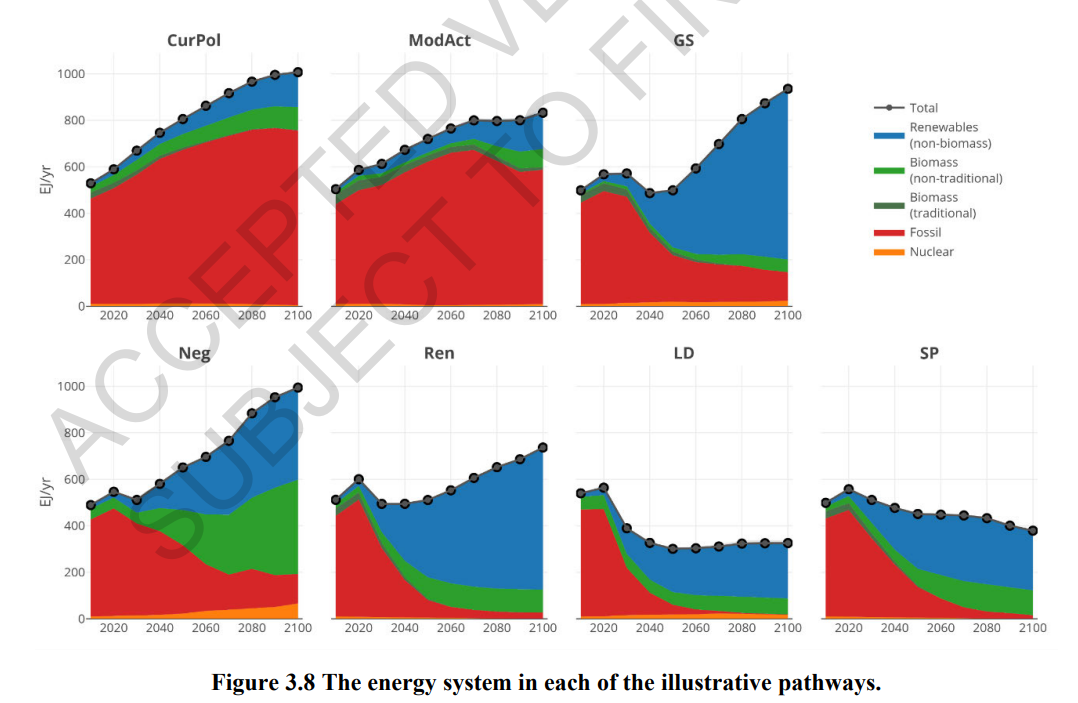
I really appreciate this work. I've been looking into some of the same questions recently, but like you say everything I've been able to find up to now seem very siloed and fail to take into account all of the potentially important issues. To convince people of your thesis though, I think it needs more of the following:
Thanks for this feedback! This is really useful, it can help me to improve.