Comments
Is using this type of technology already commonplace in EA Org's offices and Co-working spaces? If not, this might be a great (and even more cost-effective) place to pilot this idea!
Is using this type of technology already commonplace in EA Org's offices and Co-working spaces? If not, this might be a great (and even more cost-effective) place to pilot this idea!
Totally agree CO₂ and particulates have a real impact on cognition and productivity, especially for people doing mentally demanding work. Yet most still don’t use even a basic indoor air quality monitor for home or work. I got a used Airthings View Plus a few months ago (there are cheaper options like Primoaire too), and it’s led to real behavior changes better ventilation, more awareness, and 5–10% better focus. A good air quality measure device pays for itself quickly, especially in shared or poorly ventilated spaces. Given the altruistic externalities, EA orgs should seriously consider subsidizing IAQ monitors. It’s one of the highest-impact, low-cost upgrades for knowledge workers’ environments.
Fwiw, I use Ikea's air quality monitor which is crazy affordable. I use it together with 3M Aircon filter which is the most affordable way for me to not breath in the crazy pollution here. Without it, my Ikea says it's all least Delhi pollution level bad. Without knowing that I installed it, my roommate noticed the air smelled way fresher. For me, I feel sharper and less "stuffy/groggy" but maybe it's just a placebo effect.
Most of the post has been duplicated - after the first 'edit: adding some boxplots' it repeats all the previous sections.
Thank you - fixed!
What I'm confused about is the value of an air quality monitor over just getting an air purifier. A monitor will only benefit you if you act on its readings by a) buying a purifier, b) avoiding areas with pollution. If you install the monitor at home you don't really have the option to avoid it so a) is the only viable path to impact I see.
Most people can access pollution information about the city they live in and some can access it even more granularly (e.g. Berkeley has tons of PurpleAir monitors that can be accessed by app). The right decision rule is probably "if your city average pollution is high ish, just get an air purifier".
I think most of the cognitive effect that op is talking about is due to high CO2 conc and an air purifier is not going to have very much affect on CO2 levels because HEPA filters can't filter CO2 out of the air like they can for impurities.
In that case what would a person do with the information from a monitor? The only suggestion from the post that seems specific to having a monitor is "stop working and take a walk when CO2 is high", which is only useful if CO2 is generally low (if CO2 is perpetually high you can't avoid working during that time).
A monitor will only benefit you if you act on its readings by a) buying a purifier, b) avoiding areas with pollution. If you install the monitor at home you don't really have the option to avoid it so a) is the only viable path to impact I see.
Eh it's gonna depend on the particulars of each living situation but I think there are a bunch of dials/levers the monitor can cause you to adjust:
Usual/common
Potentially also:
More important than "tweak each dial 2%" though, is that I think during some small but non-trivial proportion of user-hours (5-10%?), the user would discover that their working environment is bad enough to warrant a more dramatic change than "crack a window and turn on a fan," which they wouldn't make without direct immediate feedback from a monitor. I'm not certain though of course, and certainly could be wrong about this!
Do you have views on the strength of the evidence base here? I thought it was more mixed than you make it out to be, and the anecdotal evidence cuts both ways.
I don't want to make too strong a claim here; my current guess is basically "C02 doesn't (at normalish levels) decrease intelligence per se; it makes you tired and lazy" (so playing a fun and low executive function game less affected perhaps?) On the other hand I recently learned that it's anxiogenic, which intuitively points in the opposite direction of arousal so I really don't know...
On the other other hand, compare air quality at large to, say, "temperature while studying," where the outcome variable measured is final grade. Would I really get worse grades if it was always 75° instead of 65°? I'm not sure, but even null result RCT for air conditioning affect on academic performance or math problems completed in a minute wouldn't convince me that temperature has no causal effect on cognition-intensive tasks; ceteris paribus is ~impossible to achieve!
I support this. I recently got a monitor, and here are my takeaways:
PM2.5 deposits into the thinnest blood vessels in the lung, and increases blood viscosity (I seem to not have noted down my sources in my knowledge-net, but feel free to google). If viscosity gets too high, it may decrease efficiency of microcirculation (e.g. efficiency of nutrient transport in microvasculature, plausibly including the brain). Totally underinformed hypothesis, however; do not defer to me on this—I mention it in case you (the reader) may benefit from having a hypothesis.

In honor of Draft Amnesty Day I've added a couple contextual notes, which are italicized and bracketed with the appropriate emojis 🍺🏳️🌇 like this.🍺🏳️🌃 Please excuse the unpolished formatting and structure.
🍺🏳️🌇Context: a few months ago (i.e. during the heights of 'infinite money glitch' mania) I asked the EAIF for $30k to buy 100 units of the Airthings View Plus monitor and give them away to EAs who could use one but couldn't easily buy one. The proposal got denied, but even rejected proposals can function as Forum post drafts.
The following is a lightly edited version of a smushed-together proper draft forum post, and the grant proposal I was basing it on. 🍺🏳️🌃
I believe purchasing and using an air quality monitor is one of the lowest effort and most affordable ways to improve one's productivity, subjective well-being, and/or health (in expectation, like everything else), especially if you:
🍺🏳️🌅 Parts (most/all?) of the following were in response to the following post-application but pre-rejection email
Dear Aaron,
I am contacting you on behalf of EA Funds - I am evaluating the grant you submitted for CO2 monitors.
I'd like to start by asking why you think that EAIF should purchase CO2 monitors rather than individual EAs buying them out of their own money?Also why the AirThings?[...]
Best,[Name]
🍺🏳️🌃
There’s good evidence that higher ambient CO2/particulate levels meaningfully impair cognition & productivity. I believe something akin to a market failure arising from the transaction cost of grant applications means that far too few EAs who ought to have such a device in fact do.
Further, I think it’s likely that air quality monitors are:
Goal: improve the health, productivity, and cognition of people doing altruistically important work.
Path to impact: improved cognition and productivity of workers increases both the quality and magnitude of whatever they are working on, which may in turn have any number of connections to the real world that serve as more proximate mechanisms of impact.
Anyway, this is all to say that the answer to “why [I] think that EAIF should purchase CO2 monitors rather than individual EAs buying them out of their own money?” is that ~all should buy their own (both altruistically and for their own wellbeing), but most are simply not going to.
So, I think the real choice is something like “Consider the 100 people you/I/we would give the first 100 monitors to. Should EAIF buy 100 so that (say) 90 end up using one, even if 20 would have bought (and used) their own?”
There are compromise solutions, which I’m happy to discuss; one that jumps out is a “choose your own discount” model, which I think I recall is how EAG tickets are sold. One benefit of this approach is that it preserves the signal attached to my/EAIF’s commitment to buy one in full if the person so chooses, which would seem to indicate that the device is worth using.
I don’t have any sort of strong, particular, or technical case for the particular make and model. Rather, after reading some reviews and articles / lists, I got the impression that it was the best all around C02+air quality monitor, and that any $100-$200 savings wasn’t worth the sacrificed features and risk of reduced quality.
Some features the View Plus has that (some) other models don’t:
Reading it [a few months back], this section completely sounds like an ad for AirThings, so I should mention that I don’t have any material incentive to buy from there (like I don’t own stock, no kickback schemes, etc.). I do like the product, but would be happy to buy from elsewhere if there’s any reason to.
🍺🏳️🌅 They still haven't offered to sponsor me🍺🏳️🌃
That said, if (or once) you/EAIF are willing to fund some but not the full amount I requested, I might choose/ask to/recommend getting some amount of this cheaper model at ~$50. That is to say, I’d rather give six fellow EAs one of these than give one the Airthings, but do think that the extra $250 is worth it in an absolute sense.
🍺🏳️🌅 My tentative take is that either get the nice $300 one (or consider used on Ebay for <$215-$250) or any reputable one for <$100 and intermediately-priced ones aren't a great value🍺🏳️🌃
It's been a few months, but I basically stand by everything I said and wrote above. If you're using your brain to make the world a better place and live somewhere that more closely resembles Berkeley or London than a rural alaskan windswept valley from a bottled water commercial I do think you should strongly consider getting and using an air quality monitor 🍺🏳️🌃
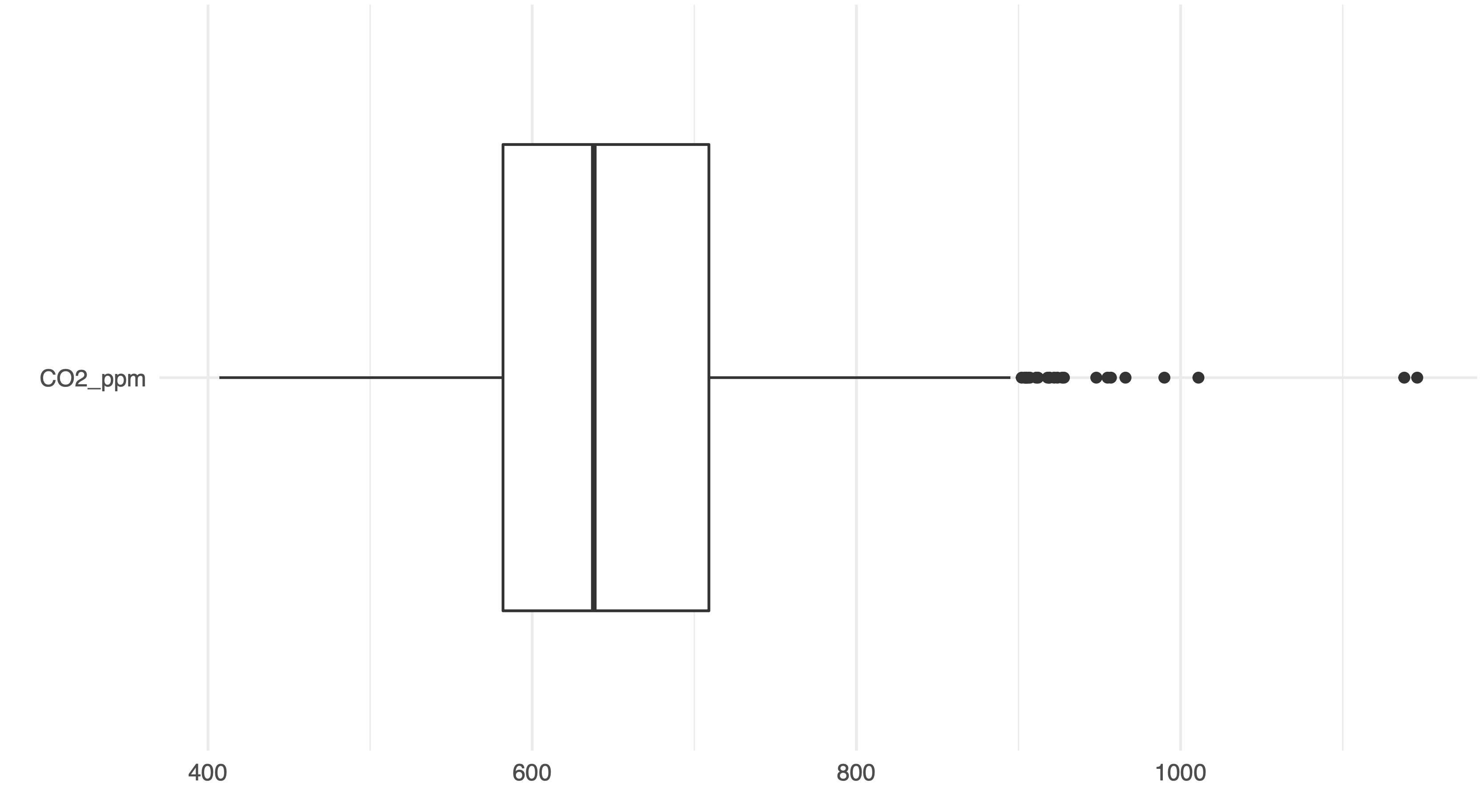
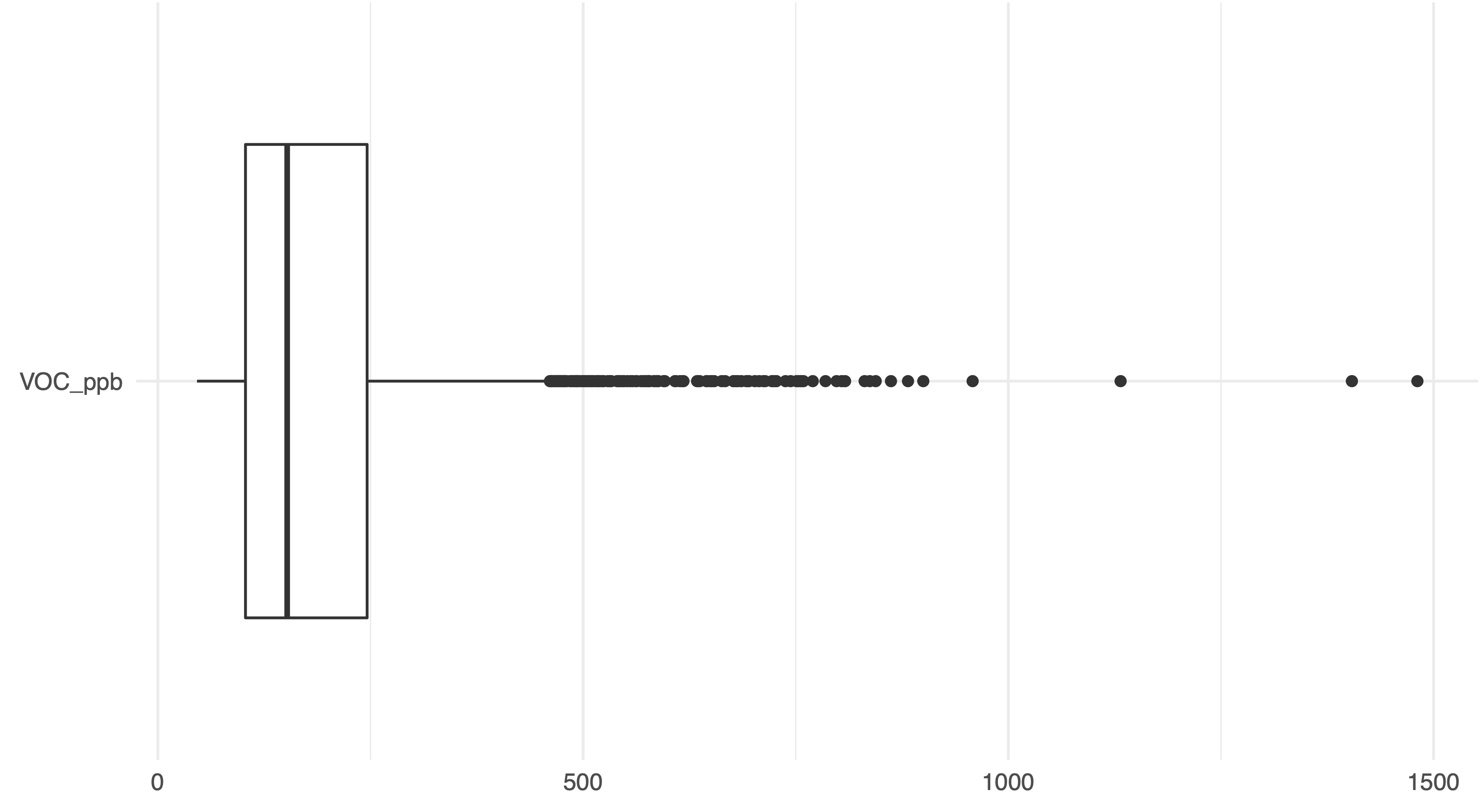
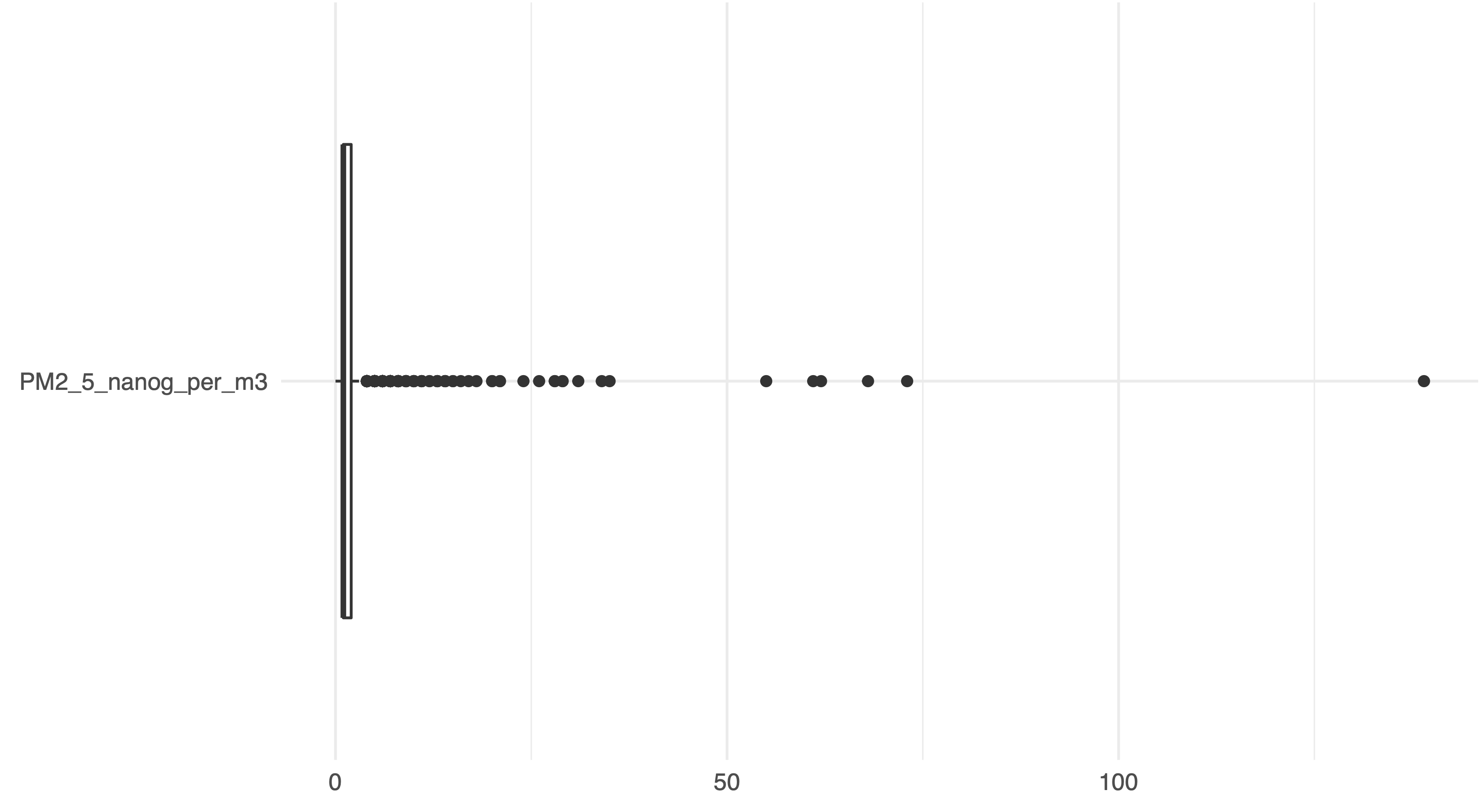
Last 3 months of measurements, averaged hourly, for C02, VOC, and PM2.5.
Not sure what to draw from this, but needless to say these variables vary quite a bit


I agree with you about particulates and VOCs[1], however I want to push back on:
I believe that a reasonable interpretation of the evidence would suggest the evidence mixed at best. I am personally quite skeptical.
***
In JP's memory of the situation there were a few bad studies a while back that found enormous (I might provocatively say implausible) effect sizes. Having not done a strong literature review, I am not aware of any that have found anywhere near the original effect size. Recently I went quickly looking to see if someone had found any more evidence and found this:[2]
...Which, yeah, sounds like p-hacking to me. At the very least, not consistent with a large effect size from CO2.
Scott Alexander agrees with me, and did a self experiment with a null result, which I would have expected to come out positive in the event of a large effect size from CO2.
***
In the end this debate isn't especially action-relevant. You should probably buy that air monitor. And pay attention to the CO2 as a measure of outdoor air exchange. Indoor air pollution is a big deal, even when you think it's fine. But it's probably not the CO2 directly doing the work.
Which cannot generally be filtered out with an air filter, and as such, improving ventilation matters for. Also airborne pathogens are a thing.
This study seems pretty cool to me (though I haven't done a thorough skeptical evaluation), and is consistent with, "indoor air pollution is a big deal, yo".