I was born at the end of the cold war, unaware of the danger we were emerging from. Duck and cover drills (as if those could protect schoolchildren from a nuclear blast) were a curiosity of the past.
The farmer-poet Wendell Berry, who wrote about the dread of nuclear war, died recently. From his 1968 “The peace of wild things”:
When despair for the world grows in me
and I wake in the night at the least...
Summary
Over the course of a year, the Fieldshaper program develops you into a field-leading grantmaker. You’ll steward $1,000,000 in grant capital, receive a $125,000 annual stipend, and deploy that capital within a sub-field of one of three key areas (farmed animals, global health, or philanthropic infrastructure); building the track record to become a grantmaker who can shape a field.
Role Details
* Title: Grantmak...
TL;DR - governance requires the right people, appropriate systems/processes/practices, and a clear understanding of organisational context. In light of this, organisations should regularly review and adapt governance to their context.
argued that governance should be treated as an outcomes-driven intervention - capable of both advancing and safeguarding key organisational and community goals in EA
outlined a Theory of Change (ToC) for how good governance can produce capable organisations, a healthy movement, and better stewardship of resources and people
identified org-level failures that good governance could mitigate against
In this post, I will share the conditions that I claim are prerequisities for good governance. This is a roundabout way of answering something like 'if governance is so important, why is it so often done so poorly?' - the answer is 'because these conditions aren't met'.
Introducing the Conditions for Good Governance
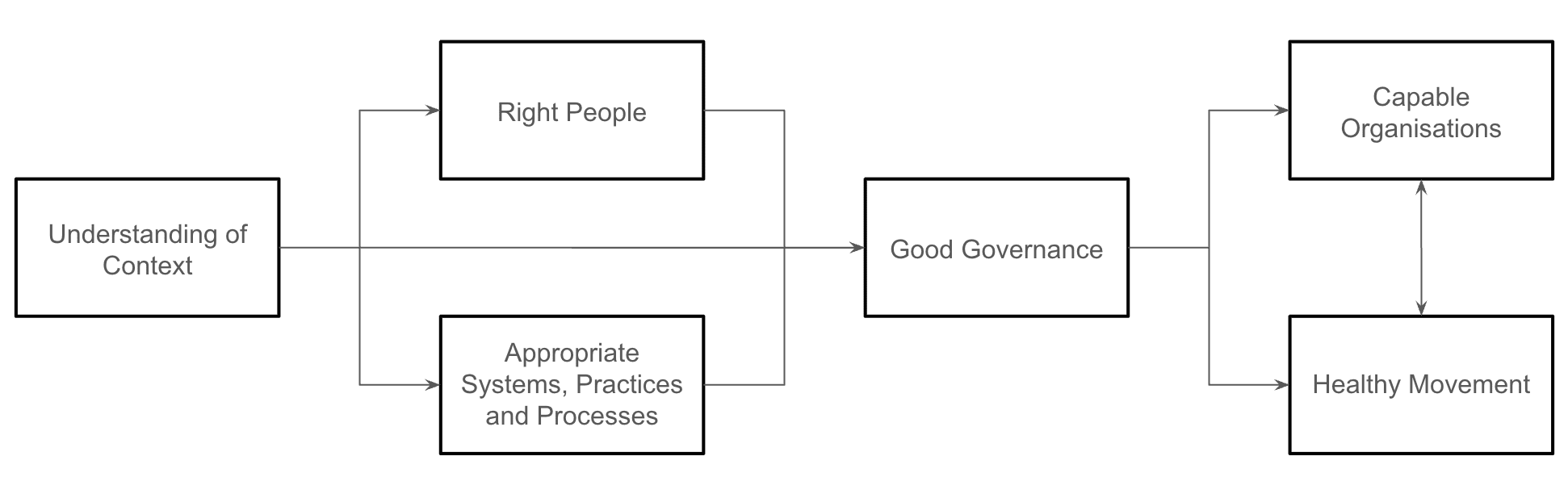
If we continue to apply the ToC lens to good governance, the first two conditions I will introduce are 'inputs' - things that are drawn on and/or deployed by an organisation to deliver activities, which lead to outputs, outcomes and so on. These inputs are:
You might immediately notice that right and appropriate are doing a lot of work there! Who are the right people? What systems, processes and practices are appropriate?
I claim that there is no platonic ideal governance set up - different organisations will necessarily have different answers to these questions, informed by their context.
Consider the lifecycle of an AIM-incubated charity - from start-up, to scale-up and maturity. The optimal governance set up for its first 12 months (piloting, testing, moving quickly), is likely very different from what is required during a period of scaling (rapidly increasing FTE, expanding into new geographies), and different again from what makes sense for the same organisation consolidating activities eight years into its journey.
I therefore suggest that another condition is 'understanding context' - the extent to which a board's composition, systems, practices, processes and activities are fit for the organisation's needs right now. Understanding context defines the option space for everything else.
Incorporating Conditions into a 'Theory of Good Governance'
'Understanding context' doesn't fit neatly into the ToC framework - context isn't an input or activity - but I think there's a neat solution.
Realist Evaluation (RE) is a close cousin to ToC. There is a body of research comparing and, more recently, combining these two approaches to develop a more robust understanding of if, how and why interventions work.
Among other things, RE consider how context informs if/how mechanisms (roughly input, activities and outputs in a ToC model) create outcomes. How EA organisations can incorporate a blended RE/ToC approach into MEL frameworks is another post, but for now, our 'Theory of Good Governance' can be illustrated, at a very high level, as:
Below, I go into each condition in more detail - offering some suggestions as to what organisations might consider when answering 'are the conditions for good governance present?'.
In future posts, I'll begin to move beyond theory and towards something more practical - offering tools and frameworks that help organisations to do governance well.
Outlining Conditions
Understanding Context
Context informs everything.
This seems straightforward to say, but I'm often asked 'how should I do [something related to governance]?', with some implication that there is one right way to do things. The unsatisfying, but usually correct, response is 'it depends.....' - the design and implementation of each organisation's approach to governance should start by considering its context.
The following list isn't exhaustive, but is a starting point for what I claim organisations should consider when designing their approach to governance:
Purpose
Strategy
Plan
Environment
Profile (size, complexity)
Risks
Values and Principles
Right People
When considering board composition, I propose organisations consider:
Those things that need to be evidenced/demonstrated by all board members
Alignment with organisational vision, mission, values and principles
Capacity to offer sufficient time and attentionto governance activities
Understanding
of the organisation's context
of what good governance looks like for the organisation
Those things that must be evidenced/demonstrated by the board as a whole, but that are informed by context (eg an org with plans to scale rapidly might board-level experience of scaling, while this might not be an important consideration for other organisations)
Skills
Experience
Credentials
Connections
Independence
Diversity
Appropriate Systems, Practices and Processes
I claim the core systems, practices and processes that enable governance activities, and the questions that can only be answered once context is understood, are:
Meetings - How often do we meet? What happens during meetings vs asynchronously? How are meetings facilitated? By who? How are discussions recorded?...
Decision-making - Who makes which decisions (board vs executive)? How are decisions made (majority vote, consent-based, something else)? Is quorum required? How are decisions recorded?...
Monitoring and reporting - What information does the organisation collect? What is shared with the board and how?...
Accountability - How do we consider exec team performance? How do we consider board performance? What action(s) can/do we take in the event of under-performance?...
Assurance and Control - How do we consider risk? What policies or processes need to be in place to mitigate and manage risk?...
A Worked Example
To bring this to life, it is perhaps helpful to revisit the example of an AIM-incubated charity:
Start-Up
The organisation has seed funding to pilot an intervention in Sub-Saharan Africa and operates through a fiscal sponsorship arrangement. Its two co-founders (the only staff members) have been through a rigorous selection process and have demonstrated the potential (to AIM and seed funders) to lead the work, but have no previous experience of founding a charity and limited experience of operating/delivering an intervention in the region. These co-founders will draw on advice and guidance from across the AIM network as they aim to rapidly test and iterate on the draft ToC they established during the incubation programme.
Considering this context, how would you think about the people, systems, processes and practices that are prerequisite for good governance?
Scale-Up
Two years later, the organisation has successfully graduated from the pilot-iteration cycle and is confident that an upcoming RCT will demonstrate the cost-effectiveness and counterfactual impact of its work. The team has grown to include 8 FTE staff members, and will grow significantly over the next two years as the organisation plans to replicate the intervention in two new geographies. Donors are positive about the organisation's work but funding will likely be a bottleneck on the organisation's ambitions for scale.
Is the same governance set-up still fit-for-purpose? How might it need to change to reflect the changing context?
Putting This Into Practice
One implication of thinking about good governance this way, and a claim I make, is that organisations should regularly review their approach to governance, asking:
How has our context changed?
What does this mean for our approach to governance?
What people do we need?
What systems, practices and processes do we need?
To what extent is our current approach to governance effective, given the context?
This should be done ~yearly, or whenever there is a significant/obvious shift in the organisation's context.
How The Good Governance Project Can Help
If you're interested in reviewing your organisation's approach to governance, you can get in touch with The Good Governance Project here - we provide free support to high-impact organisations and can provide bespoke support that helps you:
develop an updated understanding of your organisation's context, and how this relates to your approach to governance
review your as-is approach to governance, surveying the exec team and board members
identify and fill gaps in:
the composition of your board
the systems, practices and processes that enable good governance