Comments
The views expressed here are my own, not those of my employers.
Summary
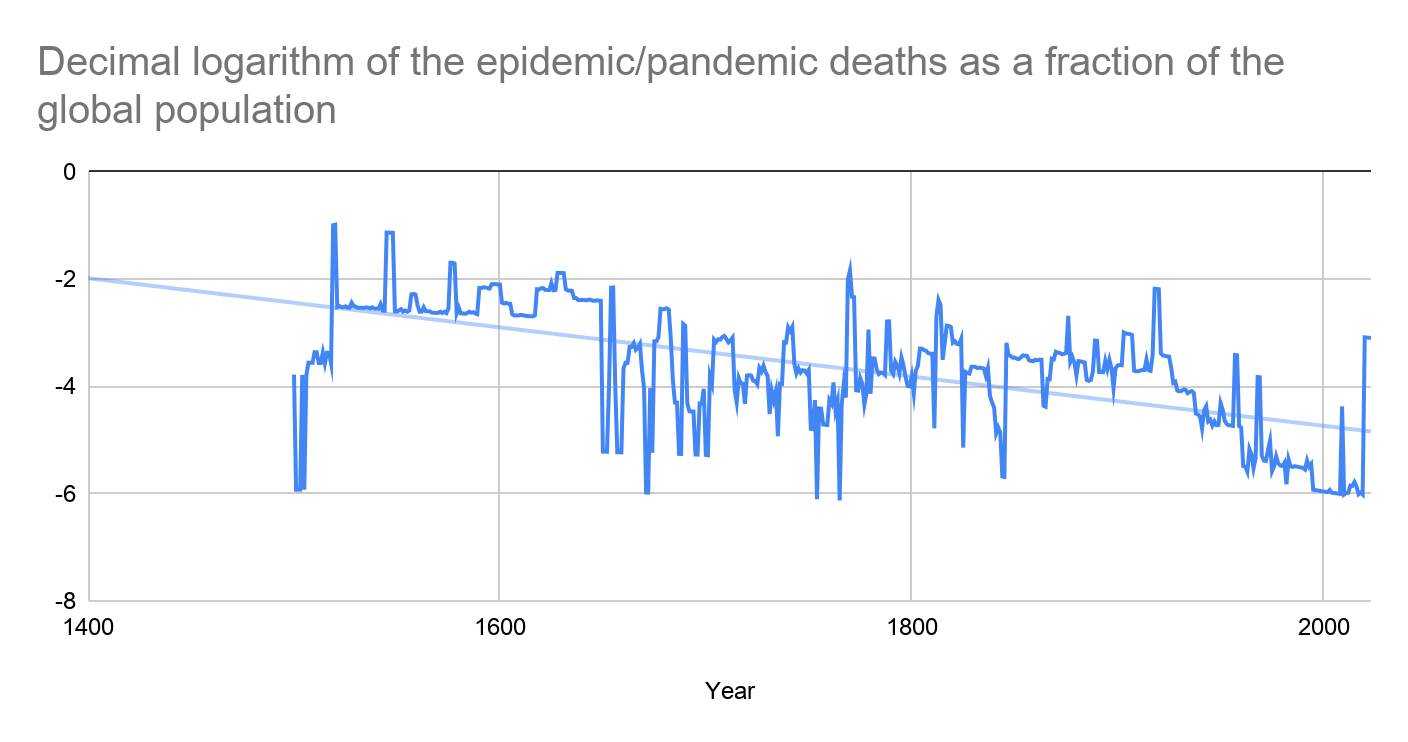
- The annual conflict deaths as a fraction of the global population decreased 0.121 OOM/century from 1400 to 2000 (coefficient of determination of 8.45 %), and the annual epidemic/pandemic deaths as a fraction of the global population decreased 0.459 OOM/century from 1500 to 2023 (38.5 %).
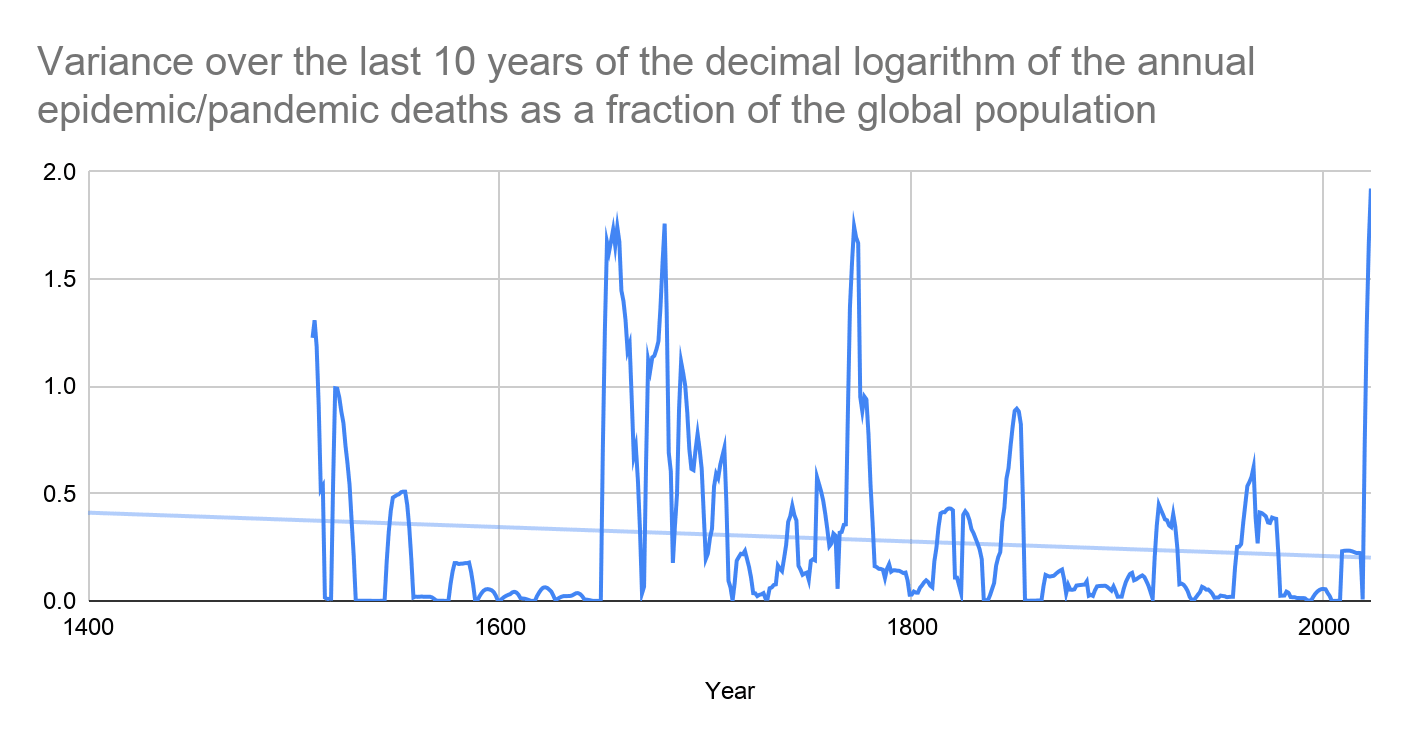
- The variances over the last 10 years of the decimal logarithm of the annual conflict and epidemic/pandemic deaths as a fraction of the global population have very weak trends over the aforementioned periods (1.90 % and 1.61 %).
Introduction
Some argue the risk of human extinction has been increasing, and will increase a lot in the next few years or decades. Toby Ord’s The Precipice is a major example. From an outside view perspective, such increases would be more likely given increasing annual deaths as a fraction of the global population. In contrast, I concluded the logarithm of the annual:
- Conflict deaths as a fraction of the global population have trended downwards from 1400 to 2000 (coefficient of determination of 8.45 %), although it is unclear to me whether the direction of the trend is resilient against changes in the modelling of the underreporting of historical conflict deaths.
- Epidemic/Pandemic deaths as a fraction of the global population have trended downwards from 1500 to 2023 (38.5 %), and I guess the direction of the trend is resilient against changes in the modelling of the underreporting of historical epidemic/pandemic deaths.
However, one could fairly object that what matters for tail risk is not the logarithm of the annual deaths as a fraction of the global population, but its variance. I studied this in this post.
Methods
I run linear regressions of:
- The decimal logarithm of the annual conflict and epidemic/pandemic deaths as a fraction of the global population. I had already run similar regressions in the previous posts, where I used the natural instead of decimal logarithm. Which one is used does not affect the fit, but the slope of the regressions involving the decimal logarithm have a more straightforward interpretation.
- The variance over the last 10 years of the decimal logarithm of the annual conflict and epidemic/pandemic deaths as a fraction of the global population. By variance over the last 10 years, I mean that among the (varying) reference year and 9 (= 10 - 1) before it.
Results
The calculations and results are in this sheet.
Linear regressions
Conflicts
Linear regression of the decimal logarithm of the annual conflict deaths as a fraction of the global population on the year
| Slope (OOM/century) | Intercept | Coefficient of determination |
| -0.121 | -1.48 | 8.45 % |
Linear regression of the variance over the last 10 years of the decimal logarithm of the annual conflict deaths as a fraction of the global population on the year
| Slope (OOM^2/century) | Intercept | Coefficient of determination |
| 0.0209 | -0.192 | 1.90 % |
Epidemics/Pandemics
Linear regression of the decimal logarithm of the annual epidemic/pandemic deaths as a fraction of the global population on the year
| Slope (OOM/century) | Intercept | Coefficient of determination |
| -0.459 | 4.44 | 38.5 % |
Linear regression of the variance over the last 10 years of the decimal logarithm of the annual epidemic/pandemic deaths as a fraction of the global population on the year
| Slope (OOM^2/century) | Intercept | Coefficient of determination |
| -0.0336 | 0.882 | 1.61 % |
Graphs
Conflicts
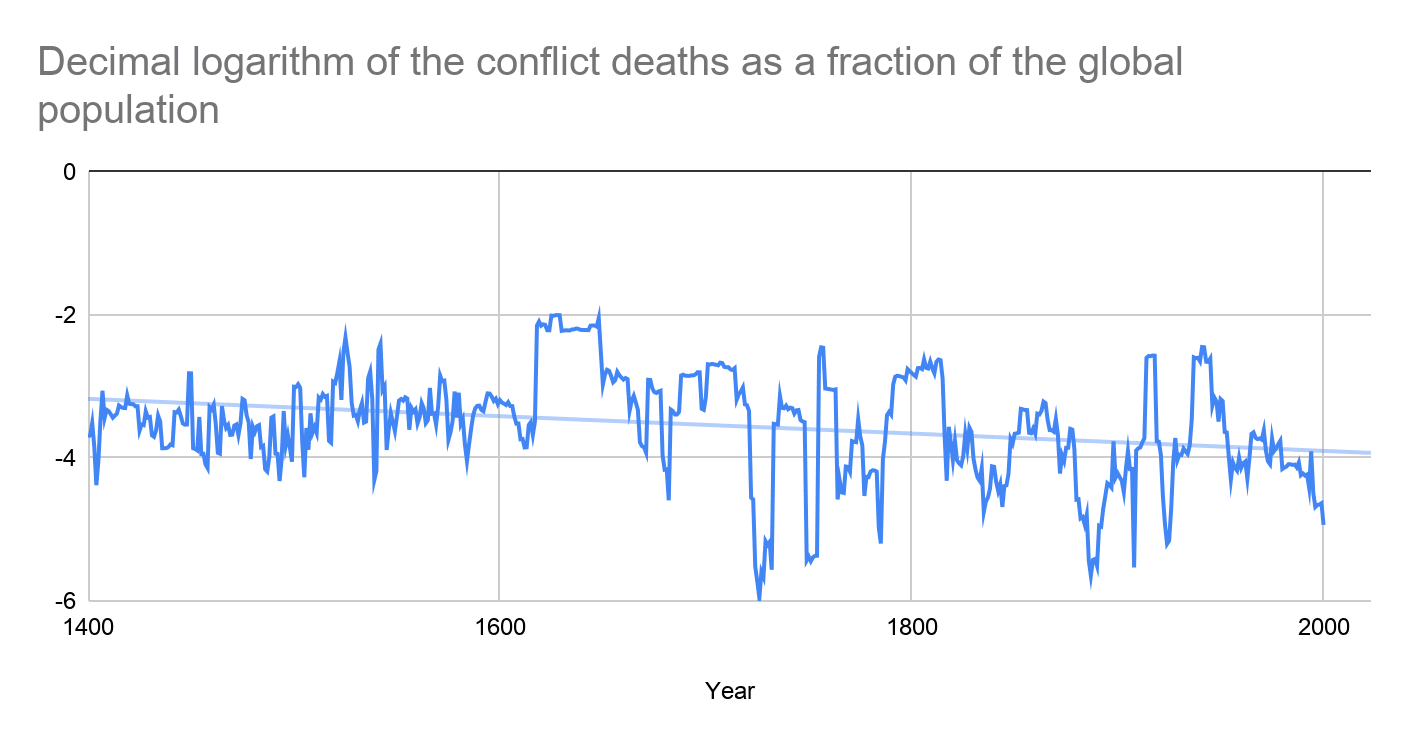
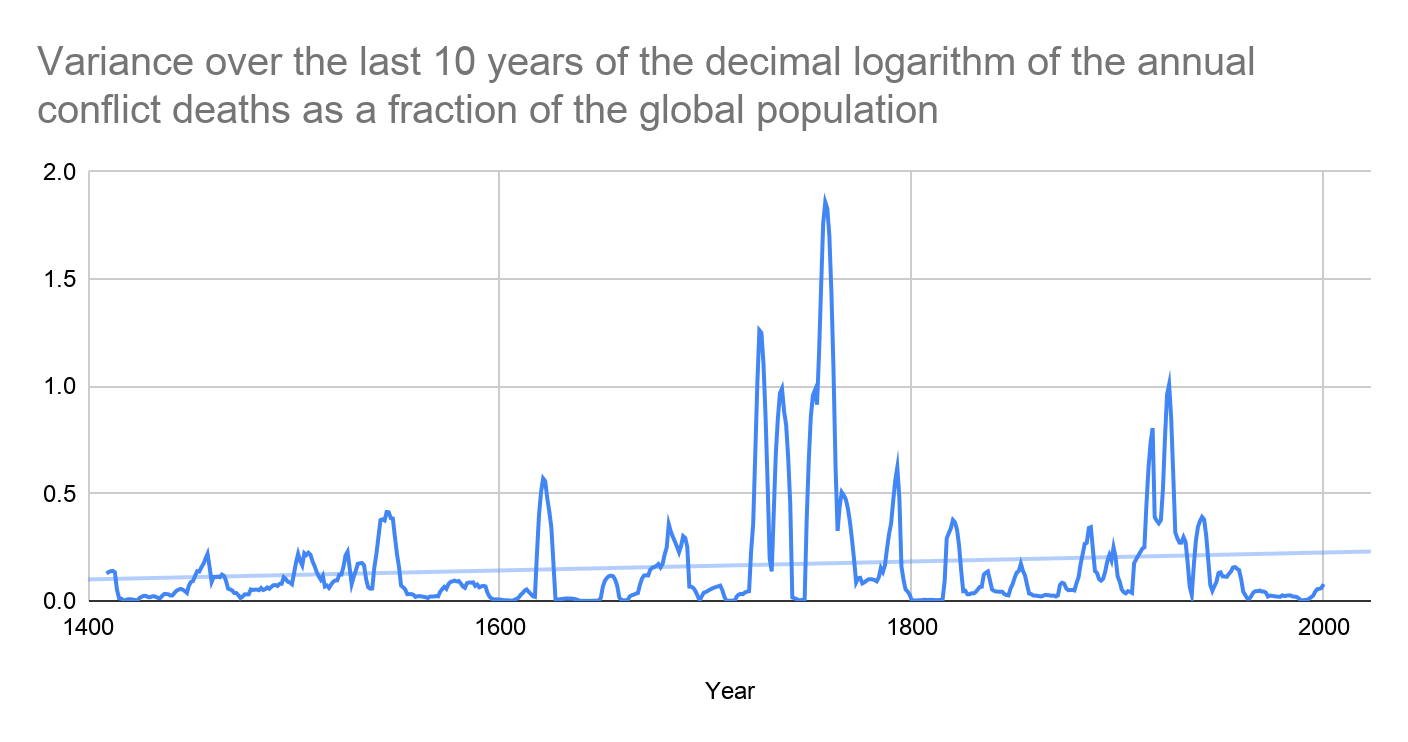
Epidemics/Pandemics
Discussion
The annual conflict deaths as a fraction of the global population decreased 0.121 OOM/century from 1400 to 2000 (coefficient of determination of 8.45 %), and the annual epidemic/pandemic deaths as a fraction of the global population decreased 0.459 OOM/century (38.5 %).
The variances over the last 10 years of the decimal logarithm of the annual conflict and epidemic/pandemic deaths as a fraction of the global population have very weak trends over the aforementioned periods (1.90 % and 1.61 %). I think downwards or weakly upwards trends were to be expected. Conflict and epidemic/pandemic deaths as a fraction of the global population follow heavy-tailed distributions, whose mean increases with variance, so such a fraction going down tends to imply a decreasing variance.