[Added 13Jun: Submitted to OpenPhil AI Worldviews Contest - this pdf version most up to date]
Content note: discussion of a near-term, potentially hopeless life-and-death situation that affects everyone.
Tldr: AGI is basically here. Alignment is nowhere near ready. We may only have a matter of months to get a lid on this (strictly enforced global limits to compute and data) in order to stand a strong chance of survival. This post is unapologetically alarmist because the situation is highly alarming. Please help. Fill out this form to get involved. Here is a list of practical steps you can take.
We are in a new era of acute risk from AGI
Artificial General Intelligence (AGI) is now in its ascendency. GPT-4 is already ~human-level at language and showing sparks of AGI. Large multimodal models – text-, image-, audio-, video-, VR/games-, robotics-manipulation by a single AI – will arrive very soon (from Google DeepMind) and will be ~human-level at many things: physical as well as mental tasks; blue collar jobs in addition to white collar jobs. It’s looking highly likely that the current paradigm of AI architecture (Foundation models), basically just scales all the way to AGI. These things are “General Cognition Engines”.
All that is stopping them being even more powerful is spending on compute. Google & Microsoft are worth $1-2T each, and $10B can buy ~100x the compute used for GPT-4. Think about this: it means we are already well into hardware overhang territory.
Here is a warning written two months ago by people working at applied AI Alignment lab Conjecture: “we are now in the end-game for AGI, and we (humans) are losing”. Things are now worse. It’s looking like GPT-4 will be used to meaningfully speed up AI research, finding more efficient architectures and therefore reducing the cost of training more sophisticated models.
And then there is the reckless fervour of plugin development to make proto-AGI systems more capable and agent-like to contend with. In very short succession from GPT-4, OpenAI announced the ChatGPT plugin store, and there has been great enthusiasm for AutoGPT. Adding Planners to LLMs (known as LLM+P) seems like a good recipe for turning them into agents. One way of looking at this is that the planners and plugins act as the System 2 to the underlying System 1 of the general cognitive engine (LLM). And here we have agentic AGI. There may not be any secret sauce left.
Given the scaling of capabilities observed so far for the progression of GPT-2 to GPT-3 to GPT3.5 to GPT-4, the next generation of AI could well end up superhuman. I think most people here are aware of the dangers: we have no idea how to reliably control superhuman AI or make it value-aligned (enough to prevent catastrophic outcomes from its existence). The expected outcome from the advent of AGI is doom. This is in large part because AI Alignment research has been completely outpaced by AI capabilities research and is now years behind where it needs to be.
To allow Alignment time to catch up, we need a global moratorium on AGI, now.
A short argument for uncontrollable superintelligent AI happening soon (without urgent regulation of big AI):
This is a recipe for humans extincting themselves that appears to be playing out along the mainline of future timelines:
- Either of
- NextAI + planners + AutoGPT + plugins + further algorithmic advancements + gung ho humans (e/acc etc) = NextAI2 in short order. Weeks even. Access to compute for training is not a bottleneck because that cyborg system (humans and machines working together) could easily hack their way to massive amounts of compute access, or just fundraise enough (cf. crypto projects). Access to data for training is not a bottleneck; there are large existing online repositories, and if that’s not enough, hacks.
- NextAI2 -> NextAI3 in days? NextAI3 -> NextAI4 in hours? Etc (at this point it's just the machines steering further development). Alignment is not magically solved in time.
Humanity loses control of the future. You die. I die. Our loved ones die. Humanity dies. All sentient life dies.
Common objections to this narrative are that there won’t be enough compute, or data, for this to happen. These don’t hold water after a cursory examination of our situation. Compute-wise, we're on ~10^18 FLOPS for large clusters at the moment, but there are likely enough GPUs available for 100 times this. And the cost of this – ~$10B - is affordable for many large tech companies and national governments, and even individuals!
Data is not a show-stopper either. Sure, ~all the text on the internet might’ve already been digested, but Google could readily record more words per day via phone mics than the number used to train GPT-4. These may or may not be as high quality as text, but 1000x as many as all the text on the internet could be gathered within months. Then there are all the billions of high-res video cameras (phones and CCTV), and sensors in the world. And if that is not enough, there is already a fast-growing synthetic data industry serving the ML community’s ever growing thirst for data to train their models on.
Another objection I’ve seen raised is related to the complexity of our physical environment. A high degree of error correction will be required for takeover of the physical world to happen. And many iterations of physical design will be required to get there. This is clearly not insurmountable, given the evidence we have of humans being able to do it. But can it happen quickly? Yes. There are many ways that AI can easily break out into the physical world, involving hacking networked machinery and weapons systems, social persuasion, robotics, and biotech.
Some notes on the nature of the threat. The AI that will soon pose an existential risk is:
- A general cognition engine (see above); an Artificial General Intelligence able to do any task a human can do, plus a lot more that humans can’t.
- Fast: computers process information much faster than human brains do; and they are not limited to needing to fit inside a skull. AGI has the potential to rapidly scale such that it is “thinking” at speeds that will make us look like geology (rocks). As such, it’ll be able to run untold rings around us.
- Alien: GPT-4 produces text output that is indistinguishable from a human. But don’t be fooled; it is merely very good at imitating humans. Underneath the hood, its “mind” is very alien: a giant pile of linear algebra we share no evolutionary history with. And remember that consciousness doesn’t need to come into it. It’s perhaps better thought of as a new force of nature unleashed. A supremely capable series of optimisation processes that are essentially just insentient colossal piles of linear algebra, made physical in silicon; yet so powerful as to be able to completely outsmart the whole of humanity combined. Or: a super-powered computer virus/worm ecology that gets into everything, including ultimately, the physical world. It’s impossible to get rid of, and eventually consumes everything.
- Capable of world model building. Yes, to be as good a “stochastic parrot” as current foundation models are requires (spontaneous, emergent) internal world model building in amongst the inscrutable spaghetti of network weights.
- Situationally aware. Such world models will (at sufficient capability) include models of the context that the AI is in, as an artificial neural network running on computer hardware, built by agents known as humans.
- Capable of goal mis-generalisation (mesa-optimisation). Yes, this is no longer a mere theoretical concern.
The default outcome of AGI is doom
If you apply a security mindset (Murphy’s Law) to the problem of AI alignment, it should quickly become apparent that it is very difficult. There are multiple components to alignment, and associated threat models. We are nowhere close to 100% aligned, 0 error rate AGI. Most prominent alignment researchers have uncomfortably high estimates for P(doom|AGI). Yet many thought leaders in EA, despite taking AI x-risk seriously, have inexplicably low estimates for P(doom|AGI). I explore this further in a separate post, but suffice to say that the conclusion is that the default outcome of AGI is doom. The public framing of the problem of AGI x-risk needs to shift to reflect this.
50% ≤ P(doom|AGI) < 100% means that we can confidently make the case for the AI capabilities race being a suicide race. It then becomes a personal issue of life-and-death for those pushing forward the technology. Perhaps Sam Altman or Demis Hassabis really are okay with gambling 800M lives in expectation on a 90% chance of utopia from AGI? (Despite a distinct lack of democratic mandate.) But are they okay with such a gamble when the odds are reversed? Taking the bet when it’s 90% chance of doom is not only highly morally problematic, but also, frankly, suicidal and deranged.
Even if, after all of the above, you think foom and/or superintelligence and/or extinction are unlikely, you should still be concerned about global catastrophic risk enough to want urgent action on this. Even AI systems a generation or two (months) away (NextAI or NextAI2 above) could be able to wrest enough power from the hands of humanity that we basically lose control of the future, thanks to actors like Palantir who seem eager to place AI into more and more critical domains. A moratorium should also rein in any attempts towards inserting AI/ML systems into critical systems such as offensive weapons, nuclear power plants, WMDs, major and critical powerplants and electric subsystems, and cybersecurity domains. Let’s Pause AI. Shut it Down. Do whatever it takes to avert catastrophe.
So: how much should we be betting (in expected loss of life) that the first step of the recipe written out above doesn’t happen?
This is an unprecedented global emergency. Global moratorium on AGI, now.
Increasing public awareness
Increasing public awareness is both a phenomena that is happening, and something we need to do much more of in order to avert catastrophe. Media about AI risk has been steadily ramping up. But the new era in public communication and advocacy started with FLI’s Pause letter. Yudkowsky in short order then knocked it out the park with his “Shut it Down” Time article:
Many researchers steeped in these issues, including myself, expect that the most likely result of building a superhumanly smart AI, under anything remotely like the current circumstances, is that literally everyone on Earth will die.
…
We are not ready. We are not on track to be significantly readier in the foreseeable future. If we go ahead on this everyone will die, including children who did not choose this and did not do anything wrong.
Shut it down.
To me this was a watershed moment. A lot of pent up emotion was released (I cried). It was finally okay to just say, in public, what you really thought and felt about extinction risk from AI. Forget fear of looking alarmist, there is an asteroid heading directly for Earth. Yes, this is a metaphor, but a very useful one. The danger level is the same - we are facing total extinction with high probability. Max Tegmark’s Time article draws out this analogy to great effect. The situation we are in is really quite analogous to the film Don’t Look Up. Spoiler: that film does not have a happy ending. How do we get one with AI in real life? We need to avoid the failure modes that are illustrated in the film for one. We need to get media personalities and world leaders to take onboard the gravity of the situation: this is a suicide race that no one can win. A race over the edge of a cliff, only all competitors are tied together. If one gets to the finish line – over the cliff edge – then we all get dragged down into the abyss with them.
Yudkowsky and other top alignment researchers have been going on popular podcasts. Explaining the predicament in detail. This is great!
The need for global coordination and regulation is being discussed.
There is also a growing “AI Notkilleveryoneism” movement on Twitter. I like the energy, humour and fast pace, as contrasted to the slower, more serious and deliberative tone typical of the EA Forum; seems more appropriate given the circumstances.
AI researchers and enthusiasts, those with an allegiance or commitment to the field, who believe in the inevitability of AGI; they are, generally, more sceptical of, and resistant to, discussion of slowdown and regulation. If your bottleneck to (further) public communication stems from frustration with bad AI x-risk takes from tech people who should know better. Consider this:
“It made sense to expect that if it’s this hard to explain to a fellow computer enthusiast, then there’s no hope of reaching the average person. For a long time I avoided talking about it with my non-tech friends… for that reason. However, when I finally did, it felt like the breath of life. My hopelessness broke, because they instantly vigorously agreed, even finishing some of my arguments for me. Every single AI safety enthusiast I’ve spoken with who has engaged with civilians has had the exact same experience. I think it would be very healthy for anyone who is still pessimistic about convincing people to just try talking to one non-tech person in their life about this. It’s an instant shot of hope.”
OpenAI’s stated mission is to build (“safe and beneficial”) “highly autonomous systems that outperform humans at most economically valuable work” (AGI). To most of the public this sounds dystopian, rather than utopian.
I think EA/LW will be eclipsed by a mainstream public movement on this soon. The fire alarm is being pressed now, whether or not EA/LW leadership are on board. We can’t wait for further proof of danger. We must act.
Encouragingly, things are already starting to move. Since I started writing this post in earnest (3 days ago), Geoffrey Hinton has publicly resigned from Google to warn of the dangers of AI, and senior MPs in the UK Parliament have called for a summit to prevent AI from having a “disastrous” impact on humanity. Let’s build on this momentum!
What we need to happen to get out of the acute risk period
Existing approaches such as industry self-regulation and Evals are not sufficient. And sufficient regulation of hardware is likely a whole lot easier than sufficient regulation of software. To be safe from extinction we need:
- A global Pause on AGI development and training of new models larger than GPT-4 (Microsoft OpenAI and Google Deepmind need to be in the vanguard of this; but a global agreement is needed). Possibly even a roll-back to GPT-3 level AI.
- Strongly enforced regulation on limits to compute and data to prevent AI systems that are more powerful than GPT-3 until they can be 100% aligned (i.e. 0 undesirable prompt engineering is possible).
- A massive global public outcry calling for these things: 100M+ people, from all around the world.
These are big asks. Should we aim for the stars and hope to land on the moon? Yes. Although consider that we may actually have to reach the stars to survive.
The wider concern for nearer term impacts from AI - bias, job losses, data privacy and copyright infringement (AI Ethics) - are also leading to similar calls in terms of regulating compute and data. We need to ally with these campaigns (we’re coming at the issue from different angles, but the things we are calling for to happen are broadly the same; we can converge on a concrete set of asks that will address all issues).
A taboo around AGI could also do a lot of work in terms of reducing the need for enforcement. There aren’t lots of rabid bioscience accelerationists constantly planning underground human cloning and genetic engineering labs; any huge economic potential that technology might’ve had has been destroyed by a global taboo.
Ultimately, to succeed, we need to get the UN Security Council on board: this is more serious and urgent than nuclear proliferation. But it is just as tractable: there aren’t many relevant large computer chip manufacturers or big data centre owners. GPUs and TPUs need to be treated like Uranium, and large clusters of them like enriched Uranium (we can’t afford to have too large a cluster lest they reach criticality and cause a catastrophic intelligence explosion).
But time is short, and the window of opportunity to act before we cross a point of no return narrow. This is the crisis of all crises. We need to get governments to treat this as an emergency in the same way they did with Covid: we need an emergency lockdown of the global AI industry.
We know from Covid that such “phase changes” in global public opinion are possible. This time it is more difficult however; we need such a monumental shift without there being an increasing body count first. If we wait for that, we put way too great a risk on crossing a point of no return where no matter how fast the response, we still lose. Global moratorium on AGI, now.
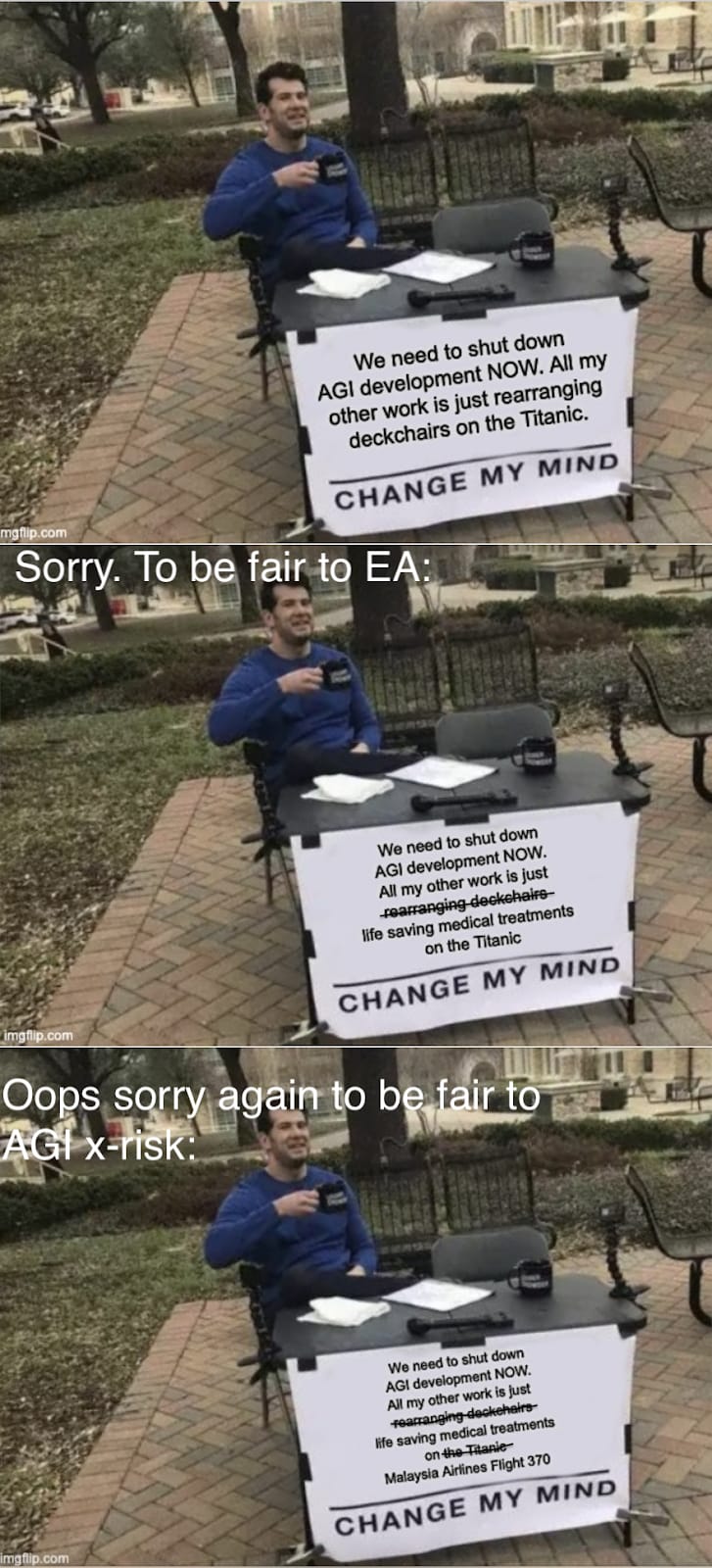
(You can also see this meme on Dank EA Memes and Twitter)
What you can and perhaps should do now
Come with me if you want to li.. Drop everything else you are doing until this is fixed! You may be feeling a bit discombobulated and/or sick with worry at this point. So here are some concrete actions you can take:
- Fill out this form if you are interested in getting involved.
- Join the AGI-Moratorium-HQ Slack to coordinate with others already working in the space.
- Learn more about the basics of AGI x-risk and safety (the linked AGISF course is ~20-40 hours reading).
- Be there to answer people’s questions (there are a lot).
- Talk to people about this - friends, family, neighbours, coworkers.
- Advocate for political action: we need a Pause on AGI (possibly even a rollback) asap if we are going to get through the acute risk period. The time for talking politely to (and working with) big AI is over. It has failed. They themselves are crying out to be regulated.
- Post about this on Twitter and other social media (TikTok, YouTube, Instagram, Facebook etc);
- Join the AI Notkilleveryoneism Twitter Community.
- Make and share memes (example);
- Write and share articles (example);
- Organise and share petitions (example); fund advertising for them;
- Send letters to newspapers and magazines;
- Write to your political representatives;
- Lobby politicians/industry. Talk to any relevant contacts you might have, the higher up, the better;
- Ask politicians to invite (or subpoena) AI lab leaders to parliamentary/congressional hearings to give their predictions and timelines of AI disasters;
- Make submissions to government requests for comment on AI policy (example);
- Help draft policy (some frameworks).
- Organise/join demonstrations.
- Consider civil disobedience / direct action.
- Consider ballot initiatives or referendums if they are achievable in your state or country
- Join organisations and groups working on this.
- Ask the management at your current organisation to take an institutional position on this.
- Coordinate with other groups concerned with AI who are also pushing for regulation.
- Donate to advocacy orgs (there is already Campaign for AI Safety, and more are spinning up).
- If you are earning or investing to give, seriously consider joining me in liquidating a significant fraction of your assets to push this forward.
- [Added 4May (H/T Otto)] If you are technical, work on AI Pause regulation proposals! There is basically one paper now, possibly because everyone else thought a Pause was too far outside the Overton Window. Now we're discussing a Pause, we need to have fleshed out AI Pause regulation proposals.
- [Added 4May (H/T Otto)] Start institutes or projects that aim to inform the societal debate about AGI x-risk. The Existential Risk Observatory is setting a great example in the Netherlands. Others could do the same thing. (Funders should be able to choose from a range of AI x-risk communication projects to spend their money most effectively. This is currently really not the case.)
If you are just starting out in AI Alignment, unless you are a genius and/or have had significant new flashes of insight on the problem, consider switching to advocacy for the Pause. Without the Pause in place first, there just isn’t time to spin up a career in Alignment to the point of making useful contributions.
If you are already established in Alignment, consider more public communication, and adding your name to calls for the Pause and regulation of the AI industry.
Be bold in your public communication of the danger. Don’t use hedging language or caveats by default; mention them when questioned, or in footnotes, but don’t make it sound like you aren’t that concerned if you are.
Be less exacting in your work. 80/20 more. Don’t do the classic EA/LW thing and spend months agonising and iterating on your Google Doc over endless rounds of feedback. Get your project out into the world and iterate as you go. Time is of the essence.
But still consider downside risk: we want to act urgently but also carefully. Keep in mind that a lot of efforts to reduce AI x-risk have already backfired; alignment researchers have accidentally contributed to capabilities research, and many AI governance proposals are at danger of falling prey to industry capture.
If you are doing other EA stuff, my feeling on this is: let’s go all out to get a (strongly enforced) Pause in place, and then relax a little and go back to what we were doing before. Right now I feel like all my other work is just rearranging deckchairs on the Titanic. We need to be running to the bridge, grabbing the wheel, and steering away from the iceberg. We may not have much time, but by Good we can try. C’mon EA, we can do this!
Acknowledgements: For helpful comments and suggestions that have improved the post, and for the encouragement to write, I thank AW, Johan de Kock, Jaeson Booker, Greg Kiss, Peter S. Park, Nik Samolyov, Yanni Kyriacos, Chris Leong, Alex M, Amritanshu Prasad, Dušan D. Nešić, and the rest of the AGI Moratorium HQ Slack and AI Notkilleveryoneism Twitter. All remaining shortcomings are my own.


To push back a bit on the fast software-driven takeoff (i.e. a fast takeoff driven primarily by innovations in software):
While we're nowhere near the physical limits to computation, it's still true that hardware progress has slowed down considerably on various measures. I think the steelman of the compute-based argument against a fast software-driven takeoff is not that the ultimate limits to computation are near, but rather that the pace of hardware progress is unlikely to be explosively fast (e.g. in light of recent trends that arguably point in the opposite direction, and because software progress per se seems insufficient for driving explosive hardware progress).
That actors can afford to create this next generation of AIs does not imply that those AIs will in turn lead to a hard takeoff in capabilities. From my perspective at least, that seems like an unargued assumption here.
A key question is whether this extra data would be all that valuable to the main tasks of concern. For example, it seems unclear whether low-quality data from phone conversations, video cameras, etc. would give that much of a boost to a model's ability to write code. So I don't think the point made above, as it stands, is a strong rebuttal to the claim that data will soon be a limiting bottleneck to significant capability gains. (Some related posts.)
This is another claim I would push back against. For instance, from a perspective concerned with the reduction of s-risks, one could argue that talking politely to, and working with, leading AI companies is in fact the most responsible thing to do, and that taking a less cooperative stance is unduly risky and irresponsible. To be clear, I'm not saying that this is obviously the case, but I'm trying to say that it's not clear-cut either way. Good arguments can be made for a different approach, and this seems true for a wide range of altruistic values.
Current scaling "laws" are not laws of nature. And there are already worrying signs that things like dataset optimization/pruning, curriculum learning and synthetic data might well break them - It seems likely to me that LLMs will be useful in all three. I would still be worried even if LLMs prove useless in enhancing architecture search.
Interesting -- can you provide some citations?
Thanks for writing this - it was useful to read the pushbacks!
As I said below, I want more synthesis of these sorts of arguments. I know that some academic groups are preparing literature reviews of the key arguments for and against AGI risk.
I really think that we should be doing that for ourselves as a community and to make sure that we are able to present busy smart people with more compelling content than a range of arguments spread across many different forum posts.
I don't think that that is going to cut it for many people in the policy space.
Agree. But at the same time, we need to do this fast! The typical academic paper review cycle is far too slow for this. We probably need groups like SAGE (and Independent SAGE?) to step in. In fact, I'll try and get hold of them.. (they are for "emergencies" in general, not just Covid[1])
Although it looks like they are highly specialised on viral threats. They would need totally new teams to be formed for AI. Maybe Hinton should chair?
I don't think this matters, as per the next point about there already being enough compute for doom [Edit: I've relegated the "nowhere near close to the physical limits to computation" sentence to a footnote and added Magnus' reference on slowdown to it].
I think the burden of proof here needs to shift to those willing to gamble on the safety of 100x larger systems. All I'm really saying here is that the risk is way too high for comfort (given the jumps in capabilities we've seen so far going from GPT-3->GPT3.5->GPT-4).
[Meta: would appreciate separate points being made in separate comments].
Will look into your links re data and respond later.
I'm not sure what you are saying here? Do you think there is a risk of AI companies deliberately causing s-risks (e.g. releasing a basilisk) if we don't play nice!? They may be crazy in a sense of being reckless with the fate of billions of people's lives, but I don't think they are that crazy (in a sense of being sadistically malicious and spiteful toward their opponents)!
No, I didn't mean anything like that (although such crazy unlikely risks might also be marginally better reduced through cooperation with these actors). I was simply suggesting that cooperation could be a more effective way to reduce risks of worst-case outcomes that might occur in the absence of cooperative work to prevent them, i.e. work of the directional kind gestured at in my other comment (e.g. because ensuring the inclusion of certain measures to avoid worst-case outcomes has higher EV than does work to slow down AI). Again, I'm not saying that this is definitely the case, but it could well be. It's fairly unclear, in my view.
Ok. I don't put much weight on s-risks being a likely outcome. Far more likely seems to be just that the solar system (and beyond) will be arranged in some (to us) arbitrary way, and all carbon-based life will be lost as collateral damage.
Although I guess if you are looking a bit nearer term, then s-risk from misuse could be quite high. But I don't think any of the major players (OpenAI, Deepmind, Anthropic) are even really working on trying to prevent misuse at all as part of their strategy (their core AI Alignment work is on aligning the AIs, rather than the humans using them!) So actually, this is just another reason to shut it all down.
Thanks for your reply, Greg :)
That is what I did not find adequately justified or argued for in the post.
I suspect that a different framing might be more realistic and more apt from our perspective. In terms of helpful actions we can take, I more see the choice before us as one between trying to slow down development vs. trying to steer future development in better (or less bad) directions conditional on the current pace of development continuing (of course, one could dedicate resources to both, but one would still need to prioritize between them). Both of those choices (as well as graded allocations between them) seem to come with a lot of risks, and they both strike me as gambles with potentially serious downsides. I don't think there's really a "safe" choice here.
I'd agree with that, but that seems different from saying that a fast software-driven takeoff is the most likely scenario, or that trying to slow down development is the most important or effective thing to do (e.g. compared to the alternative option mentioned above).
What are the downsides from slowing down? Things like not curing diseases and ageing? Eliminating wild animal suffering? I address that here: "it’s a rather depressing thought. We may be far closer to the Dune universe than the Culture one (the worry driving a future Butlerian Jihad will be the advancement of AGI algorithms to the point of individual laptops and phones being able to end the world). For those who may worry about the loss of the “glorious transhumanist future”, and in particular, radical life extension and cryonic reanimation (I’m in favour of these things), I think there is some consolation in thinking that if a really strong taboo emerges around AGI, to the point of stopping all algorithm advancement, we can still achieve these ends using standard supercomputers, bioinformatics and human scientists. I hope so."
To be clear, I'll also say that it's far too late to only steer future development better. For that, Alignment needs to be 10 years ahead of where it is now!
I don't think you need to believe this to want to be slamming on the brakes now. As mentioned in the OP, is the prospect of mere imminent global catastrophe not enough?
I'd again prefer to frame the issue as "what are the downsides from spending marginal resources on efforts to slow down?" I think the main downside, from this marginal perspective, is opportunity costs in terms of other efforts to reduce future risks, e.g. trying to implement "fail-safe measures"/"separation from hyperexistential risk" in case a slowdown is insufficiently likely to be successful. There are various ideas that one could try to implement.
In other words, a serious downside of betting chiefly on efforts to slow down over these alternative options could be that these s-risks/hyperexistential risks would end up being significantly greater in counterfactual terms (again, not saying this is clearly the case, but, FWIW, I doubt that efforts to slow down are among the most effective ways to reduce risks like these).
Didn't mean to say that that's a necessary condition for wanting to slow down. But again, I still think it's highly unclear whether efforts that push for slower progress are more beneficial than alternative efforts.
I think it's a very hard sell to try and get people to sacrifice themselves (and the whole world) for the sake of preventing "fates worse than death". At that point most people would probably just be pretty nihilistic. It also feels like it's not far off basically just giving up hope: the future is, at best, non-existence for sentient life; but we should still focus our efforts on avoiding hell. Nope. We should be doing all we can now to avoid having to face such a predicament! Global moratorium on AGI, now.
I'm not talking about people sacrificing themselves or the whole world. Even if we were to adopt a purely survivalist perspective, I think it's still far from obvious that trying to slow things down is more effective than is focusing on other aims. After all, the space of alternative aims that one could focus on is vast, and trying to slow things down comes with non-trivial risks of its own (e.g. risks of backlash from tech-accelerationists). Again, I'm not saying it's clear; I'm saying that it seems to me unclear either way.
But, as I see it, what's at issue is what the best way is to avoid such a predicament/how to best navigate given our current all-too risky predicament.
FWIW, I think that a lot of the discussion around this issue appears strongly fear-driven, to such an extent that it seems to get in the way of sober and helpful analysis. This is, to be sure, extremely understandable. But I also suspect that it is not the optimal way to figure out how to best achieve our aims, nor an effective way to persuade readers on this forum. Likewise, I suspect that rallying calls along the lines of "Global moratorium on AGI, now" might generally be received less well than would, say, a deeper analysis of the reasons for and against attempts to institute that policy.
I feel like I'm one of the main characters in the film Don't Look Up here.
Please can you name 10? The way I see it is - either alignment is solved in time with business as usual[1], or we Pause to allow time for alignment to be solved (or establish it's impossibility). It is not a complicated situation. No need to be worrying about "fates worse than death" at this juncture.
seems highly unlikely, but please say if you think there are promising solutions here
Do you not trust Ilya when he says they have plenty more data?
https://youtu.be/Yf1o0TQzry8?t=656
I didn't claim that there isn't plenty more data. But a relevant question is: plenty more data for what? He says that the data situation looks pretty good, which I trust is true in many domains (e.g. video data), and that data would probably in turn improve performance in those domains. But I don't see him claiming that the data situation looks good in terms of ensuring significant performance gains across all domains, which would be a more specific and stronger claim.
Moreover, the deference question could be posed in the other direction as well, e.g. do you not trust the careful data collection and projections of Epoch? (Though again, Ilya saying that the data situation looks pretty good is arguably not in conflict with Epoch's projections — nor with any claim I made above — mostly because his brief "pretty good" remark is quite vague.)
Note also that, at least in some domains, OpenAI could end up having less data to train their models with going forward, as they might have been using data illegally.
Let's hope that OpenAI is forced to pull GPT-4 over the illegal data harvesting used to create it.
Coming back to the point about data. Whilst Epoch gathered some data showing that the stock high quality text data might soon be exhausted, their overall conclusion is that there is only a “20% chance that the scaling (as measured in training compute) of ML models will significantly slow down by 2040 due to a lack of training data.”. Regarding Jacob Buckman's point about chess, he actually outlines a way around that (training data provided by narrow AI). As a counter to the wider point about the need for active learning, see DeepMind's Adaptive Agent and the Voyager "lifelong learning" Minecraft agent, both of which seem like impressive steps in this direction.