TL;DR
- Sustainability is a big concern; while case studies show rapid gains in HWF numbers, government ownership concerns threaten long-term gains.
- Fungibility is a potential risk.
- Donating salaries at scale may compound systemic inefficiencies.
- Remuneration is not the only dominant lever. It is unclear what happens if philanthropy pushes one lever and excludes the rest.
- Philanthropists should provide tailored support to countries rather than templated ones.
My neurosurgery rotation during my housemanship year was a frightening experience. The team consisted of a single house officer (me), two registrars, and a consultant. So you can imagine the duress we were under, most of all me; I was on call throughout the rotation and couldn't leave the hospital for anything.
The precarity of this staffing became evident one weekend. That afternoon, a man was brought into the A/E with a closed head injury. The patient’s relatives had the means, so we quickly coordinated the patient's CT scans and bloods outside of the hospital. The patient was prepped for surgery and ready to go. Unfortunately, the only consultant in the entire hospital — in fact, in the entire state at the time — was caught in traffic because heavy rainfall had turned the roads into mush.
We watched helplessly as this patient's head swelled up to the size of a football until he died. All he needed was a burr hole to relieve the pressure. Only the consultant could perform what I later learned was a senior registrar-level procedure.
But we had no senior registrars.
By WHO estimates, Africa has an average of 4 doctors for 10,000 people. The ratio of nurses, dentists, pharmacists, and other skilled health workers per 10,000 population is just as small. While the continent has seen an absolute increase in headcount from 2018 to 2024 (about 31%), this increase is small relative to population growth. The WHO also warns that these slow gains may erode by the end of the decade if we don't ramp up efforts to train and retain more health workers.
The folks at Coefficient Giving suggest funding the continent’s HWF salaries as one way to solve this problem. They estimate that $60B/year to the continent’s projected shortfall (5.3 million skilled staff and 1 million CHWs) can shrink the health workforce gap. The authors conclude that “paying salaries is one of the most direct ways to turn money into care quickly, and to incentivise people to become medical professionals.”
Remuneration is a dominant reason for health workforce (HWF) turnover/retention in the region. In one of the latest systematic literature reviews (SLRs) on the drivers of migration and turnover of skilled HWF in LMICs (Africa included), remuneration is the most common macro-level driver.
Furthermore, although the continent has a workforce shortage, many in the current pool of skilled HWF are unemployed. The most recent analysis by the WHO pegs the average unemployment rate at 27%. In some countries like Ghana and Zambia, rates are as high as 40%.
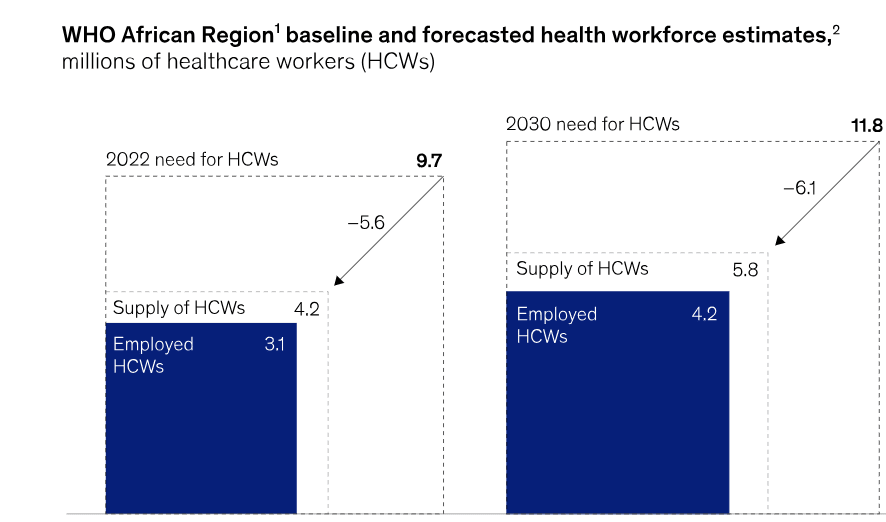
Africa’s health workforce paradox: via McKinsey
Fiscal space is one reason for this paradox. Many countries have yet to hit the 15% of budget spending as per the Abuja Declaration. A model by Asamani et al. showed that increasing health allocation by 1.5% can increase cumulative fiscal space for HWF by 38% in 11 countries. Another modelling by Asamani et al. showed that current investments into HWF must increase by 43% to eliminate unemployment. But this is overly optimistic; in reality, many countries spend more on debt servicing.
With these in mind, donating salaries seems like a good lever for rapid gains. I am, however, sceptical and wary of rapid responses to systemic issues like this one.
Sustainability concerns
What happens if/when donations stop? In 2009, Zimbabwe set up the Harmonised Health Worker Retention Scheme to reverse the emigration of clinicians and retain the current pool of workers. The scheme provided tax-free monthly allowances to doctors, nurses, environmental health workers, and laboratory technicians, with international donations making up the bulk of these allowances. Although there was a plan to phase out donations by 2013, an impact assessment in 2012 concluded that phasing the scheme required additional funding from donors. There were also suggestions that abrupt withdrawal could demotivate health workers and worsen staffing. In one report, it was said that “those receiving it were disillusioned and demotivated by the ‘phased reduction of the retention allowance and the impending total cessation’ “
In Liberia, DFID, in partnership with NGOs and the MoH, provided fully funded allowances for health workers. Although this was meant to be a 2-year programme (from 2005-2006), an assessment concluded that withdrawal could trigger loss of existing staff and increase the cost of services.
Malawi’s Emergency Response Human Resources Program (EHRP), one of the prominent examples of health workforce remuneration from foreign donors, also struggled with sustainability. An impact evaluation in 2010 recommended that donor funding be extended from 2011 to 2016. It was initially planned that the government take over top-ups from 2009, but the Malawian government did not meet this milestone.
Although donations in these countries reduced unemployment rates, sustainability challenges threatened long-term gains to their health systems.
Fungibility is a potential risk
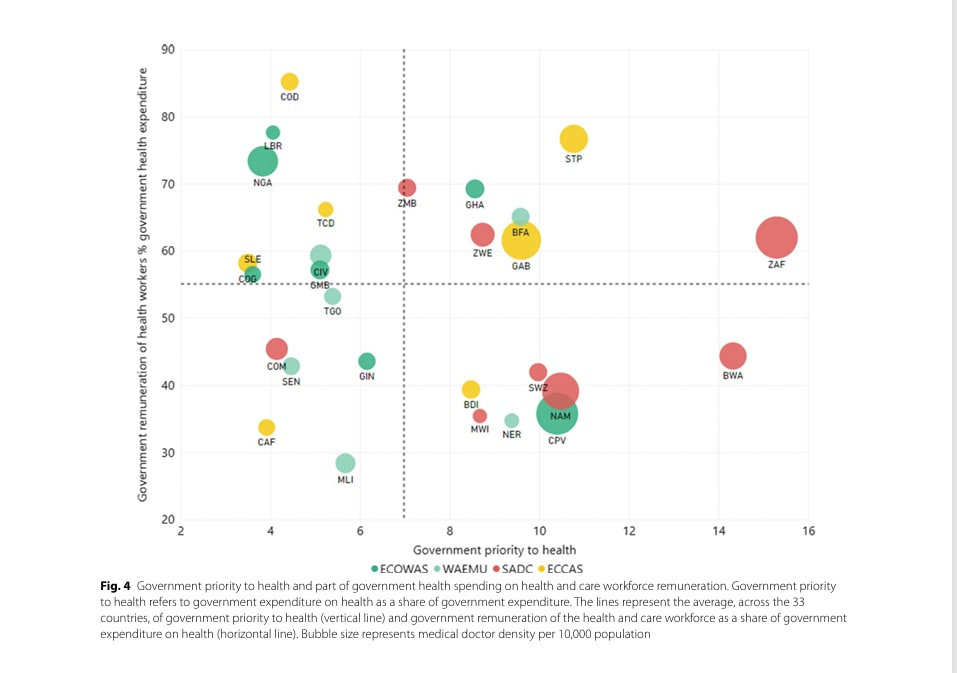
HWF spending in relation to general spending on health; source: Toure et al.
For countries in the top left quadrant (Nigeria, Liberia, Sierra Leone, etc.), which spend much of their small health budgets on salaries, donations may provide breathing room. But there is a risk of fungibility, i.e., governments may not spend more on health facilities or HWF. Fungibility is quite difficult to measure, but evidence suggests that the highest risks come from donations that go through government systems.
Nigeria’s Midwives Service Scheme of 2009, funded by debt relief and co-financed across the three tiers of government, was intended to absorb 2,488 midwives into 652 primary health care clinics. However, a lot of local and state governments failed to release stipulated allowances.
PEPFAR, designed as a co-financing mechanism, did not translate into more agency from the Nigerian government. Rather, over a 7-year period (2017-2024), funding from the US increased from 64% to 87%. What happened was that each year, the Nigerian government approved budgets for HIV response without releasing the funds.
The drastic aid cuts did not generate momentum. According to an investigation by the Premium Times, in 2025, the federal government approved N18.27 billion but only 31.2 per cent of the approved capital allocation was released. In 2026, the approved budget was N13.97 billion, but spending records show that less than 1 percent of the approved allocation was spent between January and May.
Donations may compound inefficiencies
For starters, health worker absenteeism is pervasive in a lot of the continent’s public facilities. The WHO had this to say: “Health worker absenteeism in Africa is not just a marginal inefficiency but a pervasive, system-level inefficiency significantly constraining workforce capacity, decreasing service access and could leak a significant portion of the wage bill.” Across multiple settings in multiple countries, prevalence rates range from 14-49%. Rates of perceived absenteeism ranged from 21-37% . Critical drivers are dual practice, poor pay and weak supervision.
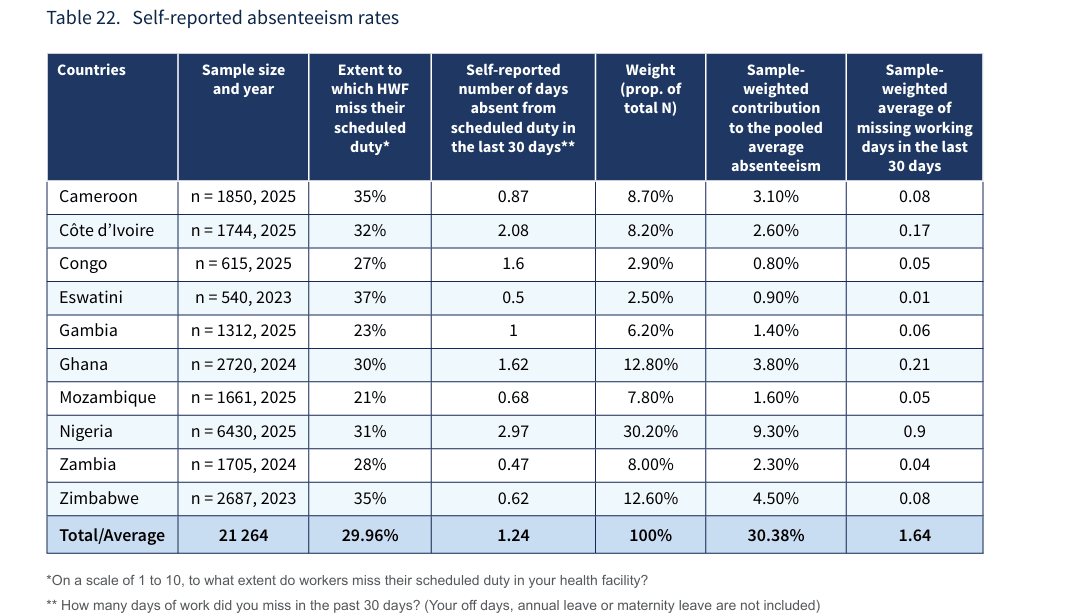
Source, WHO
Ghost workers are another plague. In my housemanship year, we were just 38 house officers. During my fifth year of medical school, there were about 150 house officers, about 3-4 in a team. Then it got to my turn, and there I was, manning multiple patients across different wards, on permanent calls, constantly caffeinated and dreading the day I plopped down dead. Where were the other 112? The word on the street was that “principalities”, under the protection of their party’s dominance, ran an elaborate scheme where they siphoned salaries of employed house officers. On paper, the hospital had more than 100 house officers. In reality, we were under 50.
Or consider Lokoja, where in March 2025, doctors in the tertiary hospital alerted the public to the hospital’s recruitment crisis. It turned out that the management contracted doctors only on a locum basis, without prospects for residency training, pensions, and other welfare benefits. After the alert, an undercover investigation by the Punch Newspaper revealed a sordid affair of ghost workers and embezzlement that culminated in the CMD’s summons by the House of Representatives.
A 2019 rapid review by the WHO included a case in Nigeria where upgraded HRH software uncovered 65,000 ghost workers. In Congo, HRH software and a MoH census showed that 25% of salaried health staff were ghost workers. In Kenya, a census failed to account for more than 3,000 salaried UHC workers.
Remuneration is not the only dominant lever
While remuneration is a dominant reason for retention/turnover, it is not the only one. In the same SLR mentioned above, remuneration is closely followed by meso-level drivers like career progression and work environment. Coefficient Giving points these out in their BOTEC.
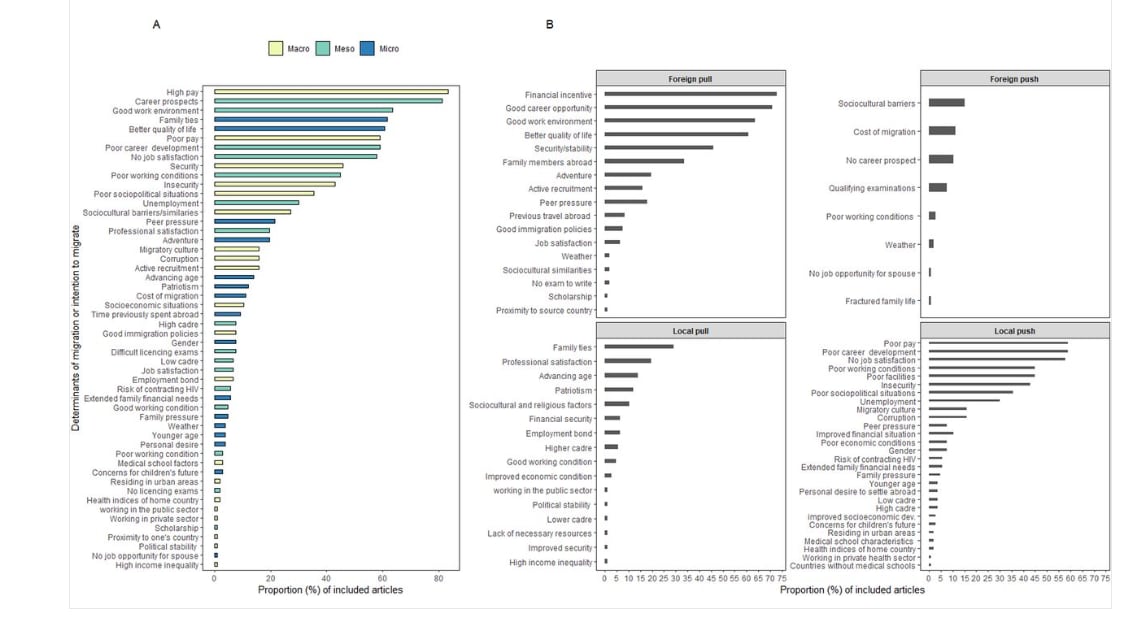
Source: Toyin-Thomas et al.
What happens if philanthropic capital pushes one lever but leaves the others? Like working conditions, for instance. Inadequate power supply, equipment, drugs, and other consumables make clinical care a drag for Africa’s clinicians. In my experience, chemical pathology blood work took, on average, 2 days; emergency CT scans were always done outside the hospital; and oxygen was scarce. These distressing scenarios worsen turnover.
Career progression concerns are just as valid. Early-career clinicians are the most vulnerable to unemployment. On the other hand, shortages are more acute in senior/specialist roles. What happens if all unemployed early-career clinicians are mopped up into health facilities but with no sustainable path to career progression?
Then there are structural constraints like facilities. Can current facilities absorb all unemployed staff? There is good reason to believe that they cannot. The WHO suggests a hospital bed threshold of 18-39 per 10,000 population. In Africa, the average density is 10 per 10,000 population. If clinicians are hired into broken facilities, the cost per service delivered can exceed the cost per worker.
So do we donate salaries for Africa's HWF?
Africa is not a monolith. I think the right question is "where are donated salaries the right levers" or better still, "what type of support do countries need?"
Consider this quadrant, for instance.
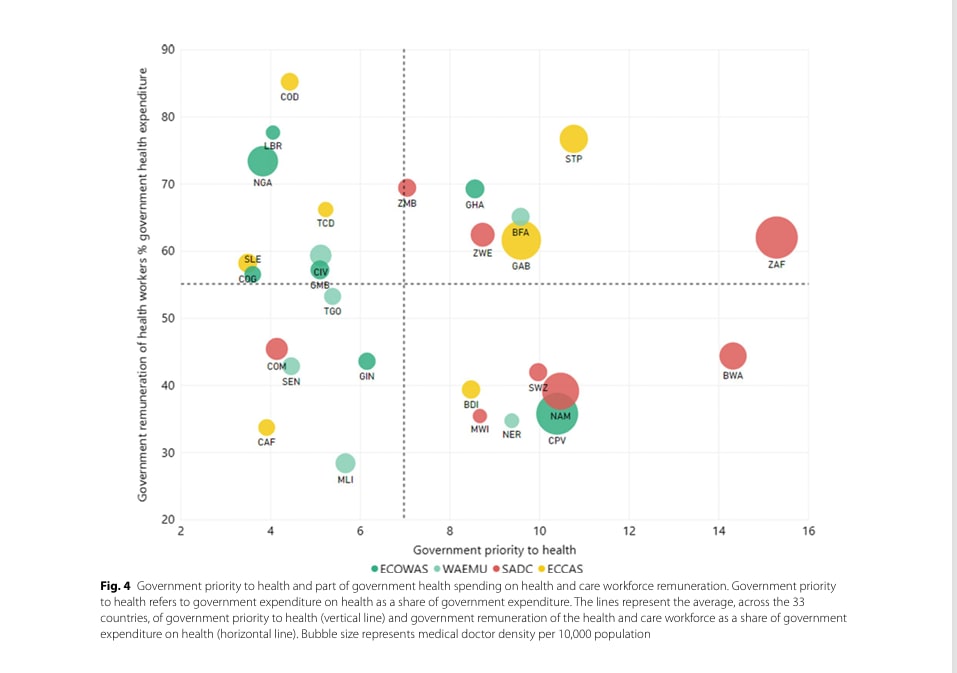
Source: Toure et al.
(The reference lines are the region's averages, 7% for health spending and 55% for HWF). Many countries on the left, i.e., those spending less than 7% of their national budget, are ECOWAS countries, while many countries closer to the recommended 15% of the national budget are countries in the Southern African Development Community. Furthermore, countries on the right side of the quadrant generally have a larger density of doctors (Nigeria is an exception).
Countries where salary donations may be unsuitable
For countries in the bottom right (spending more than 7% of their national budgets on health, but not yet hitting 55% on HWF), i.e, Botswana, Namibia, Cabo Verde (more cautiously Malawi, Eswatini, Burundi, and Niger), technical support for workforce planning and reallocation may be more useful than donations.
Countries at the top left (spending less than 7% of their budgets on health but more than 55% on HWF) may have the highest risk of fungibility. In relatively stable countries like Nigeria, Liberia, Sierra Leone, Côte d’Ivoire and Gambia, support for payroll clean-up, budget release tracking, and philanthropic support for debt-for-health swaps may be a better alternative. Fragile states like DRC, Chad, and Congo may require a different approach.
Countries where salary donations may be suitable
For countries at the top right (spending more than 7% of their national budgets on health and more than 55% on HWF), i.e., Ghana, Zambia, Zimbabwe, Burkina Faso, Gabon, São Tomé (South Africa is not included, upper-middle-income country), they may benefit from donated salaries. Here, a time-bound fund for unemployed skilled HWF may be suitable.
Lastly, for countries at the bottom left of the quadrant (with low health spending and low HWF spending), i.e., Senegal, Guinea, Comoros, and Mali, government takeover is highly unlikely. In this case, matching grants where donors pay, e.g., $1 for every $1 increase in the government's own workforce spending, may be a better alternative. In fragile states like Comoros, CAR, and Mali, this may be unsuitable.
In conclusion, let us by all means scale up end-user health technologies like bed nets, antimalarials, chlorine vouchers, and reading glasses. But for system-level problems such as health workforce shortages, we should be mindful of the many ways a large influx of money can distort or support existing health systems.
P.S. - I am currently sourcing grants for a 6-9 month research and ecosystem mapping project for an effective regrantor focused on system-level levers for private philanthropic capital in West Africa's health sector.
With the grant, I will run surveys, interview local experts, build an SROI funding benchmark, and map the current ecosystem of local change agents (I am starting with Nigeria). You can read my thesis here. If you want to know more about the project, you can book a #1-1 or send me an email.