Comments
I used AI while writing this, though I have spent 5 - 15 hours on it and I take responsibility for every word and all numbers.
Every time there is a report of sexual harassment within EA there is a lot of introspection. I want to push back on this, not to dismiss the experiences described, which sound genuinely painful, but because I am unsure the evidence supports the belief that EA is uniquely bad here.
So what do we know? In 2022, CEA's Community Health team reported handling around 19 interpersonal harm cases the previous year, ranging from uncomfortable interactions to serious allegations, across a community of thousands. On my read, 3–6 of those 19 clearly involve sexual misconduct across a community of 4,700–10,000 EAs, putting a narrower rate at around 0.03–0.13%.
Alongside this there have been perhaps 3–5 high-profile public cases on the Forum in the last five years. The TIME piece in 2023 cited 7 women, though at the time it was disputed how clearly the cases related to EA. These data don't seem clearly outside of the above range.
The cleanest peer numbers come from universities' Title IX offices, which publish annual case counts. Harvard, Stanford and MIT report disclosure rates of roughly 0.6–2% per year, and formal-investigation rates of around 0.09–0.17%. EA's reported rates sit below university disclosure rates and at-or-below their formal-investigation rates.
A McKinsey workplace survey produces much larger percentages (~1–5% annually, derived from career-lifetime rates of 35% reported in LeanIn/McKinsey 2024). But surveys measure lived experience; CEA's 19 and universities' Title IX figures measure reports filed to a central body. The chart below gives all of these rates with lower and upper bounds.
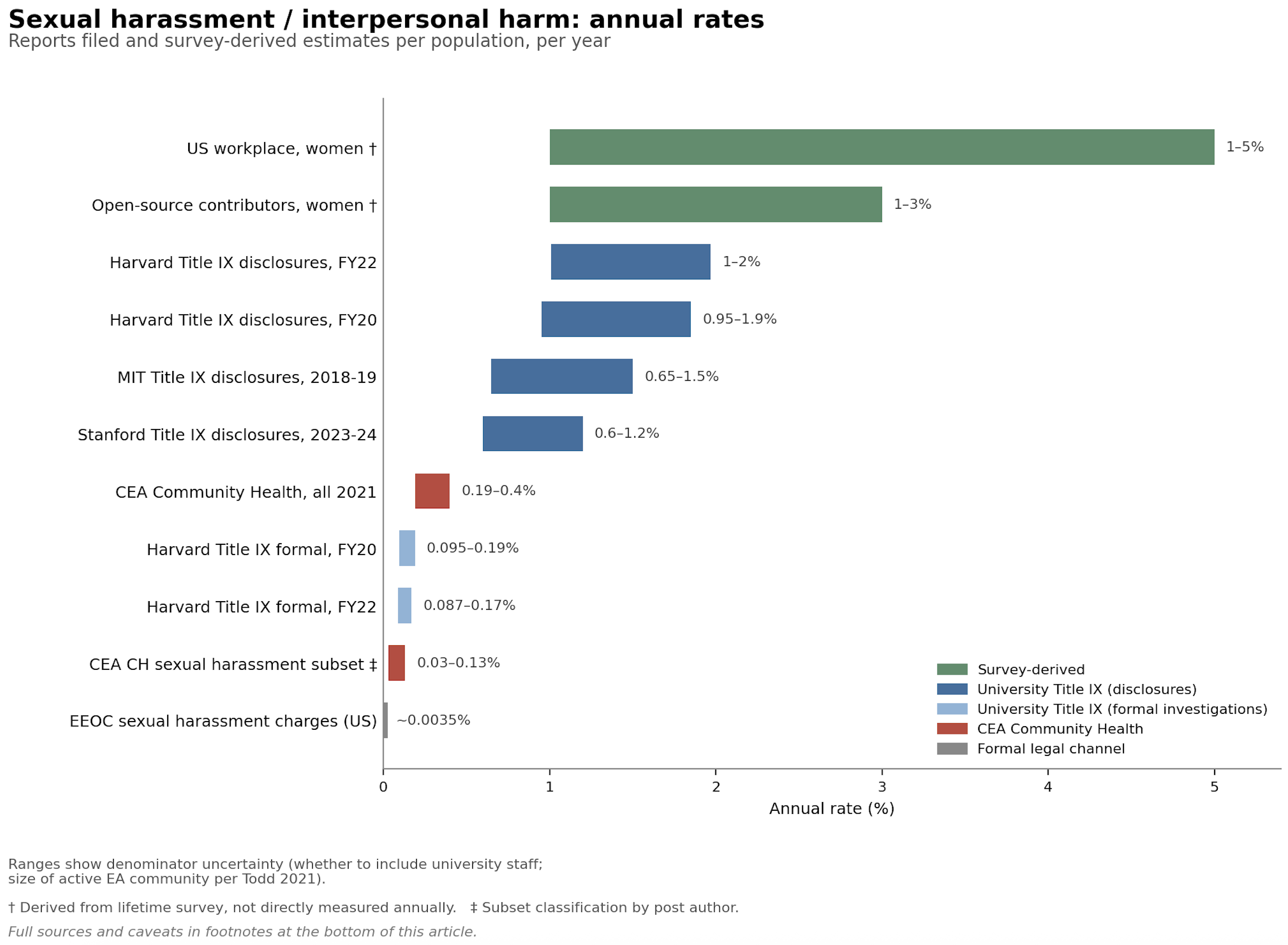
Full sources and caveats[1].
In contrast to this, many EA forum commenters seem to believe that EA is unusually bad in some general sense[2]. These are examples of comments are widely upvoted and agreed-with. I give them as evidence for a certain widely-agreed belief, but this is not a systematic review:
Funnily enough, I think EA does worse than other communities / movements I'm involved with (grassroots animal advocacy & environmentalism).
Comment (karma 92, agree 54 / disagree 11)
Thank you for speaking up—it takes a lot, especially when women in EA often face such unproductive engagement for doing so
Comment (karma 118, agree 28 / disagree 1)
there is still such a pervasive culture of sexism.
Comment (karma 41, agree 11 / disagree 0)
The EA community has a significant undersupply of information from victims of abusive conduct, since the victims are often branded as 'triggered' or 'irrational'.
Comment (karma 20, agree 14 / disagree 2)
And here are another set implying that broad cultural change is required to fix this:
MY RECOMMENDATIONS
...create systems of checks and balances that do not allow for conflicts of interest to enable biased decisions...
...Create some kind of educational content around how to be a good ally to victims and how to identify bad situations so people can intervene...
...Identify when situations involve biased actors and correct by introducing unbiased actors...
...Hire an external arbiter...
...please work with [J_J]...who has been doing grassroots justice in the Bay Area for some time now.
Comment (karma 47, agree 21 / disagree 7)
I'm a little concerned by the lack of response from org leaders (unless I missed something), and I think there's a risk that CEA leaders and others might under-update from this
Comment on a report of sexual misconduct (karma 46, agree 22 / disagree 3)
Thank you for flagging the aspects of our ecosystem's culture that we need to be extra mindful of.
Comment on a report of sexual misconduct (karma 26, agree 11 / disagree 6)
While writing this piece and rereading many of the comments on such articles I can only recall one widely upvoted comment which pushes against this notion:
Women who identified as EA were less likely report lifetime sexual harassed at work than other women, 18% vs. 20%. They were also less likely to report being sexually harassed outside of work, 57% vs. 61%.
... Overall I am not sure that anything can be concluded from these results either way.
Comment referencing an SSC survey (karma 143, agree 20, disagree 5)
So overall I claim there are lots of widely-upvoted comments that imply EA is unusually bad and few that dispute it.
When anecdotes and data disagree, there is often something wrong with the data[3], but I am confused about what's happening here. By way of example, I went to university in Durham, which after making sexual assault reporting easier, was ranked at or near the top of UK universities for reported sexual assault for the next few years. ie their ranking got considerably worse after they took steps to improve things. Was Durham culture bad in 2011? In my view, yes. Was Durham notably worse than other UK universities? I don't know. How sparse reporting and anecdotes link to the overall picture is a generally difficult problem in sexual misconduct reporting.
As for EA, there are multiple stories that fit the data we see:
So I would like more data. CEA's Community Health team conducted a Gender Experiences Project in 2023 with ~40 interviews and analysis of survey data. I am unable to find any published outputs. There are ways we could distinguish between these hypotheses and try and generate a story where the data and anecdotes are less in conflict.
But until we do, I am not currently convinced by the "EA is unusually bad" hypothesis which many commenters seem to believe. A majority of those who engage with posts about sexual harassment seem to implicitly agree with this hypothesis. I am unconvinced by it. If we imagine a community of thousands of people which was excellent in this area, I still would expect some awful accounts. If I saw this data and these accounts about another community, I think I'd think "they are probably better than most communities".
What's more, we as EAs generally want to communicate accurately about things. If the rate was previously at the lower end of normal bounds (and has probably fallen since), then this community is not abnormally bad, and we should discuss the issue accordingly. And suggested community changes should discuss tradeoffs.
I am not the ideal messenger—I don't consider myself particularly sensitive on these issues. Some will feel this isn't the right moment. I have no interest in litigating specific cases in the comments. But we of all people know the value of scale. Commenters regularly discuss this as if the community is unusually bad, requiring broad cultural change, and those arguments deserve a response.
Chart notes:
General notes on the ranges. The bars upper and lower bound comes from denominator choice, not numerator uncertainty. For the universities, the lower bound of the denominator counts students-only + academic staff), the high end adds non-academic staff (security, dining, facilities, admin); a much larger denominator that drags the rate down. For the CEA Community Health bars, the range is based on community size estimates. For the two survey-derived bars (US workplace, open-source contributors), the range reflects the conversion from lifetime to annual rate; † on the chart flags these. The EEOC bar has no range because both numerator (charges filed) and denominator (US workforce) are fixed annual figures.
US workplace, women. LeanIn.org and McKinsey & Company, "Women in the Workplace 2024: The 10th Anniversary Report" (full PDF). Derived from lifetime survey responses then turned into an annual rate; not a directly measured annual rate.
Open-source contributors, women. GitHub Open Source Survey, 2017. Derived from lifetime survey responses then turned into an annual rate; not a directly measured annual rate.
Harvard Title IX disclosures and formal investigations (FY20, FY22). Harvard Title IX and Office for Dispute Resolution annual reports: csndr.harvard.edu/data-dashboard; FY22 coverage in The Crimson. Denominator (lower bound: students+ academic staff; upper bound: students + academic staff + non-academic staff).
MIT Title IX disclosures, 2018-19. Title IX & Bias Response annual report, 2018-19 (PDF); current Institute Discrimination and Harassment Response Office; Title IX annual report archive. Denominator from MIT Facts; range follows the same students and academic staff vs students and all staff.
Stanford Title IX disclosures, 2023-24. Stanford SHARE / Title IX annual reports: 2023-24, 2022-23; Stanford Daily coverage of the 2023-24 report. Denominator from Stanford Facts; range as above.
CEA Community Health, all 2021. Julia Wise, "The community health team's work on interpersonal harm in the community", EA Forum, 18 August 2022 (CEA mirror). Range reflects active-vs-engaged community-size estimates (~4,700 to ~10,000), per Todd 2021.
CEA CH sexual harassment subset. Same source as above. The subset count is my own recategorisation of the 19 cases Wise enumerates in that post; there is no separate source.
EEOC sexual harassment charges (US). EEOC, "Sexual Harassment in Our Nation's Workplaces"; EEOC Select Task Force on the Study of Harassment in the Workplace, June 2016. Workforce denominator from the Bureau of Labor Statistics Current Population Survey.
One might agree that EA is only bad at handling cases or has bad 'vibes', but when finding these comments (and there were many more) they often seem to say EA is bad, and rarely seem to give caveats. My read is that there is a general sense across the topic of sexual harassment that EA is unusually bad and that broad cultural change is needed. I'm not claiming everyone thinks this. If you can find several widely upvoted comments which push against these or provide caveats, let me know.
"When the data and the anecdotes disagree, the anecdotes are usually right." Jeff Bezos
I tried to choose comments and posts that were narrowly about the topic such that upvotes were related to this.


(I made an anon account to post this; I'm a longtime EA and Forum user).
The discussion in the comments so far focuses on two claims:
I want to discuss this second point from my perspective, as a woman who's been in EA for some years.
Here's an analogy:
Often, I hear the criticism of EA: 'man, they have bad epistemics and huge problems with groupthink.'
I sort of agree. I can list many instances where I think EAs are driven by groupthink and social incentives in our beliefs, rather than rigorous epistemic standards.
But, I sort of disagree.
That's because I can't think of any community [1] that does better on epistemics and groupthink than EA. Everywhere else I am vaguely involved, the groupthink is way worse, and they have very narrow standards for "acceptable" beliefs. In fact, in most communities, you can't even discuss epistemic standards at all without getting yelled at or dunked on!
I feel like it would be very reasonable for someone to approach EA like:
Ooh, I should be looking out for places where there's potential groupthink, and views driven by status rather than evidence.
But I think it'd be unreasonable for someone to approach EA like:
Damn, EA is a community where there's rampant groupthink — I should be suspicious of views I hear from EAs, moreso than views I find elsewhere.
Partly, that's cause the views you find elsewhere will also have those problems — and are actually likely to be even worse on the very metric of groupthink!
... So to bring it back to sexual harassment:
The reason it matters to me whether EAs believe that EA is above or below baseline on the rate of sexual harassment is that if EA is above baseline, then it'd be very reasonable for people to approach this community like:
Damn, EA is a community where there's rampant problems with sexual harassment — I should be suspicious of whether there are sexual harassment issues at play here & how they're being dealt with, moreso than in everyday interactions.
But if EA is in fact below baseline, then that's an importantly unreasonable response. That is, everyday interactions would have a higher likelihood of sexual harassment and poor responses to it.
I think it's good for people to be cautious about the risks of sexual harassment. But [2] I don't think it's good for people to feel like EA is a place where there are very high risks.
I do think there are unacceptably high risks — in the sense that I do not think any harm is "acceptable", and we should strive to create a world free from suffering — but it doesn't follow that an appropriate response is suspicion of EAs in particular.
[This comment is already really long, so I'm loath to add length, but the main response I anticipate is 'people aren't saying they're suspicious of EAs moreso than others, they're saying they're suspicious of EAs simpliciter.' I agree, but I think the net effect of these comments and discourse and the meme that EA has a sexual harassment problem is to make people suspicious of EAs moreso than others on this metric, and to make women in this community very afraid of sexual harassment, and to make men in this community very afraid of being a sexual harasser. I just think that's unreasonable if they don't also have that attitude everywhere else in their life — which I think is what's happening, based on anecdote / personal experience hanging out with EAs]
[1] Any community of a vaguely comparable size — obv a community of a dozen, or even a hundred or so could do much better. Also maybe rats are better but TBH I'm not totally sure.
[2] And now I show my hand... I do in fact guess that EA is better than baseline, based mostly on my personal experience dealing with sexual harassment inside and outside of EA :)
I was about to write a very similar comment.
Concretely and practically, if the EA environment is unusually predatory, I should warn women I know against applying to jobs in EA or attending EA groups/events, or at least inform them that they would be at risk.
If the EA community is safer then the counterfactual (for which country-level base rates are a reasonable default) then I shouldn't (if only because doing so would put them at more risk.)
So this would be a decision-relevant thing to know about, but as you mention I'm not sure it's tractable to get this information.
Thank you.
The discussion in the comments so far focuses on two claims:
- We can't easily tell from this data whether EA is better or worse than baseline
- I agree, though I do think it's some evidence we're not much worse.
- Why does it even matter whether EA is better or worse than baseline? Community members are welcome to hold EA to a much higher-than-baseline standard, if they want to.
Yes this seems right and hope it's a thing people will take forward.
I think the fact that these issues are more openly discussed in EA than in comparable sectors can skew the discourse. If you don’t regularly attend EA events, it’s easy to think that all of the community health resources suggest an extreme problem with sexual harassment, as opposed to a proactive approach to preventing it. That said, these resources being available can make it more surprising when specific cases are not handled well.
I work in DC. The bar is so low here that it took months of public pressure for one person to see consequences for harassment that led to his staffer committing suicide by lighting herself on fire. In day to day work, it’s normal to get groped by tipsy old men at work events, and dealing with it gracefully is basically part of the job.
This is anecdotal, but something similar happened once at an EA-ish AI policy event (though by a sober, less elderly person). I mentioned it to the organizers in case other people were having issues, and the response was much more helpful and proactive than anything I would have expected in industry.
I would rather have people expect more from this community and be shocked when harassment happens than have people become jaded because other parts of society are willing to put up with worse working conditions.
I have comments, if you're interested.
Happy to hear your thoughts.
I should clarify that I wrote this as someone who left a very EA bubble and came back after working in spaces that were remarkably worse. I agree with other commenters that we should aim to be better than the baseline. Regardless of where we fall on general harassment levels, I appreciate the community’s efforts to address issues as they happen.
Personal anecdote: multiple members of the CEA events team called out a vendor for behavior that I didn't think to report as harassment. They proactively looped in HR and offered to negotiate this person’s exclusion from future event contracts at the venue. I was shocked, given my other recent work experiences.
This response didn't erase the initial interactions, but it made the rest of the event (and future events) so much better. I want everyone to feel like they are working on a team / in a community that cares about them, even if making resources visible causes some people to think we have an outsized problem with harassment.
I am not currently convinced by the "EA is unusually bad" hypothesis which many commenters seem to believe.
I disagree with you. In my experience, EA has historically been unusually bad about this. And even though I think your quantitative analysis is poor, for reasons I'll get to, I agree there may be an anecdote/data discrepancy. I think this stems from ambiguity about what counts as sexual harassment within the EA community, which suppresses reporting of potential instances.
Within the EA community, there's historically been ambiguity regarding what counts as appropriate/inappropriate behavior. This ambiguity stems from the fact that EA is both a social and professional community, and it's not obvious what should count as sexual harassment in the context of a community that is both social and professional.
My view on this is that some behaviors that should be considered sexual harassment at an EAG should not be considered sexual harassment at an EAG afterparty. But these lines can be hard to draw. As a result, I think much of the sexual harassment issue within the EA community essentially boils down to: people applying the social rules of engagement to professional contexts, where those rules aren't appropriate. For instance, I've been hit on (e.g., flirtatious DMs on Swapcard, aggressive eye contact across the room, 1-on-1s where the other person seemed to only want to talk about personal matters, conversations involving inappropriate questions ("what's your type?"), walk-meetings that turned into one-sided flirtations) at > 50% of the EA conferences I've attended (n ~ 10). To be clear, I think these kinds of behaviors can be appropriate at EAG afterparties (assuming you aren't being rebuffed), but at a conference, they aren't appropriate. And as far as I can recall, these things have literally never happened to me at a non-EA professional conference (n ~20). Thus, in my experience, the EA community has been much worse with respect sexual harassment compared to other professional communities, though I do think that things have improved in recent years. (And kudos to the Community Health Team for their work to clarify rules around this; e.g., regarding Swapcard DMs.)
Importantly, I have reported zero of these instances to the community health team; there are several reasons for this, including some standard ones: (1) each instance felt minor, (2) it felt like reporting would be more trouble than it was worth (time-consuming, burdensome), and (3) I want to maintain relationships with some of these people. But there's also a big reason that I think is somewhat specific to the EA community, and likely the biggest driver of my failing to report, which is (4) it was not clear to me (at the time, and in some cases, even now) that certain behaviors were inappropriate, because given the social/professional blurring of lines, I wasn't sure what the rules of engagement were. In most cases, the offending party was also more embedded in the EA community than I was, so I assumed that what they were doing was allowed. In other words, I assumed the EA community had a relatively restricted definition of sexual harassment for its professional events that didn't include things that would be considered sexual harassment in other professional contexts. I think that I was probably right about this, but that we've decided as a community in recent years that our definition of sexual harassment should be closer to the standard definition employed in other professional contexts. (Importantly, if these kinds of behaviors had happened at a non-EA conference, I would've immediately known they weren't allowed, and thus would've been more likely to report.)
Separately, I also don't think we should draw ~any conclusions from your quantitative analysis. Because the definitions and measures of harassment differ across the data sources you cite, charting them on the same axis ("annual rate") constitutes bad analysis. You're not comparing the same things. As an analogy, this would be like plotting "poverty rate" on the X-axis but not accounting for differing poverty thresholds across countries, let alone how information on poverty is collected (surveys vs tax documents vs news reports).
Thank you for sharing your experience, and I'm really sorry you had to experience this.
Writing the below not as a response to you, but for other readers.
(1) each instance felt minor, (2) it felt like reporting would be more trouble than it was worth (time-consuming, burdensome), and (3) I want to maintain relationships with some of these people. [...] (4) it was not clear to me (at the time, and in some cases, even now) that certain behaviors were inappropriate
I recently reported a minor concern to the community health team and it was surprisingly straightforward, they have a form here: https://www.centreforeffectivealtruism.org/community-health/contact-us with a text field and everything else is optional
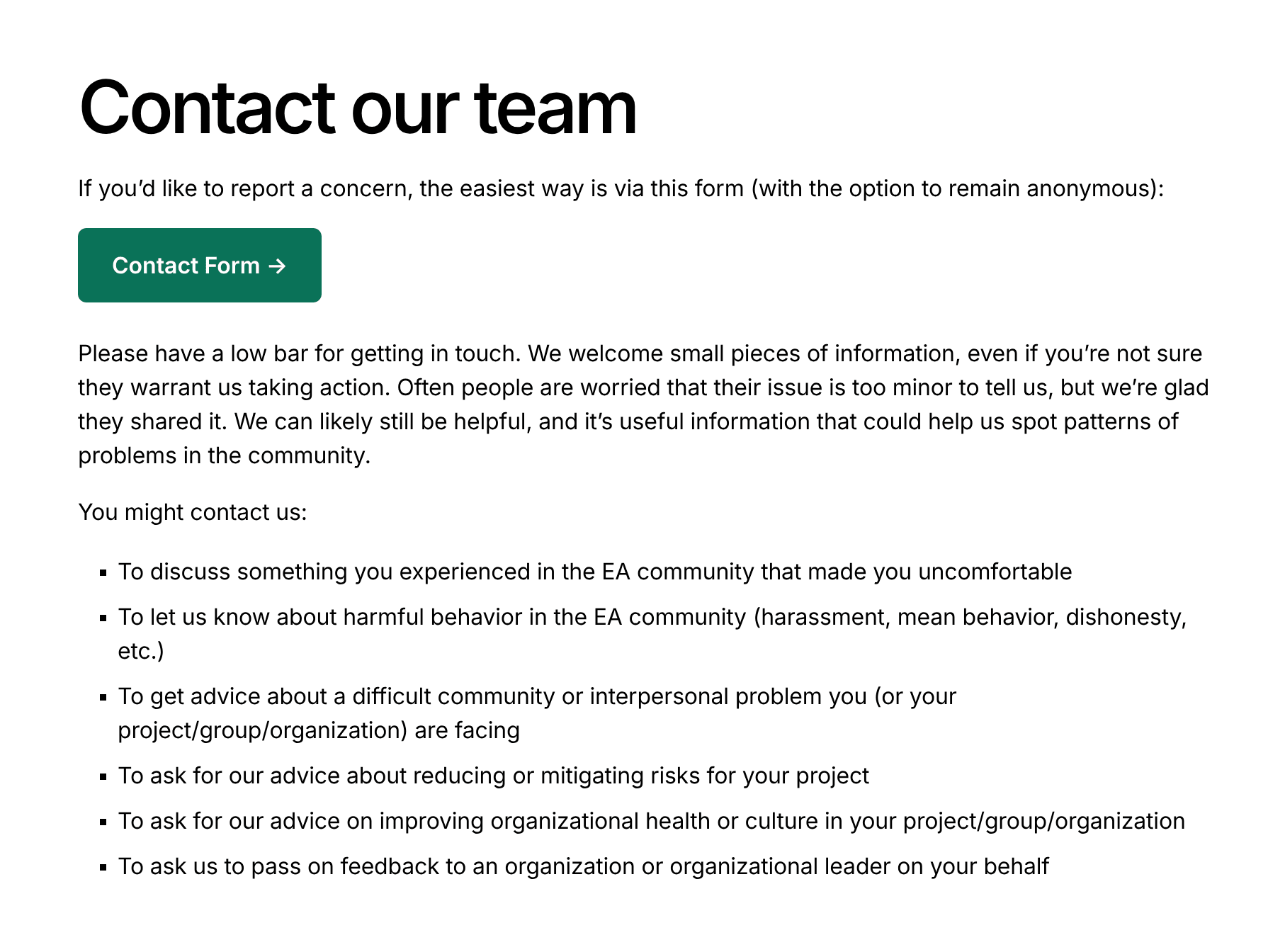
CEA has been investing between 5 and 7 FTEs (including fairly senior ones) for years in their community health team, which is several million dollars in salaries and opportunity costs, so my sense is that they really value these reports. The page starts with:
Please have a low bar for getting in touch. We welcome small pieces of information, even if you’re not sure they warrant us taking action. Often people are worried that their issue is too minor to tell us, but we’re glad they shared it. We can likely still be helpful, and it’s useful information that could help us spot patterns of problems in the community."
That said, for me it was possible to report things anonymously, I realize that's not always the case.
1-on-1s where the other person seemed to only want to talk about personal matters
I also had this happen several times, and while it was never flirtatious or anything close to harassment, the first time I found it really frustrating, and I wish there was a stronger norm about being clear if you're requesting a social 1-1 instead of a professional/impact-focused 1-1
I appreciate the straightforwardness of this comment. Feels clear that we actually disagree.
I feel like I see comments as a natural bid to discuss things, but maybe you don't.
I guess there are some things that we could discuss but that I'm not gonna bid for here.
Were we to chat, I think the area I'd like to start is here "I do think that things have improved in recent years". So even with this improvement you think that EA is still significantly worse than other communities?
One thing I'll add which I haven't seen in the comments is some of the vibe of 'EA is unusally bad' is that EA is probably unusually bad in some ways due to the makeup and culture of our community, and less bad in others. Bluntly I think much of this comes down to things like being worse at reading social cues, a high male to female ratio, and a community that is an unusual mix of professional and social network.
I get the impression from female friends that being in EA means tolerating, for example, a lot more being hit on in unprofessional situations (e.g. EAG) down to creepier contexts, with the men missing being rebuffed multiple times.
This doesn't discount your main argument Nathan, but to the extent that people complain about EA being worse, this might be what they're pointing at some of the time.
I also agree with others' comments that a lot of this conversation is about how EA is 'bad' rather than 'worse', and that as community builders we want to do better, even if we're already above average.
Hey,
And if someone makes a comment which implies that EA is unusually bad and you replied "actually EA is comparable", do you think that would go well? And if not, do you think this might be biasing how we think about things?
To your questions, depends on the person. Definitely some people and contexts where it would go poorly. And yes I do think you're pointing at something that is probably true, but see my other comment, I think the risk of biasing things in these conversations can go both ways.
So maybe you agree that it's common to see poeple imply that at least some aspect of EA is unusually bad. And you think that often to say that EA isn't unusually bad would go poorly in some contexts.
Can you tell me how the risk of biasing goes both ways? Cos currently I only see one way it can be biased. ie people are often employ slightly hyperbole and sometimes refrain from moderating because it would go poorly. Both of those point in the same direction.
In what circumstance are we going to underrate the harms here?
This isn't a symmetrical issue, but the risk of saying 'EA is no worse or even better than some reference class' in relative terms is sorta kinda like 'sexual harrassment in EA is not that bad' in absolute terms.
From speaking to some friends it seems like the many minor and occassional major harrassment incidents, and ways EA is unusually bad (e.g. misreading social cues and intense professional/social overlap), these 'not that bad ' issues might be burnout, leaving EA, needing to quite one's job, panic attacks, which doesn't even take into account all those people less able to do good in the world as a result.
Do you think it would be better for us to talk about this more accurately if we could avoid the pitfalls you see. Like we could acknowledge the specific areas where things are worse but also some where it's better?
And would it be good to compare that against other communities to give some sense of perspective and what might and might not work?
I agree that often "EA is unusually bad" isn't grounded in data (often instead in first person accounts, although I'd note that if we assume reporting infrastructure won't capture things well, that's actually where most of the signal lives). I'm pretty skeptical that we should conclude from this data that EA isn't unusually bad.
Others have made similar points but just at a high level, my concerns when comparing to the other data (e.g. Title IX) would be that we are biasing both the numerator and denominator of the reporting rate in a way that biases us to think we are doing better than we are.
I basically think errors here aren't random so your number here is a reasonable lower bound but I'm not sure it provides insight into the overall rate.
I'm pretty skeptical that we should conclude from this data that EA isn't unusually bad
Can we move to a position where we are more uncertain on EA's badness? And where we discuss it in those more uncertain terms?
On the second point, what is a more accurate estimate of the EA rate, in your view?
I'm not really convinced by your evidence that there's a widespread belief that EA is worse than other communities. Your first quote clearly says this, I grant. The other quotes seem to me to all be saying something more like "this community has this problem", and "I wish this community was better / had hoped that it would be better", without saying "we are worse than relevant comparisons", much less "we are worse than relevant comparisons because of intrinsic aspects of our culture".
FWIW, my belief, and I'm sure I'm not the only one, is more like: EA handles this badly, but also handling this badly is widespread. I don't think I've ever been in a community that I was confident had a good answer for this. EA should address this within its own community, because that's where we understand what's happening best and have the best tools for addressing it. This is true regardless of whether EA is worse, the same, or better than its peers: it's true for as long as it seems feasible to do better than we're doing.
In the end, interventions should be decided on their merits, and I think we should tip the balance away from the abstract and towards the concrete questions of what specific things we should or shouldn't do.
Hey,
I found lots and lots of comments, but to me it is so obvious that these people implicitly believe this that I struggle to argue the point. What about the comments on this article?
Thanks for questioning the common narrative even though it's awkward!
I'm pretty skeptical that we should conclude from this data that EA isn't unusually bad.
What we can do is look at the responses to the incidents that do get raised, and the experiences of victims, and judge whether or not they live up to the standards we want to see in a group that takes sexual harrasment seriously. I do not think the grades are very good on this front.
Currently about half of the comments disagreeing here seem to espouse the view that the community is bad. I expect those comments to be upvoted and agreed with. Am I reading them wrong? Do you think they are unrepresentative of the forum community at large?
I might get on to your second point in a bit.
I think you're reading some of them right, and many of them wrong, because you seem to continue to be equating "EA's performance on this issue makes me sad" and "EA's performance on this issue is worse than peers". Some people believe both for sure! But you keep including people saying the first thing as if they're saying the second. "Currently about half of the comments disagreeing here seem to espouse the view that the community is bad." -- again not distinguishing between "bad" and "worse".
Honestly my guess would be that most people don't have a clear considered belief on the comparison. They see bad behaviour and they object. It's not obvious to me why they would feel the need for a belief on the comparison. Whatever it is, the bad behaviour is still objectionable.
I hear you as pushing in a direction of "maybe we can't do anything about it, because no-one around us has succeeded in doing better". And, well, maybe! But I think this is a weak heuristic as compared with thinking directly about whether we should have stronger codes of conduct at EA conferences, or whether we need to develop more training resources or other support for orgs that are too small to have a proper HR function, or what stopped CEA from acting on what seems like clear evidence of inappropriate behaviour.
Can we stick on whether I am reading them right? Which of the three comments that I quoted do you think doesn't imply that this community is unusually bad here?
I think the third one most clearly. Doesn't suggest that other communities successfully take sexual harassment seriously, to my eyes.
Only 3 months ago we had a writeup detailing a shockingly terrible response to sexual harrassment by one of the most prominent EA orgs out there. The response is far worse than anything I've ever seen at any organisation I've ever been in. This indicates to me that the environment is nowhere the high standards that should be aimed for.
Regardless of the actual base rates, the question that matters the most is whether there is room for improvement, and I think it's blindingly obvious that the answer is yes.
You don't think "shockingly terrible" and "far worse than anything I've ever seen at any organisation I've ever been in" imply that EA is worse?
Seems there is a pretty clear comparison between the handling of an incident and how other communities would have handled it.
I agree they are saying that there is "room for improvement" and they seek not to discuss base rates. But I think there is implicitly a view that EA is unusually, unacceptably bad here.
"shockingly terrible", no, that's still not a comparison.
"far worse than anything I've ever seen at any organisation I've ever been in" -- this one is a comparison! (In my defence I hadn't seen titotal's comment when I made mine.)
But here it doesn't make a lot of sense to me to respond to that comparison with "where's your evidence?" or "what about Durham?". It's clear where the comparison is coming from, and it's clear that it's not about base rates, it's about one specific org and a specific thing they did, and it's specific about what standard they're held to. Are you saying that it's the wrong standard?
So you now seem to agree that all comments I pointed at do in fact imply that EA is unusually bad in at least some way.
Now if I could find 10 or 20 such comments, and only 2 or 3 that push back, would you agree there is a general vibe that we imply that EA is unusally bad, even if that's not what we literally believe?
I think that one comment mint have a specific meaning. But if there are 10 or 20 then maybe there is a general view which informs them. In this case, that general view is that EA is in some way unusually bad (or perhaps, to shift slightly, that it's fine to say this, even if we don't believe it).
You quote me in this reply and so to clarify, I do think you're misunderstanding my comment. I don't know whether or not EA is uniquely bad. I can speak to my personal experience on this but as I say in the comment, I think there are lots of reasons as to why determining this is really difficult. My comment was intended to point out the issues I have with the approach in the post, not to make a positive case for EA being bad.
Basically, "we shouldn't conclude from this data that X isn't Y" isn't a claim for "X is Y."
You're right that strictly, "skeptical we should conclude ¬P" isn't the same as asserting P. But I do think it carries implicit signal: people who push back on a conclusion of ¬P often aren't ambivalent on the point. If you'd written "I don't think we can conclude either way", I'd have agreed with you. That is one of the points of my piece
So I do think your phrasing is evidence of something, even if not a positive claim. And that "something" is the discourse pattern I am pointing at.
One of my comments is cited in the section about there being a wide belief in the EA community, so I can provide my personal perspective, as well as comment more broadly.
While other people have already pointed out that your comparison chart has methodological issues, which I agree with, I don't think this is a crux. While I think communities and spaces can never reach a state where there are no bad actors, or where no one does or experiences harm — I very much don't think this means harm is okay (which I'm sure you agree with), or that our response to harassment might somehow matter less if it turned out our community did better than 'baseline'. I was personally very disappointed by how CEA handled the recent harassment case, and my issue isn't that I think CEA should somehow have created a work environment where nothing bad ever occurred, or that CEA has more HR violations than baseline, but instead that it should have — bare minimum — taken reasonable steps to prevent the harassment, as required by UK law. In this case the number of incidents isn't the issue, it was how the specific incident was handled.
Regardless, I think sexism isn't something that ends at, or is only a problem in the context of, the legal definition of sexual harassment. Workplaces and college campuses have a legal obligation to prevent harassment, but the EA community exists in and goes beyond those spaces (such as an EAG afterparty, or twitter/facebook discussion threads). Sexism isn't just a failing to meet a legal standard, just like doing good isn't defined by donating to 501(c)(3) organizations. EA is a community that is dedicated to doing the most good, and has strong norms around truth seeking and respect — sexism and harassment are inherently not those things, which is why I think EA is ideologically opposed to them. As with any community, some parts will be better and some parts will be worse — but I think we have an obligation to aim for The Most Good You Can Do, and for me that obligation doesn't end once we close the cost effectiveness analysis spreadsheet. I think we as a community aspire to being the best we can.
While we could have a conversation about how harassment/sexism reduces the ability for EA to be an impactful movement, I also think we should act with virtue in our conduct, and that we have certain deontic obligations. Especially in recent years I think many within EA hold these views, even if it's not from a pure 'impact maximization' justification (I think many EAs would be quite horrified if it was somehow the case the EA movement was producing a lot of positive impact, but also was intentionally allowing harassment to occur). This is why I think the specific rate of harassment within EA is not a crux — clearly there are ongoing issues, even if the true rate of incidents was lower than whatever you think the reference class should be.
I imagine many of the people you cited feel similarly. The rate of harassment is only part of the conversation — I don't think the question of 'is the EA community bad at handling harassment' can be answered with just a comparison between reporting rates by communities. Given we are a community dedicated to doing good better, it feels almost absurd if the community were content with being at 'baseline' for harassment and our response to it.
As I said in the article I don't intend to discuss specific cases. If you wish to, sadly I'm not going to be of much use.
I agree that even if we were better than baseline it still might be worth doing more. But wouldn't it be worth acknowledging we were better than baseline?
So do you agree with the following "EA may be as good at dealing with harassment as a top american university, but we have higher standards than that"?
Thanks for writing, Nathan! I think there are two separate arguments: one says that EA is doing worse than baseline, and the other is that EA is doing worse than our shared -- sometimes implicit -- community standards. It's fair to ask people to chart their expectations against baseline for almost anything, but it's also fair to establish community norms above baseline. Some of the comments you quoted (inc. one of mine) are critiques relying on the higher standard.
While I intend to discuss this with Pete directly, my general objection is that commenters don't discuss this as if EA is seeking to have a much higher bar and failing. They mostly discuss it as if EA is unusually bad.
If there is general agreement that EA has a much higher bar I would expect to see widely upvoted comments saying how much better EA is than comparable spaces even as it still has work to do. I don't see that.
I think the absence of particular harms is easy to overlook, in all sorts of areas, especially in a space focused on identifying tractable problems, so I wouldn't update the same way based on lack of positive discussion. I'll happily go on the record and say (as a woman) that I've had much, much better experiences in male-dominated EA spaces than male-dominated non-EA spaces.
Okay :)
And what about EA compared to typical workplaces/ university spaces?
So in your head you are aiming for a significantly higher bar than top universities and workplaces?
I think so, yes. Part of why, for example, I was and am critical of CEA's leadership's response to the recent sexual harassment report is because I believe we as a community generally are often capable of and desirous of achieving a higher standard than top universities and workplaces, which I think you believe too, based on the data in this post! My guess is that we're fundamentally on the same page, but I don't want to assume this.
I think I probably agree yes, though I am a bit uncertain about how hard the marginal gains are past some point.
Do you think most forum commenters think that EA is doing better than many universities and workplaces? Like do you think they share your view of a significantly higher standard? Do you think if someone commented "we are doing as well as many other communities, but we have more to do" they would upvote and agree with that?
No idea -- I don't have nearly enough to go off of. Curious what you learn, though.
So to be clear, you don't hold a position on whether the community actually holds the view that you do?
Like if I found another 10 comments that seem to imply that EA is unusually bad, would you agree that it's a common view?
Is it possible that subgroups within EA have sexual harrassment rates that are significantly above or below baseline? For example, maybe AI related spaces or SF Bay Area spaces have higher levels of sexual harrassment. Then people who are generally in those spaces would subjectively observe that the level of sexual harrassment is high, even though it might not be if you were to average across all of EA.
If there are parts of EA that have lower than average levels of sexual harrassment, I would not expect anyone to speak up and say, "man, this animal welfare community sure doesn't have much sexual harrassment". So there is a bias in terms of who is moved to share their experience.
Possible yes. This seems like it would be worthy of investigation to understand. Right?
The acceptable baseline amount of sexual harassment in a community that is otherwise steadfastly committed to rejecting the status quo and improving the state of the world, is zero. We are not comparing ourselves to the average workplace or university.
If that's the case, the easiest way to achieve it is to entirely disband EA. If the acceptable amount is 0, then why risk anything else?
To clear up a few general points.
On missing moods. I agree this is horrible. As I've said, I don't think I'm the best person to say this. But if an issue is important, I think it's important to discuss accurately. I wish I were a more gracious, more empathetic, more concise, communicator.
Methodology:
It might seem like I am banging on about base rates, but they are in my view, a generally useful tool. It seems important to understand how bad this problem is compared to other places. Then we can decide how easy we expect it to be to fix.
I remain confused on the overall discussion. It feels (to me) like people are disagreeing with me about something. Some people say that commenters don't think EA is unusually bad, some argue that my methodology is wrong, some think that comparison isn't the right tool here. I don't think it can be all of these things at once. This feels to me like there should be more internal conflict than there is. Sexual harassment cannot be as bad as other communities, much worse, and not comparable, all at the same time, that's not how things work.
I reckon there is more internal conflict; it’s just not being disclosed.
‘To me, this isn't some carvout for sexual harassment, it's trying to treat discussion of sexual harassment like I treat everything else.’
This is a thankless endeavour. The topic is too emotionally heated, and the social incentives are too skewed towards what you’ve seen.
My own view is that the topic of whether there is or isn't a particular problem with sexual harassment in EA has become a distraction. If there are concrete failures, name them and fix them. If there are clear policies that might improve things, propose them. But the ambient claim that EA is unusually bad is under-evidenced to me too, and I don’t think the community benefits from treating that as the default frame.
This seems kind of fatalist to me. I guess we can improve on how we discuss this issue.
I am, yeah. I don't think reasonable enquiry or more discussion is likely to shift the dominant narrative on a topic this inflammatory. The reactions to the CEA post made that clear.
Yeah I think I disagree. I think that this post by virtue of not being a persons experiences can allow more pushback and hopefully something more resembling open discussion.
If I understand correctly, your question is whether EA is specifically worse than other organisations, rather than whether being on a par with other organisations is also very bad in this regard?
Because I get the impression that some people simply say that EA is bad, but don’t necessarily rule out the possibility that others are bad too.
I reckon it might be important to know whether the EA is actually performing worse, so the question does seem important to me, because one of the possible answers would be significant.
(For example, learning more from organisations that are doing better, etc.)
Even if everyone is doing very poorly, performing worse than everyone else is still very important information, even if performing just as well is by no means satisfactory.
I imagine this might be part of your approach?
For my part, I don’t have enough reliable data to form a proper opinion on this specific issue, and indeed the question seems difficult to answer based on the data: a very high reporting rate compared to others within an organisation could mean that it handles reports much better (in terms of spaces for discussion, reception, listening, procedures, etc.), and so ultimately is a better-run organisation; but the opposite could also be true: it might mean that it performs worse, whilst managing reports in much the same way as others.
Furthermore, better care, better facilities, a better reporting policy, better responses to these reports, etc., could (in theory) well coincide with an underlying greater tendency to commit assaults. I don’t think these necessarily contradict each other? Even if they might, there may be an argument to be made for that.
And in that case, identifying the reporting mechanisms would not be enough to reduce the actual number of cases.
However, in that case, I imagine the number of reports would be particularly high, so it would still serve as a warning.
I can't help feeling that these measurement issues are skewing the data in all sorts of ways,
but I still believe it’s important to make progress on this issue; it’s not a case of saying “we can’t answer” definitively and thus stopping the discussion.
However, why are you making this post?
I don’t get the impression you’re creating this post to say “let’s ask ourselves whether EA is worse, because it would be important if it is, and here’s the data I’ve been able to gather so far”, but rather with an idea that strikes me as “hey, it’s not that bad, is it?”[1], which is completely different and, moreover, isn’t very epistemologically humble given the complexity of the subject regarding the data.
I also think that’s why there are so many critical comments, because if you’d simply asked a specific comparative question whilst being perfectly clear about your aims and what you meant, I don’t think there would be any such comments, or at least far fewer of them. (I may be wrong; that’s just my current view.)
Because I’m not sure if you’ve realised that saying ‘others are worse’ or ‘others aren’t any better’ is often used to downplay one’s own behaviour. It’s a very common argument, and your article doesn’t seem at all cautious on this point, for several reasons mentioned here, which personally leads me to believe that this is the underlying motivation. (I may be wrong,I hope so, at least, but I’m mentioning this out of honesty and because I think this information is useful when writing posts.)
Which in no way detracts from the relevance of the issue (in the event that it is indeed worse).
the elements in question are: the article’s title and the way it is written, mixing comments that say it’s bad with comments that say it’s worse, even though the two have nothing to do with each other.
I think my main point is that we don't talk accurately about this issue. There isn't lots of evidence and yet many comments seem to me to imply that EA is unusually bad. That seems bad to me.
I also think that’s why there are so many critical comments, because if you’d simply asked a specific comparative question whilst being perfectly clear about your aims and what you meant, I don’t think there would be any such comments, or at least far fewer of them. (I may be wrong; that’s just my current view.)
I don't think I'm capable of raising this issue in a way that didn't get critical comments. Personally I think that's an EA problem. But perhaps it's a me problem. Suffice it to say that I spent a reasonable amount of time, rewrote it several times, looked for more data, showed it to friends. To me it seems like a pretty uncontroversial piece.
If someone wrote a piece about a charity and this was the response - ill-defined methodological criticisms which aren't followed up but are then repeatedly referenced, requests for the piece to be presented differently, implications about the author's intent, multiple disagreeing viewpoints on why the piece is bad, claims that the piece is both wrong and that the central point is anodyne - do you think you'd think that was the fault of the author, or would you think there was something else going on.
I don't think I'm capable of raising this issue in a way that didn't get critical comments...Suffice it to say that I spent a reasonable amount of time, rewrote it several times, looked for more data, showed it to friends. To me it seems like a pretty uncontroversial piece.
Did the friends you shared this with you all agree with you that this was a pretty uncontroversial piece that wasn't likely to get critical comments? If so I think probably worth sharing with a broader set of people for feedback in future, as I think this pushback was reasonably predictable. Not saying that posts aren't worth making if you get critical comments, but insofar as this is something you want to minimise, as it sounds like you were clearly trying to do this.
Separately if it's a useful data point, reading these comments made me not wish to engage with this piece at the object level, at least at the moment
1, 2, 3, 4
No, they thought it was controversial, but I took on board many suggestions to soften it.
Separately if it's a useful data point, reading these comments made me not wish to engage with this piece at the object level, at least at the moment.
So in your view I’m being defensive/unpleasant in the comments? Or at least significantly more so?
If someone wrote a piece about a charity and this was the response - ill-defined methodological criticisms which aren't followed up but are then repeatedly referenced, requests for the piece to be presented differently, implications about the author's intent, multiple disagreeing viewpoints on why the piece is bad, claims that the piece is both wrong and that the central point is anodyne - do you think you'd think that was the fault of the author, or would you think there was something else going on.
First of all, thank you for your thought experiment; I think it’s a good approach.
However, when constructing a thought experiment (or a comparison) intended to highlight a lack of consistency, for it to be relevant, it must have the same mechanics and/or structure as the subject of the discussion, thereby highlighting a difference in treatment (i.e., an inconsistency or a “double standard”).
Why is structure important, in my view?
Because otherwise, taking it to the extreme, one could also say, “Someone spoke a sentence last time and you didn’t react the same way, yet in both cases they are sentences.” ; here the comparison is flawed as a way to point out an inconsistency because the relevant level of structure is not “a sentence”; one must move to a richer level of structure to characterize the phenomenon and then point out the supposed inconsistency.
From my perspective, the key structure is as follows:
We can discuss the structure I’m proposing, but this is currently how I see the relevant structure for comparison.
For example, an important moral issue might be veganism at group meals: I don’t know if I expect it to be well received. (Actually, I know I’m pretty sure it won’t be.)
Or racism, or accessibility for people with disabilities, or managing the spread of an epidemic, etc.
I can’t imagine a very warm reception in any of these cases, and in each case the problem seems to me to be structurally the overlap between 2 and 4 (requiring 1 and 3 to function—that’s why they’re there).
Even though, as I said, I find the question interesting, and I believe I have addressed the substance of it in my previous comment.
But addressing the substance doesn’t preclude elaborating on the form as well; this is relevant insofar as it concerns something real that will have a significant impact.
Thanks for questioning the common narrative even though it's awkward! I think it's great you delayed until things got less heated.
I think one big question is whether you'd also need to consider all the complaints made to all the HR departments in EA and not just CEA's CH team. I imagine you're only going to CH if it's someone from some workplace besides your own, and that you'd go to your manager / HR team if it was someone you actually work with. If that's right, you might also need to talk to the people who run groups / coworking spaces.
If that's the best estimation strategy, I'm guessing you'd need to bump up your estimate by ~100x or so. Another thing is EA has far fewer women than these other places, so you might need to raise it by another factor of ~3.
I think this is a great point directionally, but hard to make the maths work for the numbers you've suggested.
Like, for there to be 100x more incidents of interpersonal misconduct than are reported to CH... well, there'd need to be 1000s of incidents! And there are only a few thousand EAs. It could be that the rate is in the tens of percent, but I'd find that surprising.
Ditto your adjustment for women: to get a 3x adjustment given the amount of women in other spaces:
I guess you might think "professional EA orgs" or something are more male-dominated than EA survey respondents. That seems possible, depending on what you wanna count. One thing is 80k is currently majority-women and I think however you carve it up we're a big chunk of the space :)
Agreed. Fwiw, in EA Survey 2024 data, people currently working at EA orgs are actually significantly more likely to be women or non-binary than those not (36.9% vs 29.1%, p=0.004).
Well put. And as I said in my response I also think the women in other spaces argument could equally cut in the other direction - if we assume harassment is done by men to women, there are more men per woman in EA than comparable spaces.
Re 2 vs 3 - I didn't want to have to literally whip a calculator out and crunch some stats before making a comment so I just put a squiggly.
Re 100, I think you're absolutely right. I think I'm off by an order of magnitude or two. I wouldn't be surprised if there were around 1000 individual incidents, but then I'd only expect a few % to be reported and for them to be grouped together. Tbh, I kinda scimmed the post and didn't read it throughly enough before commenting :S
So to clarify rather than the number being 300x too low, you think it might be somewhere between 2 - 20x too low?
And you're saying that you wouldn't be surprised if there were 1000 annual individual incidents among the 3000 or so EA women.
Thank you. It was quite a lot of work to get the piece into a good shape.
I'm guessing you'd need to bump up your estimate by ~100x or so
This seems way too high. I can see a case for 5x. I would be shocked to find out that in total EA HR depts receive 100x as many complaints as CH.
The factor of 3 thing is less clear. I think I can see an argument in the other direction: if it’s due to the number of badly behaved men, and in some ways EA might compare even more favourably to the university contexts. This feels like the sort of thing that one shouldn't do when one is estimating. Seems better just to present the numbers as they are.
You want to try and make a case for why it's clearly a multiple in that direction, not the other direction, then I might think about it and add it to the chart.
You seem to be taking the premise on board that we can do this kind of math. If you became convinced that a reasonable estimate was on the low end of comparable communities, would you agree with the conclusions of the article?
It is extremely difficult to determine base rates for something like sexual harassment, because it's an offence that allows for ambiguity and plausible deniability, because there's room for retaliation, etc, and it will strongly depend on how much people trust the bodies they are reporting to.
What we can do is look at the responses to the incidents that do get raised, and the experiences of victims, and judge whether or not they live up to the standards we want to see in a group that takes sexual harrasment seriously. I do not think the grades are very good on this front.
Only 3 months ago we had a writeup detailing a shockingly terrible response to sexual harrassment by one of the most prominent EA orgs out there. The response is far worse than anything I've ever seen at any organisation I've ever been in. This indicates to me that the environment is nowhere the high standards that should be aimed for.
Regardless of the actual base rates, the question that matters the most is whether there is room for improvement, and I think it's blindingly obvious that the answer is yes.
I disagree. The community response to that case was pretty unified. Were there any comments saying that the organisation behaved well? So while it may tell us things about the specific organisation, I don't think it should cause us negatively update us on the community.
Do you think that mosts orgs are like the org in that case? [I said i wouldn't comment on individual cases, so I retract this]
As an aside, do you thin that EA is unusually bad here? Or would you expect this kind of thing to happen in many orgs/workplaces, but be unacceptable there too?
There is the wider community, and then there is the professional ecosystem. I would put forward the following: at the point where you are reading a detailed account of sexual harassment supported by two independent investigations and a settlement, it is very easy to write a supportive comment. Especially for those with approximately nothing to lose by offering support. The real test isn't "when presented with a publicly documented case that has strong evidence, can you say something nice?" It's "within the professional ecosystem, if instances of potential or substantiated sexual harassment occur in your own organisation, can you respond appropriately." The second is much harder, but it is also the thing that actually matters for the health of the community. And then we can try to extend this to wider community-building (what happens within your city group? What happens at your events?), these things also matter a lot, but it can really vary by location, group, time, etc.
I hope this doesn't come across as ungrateful! I'm eternally thankful for the kind words I received, and those words did help me a lot. But the thing that would have helped much more was if the incident had been handled correctly by the appropriate people. The fact that it was handled poorly by so many people for so long has to indicate a systemic issue. The question is then whether CEA is uniquely bad here, or whether their systemic issues echo something that is also true of other organisations in the space. In my personal experience, it really depends and it really varies. I do think CEA is weirdly/uniquely bad, for many reasons (including its convoluted org structure and the complicated process of dissolving EV over the past year or so, and its other unique histories), but I'd also guess some organisations have similar issues and know of some that have had worrying incidinces. Others don't, to my knowledge and they are just very well run from what I can tell. There are also many exceptional organisations in this community! It all gets quite complicated, really.
In terms of off-line actions taken: Personally, I was very touched by the incredible response of some organisations to my post behind the scenes. While I can't talk about them, there were some legitimately exceptional and above-and-beyond responses. So anyways, I think regardless of the forum's debates, there are people who are very sad about this problem the community has (whether or not it is better or worse than baseline), and there are people putting in significant effort to improve things. There are a lot of people who care.
As I've said, I don't intend to discuss individual cases in the comments to this piece.
You said, "The community response to that case was pretty unified," which was my jumping off point.
You're right. My bad. I retract it.
One tension I grapple with in these conversations that I'm struggling to articulate is the difficulty between separating out the fact that bad things tend to be so much worse when you experience them, so that if the data isn't that damning, as I man, I can feel good about EA and continue with my day. Whereas I imagine for women who bear the brunt of it, EA being not that bad is still pretty shitty, and if I knew this viscerally, I would be a whole lot more empathetic and do a lot more to try and combat it.
Maybe the point I'm trying to make is when engaging with topics like this there can be a muting of how bad 'not that bad' is.
I don't think this invalidates or contradicts the main point of your post Nathan, more a potential missing mood to all those discussing in the comments (not calling out anyone in particular).
Probably. I imagine if I were better I could discuss this both empathetically and with perfect accuracy.
But I think almost everywhere this is discussed, the awfulness of it is made clear (including in small ways in this piece).
I think rarely are there discussions of base rates and comparisons to other communities.
Do you think the mood of "comparison" is missing from all those other discussions?
In short, often yes.
I agree.
This is a tough topic to discuss and I appreciate you being willing to discuss it on the forum.
Thanks. I think it's a good thing to get into the open. I appreciate your willingness to discuss it too.

One overall thought: I wonder if what you're picking up on isn't an implicit belief that EA is uniquely bad, but the reality that people are very invested in EA. The reactions are strong and strongly worded partly because people in this community want this community to be good. They care about it, many are morally scrupulous, they're invested in its health and ability to function, they know the people in it. I don't think they're implicitly thinking "this is so much worse than anything comparable." My guess is that if you asked directly whether EA is worse than a comparable community, most would say "I'm really not sure" or "probably not? I don't know." That's been my personal experience.
I also think the comparative framing is somewhat beside the point here. EA isn't trying to reduce sexual harassment around the world, but it is strongly trying to community-build, and the relevant question for community-building is whether this is a place people can thrive in. Given that trying to answer the question of whether EA is "better or worse" is somewhat difficult, it's worth asking how important that question really is.
One thing I love about my current organisation is they are incredibly conscientious in how they build community and support their members. As someone who has now done event planning for this community for more than 3 years, I can't even imagine trying to ask if the baseline of harassment at my events is like other comparable events. I would much rather put my time and effort into making my events safer and more welcoming. In the same way that, I don't ask if the baseline satisfaction with the content at my events is the same as the average event, because I would rather put my effort into improving the content, and so on. (Edit: I was glib with my events comparison & wording, I like data & base rates are worth knowing and can help provide context and grounding, but I hope my directional point is clear)
I'll also say this, though I suspect it won't be well-received: there's something strange about a community that advocates for reducing suffering and encourages moral ambition retreating into "well, what's the baseline?" when sexual harassment comes up. What's the baseline of people who eat meat? What's the baseline of how much the average middle-income person in a developed country donates? I understand it's not exactly the same thing, but it's disheartening to see the baseline framing applied seemingly only here.
I like this comment; the events analogy, in particular, shifted some of my beliefs and gave me a useful frame I had overlooked before. Apologies if you've already covered this in other comments.
My impression is that, if asked, many people would say that EA is significantly worse than other spaces. There's some amount of trying to figure out which other spaces are reasonable to compare to, which allows people to agree with some versions and disagree with others, but on a vibes level, I feel like people think EA is significantly worse. [1] Idk if this is useful, but unlike (most?) other commenters, I do think Nathan is responding to a real sentiment.
Re "why do we even care about a baseline?" Ime, when harassment gets brought up (e.g. on the forum), people say that there were basic/common/cheap/expected mitigations that would have prevented the incident. If it turns out that most other orgs/communities, in fact, don't have these measures in place or are similarly bad at mitigating problems, then imo it's harder for proponents of change to argue that "EA" "should"[2] solve the problem. [3]
I liked the events analogy - one reason why I don't care that much about baselines for events (particiularly ones I have little connection to) is that most events are just ... pretty bad - or at least bad at achieving goals that are analogous to mine, and if I expected a similar level of success to them, I'd spend my time doing other stuff, but I do care a lot about the performance of events that seem particularly great and where my events stack up compared to those (maybe a baseline for "competent according to me" events) - idk if there are transparent groups out there that are doing a really great job in this area and would meet the standards of forum commenters but if there are I would be curious to hear about them.
As an aside, talking about this topic does seem pretty cursed, and I don't think there's much upside socially to being on the "EA is no worse than others" side or even the "idk man, it's pretty confusing how bad EA is on this dimension" side.
To be clear, I mean "should" in more of a deontological sense than a consequentialist one. I do care about outcomes in the world, but I just don't think it's possible to have an online discussion about the consequentialist case that couldn't ~only engage with one side.
It might even point to the problem being unusually difficult to solve (otherwise, why haven't the other well-intentioned communities solved it?).
Hi Caleb! :)
I found this useful! It's good to know what others are seeing & hearing. FWIW, my personal experience with this is something vague, like:
My hot take is that, a lot of the people who suggest this don't have a super developed understanding of sexual harassment, or they don't have much real-world experience, or they're quite young. I personally don't think there is some quick fix. Partly because EA has unique features that drive its gendered-issues. Unfortunately, this is actually a more doomy view than the idea that there are quick fixes, because it further supports that women who find the community difficult to tolerate/navigate should just leave.
Over the past couple months, I've intentionally began to try and distance myself from EA and been much happier for it (I don't do in-person meetup type stuff much anymore, am trying to do less "directly EA" online stuff, and I don't know if I'd ever consider doing meta-EA work again). I guess you could say that I'm implying EA is worse than comparable communities, but I don't mean it that way. It's just like, these days I do my job and hang out with my friends/family, and I only check the forum if I get an email notification that my post has been mentioned because I forgot to turn off email notifications for mentions :')
So I guess that's where I'm coming from when I say that I personally don't care much for this comparison. I feel like I have enough personal, direct, and specific data to conclude something is going wrong and something isn't meeting my standards. I'm realising that's a way in which I'm ill-placed for this discussion. If I didn't have a pretty thorough view formed over years, base rate might also be the first thing I want to understand. I guess I'm just personally well past that, but I've updated that this specific idea is worth discussing on the forum. I'm sceptical it will ever be done well, but alas.
Ah yeah, that all makes sense.
I'm sorry that you're much happier for distancing yourself from EA - but I'm glad that you're much happier now!
> If I didn't have a pretty thorough view formed over years, base rate might also be the first thing I want to understand. I guess I'm just personally well past that
I relate to feeling this way about other topics. Normally, I just roll my eyes and don't really engage with online discussions, but for fwiw I appreciate you giving your thoughts here - it was, at the very least, helpful for me.
Hi,
I appreciate you taking time, I know this subject isn't easy for you. It isn't easy for me either.
I'm really confused by your response. If I ran events, I think hearing baselines would be a thing that would be really important to me. How much people tended to pay, how often they recommended it to friends, what the typical gender balance was and yes, if it was raised, what comparable rates of sexual harassment were.
You know a lot about event organising. What am I missing here? Why would you not want that information? Surely the first step to solving a problem is to understand how bad it is? If EA's rates of sexual harassment are much higher than universities, their approaches will likely work. If they aren't, they likely wont. It seems relevant to me.
Again, you penultimate paragraph confuses me. These are easy an uncontroversial questions (answers from perplexity):
And to continue:
What do you mean only here? Here is practically the only place it's not applied. We apply baselines almost everywhere.
I am genuinely confused. To me, this isn't some carvout for sexual harassment, it's trying to treat discussion of sexual harsassment like I treat everything else. How do we compare to other things? How much impact does our effort have in this area compared to others? How would we know if we improved?
Let me explain. The steel man of your point is: to understand a problem, you need to understand its magnitude. Yes, agree. Again, as per my edit, I was being glib. Let me be more precise.
I'll take my events example. I do want to understand base rates. I want all data, data is great! Let's pretend at most events, 10% of attendees are harassed. At my event, I find out it's 40%. Or, in a different example, it's 0.2%. Both of these are important and significant differences. Now, the base rate becomes quite important to understand and investigate.
Let's say, I find out that at my event, it's 8%. This is more comparable to the case presented in your post. My boss wants me to write an internal document about harassment at events. The first paragraph may include a base rate, for grounding. The internal document will not be titled "our events are not worse than baseline!" and the vast majority of the document will not focus on making this case. Because, what's the point? It would be a waste of my manager's time. I'll write about what problems I suspect are occurring at our events (hopefully I have a good model of this, or can investigate), and I'll talk about potential interventions we might be able to take, if any.
To the second point, you have indeed misunderstood. I've never seen a post that says, "The average donation per person within EA per year is so much higher than middle income donations generally! And yet, we still keep trying to encourage giving in the EA community. Are we understanding the scope of the giving problem? Are we somehow implying EAs aren't already way better than baseline?" And I've never seen a post that says, "woah, people are always debating about veganism and whatnot but, EAs are way lower than the base rate anyways, so why are we not explicitly acknowledging that when we try and suggest people should consider veganism? Or offsetting?" My point was never that these numbers can't be found. My point was that, we do not set our moral standards on baselines. We ask people in this community to care about suffering and to be morally ambitious. Why can't we ask that of sexual harassment, as well.
I think there are posts which question the marginal decision on donations and veganism.
Now perhaps you will object that these articles don't have much discussion of baselines. To me it's implicit in them that EA has a higher baseline interest in small donations and veganism than typical communities. If not, why would these articles be written?
As an aside, did you ever learn what comparable rates of harassment were at events similar to those you ran? How did they compare?
I've noticed a pattern of a particular rhetorical move you tend to use, whereby you sidestep engaging meaningfully with people's points and instead continue to ask pointed questions. With these questions, it's relatively clear that you have one answer you agree with and expect back. If you don't get that answer, you tend to simply continue posing further questions, sidestepping other points, and pushing in the direction of a specific answer. If this method eventually produces an answer you're looking for, or something close, I then see: "great, now that we've established [narrow thing of x] to be true through my questioning, we can conclude [original claim I've been trying to prove all along]." Sometimes, I've noticed you'll do this even if the person hasn't exactly agreed with narrow thing of x. I think this is unproductive and poor epistemics.
Your reply raises about 5 points. I responded to the ones I choose to. It seems unlikely I'm going to be able to engage with all of them. Is there one that you would particularly like me to engage with?
But to talk a little more, yeah it's hard to argue this stuff well. To me it feels like a pretty anodyne point. People make claims (which I've listed) and they seem different to the data. In response we have ~30 comments, mainly critical. Many contain long blocks of text that it would be hard to respond to in full. Yeah I expect to do a mediocre job here.
And as for us, Frances, we don't really get on. So I guess I'm discussing this pretty defensively. With respect, I think you are too. I think if I were better I'd find a way around that, but I do think this is importnat to us, so I think it's worth discussing well even if not perfectly. If you have suggestions, I'm happy to take them.
Nathan, I genuinely think this is more emotional for you than it is for me. Yes, sexual harassment is a personal topic for me, but it's also one I've thought about a lot on an intellectual level. And further, I have no emotional commitment to the question of whether EA is better, the same, or worse. I've previously written that I guess it's probably about the same as comparable communities.
It is definitely true we have had several interpersonal interactions over the years and we don't get on, but the epistemic feedback that I wrote, I meant sincerely and without prejudice. It has several agree votes. I recommend you try reading it again and really consider it, if you'd like to. As a nudge, my feedback was not "you didn't respond to each one of my points." Of course, you also don't have to read it! I'm sure I am more glib and frustrated in my tone when I talk with you, so I don't mean to suggest that our personal frustrations don't come through at all on my end. And as others have pointed out, if the original post contained a better analysis and a more genuinely curious tone, I think this whole post would've gone over differently. I genuinely think I could write a post: "how do rates of sexual harassment in EA compare to other communities?" and it would be very well written and it would probably go over great, I'm sure I'd get some pushback but I wouldn't mind. But I mean it sincerely when I say, I don't find this question particularly important so this isn't something I would personally bother writing. I'm sure someone else could also do a great job, or CH could write this very well, but it's a matter of finding someone who can write these kinds of things well, has the motivation, and the time for it.
I find it hard to engage with the full sweep of your messages. The choice for me feels like its between long slightly bitter responses and ungaged surface-level ones. I tried to avoid that by picking specific points last time, but you're right that I didn't really engage. I may not be capable of doing so. But let me see if this works.
On "people aren't saying EA is uniquely bad, they're invested" if that were the central thing, I'd expect critical comments here to open with "yes, you're probably right about the comparable-communities point, but I think you're missing the deeper thing." Almost none do. (Some straightforwardly disagree, which is a different thing) Most spend their words on what I got wrong, and only when pressed do they acknowledge agreeing with the empirical claim. To me it feels like the piece has struck a nerve. Does mere investment explain why this post provokes that response?
On "I think this whole post would've gone over differently" — I spent about ten hours on it. I could spend another ten and I don't think it would change the response. The methodological criticisms raised so far would lift the numbers by less than 10x on my read, which is still inside the bounds of the estimate. When I've pushed back on those criticisms, people have given way or stopped responding. I don't think they are the crux.
As for if you could write a post that would be more accepted. Of course you could. I'm not debating that. But I don't think it implies much either. We are different people, with different histories from different EA sub communities and I am mediocre at reading social cues.
You're right that I'm defensive. I am. Part of why is that this comment section feels deeply defensive to me—unwilling to give an inch on the central claim, unwilling to back up criticisms when challenged, willing to imply things about motives. To me, most of these comments feel defensive, including my own.
But I would like us to move to a bette mode of communication. I have at times been defensive and unengaged. Here is a new attempt to engage more fully.
I appreciate this and I think it's good to just be able to say "I find it hard to engage with your messages," so in that spirit I will try to keep this one short, I know I tend to write a lot:
Meh, you can comment further if you wish. I am choosing to engage here and it's not that costly to me. This has felt like a pretty positive interaction at least at the end.
I appreciate your points. And to your first point I agree that people care about this a lot and feel invested in it. I can empathise with a desire to reduce sexual harassment, I mean, don't most of us want to feel safe and comfortable?
Thanks for your time.
This is how I feel as well, well said.
In my epistemic norms if someone makes 5 points, I’ll respond to whichever one I choose, if they make one point, i’ll respond to that. Perhaps we have different norms.
If you have specific criticisms I’m happy to respond to them.
Agreed. I wrote one of the linked comments and don't have reason to believe EA is worse than other areas.
Agreed. "Let's take all efficient moves to improve this bad situation" would be a nice response to hear, rather than "can you prove it's worse than other places though?". If Nathan's argument is "there aren't efficient moves left to take, we've entered diminishing returns" (as gestured at by "weigh the tradeoffs"), I think he should directly make that argument instead.
ETA: Here is my full comment that Nathan quoted. If anyone has a social-economics rebuttal, I'd be interested in hearing it. Whether or not EA is doing better than other communities, the dynamic I pointed out is bad:
If I might engage you sort of conflicty, what do you think of the other comments on this post. Like many of them seem to be saying that actually EA probably is worse or that my sums are bad?
And isn't there some value in pinning down some sense of where we are?
To me this feels a bit like whack a mole. A big chunk of people are arguing (and then never responding afterwards) that my sums are bad. Another chunk are saying 'sure you might be right but shouldn't we do better' and another chunk are saying that I am not really arguing the thing I claim to be arguing.
Can't you see how all of this taxes me making the point? Can you see how it seems to me that everyone wants to make a different point about why it's bad but no one wants to disagree with each other? Isn't that strange?
My theory there is a large shape that most of you don't wish to turn your focus on and that in this post I am forcing your attention to it, so you all know deep down that it must be bad and that you must disagree. And of course you don't need to disagree with each other because the real disagreement is that I am forcing your attention to it. And that doesn't sound very healthy or very EA.
I would take a top level comment saying that on the substance I am right but that you disagree with the framing or for you to disagree with some other comments as evidence against this theory.