Thank you for reminding us of how privileged we are just compared to people not so long ago. And especially for those of us who don't understand or work at health management, science, research... this is an eye-opening story.
I also chose to give birth a baby in a not-so-well-equipped country as my homeland for similar reasons, and I have had the same sort of toxic regretful thoughts. We had a 20-day hospitalisation, and during a whole week there was no diagnosis. You can only wonder, is it that they don't have the means, or the means don't exist (yet)?
My kid will be one of the first in the country to get a routine vaccine against Chickenpox. In Spain where I come from, this vaccine has been provided for 26 years already. I can't deny every day I think of what other privileges I'm taking away from my kid by not packing and taking a plane. But I hope the taxes I pay in this land help their health system keep going and improving. This is the first year with vaccination against chickenpox, maybe next year I am surprised again. Still, my kid has better chances in a worse-than-Spain place than I did in Spain when I was born. Yes, being alive today is the right answer.
Thanks for not taking the easy path and making health more accessible for everyone.
Being aware of and grateful for privilege, and wanting to pass on our luck, has always been an important moral strain in effective altruism (just look at GWWC’s live pledge motivations). This post is a great example of it[1].
Great post, and great quote. I’m glad your boy is (presumably) doing well now. Me and mine would also not have survived if it weren’t for the innovators you’ve described here - and the economic systems that allow those innovations to be widely available in one of the existential lottery-jackpot countries in which I happen to live.
Wow Nick thank you for the poetic gratefulness for all the medical pioneers. I have often felt that but without the specific knowledge of the actual stories. It was beautiful and inspiring to read.
As a very similar professional, I know that feeling of solidarity. For eight years overseas I always used local medical clinics and wouldn’t have found myself by any means in the fancy rich expat hospital. But then I got cancer in Cambodia. They happen to be far behind in oncology. I also happen to be one of those dummies who doesn’t attend to my own health enough and I was stuck there during Covid for a while but eventually I could have gotten out with a medical leave but I didn’t. I waited too long, nobody there could really warn me properly. It spread. I finally realized I just had to go back the USA and they caught it in time so that after the typical difficult six months of surgery, radiation and chemo I survived. But it was close. I’m also permanently disfigured with facial palsy. I’m handsome on the left and a little scary from the right. But for some strange reason I’m cool with it, that’s a gift.
As for the solidarity, I’ve changed my mind. Here’s how I would ask a thought experiment question; If you had the ability to put one of the people in the hallway on a plane to guaranteed survival in a rich country and death was probably looming if not, would you do it?
The reality in this painful world is we can’t fix it all today (you can’t charter a plane and empty the hallway), but most of us would save the person we could. If that person happened to be you or a family member because of the luck of the draw, you should do it. It’s sad we can’t do it for everyone but we should for anyone we can, is how I answer the question.
You got lucky with your child, I got unlucky with my face but lucky with my life.
"We were fortunate to occupy one of the four private rooms in maternity, with running water, electricity and two beds - luxuries the 20 other NICU families did not have. Every 2 hours as we moved to the NICU to feed him, we tiptoed through and over mothers and families who lined the corridor. I was overwhelmed with guilt from two angles. First that we paid $30 a day without thought for a private room while others slept on the floor."
I am not sure if you should feel particularly guilty about this. By paying more for the private room, you probably helped the hospital fund the care for the other 20 families there, who could not pay as much.
I completely agree with you here, you're exactly right that's where the money goes and we have no good reason to feel guilty I don't think.
In saying that, I would challenge you to stay in that room and walk over those people sleeping on the floor withoutfeelingguilty. I think its good that us humans often have a sense of empathy and guilt about our relative privilege, regardless of how rational our actions might be.
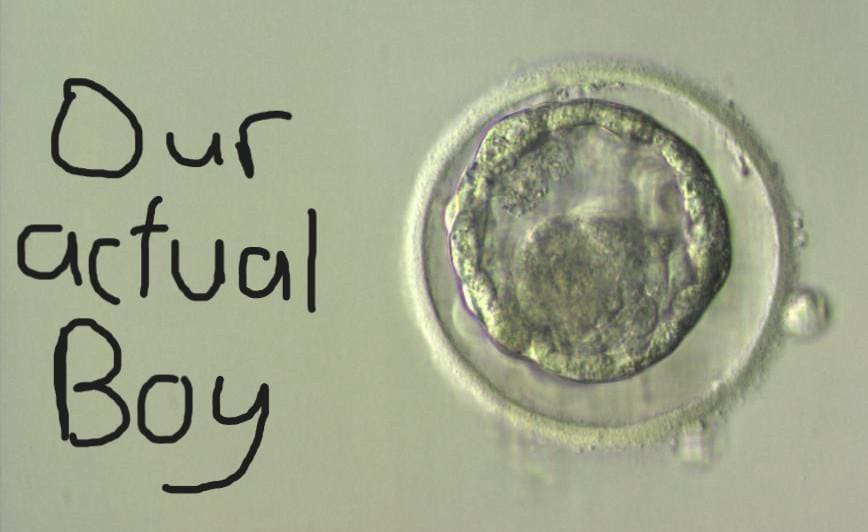
Thanks Lyndon[1], that describes the situation. Like almost 1 in 10 modern men, my sperm weren’t up to the task - at least not the old fashioned way. So IVF it was - the miracle that now feels almost commonplace.
We landed on the moon and Woodstock changed music forever. But in 1969 a quieter event transformed the world. The first human embryo was fertilised “In vitro”, outside the body. Yet 10 years passed before one was inserted into a womb, and then born. 48 years ago, Louise Joy Brown was the first woman born through IVF. This year about a million babies will be born through IVF.
IVF stands at the frontier of rich-privilege, a norm for the middle class in rich countries. In my home country New Zealand, the government even pays for it! Yet every week I meet women here in Northern Uganda who can’t have kids, and could never afford IVF. Even the human “right” to have a kid can depend on where you are born.
If I was born 25 years ago, or in Uganda, my boy would never have been.
Our Risky Choice
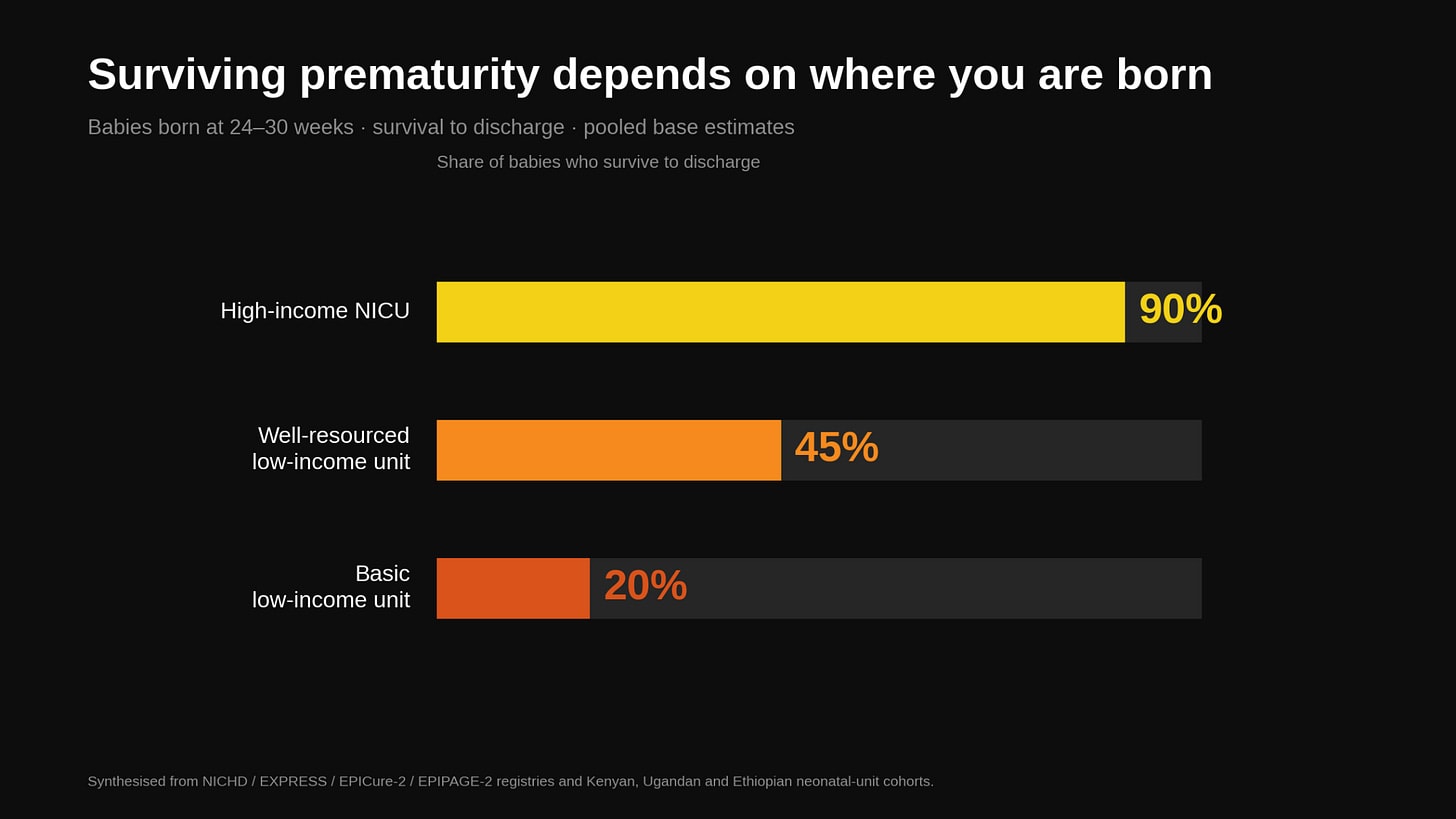
We decided to give birth in Lacor Hospital, the best hospital here in Northern Uganda and where I worked as a doc 15 years ago. If you’re wondering, yes this was risky. While we judged the hospital would be safe for my wife, should something go wrong and our boy needed the neonatal intensive care unit (NICU), he would be less likely to die in New Zealand. By my rough calculations, perhaps three times less likely. Even a good Ugandan hospital is far worse than one in New Zealand, for a few reasons
1. Prematurity. Better hospitals keep more premature babies alive. If born between 24 and 30 weeks, our boy would be twice as likely to survive in New Zealand, compared to where we gave birth.
2. Infections. Basic infection control just isn’t as good compared to a high-income NICU. Parents enter the NICU here en-masse to feed their kids and spread bugs around. Super-bugs aren’t tested for. Hands are less-washed. Cutting-edge antibiotics aren’t available. Our boy would be more likely both to catch an infection and then die from it.
3. Fewer staff and stuff. Fewer nurses, doctors and high-tech machines mean that problems will be diagnosed and treated later and more mistakes made. Despite staff’s best effort, kids just can’t be monitored and cared for with the same intensity in Northern Uganda as they can in New Zealand.
Months before birth, a couple of people told us “you’re mad to put your child at more risk”. This may be true, but despite the, overall risk seemed low-ish after a seamless pregnancy. We wanted to give birth close to our home of 13 years, in relationship and solidarity with our community. And we had the Lacor Hospital A team on the case, with a dedicated gynecologist and midwife. But despite our wonderful medical teams’ best efforts, things didn’t go as planned.
He didn’t die once - a routine miracle
“His head isn’t moving” are not words you want to hear. Our boy’s head made it through the cervix, then he got stuck completely. No manuever, nor three scary suction attempts could move out poor boy through that liminal space between the safety of the womb and our wild world. My wife suffered, our midwife sweated, fear set in.
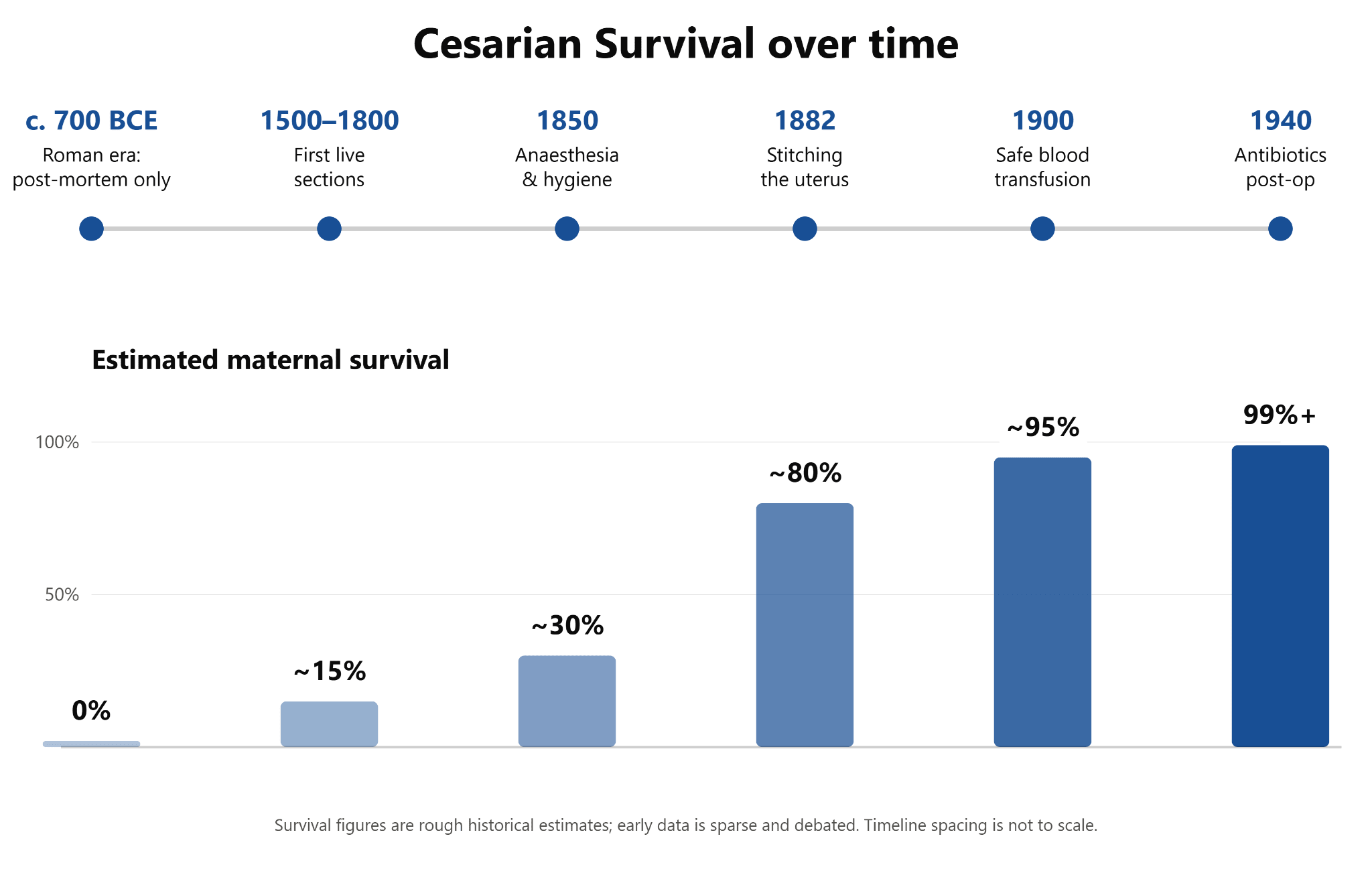
In most times and places in human history, this would have been the end. For our baby, or for my wife, or for both. But we were in the right place at the right time, with a life-saving procedure just a theatre away.
We thank the Roman innovators who first cut babies from dead lifegiving mothers. We thank the farmer Jacob Nufer, who in 1500 used his experience from pigs to first save both his wife and their baby. We thank Fransour Rousset, who proposed enfantement caesarien as a routine life-saving surgery. From the 1800s we thank Morton (ether) and Simpson (chloroform) for safer and less painful surgery. We thank Semmelweis for clean hands and Lister for antiseptics. Max Sanger who first decided to actually stitch the uterus closed. And Landsteiner and Fleming for blood transfusions and antibiotics.
We recognise your contribution to saving over 50 million mothers and babies[2].
Even in one of the poorest countries, I didn’t doubt our surgeon’s safe scalpel. Humanity’s stacked innovations have made this miracle almost routine.
Our boy was safely born.
He didn’t die twice - Neonatal care
After the exhilaration of holding our boy for the first time, things weren’t as they should be. Our boy didn’t feed properly, became lethargic and turned a bit yellow. One doctor’s assessment was enough to confirm our fears. He was jaundiced and had a fever - he might have the dreaded neonatal sepsis.
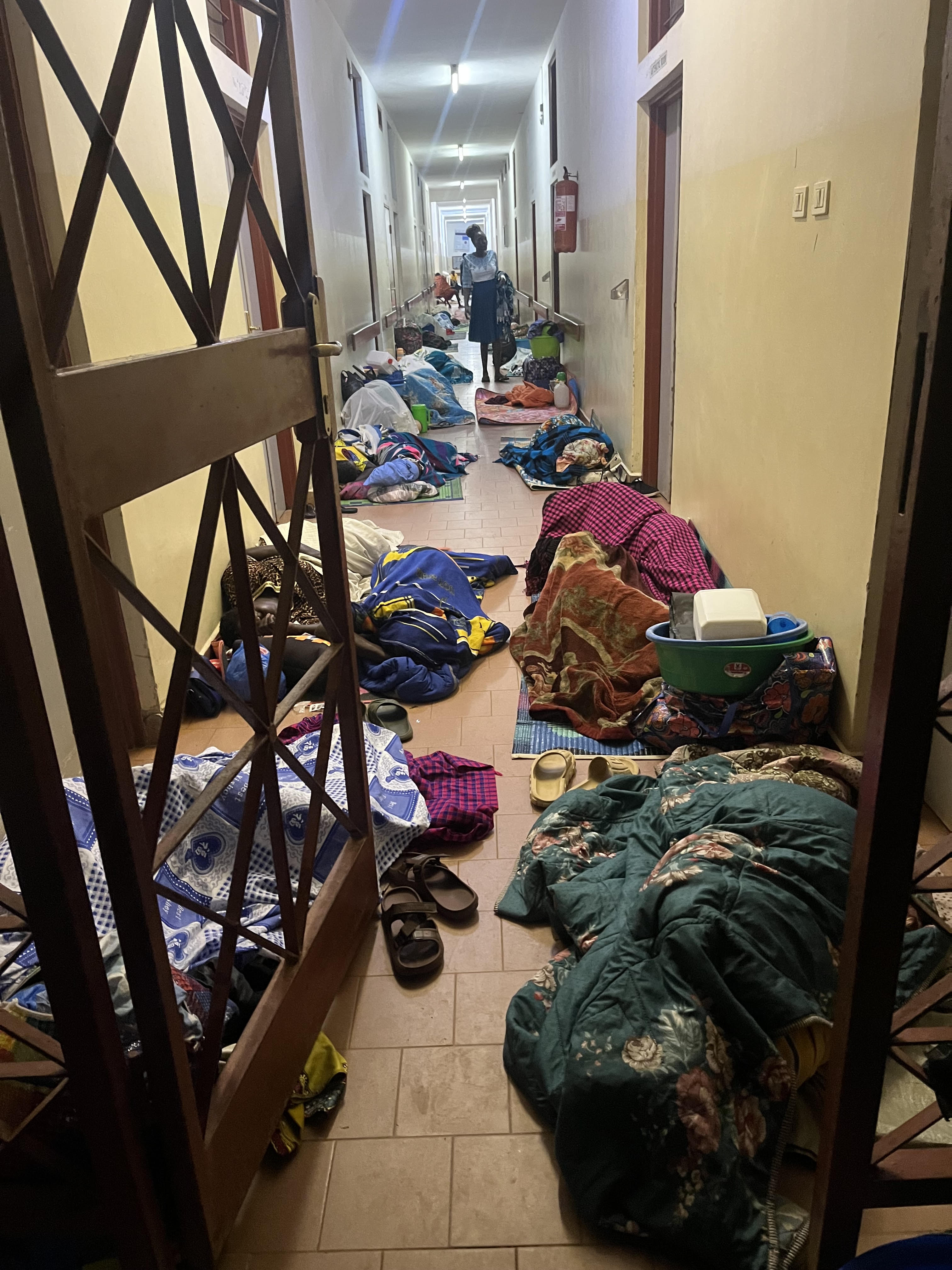
We were fortunate to occupy one of the four private rooms in maternity, with running water, electricity and two beds - luxuries the 20 other NICU families did not have. Every 2 hours as we moved to the NICU to feed him, we tiptoed through and over mothers and families who lined the corridor. I was overwhelmed with guilt from two angles. First that we paid $30 a day without thought for a private room while others slept on the floor. And guilt at our decision not to give birth in New Zealand, where our boy would be more likely to live. Guilt at our immense privilege, and guilt that we hadn’t used it to the max.
Over the next 10 days yet another wonderful set of innovations helped him pull through. Our resource poor NICU was still equipped with the most important life-saving interventions, and kept our boy warm, well monitored and infection free.
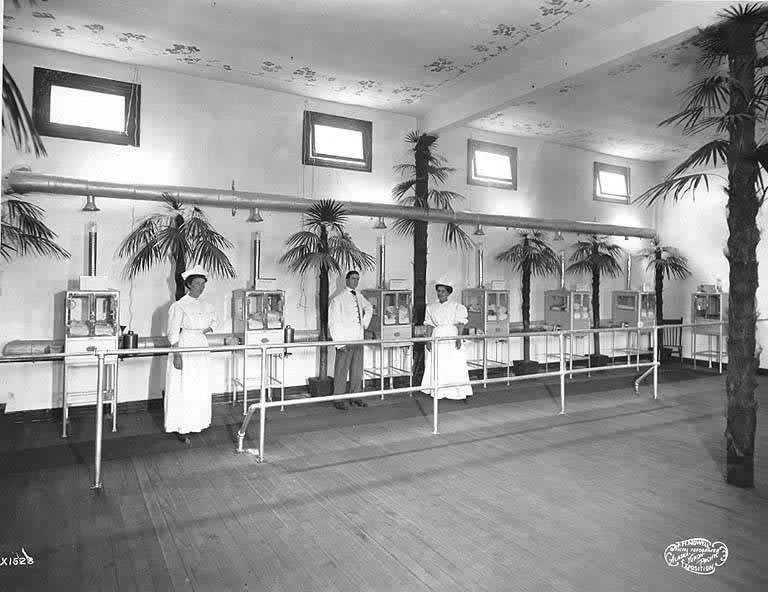
In 1880, Dr. Tarnier noticed that Paris zoo’s warming chambers kept young birds alive, and wondered why we didn’t do the same for sick human babies. Within a few years his colleague Dr. Bodin proved that incubators save lives, but as we’ve seen over the last 20 years with vaccine hesitancy, science alone isn’t always enough. Incubators needed to go viral. So they signed up an “influencer” to make incubators mainstream. Dr. Couney’s business model would be unthinkable today. Mothers got free incubator care, with costs paid for by thousands of tourists who paid entrance fees to see odd-looking premature babies in the strange space-age incubator machines.
“Couney’s Child Hatchery” was a wild commercial and medical success and helped catapult incubators into the mainstream, while warming babies become a norm around the world. Progress sometimes needs all of great ideas, science and PR to scale.
But on the newborn care front, we haven’t “won” the battle to the same extent as with the C-Section. 5000 children under one month old still die every day and 500 of those from neonatal sepsis.
Our boy had lethargy, poor feeding and fever, but hospitals can’t just put all lethargic babies in NICU on all out treatment - especially not in low-income settings. Neonatal sepsis has a diagnosis problem. No single test, or range of clinical features tells us if there’s sepsis. A Center for Global Development team believes this test could be a great life-saving bet, and have proposed a fund of 60 million dollars for any company that develops a working test. For the moment this remains a dream, good tests are far harder to invent than vaccines and treatments.
We would have LOVED one simple test to tell us if our boy was at risk of death, or just struggling a bit to get going.
I am Grateful
At a different time, or right now in a different place our boy would never have been born and might have died twice. I thank the hundreds of innovators and medical staff who took their life saving ideas and made them real. I thank the doctors and nurses who worked with limited resources to help our boy survive and thrive. I thank my mum who struggled with us in those early weeks.
And more than ever I’m grateful for my work with OneDay Health. A friend shared “After you have a kid, your work will feel less important”. But no, it feels more urgent and more important than ever. Even after the worst two weeks of my life, I can’t walk in the shoes of my friends here. I can’t imagine not having two dollars to treat my newborn’s malaria. Or 20 dollars to travel to hospital to give birth. Or even not having $5,000 to cure my child’s heart defect.
But I can imagine doing something today to help these babies live, and there’s never been a better day than today.
"If you had to choose a moment in history to be born, and you did not know ahead of time who you would be — you didn't know whether you were going to be born into a wealthy family or a poor family, what country you'd be born in, whether you were going to be a man or a woman — if you had to choose blindly what moment you'd want to be born, you'd choose now." - Barrack Obama
Edit: The match seems to now be over - the funds were expended in around 35 minutes. But many of these charities are great and should be supported regardless!
***
On October 22nd starting at 10:00am Pacific Time, Every.org is matching donations to select animal welfare organizations at a 2:1 rate, up to $2,000 per donor per nonprofit (so if you give up to $2,000, they will contribute up to $4,000 and the nonprofit will get up to $6,000). The first donation a donor makes to each el...
Crossposted to Less Wrong
‘Like most of life’s dangers, the dangers of artificial intelligence are not easily identified from the armchair.’
J Dmitri Gallow
Epistemic status
I’m not an expert in this field, and herein I make some sweeping generalisations educated guesses about the overall...

Hey Nick, I'm speechless.
Thank you for reminding us of how privileged we are just compared to people not so long ago. And especially for those of us who don't understand or work at health management, science, research... this is an eye-opening story.
I also chose to give birth a baby in a not-so-well-equipped country as my homeland for similar reasons, and I have had the same sort of toxic regretful thoughts. We had a 20-day hospitalisation, and during a whole week there was no diagnosis. You can only wonder, is it that they don't have the means, or the means don't exist (yet)?
My kid will be one of the first in the country to get a routine vaccine against Chickenpox. In Spain where I come from, this vaccine has been provided for 26 years already. I can't deny every day I think of what other privileges I'm taking away from my kid by not packing and taking a plane. But I hope the taxes I pay in this land help their health system keep going and improving. This is the first year with vaccination against chickenpox, maybe next year I am surprised again. Still, my kid has better chances in a worse-than-Spain place than I did in Spain when I was born. Yes, being alive today is the right answer.
Thanks for not taking the easy path and making health more accessible for everyone.