<< Cleaning the cups: Can be difficult where water is scarce or dirty>> This seems quite important? How would you plan on solving this problem otherwise it could lead to more infections and could potentially create more harm than good.
As someone that uses these products I do believe it requires quite alot of maintenance to ensure they are sterile every month once using them and that you can wash them out a few times a day, so Im curious on how you think this would work in countries with lower access to water who may not be able to steralise them?
As far as I can tell (both from searching manually and via Claude), none of the RCTs of menstrual cups in low-resource settings have had severe adverse events (see for example https://www.thelancet.com/journals/eclinm/article/PIIS2589-5370(23)00438-8/fulltext, https://bmjopen.bmj.com/content/7/4/e015429). That's enough to give some confidence that adverse events are rare, but not enough to really understand what the true rate is (it seems like all studies together cover at most 10000 person-years of menstrual cup usage in low-resource settings, and my understanding is that among e.g. tampon users in high-income countries, rates of toxic shock syndrome are something like 1-3 per 100000 person-years of usage, with risks for menstrual cup users thought to be broadly similar but less certain due to smaller sample sizes). Also, the RCTs have generally involved some kind of hygiene education, which I'm not sure Nick's $7.5 accounts for.
If the rate of severe complications was 1 per 10000 person-years of menstrual cup usage (which seems at the higher end of what could be theoretically compatible with the evidence we have so far) and women still wanted to use the cups when informed of the risks, that actually wouldn't change Nick's BOTEC very much (say an average severe adverse event led to a 15 DALY loss, we have 0.0598-15*7.5/10000 = 0.04855 DALY/Cup). Accounting for cup hygiene education costs might be the more meaningful change to the BOTEC, but I don't think it would change things by more than 50%. That would leave menstrual cups still looking like a potentially promising intervention.
So overall after looking at this, I don't think that the infection risk concern is a slam-dunk reason against menstrual cups as an intervention. But it seems like if future wellbeing-focused research returned promising results, it would be prudent to fund a big trial that tried hard to monitor for severe adverse events before going to large-scale implementation.
Seconding this. I've heard both "you could die from toxic shock syndrome if you don't clean your cup properly" and also there are something like 5 known cases and no deaths of TSS from menstrual cups. Getting the right balance of education would be important: conveying that cleaning the cup is needed, but it's apparently unlikely to cause a serious problem with typical use.
Thanks @Julia_Wise🔸 and @MHR🔸 for the fantastic responses. I talked to a couple of people involved in cup distribution in low income countries, and their take was that if water is good enough to wash clothes and bodies, it should be good enough to wash cups. I'm not sure if this is evidence based though.
So in some very remote places with highly dirty/infected water it could be a problem, but those situations would be rare. Like others say there's sparse to no evidence that washing cups with unclean water has caused problems with cups.
Minor point, but how would this not be evidence-based? It might not be quantitative evidence, but "the opinions of people involved in cup distribution in low-income countries" should count as evidence of some kind, no?
Also curious about this! Apart from the monthly sterilising it's recommended to wash your hands before handling the cup, which would happen every 5-10 hours or so when you need to remove and reinsert it. I know I've personally decided against wearing a cup when staying at places with limited running water and soap for fear of infection (like when camping). But similar to other commenters have no good sense of the real risks of this and would be keen to find out.
Anecdotal, but I have worked on trail crews / outdoor jobs (including crews that were 100% women) and we all used cups for multiple months at a time with no problems. Many women in the outdoors community in the U.S. (forest service, wildland firefighting, long distance trail hikers) swear by them.
One note that I don't think anyone has brought up (though I might have missed something): I think each person reached would mostly get either the health benefits or the cost benefits, not both, since people currently buying pads are already using a sanitary option and people using rags/cloths aren't spending money on products.
100% Agree good point. For the sake of a readable article I simplified and looked at the pad cost benefit rather than focusing on the larger healthcare benefit if it was rags.
I think this is a great idea and write up! I ran similar calculations and had come to similar conclusions in the past thinking it would potentially be a good solution for those experiencing extreme poverty in the US and other high-income settings at the very least. Although, as everyone has pretty much mentioned, they still depend on practical access to private toilets, clean water, soap, and adequate time to wash and reinsert during the day, and UNICEF and WHO both note that many schools globally still lack the privacy and hygiene conditions needed for dignified menstrual management just in general, so it perhaps makes school use workarounds important to iron out?
One quick suggestion: assuming that 100% of distributed cups are used seems quite aggressive to me. Using a 7.5 year average life I think suggests you are implicitly selecting on very enthusiastic adopters; I would imagine a lot are distributed and then discarded.
That's fair. I think it's probably a bit optimistic too, perhaps 5 years or less would be more realistic. Again I'm surprised we don't have solid survey data on this too, the issue really is under researched.
Nick, thank you for studying this and for sharing your findings. I do think there's probably something to this space.
That said, I think you know probably more than anyone in EA how good people in poverty are at saving money. Don't you think it's unlikely that there is an option available that could save tens of dollars a year, which people are not taking advantage of on their own initiative? I doubt that achieving sufficient capital is the issue (as for example with a tin roof) if we're talking about a $7, or even $2 product.
Maybe another way of framing this is, why do you think that this is a market failure / why do you think the free market is not addressing this on its own?
I would be very curious to know if Living Goods has looked at this; I know that at one point at least they used to sell reusable pads. It seems like an obvious fit to me, and a much lower risk one than distribution for free.
It might seem strange but there are many choices that poor people make that could save tens of dollars a year, that people don't take advantage of. I would weakly disagree that poor people are good at saving money, especially if it requires a small investment first. The book Poor Economics has a really good section on this. Here are some classic examples where poor people don't spend a few dollars to save in the future.
1. Prioritising handwashing devices at home. These prevent illness and hospital bills. Here in Uganda people will almost always buy a couch and a TV before they will even buy a 10 dollar handwashing bucket, it's kind of insane. Along the same lines consider the failure of the Evidence action Chlorine dispenser project (read the great post about this by the way). People could spend a few dollars to improve their family's hygeine but don't.
2. People could buy in even moderate bulk rather than buying tiny amounts every day. If people spent $5 vs. the usual 50c buying foodstuffs there are many cases where they could save money by spending just a bit more.
3. Selling crops out of season. People could often wait just two months and sell crops for over 20% more than in peak season. But almost everyone wants all the money right now. Then after selling people put the money in a village saving group which makes zero interest, rather than selling two months later for afar more money. Its quite incredible.
I'll also note that women are often especially economically disempowered and have even less scope to spend a bit of money to make their lives better.
In terms of the market in general, there is indeed huge market failure when it comes to period products. "Big Period" as it were has zero incentive to advocate for a product which you buy once for $5 and then never again. They sell tampons and pads every month at huge profits, and will do everything that they can to avoid products that will make them less money.
Indeed Living Goods would actually be the perfect kind of organisation to be a distribution network. But for cups to go big it would require a concerted effort across multiple actors, probably needing some kind of serious lobby group and co-ordination. I'm not suggesting that yet as I'm not sure there's good enough effort to warrant that.
Yes there are a lot of people selling reusable pads in Uganda and other countries. I'm partially challenging whether there should be more of a focus on cups than pads.
It might seem strange but there are many choices that poor people make that could save tens of dollars a year, that people don't take advantage of. I would weakly disagree that poor people are good at saving money, especially if it requires a small investment first.
I think part, but not all of that, is due to rationally putting a high premium on avoiding catastrophe, with poor families often operating barely above the limits of survival. You want to wait to sell your crops in 2 months when the market is better but what if your crops get eaten by pests, or the market actually collapses? For a poor family, that could spell total disaster, whereas at least by selling the crops today, at the low harvest season prices, you are guaranteed to get something. (That doesn't explain the TV though! But I think cash transfer studies suggest that marginal funds are normally spent more wisely than on TVs)
That points to the value of interventions that reduce that risk, e.g. "I'll lend you money at harvest time and you only pay me back if you can sell your crops at a higher price in the low season" type deals.
On the TV thing, here's an extended quote from Poor Economics in case it's of interest to others as well (emphasis mine):
The decision to spend money on things other than food may not be due entirely to social pressure. We asked Oucha Mbarbk, a man we met in a remote village in Morocco, what he would do if he had more money. He said he would buy more food. Then we asked him what he would do if he had even more money. He said he would buy better-tasting food. We were starting to feel very bad for him and his family, when we noticed a television, a parabolic antenna, and a DVD player in the room where we were sitting. We asked him why he had bought all these things if he felt the family did not have enough to eat. He laughed, and said, “Oh, but television is more important than food!”
After spending some time in that Moroccan village, it was easy to see why he thought that. Life can be quite boring in a village. There is no movie theater, no concert hall, no place to sit and watch interesting strangers go by. And not a lot of work, either. Oucha and two of his neighbors, who were with him during the interview, had worked about seventy days in agriculture and about thirty days in construction that year. For the rest of the year, they took care of their cattle and waited for jobs to materialize. This left plenty of time to watch television. These three men all lived in small houses without water or sanitation. They struggled to find work, and to give their children a good education. But they all had a television, a parabolic antenna, a DVD player, and a cell phone.
Generally, it is clear that things that make life less boring are a priority for the poor. This may be a television, or a little bit of something special to eat—or just a cup of sugary tea. Even Pak Solhin had a television, although it was not working when we visited him. Festivals may be seen in this light as well. ...
Orwell captured this phenomenon as well in The Road to Wigan Pier when he described how poor families managed to survive the depression.
Instead of raging against their destiny, they have made things tolerable by reducing their standards. But they don’t necessarily reduce their standards by cutting out luxuries and concentrating on necessities; more often it is the other way around—the more natural way, if you come to think of it—hence the fact that in a decade of unparalleled depression, the consumption of all cheap luxuries has increased.
These “indulgences” are not the impulsive purchases of people who are not thinking hard about what they are doing. They are carefully thought out, and reflect strong compulsions, whether internally driven or externally imposed. Oucha Mbarbk did not buy his TV on credit—he saved up over many months to scrape enough money together, just as the mother in India starts saving for her eight-year-old daughter’s wedding some ten years or more into the future, by buying a small piece of jewelry here and a stainless steel bucket there.
We are often inclined to see the world of the poor as a land of missed opportunities and to wonder why they don’t put these purchases on hold and invest in what would really make their lives better. The poor, on the other hand, may well be more skeptical about supposed opportunities and the possibility of any radical change in their lives. They often behave as if they think that any change that is significant enough to be worth sacrificing for will simply take too long. This could explain why they focus on the here and now, on living their lives as pleasantly as possible, celebrating when occasion demands it.
Thanks Nick for your thoughts. I've read Poor Economics but I'm not sure that the arguments there apply to this situation.
I definitely agree that the poor struggle with purchases that require capital investment, such as buying in bulk. My sense is that partly that is because capital is just vary scarce, and partly that is because of pressure to share any accumulated capital. But the menstrual cups aren't very expensive and would be a one-time purchase, so I'm not sure that argument applies here; although I suppose that in a sense the cup is the bulk version of disposable products.
I am less familiar with the phenomenon of selling crops out of season. Could this be a social pressure thing where everyone feels compelled to invest in the village saving group?
And, I definitely agree that preventative measures are a tough sell to the poor, pretty much across the board. That is why we fund free bednet distribution, by the way! In fact in general diffusion of preventative innovations is quite slow, which is one reason why they are often subsidized or compelled by governments. Insofar as the menstrual cups constitute a preventative, I absolutely agree we should not expect the poor to buy them. But, your analysis suggests the main benefit is financial, and with a pretty quick return on investment, so this situation seems different from that.
I can't speak to this product in particular but my experience at One Acre Fund in Tanzania was that it's often just really hard to physically distribute products to rural Africa without super high costs or damage. The practicalities of distribution are hard to solve, which I guess is more what Nick is looking to do here. Once you find a way to get the product in front of users and it saves them money, they'll often buy it, I agree that it might not need to be given for free (not withstanding another practical note: if you need to charge, that also generates a bunch of logistics!)
I have no particular take on LG, I was mostly focused on your question about the market failure. I've no reason to think LG couldn't do a great job, this sounds very much like their area of expertise!
In Chinese online shopping site 1688, a menstrual cup costs only $2. I personally use it and the quality is ok. For more info visit 亚洲女性 vs 月亮杯(月经杯)小组 on Douban.
I haven't used Asan's cup specifically, so what I'm saying could be way off base, but I'm extremely skeptical a cup would last more than 2 years, max. By "last," I mean, "the owner is willing to use it." Having used menstrual cups myself, and existing in social circles where menstrual cups are the norm, they get quite smelly after ~18-24 months of use, even with regular cleaning. It's not pleasant to then insert that product back into your body, and the smell can even foul the restroom. This is obviously anecdotal, but I'd estimate I've had ~10 people who menstruate share this sentiment with me over the years.
There is also a steep learning curve with learning how to use a cup correctly. It's not as intuitive as it seems, and you have to be very comfortable with your body. Even once you know how, it can be frustrating.
I'm not surprised more school days weren't gained from cups, because it assumes the reason school is missed is because of lack of period products. That contributes, but a large reason is also period PAIN and other symptoms of discomfort: in a meta-analysis of 38 studies (15 high income) encompassing 21,500 women, 20.1% missed school because of period pain, and 40.9% reported their academic performance was impacted due to pain. (Source: https://journals.sagepub.com/doi/abs/10.1089/jwh.2018.7615?cf-mal-redirected=true&)
I love menstrual cups and think they solve many problems and should absolutely be an OPTION for women. But they are never going to be the only correct choice.
My wife has used a cup for 12 years, and her friends have been similar - I wonder if these cups are the highest quality silicone ones or not? Or if there are different norms in different social groups?
2 years would make a big difference to cost-effectiveness, 5 not so much so yes this is a really important factor for sure.
Interesting idea. I know One Acre Fund had a (possibly just pilot) program distributing Afripads in Kenya (https://www.afripadsfoundation.org/the-challenge/). I happen to be chatting with old colleagues from the Kenya program soon, will share any lessons + connect you if useful.
Yes that s great point. I probably should have included a section about reusable pads as that has been the predominant solution tried out so far by NGOs in recent times. Both through local community manufacturing and larger scale commercial operations like Afripads.
Adoption is likely easier than cups but I suspect reusable pads might be inferior on price, comfort and perhaps hygiene depending on washing techniques
Nice, agreed. I could totally see cups being superior, I mostly was thinking of OAF from the perspective of having shareable lessons on e.g. marketing, impact measurement, stuff that might make ODH's work a little easier. Will share what I hear!
A few things I consider important: - It needs to be cleaned with cold water and ideally hypoallergenic soap before every reinsertion throughout the day; - It needs to be sterilized at least once a month, ideally two (before starting monthly use, after ending monthly use), with boiling water or sterilizing tablets - which maybe would be a more ideal solution, since you can always provide the sterilizing tablets with the menstrual cups as well.
A personal anecdote and other women's anecdotes: - A few women with PCOS have reported feeling more cramps during periods by using menstrual cups (and there is maybe unreliable sources claiming that up to 20% of women in India, for example, suffer from PCOS); - I have personally stopped using it and noticed way less pain from cramps, which were oftentimes debilitating, during periods, unsure if causation; - Other women -- and it seems a majority were mothers --, claimed to have suffered from uterine prolapse, and swollen/damaged cervix.
I am not claiming these anecdotes are significant, but they are worth looking at while attempting to create a program.
There certainly seem to be a bunch of wide range of practises with cleaning. Cup manufacturers (as I suppose they would) say it certainly doesn't need soap every single day. My wife doesn't use soap either daily (for what that's worth).
I found the diversity on this reddit thread interesting on this front https://forum.effectivealtruism.org/posts/jh5A2NXr5Lf9oXLSX/menstrual-cups-a-cost-effective-gem?commentId=w2K7jNQjQmDqoHCwR
I'm sure cups won't be the solution for every single woman for sure - there will always be a decent number they won't work out for.
Note: This post was crossposted from the Coefficient Giving Farm Animal Welfare Research Newsletter by the Forum team, with the author's permission. The author may not see or respond to comments on this post.
Subtitle: On vegan advocacy, effective altruism, and FIFA
I turn 40 today. Here are some hot takes.
On factory farming
1. Our biggest challenge is salience. If factory farming led the evening news, it wouldn’t last lo...
Impressions from the 21st Annual U.S. Cluster Headache Patient Conference, organized by Clusterbusters.
On the morning of the last day of the conference, E. was hanging out with other “clusterheads” outside the conference hotel when he started having a cluster headache attack. Before he could go back to his hotel room, J. offered E. his DMT v...
TL;DR:
The movement has an evidence problem. To solve it, for each intervention we need to know:
* What types of evidence that intervention needs
* What types of evidence different sources can give us
In this post, we outline a framework for evidencing an intervention through five stages:
...
TLDR:Menstrual cups cost a few dollars and have great potential to improve lives in low-income settings. High quality Wellbeing research might tell us if they’re a big bet worth making.
Every Month
Periods are a challenge to manage anywhere, but in low income rural areas, women must overcome huge physical, social and financial barriers. Every month. Most women in this tricky situation manage their periods in one of two ways.[1]
1. Reused cloths/rags, not made for purpose 2. Pads - Disposable or reusable
These aren’t great options, and in low income countries women are split between them about 50/50[2]. The worst is reusable cloths which are unsanitary, reduce productivity and contribute to a monthly cycle of worry. On the other hand disposable pads cost between $20 and $50 dollars a year[3], too expensive for those living on dollars a day. Reusable pads are cheaper, but carry similar hygiene problems of cloths.
And the scale of period poverty is massive. My best guess is that between 500 million and 1 billion women don’t buy any period products at all.
The Period Poverty Burden
There are huge financial, education and healthcare gaps between high and low income countries. Period poverty is almost a caricature of these disparities. With such a wide range of challenges that contribute to period poverty, it can be hard to isolate which is even most important (we’ll get to that). These include…
Might solve these challenges[6]. They’re a one-shot buy which can last over 10 years. Hard physical labour becomes easier, and cups might prevent health problems. Are they just better in every way (Pareto improvement)? These features plus the environmental benefits have led to gradual uptake in high-income countries. About 10-20% of women in high income countries use cups, yet most people in low-income countries have never heard of them. Even among the middle classes cups are but a whisper. 15 of our OneDay Health nurses are trying Asan Cups at the moment - only one had ever heard of them before.
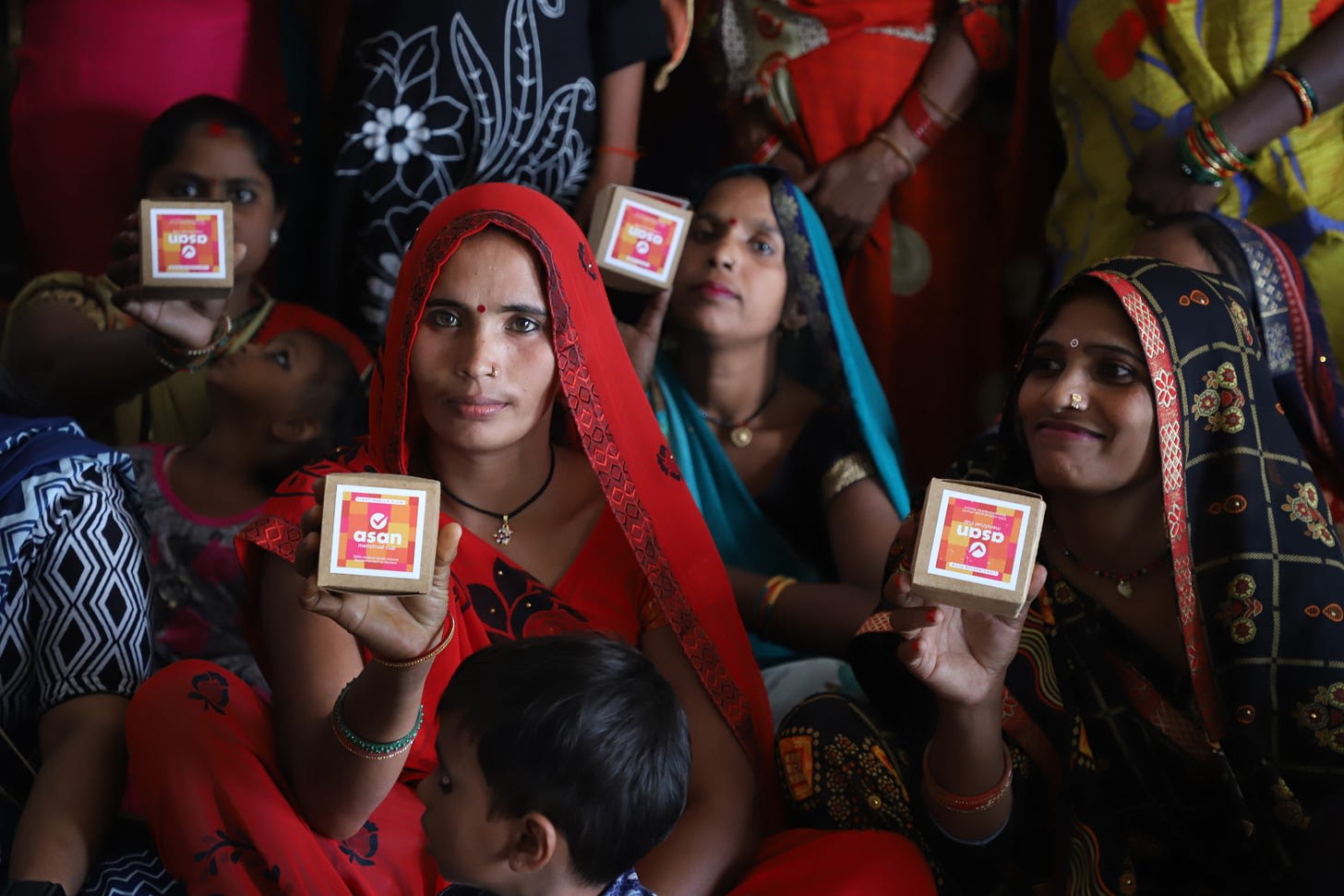
Women in Janakipuram, Uttar Pradesh receive Asan cups
Cups as a “Leapfrog” Tech?
In low-income countries, some technology has been passed over and “leapfrogged” in favour of newer, better options. In East Africa cellphones leapfrogged landlines, saving billions on infrastructure. Mobile money leapfrogged banks. The menstrual cup could leapfrog older “worse” period products. If cups really are much better, and there is a concerted drive to promote and distribute cups, we may have the opportunity to skip straight from rags to cups.
Asan Cups
Asan wants to transform the period poverty landscape for women in low income countries. Their founder Ira was inspired after seeing a domestic worker in India miss work due to period poverty, then designed the Asan cup as a Harvard grad student. Asan sells their high quality cups in high income countries for about $30, then donates cups or sells them at low cost in low income settings. Over the last 5 years they have distributed 100,000 cups through non-profit partners and factories, most in rural India. Through this process they’ve learned a lot about what drives successful cup uptake. Here are 3 key insights.
Cup quality is key. If a cup leaks or causes discomfort then women will ditch it, even if the cup was cheap. Adoption depends on a well engineered product that’s easy to use.
Peer networks are powerful. When trusted friends and community members use cups, word of mouth can spur a snowball effect. Social proof matters more than marketing.
Schools might seem like a good place to distribute cups, but have far lower uptake than community distribution. The special relationship between mothers and daughters can make all the difference.
Challenges
Mass cup distribution and uptake isn’t easy.A number of moral objections and practical challenges stand in the way.
1. Are we removing womens’ choice? Womens’ rights campaigners can balk at a one-size-fits-all menstrual solution because of the understandable stance that all women should have the right to choose whatever method they prefer. Powerful foreigners deciding what’s best for poor women can also seem paternalistic or even neocolonial.
2. Behaviour change: Is always tough. A seachange would be needed and cultural barriers dismantled for cup user to proliferate. Here in Uganda there’s a common, understandable aversion to putting any external object inside the vagina. That said, we’re encouraged by our initial nurse trial where almost all nurses who tried cups liked them so much they’re sticking with it.
3. Cleaning the cups: Can be difficult where water is scarce or dirty.
Are Cups Cost-Effective? - A rough estimate
(This gets into the weeds, feel free to skip)
I’m going to do this suuuuuuper loose BOTEC with these assumptions
1. I’ll compare Menstrual Cups to disposable pads 2. I assume context of rural Uganda, the context I know best 3. Financial benefit DALY equivalents will be taken from GiveWell 4. I’ll will use $7 as the cost for buying and distributing one ASAN cup in a rural area[7] 5. I will assume the average Asan cup lifespan is 7.5 years[8]. 6. I’ll convert everything to DALY equivalents.
1) Money Saved. One cup costs about $7 to buy and distribute and can last over 10 years, which I’ll discount to 7.5. Disposable pads cost about $1.50[9] a month in Uganda. With pads costing 18$ a year, menstrual cups might save a woman 135$ over 7.5 years. If we (mis)use GiveWell’s estimate that a 2.3x doubling of consumption is equivalent to 1 DALY, and estimate Uganda’s average GDP per capita of $987 a year that’s
135 / (987x2.3) = 0.059 DALY equivalents averted per cup
2) School days - none gained from cups? To my surprise, large robust RCTs in Nepal[10] and Kenya[11] showed no increase in school attendance for any period product use. Women are less likely to attend school during their period and menstrual cup advocates who swear black and blue that menstrual cups helps kids stay in school, but alas the best evidence shows no signal
I’m counting this one out for now, but watch this space, but more research will be incoming…
3) Health benefits - Bacterial Vaginosis There is decent evidence that cups reduce discomfort from Bacterial vaginosis, but no clear evidence of reduction of UTIs or STIs. This analysis doesn’t take into account the increased risk of HIV transmission for women with bacterial vaginosis. This protective effect of cups could increase the DALYs prevented by 10x-100x in high HIV prevalence settings.
Cups vs pads/cloth Claude translated a 10-20% reduction in bacterial vaginosis to a small DALY improvement of 0.0008 DALYs per cup. Due to low cup cost and a 7 year time horizon this still might be non-negligible at about $10,000 per DALY. As irritation and itching are major symptoms, this benefit might be better captured in wellbeing improvement.
4) Improved Wellbeing? “… for the beneficiaries, the single biggest perceived benefit seemed to be immeasurable … Although the economic and environmental impacts are immense, our focus groups revealed reduction in anxiety and stress relating to periods.” - Asan Cup survey from rural Kanartaka, India.
Wellbeing improvement might be largest benefit of menstrual cups, but this hasn’t been studied much. Women report a wide range of wellbeing improvements in qualitative studies and surveys[12], but the other hand some studies didn’t show improvement in mental health scores.[13]
Cups might improve wellbeing through a range of mechanisms which include
1. Enabling more activities (digging, playing, running) during periods 2. Reduced financial stress around monthly financial and practical burdens 3. Overall increased freedom and empowerment
Loose DALY calculation
So in the end, the only large benefit in our estimate comes from money saved, but this might just be a reflection of the lack of evidence. Here’s the final calculation…
One $7 cup = $ DALY (0.059) + Health DALY (+0.0008) + Wellbys? = 0.0598 DALYs averted per cup distributed = 1 DALY averted per $120 spent on cups + ???Wellbys
As a sense check, this would mean 1 DALY averted per about 18 cups distributed, which sounds a bit on the high side to me but not-ridiculous. This is a very low quality, early stage BOTEC, and likely to be an overestimate of cost-effectiveness.
Great potential - Let’s do Wellbeing research
Menstrual cups are a tractable, neglected and scalable intervention which have great potential to improve lives. The missing piece is whether the benefit of distributing a cup is large enough to be worth the (low) cost. As benefits cut across financial, physical and psychological realms, cup distribution could be a great candidate for a high quality study which assessed wellbeing benefits. I’m a bit surprised this hasn’t been done already.
With a concerted effort, it might be possible to move towards menstrual cups as a “norm” in low income countries over the next 20 years. They could even be adopted faster in low income countries than high income countries, just like mobile money and solar panels. But at risk of being really boring, we really do need more research….
To finish, a shameless plug for Asan Cup - Ira and her team really care about period poverty for the poorest women. If you’re in the market for a cup, consider buying an Asan. By all accounts their cup is awesome, and you’ll also help women worse off than you get super-cheap cups.
Conflict of interest: Well soon pilot distribution of Asan cups through our remote OneDay Health centers. Asan is a for-profit company so this is on one level free publicity for them.
Tampons are far too expensive for most women, and used by a surprisingly small fraction of poor rural women. In larger towns and cities though, more women do use tampons.


<< Cleaning the cups: Can be difficult where water is scarce or dirty>>
This seems quite important? How would you plan on solving this problem otherwise it could lead to more infections and could potentially create more harm than good.
As someone that uses these products I do believe it requires quite alot of maintenance to ensure they are sterile every month once using them and that you can wash them out a few times a day, so Im curious on how you think this would work in countries with lower access to water who may not be able to steralise them?
As far as I can tell (both from searching manually and via Claude), none of the RCTs of menstrual cups in low-resource settings have had severe adverse events (see for example https://www.thelancet.com/journals/eclinm/article/PIIS2589-5370(23)00438-8/fulltext, https://bmjopen.bmj.com/content/7/4/e015429). That's enough to give some confidence that adverse events are rare, but not enough to really understand what the true rate is (it seems like all studies together cover at most 10000 person-years of menstrual cup usage in low-resource settings, and my understanding is that among e.g. tampon users in high-income countries, rates of toxic shock syndrome are something like 1-3 per 100000 person-years of usage, with risks for menstrual cup users thought to be broadly similar but less certain due to smaller sample sizes). Also, the RCTs have generally involved some kind of hygiene education, which I'm not sure Nick's $7.5 accounts for.
If the rate of severe complications was 1 per 10000 person-years of menstrual cup usage (which seems at the higher end of what could be theoretically compatible with the evidence we have so far) and women still wanted to use the cups when informed of the risks, that actually wouldn't change Nick's BOTEC very much (say an average severe adverse event led to a 15 DALY loss, we have 0.0598-15*7.5/10000 = 0.04855 DALY/Cup). Accounting for cup hygiene education costs might be the more meaningful change to the BOTEC, but I don't think it would change things by more than 50%. That would leave menstrual cups still looking like a potentially promising intervention.
So overall after looking at this, I don't think that the infection risk concern is a slam-dunk reason against menstrual cups as an intervention. But it seems like if future wellbeing-focused research returned promising results, it would be prudent to fund a big trial that tried hard to monitor for severe adverse events before going to large-scale implementation.
Seconding this. I've heard both "you could die from toxic shock syndrome if you don't clean your cup properly" and also there are something like 5 known cases and no deaths of TSS from menstrual cups. Getting the right balance of education would be important: conveying that cleaning the cup is needed, but it's apparently unlikely to cause a serious problem with typical use.
Thanks @Julia_Wise🔸 and @MHR🔸 for the fantastic responses. I talked to a couple of people involved in cup distribution in low income countries, and their take was that if water is good enough to wash clothes and bodies, it should be good enough to wash cups. I'm not sure if this is evidence based though.
So in some very remote places with highly dirty/infected water it could be a problem, but those situations would be rare. Like others say there's sparse to no evidence that washing cups with unclean water has caused problems with cups.
Minor point, but how would this not be evidence-based? It might not be quantitative evidence, but "the opinions of people involved in cup distribution in low-income countries" should count as evidence of some kind, no?
Yes that's correct it is still evidence for sure, just what might be considered "lower level" evidence.
Also curious about this! Apart from the monthly sterilising it's recommended to wash your hands before handling the cup, which would happen every 5-10 hours or so when you need to remove and reinsert it. I know I've personally decided against wearing a cup when staying at places with limited running water and soap for fear of infection (like when camping). But similar to other commenters have no good sense of the real risks of this and would be keen to find out.
Anecdotal, but I have worked on trail crews / outdoor jobs (including crews that were 100% women) and we all used cups for multiple months at a time with no problems. Many women in the outdoors community in the U.S. (forest service, wildland firefighting, long distance trail hikers) swear by them.