Comments
Reflections on Building an AI Policy Student Group from Scratch

34 min readMay 24


This semester, I started the AI Policy Accelerator (AIPA), a new student group at George Washington University dedicated to upskilling students on their AI policy careers. We hosted various lectures, workshops, guest events, site visits, and an AI policy writing fellowship. Through this program, dozens of students have become more informed about AI policy, and I believe that several students are now substantially more likely to pursue careers in AI policy than they counterfactually would have been. In this post, I’ll cover the theory of change behind AIPA, how I built AIPA, what AIPA has done since its creation in January, what it has and hasn’t accomplished, a prognosis for its future, and takeaways for myself and for other university organizers.
I intend this post to be very thorough, probably much more thorough than it needs to be. If you’re interested in the background, theory of change, and organizational structure of my group, then you can start at the beginning. Otherwise, I suggest skipping straight to the “Main Events and Activities” section.
The George Washington University is a university of around 12,000 undergraduate and 15,000 graduate students, located in the heart of Washington, DC. (And when I say “the heart of DC”, I mean our campus is literally 3 blocks away from the White House.) Given our location in America’s capital, the GW student population is known for its heavy interest in political science and international affairs.
Considering GW’s location and the interests of its students, you might expect it to be a center of academic and student activity on AI policy. Unfortunately, that’s not really the case. Or to be more precise, there’s a lot of latent interest in AI policy among both students and faculty, but that latent interest has yet to be harnessed very competently.
The GW administration has taken a mostly laissez faire approach toward AI, letting each professor and department respond to AI as they see fit. A few professors have taken the initiative to design and teach AI-focused courses. I’ll highlight three in particular: Jeffrey Ding, author of the ChinAI newsletter, teaches a class in the international affairs school on AI and great power relations. Daniel Egel-Weiss teaches an excellent class on AI and biometrics policy, based largely on his own experiences lobbying state governments. And Shi Feng, who some of you may know as a MATS mentor, runs an AI safety technical lab for graduate students within the computer science department. All three of their courses fill up early at course registration time, suggesting that the demand for classes about AI policy exceeds the supply.
As far as GW students go, I would say that while many students are interested in AI, few are very informed or “AGI-pilled”. Many of my fellow students see AI as a way to cheat on homework and papers, or as a way to boost their LinkedIn presence. Some of my peers are genuinely interested in big questions like, “How should the government regulate AI?”, “How will AI impact international relations?”, or “How will AI impact the labor market?” But even these people usually don’t understand or internalize how fast and how dramatically AI is going to change things. The prevailing attitude is still to act like things are business-as-usual. I, not infrequently, have the urge to grab my fellow students by the shoulders and shake them, yelling, “Do you not understand?!?! You are living in the middle of the most dramatic revolution in all of world history! What happens today, in this city, will be written about for ages to come. And you, who have the privilege of living in the heart of government of the most powerful and technologically advanced civilization on Earth, are uniquely situated to shape that story. So why aren’t you doing anything about it?!?”
Until this semester, there was no GW student group focused specifically on AI or AI policy. I decided to change that.
I started my undergraduate studies at GW in fall 2023, originally intending to become a political science major. Over the course of 2024, I slowly got AGI-pilled, reading works like Situational Awareness and completing BlueDot Impact’s AI Governance Fellowship. In summer 2025 I interned at a small non-profit called the AI Safety Awareness Project, where I designed and led workshops to teach members of the public about AI safety and AI policy. I also switched my academic major to mathematics, and I completed my degree this May (in 3 years instead of the usual 4).
I believe that AI poses catastrophic risks, including but not limited to: the potential to cause human extinction, the potential to create novel bioweapons, the potential to concentrate power or establish a stable dictatorship, and the potential that we would inadvertently create a large number of conscious, suffering AI systems. I believe that one of the best ways to alleviate these risks is through thoughtful governance. Conversely, poor governance and misguided policies could increase each of these risks. I am not confident in any particular set of proposals regarding AI policy. (For instance, while I can see the arguments for an AI pause, I am skeptical of that proposal and suspect a pause would do more harm than good.) What I am confident saying is that we need more intelligent, well-informed, and virtuous people in relevant government positions regulating AI. While I can’t predict the future of AI in any great detail, it seems hard to imagine a world in which it’s better for the U.S. government to be less principled or less competent.
Around the end of last year, two thoughts dawned on me:
Put together, these thoughts implied an obvious conclusion: I should make this a reality.
I wasn’t completely thrilled at first. I knew that building this org from scratch would take a lot of work, and it would trade off against a bunch of other things that I could otherwise be doing with my time, and there was no guarantee that my efforts would be at all successful. But when there’s something that ought to be done, and you’re the only one who can do it, the logic of the universe dictates that you must do it. And so I did.
The motto of the GW AI Policy Accelerator is: “Artificial intelligence is rapidly accelerating. Your policy career can too.”
We have two primary objectives:
This is the hypothesis I am most confident in.
To quote from the Horizon Institute:
The US government plays an essential role in developing and governing new technologies, crafting policies to take advantage of their benefits and guard against the harms they pose. But its ability to stay ahead of the curve, spotting opportunities to anticipate and respond to developments in rapidly advancing fields like biotechnology and artificial intelligence, depends crucially on policymakers having access to the requisite expertise. And right now, that access is sorely lacking.
Government interest in emerging technology policy has skyrocketed in recent years. But the agencies tasked with implementing policies have struggled to find and retain people with the right subject-matter expertise. At the same time, many scientists and technologists are eager to enter public service careers, but they lack the mentoring, connections, and training to make the switch.
We desperately need people in government – in both parties, at all levels of administration – who understand AI and can govern it responsibly.
GW is a very political school, and GW is widely known across DC for sending a large number of its students and alumni to government offices and agencies. AI policy is one of the fastest-growing policy fields within DC. From my conversations with fellow GW students, there seems to be a lot of curiosity about AI policy, but not a lot of detailed knowledge or understanding.
While I wouldn’t call myself an expert, I know more about AI policy than probably 99.99% of people on Earth. I stay informed about AI policy news and read many of the most prominent AI policy blogs. I have prior experience teaching people about AI and AI policy through my internship last summer. And as anybody who knows me can attest, I can talk your ears off about AI and politics any day of the week.
All this to say: If anybody is capable of leading a university-level AI policy group, it would be me.
This is the hypothesis I am least confident in.
Activism is famously rather difficult! It’s hard to influence the government in directions you like.
Only a small number of AIPA participants are likely to actually pursue careers in AI policy.
Even if I can cause GW students to reach important positions in government departments, it’s unclear whether they’ll actually have much authority to influence regulation in a positive direction.
There’s also the fact that government careers can take a decade or longer to build, whereas AI moves on the scales of months or even weeks. Upskilling talented university students into AI policy would make more sense if we had 15 years to prepare for superintelligence. But if we have only 2-3 years to prepare for superintelligence (as I suspect we do), then it’s a lot less clear what value is achieved by doing that.
Steelmanning the case for this hypothesis, I might say: There’s a substantial chance that AI timelines will be longer than you think. And while most government staffers and bureaucrats don’t achieve much in the grand scheme of things, it’s possible that having just a few key people in key positions at key moments can make a difference where it matters.
For instance, last summer, Ted Cruz’s AI moratorium bill (which would have banned states from regulating AI for 10 years) narrowly failed in the Senate after it was opposed by a small network of around a dozen AI safety political activists. While it’s impossible to know the counterfactual, it’s plausible to think that without this small group of activists, the moratorium bill would have succeeded, and hence the AI regulatory landscape in America would be completely different. So it really is true that just a few people can make a big difference.
AIPA is structured into two main tracks:
A general interest track: This will involve events that we want as many students to participate in as possible. The point is to generate interest in AI, while being widely accessible and low-commitment. Some examples include:
An AI policy writing fellowship: This is a higher-intensity path for a smaller group of participants who can commit to meeting once per week over the course of the semester. The goal is for each writing fellow to produce a think-tank-level AI policy memo. (See below for more details.)
We need talented, intelligent people within both parties. Hence, AIPA is not a partisan organization. AIPA can (and indeed, should) host events with partisan orgs or partisan politicians, but it aims to balance those events as much as possible. E.G. If AIPA were to host a Democrat speaker, it should try to host a Republican speaker soon thereafter.
More broadly, AIPA does not exist to promote any particular agenda. It is, first and foremost, an educational and career development group. The goal of AIPA is not to tell its members what to think, but to give each person the tools to form and advocate for their own opinions about AI policy. Constructive disagreement is welcome and even encouraged.
AIPA does not require you to believe in AI existential risks, or short AI timelines, or even in the possibility of AGI at all. AIPA does not require you to have any perspective on AI whatsoever. You may disagree with everything ever put out by the AI safety community, and AIPA would still welcome you as a member.
The reason I structured AIPA like this is to reach a wider audience. Most people are not bought in on the most extreme / sophisticated AI safety positions. But plenty of people are bought in on milder versions of those positions (e.g. “AI is scarily powerful, and it could be even more powerful pretty soon”; or “maybe we should have more smart and competent people in government to oversee this technology, otherwise things could go really badly”). So I’m hoping to meet people where they are. AIPA won’t force you to learn or care about EA-style existential risk arguments. But if, in the process of learning about AI policy, you happen to start caring about existential risks, that is all the better.
I believe that a GW AI Policy Accelerator can hit two birds with one stone: Helping alleviate the USG’s talent shortage by cultivating the next generation of AI policymakers among current GW students. This cause is important, tractable, and neglected.
How we achieve this goal:
The Alexander Hamilton Society is a nationwide organization with chapters in dozens of universities across America. Per the AHS website:
AHS’s mission is to identify, educate, and launch young men and women into foreign policy and national security careers imbued with the Hamiltonian perspective of strong and principled American leadership in global affairs. At the heart of our approach lies a commitment to vigorous debate and intellectual discourse, while offering programming that is critical to the intellectual and professional development of a new generation of American leaders. With the world more chaotic and dangerous today than it has been in a half-century, American universities are not providing our young people with an education that allows them to understand what they are defending and why. We believe that the American polity benefits from vigorous public discussion; our students frequently tell us that our events are the most engaging — and sometimes the only — debates that take place on their campuses.
In short, they’re a foreign policy career development organization that seeks to train the next generation of American statesmen through running events on college campuses. The GW chapter of AHS is not only one of the most active AHS chapters nationwide; it’s the largest international affairs student group on campus (which is no small feat at an IA-heavy school like GW). I’ve been a member of GW AHS since my freshman year, attending many of their lectures, debates, and social events. I have a fairly good relationship with the AHS student leadership.
So, toward the end of last year, I reached out to my friend, the president of AHS at GW. I asked if I could lead my AI Policy Accelerator as a subgroup of GW AHS, and he agreed. This arrangement has been beneficial to both parties. GW AHS benefitted from having another committed organizer and more activities. We benefited from being able to take advantage of AHS’s organizational infrastructure (meaning, its social media presence, its student org status, its pre-existing network of students and outside partners, partial funding, etc.). In the future, the AI Policy Accelerator may wish to become its own independent group. But for now, we’re happy with our current arrangement as a subgroup of GW AHS, and I think that AHS would say the same about us.
Having run my own independent student orgs in the past, I must say that it’s a lot easier managing an org when you don’t have to worry about annoying bureaucratic things like getting poster approval or registering with the student government association. If you’re a university organizer looking to start your own AI student org, I suggest looking to see if you can attach yourself to a pre-existing student org on your campus. Even if the org isn’t directly related to AI, their org infrastructure can be very helpful and save you a lot of time compared to building something completely from scratch.
Quoting from the Kairos website:
We're a nonprofit focused on accelerating talent into the fields of AI safety and policy. We believe the development of transformative AI will be one of the most consequential events in history. Getting it right requires building a robust ecosystem of researchers, policymakers, technical professionals, and skilled operators who can navigate the complex challenges ahead.
We operate with urgency. If transformative AI arrives soon, we need to move fast to build this ecosystem. For us, that means staying lean, shipping quickly, and constantly reassessing whether our priorities are the right ones.
Our current strategy focuses on interventions that can scale flexibly in response to public interest, allowing the fields of AI safety and policy to rapidly absorb large amounts of talent. We execute on this strategy by supporting decentralized community building at universities through Pathfinder, and by facilitating scalable research mentorship through SPAR.
Pathfinder is a selective fellowship for students organizing technical AI safety or AI policy university groups around the world.
We provide mentorship, funding, and other resources to help fellows develop into on-campus leaders, preparing themselves and their group members for careers in the field.
I first heard about the Pathfinder program from their advertising station at EAG NYC last October. Within a few weeks, I applied and got accepted. I got matched with Daniel King of the Foundation for American Innovation as my Pathfinder mentor, and I think this was an excellent match. Daniel and I worked together quite well and have similar policy interests, so I was glad to be able to have mentorship calls with him every other week.
Throughout, Kairos has been very generous toward us, and I really can’t thank them enough. They provided most of our funding, enabling us to have food at every event, transportation when we needed it, and complementary Claude Code subscriptions for participants in our Writing Fellowship. They were also kind enough to invite me to their office in the Bay Area for a 4-day-long retreat with other AI safety students organizers from across the country. In the months since, I’ve stayed in touch and collaborated with many of the people who I met at this retreat. Indeed, I believe that the DC AI Policy Mini-Conference we organized in April (see below) was only possible because many of the organizers first met each other at the Pathfinder retreat in January.
If you’re even thinking about running an AI safety student org at your university next semester, it’s well worth your time to submit an application for Pathfinder.
The first thing I did when I got back to DC in January was announce the creation of AIPA and start recruiting an organizing team. I made announcements on my LinkedIn and Instagram accounts, and I reached out to a bunch of my friends individually. I got my friend to advertise the opportunity via the AHS GW Instagram, GroupMe, and newsletter. I sent emails to dozens of GW professors and administrators, asking them if they would be interested in supporting AIPA or even just advertising it to their students. Near the start of February, I hosted an initial interest meeting, catered with Panda Express, to officially pitch the org to students and invite them to join our organizing team, writing fellowship, or both.
In retrospect, I really underestimated the amount of time that this process would take. I had to put in a lot of work at the start of the semester just to get the word out that I was starting this project. It took a full month (late January - late February) between when I first made the announcement for AIPA and when we began our programming in earnest. Since there are only just over 3 full months in the semester, that meant we lost about a third of the time that we otherwise could have spent on programming.
Through all of these methods, I managed to recruit an organizing team of about 5 other students for AIPA. And I’m glad I did. My fellow organizers have been generally great, both as organizers and as friends. Over the course of the semester, we met once per week for 90 minutes on Sundays to handle all the miscellaneous tasks we needed to handle to make AIPA a success. This includes, but is not limited to:
An organization is nothing without its people, and I’ve been fortunate to have a great group of people helping me run AIPA this semester.
We hosted a couple of workshops / GBMs this semester to teach AI policy to a general student audience. This includes a basic Intro to AI Policy, and a deep dive into the Anthropic / DoW Dispute, back when that was a fresh news story. (Note: I’ve made these and other presentation slides publicly available, since I want high-quality AI policy information to be as widely accessible as possible. Feel free to view them, share them, or modify them for your own purposes as you see fit.)
Each of these GBMs were open to the entire student body, each was catered with pizza (specifically Andy’s Pizza, a DC classic), and each event had ample time at the end for participants to ask questions and socialize.
In addition to the GBMs, we also had some events specifically about just hanging out / socializing. I think this is a valuable part of any student org. While students are partially motivated by intellectual curiosity and a desire to advance their policy careers, what they’re really motivated by is the chance to hang out with their friends, have fun, and eat food. So it’s worthwhile to have a couple of events per semester just dedicated to community-building.
AIPA held three guest speaker events this semester.
On February 25th, we hosted a talk from Abigail Hoskin of the Horizon Institute for Public Service, a non-profit organization that helps technical people land roles in government to oversee emerging technologies. Abigail gave career advice for students looking to get their start in tech policy.
On April 15th, we hosted Mya Saint-Louis and Amy Guan of TechCongress, a non-profit organization that helps technical people land roles in Congress to oversee legislation on emerging technologies. They also gave career advice for students looking to get their start in tech policy.
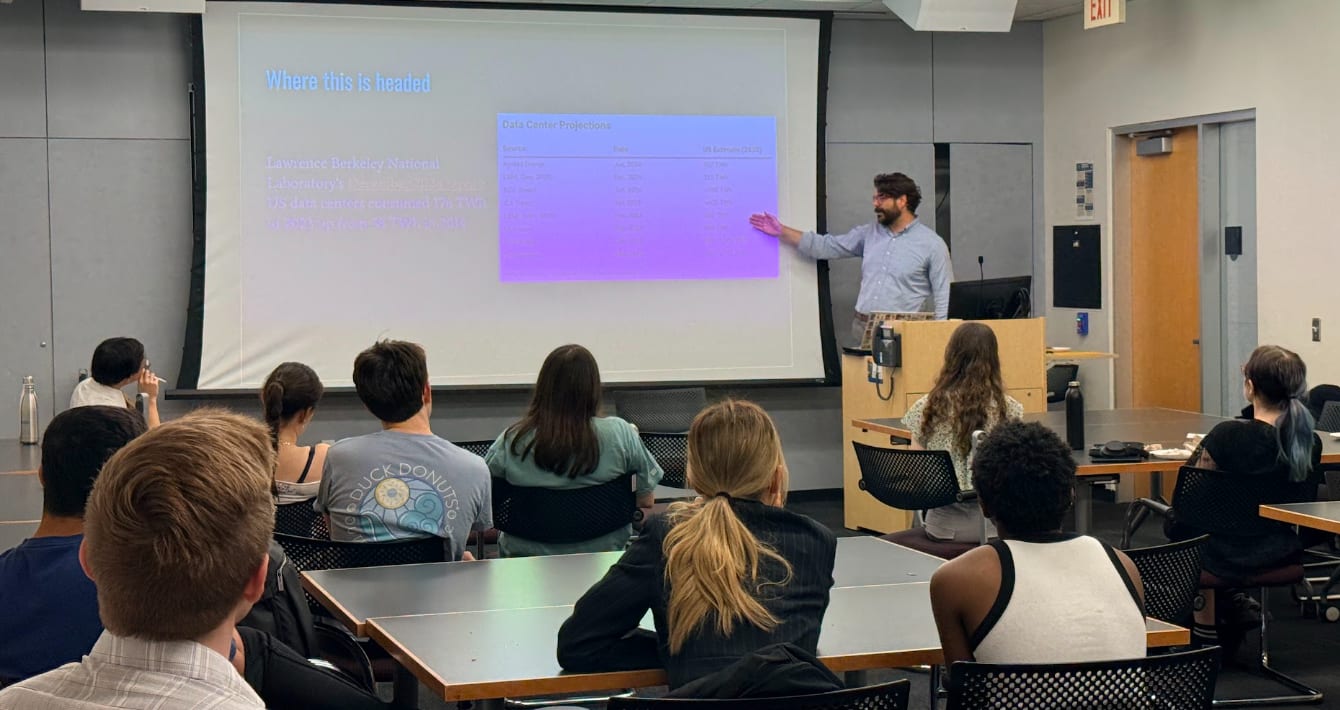
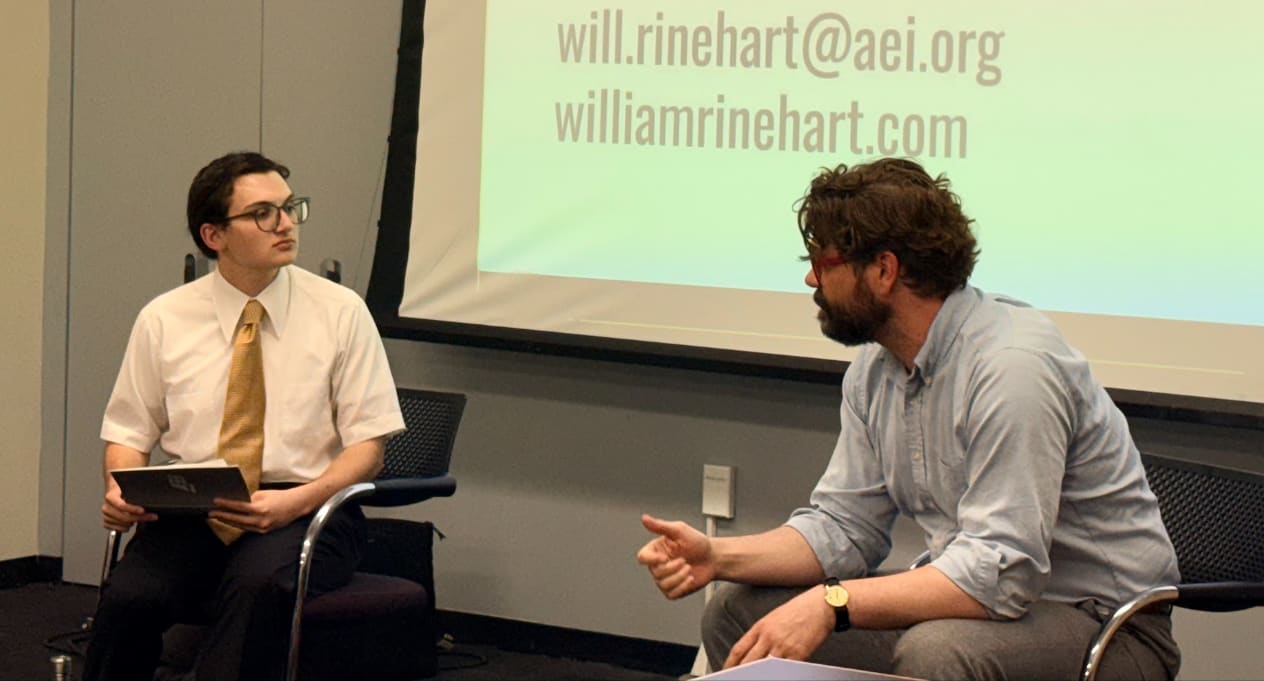
On April 16th, we hosted Will Rinehart of the American Enterprise Institute for a guest lecture titled, “Who Should Govern AI?” He gave a 30-minute presentation about his work, on topics ranging from data center regulation to model and semiconductor monitoring to using AI to forecast the economic impacts of state-level regulations. Afterwards, there was a 20 minute moderated Q&A, followed by a 20 minute open Q&A with audience members. Rinehart then generously took me and a small group of fellow students out to dinner nearby, paid for by the American Enterprise Institute.
A selection of photos from our Will Rinehart guest event
I thank all of our guests for taking the time out of their busy schedules to talk to GW students.
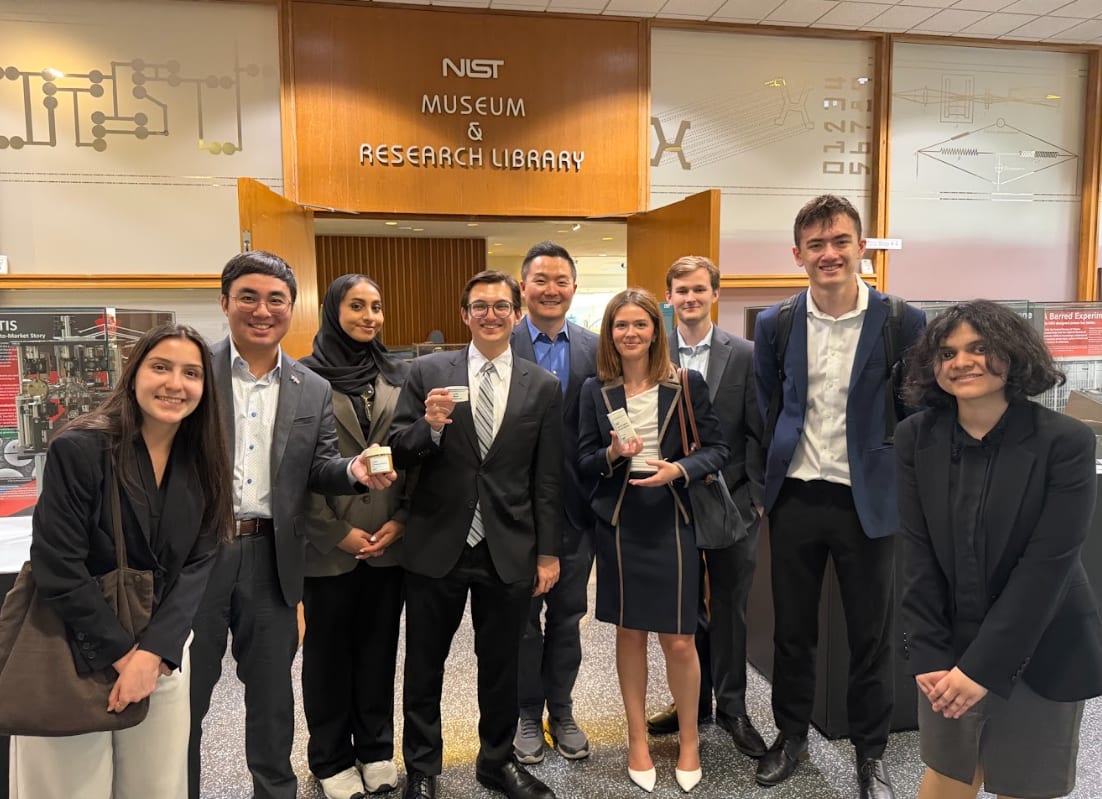
For those unaware, the National Institute for Standards and Technology (NIST) is a non-regulatory federal government agency in charge of industry standards-setting and promoting scientific research. They’re relevant for AI policy because they host America’s national AI safety institute, the Center for AI Standards and Innovation (CAISI). NIST also publishes the AI Risk Management Framework (RMF), which is the US government’s standard for dealing with AI cybersecurity threats.
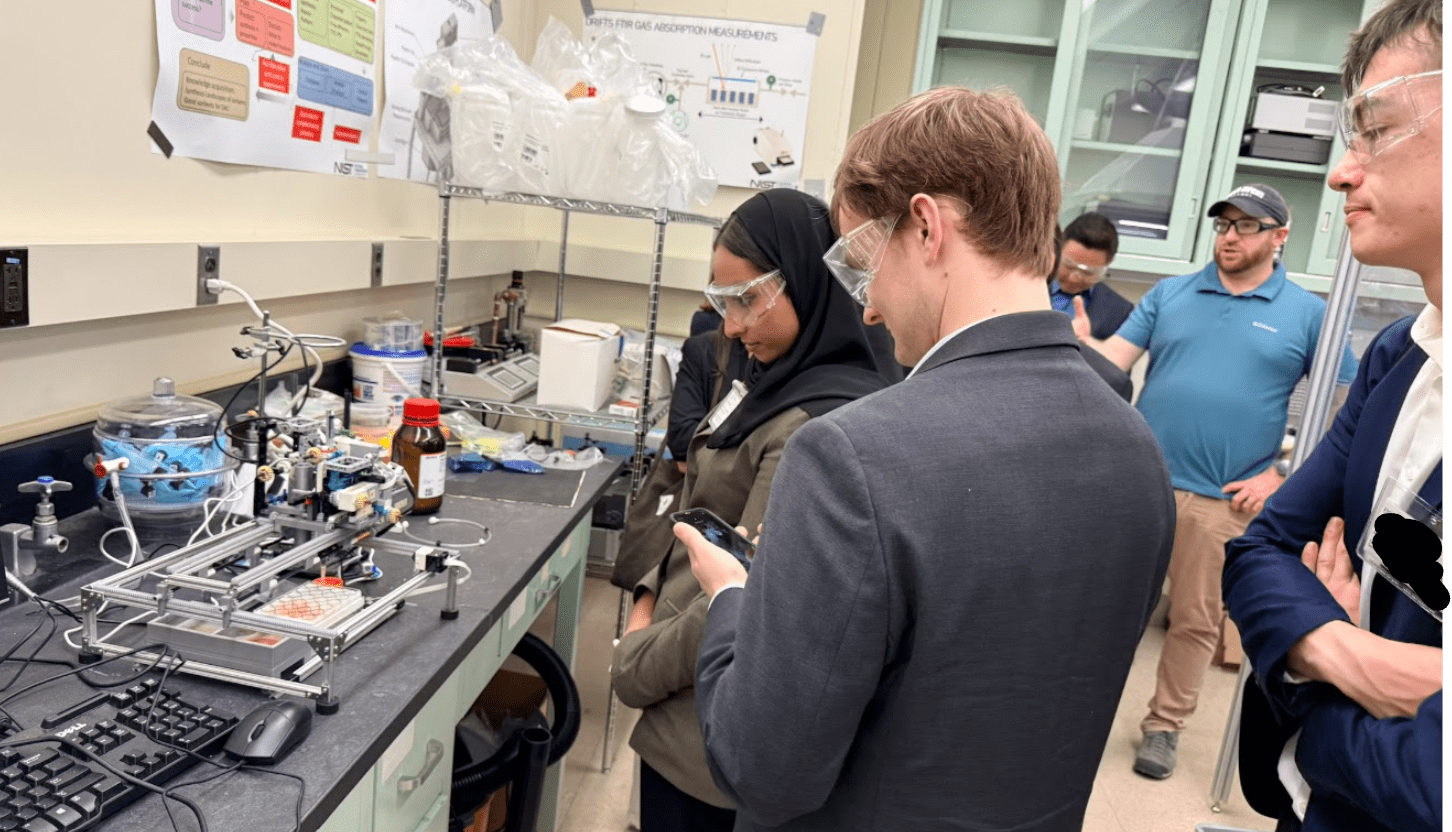
A friend of a friend of mine works at NIST, and through them, we were able to book a 3-hour guided tour of the institute. During our tour, we saw the NIST museum, we got a basic rundown of what NIST does, and we were able to briefly visit NIST’s autonomous formulations laboratory, where they use AI to advance the material sciences. The highlight of our tour was a 45-minute discussion we had with one of the primary authors of the AI RMF.
Select photos from our NIST site visit
Visiting a government agency like NIST was one of the most ambitious goals I set for AIPA this semester, and I honestly didn’t expect it to happen. So it makes me very happy that this tour happened and was a success. If you’re also an AI student organizer in the DC area, and you’re interested in fun and relevant sites to visit, I would recommend sending an email to NIST. The worst they can say is no, and potentially you could get a face-to-face meeting with one of America’s leading civil servants in charge of AI risk management.
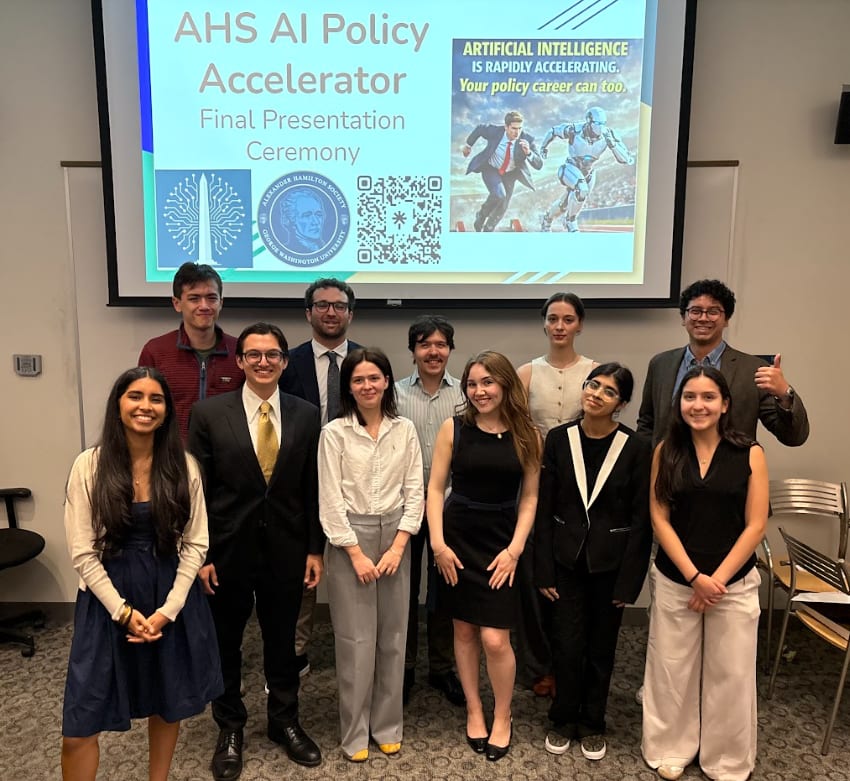
This was the most time-intensive part of running AIPA. I designed this fellowship for our most committed members, with the goal of upskilling them as quickly as possible into AI policy by helping them write think-tank-level memos about an AI policy subject of their choice. At the outset, Writing Fellows committed to attending 8 weekly writing workshops of 90 minutes each, followed by a final presentation ceremony at the end of the semester.
The writing workshops included:
(All the slides from our Writing Workshops are publicly available. Again, feel free to use, share, or modify them however you see fit.)
I structured the Fellowship so that the first couple of weeks would mostly be me lecturing / catching people up to speed on what’s happening in AI policy. Then, the bulk of the Fellowship involved Fellows independently researching between workshops, returning each workshop with what they’ve written so they can give / receive feedback from the other participants. The goal was for each of them, by the end of the semester, to not only have a polished memo that they could publish, but to be comfortable presenting their ideas to a public, professional audience.
12 people originally signed up for the Fellowship, of whom only 5 stuck around until completion. (One other Fellow said that she didn’t have time to finish her memo during the school year, but that she intends to work on it over the summer.) The published memos can be viewed on the newly-created AIPA Substack. In my opinion, the two best memos produced this semester were “The Case for Reversing the Ban on AI Rent Pricing in San Francisco” by Alex Tapia and “LLMs to Fill the Void: A Framework to Mitigate Forecasting Failures in U.S. Intelligence” by Enaya Bokhari.
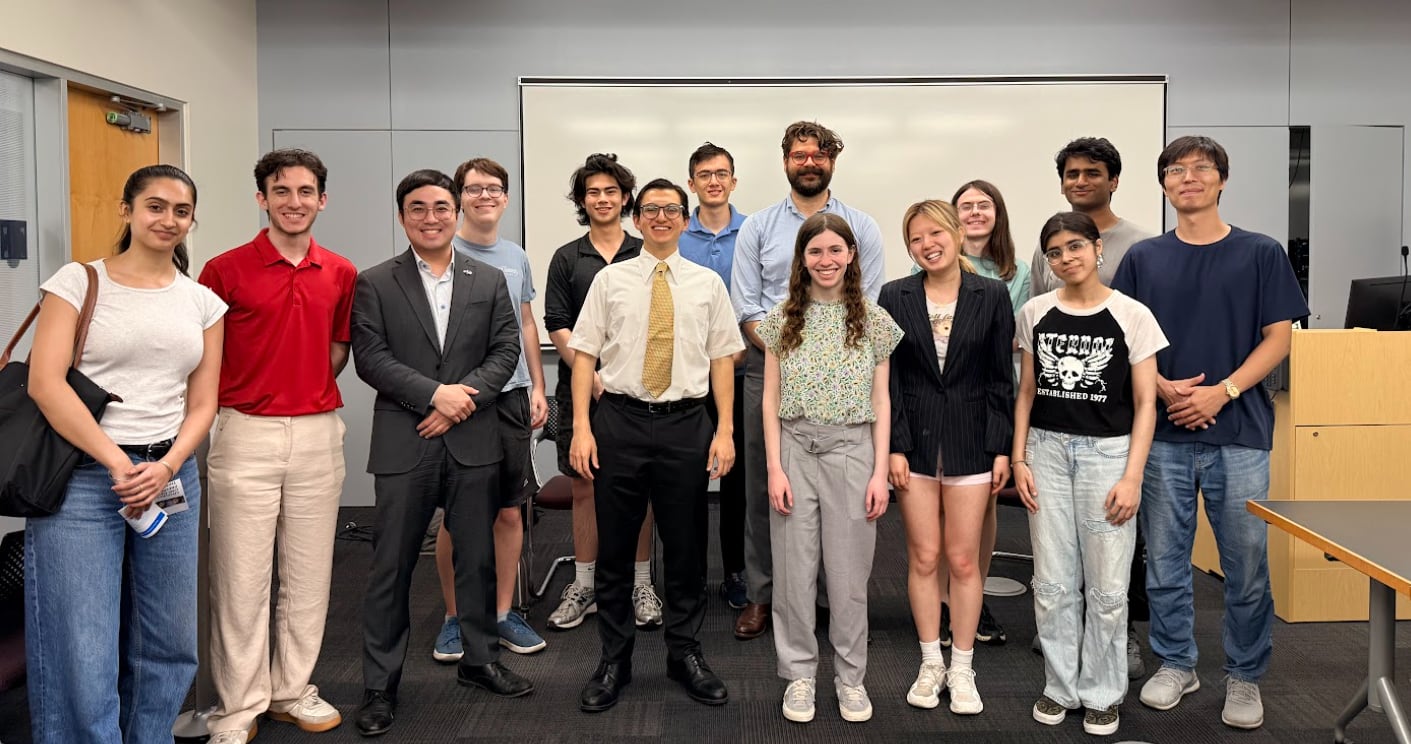
AIPA Organizers and Writing Fellows at the final presentation ceremony
To be completely honest, I’m underwhelmed by how the writing fellowship turned out. We had some real issues getting our writing fellows to regularly attend the workshops. And when the fellows did attend, they frequently had not done the readings / work that they were supposed to, so the workshops were not nearly as productive as they could have been. Most of the writing fellows procrastinated working on their memos, several of them had to rush to finish, and I think some of the resulting memos are below what their authors are capable of. I don’t know how much to blame this on my mediocre leadership quality (perhaps a more inspiring leader could have brought more out of his writing fellows), or maybe I had just set a goal that was too ambitious, given the reality that busy college students are generally not prone to volunteer extra hours of their week writing an additional paper.
In any case, I’m not actually sure that running the writing fellowship was worth my and the fellows’ time, compared to what we counterfactually could have done with that time.
From April 9-12, a group of 35 students from universities across the East Coast gathered at Workshop House for the April 2026 AI Policy DC Mini-Conference (DCMC). The event featured talks from professionals at organizations including RAND, IFP, CNAS, and FAI, along with workshops and informal meals designed to help students navigate careers in DC AI policy. Goals for the conference included:
More details about who attended DCMC and what went on can be found at the link above.
DCMC was organized by 8 students (myself included) from universities across the country. Planning for DCMC began almost immediately after the Pathfinder retreat in January. I originally lobbied against hosting a conference in the spring, since I didn’t think it was realistic to plan an event with dozens of students, dozens of guests, and a budget of thousands of dollars in under 3 months. But to my pleasant surprise, we were able to make it happen, and it was very successful. The event ran very smoothly, especially given its relatively small budget, and most of our participants and guests reported having a positive and productive experience.
I’d love to take credit for DCMC’s success, but in truth, the lion’s share of the credit goes to my friends Tristan Williams of Georgetown and Jeremy Kintana of UW Madison. They’re both phenomenal organizers. My biggest contributions to DCMC were helping book the venue, and organizing the cohort of 5 GW students who attended.
I don’t want to be too specific about finances, but I’ll just say that our total costs for the semester, including food, transportation, marketing supplies, and AI subscriptions, totaled to somewhere in the low 4 digits.
In terms of time, I would estimate that I spent around 15 hours per week leading AIPA over the course of the semester. For particularly busy weeks (e.g. the week of the DC Mini-Conference, and the week of our Will Rinehart guest event), I spent over 25 hours. I spent more time leading AIPA than I spent on any single one of my classes. I would estimate that my fellow AIPA organizers each spent about 5 hours per week on the group. What was this time spent on, specifically? A combination of attending organizer meetings, attending writing workshops, designing slides and educational materials, attending events, advertising / marketing events, and conducting administrative work (emails, communications, budget-tracking, etc.).
I imagine that if I were to run a program like AIPA again, I would spend less time per week on it, both because I now know how to work more efficiently, and because I would outsource more tasks to AI agents. (Already for some tasks, like mass-emailing professors and potential collaborators, we’ve employed AI agents, but we could have done much more to reduce our own workload.)
At the end of the semester, I sent out an exit survey to AIPA participants. Here are some of the results:
Question | Average Answer |
Did AIPA help you learn more about AI policy? (1 = No, I didn't learn very much. 10 = Yes, I learned a lot.) | 8.3/10 |
| Did AIPA help you advance your AI policy career? (1 = No, it didn't help me very much. 10 = Yes, it helped me a lot.) | 7.1/10 |
| Overall, how would you rate your experience with AIPA? | 8.7/10 |
Are you planning to stay involved with AIPA next semester? (1 = No, not involved at all. 5 = Yes, heavily involved. Not counting students who graduated this semester or are studying abroad next semester.) | 4.3/5 |
At the start of the semester, I privately wrote down a number of metrics for measuring AIPA’s success. They are as follows:
Original Goal | Realized Number | Verdict | |
| Number of active members | At least 20 | Depends how you measure it. I’d estimate around 50 students participated in at least one of our events, but of those, only around a dozen were “active members” who came regularly. | Partial success |
| Number of major events (e.g. speaker events, hackathons, site visits) | At least 4 | Again, it depends how you measure it. Counting the 3 speaker events, the NIST site visit, and DCMC brings us up to 5. | Success |
| Number of members who’ve landed tech policy / think tank roles: | At least 4 | 3 members said yes on the exit survey; 3 more said they applied and were waiting to hear back | Probable success |
| Number of members who’ve published research papers: | At least 5 | Exactly 5 | Success |
How do members feel about the org? Do they think it’s worth their time?
Based on survey results and conversations I’ve had with members, it seems like they feel good about the org, and most of the members who filled out the exit survey said they intend to stay involved with it next semester. Of course, current members of AIPA are a very biased sample to ask about AIPA, since they’re selected for liking it. There’s potentially a blindspot here, of people who tried out AIPA, didn’t like it or didn’t think it was worth their time, and then I never heard from them again.
How do outside orgs view us? Do they think we’re doing a good job?
Admittedly, I haven’t received that much feedback from outside orgs. But based on a small number of conversations I’ve had with individuals at AHS, AEI, Horizon, Kairos, and other AI safety student organizations, they seem to think I’ve done a good job leading GW AIPA.
On the other hand, perhaps the lack of exposure we’ve had with outside organizations is a signal that we’re still smaller / more obscure / less successful than I would like us to be.
How many people began their tech policy careers who otherwise would not have? How many people started working on AI safety who otherwise would not have?
This is probably the biggest question. While a number of our members have landed AI policy roles this summer, it’s hard to directly attribute that to AIPA. We have some talented people in our group who I’m sure would have gone on to do great things even without my help.
Nonetheless, I feel pretty confident saying that at least 3 of our members are now on a track to pursue AI safety / AI policy careers, who counterfactually would not have. I think that’s at least a partial success.
As stated above, I underestimated the amount of time it would take to get the word out about this org and recruit a leadership team. It took a full month (late January - late February) between when I first made the announcement for AIPA and when we began our programming in earnest. Since there are only just over 3 full months in the semester, that meant we lost about a third of the time that we otherwise could have spent on programming. Moreover, I imagine that several people who might have committed to AIPA had known about it at the start of the semester instead got involved with other activities.
In the future, it’s worth beginning preparations at least a month before the semester begins, rather than once the semester has already begun. I’m currently working with the incoming head of AIPA to ensure that she’ll be fully prepared for when the fall semester begins in August.
More broadly, I wish I had started AIPA in my freshman or sophomore year, rather than in my last semester before graduation. There’s only so much that you can do in a single semester, and I almost certainly would have had a greater impact if I’d had more time to build the org before leaving GW.
I realize that I made the deliberate choice to run an “AI policy” group, not a specifically “AI safety” group. I don’t need every one of our members to be bought in on short timelines or existential risks, and I’m still more than happy to help them advance their AI policy careers if they disagree with me on those subjects. Nonetheless, I want people to at least be aware of the big picture arguments that make EAs like me so worried, namely:
While AIPA has helped our members become more informed about AI policy, I unfortunately think many of them still don’t see the big picture. Most of the writing memos, for instance, covered “mundane” AI policy topics, like how to regulate deepfakes, or how to regulate mental health chatbots, or how to employ AI to boost short-term economic growth. While none of these topics are bad per se (I like economic growth as much as the next person), it feels mostly beside the point of what I think people should care most about.
If I were running AIPA again, I would make big-picture concerns like superintelligence and existential risks a much bigger focus. To reiterate: I don’t need everyone to agree with me on those topics, but I think that in order to be meaningfully informed about AI policy, you have to at least understand the arguments.
Similar to the point above, I made a deliberate choice to not make AIPA overly technical. I want AI policy to be accessible to as many students as possible, even and especially the ones who don’t have a technical background, who might otherwise think there’s no way for them to get involved.
That being said, it does help to know something about AI technology if you’re getting into AI policy. The goal, for students without a technical background, is to help them learn the relevant technical knowledge as quickly as possible. Unfortunately, I don’t think we did a great job of that. At the end of the semester, I don’t think most of our members could accurately explain what a token is, or a transformer, or a GPU, or what RLHF means, or the difference between training and test-time compute. This seems bad. If you try to market yourself in AI policy without actually understanding the relevant technical subjects, people will often be able to tell, and then they won’t take you very seriously.
I’m not quite sure how to fix this, though. I am personally more of a policy guy than a technical guy, so I’d feel pretty out-of-depth trying to teach others about technical subjects. Maybe the solution is to have more collaboration events with technical people from the GW computer science department or outside organizations. I encourage future AIPA organizers to run more technically-focused events, but what exactly that looks like, I don’t know.
As I said above, running the AI policy writing fellowship was the most time-intensive part of running AIPA, and at the end of it I’m just not all that impressed with the results. I think that in the future, it would be more productive to replace the writing fellowship with an AI policy reading group. A reading group has a couple benefits over a writing fellowship, namely:
Of course, if any of the members want to write policy memos, we should by all means encourage them. But this encouragement could be on more of an ad-hoc basis, rather than as a heavy-organizer-commitment weekly fellowship.
It’s easy to get distracted by the day-to-day maintenance of an organization, the proceduralism, and the inputs you put into it. (E.G. How many guest speakers did we book? How many people attended? How much money did we raise?) But what truly matters are the outputs. And for AIPA, the two main outputs we care about are:
Everything else is, at the end of the day, irrelevant. I think it’s good to frequently ask yourself questions like, “Is what I’m doing actually accomplishing my goals? Or is it just making me feel like I’ve accomplished something?” Because otherwise, you risk putting a lot of effort into something, patting yourself on the back about it, but not actually achieving the thing you set out to achieve.
Simply put, most people don’t know what they’re capable of because most people have never tried to test their limits. It can be easy to say, “Oh, that could never be me,” or, “Oh, that’s too hard.” But is it really? If you put all your heart and soul into doing that thing, how far could you go?
Prior to this semester, I’d never tried a really ambitious organization-building project like this, so I had no idea how well I would do. But now I’ve tried it for a semester. And now I know that with a few months of my hard work and dedication, I can gather a group of talented people, form a nice community around a common interest, and put on some pretty impressive events. In the process, I’ve both learned things about myself and displayed my talents for others to see. Even if AIPA hadn’t been successful, it at least would have proven that I’m capable of taking risks pouring myself into a project I care about.
In general, I believe that most people are not nearly ambitious enough. If you’re not trying something new and exciting, pushing the boundaries of what you believed to be possible for yourself, then I think you’re leaving a lot of opportunities on the table.
The reason I put so much effort into AIPA this semester is not just to have a great semester’s worth of AI policy programming, but because I wanted to build AIPA into something that can survive and thrive even after I leave GW. If I was successful in this endeavor – if AIPA continues to grow and fulfill its mission for years to come – then this will retroactively justify the effort I put in to start it over the course of this semester. Conversely, if AIPA struggles and dies shortly after my graduation, then it probably will not have been worth the time I put into it. So, only time will tell if AIPA will result in the kind of impact that I’m wishing for.
I’m currently taking a few months off after my graduation to travel, work on personal projects, and do some soul searching. I’ll be in Berkeley this June for Lighthaven’s festival season – LessOnline, Summer Camp, and Manifest! – so please reach out if you’re in the area and want to meet up.
Longer term: I intend to stay in Washington, DC for the foreseeable future and enter the workforce by the end of the year. I’m aiming for a role in AI safety / AI policy; I have a few positions in mind, but nothing locked down yet. If you think I’m the kind of person your organization might like to hire / work with, then don’t hesitate to shoot me an email at liamhrobins [at] gmail [dot] com.
There’s good news and bad news for AIPA’s future. The bad news is that three of our main organizers (myself included) are leaving GW at the end of this semester, which means that AIPA will have to find a new organizing team for the fall semester. The good news is that we’ve already selected the next head of AIPA. She was one of the most competent and committed organizers this semester, and I have full confidence in her ability to lead the org. I’ll be working with her over the summer to make sure the leadership transition goes as smoothly as possible, so that she’ll be ready to hit the ground running as soon as the next school year begins in August.
If I had to give my most honest forecast for how I think AIPA will turn out by the end of 2026, I’d say:
To reach GW AIPA, you can email GWaipolicy [at] gmail [dot] com. You can also email me personally at liamhrobins [at] gmail [dot] com.
If you’re an undergraduate or graduate student at GW, we’d love to see you get involved, and ideally join the AIPA organizing team. If you’re an AI safety / AI policy organizer at another university, we’d be happy to answer questions, give advice, or organize an intercollegiate collaboration. If you’re a think tank, advocacy group, or other organization active in DC, we’d also love to work with you. We can host speakers, send talented students your way, and organize events on the GW campus. (GW students can reserve GW spaces either for free or for well below market cost, so if you’re looking for an inexpensive venue in downtown DC, hit us up.)
I’d like to thank the Alexander Hamilton Society, and in particular their GW chapter, for parenting AIPA. Their support, professional network, advertising and org management, and the partial funding they gave us, made my life as an organizer much easier.
I’d like to thank Kairos / Pathfinder for their mentorship, financial support, and their help in getting me connected to a nationwide network of talented university organizers interested in AI safety. I’d like to thank Daniel King in particular for being such a great mentor.
I’d like to thank all the other organizations who helped / partnered with us along the way, including but not limited to the Horizon Institute, TechCongress, the American Enterprise Institute, NIST, Workshop House, Effective Altruism DC, and George Washington University itself.
Finally, I’d like to thank all the GW students who participated in and helped organize AIPA this semester. You’ve been a great bunch of people to work with; it’s been an honor and a privilege to help teach you about AI policy.