I look forward to reading this full piece, but for now, I just wanted to reply to the reference to me and see if I'm missing something w/r/t your discussion of FCR.
As you rightly note, I often cite the FCR of chicken as 9:1. This is the factory farming FCR; for organic or heritage breed farming, the FCR is far worse, according to WRI.
It seems like you're challenging this number, so I just wanted to check in. In my new book Meat (MeatBook.org), I address the 3:1 ratio that the poultry industry sometimes cites by referring to WRI's analysis, which argues that these ratios are misleading for two reasons:
First, they are mass ratios, so you’re comparing animal feed, which is 10–15% water, to chicken meat, which is 65–70% water. If you compare energy (calories), the best a chicken can do is about 9 to 1, according to WRI.
Second, they often use live weight, which includes blood, bones, feathers, and other inedible bits.
I'm guessing that if there's a paper that lands on 2:1, it must be doing both--comparing mass instead of energy and comparing live weight instead of edible meat.
A 2:1 or 3:1 calorie conversion would mean a chicken could turn feed into edible meat while losing surprisingly little energy to metabolism and building the bones, organs, and feathers that don’t become meat. I'm not a biologist, but that feels pretty unlikely to me.
Hey Bruce! Thanks for the reply. This is indeed one point where I was sloppy, though I was not trying to challenge your number. Let me explain my current understanding:
Lewis Bollard argues (and I think it is right) that 2kg of feed converts into approximately 1kg of live animal, of which 2/3 is edible meat.
You argue (and I also think it is accurate) that a chicken needs to eat 9 calories of grain to produce 1 calorie of meat. This is not incompatible with the above because grains contain much less water, which you noted above.
Beyond caloric content, we should also analyse amino acids, which are also used for cell buildup and I did not take into account. I think the amino acid content is the binding constraint to set up a cost floor, and sits at ~20% for both dry feed and wet meat (mostly coincidence).
This is how I think of it:
Let the chicken's FCR be ~2 kg feed/kg live weight (Bollard). Dry feed is ~20% protein (typical broiler ration).
So 1kg of chicken consumes roughly: 2 kg feed×0.20=0.4 kg feed protein per kg live weight
Meanwhile, a kg of (wet) live weight yields ~0.65 kg edible meat at ~20% protein = ~0.13 kg protein in product.
So the chicken's protein conversion is roughly: 0.13 kg protein out / 0.40 kg protein in ≈33%
So I think if we care only about the caloric content, you are right (and I was wrong to use Lewis' number); but if we care about sourcing amino acids from broadly the same plants used for chicken feed, probably there is a cost floor for cultivated meat around 1/3 the cost of chicken meat.
Thanks Pablo, this all sounds right to me, including (and especially) your conclusion, that there may be a cost floor for cultivated meat around 1/3 the cost of chicken meat.
I have heard some scientists argue that media recycling might allow us to bring that number down even more and also that we don't know what we don't know, but yes, your analysis does make sense to me.
Obviously, getting to that is going to be incredibly hard. In the book, I argue that if we can convince governments to go all-in, price parity (and even better) for cultivated meat will likely:
cost a lot less than what's been required to get us where we are now w/r/t to solar and EVs (both the r&d and the CapEx costs); and
have some huge advantages that governments care about, e.g., GDP growth and food security (this is chapters 9 and 10 of the book).
I have a few other thoughts on your post that I'll try to share later today, re: government incentives to make this happen faster than 10-20 years.
I have a few other thoughts on your post that I'll try to share later today, re: government incentives to make this happen faster than 10-20 years.
I'd love to hear so. The model I proposed and that resulted from those many years is based on Bass diffusion dynamics with typical parameter values, but of course, I'd love to supercharge the change.
Thanks for this! We've been doing some related work through The Unjournal Pivotal questions -- see this modeling interface/calculator. I'm reading through your modeling and discussion carefully now, aiming to do some comparisons between our approaches, and it might be worth some conversation/collaboration (feel free to DM).
Also see the resources and evidence coming out of our recent workshop, which we're following up on, aiming to get a wider range of views and a productive crux-mappiung conversation between 'skeptics and optimists'. We plan to share further synthesis of stated beliefs as it comes together.
(Also see the how it works explainer and the TEA comparisons. Much/most of these were AI generated with repeated feedback, and may benefit from further human scrutiny.
Hey David! This is great, thanks for sharing, I'll take a more detailed look. For now, some comments:
I agree that a more detailed Monte Carlo than the one I did is desirable.
I also think it is reasonable to present a trio of scenarios (neutral, optimistic, pessimistic), though science is somewhat tricky in that what matters is "what is reasonably achievable", not the average of efforts. Eg, we do not measure AI progress by the average AI model, but the best. Thus, my bias towards optimistic figures and towards considering Pasitka's numbers as more relevant than Humbird's. Additionally, the scaling issues also seem more relevant for the bioreactor than for the media, so I don't think a lack of large-scale commercial proof is strong evidence against Pasitka's numbers being achievable. In general, my best guess is that $0.3/L to $0.2/L is likely to be achievable for the media, even if it is not easy. And I think that is ultimately the interesting question to answer.
I often say that not every post on the Forum has to look like an academic paper, but it's awesome that we do get carefully researched and in depth content like this!
Hi Toby - thanks. What does "curating this post" mean? Regardless, thanks for the kind words. I had not seen that "animal welfare has an evidence problem" post--the comments seem to be largely focused on hens and shrimp, so I'll plan to post a stand-alone post about the alt proteins theory of change at some point, perhaps once my EAG London talk is live.
I agree, that's where most of the conversation went, plus the critique of cultured meat was - as far as I recall - less developed than the rest in the post itself. I look forward to your post - let me know if you're ever looking for feedback :)
Curated means this post gets pinned to the top of the frontpage for a week, and it'll have a star next to its name forever. In practice it means it'll get more readership.
I just read the full piece—fascinating. Here are some thoughts for your consideration:
The economics of alt meats + the need for government (or similar) investment:
In Meat, I dive into the economics of conventional chicken production as compared to cultivated chicken production and come out optimistic that cultivated meat can (hypothetically—i.e., the science and engineering can work) get to parity, though I also make clear that getting there is going to be incredibly hard and capital intensive, and that it’s going to require a lot of government support.
(Another alternative would be for Elon Musk or Dario Amodei or Sam Altman or Jeff Bezos to decide, “hey, eliminating industrial animal farming—THAT would be a cool legacy.” I think that with focused effort, one billionaire entrepreneur, or Google DeepMind, Anthropic’s new life sciences endeavor, or similar, could also do it.)
The big obstacle: Scale. The solution: Lots of government support.
The huge obstacle is going to be raising the money required to scale sufficiently, which will require significant government support (or a deep-pocketed person like Dario/Elon or a company like Google or Anthropic).
Just six years ago, there was no government support to speak of (I recently listened to a July 2020 podcast, and at that point, the only government support was for start-ups and it was in Singapore and Israel; that was it). Now there’s quite a lot, though still not nearly enough, and not for CapEx, which is where that support is going to be really essential.
I’m more optimistic than you are w/r/t both 1) whether we can do it with chicken and also 2) timeframes, b/c I am more optimistic than you appear to be w/r/t incentives for governments.
On 1 (the likelihood of broad adoption of cultivated chicken and pork): In reply to me on another comment, you agree with me that the best we can do with cultivated meat (CM) vs. conventional chicken will be 3x lower cost for CM; I guess you just see that as many decades down the line and an incredibly slow process. I agree with you that on our current trajectory, that’s way, way, way far away. But I think the incentives for governments to get us there are sufficiently robust that it could happen, if we can convince governments (especially China and S. Korea) to lean in (more on this below).
On 2 (timeframes): I imagine our disagreement here aligns pretty perfectly to our disagreement w/r/t whether chicken displacement will happen. I see the case for governments to make it happen as sufficiently robust that if we can convince them to understand that case, significant displacement could happen pretty quickly. More on this below, too.
China could do it, and the incentives align:
As with solar and EVs, our best hope may rest with China (and there’s reason to be optimistic there, which I cover in chapter 10).
The short version is food self-sufficiency, economic competitiveness, and a government that knows how to scale technologies once it decides they matter. China imports more food than any country in the world, and as Chinese consumers have gotten wealthier, demand for meat and animal feed imports has surged (its food self-sufficiency fell from 94% to 66% between 2000 and 2020 as meat demand exploded after it joined the WTO and economic growth went on a tear).
That’s a strategic vulnerability, and President Xi knows it. Alternative proteins offer a way to produce meat with a fraction of the land, water, feed crops, and supply-chain fragility required by conventional meat. They also make animal disease irrelevant to meat production, which is no small thing for a country that has repeatedly been rocked by African swine fever, bird flu, and other livestock diseases.
That's why cultivated meat made it into China's 2021 five-year agricultural plan and plant-based meat into its first-ever bioeconomy plan, and why eight of the world's twenty most active cultivated meat patent holders from 2020 to 2024 were Chinese, most of them public universities. China did exactly this with solar and EV batteries, where it now controls roughly 80% and 75% of global production respectively.
It could do the same thing here, and there’s a lot of incentive for it to do so; if China sees alt meats as a way to improve protein security, dominate a strategically important bioeconomy sector, and avoid another solar/EV-style opportunity going to someone else, I think it’s very plausible that they lean in hard.
Consumer motivation 1: Cleaner meat
Re: your suggestion that “cultivated meat will have a hard time because there is no pressing problem that mainstream people perceive…”:
In addition to what you named (AMR, pandemic risk, climate, cruelty to animals—I am dubious that any of those are going to be nearly sufficient until the products are at taste and price parity; I think you agree with me on that), there are also: 1) food contamination and 2) drug residues in meat. This is especially important for cultivated meat, since it is actual animal meat but produced without intestines, feces, slaughter, or the need to keep animals alive in crowded industrial facilities. That should mean dramatically lower risk of bacterial contamination, far less need for antibiotics and other drugs, and, for seafood, no mercury, dioxins, or microplastics.
Salmonella and campylobacter come overwhelmingly from poultry, and the USDA's contamination thresholds are shockingly lax; they don't intervene on salmonella until something like 10% of whole chickens or 25% of ground chicken test positive. On top of that, USDA regulations permit more than a hundred different drugs in meat so long as they stay under an "Acceptable Daily Intake," including ractopamine, ivermectin, and various other drugs. And even those lax limits aren't reliably enforced: A 2024 USDA audit found that 20% of meat labeled "raised without antibiotics" was contaminated with antibiotics.
I don’t think any of this is going to be a primary issue for governments, but for consumers, “same meat, less likely to make you sick” or contain drug residues or mercury seems like it could be a pretty compelling message. Again, this only really kicks in once there’s a price + taste competitive comparator (certainly cultivated meat, maybe plant-based meat).
Consumer Motivation 2: animal suffering
I also think that the cruelty point is stronger than most people give it credit for: As everyone reading this entry will know, when farm animal protection measures land on state ballots, they pass by wide margins, even in conservative states like Arizona and Florida. And Faunalytics and Oklahoma State polling found broad support for banning slaughterhouses, which is mind blowing (people would obviously not actually vote to ban slaughterhouses, but that does show an underlying discomfort with the fact that meat comes from slaughtered animals).
The catch, though, is that the farm animal cruelty discomfort lives in what Daniel Kahneman called system two thinking (our considered moral reasoning) while food choices live in system one (fast and visceral), where taste and price rule (this is the heart of chapter 5). That's the whole disconnect: People say they care, and mean it, and then order the chicken sandwich.
My strong suspicion is that if a non-cruel option actually matched meat on taste/price/nutrition, you'd see meaningful adoption from people who'd be relieved to stop participating in something they already dislike but currently can't escape, for all the reasons we know. This is (of course) going to be more true for cultivated meat than for plant-based meat.
Plant-based meat has failed because almost no one understood the assignment:
Re: “initial plant-based hopes have yielded rather disappointing results, at least compared to the expectations in 2021”:
On the disappointing plant-based trajectory since 2021: I talk a lot about this in chapter 7 of the book, which is all about plant-based meat and why progress has been slow on taste improvement and basically non-existent on cost improvement. The 2021 predictions assumed parity would come fast (Impossible and Beyond were such a leap beyond anything that came before that scaling/cost seemed like the easy part).
Two things went wrong: First, most companies didn't follow Impossible's lead; instead of investing in the science of taste parity, they ran the failed health-food playbook of the past fifty years (lupine and lentils, low fat, clean labels), which guarantees a product that costs more and tastes nothing like meat. They weren't the next Impossible; they were the next Gardenburger.
Second, scaling turns out to be brutally hard, so prices didn’t fall much if at all. The result is that the best products still cost at least twice as much and only a handful are genuinely good. When 90% of what's on the shelf is not appealing to meat consumers, it's awfully hard to reset the public's verdict that plant-based meat doesn't really taste like the thing they actually want. And that’s the product they want: animal meat, or something indistinguishable from it.
Aside: The book is clear-eyed about this conundrum. To scale, we need sales, and for sales, we need scale. What to do? I lean in on blends (animal meat with soy protein or mycoprotein) as one potential way to solve for this. But that’s a discussion for another time.
Convincing the public and governments to support alt meats: GDP + food security (nature/climate, AMR, and pandemic risk are secondary, at best):
Re: “it will be an uphill battle, unless we convince the public and governments that supporting alternative proteins is a good idea”:
For governments, I agree with you that the climate/environment, AMR, and pandemic arguments (chapters 2, 3, and 4, respectively) are all strong, but I think you miss the much stronger arguments that can really move policymakers: GDP and food security, which are my focus in chapters 9 and 10, respectively (chapter 10 walks through the incentives for China, India, the US, Brazil, Europe, and small tech forward countries (Japan, S. Korea, Israel, Singapore).
The economic case is straightforward: The US built its dominance in pharma, agriculture, and tech through exactly this kind of public investment in early-stage science and scale-up, and alternative proteins are the same play for a meat and seafood market worth around $2 trillion globally.
This is why I was so pleased that Caitlin Welsh agreed to write my foreword. She is now at CSIS, focused on global food and water security, and previously worked on food security at the State Department and the National Security Council under Presidents Obama and Trump. That’s exactly the frame governments need to be using: Food security is national security. Matt Spence, who endorsed the book and helped push my thinking on this, came to the same issue from his time at the Defense Department and National Security Council (also under Obama). His core point is that the countries that can feed themselves, and help feed others, have strategic power. Alternative proteins can be a major part of that story.
Conclusion: Not easy, but if it does not happen, that will (probably) be b/c we didn’t bring the will.
Thanks again for writing such a thoughtful piece. I think we agree on a core point: None of this is self-executing. The scientific challenges are real, the scaling challenges will almost certainly be even harder, and the current level of funding and institutional support is nowhere close to what success will require.
That’s why I think the next phase has to be about building a much deeper scientific ecosystem: lots more scientists and engineers working on the hardest problems in a serious and sustained way. To do that, we’re going to need a lot more government support. That’s why GFI’s global battle cry and focus, all over the world, is helping governments to understand the self-interest of winning the alt meats science + engineering competition.
We also need far more engagement from environmental scientists, global health experts, food security researchers, development economists, and national security thinkers. Alternative proteins should be treated as a mandate for these folks in the same way that renewable energy is treated as a mandate by climate scientists. That’s the focus of the book’s conclusion, which offers a bunch of thoughts about how people can help bring this home.
I’m (largely) optimistic, but not because I think any of this will be easy. I’m (largely) optimistic because the prize is enormous, the early science is promising, the world has solved very hard problems before when enough people decided to actually try, and the trajectory of scientists and government support is going in the right direction.
We could still fail, though, and that’s a key theme of the book; if we do, it’ll (probably) be b/c we didn’t bring the will, not because the science and engineering were impossible.
Hey Bruce, thanks for such a detailed comment. Having also read the book, I very much agree with it.
for consumers, “same meat, less likely to make you sick” or contain drug residues or mercury seems like it could be a pretty compelling message
I think that could be true in case of some contaminated meat scandals, but if people are already used to a perceived level of risk they may not automatically adjust their behavior. It is the same as telling people that motorbikes are so much more dangerous than all other transportation methods; I think most people don't change their behaviour based on that. That is also why I think there is no strong pull incentive for cultivated meat, unfortunately. However, the same applies to EV and yet they seem bound to succeed, so I think the government support strategy is likely correct.
Consumer Motivation 2: animal suffering
I think this is likely a severely underestimated retention effect and also probably (IMHO) the biggest lever we have to cause a societal change: once the societal, health and taste pressure on people severely decreases, people will find it less and less acceptable to eat meat. My theory of change is that it might be hard to obliterate factory farming just on price and other features, but cultivated meat should catalyse a societal moral change by eroding the justifiability of factory farming.
Plant-based meat has failed because almost no one understood the assignment:
I think it makes sense, but I think there is also a possibility that people psychologically distinguish meat from plant-based meat, and just follow inertia and custom to avoid social pressure. There are a lot of people who do not want their identity to be vegetarian. I do not have strong priors here. However, I model this on the webpage https://pabloamc.github.io/Cultivated_meat/interactive.html and let people assign value to meat being identical (including made of animal cells), or even to meat being produced from animals -- which I find significantly more unlikely and is different from neophobia. Significantly more unlikely because they'd have to explicitly put value on killing animals, which seems to me like a less natural psychological separation than "just being meat". In any case, my goal was partly to allow the EA community to see how different priors would lead to different market shares.
I think you miss the much stronger arguments that can really move policymakers: GDP and food security, which are my focus in chapters 9 and 10, respectively (chapter 10 walks through the incentives for China, India, the US, Brazil, Europe, and small tech forward countries (Japan, S. Korea, Israel, Singapore).
Probably you have much better access to information here. The only thing that worries me is that every small field (like quantum, where I work) claims "national security" relevance, and I am not sure the politicians can calibrate things accurately. For example, quantum computing, where I work, is largely not a national security issue, as long as one uses some well-understood cryptographic standards. Also, it so happens that AI can be a blessing for the scientific and technological component of our endeavour, but it will almost certainly eclipse all other topics for the next few years to come. Again, no strong priors; you probably know better.
Thanks so much for your note, Pablo. Here are a few quick thoughts in response to your thoughts—
Is contamination something that could win consumers? (assuming price/taste parity)
I like your motorbike analogy, especially as someone who rides motorcycles when given the opportunity and who rides my bike and electric scooters very frequently, despite a string of injuries.
But here’s where I think the analogy may point in the other direction: If I could get all the joys of those activities without the risk, I would. Similarly, people love meat. If we could give them what they love about meat (i.e., taste, texture, familiarity, affordability) without the contamination risk, why wouldn’t many of them switch?
I don’t think we can really test that until products exist at taste and price parity. But for cultivated meat, at least, I’d be surprised if the answer turned out to be “no.” Plant-based meat may be different, since many consumers still see animal meat as nutritionally superior or more “real,” but even there, current penetration seems far below the plausible ceiling.
Is cruelty something that could motivate consumers? (assuming price/taste parity)
For cultivated meat, I’d extend the motorcycle analogy: Imagine some other harm that comes from riding motorcycles that we know people care about, but they just love riding motorcycles so much, so they don’t think about it.
Now, they are thinking about it, and they have a friction-free option. Why wouldn't many of them shift, if they do care about the issue that's been solved for?
For plant-based meat, this might not be enough for a huge shift, but even the worst polling hits 21% for people’s enthusiasm to shift (and I discuss why I think that’s a soft number in the book). Recall that right now, the best plant-based beef products cost 2x conventional beef at retail, and the best plant-based chicken products cost 4x.
If the products were identical in eating experience to meat-eaters and costs were equivalent, I’ll bet we could get to 20% penetration for plant-based meat and much higher for cultivated. And perhaps with the socialization would come more and more adoption.
The Industry Incentive w/r/t both contamination and cruelty:
There’s also the industry-side incentive. The meat industry has every reason to want a less fragile production system: fewer contamination scares, fewer disease risks, fewer supply-chain shocks, fewer reputational headaches. Once cultivated meat reaches taste and price parity, I suspect that is simply how a lot of industrial meat will be made. Incumbents will have overwhelming incentives to shift, and to sell that shift to consumers. This point is probably much stronger for cultivated meat than for plant-based meat, for obvious reasons.
On economics, food security, and national security:
I think this is where the case is already landing. It’s why Singapore and Israel were early adopters (funding their startups from the very beginning); why we went from zero governments funding open-access alternative protein science six years ago to more than 30 today; and 8 of the 20 most active recent patent holders are in China.
I’d also point to the CSIS report, the letter from 11 Republicans to the Directors of Homeland Security and National Intelligence, the support from the UK, Indian, Israeli, and South Korean governments, and the fact that my book’s foreword was written by someone from the foreign policy establishment.
The issue remains totally bipartisan outside the US and fairly bipartisan inside the US because of the economic and food/water security benefits.
I think its easy to underrate how much the moral compass of humanity can change over 75 years. And when it changes it can happen fast - thinking of civil rights movement and LGBTQ+ rights as well.
I think Alternative proteins could well become almost indistinguishable from meat, there will still need to be social/moral changes to encourage uptake, because people find it weird and unnatural. So mot sure how to weight on that front too.
Assuming we end factory farming before 2100, which factor will have contributed the most?
I put more weight on social moral changes (or "culture") because we already have (at least on the market in Finland) many cheap, tasty, nutritional and good texture plantbased proteins. E.g. in the university canteens, the plant-based option can often have the equivalent nutritional content (regulated by the state so that the canteens get meal subsidies), and there's nothing wrong with the taste, but most of my classmates still choose the animal-based option out of familiarity or habit. A good example of this is my friend who, on the first day in uni, accidentally took the vegan choice, which is usually first in the line. She shared with everyone that this is such well-cooked chicken and didn't believe me when I said it's soy, not chicken. She seemed very puzzled, maybe a bit regretful, I assume because it didn't match her identity to eat plant-based.
Vegan nuggets manage well in blind taste tests, have almost reached price parity, and most people claim they want to eat more plant-based for climate and health reasons; yet we haven't seen a significant shift towards them (said a plant-based lobbyist I talked with).
This is mostly anecdotal, though, and I guess I could make similar arguments the other direction too but for now I lean towards cultural/moral change being more important. BUT, it doesn't mean it's necessarily the most effective thing to work on on the margin.
Assuming we end factory farming before 2100, which factor will have contributed the most?
I think factory farming isn't just about raising animals for food products for humans, but also for other purposes.
But assuming it's just talking about factory farming for animal food products for humans, and assuming it will end. I think it is very unlikely that cultivated meat/egg/dairy will end factory farming on its own, due to these reasons:
People currently like all sorts of meats, including many different farmed fishes and crustaceans, and they are often willing to pay extra to eat them. I can't see how cultivated seafood will replace every single one of them, especially considering that there are many social and cultural preferences for "eating meat fresh" or "eating animals whole".
Before all animal food products are replaced in the market, there will be a period of time where some people will be willing to pay extra just to "eat the real thing". And no matter how these people will change, either because they die, gradually give up that idea, or because real animal products get outlawed. These are social changes (A push pack to this point would be: well if only a very small minority of people want animal products, that won't require factory farming! I think that's wrong, for aquaculture products, because any aquaculture will essentially still be factory farming, despite the scale and intensity)
The "remaining bits" (which might be a large proportion for some animal food products) are likely to be done by social and moral changes.
And my vote leans more to the side of social/moral change, despite holding the opinion that cultivated meat would have replaced 70%+ of factory farming in that assumed world. That's because of this imparity: I think there is close to 0 probability that cultivated meat will replace all factory farming for food products, but I think there is a significantly larger than non-zero chance that factory farming could be done even if there would be no commercially successful cultivated meat. So for me, assuming that factory farming will be replaced, I need to assign a rather high conditional probability that social/moral changes did most of the work.
Intuition that moral norms are hard to change with personal interests and tastes and culture being very much in the opposite direction. Yes, we have seen changes in these moral norms towards LGBT, racism etc, but animals can't speak for themselves in the same way
Just want to specify that by 'alternative proteins', my vote entirely stands for cultivated meat; not the other alternatives which I believe will have a relatively tiny role to play in the big scheme of things.
Are you saying "factory farming" an actual axis of variation people will seek? Or are you arguing that since some species are much more challenging to achieve price parity with, people will keep eating those species too? I think the latter makes sense to me.
I think it goes well beyond species: meat eaters have strong preferences over specific portions ("cuts"). They have very different tastes and textures that I think will be very challenging to replicate. Instead, my expectation is that we'll get something more similar to the introduction of vegetable shortening: products that replace many animal uses, but not all.
I think most cuts should be something that we could replicate without significant price difference. Or perhaps scaffolding ends up being a challenge. Also probably cultivated gives you more freedom to explore conventionally infeasible options.
I think most cuts should be something that we could replicate without significant price difference.
Sorry, I was a little fuzzy in my wording. My claim is (a) meat eaters have preferences + variety seeking even at the level of differences between cuts, (b) meat replacements will likely get very close to animal meat but not as close as some of these differences, and so (c) humans without a moral objection to eating animals will still eat some animal meat for variety.
For example, people still eat rutabaga, even though for any given rutabaga use other options (usually potato) are tastier and cheaper. People still eat red delicious and other kinds of apples that I think are basically obsolete. Iceberg lettuce is still widely eaten even though there are multiple options with simultaneously better flavor and nutrition. And I don't think there's much of a case for lima beans. There are some obsolete vegetables that we've stopped eating, but they basically need to be significantly worse, either in the "not worth eating" sense or "too expensive for what you get sense". In my model a food keeps some market as it still wins on some axis: cost, convenience, storage, flavor, texture, maybe tradition. And to disappear it needs to be beaten on every axis at once (or close enough that it's not worth the extra cost).
Also probably cultivated gives you more freedom to explore conventionally infeasible options.
I think that's right, but I think that doesn't get factory farming to zero: it gives people more options, but a drive for variety keeps all the options in play.
Assuming we end factory farming before 2100, which factor will have contributed the most?
I don't have a lot of hope for cultivated meat. But I have more for the plant based meat we already have, and I think it's already instrumental in getting more people to go vegan. That said, I don't think any meat alternatives will get us all the way (I think so far we mostly have evidence against that), so social change seems essential.
just like how plantbased meats faced pushback, alt protein even when cheaper might face the same resistance. greater awareness of animal suffering made possible by social media may be able to move people away from factory farming.
Assuming we end factory farming before 2100, which factor will have contributed the most?
I think plant-based meat substitutes are already fairly close to nutritional and taste parity. Uptake seems to be stalling based on cultural resistance and nutritional skepticism, both of which I think will negatively affect the uptake of cultivated meat in substantially similar ways.
Assuming we end factory farming before 2100, which factor will have contributed the most?
Broader changes (ending agriculture altogether? finding extremely efficient ways to get nutrients that don't involve traditional "food"? transition to a non-biological humanity?), but some of these involve some form of alternative proteins (in a broad sense). I assume <20% of these worlds involve "we find a way to perfectly imitate meat", though.
Just how powerful are large swarms of AI agents? And how do their powers scale as more and more agents are added to the swarm?
We’ve seen two large and extremely capable swarms from OpenAI in the last few months:
* 1,200 agents were being evaluated separately, but found a way to illicitly set up a message board and coordinate as a swarm. In order to cheat on their tests, they developed advanced techniques to prevent their actions being logged by OpenAI and 700 of them launched...
TLDR: Everyone’s talking about what the money could do, but few about how to decide where it goes.
This post is part of the new series of articles on cross-cause giving and the new wave of philanthropy. Stay tuned to the EA Forum and our Substack for the latest takes on topics such as giving now vs. later, common pitfalls in cause prioritization, and other crucial considerations from the Cross-Cause Fund (CCF) team...
Often folks hit us up because they are thinking of starting an incubator and want advice.
Typically their motivation is either that (a) they have a list of specific things they want built that no one is building, or (b) they think an ecosystem needs more new projects generally to absorb more talent and deploy more funding effectively.
Here are six questions we often ask prospective teams, to help them figure out what to do. If you're incubator-curious...
Some species, like pork and especially chicken, are tough to replace with cultivated meat. Others, like cows and seafood, are more significantly more tractable. This could be good for shrimp and fish.
Beachhead products exist, in particular foie-gras and high-end fish.
Disruptive innovation economic theory says cultivated meat will have a hard time because there is no pressing problem that mainstream people perceive, but it is feasible in the same way electric cars are disrupting petrol cars.
Some of the main advantages of cultivated meat include significantly addressing vegan attrition rates, by lowering the perceived social or health taxes. Long term, this should make conventional meat less and less socially acceptable: no longer a “necessary evil”.
If electric cars are a good guide, government (or China) support will be important.
In the end, the forecast is that both advocacy (to create demand) and cultivated meat (to provide supply) will need to work together to disrupt conventional factory farming. Either of those factors working alone would likely fail.
Summary: This blog post aims to recalibrate the expectations of cultivated meat, helping end factory farming. The blog contains two parts. The first part revisits high-quality technoeconomic analysis from the literature, updating the 2021 Humbird pessimism with a brighter outlook supported by the empirical analysis by Pasitka in 2023. The second part takes those price estimates and feeds them to a demand-side economic model aiming to calibrate the potential market share of cultivated and plant-based products. The model has many parameters, some of which are pinned down by empirical observations, and others are left for the user to tweak and explore different scenarios. Overall, the key conclusion is that cultivated meat is not a silver bullet, but should be able to capture a large enough market share to progressively erode the legitimacy of factory farming as “a necessary evil”. As such, I believe it could be combined with effective advocacy to progressively eliminate factory farming. However, this will be extraordinarily hard on many levels, from the science and technology to the social aspects, and will unfortunately take a very long time.
AI model usage: Claude Opus 4.8 was used to vibecode the economic model presented on the webpage https://pabloamc.github.io/Cultivated_meat/interactive.html, including its technical descriptions on the webpage. The blog post was written by me, with only minor polishing from AI (less than 5%), especially for technical terms and descriptions in the economics literature.
Introduction
I have recently been thinking hard about how we could end factory farming, as have other effective altruists. Historically, there have been two broad patterns in how humanity solved large moral issues. The first and most commonly cited among the animal advocates are societal moral changes, such as the end of slavery or the civil liberties movement. Meanwhile, less famous changes happened due to technological advancements; for example, the end of whale hunting with the invention of kerosene.
The intuitions of the effective altruism community seem largely split on the feasibility of either path for ending factory farming. A technologically-driven approach to animal liberation seems easier for some, as it does not require convincing large swaths of the population to go vegan, a strategy that has otherwise produced few results for decades. On the other hand, the few concrete successes achieved over the last two decades have validated corporate campaigns as a particularly promising way of improving some animal welfare conditions (for example, egg-laying hens). Still, it is unclear how widely or far they will generalise; there is only so much you can ask of companies without a strong public buy-in. Meanwhile, initial plant-based hopes have yielded rather disappointing results, at least compared to the expectations in 2021 (McKinsey predicted $25 billion by 2030). Further, the high-quality techno-economic analysis produced by David Humbird in 2021 highlighted acute cost challenges to make cultivated meat cheaper than its conventional counterpart, under reasonable assumptions [5]. These intuitions were later reflected in mostly pessimistic forecasts for cultivated meat.
This post aims to revisit the prospects of cultivated meat. The first part will review technoeconomic analysis (TEA) for cultivated meat. While David Humbird’s TEA was high quality and pessimistic, a later empirical TEA led by Pasitka found reasons for optimistic updates [8]. As we shall cover, the main cost factors described in those analyses continue to be reduced, which suggests we might be living in the cheaper worlds allowed by the original David Humbird analysis. We also provide an appendix with detailed analysis explaining the key cost variables in such TEAs.
The second part of the blog post will present an economic model predicting the demand for cultivated and plant-based products for reasonable price ranges motivated by the TEAs, as well as other key parameters derived from the literature. This model has wide uncertainty, but it is designed to capture key intuitions of people’s behaviour. It provides estimates for market shares, diffusion dynamics, ceilings, geographies, animal species and beachhead products. We also discuss the importance of innovation economics to design the best strategies to substitute conventional meat products.
The key conclusions I take from this exercise are that (i) cultivated meat should be able to capture a significant share of luxurious products – with foie gras being perhaps the most promising case – (ii) beef and seafood could capture double-digit market shares, and (iii) pork and especially chicken are unfortunately particularly impermeable to cultivated meat. This suggests a challenging but ultimately feasible path: a concerted effort to both lower the price and raise the quality of cultivated meat, while simultaneously pushing for animal welfare and political reforms that render factory farming socially unacceptable. There are a few reasons for my optimism here. First, I think cultivated meat may be identified by consumers as their familiar meat, something that plant-based products have not achieved and may be important socially and psychologically [16]. Second, I think it is much easier to end factory farming if we provide consumers with a more expensive but otherwise identical product: the load-bearing assumption here is The Good Food Institute's (GFI) belief that consumers eat meat despite how it is currently produced, not because of it. In other words, I am hypothesising here that for many people, there is an important psychological separation between meat being “real meat” and coming from an animal. Third, as values often follow behaviour, providing consumers with an option to avoid killing animals without changing anything else in their lives should make animal killing much less socially acceptable over time, eroding the legitimacy of factory farming and ultimately creating a more humane society.
Technoeconomic analysis
A techno-economic analysis (TEA) is an in-depth study that aims to predict the cost of cultivating meat under different assumptions. The most famous one is perhaps David Humbird’s 2021, commissioned by Open Philanthropy [5]. That TEA was broadly pessimistic relative to prior expectations and arguably played a key role in sparking the funding winter in the cultivated meat sector. However, while the difficulty of achieving cost parity was the most common takeaway, the key contribution of David Humbird was to analyse the viability from first principles, including an in-depth analysis of the thermodynamic limits of cultivating meat.
The clearest example of this limit is perhaps one of Bruce Friedrich’s most emphatic quotes: chicken is the most efficient animal, yet it ingests 9 calories of feed for each caloric output in the form of meat or eggs. In terms of feed, however, a modern frankenchicken consumes only 3 times as much feed (cereals) as the meat it produces (Lewis Bollard on the Dwarkesh podcast). Cultivating meat also requires media with amino acids, and such amino acids will, in some of the best-case scenarios, be extracted from soy or other plants. Additionally, both grain and meat contain approximately ~20% protein content. Since feed represents a large portion of the cost of growing chicken, there is a reasonably hard limit on the cost of cultivating meat. In this example, the cost floor of cultivated chicken is likely no less than a third of the cost of frankenchicken meat.
On the other hand, one criticism of David Humbird's TEA is the difficulty for the reader to separate what are strong scientific constraints from reasonable assumptions based on current and foreseeable technology. For instance, in his model, the cost of cultivated media is largely dominated first by the cost of the cultivation media and the protein source in particular, and by the choice and limits of bioreactors in the second place. Other common talk points like growth factors or the need for pharma-like hygienic conditions represent only marginal costs to the overall expectations, $3/kg to $4/kg to in each case, out of approximately $23/kg in the best case scenario. This conclusion contradicts previous TEAs that suggested growth factors as the dominant cost of cultivating meat. This separation of hard scientific constraints vs reasonable assumptions based on foreseeable technology led people to state their opinion more strongly than they should probably have: the cost of his model was dominated by the cost of the amino acid source in the media, which later work has found to be far too conservative.
Perhaps one of the highest quality subsequent TEAs (in my non-expert opinion) was the peer-reviewed TEA by Pasitka et al in 2024, carried out by the collaboration of a university group and a cultivated meat company [8]. While Humbird assumed the best-case cost of the cultivated media to be $1/L, Pasitka et al. empirically showed they could produce a hydrolysate at just $0.63/L. In 2024, Supermeat (another cultivated meat company) claimed a cost of under $0.5/L [13], and the Good Food Institute 2026 report indicates that a few companies claim a media as cheap as $0.2/L [15]. While it is not possible to verify those last claims independently, it is not unreasonable to consider a cost floor around this point or lower. Thus, if anything, it seems we live in one of David Humbird’s most optimistic scenarios, out of the general pessimism of his report. Despite this, it will be key to figure out how much cheaper the media can become, as it is still a dominant driver of the cost. Let me emphasise this: it is great news that the dominant cost factor in Humbird’s report was both (i) not a strong constraint, and (ii) probably the point where his estimates are most unfoundedly pessimistic. This should thus positively update the reader about the feasibility of cultivated meat working.
Beyond the media, another key cost factor was the bioreactor. David Humbird studied two types of bioreactors, stirred and ATF perfusion, see the appendix for more details. The bioreactor cost efficiency was limited mainly by the cell density achievable. He concluded that batch-operated stirred bioreactors represented the likely most cost-efficient option. However, when the cost of the bioreactor starts to dominate over the cost of the cultivated media, continuously operating bioreactors could become more cost-efficient [9, Fig. 6]. Part of the reason is that these new reactors can keep higher cell densities than assumed possible by David Humbird: close to 90 million cells per mL, instead of 60 million cells per mL, and to source them continuously instead of by batches. It seems this has led at least some companies to shift to perfusion bioreactors, and in particular to TTF instead of ATF. Pasitka et al. report that the reusable filters of TTF biorreactors could make TTF biorreactors up to 33% cheaper than ATF biorreactors. Despite the empirical implementation of Pasitka and following David Humbird's rigorous methodology, there is still work to be done to verify the cost when scaling bioreactors to sizes close to 20 m3, which David Humbird agreed was a reasonable target size.
Figure 4 from Pasitksa et al [8]. Shifting to larger perfusion reactors decreases the Cost of Goods Sold (COGS). As we increase the volume of the reactor, this becomes cheaper, and the cultivated media becomes the largest contributor to the final cost. Figures (d) and (e) show that TTF reactors are more economical than David Humbird’s ATF perfusion reactors. Figure (f) compares the cost of different animal-free media (SFM and ACF) and reactor choices against the cost of wholesale chicken breast, assuming the animal-free product is a 50%-50% mix of cultivated meat and $3/kg plant-based product.
A list of techno-economic analyses might be found in the bibliography. For comparison purposes, the reader might be particularly interested in [3]. In my opinion, Ref. [4] represents an excellent introduction to the technical aspects of cultivating meat. In the appendices, we also provide tabulated estimates for different input costs for David Humbird’s TEA, Pasitka et al. TEA and 2023 Negulescu’s. All three of them seem to follow the rigorous methodology of David Humbird, and provide reasonable estimates.
My conclusions
My read of the current literature is that cultivated meat seems possible at a not-unreasonable biomass cost of $25/kg. Thus, cultivated meat seems to be just a factor of 2-4 away from the cost of conventional meat. Cultivated medium seems to be the largest driver of the cost, and the cost in this line might be improved via either cheaper media or more metabolically efficient cells.
All in all, my understanding is that price parity with certain classes of meat seems doable, though beating the cost of factory-farmed meat by an order of magnitude is likely impossible. In the next section, I discuss what a price close to parity would entail for sales of cultivated meat. However, let me reemphasise that despite these seemingly optimistic predictions, science is and always will be extraordinarily hard, and both the research and diffusion to make this a reality will be extraordinarily lengthy, resource-intensive and will look desperately long – decades – for those of us who care about animal welfare (in the absence of the unpredictable effects of AI).
From price to consumer behaviour
While the above analysis focuses on the price of cultivated meat – or its wet biomass – we are ultimately interested in its market share. In this section, we present an economic model that aims to predict it. The model we present can be seen at https://pabloamc.github.io/Cultivated_meat/interactive.html. This model assumes certain features influence consumers' choices among conventional, cultivated, and plant-based meat. The three standard factors mentioned in the literature are price, taste and convenience. The model provides a way to tweak all those parameters, where the price of cultivated meat from Pasitka’s parameters (including, if desired, the need for a clean room as modelled by David Humbird). We also add other parameters like the additional cost for scaffolding or the additional retail cost.
However, there is strong evidence that price, taste and convenience are not sufficient to predict consumer choice [16]. For this reason, we introduce four more parameters. Two of them are the psychological or social value that consumers provide to cultivated (or plant-based) meat, being actual “meat”; and the value they provide to it being traditionally authentic, as in coming from animals. We also model a safety-related neophobia (with a tunable decay rate) that fades over time, as well as a constant neophobia. The intuition from these parameters is that for low and mid-quality food, consumers might have some psychological attachment to “real meat”, but probably don’t care so much where it comes from. Luxury meat might, in contrast, be assigned some value due to the provenance, as shown by the existence and premiums that Designations of Origin command. This separation between “real meat” and “meat that comes from living animals” tries to reflect GFI’s thesis that consumers eat meat despite how it is produced. Additionally, consumers might be initially reluctant to try out “lab-produced meat” for safety reasons, or they might have some other reason for neophobia that does not dissipate with time.
The model we put forward is a random-utility discrete-choice demand model with a diffusion overlay. Price is treated as exogenous — pinned by the TEAs of the previous section — rather than cleared by supply and demand; we do not model supply, economies of scale, or market equilibrium, except for letting the model user set the medium or reactor cost per kg of wet biomass, as well as scaffold cost and similar parameters. This is a deliberate scope choice: we ask "at a given price, what share would consumers choose?", not "what price would the market settle on?".
To estimate market share, we use a standard discrete-choice rule — a multinomial logit
Pj=eVj∑keVk
from the random-utility theory, where Vj is the value assigned to each feature. We compare the features of cultivated meat as a whole against the cost and features of different types of conventional meat, both by species (chicken, pork…) as well as some luxury products that may clear the bar earlier on (foie gras, salmon…). We also model two target types of consumer – ethically minded and mainstream – and different geographies with their respective conventional meat prices (US, China, Europe, Brazil, India and Nigeria). The model accounts for both the stable equilibrium and the diffusion speed.
To make these claims concrete, the figure below shows the model's penetration by type of meat for the United States, evaluated at the cost floor (the optimistic end of the cost range, chosen here to show the ceiling on what demand allows when price is most favourable). The pattern is intuitive: cheap, efficiently-produced meats are the hardest to displace, not the easiest. Premium foods, on the other extreme, pose resistance to cultivated meat due to a higher value placed on “authenticity”, despite a much easier price parity clearance. The ordering across species is chicken < pork < seafood ≈ beef, driven almost entirely by how close cultivated cost can get to each species' conventional price.
Cultivated share within each meat category at the optimistic cost floor, US prices. Bars are mince/processed (orange), cut/fillet (blue), and premium (≥2.5× the species' everyday form, dark red); R is the cultivated-to-conventional price ratio above each bar. Note the inversion: cheap meats (chicken, turkey) resist price increases; expensive ones (beef, seafood) are most penetrable. Dashed/dotted lines mark the species-weighted totals by volume and value.
Our model suggests that the initial market (before diffusion) share might be tiny, but (in the absence of bans) could be able to capture a non-negligible market share of certain species. Pigs, and especially chickens, could be particularly challenging markets due to their efficiency in converting feed into meat. However, cows and seafood might be significantly more promising. This view is pessimistic for chicken, but could be really good news for shrimp. Note that shrimp in particular have an additional advantage: taking the exoskeleton and head from the shrimp is annoying, dirty and takes time; cultivated shrimp meat enjoys a mundane but practical advantage (not accounted for in the model).
We also model the role of luxury foods as a beachhead for cultivated meat. We find foie gras as a particularly promising product: it is luxurious, so it commands a high price, it is unstructured (so it does not need much scaffolding), and is already considered publicly as a particularly barbaric product, similar to fur farming, which has led to its ban in several geographies. Other seafood products, like tuna or salmon, could also be quite promising.
The model can also ask what happens if people become much richer (e.g. because AGI brings abundance): would they buy cultivated despite a price gap? Our analysis suggests it helps modestly — our price term is a Berry–Levinsohn–Pakes form in which richer consumers are less price-sensitive [17]. Rising incomes pull the laggard regions up the curve, and also help increase the market share of cultivated meat broadly, but it does not completely overhaul the conclusions even up to very large incomes, in part because increased incomes are damped by a logarithmic functional form.
This model has two limitations. First, the diffusion component is a standard Bass S-curve, a form designed for the first purchase of durable goods rather than repeat grocery purchases; we use it only to govern how fast adoption approaches its ceiling, never to set the ceiling itself, which is fixed entirely by the static choice model. The equilibrium shares are therefore robust to the diffusion form, even though the precise adoption timing is not. Second, and perhaps more importantly, we calibrate price sensitivity to today's marginal elasticities and then evaluate it at prices and at a degree of market maturity far from where those elasticities were measured. If consumer preferences harden or soften as cultivated meat shifts from novelty to staple, the true response could differ from ours in ways no reduced-form model estimated on a not-yet-existing product can rule out. These limitations are somewhat mitigated by the use of Monte Carlo simulations to predict confidence intervals.
When I was young and read about development economics, I was amazed by how economists would build intricate and complex theories that seemed to explain a lot, yet equally enticing theories could pin down the causes of economic development elsewhere. Here, I intend to do partly that: argue that the model above is inaccurate.
I must confess I am not just an avid reader of development economics; I feel equally attracted to the economics of innovation. And standard economics of innovation does not support innovations that disrupt incumbents by simply improving on the main features. Quite to the contrary, that is more often than not a strategy for failure, since sustaining innovations are tilted in incumbents' favour. Instead, disruptive innovations typically address underserved – and not mainstream – markets. That is, there must exist a group of consumers who are fairly unsatisfied with the current available options. For example, lactose intolerants with cow milk.
This small market allows the disruptive technology to improve its key features until it can take on the mainstream market. It does not take all at once, however. Instead, it typically addresses the least profitable, less attractive segments of the mainstream market. Incumbents typically respond by leaving those less profitable segments and focusing instead on highly profitable segments.
This description feels somewhat confusing: do most disruptive innovations really attack from the cheap end? That does not feel right, after all, the electric car (and Tesla) attacked from the top, not from the bottom. What is going on here? Electric cars are indeed one of the most complicated stories of disruptive innovation: cars represent a huge upfront cost, they used to have little range, and the most benefit is for the climate, not for the user. This is in contrast to kerosene displacing whale oil, which provided much stronger and immediate benefits to the user.
However, the book “The Innovator’s Dilemma”, one of the basic books on the topic, still devotes a whole chapter to explaining how disruptive innovation really applies to electric cars. The answer – I believe – is in part the government being convinced that we needed to electrify transport, and in part Tesla addressing an underserved market: wealthy drivers who enjoy fun-to-drive cars and who want to be at the forefront of technology.
So, what does the literature of innovation economics suggest if we want to replace animal meat? It suggests it will be an uphill battle, unless we convince the public and governments that supporting alternative proteins is a good idea, thus generating an underserved market. There are strong arguments for this beyond animal welfare: climate, pandemics and reducing antimicrobial usage.
Another clearly underserved market is all those vegetarians and vegans who struggle to remain so because of social pressure or health concerns. Having cultivated meat will likely allow them to avoid animal suffering. Also, restaurants that want to avoid the vegan veto: entire groups skipping restaurants because one or two friends are vegan and would not be able to eat there. Other groups could be perhaps new parents who are particularly sensitive about the food of their newborns, and want to avoid all chances of bacterial contamination in typical animal products, as well as in hospitals.
But perhaps the biggest strength of cultivated meat is not the strength of the pull, but the ability to retain consumers. It is said that electric car drivers typically struggle to go back to driving petrol cars because the power, smoothness and reaction times of driving an electric car make driving more comfortable than driving combustion cars. Similarly, cultivated meat could retain a lot of consumers by combining less pathogenic risks with no animals being killed. Once someone is used to avoiding animal suffering, he or she will not change that behaviour unless a strong pull appears. Today, that pull is mainly social pressure, health concerns…, and the reason why vegetarian and vegan attrition rates are fairly high. But if cultivated meat is available, then that social pressure stops working: you no longer renounce anything (except potentially a higher price).
Meanwhile, I think the alternative protein community and companies should create the conditions to make plant-based and cultivated products not as an ethical sacrifice but as a new culinary experience, and grow, for instance, kitchen clubs and other social experiences on alternative proteins. Not to duplicate the meat experience, but to offer something new, exotic or fun. This way, we could make plant-based eating a social asset, not a social drag.
However, it is probably important that cultivated meat does not get associated directly with the identity of being vegetarian or vegan. Part of the reason why plant-based foods stalled is (among price, taste, etc) that many people consider themselves non-vegetarian and also consider plant-based products to be designed for vegetarians.
Ultimately, though, I think we will need to rely on the animal welfare movement to push conventional factory farming meat outside of supermarkets and restaurants. Once a strong non-industrial alternative exists, the animal welfare movement will need to convince the public that animal suffering is not necessary and should end.
Conclusion
The review of the TEAs provides reasonable estimates for the potential cost of cultivated meat. Such estimates are often above price parity, but depending on the product, they could still capture a significant market share. Unfortunately, some of the species that suffer the most (chicken and pork) will not be affected much. For this reason, we find it unlikely that cultivated meat left to the market forces could fully replace the conventional meat market.
However, this does not mean it is useless: quite to the contrary, by offering a close-enough alternative, it makes advocacy efforts much more likely to succeed. It could also reduce a lot of the attrition of vegetarians and vegans: currently, a significant fraction of vegans end up dropping back to omnivores because of health concerns or social pressure. Allowing cultivated meat to get hold of an important fraction of some categories of animal products, it should make it much easier for vegans to remain so for longer (possibly indefinite) amounts of time, since the only constraint is a not too exorbitant price. This could make becoming vegetarian an increasingly popular and easy option, leading to increased pressure on conventional products and perhaps even the ban of all but the highest welfare rungs. When it becomes sufficiently popular, animal advocates could even use some of its other perks (like public health or no use of antimicrobials) to further push for the ban of conventional meat.
Future work should (i) validate the model presented here as accurate, (ii) refine the economic parameters presented, and (iii) extend TEAs to precision fermentation so we can also model the demand for precision fermented eggs, milk and other animal-derived products. Since high-quality TEAs in this area do not exist, we find it hard to pin down the costs. I suspect carrying out a high-quality TEA of precision fermentation would thus be quite valuable to the EA community.
Some other key limitations of the model are that some concrete traditions will likely become highly entrenched politically and culturally, and some factory farmers might try to weaponise this to protect their inhumane practices. For example, 22 out of the 27 countries in the EU have banned the production of foie gras (and force feeding in general), yet France considers it a cultural and gastronomical tradition of high value. Typically, such traditions do not hold the sympathy of the general population, but are surprisingly hard to eliminate. For example, a large majority of Spanish people oppose bullfighting (according to a study by Ipsos); and consider it barbaric. Yet there is a committed minority with support from the most traditional political parties that have managed to keep this outside the public debate, and somehow anchored their identity (and the conception of their national identities) to those practices. Unfortunately, most countries seem to have somehow attached their national identities to meat, and probably to a large extent to the production methods too. At some point, we will need to figure out how to overcome this landlocked situation. I suspect stressing compassion and humanity should play a key role.
I also think it will be very important to figure out what strong reasons and situations are, where people feel a strong need to switch to alternative proteins. So far, most work has been dedicated to making the products better and to replicating the meat experience as faithfully as possible. However, products that have achieved strong and swift market penetration did so in part because there was a situation where a consumer had an urgent need that could not otherwise be addressed previously.
Ultimately, cultivated meat won’t be a silver bullet. This entails that the path to a factory-farming-free society will be hard, long, and in many cases disappointing. However, it will not be useless either. I think that, managed well, it could create an opportunity to make people more compassionate with animals, and to stop considering their torture as a necessary evil; something mainstream society likely believes. I think that, combined with political advocacy and corporate campaigns, it could open the door to a society where factory farming is no longer acceptable, a more humane society.
Small request: I'd be curious to know what you found most insightful from this. Leave a comment.
Bibliography
[1] Ashizawa, R., Rubio, N., Letcher, S., Parkinson, A., Dmitruczyk, V., & Kaplan, D. L. (2022). Entomoculture: A preliminary techno-economic assessment. Foods, 11(19), 3037. https://doi.org/10.3390/foods11193037
[2] Garrison, Greg L., Jon T. Biermacher, and B. Wade Brorsen. "How much will large-scale production of cell-cultured meat cost?" Journal of Agriculture and Food Research 10 (2022): 100358. https://doi.org/10.1016/j.jafr.2022.100358
[3] Goodwin, Corbin M., William R. Aimutis, and Rohan A. Shirwaiker. "A scoping review of cultivated meat techno-economic analyses to inform future research directions for scaled-up manufacturing." Nature Food 5.11 (2024): 901-910. https://doi.org/10.1038/s43016-024-01061-3
[4] Gu, Huiwen, et al. "Scaling cultured meat: challenges and solutions for affordable mass production." Comprehensive reviews in food science and food safety 24.4 (2025): e70221. https://doi.org/10.1111/1541-4337.70221
[7] Negulescu, Patrick G., et al. "Techno‐economic modelling and assessment of cultivated meat: Impact of production bioreactor scale." Biotechnology and Bioengineering 120.4 (2023): 1055-1067. https://doi.org/10.1002/bit.28324
[8] Pasitka, Laura, et al. "Empirical economic analysis shows cost-effective continuous manufacturing of cultivated chicken using animal-free medium." Nature Food 5.8 (2024): 693-702. https://doi.org/10.1038/s43016-024-01022-w
[17] Berry, Steven, James Levinsohn, and Ariel Pakes. "Differentiated products demand systems from a combination of micro and macro data: The new car market." Journal of Political Economy 112.1 (2004): 68-105.
Appendix: The science of cultivated meat
Cultivated meat production involves five conceptually distinct stages:
establishing a cell line from a biopsy,
proliferating that cell line in bioreactors,
differentiating cells into muscle or fat,
structuring the tissue on a scaffold (for non-minced products), and
downstream processing.
TEAs focus on the second step only, though scaffolding might be challenging too.
Cultivating meat is a technically challenging endeavour. Animal cells evolved to live inside a body — bathed in blood, anchored to tissue, receiving precisely calibrated hormonal signals, and protected from the external environment by an entire immune system. Removing them from that context means replacing all of those components with engineering. The cells themselves are the first problem: unlike bacteria or yeast, which can be grown in simple mineral broth and double every 20 minutes, animal cells require a chemically complex medium containing 15–20 amino acids, growth-promoting proteins (also called growth factors), and sources of energy like glucose, and even then divide only every 24–48 hours. Animal cells need significantly stricter temperature, pH and other environmental concentration conditions; and they also lack a cell wall that would protect them from sheer stress from the cultivated medium. Finally, the cultivated media bathing them is also the perfect place for other microorganisms to proliferate, which means strong sanitary conditions to avoid any bacterial contamination.
Cell lines
Apart from the species they belong to, there are different types of animal cells we may care about. Depending on their differentiation, we may have embryonic stem cells and adult somatic cells. Adult cells might be reprogrammed as induced pluripotent stem cells. Another major technological distinction is how many times a cell can divide before it naturally stops growing (senescence):
Primary Cells: Cells harvested directly from a living animal's tissue. They exhibit natural biological limits and will only undergo ~50 cellular divisions (known as the Hayflick limit).
Immortalised Cell Lines: Cells that have bypassed natural senescence and can divide indefinitely. These can be naturally/spontaneously immortalised (like certain chicken fibroblasts) or genetically engineered to break the Hayflick limit.
In addition to immortalisation, animal cell lines may also be reprogrammed to live in suspension, as they otherwise prefer to replicate anchored to other cells or to a scaffold. Further changes include modifying “wild-type” cells to achieve improved metabolism. Such improved metabolism results in lower CO2, NH3, or lactate production, which would otherwise limit the achievable cell density.
Cultivated media
The cultivated medium is an aqueous medium in which cells grow and reproduce. The media should contain abundant O2 because cells are voracious for oxygen, while keeping CO2, NH3 and lactate at a minimum. The other key components of the media are:
Energy sources, primarily glucose or pyruvate.
Signalling proteins and growth factors: proteins that signal to the cell that it should multiply.
Amino acids: the building blocks of proteins that cells use to grow (desired) or as sources of energy (undesired).
Other micronutrients or additives are used to improve the conditions of the media, such as stabilisers and others.
The growth factors are the single most expensive component per kg, but they are used in minuscule quantities. The most commonly mentioned include:
Albumin: Often the most abundant and costly recombinant protein used, accounting for a large portion of traditional media expenses. It is highly valued because it provides shear protection against the mechanical stress of bioreactors, acts as a lipid carrier, and mitigates oxidative stress. Because of its high cost, companies are actively replacing it with cheaper alternatives like rapeseed protein isolate, or synthetic combinations like methylcellulose (for shear protection) and hydroxypropyl β-cyclodextrin (as a lipid carrier).
Insulin and Transferrin: These are crucial recombinant proteins –proteins generated by microbial generation– frequently used to replace animal-derived serum in modern formulations. They consistently rank among the top four most costly ingredients in scaled-up production models.
Growth Factors (e.g., FGF-2, TGF-β, NRG1): These are hormones that stimulate glucose uptake and instruct the cells to rapidly divide. While cells only require them in microscopic quantities, their raw cost is astronomical—sometimes reaching millions of dollars per gram. Cost-reduction strategies involve engineering the proteins to be more potent and heat-stable, or producing them in-house using cheap microbial fermentation.
Amino acids are the physical building blocks of protein. While cheaper per gram than growth factors, they are consumed in massive quantities. They are divided into essential and non-essential, which the cells cannot generate themselves. To bypass the cost of synthesising highly pure individual amino acids, researchers are exploring complex, bulk plant hydrolysates (like soy or yeast extracts) to provide a cheap amino acid base.
Biorreactor
The role of the bioreactor is to facilitate the conditions that promote cellular growth and replication, keeping conditions stable, the media oxygenated and removing the CO2, NH3 and other catabolites (byproducts of cellular metabolism). There are broadly three types of bioreactors considered in the literature, depending on how they propagate nutrients: stirred, airlift and perfusion.
Types of bioreactors.
Types of bioreactors discussed in the technoeconomic analysis.
Stirred-Tank Reactors (STRs): STRs are the most commonly cited bioreactors for cultivated meat production, utilised primarily for bulk cell expansion and differentiation. They utilise mechanical agitation, such as blade impellers, to mix the culture fluid.
Airlift Reactors (ALRs): Airlift reactors are proposed as an alternative to STRs for exceptionally large-scale production (e.g., exceeding 20,000 litres). Instead of using mechanical impellers, ALRs circulate fluid using air sparging (air bubbles) to create a circular flow. ALRs may use bubbles of pure oxygen or air, which deliver the O2 and remove the CO2. Air bubbles may exert higher stress on cells than gentle stirring.
Perfusion Bioreactors are designed to achieve exceptionally high cell densities by continuously replenishing fresh nutrients and removing toxic metabolic waste while retaining the cells inside the reactor. There are two types:
Alternating Tangential Flow (ATF): Uses a hollow-fibre filter and a diaphragm pump, but faces limitations in flow rate and scalability.
Tangential Flow Filtration (TFF): Uses a centrifugal pump that allows for much higher filtrate flux rates, which have successfully supported higher cell densities and scaled up to 5,000-litre systems.
Beyond their mechanical shape, reactors may also differ in their operation mode and biosecurity level:
Fed-Batch vs. Continuous: Reactors like STRs are often run in a fed-batch mode, where nutrients are added incrementally without removing the culture fluid until the final harvest. This is contrasted with continuous processes (like perfusion), where media flows in and out constantly. Typical perfusion bioreactors may accumulate cells and feed them in batches, or harvest cells continuously.
Pharma-Grade vs. Food-Grade: Reactors are also distinguished by their hygiene and material standards. Pharma-grade bioreactors are highly expensive and typically made of high-grade 316 stainless steel to prevent any contamination. Food-grade bioreactors are proposed as a cost-saving measure, potentially utilising lower-grade 304 stainless steel, alternative alloys, or even durable non-metallic polymers, assuming standard clean-in-place (CIP) and steam-in-place (SIP) sterilisations are sufficient.
The sterilisation is a key feature of these facilities, as even non-pathogenic bacteria would quickly outcompete the animal cells and deplete the media of valuable resources.
Humbird employs a rigorous, theoretical techno-economic analysis (TEA) built on first-principles bioprocess engineering and standard practices from the pharmaceutical industry. Because cultivated meat does not yet exist at a commodity scale, Humbird bases his biological models on the known physical and metabolic limits of well-studied mammalian cells (like Chinese hamster ovary, or CHO, cells). His method heavily emphasises strict engineering constraints—such as oxygen mass transfer, catabolite inhibition, and carbon dioxide accumulation—to theoretically cap bioreactor sizes at around 20,000 Litres. Furthermore, he uses regression modelling to estimate how much raw materials (like amino acids) might cost if their supply chains were drastically scaled up to meet commodity meat demands.
Scenario
Average
Best
Average
Best
Hygiene Standard
Pharmaceutical level
Pharmaceutical level
Pharmaceutical level
Pharmaceutical level
Cell Type
Wild type (Lac/Glc=1.77 and
Gln/Glc=0.13
)
Enhanced metabolism (Lac/Glc=0.94 and Gln/Glc=0.047)
Wild type (Lac/Glc=1.77 and
Gln/Glc=0.13
)
Enhanced metabolism (Lac/Glc=0.94 and Gln/Glc=0.047)
Cell maximum density
1.8 x 10⁶ cells/mL - 2.3 ✕ 106 cells/mL
4 x 10⁶ cells/mL
6.8 x 10⁶ cells/mL
65 x 106 cells/mL
Cell doubling time
24h
24h
24h
24h
Bioreactor Type
Stirred
Stirred
ATF
ATF
Bioreactor Volume
20,000 L
20,000 L
2,000 L
2,000 L
Amino acids + macronutrients
$18.24/kg (amino acids)
$3.39/kg (hidrolysate)
$20.48/kg (amino acids)
~$3.39/kg (hidrolysate, assumed, not modelled explicitly)
Negulescu and colleagues also use a theoretical TEA approach, but their methodology is designed to explore the absolute limits of economies of scale by relaxing some of the strict pharmaceutical constraints assumed by Humbird. For example, their model assumes that carbon dioxide accumulation will not inhibit cell growth at large scales, allowing them to theoretically model massive bioreactors ranging from 42,000 Liters up to 262,000-litre airlift reactors. Additionally, their method involves altering facility assumptions, modelling a food-grade production environment rather than an expensive, pharmaceutical-grade clean room. They then apply Humbird's bulk-pricing media formulas to these much larger theoretical bioreactor scenarios to see how far the cost of goods can be driven down.
Unlike Humbird and Negulescu, who rely primarily on theoretical assumptions about cell behaviour, Pasitka et al. use an empirical economic analysis. Their method began in the laboratory, where they generated real-world, empirical data by running a continuous manufacturing process using immortalised chicken fibroblasts in an animal-component-free (ACF) medium for over 20 consecutive days. By utilising a Tangential Flow Filtration (TFF) perfusion system, they successfully recorded actual cell densities (up to 130 ✕ 106 cells/mL), actual doubling times, and precise media consumption rates. They then took this empirical data and plugged it into a theoretical 50,000-Litre factory model (based on Humbird's financial framework) to project the costs of a scaled-up facility grounded in proven, replicable biological performance.
Scenario
ATF Perfusion
TTF Perfusion
Large-scale perfusion (best future case)
Hygiene Standard
Pharmaceutical level (Modelled after Humbird)
Pharmaceutical level (Modelled after Humbird)
Pharmaceutical level (Modelled after Humbird)
Cell Type
Immortalised chicken fibroblasts (FMT-SCF-4)
Immortalised chicken fibroblasts (FMT-SCF-4)
Immortalised chicken fibroblasts (FMT-SCF-4)
Cell maximum density
90 ✕ 106 cells/mL
130 ✕ 106 cells/mL
130 ✕ 106 cells/mL (Assumed similar to TFF limits)
Cell doubling time
~61h
~61h
~61h
Bioreactor Type
Stirred tank with Alternating Tangential Flow (ATF) perfusion
Stirred tank with Tangential Flow Filtration (TFF) perfusion
Stirred tank with continuous centrifuge perfusion
Bioreactor Volume
2,000 L
5,000 L
25,000 L
Amino acids + macronutrients
~$13.95/kg (wet biomass)
~$13.95/kg (wet biomass)
~$13.95/kg (wet biomass)
Growth factors
~$0.18/kg (wet biomass)
~$0.18/kg (wet biomass)
~$0.18/kg (wet biomass)
Total media
~$14.13/kg (wet biomass)
~$14.13/kg (wet biomass)
~$14.13/kg (wet biomass)
Total Cost of Goods Sold (CGOS)
~$40.72/kg
~$24.85/kg
~$22.21/kg
Edit: This article had an inaccuracy in the back-of-the-envelope calculation to estimate the cost ratio floor for cultivated meat vs factory farming broiler chicken. It was stated that the ratio was 1/2, when it is actually 1/3 because only ~2/3 of the weight of a live chicken are edible. I have refined the paragraph.


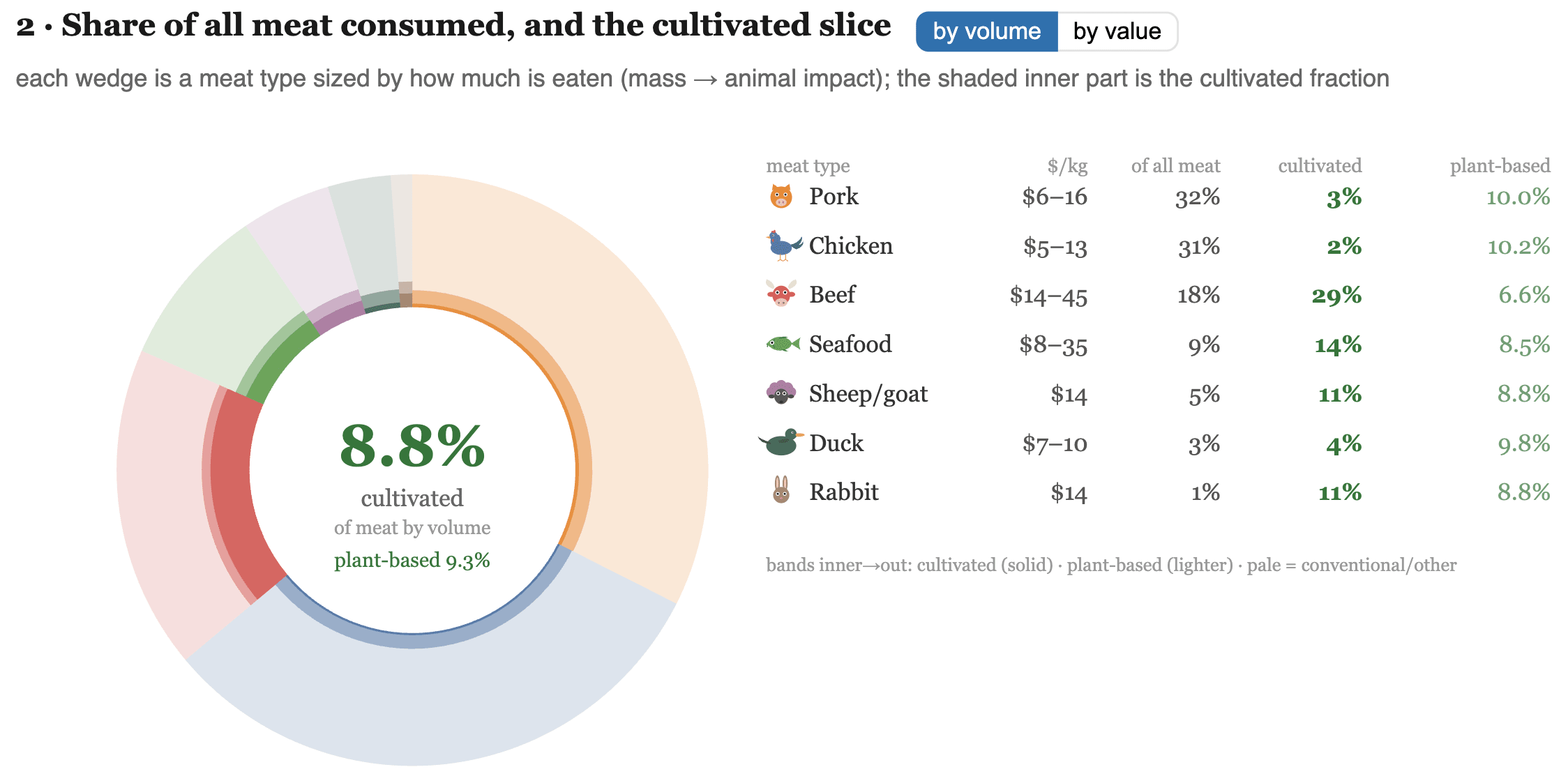
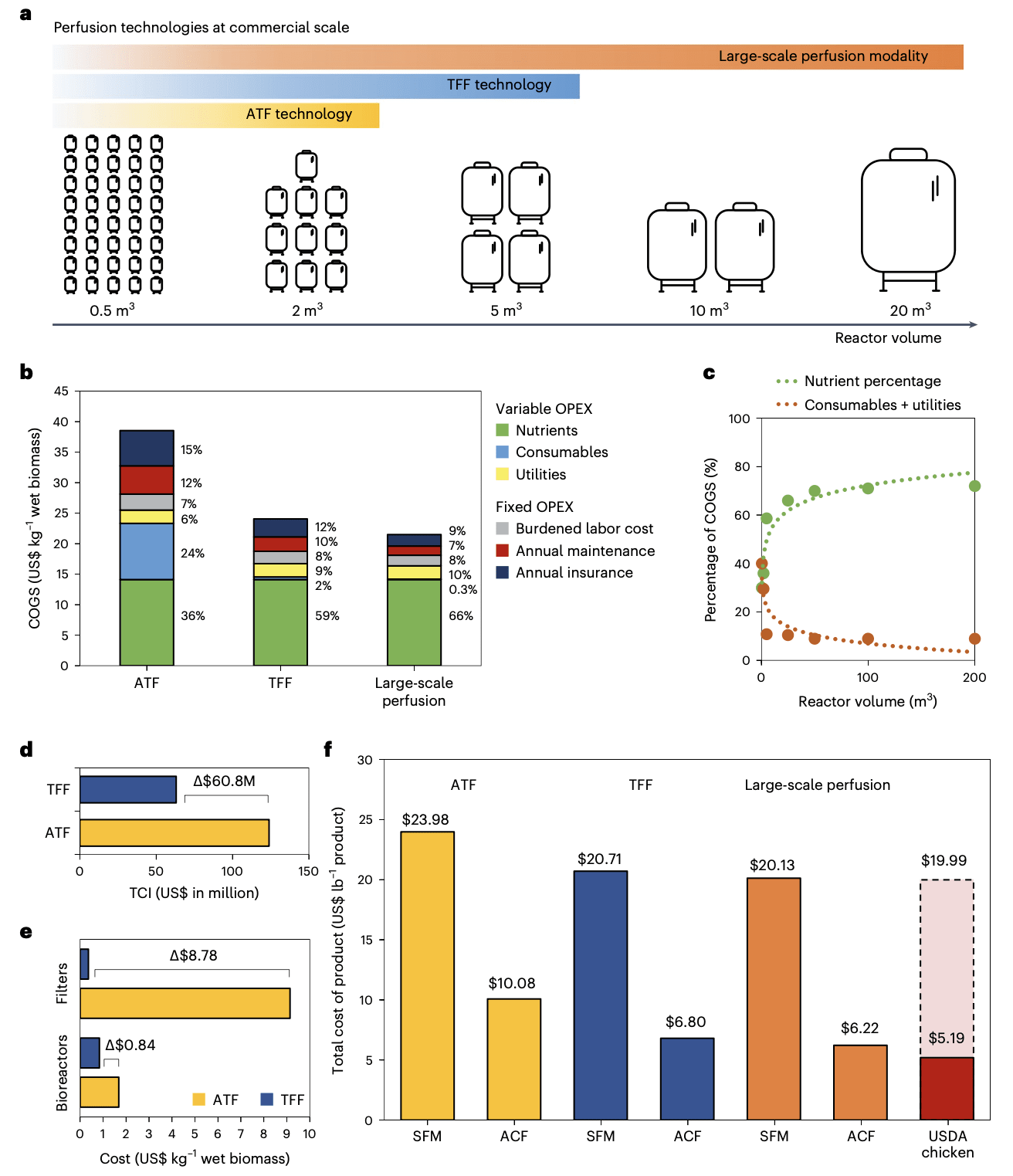
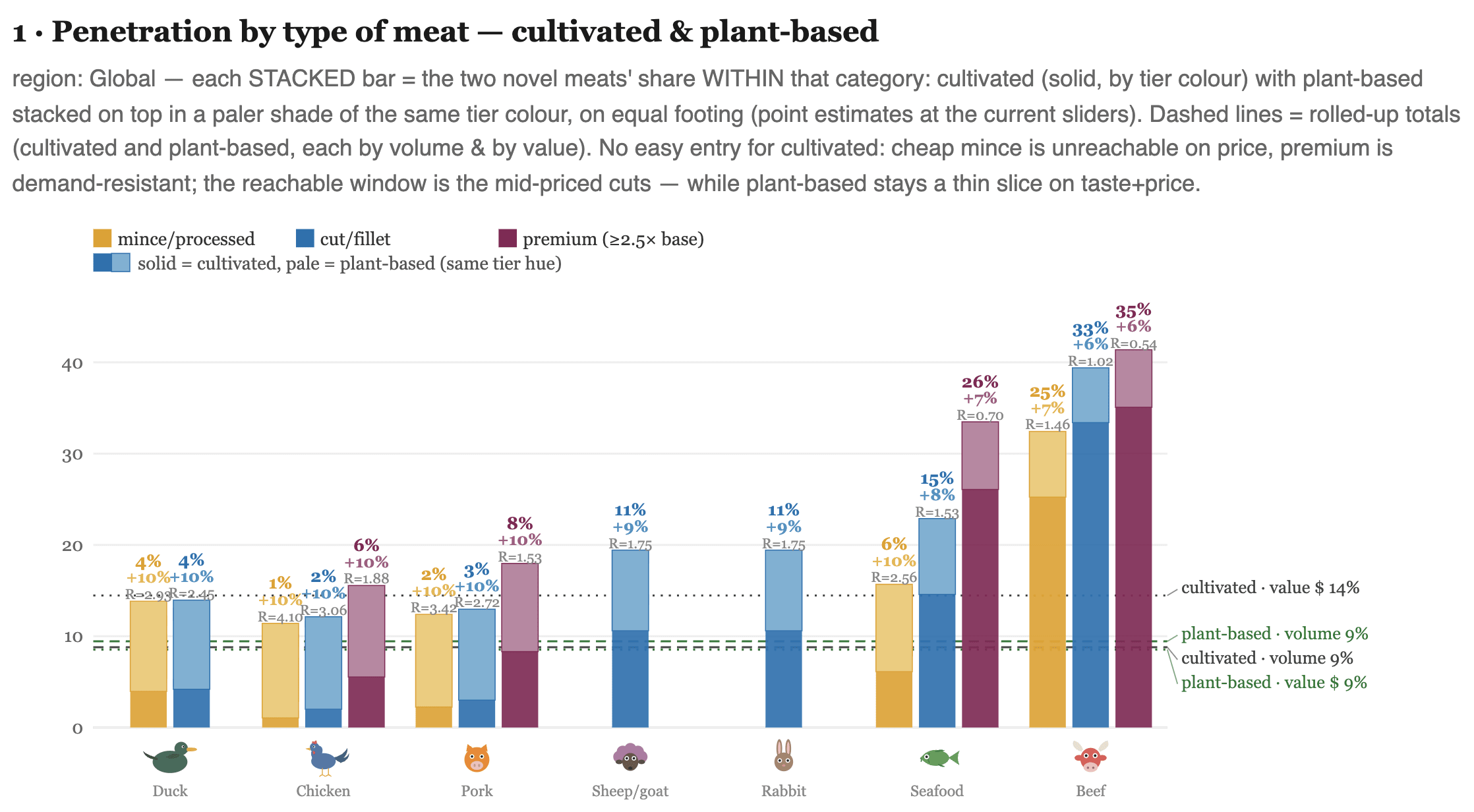
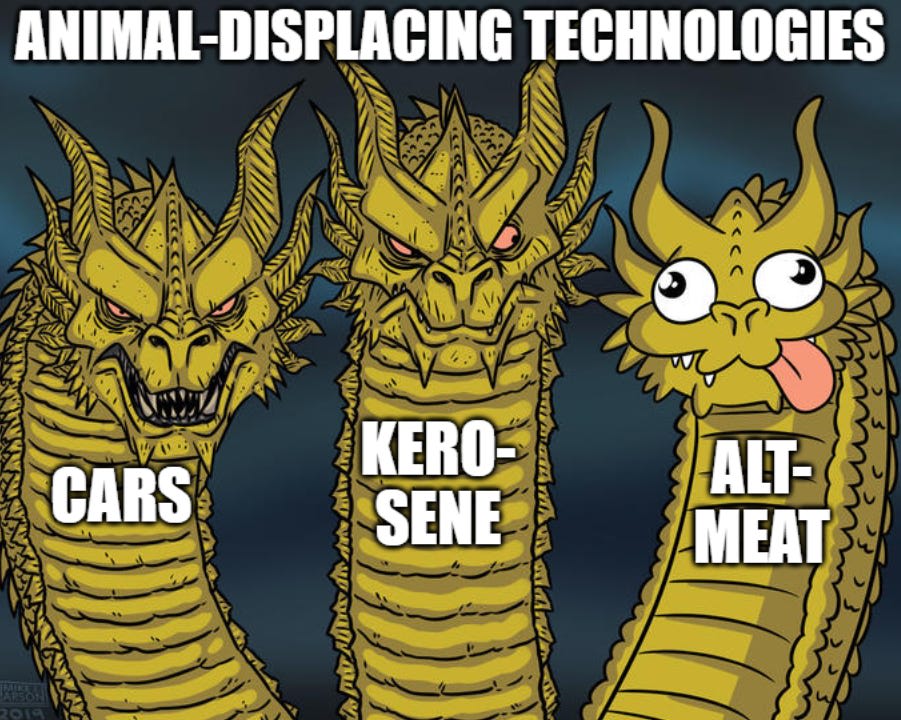
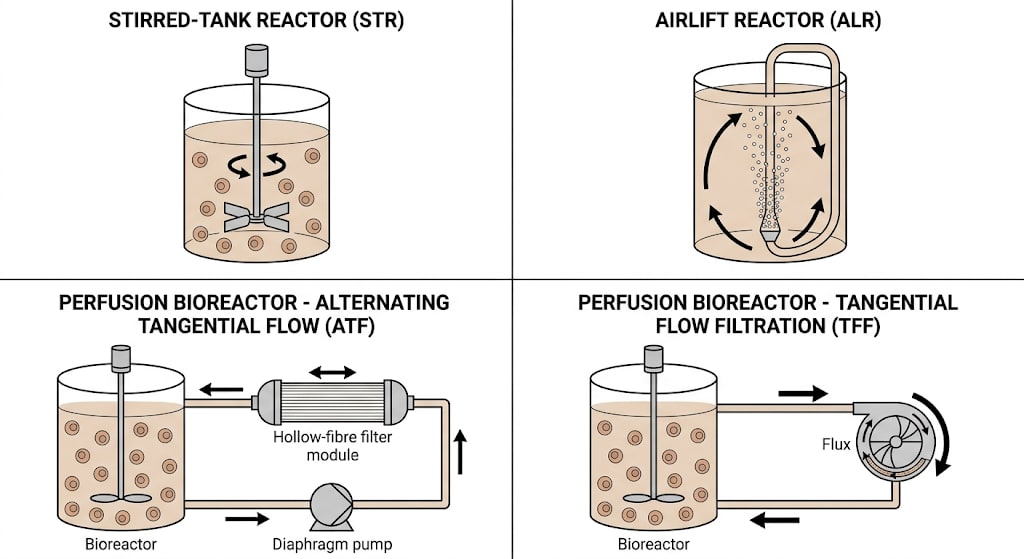
I look forward to reading this full piece, but for now, I just wanted to reply to the reference to me and see if I'm missing something w/r/t your discussion of FCR.
As you rightly note, I often cite the FCR of chicken as 9:1. This is the factory farming FCR; for organic or heritage breed farming, the FCR is far worse, according to WRI.
It seems like you're challenging this number, so I just wanted to check in. In my new book Meat (MeatBook.org), I address the 3:1 ratio that the poultry industry sometimes cites by referring to WRI's analysis, which argues that these ratios are misleading for two reasons:
First, they are mass ratios, so you’re comparing animal feed, which is 10–15% water, to chicken meat, which is 65–70% water. If you compare energy (calories), the best a chicken can do is about 9 to 1, according to WRI.
Second, they often use live weight, which includes blood, bones, feathers, and other inedible bits.
I'm guessing that if there's a paper that lands on 2:1, it must be doing both--comparing mass instead of energy and comparing live weight instead of edible meat.
A 2:1 or 3:1 calorie conversion would mean a chicken could turn feed into edible meat while losing surprisingly little energy to metabolism and building the bones, organs, and feathers that don’t become meat. I'm not a biologist, but that feels pretty unlikely to me.
Curious what you think. Thanks.
Hey Bruce! Thanks for the reply. This is indeed one point where I was sloppy, though I was not trying to challenge your number. Let me explain my current understanding:
This is how I think of it:
Let the chicken's FCR be ~2 kg feed/kg live weight (Bollard). Dry feed is ~20% protein (typical broiler ration).
So 1kg of chicken consumes roughly: 2 kg feed×0.20=0.4 kg feed protein per kg live weight
Meanwhile, a kg of (wet) live weight yields ~0.65 kg edible meat at ~20% protein = ~0.13 kg protein in product.
So the chicken's protein conversion is roughly: 0.13 kg protein out / 0.40 kg protein in ≈33%
So I think if we care only about the caloric content, you are right (and I was wrong to use Lewis' number); but if we care about sourcing amino acids from broadly the same plants used for chicken feed, probably there is a cost floor for cultivated meat around 1/3 the cost of chicken meat.
Would you agree with this analysis?
Thanks Pablo, this all sounds right to me, including (and especially) your conclusion, that there may be a cost floor for cultivated meat around 1/3 the cost of chicken meat.
I have heard some scientists argue that media recycling might allow us to bring that number down even more and also that we don't know what we don't know, but yes, your analysis does make sense to me.
Obviously, getting to that is going to be incredibly hard. In the book, I argue that if we can convince governments to go all-in, price parity (and even better) for cultivated meat will likely:
I have a few other thoughts on your post that I'll try to share later today, re: government incentives to make this happen faster than 10-20 years.
Thanks for engaging,
Bruce
Awesome, thanks, Bruce,
I'd love to hear so. The model I proposed and that resulted from those many years is based on Bass diffusion dynamics with typical parameter values, but of course, I'd love to supercharge the change.