Thank you for doing this work, I really appreciate how transparent and easy to interact with this is (especially for someone like me who doesn’t have a technical or econometric background).
If you or anyone else reading this is up for it, I would love to see followup writing and analysis on the most impactful gifts from Yield Giving across each of its focus areas. It would be wonderful to incorporate a plurality of values in addition to QALYs (e.g, LAYS for education, income gains for financial security, WELLBYs for mental health, a combination of innovation, redistribution, carbon, and earnings gains for individuals & cities for housing, etc).
I think that independent analysis can be an incredibly valuable resource for a philanthropist, particularly one giving with the scale and trust of Mackenzie Scott (I loved GiveWell's change our mind contest!) By highlighting “best buys” from Yield Giving’s portfolio and providing examples of other impactful organizations that might fit their strategy, this type of impartial and rigorous work can celebrate effective giving and provide a public good to the broader philanthropic ecosystem.
This is a really beautifully designed interactive tool and I appreciate how transparent you’ve been with the code.
But looking at this from the perspective of someone who works on the ground in global health and development, I worry that analysing a $26 billion portfolio built for systemic equity through a narrow, health only calculator could mislead philanthropists. It’s a bit like looking at a massive civil rights or education budget and finding it lacking because it didn’t buy malaria nets.
If you talk to practitioners who actually execute this work, a few big real world missing pieces stand out:
The charities this model uses as a benchmark focus on narrow, medical interventions with quick, easily measured metrics. MacKenzie Scott’s giving is intentionally structural. She's investing in areas such as civic engagement, local leadership and systemic justice. Discounting the value of structural work just because it doesn't yield a clinical trial isn't scientific rigour. It's just a measurement blind spot for things that cannot be neatly randomised.
You cannot scale single disease programs linearly. If you suddenly dump billions into narrow medical tracks, you hit a hard wall on the ground. You trigger local wage inflation for scarce medical staff, overwhelm local supply chains and completely pull local nurses away from general primary care just to service a single subsidised metric.
Since the baseline assumptions (the credibility tiers and realisation numbers) were drafted by AI, the model is essentially running complex math on top of text approximations. It takes what is essentially an AI's best guess and wraps it in a bunch of equations to make it look definitive, rather than building the model on actual data from the field.
This is an incredibly interesting data exercise, but by leaving out field realities, the model relies on flat, linear scaling assumptions that completely overlook the law of diminishing returns. If the goal is to make this genuinely informative for philanthropists trying to drive long-term change, I'd love to see it evolve by bringing in some of those real world constraints.
MacKenzie Scott's $26 billion, in QALYs: an interactive, evidence-weighted CEA
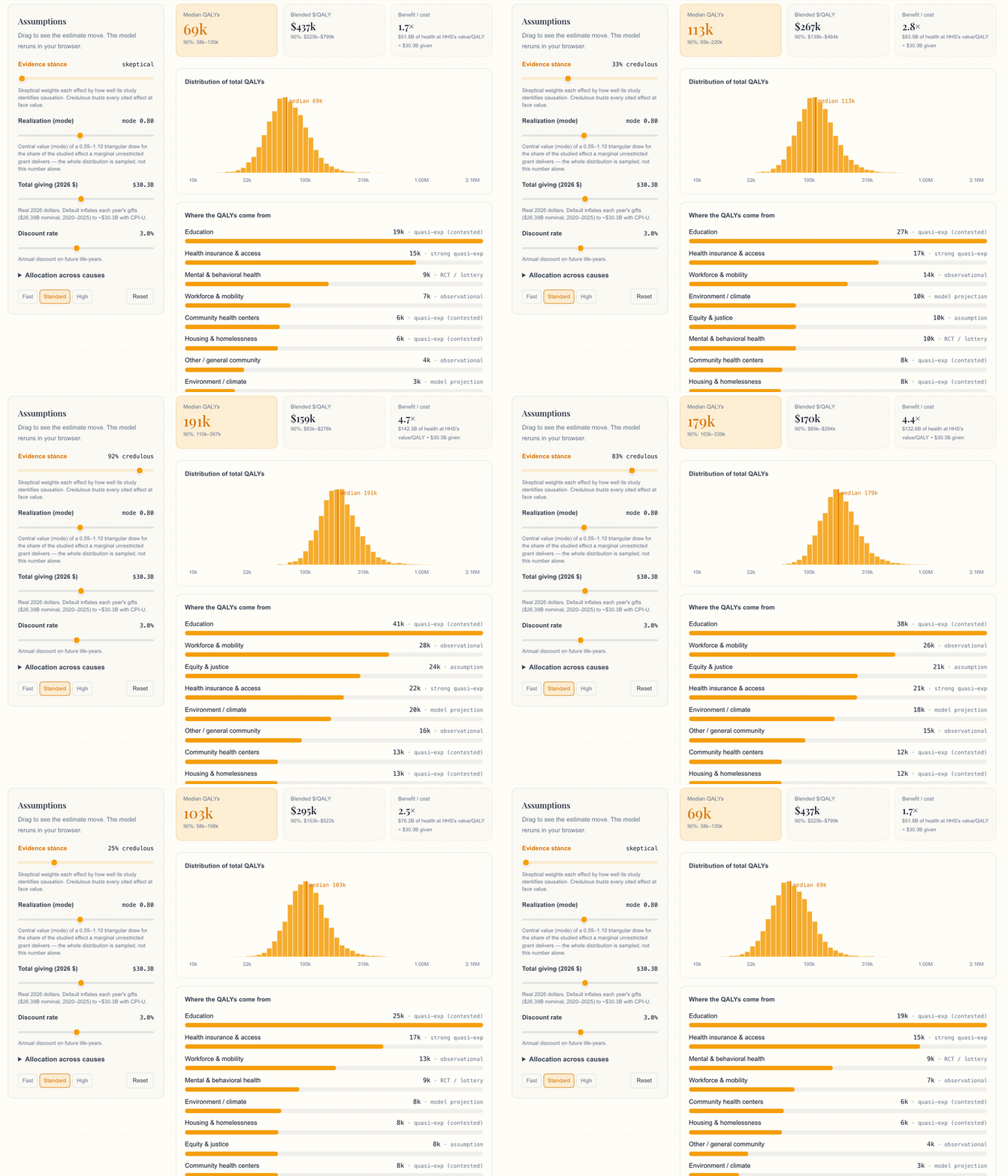
Epistemic status: a fully parameterized Monte Carlo model whose every input is inspectable and overridable — not a measured fact. The cost-effectiveness anchors come from published causal studies; the judgment priors (evidence-credibility tiers, realization, allocation concentration) were drafted by Claude and reviewed by me, and each is a slider. I'd value attacks on specific parameters over general takes.
Headline at the skeptical default (100k draws): median ~70,000 QALYs (90% interval 38k–136k), a blended ~$435k per QALY, benefit/cost 1.7× at HHS's value per QALY. Take every cited effect at face value instead and the median is ~200,000. The gap between those two numbers — the causal-credibility discount — is the finding.
Against the global-health frontier
Her blended portfolio prices out at ~$435,000 per QALY. GiveWell's current program averages (~$4,000–5,500 per under-5 life saved, 2022–24) convert to ~$200 per discounted QALY under this model's own conventions — ~25 discounted QALYs per child death at 3%, which is stricter than the undiscounted ~$100/DALY folk numbers. Handicapped with the same realization and credibility discounts, the frontier still buys ~1,500× more health per marginal dollar.
That's a marginal comparison. How far does the frontier fall as money scales? Three points on the supply curve, in GiveWell's own units (multiples of their cash benchmark):
The revealed curve. When funding grew in 2021–22, GiveWell planned to fund up to ~$750M/yr of opportunities at ≥6× the benchmark; when projections fell they raised the bar back to 10×. Billions per year plausibly clears in the mid single digits of the benchmark — a few hundred times her blended portfolio in health terms.
The floor moved up. The benchmark itself is cash to the very poor — the intervention with the most absorptive capacity — and GiveWell now estimates GiveDirectly at 3–4× its own historic benchmark, on recipient spillovers and new child-mortality results (my replication scores it at ~2.6–3.8× across countries). Cash now beats "1× cash"; GiveWell kept the historic unit while it re-evaluates.
In this model's health-only currency, the child-mortality channel alone prices cash at roughly $8,000 per discounted QALY (GiveWell's uncertainty-adjusted ~23% under-5 reduction ≈ $200,000 per child death averted) — ~50–100× more health per dollar than her blended portfolio, at effectively unbounded scale. And that's conservative: Richterman et al. (2023, Nature) find government cash programs across 37 countries associated with a ~20% reduction in adult-female mortality (and 8% under-5, with population-wide spillovers), and the GiveDirectly RCT itself measured a +0.26 SD gain in psychological well-being — a quality-of-life channel, not mortality. Cash's pure consumption value stays out of frame here (as does Scott's non-health value), but its measured health effects belong in, and they push the floor multiple below 50–100×. Money isn't the only binding input either: even funded, evidence-backed interventions hit delivery-capacity limits. So: ~1,500× at today's margin, plausibly a few hundred× for marquee programs at her scale, and somewhere under ~50–100× even if every dollar became cash.
What's different from a standard back-of-envelope
The allocation is her own data, not a guess.Yield Giving's gift database discloses dollar amounts for 2,035 of 2,711 gifts (~two-thirds of the total), with org-reported focus areas on every disclosed dollar. Each gift's dollars split across its organization's areas, mapped onto 13 intervention archetypes (every mapping rule documented). The undisclosed third is imputed, not dropped: her essays give each year's total, so the residual is a known dollar amount, distributed over that year's undisclosed gifts in proportion to the recipient's pre-gift IRS 990 revenue (via ProPublica's Nonprofit Explorer) raised to an elasticity fit on the disclosed pairs. Imputation moves each cause share by at most ~1.5pp — the disclosed two-thirds was representative.
Cost-per-QALY comes from causal estimates where they exist. Medicaid mortality (Sommers 2017; Miller, Johnson & Wherry 2021), community health centers (Bailey & Goodman-Bacon 2015), supportive housing (Holtgrave et al. 2013), collaborative-care depression. Where no health pathway has credible evidence (equity & justice, civic, arts — the largest dollar buckets), the model uses wide skeptical priors rather than an optimistic sector average.
Every effect is shrunk by how credibly it's identified. Each archetype's evidence gets a design tier (randomized/lottery → strong quasi-experimental → … → assumption-only), and a credibility weight drawn from that tier's Beta distribution linearly shrinks the effect toward zero health impact. Internal validity only; transport and delivery live in a separate realization factor, so the layers don't double-count. The tier levels are AI-proposed, author-reviewed priors — the ordering is the defensible part, and the evidence-stance slider sweeps them from skeptical to face value.
A byproduct finding
Across 1,313 disclosed gift–revenue pairs, gift size scales with the recipient's pre-gift revenue to the power 0.41 (R² 0.37). A 10× bigger organization gets about 2.5× more money — her giving is far flatter across organization size than proportional.
What this doesn't capture
A QALY is a health metric. Most of Scott's giving targets economic mobility, education, and equity, whose value is largely non-health; a WELLBY or consumption frame would credit those buckets far more. The model is deliberately scoped to one question: how much health does the money buy? It is not a verdict on her choices.
Process, for those interested in AI-assisted research
The accounting is mechanical; the judgment layer is where the AI worked. Claude drafted the credibility tiers and priors; Codex (GPT-5.6-sol) reviewed the assumptions cold across several adversarial rounds and caught real errors (an un-inflated 2007-dollar figure, a $/life-year used as $/QALY, a misattributed citation); GPT-5.6-terra audited 827 nonprofit name→EIN matches against the live IRS data. Each correction made the model more skeptical or more honest, and none was caught by a human. Every prompt I typed is in the blog appendix, verbatim.
If you think a specific parameter is wrong, the parameter file cites its source inline, and I'll take PRs — or just move the slider and see whether it matters.
This is a crosspost from the new Animal Welfare Alignment Newsletter by Anima International. You can subscribe on Substack if you are interested in following these efforts. Audio reading also available on Substack.
The goals of this post are to:
1. Raise a question I see as crucially important to the goal of aligning AI to animal welfare...
Hello! I'm Justin Portela. I got hired by GWWC to make YouTube videos after AI in Context did such a kickass job.
My channel is using that same cinematic, high-production value beauty to talk about everything in the EA universe that isn't AI.
...
“How long have you been v*g*n?”
This is one of the most common icebreakers at animal protection events. It’s a baseline assumption, and it mostly holds true: if you’re out advocating for animals not to be tortured or abused, realistically these days you are v**n, or close. And it makes for good conversation. It seems fairly safe to assume when you meet strangers.
But this assumption is hurting the movement in a way which we don’t always notice: someone new comes into the sp...



(Just FYI, the current forum policy is to downrank LLM-written posts, if you want more visibility on this—which is undoubtedly useful work—it currently reads to my eyes as very LLM-written so could be adjusted a bit)
Actually, we don't downrank them, we just auto-tag them as AI-generated (although this one hasn't run automatically- doh)