A lot of operational improvements look solid while the person who introduced them is still there, and then disappear when that person changes role or leaves. Given how much institutional knowledge you found sitting in founders’ heads and inboxes, staff turnover over the next year could be quite a revealing test.
If some of the organisations go through that kind of transition, whether the processes still work without the person who set them up seems like a stronger test of institutionalisation than another readiness score on its own.
I agree to an extent-- building redundancies into systems and institutional memory is both important and a luxury for resource-strapped orgs. Nonetheless, if an org has experienced a notable process improvement that they then lose upon employee turnover, they will likely be motivated to add capacity back to cover that lost process. This experience with process improvement may well inform the qualities they look for in their next hire. So still very much a net gain along the organizational maturity ladder!
WorkStream Nonprofit is a nonprofit dedicated to removing operations bottlenecks to impact. We’re an operations support organization for mission-driven nonprofits. Most of our work is hands-on: back office operations + fractional COO work, financial management, hiring support, and operations training and coaching.
GRIP, our Growth Readiness Improvement Program, is a program we developed in 2025 to make that impact more accessible: it’s a lightweight diagnostic and improvement program designed to help small and mid-sized nonprofits identify operational constraints, strengthen internal systems, and build the foundation needed for sustainable growth.
We’ve now run 15 orgs through it to completion, with 6 still in progress. We have some data now - and it seems to be a very effective intervention.
Here’s our write-up of what we assumed going in, how we ran it, what the numbers say, and what we’d tell founders and funders based on the results.
Summary
GRIP is our short, 4-session operational readiness program for nonprofits. 21 orgs have gone through it since mid-2025: 15 have completed, and 6 are still in progress
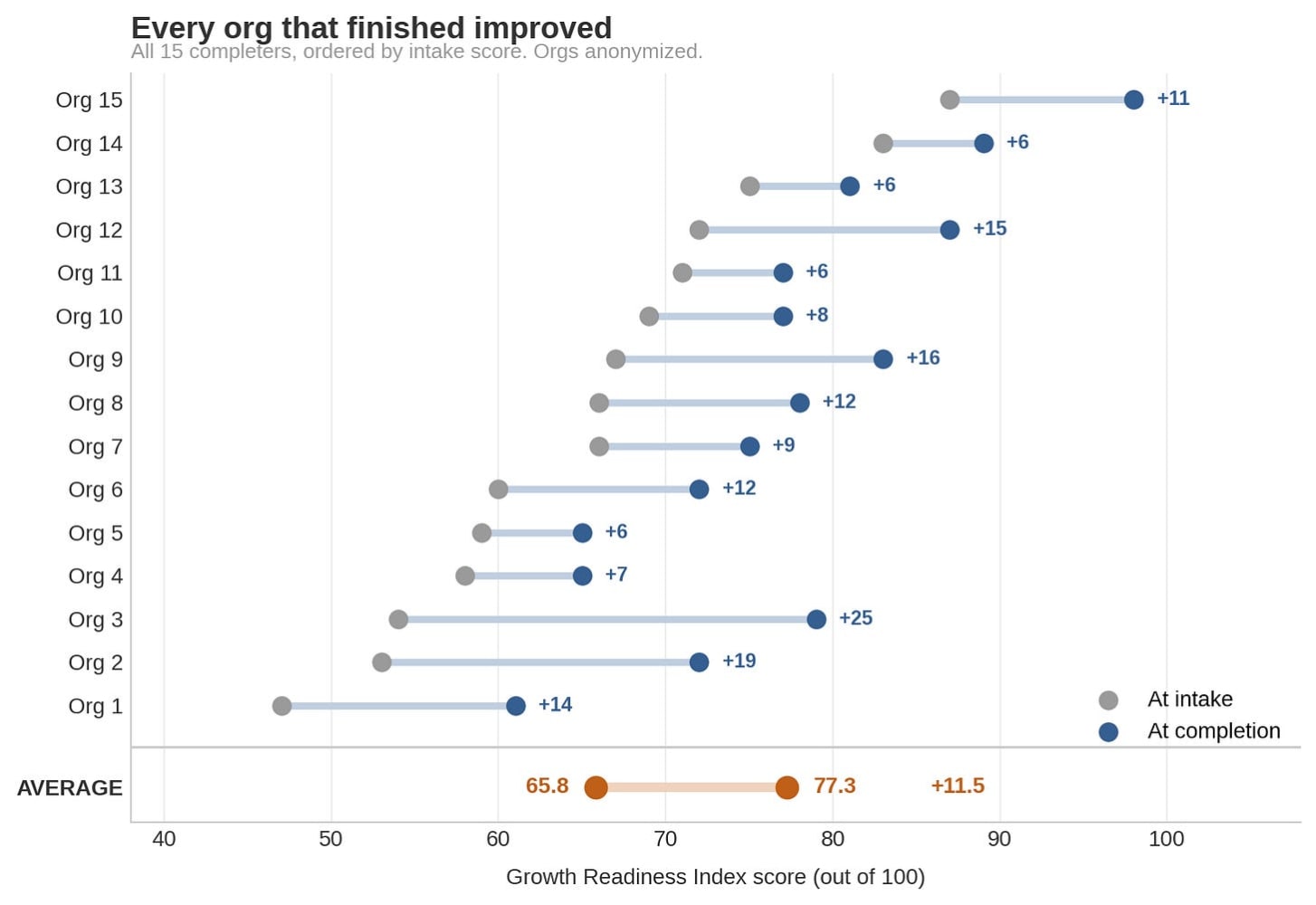
Every org that completed the program improved: all 15 completers, with an average gain of 11.5 points on our 100-point readiness index, a 19% average improvement
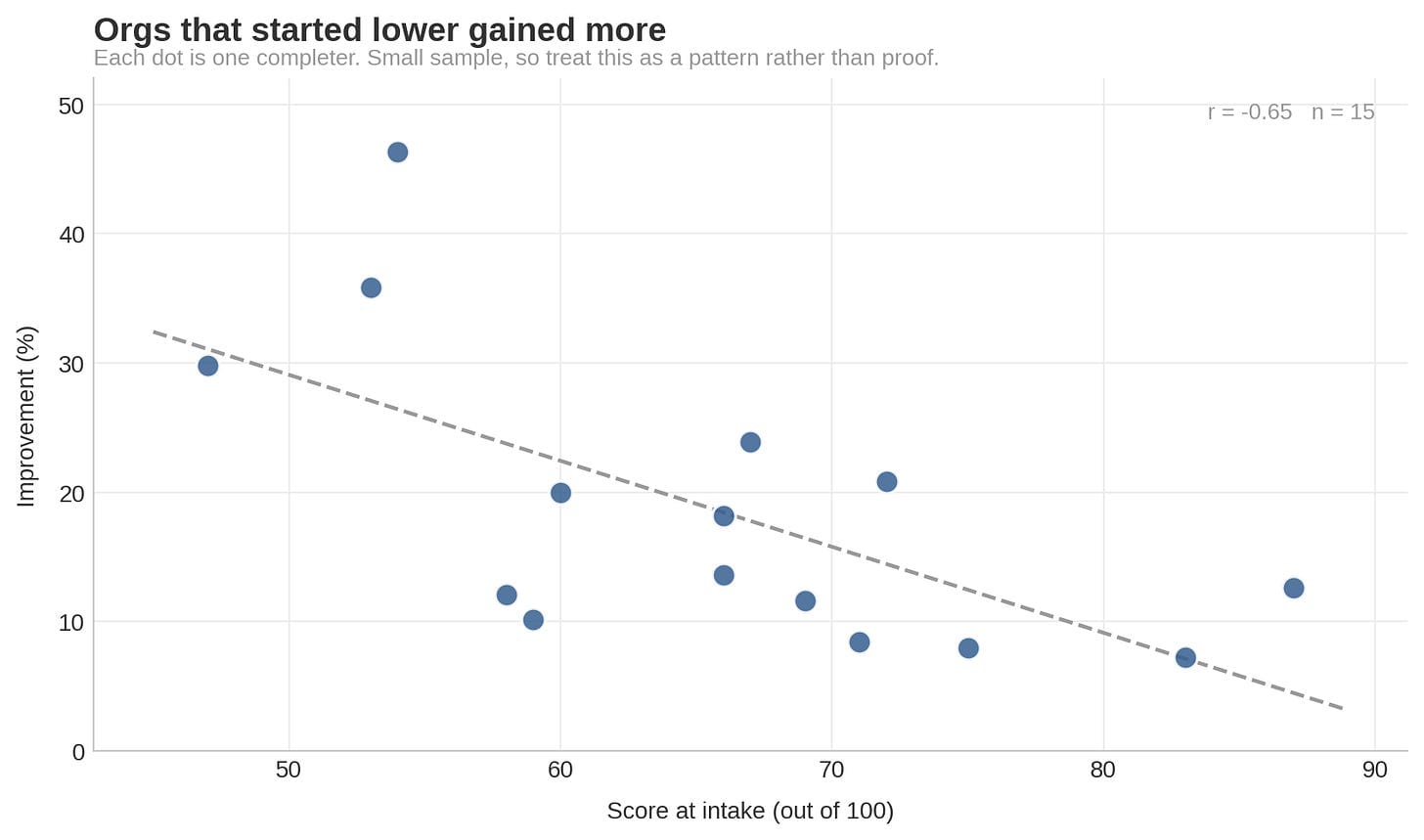
The lower an org’s starting score, the bigger the gain. Individual improvements ranged from 7% to 46%. The average starting score was 65.8, and the average completion score was 77.3
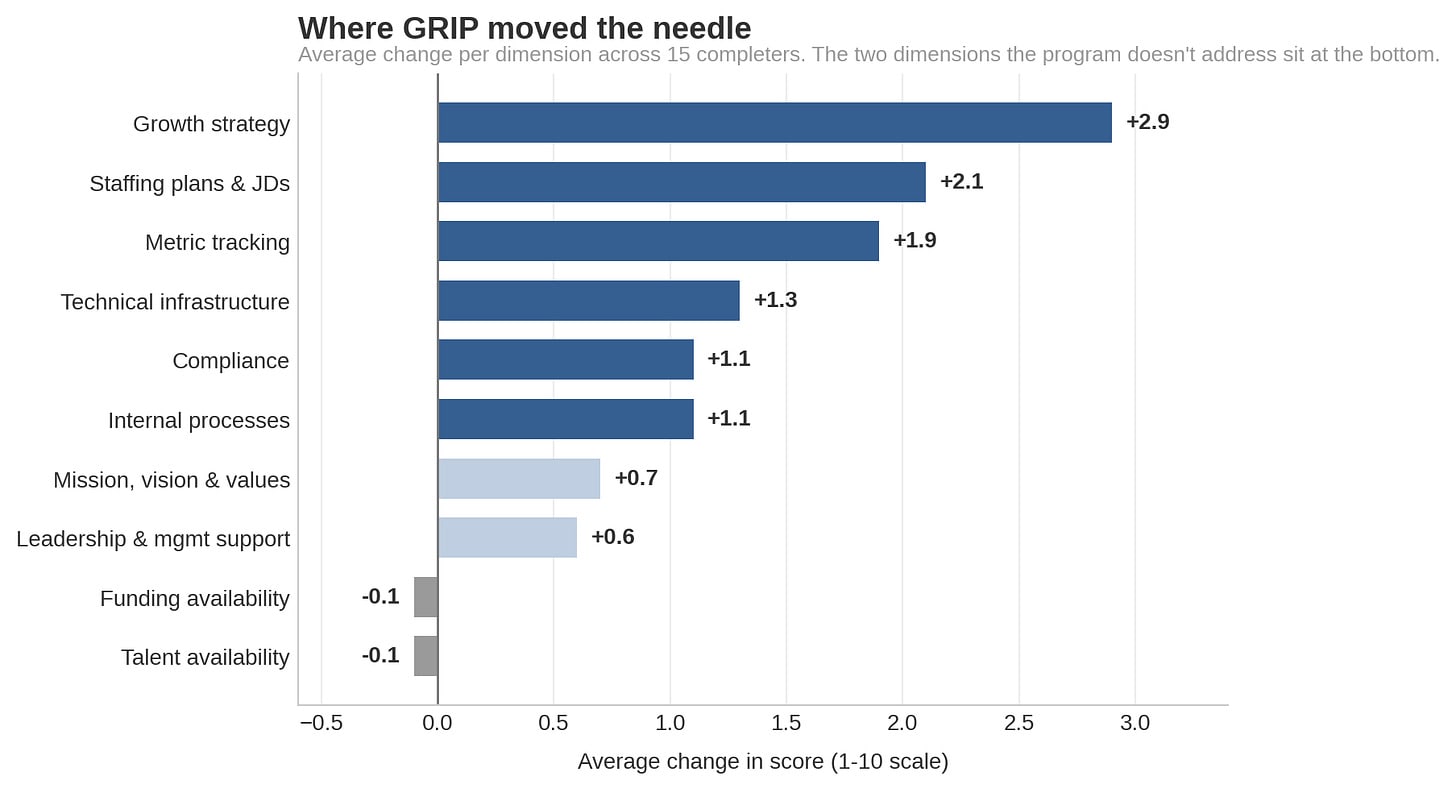
The biggest gains were in growth strategy, staffing plans, metric tracking, and technical infrastructure
Of the 21 participating orgs, 19 participated at no cost, and 2 paid the $950 fee. It was run mostly on volunteer time by Deena Englander and Freddy Zwanzger. While the results have been strong, we will need continued funding to keep operating it for free or at a reduced cost. Even at the full price of $950, it’s still a very cost-effective intervention.
Our assumptions going in
GRIP is built on a few beliefs about how small nonprofits operate:
No one person is an expert in everything
The majority of organizations are stretched thin and don’t have resources to engage consultants
The majority of organizations don’t have business management experience
Guidance from experienced professionals can really help an org stabilize
There are some fundamentals that all orgs need, and those are replicable across many orgs
If those are true, then a short, structured program should be able to improve operations without a big consulting budget. That was our belief, and what we set out to test.
The process
Between July 2025 and August 2026, 21 orgs went through GRIP: 3 early completers of a test, then a structured 15-org batch that ran from February to August 2026, and 3 rolling participants. 6 of the 21 are still mid-program. Deena Englander and Freddy Zwanzger facilitated these sessions, bringing in specialists and team members to support as needed.
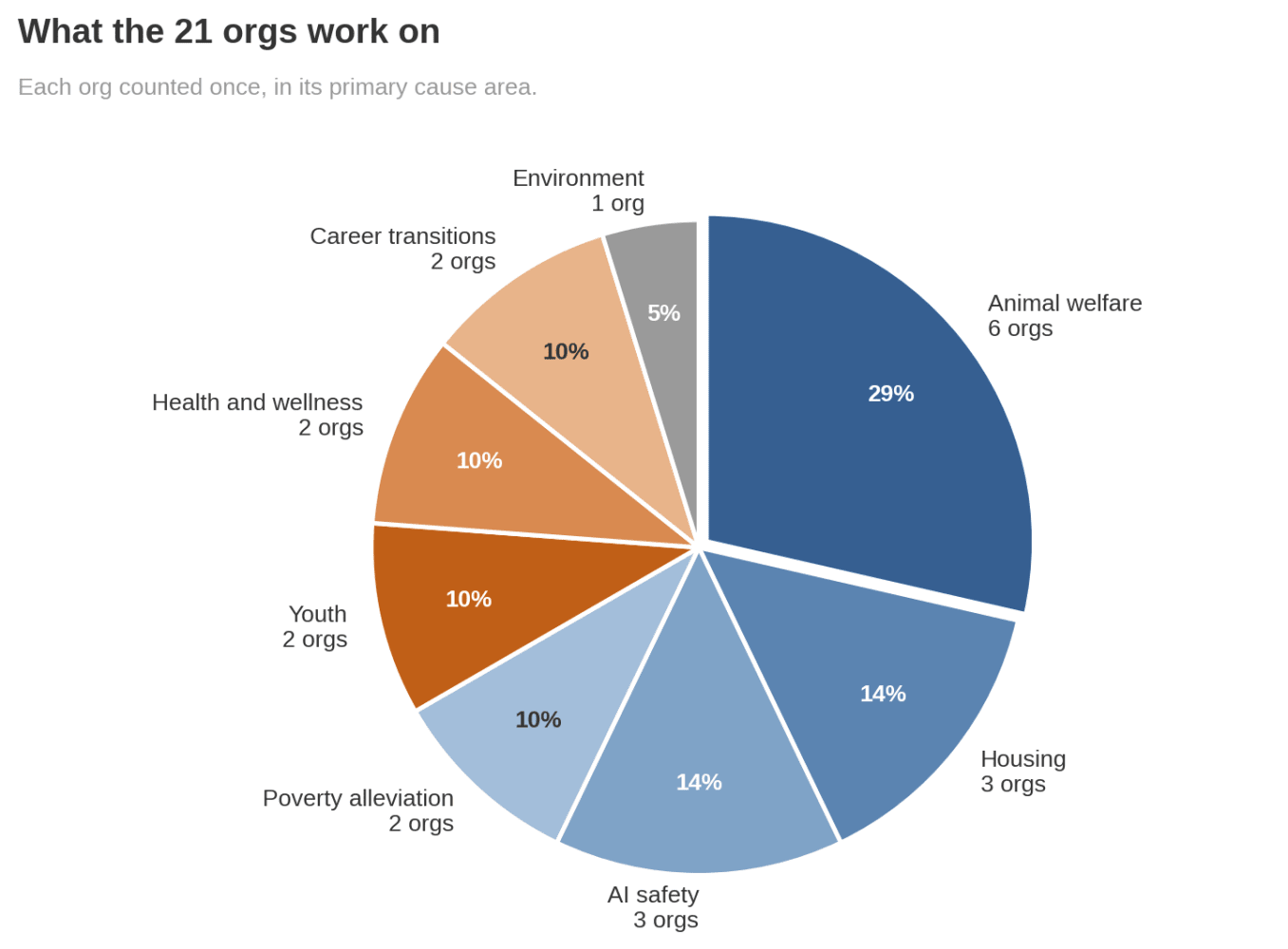
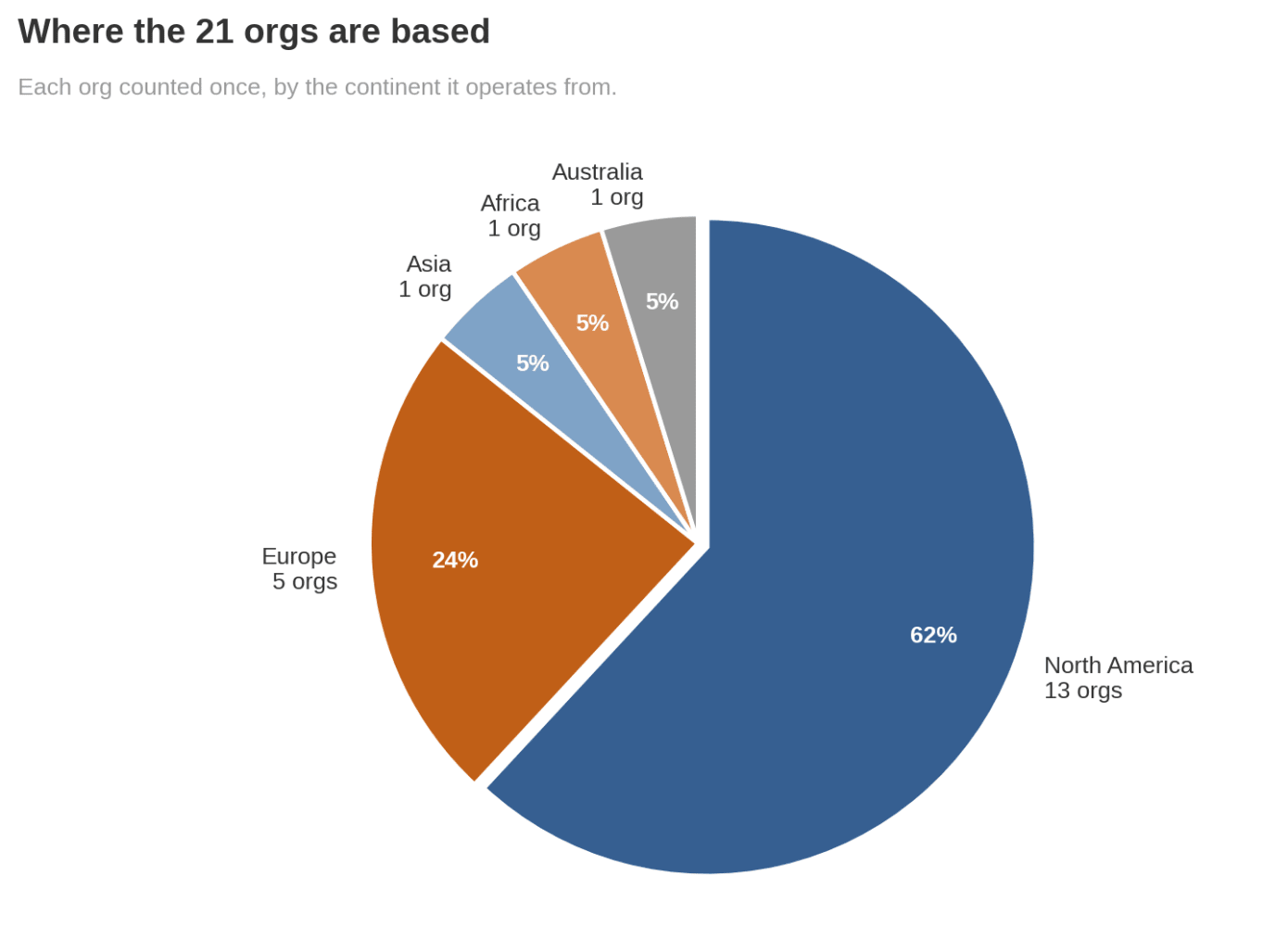
We deliberately recruited a diverse cohort; we believe organizational fundamentals apply across sectors, cause area, and org structure. Cause areas included animal welfare, AI safety, arts and music education, housing, mental health, maternal and infant health, food rescue, environment, women’s economic empowerment, youth development, and community development. Geographically, the orgs were spread across North America, Europe, Asia, Africa, and Australia. We accepted 65% of all applicants.
The format was the same for everyone: a 1.5-hour intake, three 1-hour follow-up sessions, and a recap either as its own session or folded into a follow-up. Across 2026, that was 70 sessions.
To measure progress, we used our Growth Readiness Index (GRI): 10 operational dimensions, each scored 1 to 10, for a 100-point total. The dimensions cover things like growth strategy, staffing plans, internal processes, technical infrastructure, metric tracking, and compliance. Scores are self-reported, which has obvious limits, so we sit with each org and help them calibrate their scoring to keep it honest. With our facilitation, each org scored themselves at intake and again at the end.
The results
Every org that completed the program improved. All 15 completers so far gained an average of 11.5 points on the 100-point index, an 18.6% average improvement. The average score rose from 65.8 at intake to 77.3 at completion, and individual improvements ranged from 7.2% to 46.3%. None declined.
The orgs that started lower gained more. Our three lowest intake scorers (47, 53, and 54 out of 100) improved 30%, 36%, and 46%, while our two strongest orgs at intake (87 and 83) still gained 13% and 7%. The sample size is limited, so treat this as a pattern rather than proof, and some of it makes intuitive sense: an org that starts at 87 doesn’t have 20 points to gain.
Looking at the individual dimensions tells you where the program actually does its work. Where the needle moved most (based on averages):
Actionable growth strategy: +2.9 on the 1-10 scale, with 13 of 15 orgs improving
Staffing plans and job descriptions: +2.1 (13 of 15)
Metric tracking: +1.9 (13 of 15)
Technical infrastructure: +1.3 (6 of 15)
Compliance: +1.1 (10 of 15)
Recurring themes
After 21 orgs, the same gaps keep showing up at intake. Three stand out:
Strategic planning: Growth strategy was the lowest-scoring dimension at intake (5.0/10 average) and saw the biggest gain. Most orgs can articulate their mission; far fewer have a concrete plan for the next 12 months. This is the gap our “built to be funded” course addresses.
Software and systems: Technical infrastructure averaged 5.7/10 and metric tracking 5.4/10 at intake. In practice, this usually means no real CRM and no project management system, so institutional knowledge lives in inboxes and founders’ heads.
Compliance:. This one surprised us a bit: compliance came in as a relative strength at intake (7.3/10 average), but it still improved for 10 of 15 orgs, usually through quick wins.
Counterfactual value
Would these orgs have gotten there on their own? We can’t rule it out; we don’t have a control group. But look at the shape of the data points. The gains cluster in exactly the dimensions we worked on most (growth strategy +2.9, staffing plans +2.1, metric tracking +1.9), while the dimensions we don’t touch, funding availability and talent supply, stayed flat over the same months. If orgs were simply maturing on their own, we’d expect movement across the board. Participants described the value the same way: surfacing things they had overlooked, not speeding up work already in motion.
The case for GRIP is straightforward: relatively low cost (time + $) with significant operational improvements. Four sessions moved average readiness by more than 11 points. Better operations infrastructure means you can improve the impact process and scale effectively.
The most effective time to engage in it
When should an org do this? Based on what we saw:
Before scaling: set up great systems before they’re needed so the process of growth is seamless
During leadership changes
Ahead of program expansion
Orgs established 1-3 years: they’ve usually finished figuring out their programs, and now it’s time to bump up to the next level
It’s helpful at other stages too. Every completing org improved regardless of its starting point, and the orgs with the most room to grow gained the most.
Life happens, and orgs change; we’d recommend repeating it every 2 years, or more frequently if there’s been significant growth.
Note for funders: Subsidizing enrollment means a higher likelihood of impact per dollar spent. Operational readiness is cheap to build relative to program budgets, and every dollar that flows through a better-run org goes further.
What participants said
A few reflections from the cohort, shared with permission:
“Freddy was professional, supportive, patient, and adaptive to our needs. The GRIP program covered many key aspects of what we needed to focus on to grow at this stage of our nonprofit journey. It’s set us up to be more mindful of how we are growing sustainably.”
Meredith Marin, Vegan Hospitality
“Deena quickly surfaced levers, including executive assistant support, and thinking more deeply about our role scopes, and translated them into concrete next steps. The result was sharper accountability and momentum across our work, which should translate into impact for animals!”
“The process pushed us outside of our comfort zone to think more expansively and creatively about what our organisation could become. Freddy was really insightful and full of different ideas, which sparked a lot of useful internal conversations for us.”
Hereward McGillivray, Active for Animals
“The GRIP Readiness program provided invaluable clarity and strategic direction for our food rescue organization. Participating in April allowed us to re-evaluate our day-to-day operations and evaluate our long-term impact through a fresh lens, and I appreciated Deena’s honesty from an outside perspective. The external perspective and consulting brought by the Workstream Nonprofit team was transformative and something we still refer to and use today. They identified operational efficiencies and strategic opportunities we had overlooked, equipping our leadership team with actionable frameworks to scale our food redistribution efforts effectively. For any nonprofit looking to strengthen its foundation and expand its mission, the GRIP Readiness program is an exceptional investment.”
Omar Tarabishi, Leftover Love
“GRIP was great — it was very helpful to work with someone as knowledgeable as Freddy, who helped us systematically work through our priorities, develop strategies, and identify opportunities for improvement.”
GRIP participant (org anonymized at their request)
“Deena helped us to identify the areas in which we could really improve our operational capacity. She then provided guidance, tools and resources to support that growth while providing much needed accountability through the implementation process. As a small team, operating at capacity constantly, focusing on the highest impact priorities and making progress was empowering and gave us momentum to stay focused on our goals. We achieved measurable success and came away from the program with new clarity. Most of all, Deena felt like a valuable team member who learned to speak our language and help us tell our story. Overall a very expansive and transformative experience for me in my role and for the organization overall. I highly recommend working with Deena and GRIP! “
Gia Baiocchi, Apis Arborea
Limitations on this analysis
Scores are self-reported. We facilitate the scoring to keep it calibrated, but an org that just spent four sessions with us has some pull toward scoring itself well. There’s no control group. The sample is small, 15 completers, and participation was self-selected: these are orgs that sought out operational help and stuck with it, which is not the average nonprofit. And we don’t yet know whether the gains hold. We score at the end of the program, not 6 or 12 months later. If anything, we’d expect scores to drift down for some orgs as they grow: new programs and new staff create operational gaps that didn’t exist before. The index measures readiness relative to where an org is now, which is why we recommend repeating the assessment rather than treating one score as permanent.
What next?
We’re seeking funding for our 2027 cohort; ideally, we’ll work with funders to fund a specific subset of applicants that reflects their giving priorities, e.g., animal welfare or AI safety.
If we don’t receive any funding, we will continue the program as a paid service, with pro bono exceptions made on occasion.
We’re working on collaborations with funders and incubators to sponsor organizational support for their portfolio companies once they’ve moved past the startup phase.
We’re keeping this running as a paid service on demand - if you think this might be helpful for you, apply here or schedule a time to talk with us.
TL;DR
* GOAL 3 is a social enterprise that created IMPALA, a patient monitoring and digital platform system for low-resource settings. There is also a GOAL 3 foundation that raises funds to ensure underserved communities will be reached.
* A recently completed report from Rethink Priorities calculated IMPALA to have a cost per DALY averted of $7–17 in paediatr...
This month effective altruism has gotten lots of attention, including a cover story in The Economist. It feels pretty surreal to be on the receiving end of it. But I feel grateful these ideas have caught on, and even more grateful for the drive, earnestness, and compassion of so many people who took strange but well-argued ideas seriously and then actually acted on them....
Note: This post was crossposted from the Coefficient Giving Farm Animal Welfare Research Newsletter by the Forum team, with the author's permission. The author may not see or respond to comments on this post.
Subtitle: On vegan advocacy, effective altruism, and FIFA
I turn 40 today. Here are some hot takes.
On factory farming
1. Our biggest challenge is salience. If factory farming led the evening news, it wouldn’t last lo...



Great read @Deena Englander !