Disclaimer: This blog post focuses on a new piece of research from Rethink Priorities. I was not involved with the funding or execution of this research, and therefore write this piece merely as a consumer. However, I am the Executive Director of Giving Green and a board member of Rethink Priorities, and acknowledge that these affiliations may bias my...
I am writing up two charity ideas I’ve wanted to investigate, but haven’t been able to, in the hopes someone will investigate them further. If you end up investigating either, I'd be most interested to see what conclusions you come to!
Vulture preservation as a global health intervention
Since the mid 1990's the vulture population in India has been rapidly declining. The reason is due to a few chemicals which are fed to livestock, which is highly poisonous to vultures.
...
Summary
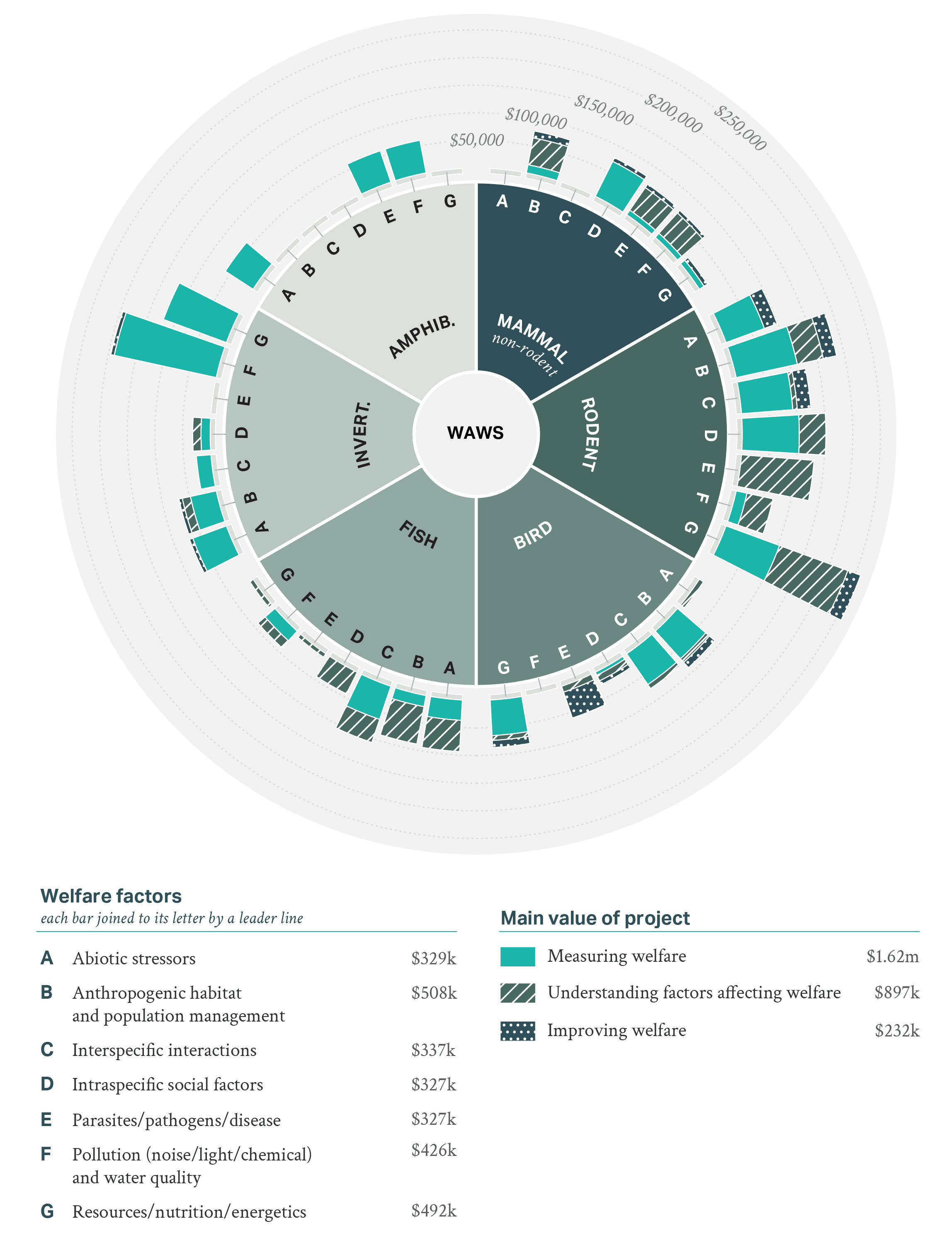
This post will summarize the trajectory of Wild Animal Initiative’s field-building for wild animal welfare science so far, along with patterns and indicators we want to see more of going forward. Beginning with an initial phase focused on establishing credibility and awareness of the field, through a second phase that has placed more emphasis on the distinctiveness and broad priorities of the field, we are now moving into a third phase designed to co...

People often appeal to Intelligence Explosion/Recursive Self-Improvement as some win-condition for current model developers e.g. Dario argues Recursive Self-Improvement could enshrine the US's lead over China.
This seems non-obvious to me. For example, suppose OpenAI trains GPT 6 which trains GPT 7 which trains GPT 8. Then a fast follower could take GPT 8 and then use it to train GPT 9. In this case, the fast follower has a lead and has spent far less on R&D (since they didn't have to develop GPT 7 or 8 themselves).
I guess people are thinking that OpenAI will be able to ban GPT 8 from helping competitors? But has anyone argued for why they would be able to do that (either legally or technically)?
I think the mainline plan looks more like use the best agents/model internally and release significantly less capable general agents/models, very capable but narrow agents/models, or AI generated products.
The lead could also break down if someone steals the model weights, which seems likely.
They could exclusively deploy their best models internally, or limit the volume of inference that external users can do, if running AI researchers to do R&D is compute-intensive.
There are already present-day versions of this dilemma. OpenAI claims that DeepSeek used OpenAI model outputs to train its own models, and OpenAI doesn't reveal their reasoning models' full chains of thought to prevent competitors from using it as training data.