Comments
State of Pandemic Early Warning

This lightly-edited version of a memo that I presented at the Summer 2026 Biosecurity Summit outside of DC. While others at SecureBio often see things similarly, I'm attempting to present my view and not a SecureBio "house view".
We need to be robust to adversaries who want to cause very large-scale harm with biology. This includes actors (human or AI) who want to kill all humans, cause short-term incapacitation or long-term civilizational collapse, or who have strategies for sparing some while they harm others. There are multiple reasons an actor might have these targets aside from being directly omnicidal, such as reducing response capacity during an AI takeover.
That there is an attacker itself is a key constraint to any defensive system: it must be designed for adversarial attacks. The attacker can assess the state of the world's detection systems and plan accordingly. Taken to the extreme, this presents a "minimax" landscape: a system is only as good as its weakest link (the place where it is least sensitive). This is an important framing, and it correctly prioritizes getting some sensitivity towards a wide range of attacks over very high sensitivity towards just a few. On the other hand, (a) to the extent that gaps depend on non-public choices, you can maintain strategic ambiguity to prevent attackers from aiming for the gaps, and (b) reducing the number of gaps reduces attacker options.
The strongest form of success is to deter an attacker by denying them the ability to achieve their goal: an adversary who knows an attack wouldn't accomplish their goal will generally not try that attack. This deterrent effect is tightly coupled to the extent to which detection would indeed thwart the achievement of the attacker's goals. This means that achieving deterrence-by-denial means both building an effective system, from detection through to action, and making it known that you've built it.
The other main kind of deterrence is deterrence-by-punishment. If you develop strong attribution capabilities, an attacker risks identification and retaliation. The extent to which this would deter an adversary, however, depends a lot on what they have to lose. A state seeking strategic advantage might be deterred by the prospect of retaliation, while someone keen on killing everyone (including themselves) has little left to threaten.
Where specifically does biosurveillance fit in? What are the threats, and where can it make the difference between an attacker succeeding and failing?
Initial Detection of Stealth Pandemics
A stealth pandemic is one where a pathogen spreads through most of the population unnoticed, with no or unremarkable symptoms, before causing very serious effects. [1] If it were subtle enough, people wouldn't realize how serious the situation was in time to respond effectively. While we call these "stealth pathogens", whether a given pathogen would cause a stealth pandemic depends on the interaction between the pathogen, the body, and humanity's many ways of noticing that something unusual is happening.
Whether it is possible to create a pathogen that would be sufficiently difficult to notice is an open question: I've heard different things from different experts. When considering (a) the significant advances in biological design tools and general biological understanding that we've been seeing with AI progress, and (b) the speed and unpredictability of the process by which unusual symptoms today lead to attention and action, I do think there's a significant chance that within the next five years many actors would be in a position to cause stealth pandemics.
Detection of suspicious sequencing reads may not be sufficient to estimate whether they represent an ongoing stealth pandemic. A pathogen may be constructed in a way that makes its potential for rapid spread and delayed harm obvious, but that is far from guaranteed. Assessing this likely requires additional scientific work: genome completion, estimating likely effects in the human body, and considering whether the genome suggests an intentional attack.
Triggering Initial Response
A pathogen doesn't have to be stealthy to be disastrous: it could simply be very hard to contain (a "wildfire pandemic"). Beyond its direct effects, such a pathogen could be intentionally released to reduce capacity at a critical time, such as during a coup or an AI takeover attempt.
Whether an outbreak is wildfire, stealth, or has aspects of both, the time from initial discovery to serious response is critical. Initial indications are generally ambiguous, and it is often difficult to understand the extent or trajectory of the threat. With the 1976 swine flu, we overreacted and vaccinated 45M people because we didn't have the monitoring to know it wasn't spreading widely. With 2014 ebola in West Africa, we underreacted and let it spread freely for three months because the extent wasn't recognized. Similarly, with 2026 ebola, we saw another three month delay, this time in part because field PCR tests couldn't see it. The case of 2009 H1N1, however, showed how a well functioning (though flu-specific) biosurveillance system could enable timely response. In today's COVID-weary climate where public health is deeply worried about losing credibility through false alarms, biosurveillance can help avoid a default of delaying response while waiting for more information.
Enabling Ongoing Suppression
Once an initial response is in motion, you need monitoring to effectively deploy mitigations and know whether they're working. How much value there is depends on how symptoms relate to infectiousness. If symptoms are absent or highly delayed, effective response is essentially impossible without solid monitoring. At the other extreme, if symptoms are highly visible and begin immediately, monitoring is moderately valuable: you know you have a problem, but with "fog of war" you don't fully know its extent or distribution. Large-scale monitoring allows you to compare locations and track trajectories to optimize resource deployment.
I give relatively little attention to this biosurveillance application in this memo, mainly because I think it's a place where what exists today is closest to what needs to exist, so this is a lower priority for additional work.
There's no single threshold, where you win by building a system with a specific level of capability. Biosurveillance systems reduce the cost-benefit tradeoff of initiating a pandemic; increasingly capable systems decrease the likelihood that an attacker deems this worth their effort and reduce the harm if they decide to attack. Still, for each application, there are some 'sweet spots' where the cost-benefit ratio is maximized.
Initial Detection of Stealth Pandemics
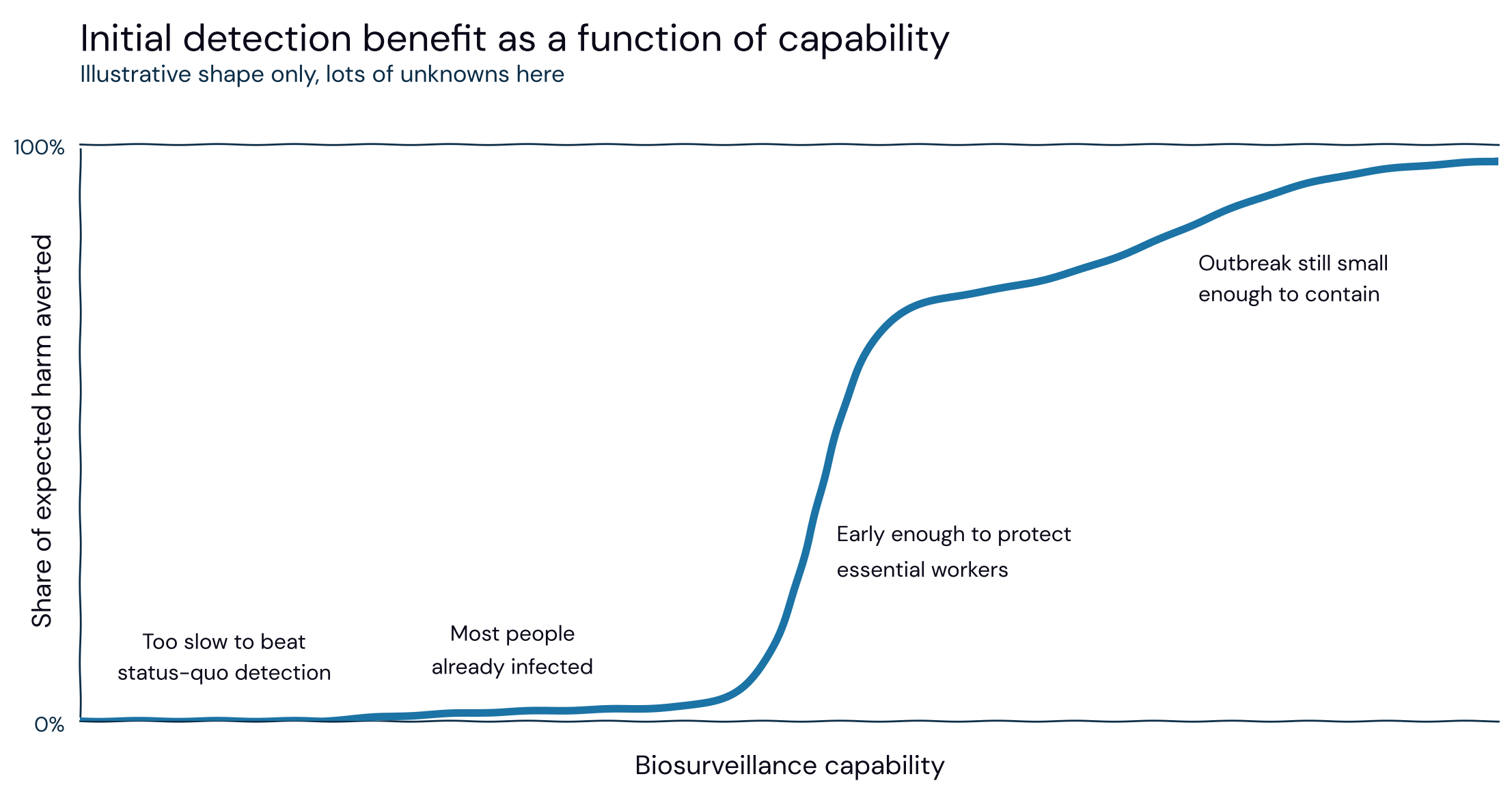
If you imagine the most capable system that can be deployed for a given level of investment, it will be capable of averting some fraction of expected possible stealth harm. Here's how I see it:
None of these are hard boundaries. There are factors that 'smear' these thresholds across many capability levels: some of this is luck (ex: who contributes to what samples), while some is uncertainty about the world that both we and an attacker would share (ex: how much shedding a given pathogen would actually produce in a large population). Here's an illustrative chart:
I've intentionally left the x-axis vague. It's not "cumulative incidence at detection", because (a) that's horizontally smeared as described above and (b) it would imply that increased capacity is downstream of sensitivity only and not other important factors like what kind of pathogens you can detect at all or how quickly you can trigger response. Instead, the x-axis represents the level of resources invested.
A system that is sufficiently capable to flag pathogens early enough to protect enough workers to avert civilizational collapse is well worth the investment; additional sensitivity beyond this is valuable, but likely substantially less cost-effective.
This means that success looks like a pathogen-agnostic system that flags attacks in time to protect enough workers to prevent civilizational collapse and buy time for pathogen-specific mitigations. How early this needs to be depends on how quickly response can happen. If effective response takes a month from detection, you need to flag before ~0.05% of people have been infected. On the other hand, if it takes two weeks, you only need to flag before ~2% of people have been infected, and if you can get it down to seven days, then even flagging at 10% cumulative infections would be enough. See appendix for more detailed reasoning.
Note that the "fast enough to beat status-quo detection" regime would be a far higher bar for wildfire than stealth. This means that, on time scales rapid enough to factor into planning, I don't expect it to be economically feasible to build a system where biosurveillance would be your first indication of a wildfire pathogen.
Triggering Initial Response
We don't know very much about what would actually get decision-makers to take sufficiently prompt action. In a stealth scenario, this is extremely challenging, since response must begin before the main symptoms manifest, but even in a wildfire scenario, there's a huge difference between a response that follows immediately from when someone identifies the first cluster vs one where it kicks off in earnest only after deaths start to become highly visible.
Success looks like a very short time, ideally under a week, from when a catastrophic pathogen is flagged until the danger has been recognized, PPE has been distributed to essential workers, biohardening has been deployed or activated, lockdowns have been instituted, and development of rapid diagnostics and other medical countermeasures has begun. These are very costly actions, in economic terms but also via anteing political capital and institutional trust. Biosurveillance can contribute by giving decision-makers the information to determine whether those costs are worth paying. This looks like clarifying the extent of spread to date, estimating trajectory, and performing initial wet lab work such as genome completion.
Beyond the technical work, response requires trust. Before someone will act on an alert from a system they need to believe that it indicates something real, and that trust needs to be built over time. Non-catastrophic detections are key, showing you can track trends that match what other evidence shows, surface matters of public health concern, and turn up real engineered 'benign positives'.
Most of the work in reducing time to response, however, is outside biosurveillance. This could include helping government agencies develop better plans for how to handle various indications, running exercises that get the actual principals to experience the feeling of making these specific calls with realistically incomplete information, or streamlining inter-agency communication so available clinical and epidemiological data gets to the right people quickly.
Enabling Ongoing Suppression
Wastewater PCR was used by Australia, New Zealand, and Singapore (down to the building level), among others, as part of their suppression strategies to guide public health response during COVID-19. At the point when transmission has been diminished to some threshold, or if an attack is identified before the pathogen has spread widely, a sensitive biosurveillance system can tell you when and where you need to focus more expensive and intrusive detection methods and interventions.
This means that a system for successfully maintaining suppression looks like a larger-scale and more fine-grained implementation of the biosurveillance component for triggering initial response. Knowing that something is spreading in ten major cities around the US might be enough to spur rapid action, but you need a much more detailed picture if you're trying to maintain ongoing suppression.
Initial detection of stealth pandemics is SecureBio Detection's focus, and where I have the most developed view. I'll walk through what I think is needed for this scenario, and then discuss how this changes for other scenarios. Please don't interpret this structure as a claim about the relative likelihood of stealth scenarios!
Sampling Strategies
Municipal wastewater is a very helpful sampling modality: in most cities, sewage is processed at a small number of locations, letting you track pathogens across hundreds of thousands of people from a single easily-collected sample. Since many pathogens don't shed heavily into wastewater, however, and it's a very noisy sample type, comprehensive initial detection at a reasonable cost likely requires tracking additional sample types. SecureBio runs a nasal swab program; beyond swabs I see air, blood, aircraft wastewater, and leftover material from clinical tests (clinical lab discards) as the strongest candidates for supplemental sampling. SecureBio has looked into these strategies in some depth (initial overview, blood, aircraft wastewater, clinical discards), but there's still a lot that could be learned here.
Lab Technology
You need technology that is pathogen agnostic: if you monitor only specific pathogens, the adversary can choose ones you don't monitor. With current and near-future tech, "pathogen agnostic" means sequencing. For viruses, it is practical to concentrate particles by size, and then perform untargeted and enriched metagenomic sequencing metagenomic sequencing. This lets you do the rest of the detection in the computer, for maximum flexibility and generality, and this is what SecureBio does today.
For bacteria, I'm pessimistic about adapting this approach directly, at least with wastewater, because the genomes are much larger and there is a rich background of sewer bacteria that can't be physically separated from potentially threatening bacteria before sequencing in the same way that viruses can. How to handle this is still an open question; see below.
For mirror life, the initial stages of spread might be very hard to recognize, and an important step would be learning that mirror life was spreading at all. It's likely that a highly sensitive and relatively cheap assay could be developed, but no one has started on this yet.
Computational Technology
Metagenomic sequencing moves much of the problem of initial detection from the lab into the computer. This means massively more sequencing reads than humans could evaluate (8+ orders of magnitude), so we need a detection system that can identify which reads indicate something concerning is happening. Some reads can easily be recognized as concerning (ex: nucleic acid subsequences unique to the smallpox genome should not be in wastewater) while others require very sophisticated processing (ex: understanding the complex background well enough to flag de novo genomes with no sequence similarity to anything currently existing). The general approaches are looking for sequences with one or more of the following features:
The computational approach is very difficult given the scale of the data, uncertainty over what an attack might look like, and the need for rapid analysis. On the other hand, these are the kinds of highly computational problems where I expect AI can be very productively applied, whereas many other aspects of this system require relatively slow real-world effort.
Pathogen-agnostic biosurveillance is still in its early stages. I know of four systems doing untargeted metagenomic sequencing for biosurveillance today:
There are also several hybrid-capture sequencing projects that might detect an attack if the agent was similar enough to existing pathogens.
In addition to detection via pathogen-agnostic sequencing, there are also paths where an outbreak becomes visible via showing symptoms in a sufficiently large fraction of infected people. This could lead to suspicious clusters, and then to sequencing and noticing that a genome looked edited. This is not a well-developed path today, but (as discussed below) I'd like to see investment here.
Here's an overview of what I think most needs doing. It represents the current state of my thinking, but it's not as thoroughly considered as I wish it were: please don't overweight it in your own decision-making! While SecureBio Detection is exploring some of these, I think the ideal structure is a healthy ecosystem of organizations taking on different parts of the problem in parallel. SecureBio is often able to share samples, sequence prepared nucleic acids, or share data to help others make progress.
In roughly descending order of how valuable I estimate non-SecureBio work would be, representing a combination of both overall value and the value of the work happening independently:
During the COVID-19 pandemic, many groups built out PCR-based targeted wastewater monitoring. In the US, wastewater monitoring networks include NWSS (CDC), WastewaterSCAN (philanthropic), and Biobot (private). EU member states, Canada, Australia, and other countries track wastewater as a standard part of their public health systems. There are maybe two dozen countries that have some form of wastewater PCR that could be retargeted to track a new pathogen in an emergency once its genome was known.
On the other hand, none of this would move quickly enough today to address a wildfire pandemic. There are delays throughout the process: some of this is technical (ex: stocking consumables), but most of it is organizational (ex: policies that permit setting production work aside, overtime budgeting, on-calls, deals with synthesis providers for rush orders). Even in a serious emergency, I think ten days is a good best-case estimate today. With good preparation, however, three days is possible. I think getting these existing networks to prepare for rapid turnaround emergency response is really valuable, and SecureBio has started to have some of these conversations.
This is also a place where the same metagenomic sequencing system you would build for stealth pandemic detection could help you cut off additional days in your response. The technical and organizational delays that slow down PCR-based detection are downstream from how changing targets requires making changes in the physical world. Untargeted sequencing lets you skip those steps, at the cost of much lower sensitivity. On the other hand, once you know what you're looking for, you can use approaches (like PCR) that are significantly more sensitive in the case of SCV2, by a factor of about 100. If you've built a sequencing system that can flag a stealth pandemic before 1% of people have been infected, then that factor of ~100 means it would be able to confirm a wildfire pandemic at ~0.01%. Still, it's not clear to me that even 0.01% is early enough. It's possible that you need 0.001% or even lower, at which point this argues either for a substantially larger investment in untargeted sequencing (to get enough data quickly) or giving up on sequencing for this application (because it can't economically reach the target sensitivity).
If you wanted to firmly decide whether to go with MGS or PCR to accelerate initial response to a wildfire pandemic the key thing you'd need would be estimates of (a) what fraction of the population would likely be infected when a wildfire pandemic was noticed, and then (b) how many doubling periods there would be before decision-makers took action in the absence of this system. On the other hand, I'm not sure a firm decision is needed, and instead lean towards different groups exploring these approaches in parallel.
The same PCR-based targeted wastewater monitoring that was built for COVID-19 and could potentially accelerate response to a wildfire pandemic could also be applied to ongoing monitoring to support suppression. This is already widely understood to be valuable, but there is still less investment here than there should be. In a legitimate emergency, I expect governments to be able to organize existing capacity and deploy it reasonably well, but not as quickly as would be ideal. My bigger worry is whether that existing capacity would be large enough. For example, you would ideally have monitoring at the neighborhood or building level, which means you'd need a very large number of in-manhole composite samplers. Since these are low-volume products built by a small number of manufacturers, it would be hard to build more quickly during a crisis.
The main work is building up capacity in advance that can be quickly deployed in an emergency. The best bet for such capacity is systems installed for ongoing public health monitoring: this ensures that they work, including as part of a larger system, and that lots of people know how they work. It also gives some ongoing benefit, which may make it an easier sell than stockpiling.
There is a long chain of reasoning in estimating in what fraction of attacks a system would achieve the goal of protecting enough workers, and that chain involves several steps where our knowledge is limited. Still, we can make the best estimates we can. The three key parameters, are:
Taking this all together, you get the target that SecureBio has been working towards for a while: a system sensitive enough to avert civilizational collapse would need to flag a pathogen before, very roughly, 1% of people had been infected: 1% * 215/3 = 32% < 50%.
[1] While mirror bacteria could spread through the environment instead of between humans, to the extent that they might still propagate widely before detection, I group them in with stealth.
[2] This is not dependent on which specific workers are considered "vital" or "essential" or even how many there are, though of course that has large impacts on the question of how to get them protected.