Comments
EA Poland helped launch AI Safety Poland. ~$16k keeps us running through mid-2027


17 min readNov 17
9
TL;DR
- Who we are: EA Poland (Fundacja Efektywny Altruizm), 2 FTE. We help people in Poland discover effective altruism and act on it, for example by moving into high-impact work. We do this mainly through our Intro to EA Fellowship, guidance via 1:1 conversations, and incubating local initiatives (AI Safety Poland and Więcej Dobra, both now independent, and Biosecurity Poland).
- Our biggest 2026 results: AI Safety Poland, which we incubated, became an independent organisation funded by Coefficient Giving. Our first EA Summit in Warsaw (157 attendees, CEA-funded). About 40 Fellowship completions expected by year-end (26 by Q3 2026; 17 in all of 2025); 10 significant actions (SAs) we know of by 6 people we led to directly.
- Funding gap at current salaries: January–March 2027 is nearly covered (≈$1.3k missing). Without new funding, we run out of money for salaries in April. The first half of 2027 is missing ≈$16k; the full year ≈$44k. This already counts 80% of the monthly donations our donors have pledged for 2027. You can donate here.
- Why the gap exists: in 2026, we got two grants, from CEA for the EA Summit and from Coefficient Giving for policy careers research. Delivering both well while keeping what works (the Fellowship, 1:1s, and support for AI Safety Poland) left us little time for fundraising until the Summit was over in early October. From March 2027, no grant pays our salaries. We applied to EAIF in early November and only then learned that its decisions can take much longer than we expected. By mid-December we will also apply to two Polish government programmes, which decide by the end of March, and we are exploring an application to Coefficient Giving. Donations are our bridge to those decisions, and our buffer if they go against us.
- Two budgets: the gap above keeps us running as we are now. Our EAIF application budgets salary raises to roughly the Polish average wage; we don't ask individual donors to fund those.
- Our own BOTEC: ~$330–500 per Fellowship completion and ~$4–6k per significant action in 2027 (~$9.5–9.7k in 2026), calculated by dividing our budget by our 2027 targets, which build on our 2026 results; attribution rests on what people told us.
- We won't have much capacity to engage with comments, but we will read them all. If you are considering supporting us and have questions, book a call with Chris.
Our biggest result of 2026: AI Safety Poland
In mid-2025, AI Safety Poland (AISPL) was close to dormant. We helped bring together its five-person team. We recruited one of the coordinators from the existing AI safety community, and one team member joined through our Fellowship. The other three all named a 1:1 with Chris as a key factor in getting engaged with the initiative.
We also sponsored it fiscally, funded its website, initiated its AI safety career advising together with one of its co-founders, and supported it with its theory of change development. In June 2026, it registered as an independent foundation, and it now has its own funding from Coefficient Giving.
Since Q4 2025, it has grown fast. Apart from offering career 1:1s, it organised Warsaw AI Safety Day (about 235 participants), runs regular webinars and local meetups, and hosts a Slack workspace with about 170 monthly active users. Its members have got into programmes such as SPAR, ML4Good, ARENA and GovAI, and BlueDot reports that dozens of people AISPL referred took its courses.
None of this would have happened without AISPL's own team, who built it and run it day to day; our role was mainly in helping it start.
AISPL has asked the people behind the roughly 20 significant actions in its community this year how much it contributed, and answers for 11 actions are in so far. Five of them, by five people, are rated above 25%, including a career change into full-time AI safety research and a full-time role at an organisation working on AI risk. Six are rated 25% or lower, three of them at 0%. All five of the higher-rated actions began with a 1:1 in AISPL's career advising, the programme mentioned above.
We don't count AISPL members' actions in our own numbers unless the person attributes the action to EA Poland specifically, for example, to a 1:1 with Chris or to our Fellowship.
If you want to judge whether our model works, this is the clearest case we have: an intro programme, 1:1s and hands-on incubation contributed to an independent organisation that now helps people take such steps without our involvement. It is, however, one case, and it owes a lot to an unusually strong founding team, so it shows our model can work rather than that it reliably does.
Who we are
We are a two-person national EA group. Our ED, Chris Szulc, has done EA community building for 7 years; Diana Krasocka, who runs the Fellowship, our comms and operations, is herself a 2022 Fellowship graduate.
We are smaller than we were: in January 2025 our co-director left due to funding constraints, as we wrote in our 2025 update. Our spending went from about $161k in 2024 (including one-off book projects) to about $118k in 2025 and about $97k in 2026 (our full-year estimate), including the CEA-funded EA Summit (~$30k), which also covered part of our salaries.
Keeping the current team at current salaries costs about $66k a year. We think the right budget for 2027 is about $82k: the same 2 FTE with salaries at roughly Poland's average wage, plus a 5% buffer. This post asks only for what keeps our current team running.
Our theory of change:
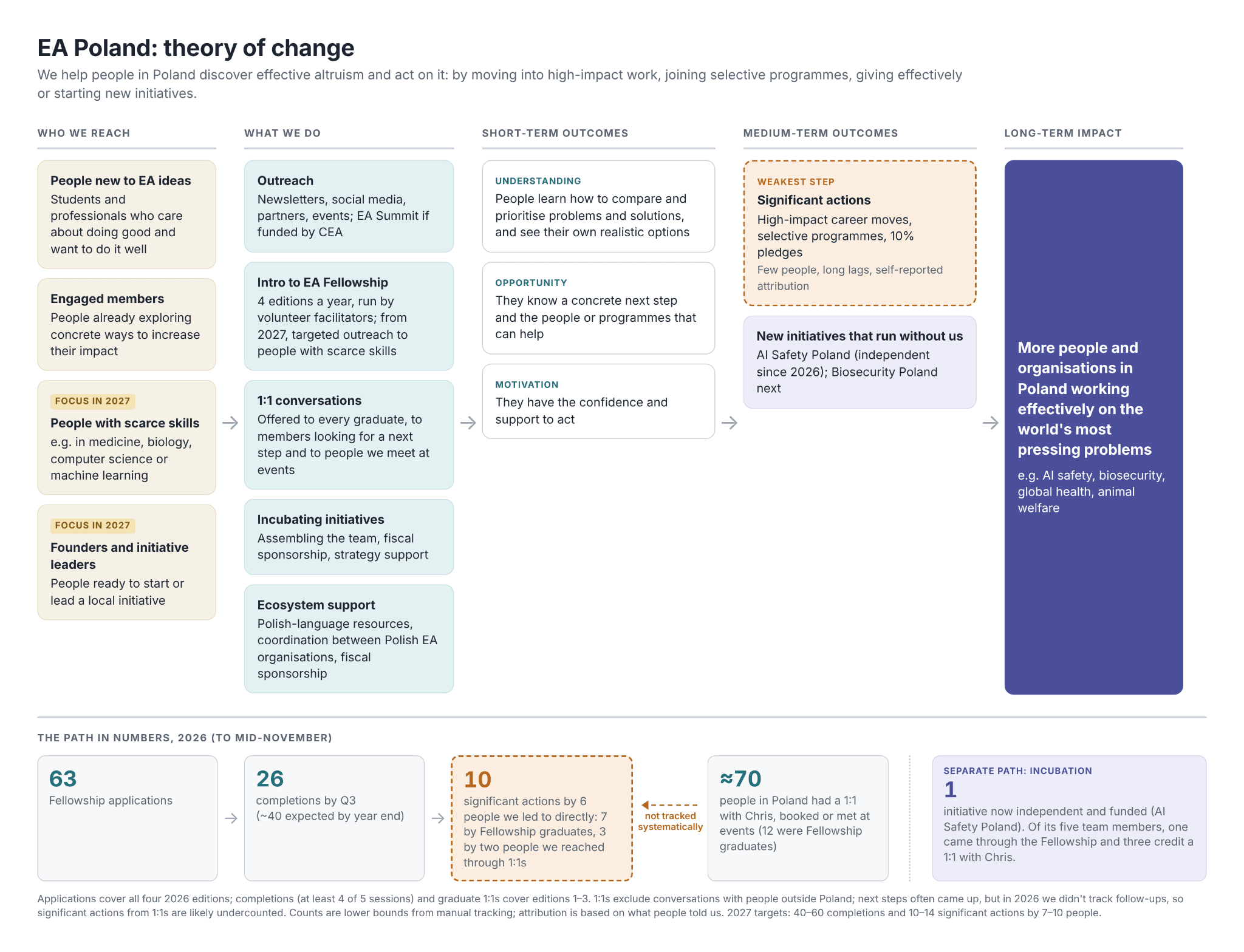
Most significant actions so far come from Fellowship graduates and 1:1s with Chris.
By a significant action (SA) we mean things like joining a selective programme (e.g. MATS), pledging to give 10% of one's income to effective charities, or moving into high-impact work.
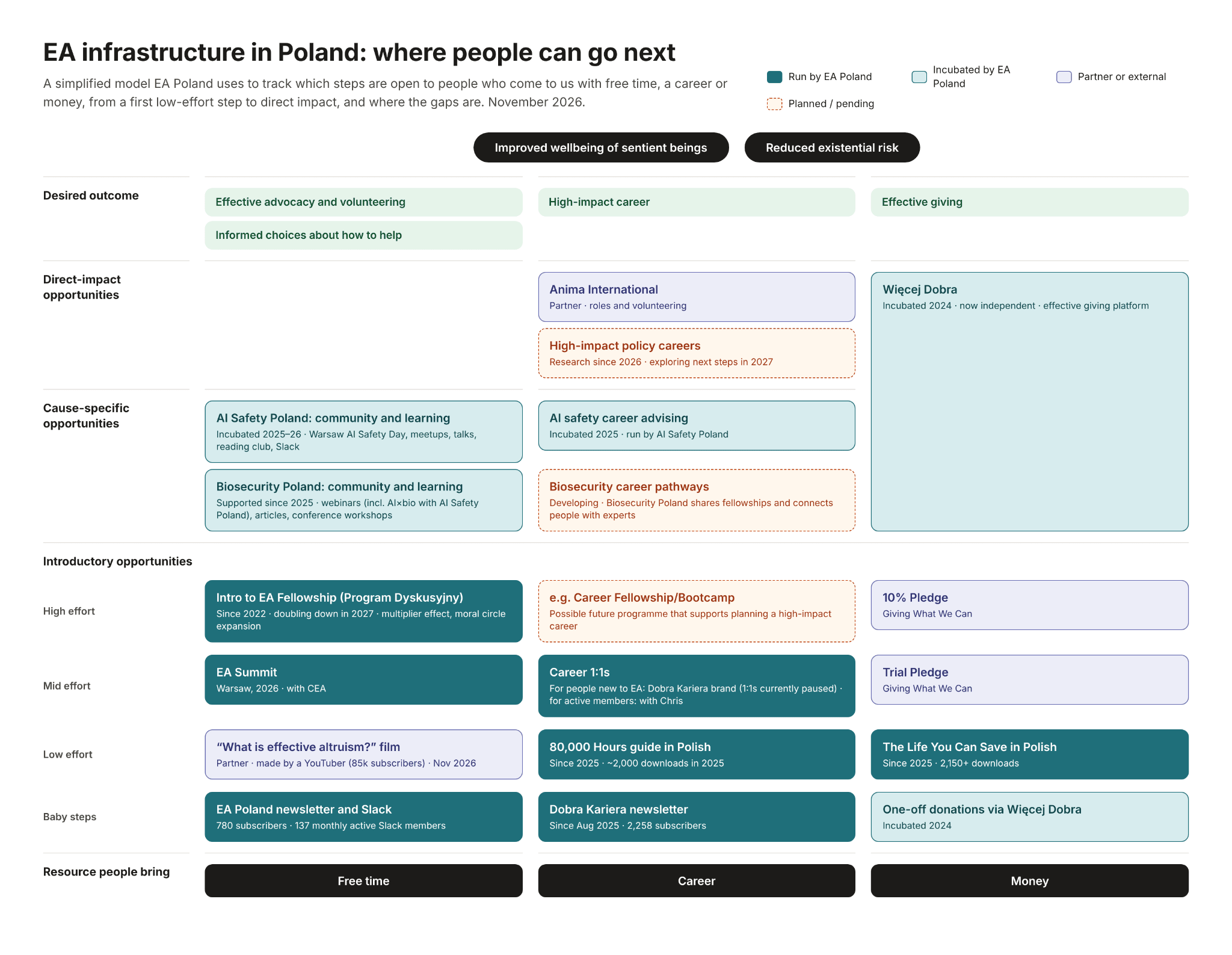
One of the tools we use to plan is a simple map of EA infrastructure in Poland. Whatever people bring (free time, a career or money), we want them to find a good next step at every level of effort, from a first "baby step" to direct impact. The map shows what exists, who runs it and where the gaps are; it is one of the inputs when we decide what to run, incubate or leave to others.
Most entry points now exist. Next, we want to make what works more cost-effective and help more opportunities grow further along the path, in specific causes and direct impact.
2026: what we planned and what happened
AI Safety Poland's independence was also a forecast that came true. In our 2025 update, we expected AISPL to become autonomous in 2026, which would let us turn to incubating another group, such as Biosecurity Poland. AISPL now runs on its own.
Here is how the other 2026 goals from that post turned out, plus two things we took on that weren't in it:
2026 goal (from our 2025 post) or new work | Result |
| AI Safety Poland becomes autonomous | Met. AISPL runs and fundraises on its own; ~20 significant actions in its community, of the 11 rated so far, 5 are above 25% attributable to AISPL |
| Then help incubate another group, e.g. Biosecurity Poland | On track. We fiscally sponsor it, brought in two of its co-founders and support its leadership; it is our 2027 focus. |
| 5–10 significant actions attributable to us | Met. 9–10 we know of (see attribution below), by 6 people we led to directly; likely more we haven't identified. |
| Not in our 2025 post: EA Summit Warsaw | Done (CEA-funded). 157 attendees; likelihood to recommend 8.85/10; 47% of 93 survey respondents said it changed their plans. |
| 3–4 Intro to EA Fellowship editions, at least 40 participants | Met. 4 editions and 59 participants; about 40 completions expected, up from 17 in 2025. |
| Personally support at least 50 active members, and others looking for ways to get involved, through 1:1s | Met. About 70 people in Poland had a 1:1 with Chris, roughly 30 of them already active members. |
| Not in our 2025 post: research on policy careers | Ongoing. Funded by Coefficient Giving until the end of February 2027. |
| A grant of $12–35k for an EA video made by an influencer | Different route. A feature-length Polish film about EA, crowdfunded by the creator's audience, comes out this month. |
| 125–130 monthly active Slack members | Met. 137 as of Nov. 2026 |
| 120–180 career 1:1s, mostly with people new to EA | Pivoted. After EAIF declined this project in January, we focused on the EA Summit and policy careers research instead. |
| Secure 2–2.5 FTE for 2027, incl. 10–15% from non-EA sources, by December 2026 | Not yet; non-EA share deprioritised. This is the gap this post is about. |
A few details behind the table:
- Fellowship and 1:1s: 26 completions by Q3, counting everyone who attended at least 4 of 5 sessions; the latest edition had a record 20 applicants. 46% of graduates took up a 1:1 with Chris, and about 30% of those 1:1s led to a concrete step or plan. Of the roughly 40 people Chris met who weren't active members yet, most booked a call themselves to find a way to get involved.
- Significant actions: 7 by Fellowship graduates and 3 by two people we reached through 1:1s (to mid-November; one more is still being verified). For example, a Fellowship graduate co-founded AI Safety Poland and co-organised Warsaw AI Safety Day (~220 participants), and created a high-quality AIS YouTube film with a BlueDot grant, and a doctor met his future Biosecurity Poland co-founder in his Fellowship cohort and chose biosecurity as his career path; he is now applying to international fellowships. Most of our 2026 cases are early steps (career choices, applications, new groups). This follows from our strategy so far: we focused on building basic infrastructure (see the map above) and the top of the funnel, such as the EA Summit and the Fellowship. As people move through it, we expect more significant actions each year, including more people taking up direct work. We’ll report which of this year’s cases turn into roles over the next 1–2 years.
- EA Summit: likelihood to recommend 8.85/10 (93 survey responses, self-reported); 9 attendees joined the Fellowship.
- Policy careers research: Coefficient Giving funds half of Chris's time for research mapping which roles in Polish public administration matter most for problems such as AI safety and biosecurity. It informs our career advice. Separately from the grant, Chris represents EA Poland in two civil service working groups, one of them on career paths for young people in the civil service. Depending on the results, we may apply for a next stage.
- Non-EA funding: our first application to NOWEFIO, a Polish government programme for civil society ($80k), wasn't funded, but two evaluators scored it 82 and 89 out of 100. We received our first PLN 3,522.50 (≈$900) from Poland's 1.5% income tax allocation. By mid-December we will submit two government applications: to PROO (about PLN 280k, ≈$72k, to build our fundraising capacity) and, using the evaluators' feedback, again to NOWEFIO (about PLN 270k, ≈$69k, for our high-impact careers work). In 2027 we'll keep our non-EA efforts to these two channels.
What went less well: in late 2025 we applied to EAIF for a project built around career 1:1s for newcomers. It was declined in January 2026. We asked for feedback but haven't received any, so we don't know what the main problem was. That project was the core of the 2026 goals in our 2025 update (120–180 career 1:1s), so we consciously dropped that target.
We also lacked the capacity to follow up with Summit attendees and encourage them to apply to EAGx Berlin.
Since then, we have narrowed our community work to one main path we can measure (Fellowship, then a 1:1, then a next step) and rebuilt our tracking. One gap remains: we didn't systematically follow up after 1:1s, including those with people we met at events such as EA Summit and WAISD, so we likely undercount what came out of them.
What we plan to do in 2027
We have two main goals: 10–14 significant actions by 7–10 people, and a stronger Biosecurity Poland, possibly as a standalone organisation.
Everything below helps people who want to do more good find a concrete next step. Across all of it, we will put particular effort into reaching people whose skills are scarce in high-impact fields, for example those who could move into biosecurity or AI safety after the Fellowship.
- Fellowship: four editions and 40–60 completions, with more targeted outreach, including to people with backgrounds in demand in biosecurity or AI safety.
- 1:1s: Chris plans career and mentoring 1:1s with about 75 people in Poland, plus a few conversations with the EA community abroad. Every Fellowship graduate is offered one (we expect 20–25 to take it up); most of the rest are with active community members looking for a next step, including people whose skills are scarce in high-impact fields. The conversations with the broader community help us stay up to date with best practices and opportunities. From 2027, an automated reminder will prompt a check-in about three months after each 1:1.
- Biosecurity Poland: help it grow as AI Safety Poland did, by bringing in people and supporting its leadership. If it makes strategic sense and the right person wants to lead it, we aim to help it become a standalone organisation. We don't count this in our SA target, but on our track record so far it may be where most of our value lies.
With funding only to mid-2027, we can commit to the first half of this plan (about two Fellowship editions) and would review the rest when grant decisions arrive.
Three things we might want to test or continue depend on separate funding and are not part of this ask: a second EA Summit, if CEA funds it; a next stage of our policy careers work, depending on what the current research finds; and a pilot Career Fellowship that helps people plan a high-impact career. None is included in the figures above.
Depending on what gets funded and how much, we would mainly bring in more people to run them rather than stretch our current team. If our core work is funded, we would bring in other people to organise most of the Summit and keep our own role to where our experience matters most; if it is not, the Summit would become a larger part of our own work.
More generally, the final shape of our strategy will depend on what gets funded and when. In 2026, for example, we only learned in February that we would run the EA Summit, and that affected our priorities for the rest of the year.
Our funding gap
Running our two-person team costs PLN 21,606 (≈$5,540) a month: both salaries at current levels, payroll accounting, bank fees, all the software we use, and our registered office address. A Group Support grant might cover some of these, but we are yet to apply for it, so we count them all here.
All dollar figures use PLN 3.90 per USD, the rate in our EAIF application.
Period (2027) | Missing at current salaries | Status |
| January–March | ≈PLN 5k (≈$1.3k) | Nearly covered |
| January–June | ≈PLN 61k (≈$16k) | Our goal for this giving season |
| Full year | ≈PLN 172k (≈$44k) | Depends mostly on grant decisions |
Why the gap exists. In 2026 we received two grants: from CEA for the EA Summit and from Coefficient Giving for research on policy careers. Both are relatively short and demanding. Delivering them well while keeping the Fellowship, 1:1s and support for AI Safety Poland going left us little time for fundraising until the Summit was over in early October. From March 2027, no grant pays our salaries. It is also why we are behind on last year's goal of securing 2027 funding by December.
How we count: we start from the funds we hold now and regular donations through December. We then add 80% of the monthly donations our donors have pledged for 2027 (~PLN 3.0k of ~PLN 3.8k a month), because some pledges lapse. We count no grants we haven't received. Even if every pledge arrives all year, it covers less than a fifth of our monthly costs, so without new funding we run out of money for salaries in April.
Why the first half-year? It bridges the time to our grant decisions, and if they go against us, it gives us time to find other funding or scale down responsibly rather than overnight.
We applied to EAIF in early November, and its decisions can take several months. By mid-December we will apply to two Polish government programmes (decisions by the end of March; details under the 2026 table). Right after this post, we will also explore an application to Coefficient Giving that could fund our core work instead of EAIF; we would accept only one of the two. We don't count on any of these in the figures above.
Six months of runway won't end fundraising, but it lets us plan the Fellowship and support for Biosecurity Poland around grant decisions rather than next month's bills, and keeps fundraising to a smaller share of Chris's time.
Two budgets, two purposes. The gap above is what it costs to keep running as we do now, with salaries at ~0.9× Poland's average wage. Our EAIF application budgets 2027 differently: salaries at roughly the national average, the software and Fellowship ads we already use, and a 5% buffer.
It requests $61k for Diana full-time and half of Chris's time. His other half goes to our policy careers research, which Coefficient Giving funds until February 2027. As our 2027 strategy takes shape, we may want to keep that half on policy work, so we ask EAIF only for the part that fits its scope, and no part of his time is funded twice. From March, the second half depends on donations: recurring pledges for 2027 cover roughly two-thirds of it, and the rest, a few thousand dollars for the year, would come from what we raise now. This cushion from individual donors means our work doesn't hinge on a single grant decision.
We don't ask individual donors to fund the raises: if EAIF funds the application, the raises come from that grant; if not, we continue at current salaries. The $16k we ask for here is sized for the case where no grant arrives in time. If EAIF does fund us, donations made after this post would extend our runway into 2028 rather than duplicate the grant, and we would say so in an update here.
What marginal funding buys
The first ≈$1.3k closes January–March. After that, every ≈$4.8k adds one more month of runway from April, on top of what donors have pledged.
Amount | What it buys |
| ≈$185 (PLN 720) | One day of work for our two-person team |
| ≈$1.3k | Closes January–March 2027: the first-quarter Fellowship edition and 1:1s go ahead as planned |
| ≈$4.8k | One more month of runway from April; at our 2027 cost per SA, roughly the work behind one significant action |
| ≈$16k | The whole first half of 2027: the Fellowship, 1:1s and support for Biosecurity Poland continue while grant decisions are pending. $16k closes the gap that keeps this running; on our 2027 targets, the whole half-year means ~20–30 Fellowship completions, 1:1s with ~35–40 people and ~5–7 significant actions |
| ≈$44k | All of 2027 at current salaries, if no grant comes through: our full 2027 targets of 40–60 Fellowship completions, 1:1s with ~75 people and 10–14 significant actions, plus support for Biosecurity Poland |
| ≈$101k | Two full years (2027–2028) at current salaries: fundraising becomes occasional rather than constant, and that time goes to the Fellowship, 1:1s and Biosecurity Poland |
These outcomes come from the work each amount keeps running, not from the donation alone; on our BOTEC below, every ~$5–10k corresponds to roughly one significant action.
Cost-effectiveness: a back-of-the-envelope calculation (BOTEC)
Our 2027 target is 10–14 significant actions by 7–10 people, fed by 40–60 Fellowship completions. That is close to our 2026 result of 10, because part of our time in 2027 goes into incubating Biosecurity Poland (more on that below). Four of this year's 10 SAs were tied to building new groups (three to AI Safety Poland, one to Biosecurity Poland). The target is higher than the 8–12 in our EAIF application, which we will update.
On the $61k budget in our EAIF application (1.5 FTE), that gives:
- ~$330–500 per completion, counting only the Fellowship's ~$20k share (35% of Diana's time plus a share of operations and ads);
- ~$4.4–6.1k per SA for the whole budget.
Looking back instead: all our 2026 costs (about $97k, including fundraising, admin and the EA Summit) divided by 2026's 10 SAs give about $9.7k per SA. Leaving out both the policy careers research funded by Coefficient Giving (about $12k in 2026) and the one SA it produced (see attribution below) gives about $85k for 9 SAs, or $9.5k per SA. We count fundraising, admin, and the Summit because they serve these actions too; the Summit sits at the very top of our funnel.
Neither figure is directly comparable with the one above, as the EAIF budget includes no Summit, and both are upper bounds: the Summit's effects will show mostly in later years, and the same money also paid for incubating AI Safety Poland and Biosecurity Poland.
On attribution: based on what each person told us, 8 of the 10 SAs of 2026 are at 76–99% attribution, one at 51–75% and one at 26–50%. One of the 76–99% SAs is a contract on our own policy careers research project, and we are unsure whether to count it; hence 9–10 SAs, depending on this one case. Most 2026 ranges are our reading of people's answers. From 2027, we score attribution in a 6-month survey and round down when unsure.
This excludes what the groups we incubated achieve on their own (AI Safety Poland, Biosecurity Poland), where a few successes carry most of the value but attribution is much harder. AI Safety Poland now supports significant actions in its own community and expects ~15 career changes there in 2027, by its own estimate. If Biosecurity Poland develops the same way, the actions it generates will come on top of our target; we don't count them in it.
This is a deliberate bet: the sooner Poland has groups that support significant actions on their own, and do it well, the more such actions there will be overall. We suspect that spending the same hours on generating SAs ourselves, without incubating new groups, would have less impact. Whether our cost per SA is a good price depends on how much you value these actions; counting what AI Safety Poland achieves, and what we hope for from Biosecurity Poland, could change the picture considerably.
Uncertainties and reasons not to fund us
- Attribution is self-reported. Most of our estimates come from the people we support, who may be generous to us. Our counts are probably lower bounds (manual tracking), but our attribution is probably an upper bound.
- Applicant quality is our weakest link. More interest (after the Summit and a feature-length Polish intro to EA by a YouTuber, out in November) does not guarantee more people are likely to take SAs. In 2027 we will test more targeted outreach and track this by cohort. Our targets don't count on the film.
- Small samples. 10 SAs by 6 people is a small base for any cost-per-SA figure.
- Key-person risk. Each of us is a single point of failure for our part of the work; the Fellowship also depends on volunteer facilitators.
- Funding instability. We work project by project, which costs Chris's time. If you think national groups should be funded mainly by institutional funders, the strongest case for donating here is the bridge and buffer around those decisions, not long-term support.
- EAIF declined our last application. We didn't get feedback so we don't know why. If the reasons still apply, EAIF may decline again, and you may reasonably treat that decision as evidence about us.
How to donate
You can donate once or monthly here: efektywnyaltruizm.org/wesprzyj-nas.
We have no form that asks where donors heard about us, so if you donate after reading this post, please add "EA Forum" to your bank transfer title, or send a short note to chris@efektywnyaltruizm.org. It helps us and the Forum team see whether posts like this work.
For any questions, email chris@efektywnyaltruizm.org.
If you are weighing a donation and would rather talk it through, book a call with Chris; we are happy to share more detail than fits in a post.
Thank you for reading.

EA Poland had counterfactual impact by incubating Więcej Dobra (our "Effektiv Spenden") and AI Safety Poland and now it also incubates Biosecurity Poland which I think, due to how neglected this area is and how it is even more important to do biosec in each country, can be as impactful or more.
I wish Chris could have the resources to keep up the good work, I support him however I can, but this is something that easily could blow up if they could afford more than 2 FTEs. I see EA Poland as the go-to career advisor for polish people and in future an incubator for even more initatives in each cause area.