Comments
Transformative AI Fund: strategy and funding needs (November 2026)

11
Summary
EA Funds launched the Transformative AI Fund in August to replace the Long-Term Future Fund, and we're now starting our first fundraising push. Since the start, we've received over 1,300 applications. Of these, we expect 5% to clear our bar. We're aiming to raise $15M, enough for a year of grants at current demand. We may need to raise even more in a few months if demand continues to grow. Each additional $50k means roughly another grant funded. You can donate here.
Our strategy and team
- More funding is only impactful if it fills gaps in good projects, and we need more good projects. Giving by the largest AI safety funders is on pace to more than triple in 2026, and AI wealth may add billions more. Existing organizations are unlikely to sustainably grow fast enough to put that money to work. Early grants start new projects that later funding can scale up.
- Building wide. The field needs many new organizations and projects to test approaches nobody has tried, and more than one organization owning critical parts of the safety agenda. That means many small, early bets, giving the field more shots on goal.
- Early parts of the funnel are overlooked. By available estimates, funders that take open applications for early grants account for under 2% of AI safety funding. Peer funders tell us they have several million dollars of small applications they would likely fund if they had time to evaluate them.
- TAIF fills the gap with fast, early grants. We fund individuals, new organizations, and new projects, typically $10k–150k, rarely exceeding $300k, through open applications and rolling decisions. We complement larger funders by getting ideas tested and organizations started that otherwise wouldn’t exist.
- The team. Lowe Lundin, Head of Fund, is a part-time Lightcone Commons evaluator and previously ran an AI impact consultancy, was a grantmaker at Astralis Foundation, led Meta Charity Funders, and co-founded Impact Academy (now SteadRise). An additional full-time grantmaker joins us in December to bring down decision times. Loïc Watine directs EA Funds; CEA’s grant ops team handles payments, agreements, and compliance; and CEA’s Community Health team supports grantee due diligence.
How we’re updating on recent evidence of AI progress
- The pace of AI development has picked up since we wrote our first strategy in August. METR estimates that Anthropic now improves its models about twice as fast as before, mostly because of AI itself, and OpenAI's pretraining loss has fallen about seven times faster since early 2026 than over 2022–2025. METR further says that available evidence can't rule out much faster acceleration within the next year.
- In response, we now put relatively more weight on work that pays off within 18 months. We also expect a growing fraction of the most valuable work to be reactions to suddenly arising events: responding to an incident (investigating, publishing findings, briefing officials, running awareness campaigns), analysis for an unexpected policy window, or a convening after a crisis.
- However, we believe in winning, not in losing less. This is not a full shift towards short-timeline work. Timeline forecasts are based on our best available models and mostly assume development continues unfettered, and timelines may turn out longer, for example, if development is slowed by regulation, a pause, or hard technical problems. Some work, such as hardware-enabled governance mechanisms, may be essential for things to go well but take years to build. We'll keep funding such work when it gives us the best overall chance of winning across the futures we might find ourselves in, even though it would come too late in the futures where timelines are short.
- Reactive funding and building wide will be parallel tracks in the fund. The field still needs more hands on deck, whatever happens next. We expect to update our strategy continuously and write more about this as the situation evolves.
More funding is only impactful if it fills gaps in good projects, and we need more good projects
The 13 AI safety funders tracked by Manifund’s AI Safety Funder Bulletin gave about $0.6B in 2025 and are expected to give about $1.86B in 2026.
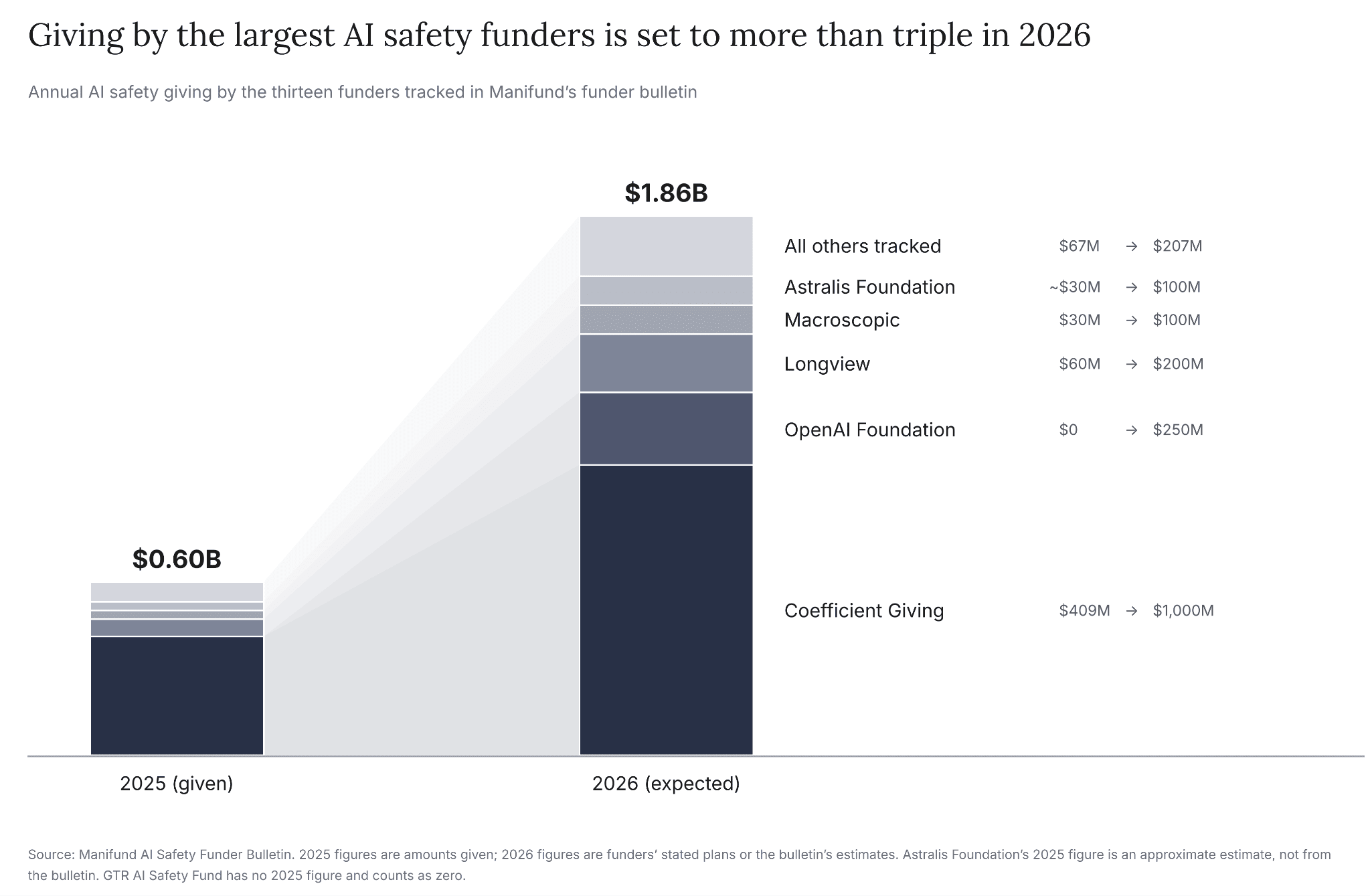
However, money expected from the AI IPO funding wave might dwarf these pools. Grace McLain at Metaculus estimates, with high uncertainty, that we’ll see about $23B in additional funds deployed by the end of 2031 (median forecast). If we also assume that the field will soon attract more attention, new funding pools, and talent, while being perceived as more urgent by a wider public, a reasonable conclusion is that the field will need to follow a steep growth curve to rise to the occasion.
Steep growth is only worthwhile if there are good places to deploy funds, and finding these will not be easy. We need good targets for funding, but current organizations are highly unlikely to sustainably grow at sufficient rates to absorb such funding. Early grants start new projects that later funding can scale up.
Building wide
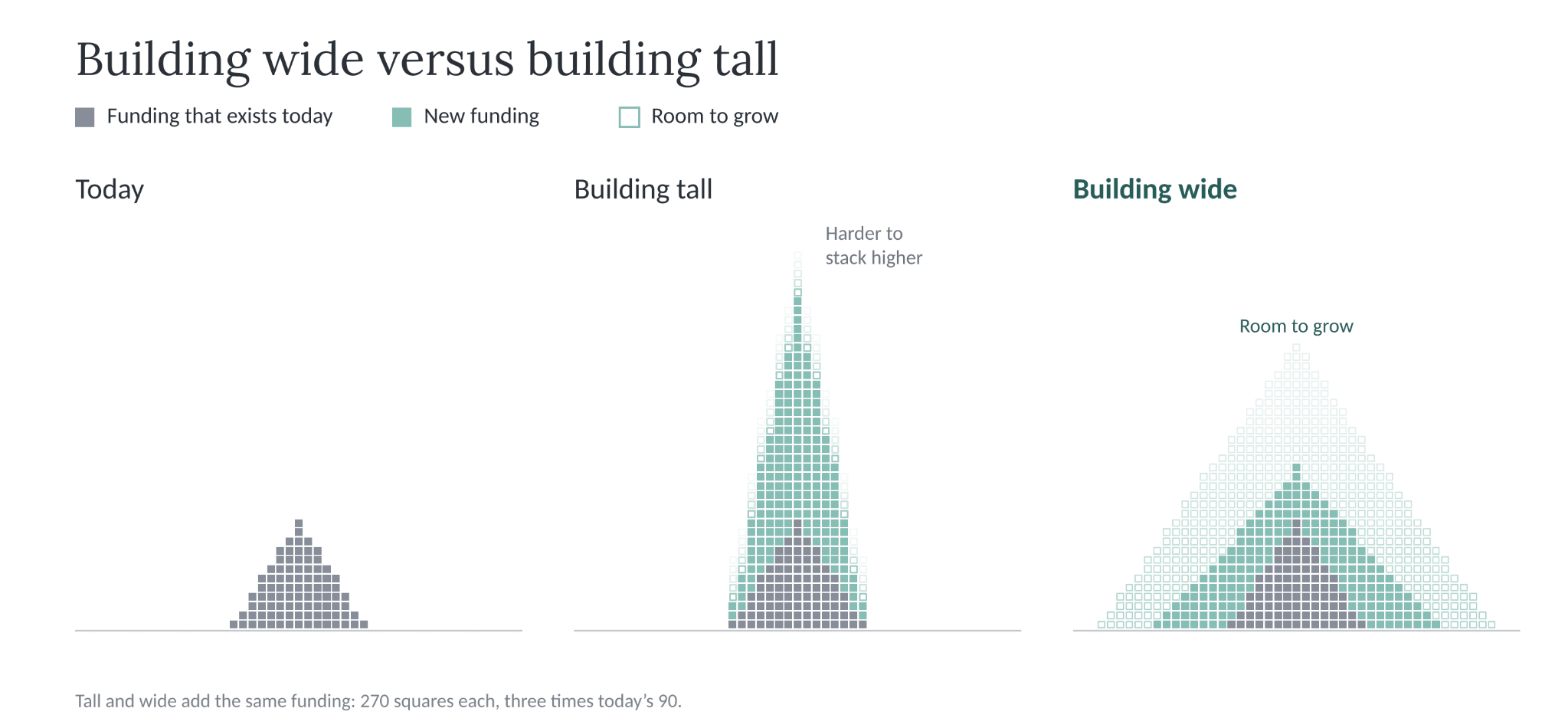
Providing existing organizations with resources to grow is important, but we can’t only build tall; we also need to build wide[1]. Coefficient Giving’s Project Tailwind describes AI as an industry with a nascent safety ecosystem and with “critical, basic problems that no one owns”. We need to explore more branches of the search space.
Building wide looks different from building tall. It means funding new initiatives at early stages, backing long shots, and tolerating failure. Venture capital works the same way: investors write many small checks expecting most to return little, and about 6% of investments produce about 60% of returns. In baseball terms, slugging percentage matters more than batting average.
The VC approach is easier at early stages. A failed $50M grant makes donors question a funder’s judgment, while a failed $50k grant is one non-performing grant in a wider portfolio.
Beyond directing funding to new areas, a “widening” of the space should also include more mature organizations within critical areas, so that no single team carries any one part of the safety agenda. As attention to the field grows, it will become ever more essential that the space spread its eggs across more baskets.
Early parts of the funnel are overlooked
Organizations take time to build, and larger checks to established organizations at later stages presuppose smaller ones that got them started. A Manifund regrant gave Timaeus its first funding, and Timaeus later merged with Resolution, which was awarded Coefficient Giving’s largest-ever AI safety grant, $160M.
But little funding reaches the earliest stages. Of the roughly $1.86B that the funders tracked by Manifund’s AI Safety Funder Bulletin are expected to give in 2026, about $33M, or under 2%, comes from funders that take open applications for small, early grants.
Peer funders tell us they have several million dollars of small applications in their pipelines, which they expect would clear their bar if they had the time to evaluate them. However, factors such as evaluator time and risk exposure mean few funders cover the earliest stages, so many early initiatives go unfunded. This is why we believe the Transformative AI Fund fills an important gap.
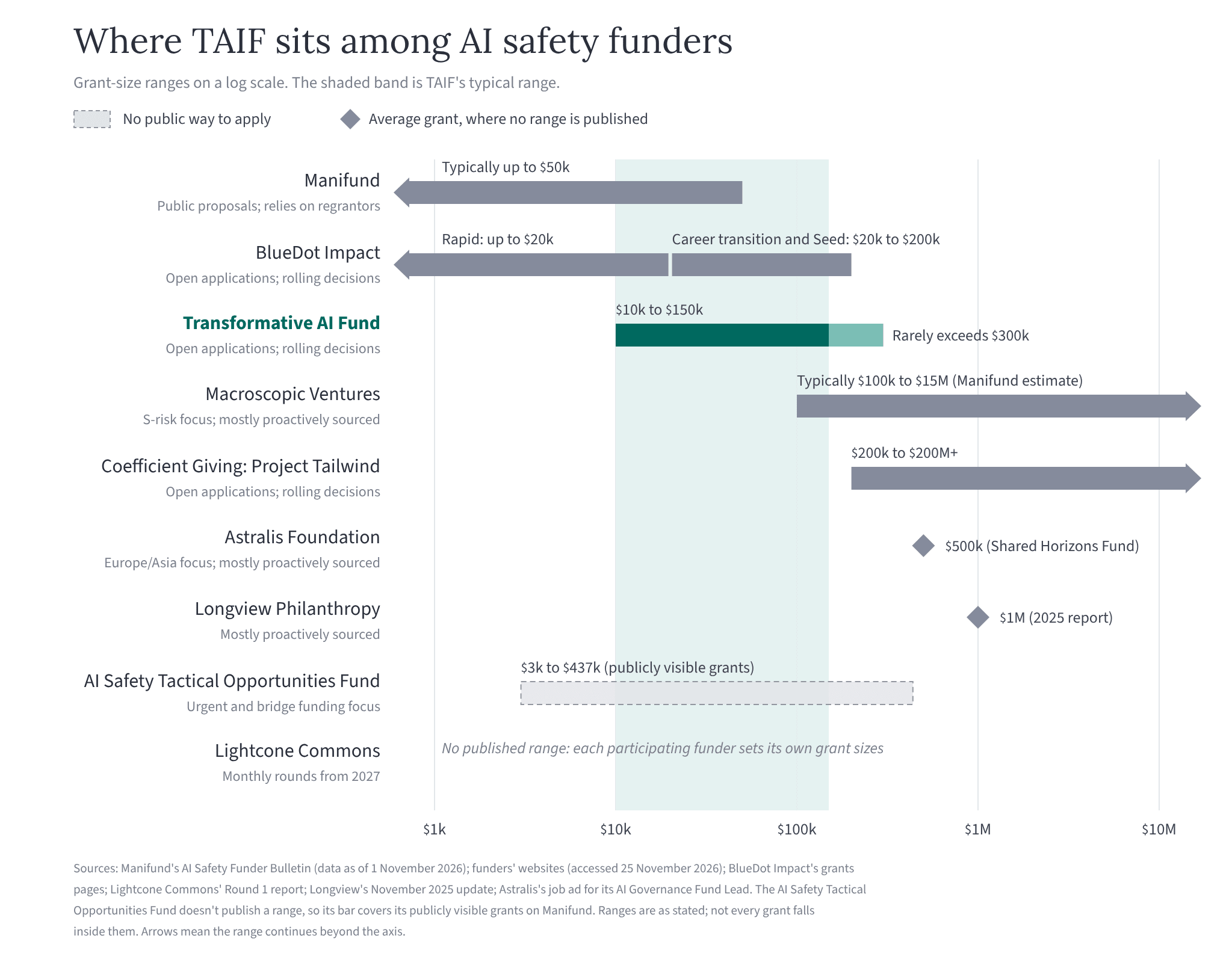
BlueDot Impact also makes grants in our range, but we think applicants are better off with more than one funder (“building wide” applies to funders as well). The ecosystem needs plurality to thrive; actors have different things they’re excited about funding, reach different audiences, and have different constraints on what they can and can’t fund. Similarly, applicants have constraints on who can fund them and which type of funder suits them best.
TAIF fills the gap with fast, early grants
- Size. Our grants are typically $10k–150k, and grants above $300k will likely be rare.
Speed. We decide on a rolling basis, without rounds, and are adding grantmakers to cut decision times as much as possible. We also expect a growing fraction of the most valuable work to be reactions to suddenly arising events: responding to an incident (investigating, publishing findings, briefing officials, running awareness campaigns), analysis for an unexpected policy window, or a convening after a crisis. Waiting time can take away much of the value of such work.[2]
- Open applications. Anyone can apply, without a referral or a prior program, and we can fund work that can’t be public. Open applications surface projects nobody thought to ask for, and a meaningful share of our best grants will likely be to things we wouldn’t have thought to solicit.
- Tolerance for failure. We expect most grants to return little and a few to pay for the whole portfolio. That said, we’re careful to avoid funding projects with a significant risk of negative impact.
- Transparency by default. Public grants go in our grants database, and we will publish quarterly reports with aggregated breakdowns and write-ups of representative grants. Work that needs privacy is left out of the database but included in aggregates.
- Grantee types. We can fund individuals, non-profits, and for-profits in most parts of the world, as well as policy-adjacent work.
Focus
We believe that to make the transition to transformative AI go well, we need to:
- Widen and deepen the field’s organization and talent pool: we write first checks for new organizations, new projects, and people to help them get off the ground.
- Explore more branches of the search space: many promising directions haven’t been tried, and the only way to find out which ones work is to test them, so we make many small bets to get quick information about which approaches work and which don’t.
- Take bets on long shots with theories of victory, rather than on marginal progress on existing agendas: some of the most valuable work may come from ideas that look unlikely today, so we back them knowing most won’t pay off.
Our focus areas are[3]:
- AI governance. Policy research and non-partisan, policy-adjacent work.
- Technical AI safety. New agendas often need cheap tests before being funded at scale.
- Field-building. Increasing the number of people working on important problems.
- Monitoring, forecasting, and communication. Understanding our current position, where we might be heading, and disseminating it well.
- Work on especially neglected non-GCR aspects of transformative AI, such as flourishing futures and digital sentience.
- We fund biosecurity and nuclear work only where it intersects with AI, since we currently see fewer opportunities in these areas and have limited in-house expertise.
We will not be funding work:
- Whose main effect is advancing AI capabilities or making AI systems more commercially reliable. Where work is dual-use, we take extra care that benefits outweigh risks, including by consulting technical experts and ensuring strong buy-in from people involved in the project.
- That funges with funding from larger funders, such as Coefficient Giving and Longview Philanthropy.
- Without a clear existential-risk angle, or, for non-GCR work, that isn’t especially promising or neglected.
Funding needs
Since launching on 11 August, we’ve received more than 1,300 applications. We estimate that about 5% of them clear our bar. We’re aiming to raise $15M to cover our current needs for a full year, and we may need to raise even more in a few months if demand continues to grow.
If you have any questions about your donations, please reach out to transformativeai@effectivealtruismfunds.org.
- ^
Yes, this is a concept borrowed from the 4X strategy genre!
- ^
Due to the unexpectedly high growth in the number of applications we’ve received, we’ve not yet lived up to our own speed goals. This is why we’ve already hired one additional grantmaker, and will likely open a hiring round for another one soon if we’re on track to meet our funding goals, so keep an eye out if you think you’d be a good fit.
- ^
We have chosen not to share any specific examples in this public version of the document, as we worry about applicants tailoring their applications to our examples, which makes it harder for us to judge fit. Specific examples are available to funders upon request.

