Just as some feedback, I don’t think the usual objection to working on longtermism or GCRs is ‘it’s not valuable enough’, even from a general audience. I think it would be more persuasive to explain somewhere why working on these causes would achieve anything at all. It’s not clear from your post that there would be a relationship between effort and rewards, and I suspect a lot of people share the intuition that any counterfactually valuable work on the very long term future would be washed out or easily reversible.
Surely having people work hard to reduce existential risks lowers existential risks relative to them not doing that in expectation. Especially when there are just a few people working on some of the biggest risks.
Why would that be the case? I could work from my hut in Uganda on trying to shoot down Russian drones over Ukraine and it would not achieve anything. Obviously that's a dumb strawmanb but just because people work on something doesn't mean they will achieve anything.
And apart from the modal return being probably ~0 (which might not be a problem if funding lots of useless stuff guarantees sufficiently useful projects get funded), it is also possible for longtermist work to be actively counterproductive, with significant uncertainty around the direction as well as the magnitude of the impact of many longtermist activities[1]
Indeed many longtermist arguments strongly imply that work of other longtermists is counterproductive (it is hard to see how Anthropic and Pause AI can both be right about frontier models)
And even you're certain you've picked the correct side of a particular risk-mitigation debate, political donations and campaigning are particularly prone to provoke responses from opponents. This is true of a lot of campaigning, but "AI is very dangerous" is more easily inadvertently motivating accelerationists to act to militarise it first than "this suffering could be stopped" is pivoted into an argument for more cages or fewer bednets
there are probably exceptions to this; it's difficult to imagine that an asteroid early warning system will hurt us, even if it turns out to be useless
Related to/expandng upon @huw 's objection, you not only need to show that longtermist organizations make a difference in the probability of extinction, but that it lasts for a long time. Even if we assume that your $10 Billion would reduce the probability of extinction in 2026, we could counterfactually face extinction in 2027, or 2028, or... etc.
In effect, your calculation assumes that your reduction in existential risk lasts forever. This is a classic example of the "1% fallacy," where the tiny probability is really hard to achieve.
I would say any intervention that moves us from the path of extinction to the path of never going extinct ever for the next 10^(big number) years is exceptionally valuable. But that's a different category of interventions than simply "reducing the probability of extinction."
Even if you believe that the value of utility in the future is equal to the value of utility in the present, you should always discount by a minimum of your probability of extinction per unit time.
This has some really counterintuitive implications.
Let's consider the value of preventing extinction entirely for a year, which would be an absurdly large claim for any organization to make by orders of magnitude.
Maybe the probability of extinction per year is really high. That means that reducing it to zero is a massive change in our odds of survival (yay!). It also means that our probability that everyone will die in the next few years anyway is also large (darn!).
Maybe the probability of extinction per year is really low. That means reducing it to zero is unlikely to actually do anything (darn!). But if it does, we'll probably stick around for a long time (yay!).
It turns out these effects exactly cancel out mathematically. Using an annual probability of extinction x, the value of preventing extinction is:
That means that preventing extinction for 1 year is equal to 1 year of utility. Granted, 1 year of utility is a lot, but it is very different from 10^40 or 10^58 lives.
Using the numbers you used in your post,[1] each dollar reduces the probability of extinction by one in a hundred trillion. We should multiply that by the value of one year of utility. I'll use 10 Billion DALYs (representing 1 year of life for ~10B people) for simplicity, which results in a cost-effectiveness of $10,000 per DALY. That's orders of magnitude worse than Global Health, your "worst" EA Cause Area.
Caveats/objections:
Accounting for population growth/improving livelihoods, the value of each year does increase over time, but unless you assume unconstrained exponential growth and a very small probability of extinction every year, that effect is relatively mild compared to the discounting and that won't shift the endline result much.
You could claim that the extinction probabilities are heavily correlated so by preventing extinction in one year you're also preventing it every year afterwards. I think there's a reasonable argument to be made that probabilities are correlated across short time spans, but I find it much less plausible across long time spans. As a result, this could shift the value up, but I don't think it resolves the underlying issue.
You could claim that the probability of extinction is particularly high this year but will drop off later. However, that requires a very specific view of probabilities that is not argued for here in your post. Even if you believe we are at a "hinge of history," you would need to make the claim that the duration of the hinge is very short and the probability of extinction after the hinge is tiny.
I acknowledge that the numbers in your post are intended to be very conservative. I also have my own reasons to object to your choice of conceptual approach to considering what cause is the best cause area. However, I am considering your numbers as listed for the sake of argument.
Even if you think conditional on preventing a catastrophe there's a 99.9% chance we'd still go extinct later, before achieving some vast intergalactic future, that's still only 3 OOMs.
I DO believe that preventing extinction is valuable and there are some projects promising enough to prioritize over work in other cause areas.
I DON'T believe that longtermism dominates all other cause areas in expectation, or that the argument you have made in favor of longtermism is convincing.
This seems to me to be another instance of the 1% fallacy (or the 0.1% fallacy, or the 10^-18 fallacy).
In your post, you talk about being skeptical of arguments where infinities cancel. I would argue that uncanceled infinities are generally a sign of a model being applied beyond its range of efficacy.
If you start off with a rough model and extrapolate it out to get a big enough number, all you have to do is come up with a set of conditions under which that number could plausibly be achieved, no matter how improbable. Then, say "Zero isn't a probability, and you don't have enough evidence to show that the probability cancels my big number." from the start and suddenly you have a large expected value.
However, when you refine the model (considering higher order effects, more thoroughly treating counterfactuals, turning exponential curves into more accurate s-curves), the big number drops out.
The base rate for the infinite is 0. As a result, I am much more skeptical of models where infinities don't cancel.
Could you please provide any concrete grounding for the probability of counterfactually shifting from extinction to a vast future (not delaying extinction temporarily) that is not based on a very small subjectively "conservative" probability?
Hi Matthew. Nice to know how you are thinking about this.
TLDR: my ranking for donations: Longtermist political donations>growing EA>other Longtermist donations>animal welfare>global health.
My ranking for careers: Growing EA=Longtermist careers>animal welfare>global health.
By growing EA, you mean growing longtermist EA? What makes a donation or career longtermist? If you think the longterm benefits of decreasing the risk of human extinction over the next few 10 years are much larger than its nearterm benefits, you should also think the longterm benefits of animal welfare and global health interventions are much larger than their nearterm benefits? If so, how do you compare the longterm benefits in a principled way? You estimated "each dollar [donated to longtermist interventions] increases the number of well-off future people in expectation by 10^26", and GiveWell's top charities save around 2*10^-4 lives per $ (= 1/(5*10^3)). However, I assume your best guess for the reduction in existential risks would not have to be less than 2*10^-30 (2*10^-4/10^26) times as high, i.e. less than 2*10^-32 pp (instead of your assumption of 0.01 pp), for you to prioritise global health over longtermist interventions.
1.1 The case for Longtermist interventions being best
You assumed decreasing "existential risks" by 0.01 pp (you said ".01%", which is different) would increase the value of the future (10^40 human lives) by 0.01 %, resulting in 10^36 human lives of expected benefits. How do you justify that assumption? I donotthink it is valid.
Experts consistently think there’s a several percent chance that misaligned AI kills everyone.
Are you aware of any quantitative model suggesting this? I am only aware of almost purely subjective guesses, and products of these.
GWWC estimated their giving multiplier in 2025 was 7. You linked to an analysis I did of their giving multiplier in 2023-2024. GWWC estimated this was 6, and I got values of 8 to 9.
3.1 The basic case for animal welfare
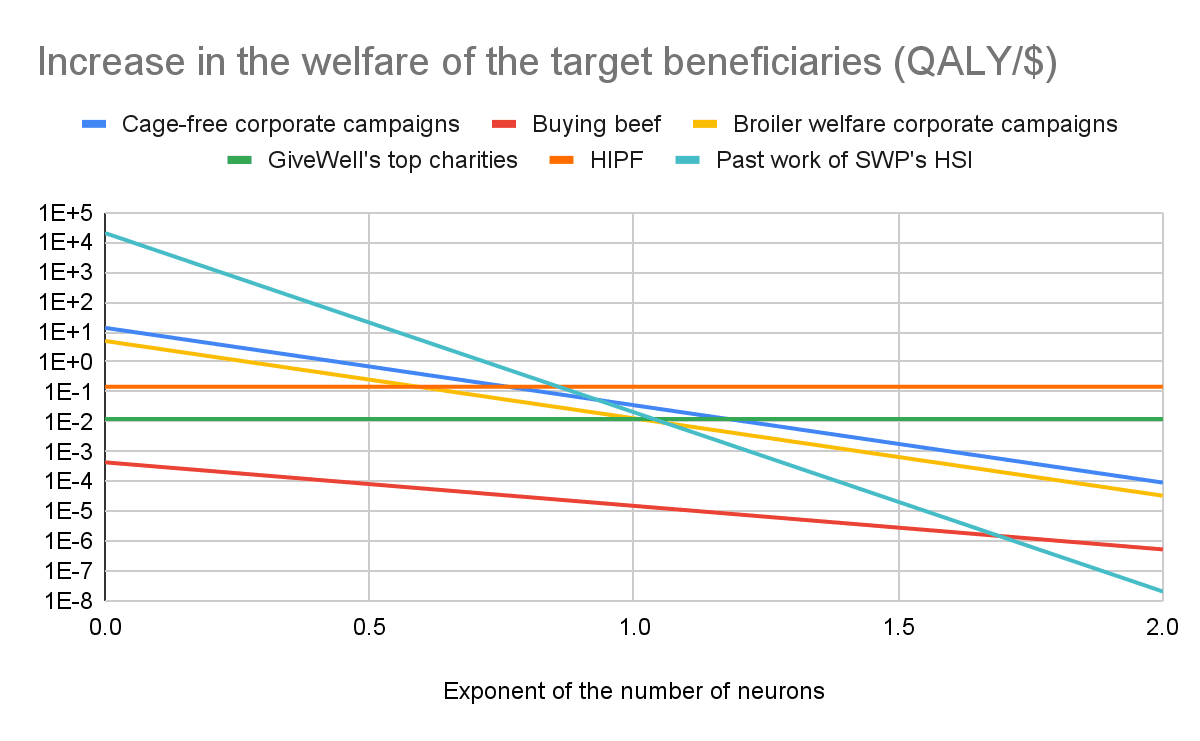
I believe you are underestimating the uncertainty involved in welfare comparisons across species. I would say animal welfare interventions may increase the welfare of their target beneficiaries much more or less cost-effectively than global health interventions. Here are my estimates assuming sentience-adjusted welfare ranges proportional to "individual number of neurons"^"exponent", and "exponent" from 0 to 2, which covers the best guesses than I consider reasonable. For an exponent of 2 (which means the sentience-adjusted welfare ranges decrease 2 % for a 1 % reduction in the individual number of neurons), I estimate GiveWell's top charities increase the welfare of humans 135 times as cost-effectively as cage-free egg corporate campaigns increase the welfare of chickens.
By growing EA, you mean growing longtermist EA? What makes a donation or career longtermist? If you think the longterm benefits of decreasing the risk of human extinction over the next few 10 years are much larger than its nearterm benefits, you should also think the longterm benefits of animal welfare and global health interventions are much larger than their nearterm benefits?
I think most efforts to grow EA grow both Longtermist and non-Longtermist elements of EA. I do agree though that the Longtermist effects of animal welfare are much bigger than near-term benefits.
If so, how do you compare the longterm benefits in a principled way? You estimated "each dollar [donated to longtermist interventions] increases the number of well-off future people in expectation by 10^26", and GiveWell's top charities save around 2*10^-4 lives per $ (= 1/(5*10^3)). However, I assume your best guess for the reduction in existential risks would not have to be less than 2*10^-30 (2*10^-4/10^26) times as high, i.e. less than 2*10^-32 pp (instead of your assumption of 0.01 pp), for you to prioritise global health over longtermist interventions.
Yeah, it's rough and there's not a perfect method. You just need to use your best judgment. Taking into account moral uncertainty + interchangeability of money, I wouldn't be that extreme, but I have some credence that something like that extreme of a tradeoff is right.
Are you aware of any quantitative model suggesting this?
Don't think we need one for those sorts of things, just like we don't need a quantitative model suggesting, say, the odds of Vance being the next president are around 30%.
GWWC estimated their giving multiplier in 2025 was 7. You linked to an analysis I did of their giving multiplier in 2023-2024. GWWC estimated this was 6, and I got values of 8 to 9.
Oops, dumb, will fix.
I think we've talked elsewhere about why I don't buy that soil nematodes etc make us totally clueless about which animal welfare interventions are good.
I think most efforts to grow EA grow both Longtermist and non-Longtermist elements of EA.
Would it make sense for you to distinguish between growing longtermist and non-longtermist elements of EA? You prioritise longtermist interventions over animal welfare and global health ones.
I do agree though that the Longtermist effects of animal welfare are much bigger than near-term benefits.
Likewise for global health interventions? If so, animal welfare and global health interventions are also longtermist in the sense their longterm benefits are much larger than their nearterm benefits? In this case, it would be better to avoid terms like "Longtermist political donations", "other Longtermist donations", and "Longtermist careers", which could refer to animal welfare and global health interventions? If I thought the longterm effects of the vast majority of interventions were much larger than their nearterm effects, I would simply refer to the areas of the interventions instead of highlighting they are longtermist.
Yeah, it's rough and there's not a perfect method.
You did not make any comparison of the longterm benefits of different areas? At this point, I am just looking for one comparison, not a perfect one. Why not defaulting to the basic intuition that the benefits over the next few decades are a good proxy for the total benefits, which suggests global health interventions are more cost-effective than ones aiming to decrease the risk of global catastrophes?
I wouldn't be that extreme [GiveWell's top charities being 2*10^-30 times as cost-effective as some longtermist interventions], but I have some credence that something like that extreme of a tradeoff is right.
I doubt GiveWell's top charities are 2*10^-30 times as cost-effective as some longtermist interventions.
Don't think we need one for those sorts of things, just like we don't need a quantitative model suggesting, say, the odds of Vance being the next president are around 30%.
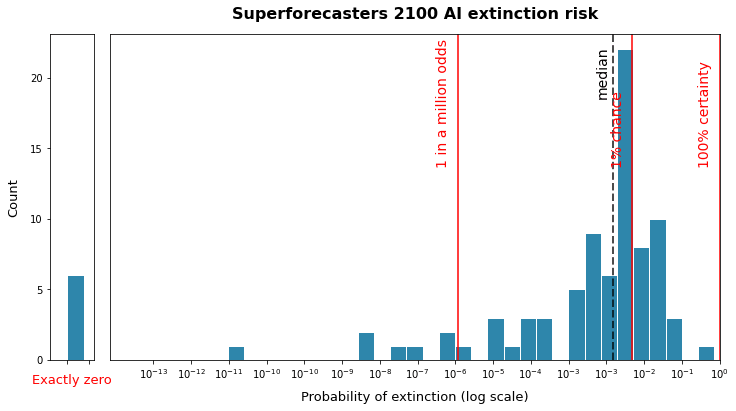
There is huge disagreement about the risk of extinction due to AI. Below are the predictions from superforecasters made in the Existential Risk Persuasion Tournament (XPT). There is nothing like that disagreement about the probability of Vance being the next president of the United States (US) assuming he is one of the 2 final candidates, which makes huge deviations from 50 % extremely unlikely.
I think we've talked elsewhere about why I don't buy that soil nematodes etc make us totally clueless about which animal welfare interventions are good.
The last point I made in my comment was not about this. I meant that global health interventions may be much more cost-effective than animal welfare interventions even neglecting effects on soil invertebrates (like nematodes).
To see this, let’s be generous and say the expected number of future well-off people added by preventing an existential catastrophe is only 10^40
I think your argumentation supports the 10^40 number more than the "well-off" claim. I'm not sure for the best canonical source expressing skepticism of the "well-off" bit, but The Future Might Not Be So Great contains a long list of arguments about whether future people will be well off; I would be interested in you responding to some of those.
Certainly non-zero, but less than I'd expect naively. I don't actually agree that it's that hard compared to other things that EAs try to make decisions about.
TL;DR
* GOAL 3 is a social enterprise that created IMPALA, a patient monitoring and digital platform system for low-resource settings. There is also a GOAL 3 foundation that raises funds to ensure underserved communities will be reached.
* A recently completed report from Rethink Priorities calculated IMPALA to have a cost per DALY averted of $7–17 in paediatr...
This month effective altruism has gotten lots of attention, including a cover story in The Economist. It feels pretty surreal to be on the receiving end of it. But I feel grateful these ideas have caught on, and even more grateful for the drive, earnestness, and compassion of so many people who took strange but well-argued ideas seriously and then actually acted on them....
Impressions from the 21st Annual U.S. Cluster Headache Patient Conference, organized by Clusterbusters.
On the morning of the last day of the conference, E. was hanging out with other “clusterheads” outside the conference hotel when he started having a cluster headache attack. Before he could go back to his hotel room, J. offered E. his DMT v...
Effective altruists advocate giving your money to where it does most good. The leading areas EAs recommend donating to are making the long-term future go better, animal welfare, global health, and growing the effective altruism movement. Yet there’s been surprisingly little comparison between these cause areas. Here, I’ll explain my ranking: why I think it’s best to donate to Longtermist organizations or organizations focused on growing EA. I’ll also explain why I think animal welfare is better to donate to than global health.
Comparing cause areas is important. I sometimes find there’s a weird tendency among EAs to throw out cost-effectiveness when analyzing different cause areas—to treat all causes as equal, and only look at effectiveness within a cause area. This is wrongheaded. If we care about doing the most good, then we should primarily give to the best cause area. The moral imperative towards cost-effectiveness doesn’t go away just because all the cause areas have a generic EA stamp of approval.
In general, I’ll assume you’re broadly on board with the basic assumptions behind each cause area. So, for instance, I won’t bother arguing for Longtermism or against the idea that animal torture isn’t a big deal because they don’t have a rational nature and can’t solve differential equations. That’s because this article is primarily about trying to evaluate what those convinced by the central EA ideas should do, rather than to convince people that these ideas are right. I will, however, link to places where I’ve defended the cause areas in more detail and provide brief summaries of the essential arguments.
TLDR: my ranking for donations: Longtermist political donations>growing EA>other Longtermist donations>animal welfare>global health.
My ranking for careers: Growing EA=Longtermist careers>animal welfare>global health.
1 Longtermism
1.1 The case for Longtermist interventions being best
The case for Longtermist organizations being best is pretty straightforward. The future could be huge. One back-of-the-envelope calculation guessed there could be around 10^58 future well-off people—and another calculation was 20 orders of magnitude greater (see here and here for additional reasons to think this is conservative). There are a number of ways we could screw up the future. Experts consistently think there’s a several percent chance that misaligned AI kills everyone. Despite this, there are only about 1,000 people working on it. Some other crucial cause areas, like preventing AI-enabled coups and improving AI character, have just a few people working on them.
If this is right, Longtermist activities surpass everything else in value. To see this, let’s be generous and say the expected number of future well-off people added by preventing an existential catastrophe is only 10^40—meaning odds are only 1/10^18 that anything like the Bostrom calculation is right. Now, let’s say that ten billion dollars would reduce existential risks by .01%. This strikes me as very conservative. Doing so is enough to hire 10,000 people, which would massively increase the number of people working on the biggest issues.
Note: this money likely wouldn’t directly go into hiring 10,000 extra people. Longtermism is mostly talent-constrained—there aren’t tons of projects that Longtermist organizations want to fund but can’t for lack of funds. But still, my guess is that across time, this is a conservative lower bound on the effectiveness of Longtermist donations (especially given that it’s likely that there will soon be projects that Longtermists can productively pour lots of money into). If you find these numbers too high, shave off a few zeroes however you see fit. Though remember that we already shaved off eighteen zeroes just for funzies, and that is surely enough to cover!
But even by these very conservative estimates, each dollar then lowers the odds of extinction by one in one hundred trillion. Thus, each dollar increases the number of well-off future people in expectation by 10^26. That’s more than all the people who have ever lived. And remember, overall these assumptions are outrageously conservative.
This might seem surprising. But when you take note of how big the future might be, even tiny effects on it might be enormously impactful. See here for my broader defense of Longtermism.
1.2 Longtermist jobs>>Longtermist donations
Thus, it seems pretty clear that Longtermist donations surpass everything else in expectation. Even with pretty aggressive fudging of the numbers, it easily outweighs other things. Getting Longtermist jobs is especially impactful, because talent is a much bigger constraint than money. See here for some especially impactful project ideas that an individual could work on, and check out the 80,000 Hours job board for high-impact Longtermist careers. 80,000 Hours also has more general career advising.
I want to emphasize: getting one of these jobs is much much much much more impactful than donating. Some very wealthy longtermists are already willing to fund nearly any sufficiently promising project. The greater need is therefore to identify and build additional high-impact projects, rather than merely to raise more money. Donations are still good, but they’re a lot less good.
1.3 Where Longtermists should donate
For Longtermist donations, some good places to donate are the EA Long-Term Future Fund, Longview, and Forethought (conflict of interest alert: I work for Forethought, and Forethought has gotten grants from Longview, but I write this all in my own personal capacity). The first two of these provide grants for impactful Longtermist projects. If you think Longtermism is right, then it’s probably a pretty good bet to give your money to smart people who spend their days thinking about how best to spend money longtermistly. Impactful political donations are likely many times more impactful than this (and harder for Anthropic donors to saturate). Note: this isn’t a particularly idiosyncratic view of mine; my sense is that most Longtermist grantmakers would agree with this.
If you are convinced that Longtermism is this important, then you really should try to make an impact in Longtermist areas. Demandingness concerns do not apply when we’re dealing with this kind of positive impact. If the impact in expectation that one person can have by working on Longtermist cause areas is equivalent to preventing more suffering than all the suffering so far in human history, then it’s obviously obligatory. Even if morality doesn’t always demand doing what’s best, it does when the stakes are this high.
The case for this being good is pretty straightforward. Many of the people doing the best work on the world’s biggest problems are EAs. EA is generally more talent constrained than money constrained, so getting productive people involved in the movement is valuable. And growing EA pretty straightforwardly dominates global health and animal welfare, because growing EA returns more money to global health and animal welfare. I don’t think it’s clear whether this is higher or lower impact than Longtermist donations. But it seems clear it beats global health, say, when each dollar given to GWWC returns many dollars to global health charities.
2.2 Comparing growing EA to direct Longtermist interventions
Two factors support growing EA over traditional Longtermist organizations:
Longtermism is more talent constrained than money constrained. In other words, there’s a bigger problem with a limited supply of talented people than a limited supply of funds. This supports converting money into talent by growing EA.
In my view, most future value is lost in worlds where we survive but fail to get a near-optimal future. If this is a bigger threat than specific catastrophes, then growing the influence of those motivated by doing what’s best is hugely important.
One factor that points in the opposite direction: we might be at an unusually important time given very rapid AI technological advancement. It may be that work in the next few years will be more important than work in the years after that. Thus, growing EA—which often takes years to pay off—won’t be worth it in time. On the other hand, we should have reasonable uncertainty about when AI will arrive, so there are still decent odds that superintelligent AI arrives after growing EA pays off.
Another advantage of promoting EA is that even if you’re wrong about what’s best, you still can contribute to whichever area is most important. So even if I’m wrong that Longtermism is right, I can still know that I’m preventing people and animals from suffering and dying. I suspect that this moves me more than it should.
My general guess, if I had to rank these things gun to my head, is that the ranking for donations would be something like:
Longtermist political donations>EA promotion>Other Longtermist donations.
And for careers, it’s too close to call, though I’d tentatively prioritize specifically Longtermist careers over EA promotion careers that don’t focus mostly on Longtermist stuff. Though things are close enough that the main things you should consider are personal aptitude and fit. While my guess is that pretty much any net-positive Longtermist job will beat the best global health job in expectation, the same isn’t true here.
3 Animal welfare and global health
3.1 The basic case for animal welfare
The basic case for animal welfare over global health is that it is ridiculously cheap to help animals. Charities helping chickens prevent about 10 years in a cage per dollar they raise. This pretty clearly dominates global health’s direct impacts on humans. It costs about 4,500 dollars to save one life. Let’s assume the saved person would have lived an extra 40 years.
Thus, for 4,500 dollars you can either add 14,600 days of human life or spare chickens from 45,000 years in cages. Even if we assume that the ten-year estimate is inflated by one order of magnitude, then it still comes out to sparing a chicken from a year in a cage or adding about three days of extra human life. Surely sparing the chicken from a year of nightmarish torture is better?
And note: many animal welfare charities are even better than this. Given the near total neglect of invertebrates and wild animals, donating to help them can be even more impactful. And when one takes into account the long-term effects that neglect of animals—farmed and especially wild—would have, this seems quite good from a Longtermist perspective. We might spread factory farming throughout the galaxy, and we’re even likelier to spread wild animal suffering.
3.2 Longtermism and growing effective altruism>animal welfare
Let’s first compare animal welfare donations to Longtermist donations. Animal welfare, I’d guess, is lower stakes than Longtermism. Nearly all expected future welfare will be experienced by digital beings. This is both because of the amazing possible efficiency of compute3 and the ease of converting large amounts of energy into well-off digital minds. Given how many digital minds there could be, this holds even if you have a low credence in the possibility of digital sentience.
Thus, if you’re interested in steering the long-term future, you should focus more on digital welfare than animal welfare. This favors Longtermist interventions over animal welfare interventions, because they have a much more direct route to benefitting digital minds.
The case for growing EA over animal welfare is similar.
Its indirect effects are greater. Getting hard-working people on board with animal welfare probably has better second-order effects than direct work on animal welfare. It leads to more people who are on board with reducing animal suffering, which is important for eventually abolishing factory farming and seriously mitigating wild animal suffering.
Growing EA also grows animal welfare—my guess is that each dollar spent growing EA returns multiple dollars to effective animal charities.
Growing EA has similar benefits to Longtermist donations—benefitting digital minds, in expectation, which likely swamps the benefits of animal welfare charities. Thus, if Longtermism beats animal welfare, probably growing EA does too.
3.3 Animal welfare>global health
Now let’s compare animal welfare to global health. The best argument for global health over animal charities is that global health charities lower wild animal populations. I’ll first explain this argument and then say why I don’t buy it.
There are strong reasons to think that animals in nature live bad lives. Most animals, especially the small and simple ones that are most numerous, have very short lives that end in a painful death. For this reason, I think it’s more likely than not that it is good for wild animal populations to be lowered. Humans lower wild animal populations to a staggering degree, especially populations of insects. Brian Tomasik estimated that the average person prevents about 14 million years of insect life per year they’re alive.
Similarly, Tomasik estimated that the Against Malaria Foundation prevents about 14,000 insect life-years per dollar. Let’s assume chickens are 10 times more conscious in expectation than the average insect. Let’s additionally assume that insects in nature on average live about 2 weeks. This means that each dollar given to the Against Malaria Foundation prevents about 392,000 insect deaths, which are mostly pretty painful. Adjusting for sentience, this ends up about as good as preventing around 39,200 painful chicken deaths. Let’s cut this by a factor of ten to adjust for uncertainty about the net effect of global health charities on insects.
Which is worse: ten years in a cage or 3,900 painful deaths? Well, that’s about one death per day. It’s not obvious how a day in a cage compares to a death from starvation or predation. So for this reason, I’m pretty uncertain about the direct comparisons.
However, the expected second-order effects of animal welfare donations are a lot more positive than those of GiveWell donations. Here is why: nearly all animals, in expectation, will live in the far future. More importantly, almost none of them will live on earth. There are about 10^21 stars in the reachable universe. Even if you think it’s pretty unlikely that we’ll settle many of those planets, one-in-a-million odds that we’ll settle 1% that many planets still means that we’ll settle 10^13 planets in expectation.
Compared to this, whatever long-term environmental effects GiveWell charities have on earth is an insignificant blip. If we’re concerned about benefitting animals, what matters most is ensuring that their lives are good outside of earth. It’s easy to see how changing legal standards for animals and shifting cultural attitudes might do that. It’s hard to see how GiveWell charities would do that.
I’ll write an article about this at some point, but just as nearly everyone who will live, in expectation, will reside in the far future, almost everyone in expectation will reside in distant star systems. The universe is big (source???). Thus, when trying to make the world better, just as we should care a lot about making sure that the vast distant temporal regions go well, we should also mostly focus on trying to make the vast distant spatial regions go well. That matters a lot more than what happens on earth. Thanks to Toby Ord for pointing this out. When you take this seriously, animal welfare impact-mogs global health.
4 Conclusion
Comparing cause areas is important and difficult. The thing I’m most sure of is that EA promotion and Longtermism beat global health and animal welfare. I’m also pretty sure that animal welfare beats global health in expectation. In any case, all the areas are hugely important, and people who give to one tend to give to others as well, so just generally giving EA charities more money is very good!


Just as some feedback, I don’t think the usual objection to working on longtermism or GCRs is ‘it’s not valuable enough’, even from a general audience. I think it would be more persuasive to explain somewhere why working on these causes would achieve anything at all. It’s not clear from your post that there would be a relationship between effort and rewards, and I suspect a lot of people share the intuition that any counterfactually valuable work on the very long term future would be washed out or easily reversible.
Surely having people work hard to reduce existential risks lowers existential risks relative to them not doing that in expectation. Especially when there are just a few people working on some of the biggest risks.
Why would that be the case? I could work from my hut in Uganda on trying to shoot down Russian drones over Ukraine and it would not achieve anything. Obviously that's a dumb strawmanb but just because people work on something doesn't mean they will achieve anything.
And apart from the modal return being probably ~0 (which might not be a problem if funding lots of useless stuff guarantees sufficiently useful projects get funded), it is also possible for longtermist work to be actively counterproductive, with significant uncertainty around the direction as well as the magnitude of the impact of many longtermist activities[1]
Indeed many longtermist arguments strongly imply that work of other longtermists is counterproductive (it is hard to see how Anthropic and Pause AI can both be right about frontier models)
And even you're certain you've picked the correct side of a particular risk-mitigation debate, political donations and campaigning are particularly prone to provoke responses from opponents. This is true of a lot of campaigning, but "AI is very dangerous" is more easily inadvertently motivating accelerationists to act to militarise it first than "this suffering could be stopped" is pivoted into an argument for more cages or fewer bednets
there are probably exceptions to this; it's difficult to imagine that an asteroid early warning system will hurt us, even if it turns out to be useless