My - purely anecdotal - sense is that GiveWell pays more than many of its social sector peers. I imagine for many employees, their compensation at GiveWell exceeds what they'd earn if they took the next-best available job (as judged by the employee), which is often also in the social sector. This would create some "job lock" where people will stay at GiveWell even if they think they can do more good elsewhere; that extra good is outweighed by their higher material well-being if they stay at GiveWell. 

I wish nonprofit salaries were uniformly higher, but since they aren't, when one org has higher salaries than its peers, that has both pros and cons, from the vantage point of social good. The pros include (1) attracting people into the social sector whose counterfactual job was not a socially-minded one (2) for the org, attracting talent away from other social sector orgs that it can use better than peers would. A con is the golden handcuffs, when the opposite of (2) holds: Some people forgo the chance to do something higher impact to stay at GiveWell. 

GiveWell isn't the only org in the social sector that seems to pay well relative to peers (the Gates Foundation and IRC also come to mind). So I don't mean to pick on GiveWell. Using them as the example is out of respect: GiveWell is the org that seems like it would have thought through this issue and would weight not just the pros and cons to the org, but also spillovers to other social sector orgs. Have they ever written about their (non-CEO) compensation philosophy? 

42

3
1

Reactions

3
1
Comments12
Sorted by Click to highlight new comments since:

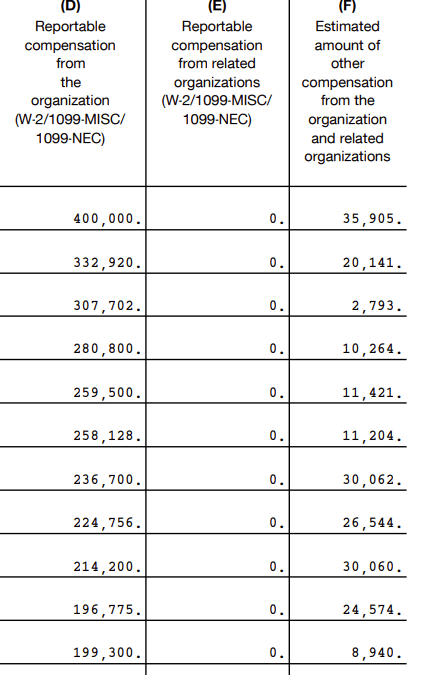
I'm mostly aligned with the Seema's view, though I think it's systematic of a wider problem in which funders pay more than their grantees almost universally. I've experienced at both IDinsight (where I was Chief Economist) and Rethink Priorities (where I'm on the board) a steady drumbeat of top talent going to funders, including GiveWell and Coefficient. I don't believe this happens because of any careful thinking on where talent is best allocated in the sector, but instead because (a) foundations just can pay more because they don't have a binding budget constraint and (b) even if they do have enough money (which they typically don't) nonprofits need to be careful about salaries because top salaries are public on 990 forms and donors will be scared away by large salaries.

When I've spoken with friends at funding orgs and brought up the issue of salary disparity, I've usually heard some version of attempting to align salaries with other foundations or the private sector. But that doesn't address this imbalance between foundations and NGOs/grantees in their space. 

After spending some side on both the donee side as well as the donor side (with Giving Green), my opinion is that giving away money is easier and more fun day-to-day than working for an org where you have to fundraise and/or serve demanding clients. Therefore I don't fundamentally think that donor orgs need to pay more to attract similar level of talent as NGOs. But trying to fix the coordination problem required to shift norms in the sector is likely impossible. 

Very useful observation that a lot of the high payers are funders and why they're able to do that in a way grantees can't. 

My most actionable suggestion is for GW and CG (and others, but again, I'm singling them out as a compliment) to gather and report descriptive statistics on past and future jobs and salaries of employees, plus maybe some employee surveys, to understand if the counterfactual job was a higher-paying job in the private sector or a lower-paying job in the social sector. [I realize there are permutations besides my either-or.]

I once saw on the Forum that someone had scraped the 990s from a bunch of EA and AI safety* orgs and put all the salaries in a spreadsheet, with names - it wouldn't be that hard to go from that to at least an estimate of what you're looking for, for the highest-paid employees. I can't find a link to the post anymore, and want to respect that they might have taken it down with good reason, but given it's public information, if some enterprising data-wrangling Forum-poster wants to dm me for it I'm not opposed to sharing the link...

*I do have a loose intuition that besides the grantmaker/grantee divide, the AI/not-AI divide within EA is driving some of the bizarre funding and salary dynamics

Thanks for the post. I think the golden handcuffs concern is worth flagging, but it's likely outweighed by the bigger problem: talented people who never enter the social sector because they can't afford the pay cut.

There's also a structural issue here. Nonprofits can underpay because they're extracting a "mission commitment subsidy" from employees. And this gets reinforced by funders/donors who often treat salaries as wasteful overhead rather than core inputs to doing good work. That creates perverse incentives where orgs compete to look "efficient" by under-investing in people.

Somewhat obvious note: These organizations can pay more because they're exceptionally well-funded. The real issue isn't that some orgs pay well, it's the unevenness. If compensation were uniformly reasonable across the sector, people could move based on impact and fit rather than financial need. 

That all said, publishing compensation philosophies would be broadly beneficial (and more fully in line with transparency). 

(FWIW, these points are also broadly true in the public sector.)

talented people who never enter the social sector because they can't afford the pay cut.


FWIW I don't like this framing. These people can almost certainly afford the pay cut, because probably if you get a job as a researcher/employee at some average US nonprofit, you are making above the US median and in the top few % globally. 

But yes, it's more likely to tempt people who would otherwise not work for a nonprofit.

Sure, I agree that "can't afford" is doing a lot of work there, and most people considering nonprofit roles are coming from positions of relative privilege (especially globally). I should have clarified that I'm benchmarking large nonprofits, large philanthropies, and for-profits versus other nonprofits. 

What I meant is more about opportunity costs and life constraints rather than subsistence: someone with student loans, family to support, or who's trying to afford living in/near a high-cost city might find the financial gap genuinely prohibitive, even if they're still well-off in absolute terms.  Also, smaller nonprofits typically offer minimal or nonexistent benefits: limited healthcare, no retirement matching, sparse parental leave, while also having high education requirements and geographic constraints (often expensive cities). 

We agree on wishing for higher salaries across the board, and the points I'm raising are about the unevenness. I just don't know if the higher salaries offered by some orgs are mainly attracting people from the private sector or from other orgs in the social sector. Ideally there'd be some data to speak to that (e.g., where people came from, where they left to, self-reports on other jobs they considered during their job search) too!

Hi Seema, thanks for this thoughtful post! I work as a grantmaker at Coefficient Giving (formerly Open Phil) and I’ve had similar thoughts in the past. Last year, CG began offering a modest severance package for staff who leave voluntarily to mitigate the golden handcuffs effect. Anecdotally, a number of colleagues have left for lower-paying jobs at other impactful nonprofits over the past year. It’s hard to say whether staff would pursue other opportunities more often if CG paid less, but it’s been reassuring to see that some staff feel comfortable leaving and the decision is celebrated by the org.

CG’s HR team also regularly conducts benchmarking exercises to sense-check that staff compensation is in line with other foundations and roles with similar levels of responsibility. Overall, CG (and I strongly suspect GW) spends considerably less on opex than peer foundations. Staff fly economy, bureaucracy is low, and people have the tools they need to work efficiently so the ratio of money moved per FTE is high.

A number of CG and GW staff members choose to donate some of their pay, and CG/GW may have this in mind when setting compensation. Personally, I’ve passed up pay or donated a little over half my income this year. Some staff use part of their pay for childcare, which helps them achieve their professional ambitions while maintaining work-life balance.

I share the concern that the ecosystem effects of drawing talent through high salaries may be under-appreciated. But when I zoom out, I directionally think that increasing compensation in the social impact space is valuable. For example, there has been a push to increase salaries in the animal advocacy field in recent years and my understanding is that this has increased professionalism and decreased workplace harassment - employers have a larger talent pool to draw from, and have an easier time replacing problematic employees. 

Of course, there are always tradeoffs, and I sometimes feel uncomfortable that orgs working to end poverty offer lavish compensation (even by US standards). But all things considered, I think there are fair reasons why an org like GiveWell would choose the compensation structure it does.


On an unrelated note, I help organize Princeton’s Effective Altruism student group. We and the School for Moral Ambition club would love to host you at an event to discuss your work when you’re back from sabbatical - it’s wonderful to have a fellow randomista on campus!
Thanks for your reply, Sam. I also directionally think higher salaries overall would be good. I read your second paragraph (Staff fly economy, etc) as reasons why CG might use the talent more productively than peers would; that employee produces stuff but w/o the other operating expenses that another org might have. That's the cleanest case where I see no major cons with the higher-than-peer salaries. 

But my anecdotes are two cases in recent months where NGOs were trying to recruit people who were really attracted to the role but the salary was considerably lower than their current salary (at GW in one case and Gates in another). The NGOs "couldn't" match because it wasn't just matching one person's salary; you wouldn't want the new hire to be paid more than their supervisor so you'd have to re-align a lot of people's salaries. The gap between that first choice candidate and other candidates wasn't large enough to justify that total cost. 

Anyway, I am quite open to the idea that, all things considered, the higher-than-peers salaries are the right thing to do. My hope was to prompt more explicit thinking about this, if it's not occurring, and, if it is, more sharing of that thinking, in the spirit of radical transparency.

Look forward to meeting you when I am back next fall and happy to participate in a club event. 

If donors thought the other thing was more valuable than GiveWell, they should donate there instead, and that other group could then pay higher salaries and attract the talent.

i think orgs are responsible for thinking about other factors besides just this. The positive and negative effects of high/low salaries are many and varied, I think "leave it to the strange NGO marketplace" doesn't tell the whole story.

I think this is generally true, but not sure that GiveWell is the best example of competition in social sector peers, since they seem mainly focused on hiring Western-based number crunchers who might otherwise be at a university or analysing financial data in the commercial sector, rather than poaching a small pool of educated staff from local NGOs or the best-networked, highest-performing grant fundraisers in the West.

Curated and popular this week
Relevant opportunities