I think I'm also surprised by the difference between 2 and 3. Unless this is driven primarily by the possibility of a month-long disease (which doesn't weaken the regime)? (Maybe also it takes a while to depose someone in some cases? So e.g. he might go on a couple-month-long "holiday" while they figure things out?)
I think I'm also surprised by the difference between 2 and 3
I view deposing as involving something internal, quick, and forceful. I think if Putin retires willingly / goes quietly (even if under duress), this would count as him leaving power without being deposed. Likewise, if he died but not because of assassination, that wouldn't count as being deposed.
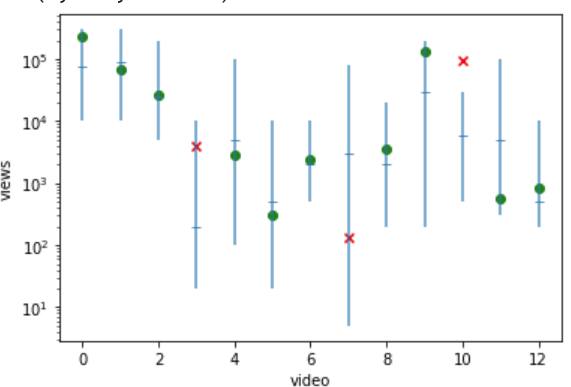
This is niche, but I've been wondering how well I can forecast the success my TikToks. Vertical blue lines are 80% CIs, horizontal blue line is median estimate, green dot is if the actual was within 10x of median, red x otherwise.
For the next year:
90% I have at least one video with 100k+ views
40% I have at least one video with 1M+ views
20% I make a serious effort to be popular again for at least a month
85% I have at least one video with 1M+ views conditional on me making a serious effort for at least a month
Thanks for sharing & good luck with the TikToks! I notice I'm curious about e.g. how likely 100M views on a video are, given 1M views (and similar questions).
Thanks! I previously found that my videos roughly fit a power-law distribution, and the one academic paper I could find on the subject also found that views were Zipf-distributed.
Since power law distributions are scale-invariant, I think it's relatively easy to answer your question: p(100M|1M)∝p(100|1) etc. In that original post I thought that my personal views roughly fit the model P(Views≥10k)=0.3k−2; I haven't looked at that recently though and expect the coefficients have changed.
I'll start off with a couple of predictions — all of these are very quick attempts (so not very resilient):
Vladimir Putin will be president of Russia — 85% (I made a quick base rate from taking a quick look at comparable regimes in this data, then also wanted to add the current chaos as an input & looked at this Metaculus question) (as mentioned above, I don't think this is resilient!)[1]
Will a cultured meat product be available in at least one US store or restaurant for less than $30? — 50%
WHO declares a new Global Health Emergency in 2023 —20% (extremely rough; had estimated (probably poorly) for pandemics, multiplied by a rough multiple, don't have time to do any checks)
In case anyone's interested, base rates seemed to give 0.94 chances of him remaining president for another year, 0.89 for another 2, 0.85 for three, 0.83 for four, and 0.81 for five. And here's the Metaculus question:
Great, thanks! Really appreciate this; I was really off — I think I had quickly taken my number/base rate for pandemics, and referenced a list of PHEICs I thought was for the 21st century without checking or noticing that this only starts in 2007. I might just go for this base rate, then.
Misha beat me to it RE: PHEIC base rates, but I'd also be interested in the 50% figure for cultured meat, given FDA approval last month for UPSIDE Foods (formally Memphis Meats). How much of the 50% figure is driven by pending USDA approval, VS time to market VS the $30 figure?
I was thinking very loosely about both, without doing any proper homework. I had the sense that USDA approval would take a while (for a sense of how loosely I approached this: I didn't remember which of FDA or USDA had already approved this), and was under the vague impression (from a conversation?) that this wouldn't go straight to stores or chains, but would instead go to fancy restaurants first (just now confirmed that the restaurant listed here is very high-end). But then again, I vaguely expected ~full-enough approval in 2023, and I felt like "available for $30" could happen in lots of ways (e.g. there's some "tasting" option that's tiny and therefore decently cheap), etc. So I went with 50% without thinking much longer about it.
I went and checked just now, however, and am seeing this article (Nov 16), which notes
Upside has previously said “end of 2022” as a launch date for its cultivated chicken. The company must still secure approvals from the United States Department of Agriculture (USDA) before it can actually sell to consumers. In a statement Upside promised more details on timing and launch to follow.
The link is to an article from April, and although companies might be over-optimistic and might over-promise, I guess that means that this timeline is vaguely feasible, which pushes me towards thinking that I should be more optimistic.
Also, I just checked Metaculus, and it appears that in April, ~forecasters thought that there's a roughly 19% chance that cultured meat might be available for sale in the US by the end of 2022 (community prediction was 37%), which seems wild, but again, makes me think that I was more pessimistic than necessary before:
"Oversee initial cell collection and the development and maintenance of qualified cell banks, including by issuing regulations or guidance and conducting inspections, as appropriate."
&
"Oversee proliferation and differentiation of cells through the time of harvest, including by issuing regulations or guidance and conducting inspections, as appropriate."
After that, it looks to me like there's another phase of regulatory steps that's centered more in the US Department of Agriculture.
The bear market in stocks will continue, and the S&P 500 will decline an additional 30-45%. VC-backed and unprofitable early stage companies will continue to remain at the center of the storm as access to capital further deteriorates. The crypto bear market also accelerates. Open Philanthropy has to cut its spending target again and GiveWell again falls short of its goals. The EA community realizes how linked it was to frothy financial asset valuations.
EAs appeal to Warren Buffett and Mark Zuckerberg to consider filling some of the gaps, and one or both of them commits to doing so.
2022 has almost wrapped up — do you have EA-relevant predictions you want to register for 2023? List some in this thread!
You’re encouraged to update them if others give you feedback, but we’ll save a copy of the thread on January 6, after which the predictions will be “registered.”
Will WHO declare a new Global Health Emergency in 2023? Yes. 60%
WHO declares a new Global Health Emergency in 2023 - 60% (I’m not very resilient on this — if I thought about it/did more research for another hour, I could see myself moving to 10-80%)
Once someone has registered a prediction, feel free to reply to their comment and register your own prediction for that statement or question.
You can also suggest topics for people to predict on, even if you yourself don’t want to register a prediction.
Other opportunities to forecast what will happen in 2023
Astral Codex Ten (ACX) is running a prediction contest, with 50 questions about the state of the world at the end of 2023 (you don’t have to predict on all the questions). There will be at least four $500 prizes. (Enter your predictions by 10 January or 1 February, depending on how you want to participate.)
I think the questions from the ACX tournament are a great place to start (here they are on Manifold). Here are some of them (each about whether these things will be the case by January 1, 2024):
Will Vladimir Putin be President of Russia?
Will a nuclear weapon be used in war (i.e. not a test or accident) and kill at least 10 people?
This resolves as positive if Open-AI publishes a paper or webpage implicitly declaring GPT-4 “released” or “complete”, showcasing some examples of what it can do, and offering some form of use in some reasonable timescale to some outside parties (researchers, corporate partners, people who want to play around with it, etc). A product is “GPT-4” if it is either named GPT-4, or is a clear successor to GPT-3 to a degree similar to how GPT-3 was a successor to GPT-2 (and not branded as a newer version of GPT-3, eg ChatGPT3).
A deepfake is defined as any sophisticated AI-generated image, video, or audio meant to mislead. For this question to resolve positively, it must actually harm someone, not just exist. Valid forms of harm include but are not limited to costing someone money, or making some specific name-able person genuinely upset (not just “for all we know, people could have seen this and been upset by it”). The harm must come directly from the victim believing the deepfake, so somebody seeing the deepfake and being upset because the existence of deepfakes makes them sad does not count.
This will resolve positively if a major news source reports that an AI entered a programming competition with at least two other good participants, and won the top prize. A good participant will be defined as someone who could be expected to perform above the level of an average big tech company employee; if there are at least twenty-five participants not specifically selected against being skilled, this will be considered true by default. The competition could be sponsored by the AI company as long as it meets the other criteria and is generally considered fair.
Edit: The match seems to now be over - the funds were expended in around 35 minutes. But many of these charities are great and should be supported regardless!
***
On October 22nd starting at 10:00am Pacific Time, Every.org is matching donations to select animal welfare organizations at a 2:1 rate, up to $2,000 per donor per nonprofit (so if you give up to $2,000, they will contribute up to $4,000 and the nonprofit will get up to $6,000). The first donation a donor makes to each el...
Crossposted to Less Wrong
‘Like most of life’s dangers, the dangers of artificial intelligence are not easily identified from the armchair.’
J Dmitri Gallow
Epistemic status
I’m not an expert in this field, and herein I make some sweeping generalisations educated guesses about the overall...



I've recorded a bunch of my predictions in a spreadsheet here.
This is really cool! Thank you for sharing. I was slightly surprised by how low these are:
And these are really interesting:
I view deposing as involving something internal, quick, and forceful. I think if Putin retires willingly / goes quietly (even if under duress), this would count as him leaving power without being deposed. Likewise, if he died but not because of assassination, that wouldn't count as being deposed.