
Effective givingEffective giving
Finding effective donation opportunities, discussing giving strategies, and coordinating with other donors
Posts tagged Effective giving
Quick takes
Effective giving is the branch of effective altruism focused on charitable donations.
The main purpose of effective giving is to support a charity or project that can achieve an especially large amount of good with that support. However, effective giving on a sufficient scale can also influence the charitable sector, giving charities an incentive to improve their own effectiveness.
There is a variety of questions related to effective giving.
For instance, how can one ensure that a donation has the largest possible direct impact? Should donors give to multiple organizations? This is common, but there are reasons to think that it may be more effective not to diversify donations in this way.
Donors can also think about when to give their money — in which cases is saving money and giving it later better? And all of this gets more complicated when multiple donors are involved; a person’s donations may impact the effectiveness of another person’s donations, raising the tricky question of how they should coordinate to collectively maximize their impact.
The indirect impact of donations can also be important to consider. For instance, giving publicly could encourage others to donate.
Thinking back to my first big (well, big for me) donation and an unusual series of thoughts I had. Sharing in case anyone has experienced the same.
--
I've practiced frugality to a significant extent, largely because I want to donate/salary sacrifice so much of my income to effective charities. As a result, whenever I'm spending a significant amount of money on anything, alarm bells go off.
I was surprised that alarm bells went off when donating. I had thought through where I donated extensively, and charity was the reason why I wanted to save money in the first place. But I still felt stressed because I was "spending money."
This is such a clear example of missing the forest for the trees. I think we need to be careful about instrumental values/rules and making sure they don't become absolute limitations that decrease overall impact.
Over 40% of my lifetime donations happened this month. I expect to never be able to make that statement again. These are weird times.
For context on why it is extra weird, I've been donating since 2015 and have always donated 10% of my salary each year (or more).
I understand you aren't really able to give individualized feedback. Though, as applicants, it would be really helpful to have some more clarity. I think you'd like to give more feedback, if you were able. In thinking about this, here's an idea I had.
You could create a score chart, where for every application you keep numerical or binary scores on the reasons it did well or not in the evaluation. Then you can release some statistics publicly.
You could for example be able to say things like:
(I picked more negative than positive slices in these examples, but the positive side is just as interesting.)
In fact, some of these statistics would be helpful for donors to <funder>. The scores should track some pretty different kinds of dimensions.
Would this be hard to do? I think there can be some pretty different levels of ambition here and some are pretty easy. Releasing just a few pieces of statistics for example might be possible to do based on your current tracking.
Potentially, you could even let people request access to some subset of these scores for their application specifically. Something like, the email used to send the application can send an email to request an automated response with the scores you'd be prepared to divulge.
Could this create more opportunities for gaming? Well yes, but assuming your criteria are actually good proxies for value, then you also achieve: (1) Better applications (so you get to grant valuable things you might filter otherwise), and (2) Better projects (people make their projects have better theories of change etc).
The lack of two-way communication in funding seems like a large missed opportunity to me!
Grantmakers, even when you don't grant, wield a lot of influence. You shape incentives in the ecosystem.
Earning to give is lonely and requires repeated decisions. This is bad.
If you're earning to give, you are lucky if you have one EtG team-mate. The people you talk to every day do not have moral intuitions similar to yours, and your actions seem weird to them.
If you do direct work, the psychological default every day is to wake up and do work. You are surrounded by people who think the work is important, and whose moral values at least rhyme with your own.
If you earn to give, most days you do not give (you're probably paid bi-weekly, and transaction costs discourage even donating that frequently).
These differences apply continual pressure for EtG folks to become less hard-core than we intended to be. I wish I had more counter-pressure.
[None of these observations are novel]
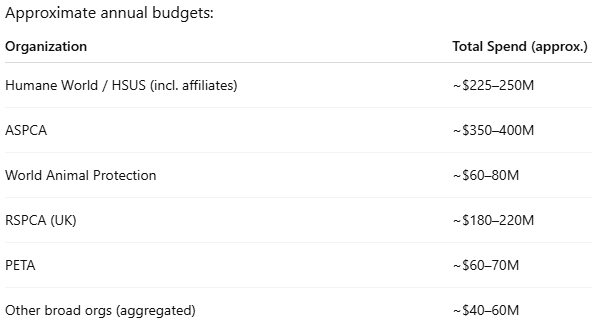
I’ve only recently come to appreciate how large the budgets are for the ASPCA, Humane World (formerly HSUS), and similar large, broad-based animal charities. At a quick (LLM) scan of their public filings, they appear to have a combined annual budget of ~$1Bn, most of which is focused on companion animals.
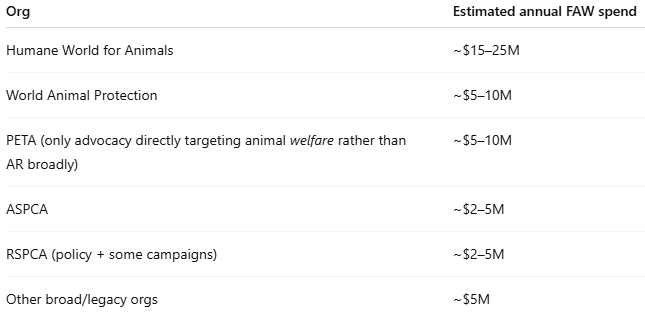
Interestingly, both the ASPCA and Humane World explicitly mention factory farming as one of their areas of concern. Yet, based on available data, it looks like <5% of spending in this category is directed toward factory-farmed animal welfare — despite factory farming accounting for the overwhelming majority of total animal suffering.
Given that factory farming is already in scope for these orgs, and that is responsible for the vast majority of animal suffering, it would seem quite reasonable for these orgs to increase their spending on FAW several-fold. I doubt their donors would object!
The GiveWell FAQ (quoted below) suggests that GiveWell focuses exclusively on human-directed interventions primarily for reasons of specialization—i.e., avoiding duplication of work already done by Coefficient Giving and others—rather than due to a principled objection to recommending animal-focused charities. If GiveWell is willing to recommend these organizations when asked, why not reduce the friction a bit?
A major part of GiveWell’s appeal has been its role as an “index fund for charities.” While ACE and similar groups offer something comparable for animal causes, GiveWell has a much larger donor base, and donors often prefer to consolidate their giving into a single recurring contribution. An optional Animal Welfare allocation could serve those donors better while remaining consistent with GiveWell’s stated reasoning.
Why doesn't GiveWell recommend organizations focused on animal suffering?
GiveWell has not prioritized research into organizations focused on animal suffering in part because there are two organizations we know well that are investigating this question: Open Philanthropy and Animal Charity Evaluators. We have limited research capacity, and would guess that we may come to similar conclusions as those groups about which groups to recommend, although we would likely have a different research process[...]We generally point interested individuals to these two organizations when they reach out to us for recommendations in this cause area.
It seems like a worthwhile project to ask/pressure Anthropic's founders to make their pledges legally binding.
Anthropic's founders have pledged to donate 80% of their wealth. Ozzie Gooen estimates that in a few years this could be worth >$40 billion.
As Ozzie writes, adherence to the Giving Pledge (the Gates one) is pretty low: only 36% of deceased original pledgers met the 50% commitment. It's hard to follow through on such commitments, even for (originally) highly morally motivated people.
Into Financial Independence and EA? Check out the Generosity, Legacy, & FI forum on the ChooseFI Forum.
I’m continuing to explore this theory of change: if we can give people financial literacy tools to build confidence and financial security, we can help create the conditions for more people to give back, and give more effectively.
A big part of that is creating a space where people who care about personal finance and doing good can find each other. If you’re interested in both FI and effective giving, I’m hoping this can become a place for you to connect, learn, and share ideas.
The founders of ChooseFI graciously agreed to create this forum at my request, and now I’m hoping we can get it off the ground.
Head here: https://app.choosefi.com/d/hi-everyone-welcome-to-generosity-legacy-fi