Comments
Summary: this is a post about animal welfare in space, specifically, the goal of preventing animal suffering from spreading to the stars, including risks from terraforming, directed panspermia, and animal farming spreading to space. I think this is a concerning scenario but that work on animal welfare in space directly is not likely to be impactful. Instead, I think we should focus on other areas that make the future better more broadly. Direct campaigns about animals in space are difficult to make progress on, may spread the idea of seeding life by arguing against it (attention hazards), and risk locking in present-day values, so I think they are likely to do less good than this broader work, and could do harm. Instead, we should focus on ending factory farming and addressing wild animal suffering before large scale space expansion, implementing space governance interventions that allow the rule of law to expand to space at all, and work to make the transition to a world with superintelligent AI go well.
Epistemic status: I'm overall quite confident about the argument in this post that the case against funding this area directly is stronger than the case for it. I know the subject of animals and space well. I have a degree in zoology and a masters in environmental geoscience. I also recently finished a PhD in astrobiology and I now work on space governance under transformative AI at Forethought. I spent a few years advocating for spreading life to the stars, and then a few years advocating against it. I've interacted a lot with the communities who want to spread biospheres to the stars, and the communities who want to prevent that.[1] However, I'm not a philosopher and I'm not a particular expert on cause prioritisation, so I'm expecting to miss some of the best methods for addressing the question of whether to fund work on animal welfare and space.
I'll first set out what I think is the strong argument for working on space animal welfare.
Animals on Earth suffer a lot, both in captivity and in the wild. Factory farming is the most horrendous atrocity that humanity has ever committed, and most suffering on Earth seems to occur in nature, where trillions of sentient beings live short lives where they die in excruciating pain.
If human civilization expands throughout the galaxy, we may bring our food system with us, possibly torturing trillions of animals across vast space and time. Even if the probability of us doing this is low, it would be so horrible if it occurred that we ought to take action to prevent it now. Additionally, other people are interested in seeding new biospheres on other planets, including on other star systems. This could replicate the wild animal suffering of Earth across billions of other habitable planets across the galaxy.
However, many people think the natural world is good and worth spreading.
There is a literature on "directed panspermia", the goal of seeding distant star systems with life to create new biospheres,[2] going back to the 1970s. Michael Mautner has argued that humans have a moral duty to spread life through the galaxy, which he calls “panbiotic ethics”. In 2016, the Genesis project was published which proposed sending light-sail probes to exoplanets that may stay habitable for only a few hundred million years, too short for complex life to evolve unaided, and seeding them with microbes to speed up the development of biospheres. There is also a large literature on terraforming, and influential authors on the subject, like Chris McKay, have argued on environmental-ethics grounds that we should restore Mars as a home for life, starting with microbes.
In January 2019, China’s Chang’e 4 lander carried a sealed “lunar micro-ecosystem” to the far side of the Moon with fruit fly eggs, yeast and seeds, and a cotton seed sprouted before the contents died when the lunar night set in. Three months later, the Israeli lander Beresheet crashed on the Moon carrying thousands of dehydrated tardigrades.[3] In October 2026, the Spring Institute for Forests on the Moon launched some shrimp to the International Space Station to test the viability of a self-sustaining ecosystem in space. These are small research payloads, though several of them are framed as first steps towards self-sustaining ecosystems off Earth.[4]
Additionally, decisions are currently being made about the diets of humans in space. China’s Yuegong-1 (“Lunar Palace 1”) ground experiment fed its crews mealworms farmed inside the sealed habitat during a 370-day run in 2017–2018, whereas Aleph Farms grew cultivated beef cells on the International Space Station in 2019. Whether settlements farm animals or rely on plants and cultivated meat is partly being shaped in research programmes like these, which is a much easier place to influence it than a future colony’s food system.
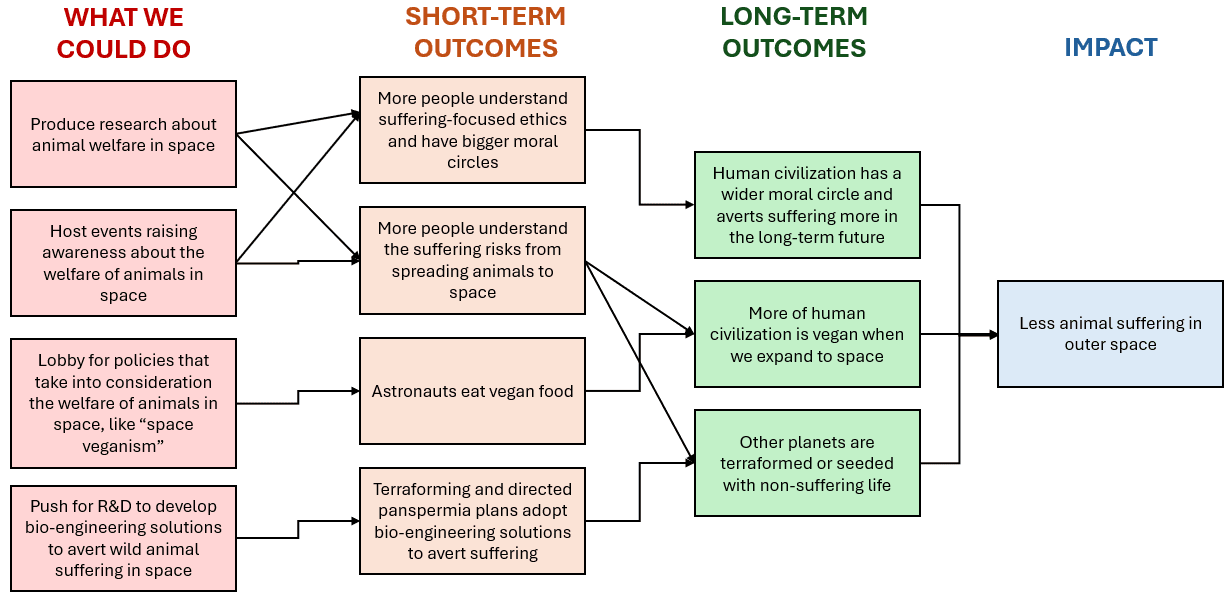
There do seem to be approaches that could result in less animal suffering in outer space in the long-term future. Here's a possible theory of change for working on animal welfare in space:
Interventions to reduce animal suffering in space may also help other sentient beings like digital minds, which is makes moral circle expansion a great longtermist strategy.[5]
Some allies already exist for parts of these issues, though none of them works on animal welfare in space as such. For example the Cosmic Footprint Society recently presented at a public hearing on space ethics held by UNESCO’s World Commission on the Ethics of Scientific Knowledge and Technology in September 2025, where they proposed a global register of what humanity does beyond Earth. And they published a call to address humanity's cosmic footprint in Nature Astronomy in July 2025, since endorsed by more than 150 people and organisations (as of the date of writing), asking states, scientists and companies to assess humanity’s impact beyond Earth. Among the large and possibly irreversible effects it lists is the spread of Earth life to other worlds, “inducing the creation of new biospheres”. They accept project proposals and have a global network of people interested in tracking humanity's cosmic footprint. Additionally, planetary protection exists so that scientists can search Mars, Europa and Enceladus for native life without finding organisms we brought from Earth, so the agencies and scientists who want to prevent forward contamination want some of the same rules as people who want to stop wild animal suffering being seeded on other worlds, even though they want them for different reasons.
Overall, the welfare of animals in space is plausibly very high stakes, some precedents are being set now, the interventions could possibly help more than just animals, and allies and organisations exist to help us avoid spreading animal suffering into space.
I think working on animal welfare in space is neither a top area for interventions within space governance nor a top area for interventions within animal welfare. My overall view is that efforts to promote animal welfare in space directly are likely to do less good than the alternatives, and could have an overall negative impact on the long-term future by drawing attention away from more pressing issues, making the idea of spreading animals to space more prominent, and promoting lock-in of present-day values by making normative claims about extrasolar governance. Rules that only delay irreversible acts and keep options open for later reflection seem better, but I don't think directed panspermia qualifies as irreversible (which I cover below). I think that, if you care about animal welfare in space, the cause is better served by indirect efforts that are more likely to lead to better decisions being made about the long-term future, including ending factory farming now, figuring out how to reach viatopia (a state of the world from which we are well placed to steer towards a very good future), making sure that the rule of law expands to space at all, and making the transition to a world with superintelligent AI go well.
Animal welfare in space is not a near-term concern. I think that animal welfare in space will matter on long timescales only. I expect space expansion in the Solar System to be driven by AI and robotics: once robots can run autonomously in space, they can mine resources and build more robots and solar panels to power more mining. This robot-driven space industry could grow exponentially, requiring fewer exports from Earth as it matures. So, I expect that farming animals or seeding biospheres will be a tiny fraction of all activity in the Solar System over the next few decades. As a result, I don't think focusing on animal welfare in space is well justified on neartermist grounds (especially when compared to the extent of factory farming and wild animal suffering already on Earth, it seems unlikely that space habitats in the Solar System could exceed that on a timescale of decades, if ever). I expect that most people are discussing animal welfare in space in the context of longtermism anyway.[6]
Directed panspermia is reversible. The threshold of irreversible space expansion is very important. Before that threshold, it would be great if we'd have conducted a Long Reflection and set out on a trajectory to reach near-best futures. I don't think directed panspermia (seeding distant star systems with life) easily qualifies as crossing that threshold. If multiple rockets are sent on missions to distant star systems to seed them with life, then I think later missions could overtake them, or arrive later, and reverse any activities that would lead to large scale suffering before a biosphere emerged over millions or billions of years.[7] So, I don't think working on animal welfare in space can be justified based on current proposals to send interstellar missions, and I think that long-term outcomes for animals will mostly depend on much higher stakes decisions about extrasolar governance, like whether or not we agree on a baseline constitution and build the infrastructure to enforce it.
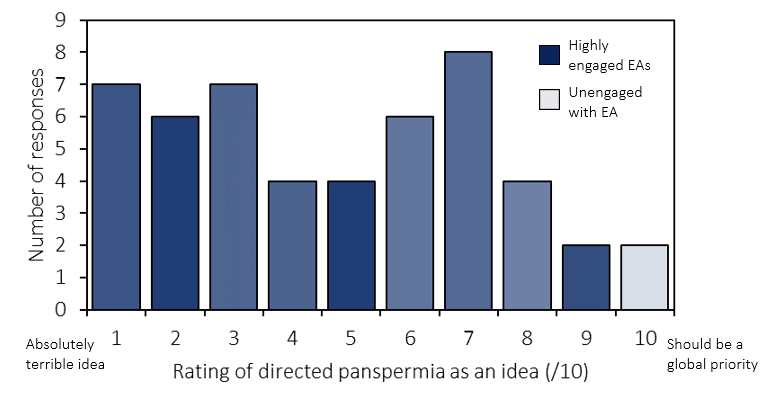
Campaigns against animals in space are hard to win and may spread the idea. It would be hard for a launch company to make any decision about animal or digital-mind welfare, and if advocates push them to make such a decision, I expect the likeliest outcome is the decision advocates do not want. Putting new regulations into effect in space is hard already, even on topics that aren't based on niche moral views like caring about animal welfare (or the long-term future). Extending planetary protection under Article IX of the Outer Space Treaty is an easier route, but it still lacks enforcement power, and COSPAR's policy on planetary protection is mainly treated as a guideline. It only takes one wealthy person to put organisms on the Moon or Mars, so a campaign may not be able to prevent it. Talking about spreading life could make it more likely. Many people like the idea when they hear it: spreading nature to the stars can bring back people's faith in humanity and their hope for the future. Directed panspermia has even been championed on the EA forum twice before, here and here.[8] EAs, too, can be drawn to the idea of seeding the universe with life. I asked effective altruists in London (via a WhatsApp group) to fill out a very simple survey on their opinions of directed panspermia about 2 years ago. They were asked how engaged with EA they were (/10) and then they rated the idea of directed panspermia (/10):[9]
I'm not sure how much people's views have updated since then, but the survey suggests that directed panspermia is not an unpopular idea. I was surprised that the graph was not clearly skewed towards the negative end. I've also had many conversations with people who want to spread biospheres to space, and my overall impression is that pushing against spreading nature to the stars sounds like a weird view to many people, and changing minds on this topic is not easy. I know the appeal of the idea. When I was a zoology student (and big environmentalist), I pivoted to astrobiology based on a desire to spread nature to the stars. EAs changed my mind on that goal, but I don't know of anyone else who changed their mind in that way. Overall, the likelihood that pushing against directed panspermia makes more people adopt it as a mission updates me towards working on this indirectly instead of directly, e.g. advocating for moral circle expansion more broadly instead of advocating against bringing animals to space or seeding new worlds with life.
Lock-in, and ambivalence about extrasolar governance. I'm not sure that it's useful to work on particular issues that could come up in the long-term future, like wild animal suffering spreading to the stars. When it comes to extrasolar governance, I think the vast majority of the impact is in trying to get some sort of deep reflection about what our goals should be, and then to decide based on that reflection. This would be hard to achieve, but it could capture wild animal suffering and put us in the best position to tackle a range of other issues, like being fundamentally wrong about moral philosophy, astronomical existential risks, acausal trade, the welfare of digital minds, handling our interactions with aliens well, and a whole range of other challenges we might not yet be aware of. So, I think the right approach is to be extremely uncertain about extrasolar governance, and we should favour interventions that keep the options open by not imposing any rules or norms on the long-term future yet. Beyond that, instead of advocating for goals or bans for specific extrasolar activities, I'd recommend working on the projects that Forethought has described to make the transition to a world with superintelligent AI go well and help us reach better futures, like automated macrostrategy, AI for improving collective epistemics, and AI tools for coordination.
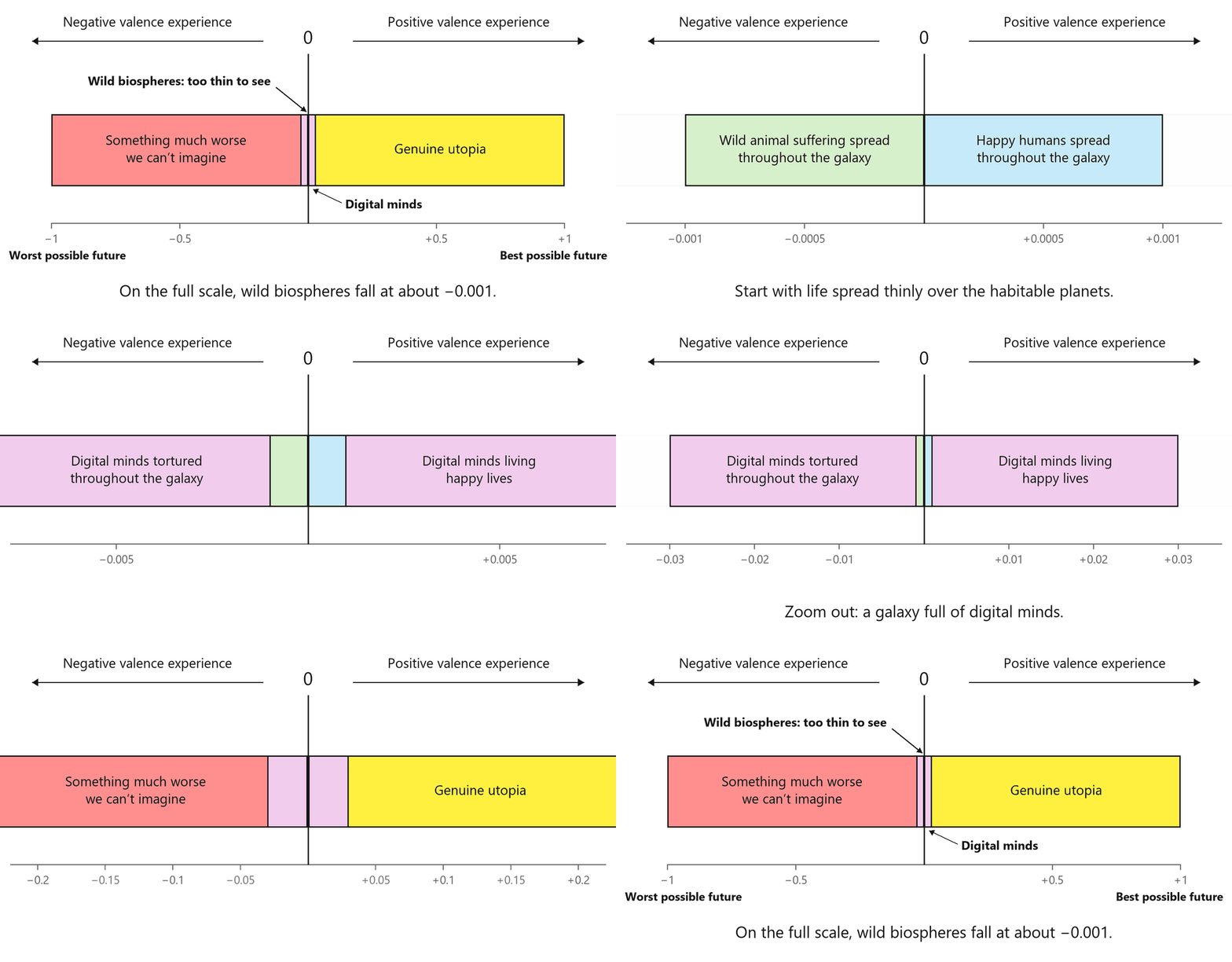
Addressing animal welfare in space could be a small piece of the pie overall. Working towards a deep reflection about humanity's goals for the long-term future could address the suffering of wild animals, as well as many other suffering risks we might not be aware of, and may enable us to reach near-best futures too. To get a sense of what I mean, here's an illustrative gif showing how small a share of what matters wild animal suffering in space could be (obviously these are totally made up numbers).
Animal welfare in space is downstream of present-day animal welfare goals. Ending factory farming and addressing wild animal suffering now, while we're all still on Earth, seems hugely important. Transformative AI could make space expansion come a lot sooner than expected, so I'd treat the start of large-scale space expansion as a deadline for changing society's views around animal welfare. If space expansion starts before that work is done, the agents who expand would plausibly take factory farming and our indifference to wild animal suffering with them, and they could be much harder to reverse than they are today. For those most concerned about animal welfare in space, I'd put the effort into the countries and companies most likely to lead space expansion, which on present trends means the US and China, into interventions that change diets and attitudes to wild animals quickly.
Animal welfare in space is not a top space governance intervention either. Currently, I think the main research areas I want to work on in space governance are these (described in terms of how they help to reduce s-risk; this list changes often):
The case for working on animal welfare in space is that the stakes are plausibly very high, decisions about space diets and seeding life are being made now, the work could help other sentient beings such as digital minds. Also, allies such as the Cosmic Footprint Society and the planetary protection community exist already. However, I think the case against working on it directly is stronger because:
Ideally I would have sent this post to a few people before publishing it, but I wanted to post it in time for Funding Strategy Week on the EA Forum.
The term comes from Francis Crick and Leslie Orgel, “Directed panspermia”, Icarus 19 (1973): 341–346, which proposed that life on Earth could have been seeded on purpose by another civilisation and noted that we could soon do the same. The first paper on actually seeding other star systems seems to be Michael Mautner and Gregory Matloff, “Directed panspermia: a technical and ethical evaluation of seeding nearby solar systems”, Journal of the British Interplanetary Society 32 (1979): 419–423, followed by Mautner’s book Seeding the Universe with Life (2000). The older, undirected idea of panspermia goes back to Lord Kelvin in 1871 and Svante Arrhenius in 1903.
The tardigrades very probably did not survive: impact experiments by Alejandra Traspas and Mark Burchell, 'Tardigrade survival limits in high-speed impacts: implications for panspermia and collection of samples from plumes emitted by ice worlds', Astrobiology (2021), suggest the crash would have killed them.
Other examples: in June 2021, NASA sent ~5,000 tardigrades and 128 baby bobtail squid to the International Space Station on SpaceX CRS-22, and in April 2024 China flew four zebrafish and some hornwort to its Tiangong space station on Shenzhou 18 to run a small closed aquatic ecosystem.
Jacy Reese Anthis and Eze Paez, 'Moral circle expansion: A promising strategy to impact the far future', Futures 130 (2021).
For earlier work on suffering risks from space colonisation, and on broad against narrow ways of reducing them, see Brian Tomasik, 'Risks of Astronomical Future Suffering' (2011), and Tobias Baumann, Avoiding the Worst: How to Prevent a Moral Catastrophe (2022).
The main exception to that is if we seed distant worlds with life and then go extinct. In that case, either aliens then take over those worlds, or they could grow into new civilizations themselves. I think that's probably a good thing, as they could have another shot at reaching near-best futures, and a biosphere will probably emerge and turn into a civilization on a very tiny portion of the overall lifetime of the universe (especially if multiple planets were seeded, as it is more likely that one of them would turn into a civilization).
It has been challenged in depth from a wild animal welfarist point of view here. A kurzgesagt video advocated for spreading ecosystems to other planets, and it was heavily criticised on the EA Forum.
This is based on 50 responses from people in the EA London WhatsApp group. The darker the bar, the more engaged the respondents were with EA.