Are you looking for a project where you could substantially improve
indoor air quality, with benefits both to general health and reducing
pandemic risk?
I've written
a bunch
about
air
purifiers
over the past few years, and its frustrating how bad commercial
market is.
The most glaring problem is the widespread use of HEPA filters. These
are very effective filters that, unavoidably, offer significant
resistance to air flow. HEPA is a great option for filtering air in
single pass, such as with an outdoor air intake or a biosafety
cabinet, but it's the wrong set of tradeoffs for cleaning the air
that's already in the room. Air passing through a HEPA filter removes
99.97% of particles, but then it's mixed back in with the rest of the
room air. If you can instead remove 99% of particles from 2% more
air, or 90% from 15% more air, you're delivering more clean air. We
should compare in-room purifiers on their Clean Air
Delivery Rate (CADR), not whether the filters are HEPA.
Next is noise. Let's say you do know that CADR is what counts, and
you go looking at purifiers. You've decided you need 250 CFM, and you
get something that says it can do that. Except once it's set up in
the room it's too noisy and you end up running it on low, getting just
75 CFM. Everywhere I go I see purifiers that are either set too low
to achieve much or are just switched off. High CADR with low noise is
critical.
Then consider filter replacement. There's a competitive market for
standardized filters, where most HVAC systems use one of a small
number of filter sizes. Air purifiers, though, just about always use
their own custom filters. Some of this is the mistaken insistence on
HEPA filters, but I suspect there's also a "cheap razors, expensive
blades" component where manufacturers make their real money on
consumables.
Then there's placement. Manufacturers put the buttons on the top
and send air upwards, because they're designing them to sit on the
floor. But a purifier on the floor takes up valuable space, is
farther from where we inhale, and is at more risk of damage. Purifiers
should be designed to use the space above our heads: on top of
bookcases or shelves; mounted to walls or ceilings.
Finally, there's very little innovation. The top purifier on the
Wirecutter is the Coway Airmega
AP-1512HH, which has been their top pick since they first reviewed
purifiers in
2017. It's not a bad purifier (I have several and they do what
they're supposed to) but it's not close what's possible when
maximizing CADR while minimizing noise and cost.
When I first got really into air purifiers three years ago, just
before I decided to focus
on a different aspect of pathogen control, I proposed a simple
design:
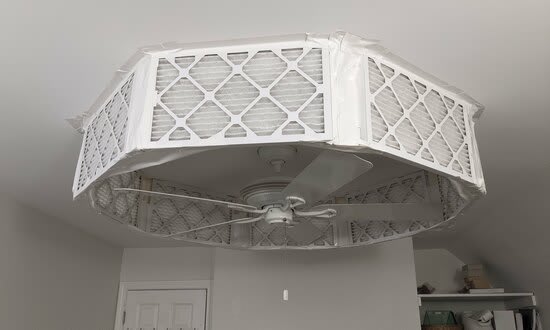
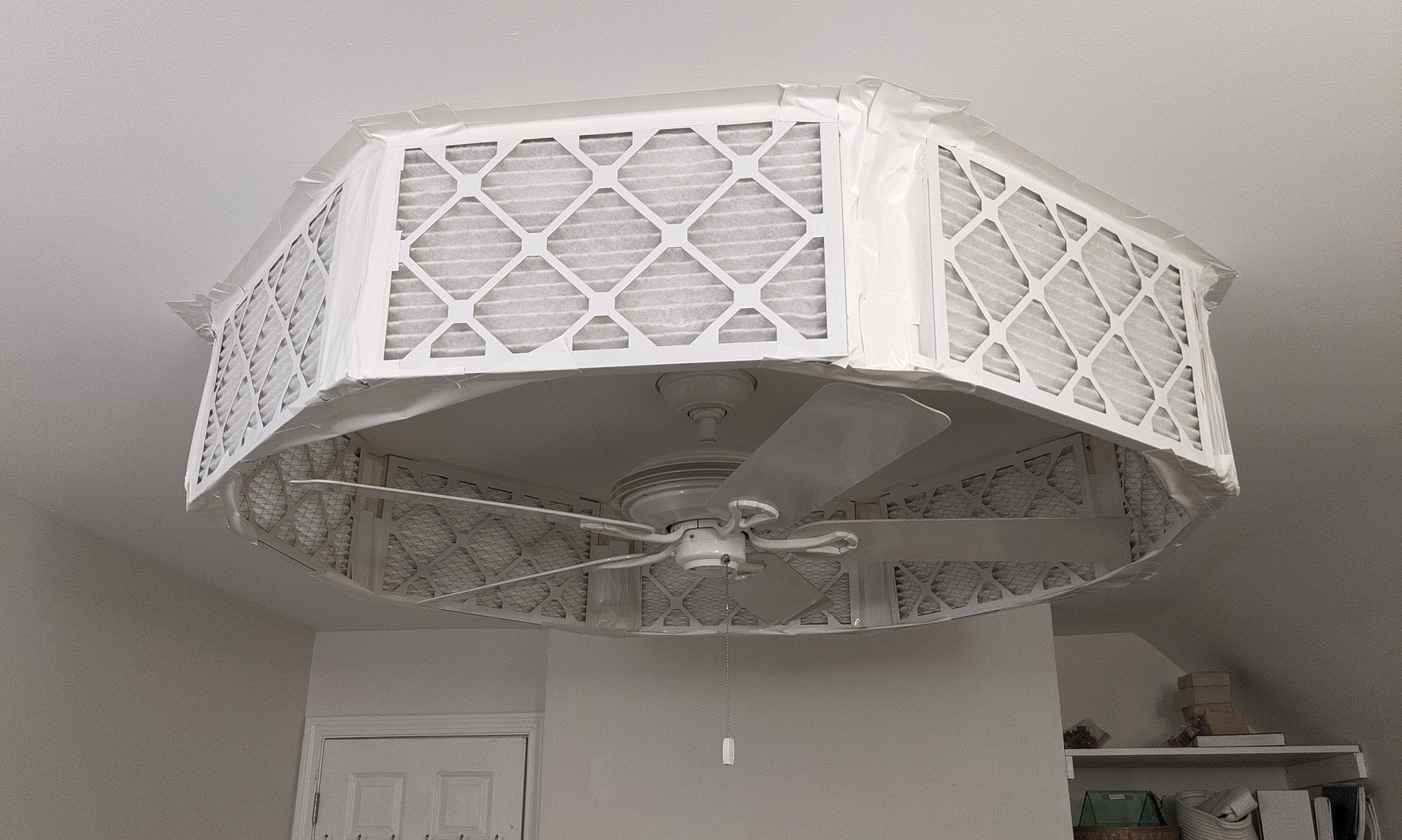
This is a regular ceiling fan, with a ring of HVAC filters around
it. The fan draws air through the filters, which capture particles
through a mixture of impaction, interception, and diffusion. It
cleans a lot of air with low noise, stays out of then way, and is
built from standard parts that have healthy highly competitive
markets. As far as I can tell, this design is still much better for
many applications than anything on the market, and for bigger spaces
purifiers built around a high-volume
low-speed fan (ex)
would be even better.
Making a nice version of this would look like two components.
A frame the attaches around an existing 52" fan to hold
standard HVAC filters. You'd go through the drywall and attach to the
joists, so you'd need to handle uneven joist spacing. The frame needs
to get a good seal to the ceiling and around the filters to minimize
leakage, the filters need be easily removed and replaced, and the
whole assembly should be pretty. The frame can come in several
user-assembled pieces each just a bit bigger than a filter, which
allows it to be flat-packed.
A mesh cover to go around the outside of the frame, to make it
look nicer since standard HVAC filters are not designed for
aesthetics. It would also act as a pre-filter, and you could take it
down to wash or vacuum, extending the life of the HVAC filters.
I really don't exactly need another project right now, but it's been
three years since I first proposed this and the competition has barely
improved. Anyone want to take this on? This would look like
designing the frame, testing and validation, manufacturing, and
marketing. I'd be very happy for someone else to commercialize this
idea; it being out there is all the payment I'd be looking for.
Comment via: facebook



Like you, I'm also somewhat surprised there hasn't been more innovation here. I'm also disappointed by the current market for HEPA filters, and the widespread perception of HEPA supremacy. To some extent, part of the reason why we see low innovation may be connected to the problem of low HVAC competence, which I've written about previously
In my view there's a point somewhere around a corsi box and possibly before where we're probably better off embracing the HVAC trade and all of the tools and materials this encompasses. This probably means replacing tape with tin snips, and cardboard with sheet metal. These tools and materials exist for the express purpose of reducing time and expense, while delivering effective, aesthetically pleasing results. This should be done in a way that advances diy projects, but opens up an entirely new world of fans, ducts and filters of myriad stock sizes, each as separate components that can be placed together in a variety of configurations and installed virtually anywhere in a building.
As an example, vevor has a 6", 400 cfm fan for ~$50. This is compact enough to be installed near the ceiling of a closet, which would greatly reduce motor noise in drawing air from/supplying to the adjacent room. Adding a sidewall filter grill and filter will run another $115, and we'd probably need some ductwork and a supply register. But at this point we probably have a permanent, quiet, discreet system for delivering >350 cfm cadr for <$250 in materials.
Just woke up to what you mention about optimization in HVAC installation, here in Sweden they mount ductwork components with something akin to TDC/TDF - it is literally easier than Lego! It is so fast I was blown away working with it. And no special tools required. Awesome podcast you did btw on Pigeon Hour!
Very similar to systems in the US! My sense is that many people have an ugh field wrt embracing basic trade knowledge, which is a significant impediment to even intermediate level projects. Glad you enjoyed the podcast!
A pair of CR boxes can also get 350 CFM CADR at the same noise level for less materials cost than either this or the ceiling fan, and also have much less installation cost. E.g. two of this CleanAirKits model on half speed would probably cost <$250 if it were mass-produced. This is the setup in my group house living room and it works great! DIY CR boxes can get to $250/350 CFM right now.
The key is having enough filter area to make the static pressure and thus power and noise minimal-- the scaling works out such that every doubling of filter area at a given CADR decreases noise by 4.5 dB, assuming noise is proportional to power and pressure goes as (face velocity)^1.5, which are common rules of thumb. I'd guess that the pair of CR boxes has 5x more filter area, so an 11dB advantage for the closet sound isolation to make up. MERV filters also get slightly higher efficiency when the face velocity is slower.
I have used inline fans for other purposes and even the air passing through a 6" duct generates some noise and adds static pressure. With a CR box you're doing the minimal work necessary to filter air.
Standard HVAC parts do have many advantages though. The aesthetics are unmatched and all parts are likely to be available, and they're very durable.
Are you limiting your noise estimates to strictly airflow/static pressure? The research I'm aware of suggests Corsi boxes perform at >40db and up to 60db on high speed (~350 cfm). https://housefresh.com/corsi-rosenthal-box-review . During the pandemic this was widely discussed as a major impediment to their adoption.
Upsizing terminations substantially reduces room-facing air velocity. Assuming 400 cfm, the velocity at the termination I link will be roughly 175 fpm. This is extremely low, and I'd expect to achieve 20-25 db. Most residential return registers are undersized and thus outside ACCA's duct design standard of 500 fpm. It's also less than standards widely used for quiet spaces (200-300 fpm). You could continue pursuing improvements here via upsizing further if you're so inclined, or using clever placement to put the filtration system away from the room activities or behind (offset) cabinetry or furnishings.
That's a box fan CR box; the better design (and the one linked) uses PC fans which are better optimized for noise. I don't have much first-hand experience with this, but physics suggests that noise from the fan will be proportional to power usage, which is pressure * airflow, if efficiency is constant, and this is roughly consistent with various tests I've found online.
Both further upsizing and better sound isolation would be great. What's the best way to reduce duct noise in practice? Is an 8" flexible duct quieter than a 6" rigid duct or will most of the noise improvement come from oversizing the termination, removing tight bends or installing some kind of silencer device? I might suggest this to a relative.
Ah, sorry, the CR reference threw me off. That link seems to suggest those are in the 40 db range.
Duct design uses equivalent length as a metric across duct types and fittings with 1 foot of straight metal pipe as a '1'. The problem with flex is that each foot has an equivalent length of 1.5, which adds a moderate amount to system length (although to keep this in perspective many near air handler transitions are >100'). For something like this I'd probably do a short run of flex near the motor (both sides) to dampen motor/vibration noise and transition to metal beyond. Avoid cornering with flex! In general, remote fans, eliminating line of sight on the motor and oversizing ducts/terminations will be shockingly quiet to most room occupants. If you want to get super clever, you can start doing offset openings in walls by cutting grilles high on one side and low on the other, but it can be difficult to pull sufficient air while keeping velocity low (400 cfm = 6 stud bays).
You can get down to 25 dB by running two at half speed. Fan noise is proportional to RPM^5, so 50% speed will mean -15dB noise. The fans just need enough static pressure to maintain close to 50% airflow at 50% speed.
Do you have tested numbers? Going from high to low on 4 filter CR boxes shows a reduction in airflow in the range of 30%-40% and db reduction around ~13%.
(edited to fix numbers, I forgot 2 boxes means +3dB)
dB is logarithmic so a proportional reduction in sound energy will mean subtracting an absolute number of dB, not a percentage reduction in dB.
HouseFresh tested the AirFanta 3Pro https://housefresh.com/airfanta-3pro-review/ at different voltage levels and found:
So basically you subtract 13 dB when halving the CADR. I now realize that if you have two boxes, the sound energy will double (+3dB) and so you'll actually only get -10 dB from running two at half speed. So a more accurate statement for the Airfanta would be that for -15dB noise at the same CADR, you need something like 2.8 purifiers running at 36% speed. It's still definitely possible to markedly lower noise by adding more filter area.
Your box fan CR box data tell a similar story. If logarithmic scaling is accurate, the sound reduction for halving CADR would be ln(1/2)/ln(165/239)*(8 dB) = 15 dB, or 12 dB for maintaining CADR with double the units. It just doesn't have a speed low enough to get these low noise levels (and due to the box fan's low static pressure you might need to add more filters per fan at low speeds).
Airfanta's absolute noise levels are high for a CR box type design but this is a device that retails for 298 CNY = $41 USD in China, runs at high speed, and uses near-HEPA (95%) rather than MERV filters so is to be expected.
Bummer. Operating at 25 db would have been really impressive for a room filter but it looks like it's not even close. Extrapolating from David Elfstrom's airflow estimates it looks like ~1/2 cfm would put it >40 db, which isn't great. So if we want to create a satisfactory occupant experience we probably shouldn't put down the tin snips just yet.
A filter with PC fans isn't a "CR box" -- a Corsi-Rosenthal box is specifically a design based on box fans. For example, Wikipedia, US Davis, Clean Air Crew, and the Corsi-Rosenthal Foundation mention only box fans.
Usage varies-- the top five posts on /r/crboxes all use PC fans. Other guides do too, and CleanAirKits and Nukit both describe themselves as PC fan CR boxes.
Interesting! I hadn't realized people had started using the term this way!