Comments
Really interesting topic, thanks for sharing James! I was wondering whether you could share any info about your lit review methods (e.g., how you found your included articles)?
Really interesting topic, thanks for sharing James! I was wondering whether you could share any info about your lit review methods (e.g., how you found your included articles)?
Thanks Emily, much appreciated! I also really enjoyed your recent work on interventions that influence animal product consumption so thanks for doing that.
For methodology, that's a good point and definitely something we should include more information on so will do that for an updated version in the near future. Not sure if you saw it but we do have a database of resources we compiled whilst doing this if you want to see the inputs.
On how we actually found the included pieces, this was a mix of methods, and we didn't do it in a systematic way akin to your work, although we might consider doing this in the future (suggestions welcome if you think is a good idea!). As we were mainly doing this for our own understanding and getting a lay of the land, we didn't think it was too crucial to do a systematic analysis (and our advisors also suggested this). But a few of the ways we did find papers:
Quite roughly, I'll outline some of the criteria we used:
Really impressive work! I think the idea that protest movements could be very high-impact is pretty convincing. It's a lot of ground to cover to try and find more concrete answers to how much impact movements have and how this can be maximised but I think this report makes good progress towards that.
More generally, great to see in-depth research on plausibly impactful topics that we've not looked at much as a community.
Social Change Lab is a new EA research project that is conducting research into whether protest could be a cost-effective way to achieve positive social change. We’re initially focusing on climate change and animal advocacy, and trying to understand whether protest should play a larger, or smaller, role in accelerating progress in these cause areas. Whilst more speculative, we’re also considering if protest can play a role for other issues, such as pandemic prevention, immigration reform, and existential risks.
We put out some preliminary research in November last year, looking at the role that Extinction Rebellion UK played in making climate change more salient in the UK, and giving an overview of a small amount of the literature on the efficacy of protest. At the moment, we’ve just finished two literature reviews: one on the impact of protests and Social Movement Organisations (SMOs), and one on factors that affect success rates for protests. We are grateful to have received funding from the EA Infrastructure Fund to cover our expenses until July 2022.
Whilst EA has the goal of doing as much good as possible, it’s not clear what the best ways to do this yet are. In a survey of 40 EA community leaders, people were most excited about greater “EA exploration” i.e. greater research into possible causes, interventions and ideas that could allow us to do more good. In particular, surveyed community leaders were interested in bringing in ideas from outside of traditional EA discourse. Similarly, as noted by Charity Entrepreneurship, there is lots of opportunity for organisations that engage in Exploratory Altruism, and we intend to explore the possibility that protest could be more cost-effective than other EA-recommended routes to change.
Generally, as a community, we’ve been pretty research-focused in trying to understand the best ways to improve the world. However, much of this work hasn’t touched on how social movements interact with the world, and how they affect social change. [1] We see this as an opportunity to add value by providing research that addresses some unanswered questions about the role of social movements in improving the world.
Specifically, we think this work can be valuable to two audiences in particular:
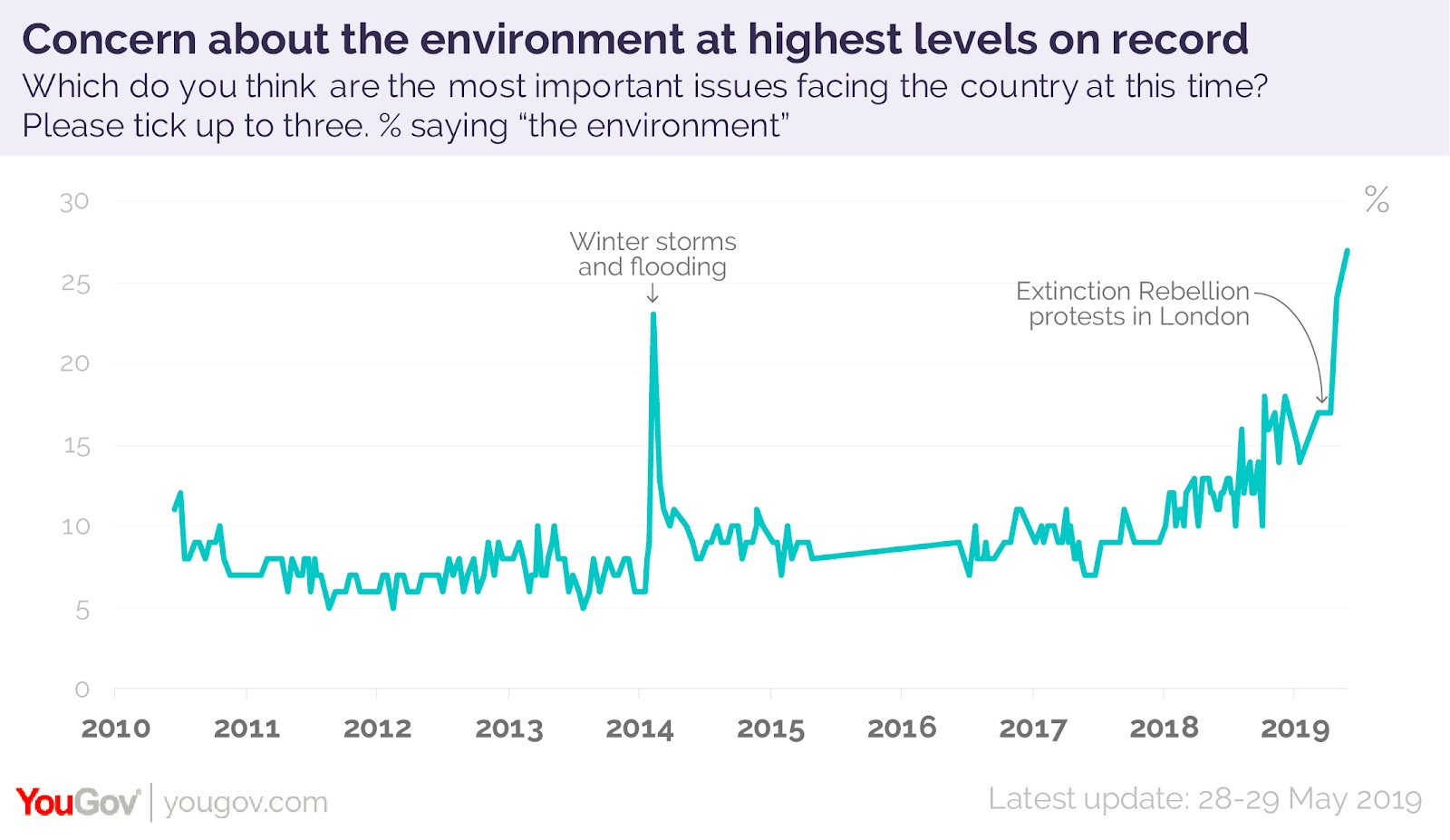
We believe that there is moderate evidence that protest can have an impact on public opinion, voting behaviour, public discourse, legislator behaviour, and corporate behaviour. Our interest in protest began by examining the impact of Extinction Rebellion, whose protest activity coincided with an increase in concern around climate change in the UK - as can be seen in the figure above. The concern about climate change in Europe and the United States has been increasing rapidly, and we believe that it is plausible that this increase has been at least partially due to protest activity by Extinction Rebellion, Fridays for Future, and Insulate Britain. That being said, it is clearly not the case that the increased salience of climate change is sufficient evidence to demonstrate that there is a causal connection between protest activity and concern about climate change. We think that if the claimed impacts of protests are accurate, that they can significantly alter public opinion or affect policymaker’s beliefs, then there is a strong case that EA should be considering this type of advocacy amongst others, such as direct policy advocacy.
Our Progress So Far
Some preliminary research we conducted last year suggested that Extinction Rebellion may have abated 16 tons of GHGs per pound spent on advocacy, making it 12x more effective than the Clean Air Task Force (CATF), the top EA recommended climate change charity. Whilst this is far from conclusive, with plenty of valid critiques raised of this research, we think it’s enough evidence to look into this topic with greater detail.
Currently, we are finishing off several initial projects, whose results can be seen below, namely: a literature review on protest outcomes, a literature review on factors that are likely to make protests successful in achieving their aims and a series of interviews with grantmakers to understand their current beliefs and uncertainties around protest. For our literature reviews we are focusing on academic papers that use quasi-experimental techniques and experiments, as well as looking at papers that examine observational data while also having rigorous causal identification strategies.
Literature Review on protest outcomes
We have found research that leads us to believe it is likely that there is a causal impact of non-violent protest in positively affecting public opinion, voting behaviour, media coverage and policy. The summary of our literature review that highlights some of these points is as below, where you can see the full literature review here. A database of relevant research papers we’ve included in this research can be seen here. It’s important to note that this is the first draft of our literature reviews, pre-feedback from relevant experts, so it’s likely they’ll be refined and improved going forward. Feedback and comments are very much welcome, on this post or via email.
Summary Table
| Finding | Confidence |
|---|---|
| Protest can have significant short-term impacts | Strong |
| Protest can be effective in North America and Western Europe | Strong |
| Protest can have significant impacts on voting behaviour and electoral outcomes | Medium |
| Protest can influence public opinion | Medium |
| Protes can influence public discourse and media narratives | Medium |
| Protest can influence policy | Low (mixed evidence) |
| Protest can influence policymaker beliefs | Low (little evidence) |
| Protest can be effective in the Global South | Low (little evidence) |
| Protest can have significant long-term impacts (on public opinion and public discourse) | Low (little evidence) |
Note: Confidence ratings are based on the number of available studies supporting the claim. Low = 0-2 studies supporting, or mixed evidence; Medium = 3-6 studies supporting; High = 7+ studies supporting.
This initial review of the literature suggests to us that it is highly plausible that protest is an effective strategy in some cases, and that it is worth exploring the possibility that protest is more cost-effective than current EA recommendations. Again, we encourage interested folks to read the full literature review on protest outcomes here.
Literature Review on protest movement success factors
You can see our full literature review on protest movement success factors here.
Grantmaker Interviews
We interviewed grantmakers from 8 different grantmaking institutions within the EA community (e.g. EA Funds, Open Philanthropy, Founders Pledge, etc.), working across animal welfare, climate change and building the EA movement. In addition, we interviewed one partially EA-aligned animal welfare grantmaker, and one climate grantmaker who funds a significant proportion of existing climate protest, but these results are not included in the tables below. These interviews ranged from 30-60 minutes, with the purpose to ascertain the existing uncertainties and beliefs grantmakers had around protest as an intervention.
The results can be seen in the tables below. We asked many more questions, but the most relevant and important questions can be seen below. Generally, we were trying to understand the prior beliefs of grantmakers, so asked fairly open-ended questions. We intended to release more full summaries of our interviews closer to the final publication of our report, in several months.
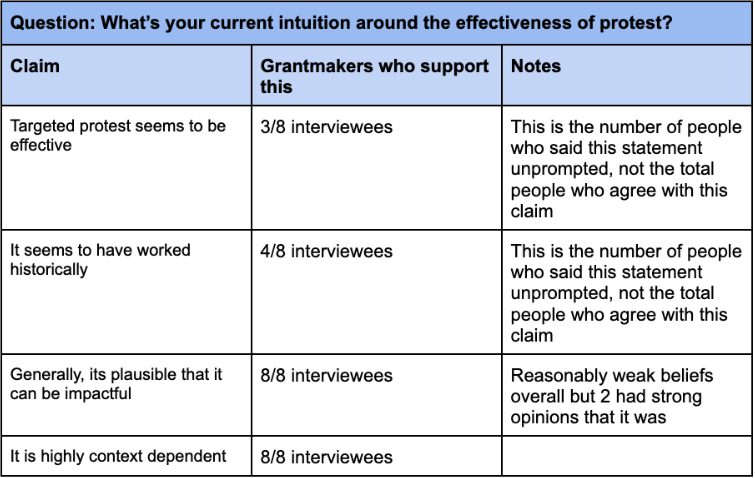
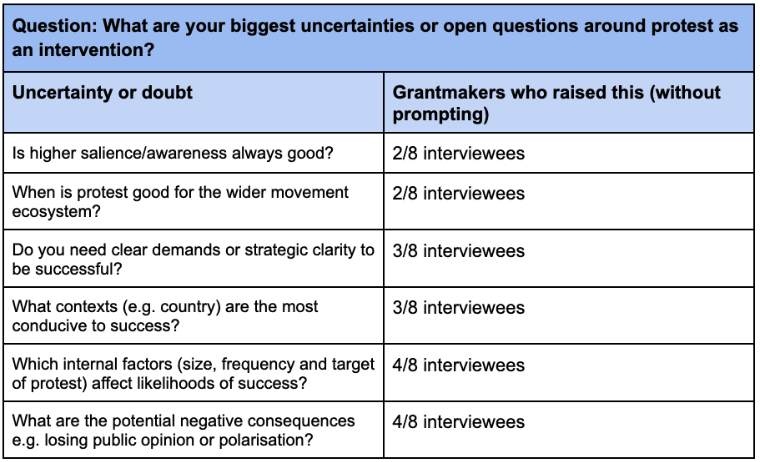
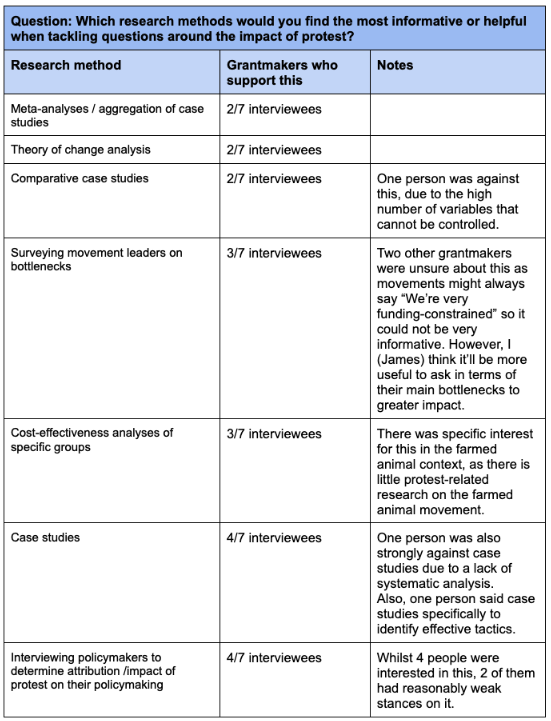
Other research methods we asked about included natural experiments (1 person for), public opinion polling (2 people for), Twitter research (2 against). As you might be able to see from our table above, there was a fair bit of disagreement amongst grantmakers on what kinds of research they would find the most useful. This doesn’t make our life easy when trying to prioritise our future research methods sadly! There were some patterns we noticed e.g. animal-focused grantmakers preferred case studies over grantmakers from other cause areas, due to a lack of focus on animal advocacy in the existing protest literature.
Informal EA Survey
We also conducted a small informal EA community survey (with 49 respondents) who ranked on a 1-5 Likert Scale how compelling they found the above research methods. This was done mainly out of interest and informed our decision-making to a very small degree, but the results can be seen below for reference. Interestingly, the EA community (that we sampled) and grantmakers we interviewed had somewhat different priorities, with policymakers interviews being the exception that both groups were excited about. However, we wouldn’t put too much weight on this survey as we did end up adding more research methods after this survey was conducted, based on further conversations.

Next Steps
We have several ideas for research over the next few months, based on interviews with grantmakers and other researchers, and on the responses we got to our survey of members of the EA Community.
Key Questions we’ve identified for further research
After talking to grantmakers and hearing from other EAs, some concerns and questions have been raised repeatedly that we are keen to think about:
Challenges
There are several reasons why we might not be successful in our aims to answer some of these thorny and complicated questions around the impact of protest on social change:
James Ozden has spent the last three years working within social movements to tackle climate change and reduce animal suffering, as the Director of Animal Rebellion. In addition, he worked on strategy for one of the most well-known social movement organisations in recent history, Extinction Rebellion. More recently, James completed the Charity Entrepreneurship Incubation Program on how to launch highly impactful nonprofits using EA principles.
Sam Glover recently graduated from a Master’s degree in Democracy and Comparative Politics at UCL - his Master’s thesis involved using machine learning on Twitter data to establish how legislators react to Eurosceptic pressure in their constituency, and helped familiarise him with advanced quantitative methods. Sam recently joined Social Change Lab as a Research Manager, where he helps carry out our research and literature reviews on the effects of protest and social movements.
Feedback
It would be hugely beneficial for us to receive feedback from the members of the EA Community. While we have already put out a survey to try and get a better understanding of what kind of research EAs would find beneficial (which you can fill out here), it would also be really helpful to hear specific and detailed feedback from EAs who have views on research around the efficacy of protest. If you’re interested in giving feedback on our literature reviews, surveys or other work, please contact us using our emails below!
Similarly, if you are someone with an understanding of how effective protest has been for a specific cause area, we would be keen to talk to you. This could be for the two main cause areas we’re focusing on, animal advocacy and climate change, or other areas that we haven’t yet explored.
Funding
We are currently operating on a grant from the EA Infrastructure Fund which will last until June 2022. We have been talking to grantmakers and advocates to get a better understanding of how we can benefit the EA community, and will be conducting some greater impact evaluation of our work towards the end of our project. If we and others believe our work is impactful and useful, we will be seeking funding to continue our operations past June. If our work is not as helpful as we hoped, we don’t plan on continuing.
Website: https://www.socialchangelab.org
LinkedIn: https://www.linkedin.com/company/social-change-lab/
Contact James: [email protected]
Contact Sam: [email protected]
There are obvious exceptions, with a good compilation of social movement work done by EAs here.
By moderate evidence, we generally mean 3-6 studies supporting a claim. By strong evidence, we mean 7 or more studies supporting a claim. This is somewhat arbitrary, and our lines could be drawn in different places.


Hi James, thanks for this and I feel like this research is super-helpful. As you know, we at Giving Green have also explored the question of protest (as a form of what we call "outsider legislative advocacy"), and are also generally bullish on these techniques. But also, (as you mention), I think only a small minority of protest movements are really successful. We've had a lot of trouble identifying organizations we want to recommend in the context of climate policy in the US.
We're looking forward to applying your findings as our search continues!
Hi Dan - thanks for this! Definitely agree in that protest movements can be hits-based and most don't do much but the best ones can be hugely influential. That's definitely one of the hardest questions to resolve e.g. how do we predict which movements will fall into the latter bucket a priori, hence our work on identifying factors of successful movements. We're planning on doing some more work on this in the next few months so will keep you posted and definitely hope it's helpful to Giving Green!