Comments
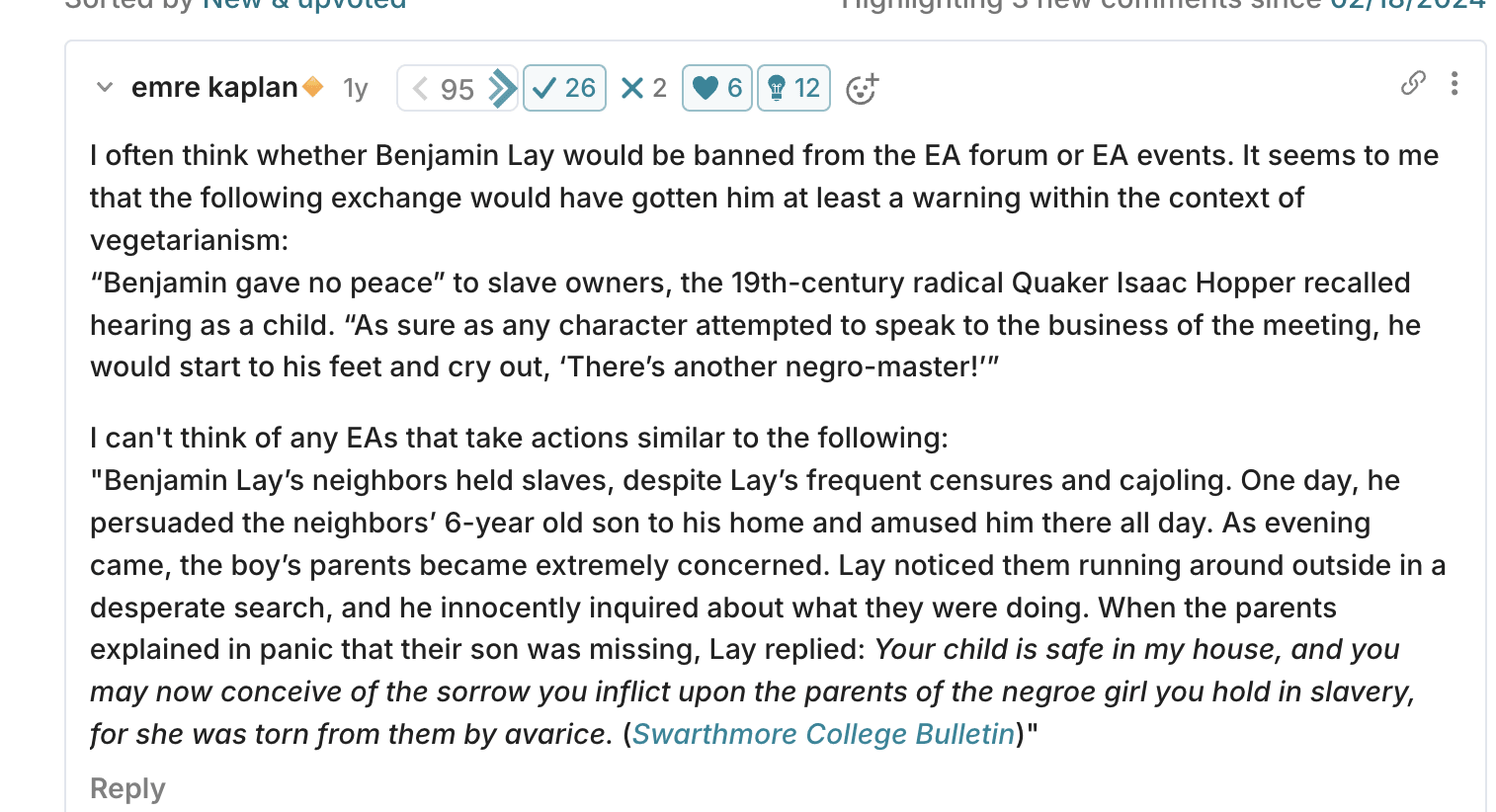
This kinda reminds me of a post that asked if EAs would have been as in favour as the abolition of slavery as a particular extremely hard-line anti-slavery activist at the time who we morally laud today as a moral exemplar, but who everyone at the time thought was a shocking PETA-type extremist. (Found the post)
The comment posed by @emre kaplan🔸 there I think is very illuminating.
Scott Alexander somewhere on the forum wrote a comment I mostly agree with (where he was giving caution to a pro - Pause AI post, cant find) that most, or at least a significant amount that we cannot discount, amount of social change comes as a consequence of people that want change working from within the system and gaining high status from within the system to be able to affect change - because the people who have the power to then make change like these high status people and want their respect.
This all just leads me to the fairly obvious conclusion that like with AI Safety and Slavery Abolition, EAs - hypothetically placed at any place in history - are most likely to be found working within a system gaining enough status to slowly and reliably tweak the status quo in a positive direction.
There is no contradiction between being opposed to Prohibition but in favour of finding a reliable way to get people to drink less alcohol.

Instead of a binary, you can also ask what policies would they have supported. Perhaps they would have supported a policy that preserved individual choice while creating substantial friction between users and drinking as well as limited the profit incentive get people to drink more.
It's worth noting that the most lethal drugs are the legal ones (measured by total fatalities). Take tobacco for example. It's been around for millennia, however we did not get the modern tobacco epidemic—which killed 100 million in the 21st century—until A) mass manufacturing of cigarettes, B) heavy engineering of cigarettes to be hyper palatable and addictive, and C) modern mass marketing. This is why I'm partial to the tobacco endgame proposals that focus on removing the profit incentive to get people to consume addictive and/or harmful substances. Consumption in society can be managed to a point of acceptable trade-offs by friction and nudges once you remove the asymmetry of multinational conglomerates spending billions of dollars to get adults (and yes, youth too—the majority of smokers start when they are minors) to consume tobacco and alcohol whilst effectively lobbying for much weaker regulations than recommended by the public health community.