Comments
I don’t know how you get around this, but the framing of ‘lives saved’ feels a bit off, if you’re not going to count ‘deaths caused’. There are some people on there who have caused a lot of harm in the past through their direct actions.
I don’t know how you get around this, but the framing of ‘lives saved’ feels a bit off, if you’re not going to count ‘deaths caused’. There are some people on there who have caused a lot of harm in the past through their direct actions.
I do count 'deaths caused' via donations (the AI capabilities cause area has a negative cost per life saved), but the root of the issue is that I look only at impact via donations and not overall impact via everything a person does. I eventually want to include those things too, but it seemed like too much work for the first version.
I do have a rule which keeps SBF off the list, that I exclude money donated if it was the proceeds of a crime. In that case there's a pretty clear line that can be drawn.
Do you have a suggestion for a simple policy you'd want me to adopt to deal with general harmful non-donation actions?
I have thought about this a lot and have my own (work in progress site) (dm me if you want to see it).
My issue is that I think for this to get widespread adoption, it needs to be seen as canonical, and yet most peopel don't really agree on the core assumptions of any kind of ranking. Like forbes can do a rich list because we roughly agree on money. But it seems too many steps to teach people both the ranking and the assumptions at once.
But maybe that's just me.
What did peoople think of it? Does anyone expect to check it more than once a quarter?
I really don't think things need to be seen as "canonical" to get widespread attention or adoption. I think you're right though that its unlikely to be seen as a permanent/long term ranking that people refer to periodically. I can more see this kind of thing going vival or getting traction from time to timeif done in the right way.
Cool project! I haven't dug into into the methodology, but one interesting (and very rough) implication: if the total set of donations ($393B) had had an average of $10,000/life saved (roughly half as good as Givewell, assuming you can't get $5,000/life-saved due to diminishing marginal returns), then they would have saved ~39M lives. The actual total of lives saved according to this is ~30M.
So (assuming the methodology checks out and this calc is roughly right) getting these top philanthropists to be more cost-effective could have saved nine million lives.
If these 9 million lives were saved were over a 30 year time span (rough guess, some donations are older than this, but I think most are much more recent), that's around 300,000 lives saved per year. Which is about equivalent to curing leukaemia.
I'm on the antepenultimate rank with 404 lives saved! I'll try to beat Edythe Broad when I have a real income again! Thanks, Elliot! Awesome work! :-D
Cool project!
I think instead of popularising the site itself, it's better as a source for journalists or social media to create viral moments.
Two headlines that come to mind are:
"You only need to donate X amount to beat billionaire philanthropists at saving lives"
Or something like
"Why do some rich people make such bad (philanthropic) investments?"
hey maybe also include deaths caused by elon musk, and it would be interesting to have a short describtion of how these people did (e.g. where they donated) when you hover over their profile
The list is an interesting concept, and maybe it can inspire billionaires to donate more. The visuals are good and it is clear.
However, I fear that as a tool it will have limited spread by design. There are the assumptions, of course (though I personally think including animals is great).
But it's mostly the fact that many people have in mind the terrible harms caused by several of the people on the list (shutting down USAid, developing social networks that favour addictions, making money from tobacco, investing in factory farms).
I don't know what criteria to use to deal with that, but I think entire segments of the population will be very skeptical of the project because they know that billionaire X did bad stuff and still appears the list as a life saver.
For me, your best shot at using this website is not at getting widespread adoption (which is always super hard), but by getting rich people to see that they are ranked lower than the other ones and wanting to improve their ranking.
Yeah I think the chance of widespread adoption is quite low (< 1%?), but worth a shot. Without adoption I don't think rich people will care much about the rankings themselves (if ~no one else cares about the rankings, then being higher on the list doesn't help their status). But even without much adoption there's a chance for a billionaire to see the list and realize that they weren't thinking about effectiveness enough or in the right way, and become another Moskovitz-like figure.
I've been surprised that three of the commenters so far have had this concern that someone like Musk being ranked 26th/73 will make people want to dismiss the list as a whole. One thing I mentioned in the post is wanting to eventually include all the effects of a person on the world rather than just donations. I'm not sure if this would help though, or just open up way more surface area for people to want to dismiss the list because some assumption went against a deeply held belief of theirs.
I think this is a useful project.
You currently have ALLFED classified as Disaster Relief. I think it's closer to AI Existential Risk because:
As for your Longtermist calculation, it goes out 1 trillion years, but you are assuming roughly current population, so no expansion into space? Not that it matters for ranking - when I did longtermist cost effectiveness calculations (here and here), I just put it in terms of long-run future improvement and didn't try to calculate lives saved.
Thanks!
I agree that ALLFED should not inherit the default disaster relief numbers. Ideally it would have its own analysis, because even if the numbers do end up being similar to AI x-risk, the reasons why would be pretty different. I also think the estimates shouldn't be influenced by the motivations of donors.
If someone wants to add a custom effectiveness analysis of ALLFED (it looks like CEARCH's numbers are just for part of the portfolio), that'd be great. Otherwise I plan to eventually get to it.
The curated longtermist assumptions use a growth rate of 0.000002% over 10 billion years with a ceiling of a million times the current population, so the population reaches 8.3 quadrillion after 711 million years. Still probably on the low end if we start colonizing space.
Yeah the LLM driven donation research did find both of those sources and both are used as proof for at least some donations. This wouldn't have caused people to be added who weren't already on the list though.
I agree that ALLFED should not inherit the default disaster relief numbers. Ideally it would have its own analysis, because even if the numbers do end up being similar to AI x-risk, the reasons why would be pretty different.
The peer-reviewed estimates (here and here) say with high probability that ALLFED is more cost effective than AI x-risk, but external analyses were closer to on par with AI Safety. So I think it's reasonable to use the AI x-risk number, even though it is for different reasons.
By the way, I think other pandemic and nuclear work that is targeting the worst case scenarios would have some long-term impact even if the catastrophe didn't cause extended civilizational collapse because it could make other risks more likely (e.g. global totalitarianism, or worse values ending up in AGI) or extending the time of perils.
If someone wants to add a custom effectiveness analysis of ALLFED (it looks like CEARCH's numbers are just for part of the portfolio), that'd be great. Otherwise I plan to eventually get to it.
The peer-reviewed estimate (here) has higher cost effectiveness for all parts of ALLFED than the CEARCH estimate, so I think it's reasonable to use CEARCH's estimate for all of ALLFED (or just use the similar AI x-risk number). But I'd be interested in your estimates as well!
Yeah the LLM driven donation research did find both of those sources and both are used as proof for at least some donations. This wouldn't have caused people to be added who weren't already on the list though.
I'm confused - there are many people on the MIRI list who are not on your list and you said you were open to adding people who were not well known.
I created a standalone page for ALLFED: https://impactlist.xyz/recipient/alliance-to-feed-the-earth-in-disasters
I didn't have time to do my own analysis and I'm also trying to get ideas for automatic processing of feedback by LLMs, so I let GPT5.6 and Claude Fable analyze this, with some minimal prompting from me.
Here's my transcript with GPT5.6: https://github.com/impactlist/impactlist/blob/master/docs/ALLFEDChatTranscript-2026-07-25.md
And my transcript with Fable: https://github.com/impactlist/impactlist/blob/master/docs/ALLFEDChatTranscript-ClaudeCode-2026-07-25.md
I'm curious if you have thoughts on how it'd be if you submitted feedback like you've done here into some sort of form, the LLMs went back and forth processing it like that, updated the site, and published a transcript like the above. I think if I make it fully automated right now it'd be fairly exploitable due to LLM sycophancy, unless I tried pretty hard to mitigate that.
> "there are many people on the MIRI list who are not on your list and you said you were open to adding people who were not well known"
I'm open to it but I'm thinking it's best to prioritize by some combo of: people who actively want to be on the list, people with at least a little bit of public reputation even if it's some niche, and lives saved.
I think adding ~10 'unknown' EAs/rationalists gets the point across to readers that even normal people can have huge impact and can outdo these billionaires, and I'll likely pick some from the MIRI list and the LessWrong donors list to add soon if I don't get enough requests from people. But I'm less sure about adding ~70 of them and immediately doubling the size of the list, as it might make the list less interesting for almost everyone to browse through, and there's a selection bias there. I don't have a principled policy on this yet, but this concern is why I haven't asked an LLM to just add everyone on the MIRI list yet.
Thanks for doing the work to make a specific ALLFED cost effectiveness estimate! I think the AIs made a number of good points. However, I was saying the CEARCH result is ~$170 per life because GiveWell uses $5000/life and CEARCH was saying 30x as cost effective as GiveWell. I think GiveWell uses averting a child death means saving ~37 DALYs, and an adult death ~30 DALYs. I don't think the AI's assumption of 80 QALYs per life saved is realistic (unless you are expecting radical life extension). The AI starts with CEARCH and then adjusts cost per life saved upward. I think there are good reasons why CEARCH is an overestimate of cost per life saved. For one, it finds nuclear risk to be significantly smaller than volcanic risk. Most analysts in this space think that the nuclear risk is significantly larger than the volcanic risk. Furthermore, the AI assumes that ALLFED's work outside of policy for abrupt sunlight reduction scenario (ASRS) is less cost-effective than the ASRS policy work. However, I think the pandemic work is likely to be even more cost-effective, especially from the long term perspective, because pandemics are generally regarded as a greater existential risk.
The AI did seem to agree with the argument that ALLFED should have a long-term impact, it just didn't think that the AI x-risk estimate should be used. That's fine - I didn't think you would want to do a bespoke model for ALLFED, but now that you have done it for the near term, I do think it is important to do it for the long term. The AI points out that the marginal cost effectiveness calculations of the longterm impact in the journal articles are out of date because we have now spent more money. Of course that's true, but that's why we also calculated the cost effectiveness of spending hundreds of millions of dollars to see if the whole effort was justified. And indeed that still came out as more cost effective than AI safety. Now of course other things have changed since ~2021. AI timelines have gotten much shorter, but we were assuming that only $3 billion would be spent on AI safety, and I think it's pretty clear that a lot more than that will be spent now (especially if you count the total compensation including stock options of AI safety workers in the labs (even with your weighting of 0.3 for lab work), but that might be a topic for another post). AI 2040 hopes that trillions of dollars will be spent on AIS. Also since then, nuclear risk has gotten larger per year with the Ukraine war and potential acceleration and destabilization due to AI. Also, engineered pandemic risk per year has gone up with AI capabilities. However, this does mean a shorter number of years in expectation that the nuclear and pandemic risk might be relevant if you think the nuclear and pandemic risk will go away after AGI/ASI. For comparison, your cost per microprobability of reduction in x-risk of AI safety is $1.2 million. The median in the papers for the 3 billionth dollar on AIS was $2.5 million, with the mean being lower, so pretty good agreement with your value. So overall, since 2021, the relative marginal cost effectiveness of spending hundreds of millions of dollars on GCR resilience vs what we think will be spent on AIS I don't think has changed too much.
The AI missed other outside evaluations of ALLFED's longterm impact:
Speedrun: Demonstrate the ability to rapidly scale food production in the case of nuclear winter by Marie Buhl from Rethink Priorities: "my (extremely rough) estimate that this project reduces x-risk with a cost-effectiveness of ~$260 million per 0.01% absolute reduction[1] (~70% confidence interval: 2.2 million to 2.7 billion). If this estimate were accurate, then this project would clear our median roughly estimated cost-effectiveness bar of $500M per basis-point of x-risk averted".
Shallow evaluations of longtermist organizations by Nuño Sempere: "I disagree strongly with ALLFED's estimates (probability of cost overruns, impact of ALLFED's work if deployed, etc.), however, I feel that the case for an organization working in this area is relatively solid." (Note that this is a 5 year old analysis, but he recently said he respects ALLFED more now).
I'm curious if you have thoughts on how it'd be if you submitted feedback like you've done here into some sort of form, the LLMs went back and forth processing it like that, updated the site, and published a transcript like the above. I think if I make it fully automated right now it'd be fairly exploitable due to LLM sycophancy, unless I tried pretty hard to mitigate that.
Interesting idea! I guess it would be less exploitable than direct edits like Wikipedia.
-
As for putting 'unknown' EAs/rationalists on the list, I see the drawback of putting a lot of them on if you are targeting a general audience. But I do think it is compelling to show that even without a long-term perspective, donating to existential risk reduction can allow everyday people to beat billionaires in terms of lives saved.
Thanks for the additional thoughts. I'll feed in your suggestions when I get some time and make any updates that result from that.
RE: unknown EAs/rationalists, yeah I agree having some of them on the list is valuable. I plan to add some soon if I don't get enough volunteers.
Thanks for doing an estimate of the long-term impact of ALLFED!
A marginal donation to a resilient-food organization produces about one-third as much risk reduction per dollar as Buhl's modeled pilot program. Buhl spent about 10 hours on the initial analysis and another 5-10 hours revising it after feedback from ALLFED. The model covered a hypothetical $10-$100 million project rather than a current marginal donation. Additional hazards, research, and advocacy provide some omitted upside. This assumption raises the estimated cost per microprobability by 3x as one all-things-considered adjustment.
Since ALLFED has not gotten that much money, I would argue that the marginal cost effectiveness should be higher than Buhl's estimate, not 3x lower. Indeed, we are focusing now on pilots that cost a lot less money, but still have similar impact. One example is growing plants in simulated nuclear winter conditions.
Strong work across this broader category produces half as much risk reduction per dollar as the resilient-food organization-level anchor. Resilient food is the only intervention in this category with a quantitative independent estimate of this pathway. Cross-hazard planning, infrastructure continuity, and recovery work have less direct evidence, although some interventions could be better. This assumption raises the estimated cost per microprobability by 2x.
For the impact on this century, the AI argued that policy was evaluated, but other things like resilient food pilots have not been evaluated, so it assigned an overall lower cost effectiveness. Now for the long-term future impact, the AI is arguing that resilient food pilots have been quantified, and other things like policy have not, so it is assigning a lower cost effectiveness. I think it's more defensible to assign about the same cost effectiveness across the board (we do try hard at ALLFED to equate the marginal cost effectiveness of different projects we can work on), though I agree it would be best to do a separate cost effectiveness analysis on the biosecurity work.
But the most important thing is that there is a long-term future impact of ALLFED quantified at all, so I appreciate your effort.
All 3 top of your list are net negative for the world. By far.
They navigate fiat currency, meta perpetuates it, warren is an investor inside fiat currency and that is net negative too. Bill gates have microsoft, microsoft have extreme negative impacts, he also perpetuates fiat somehow, and navigate real state that is all fake and depends on fiat to work.
Free currency would promote more good than basically every philanthropy in the world combined. And most of those Philanthropics perpetuate fiat currency one way or another.
Please make it so you can sort by % of wealth donated too
I just added this feature.
I see what you are trying to do here and it's an interesting project but like some other commenters I'm unsure if it will have the effect you are aiming for.
When people can get on this list for donating 1% or far less of their net worth, it ends up looking like a celebration of capitalism, rather than a celebration of altruism (effective or otherwise).
The people on this list came to own enormous wealth, and some have donated minuscule amounts of that wealth and now are to be revered - it doesn't sit well and might even encourage billionaires that they only need give away relative pennies to earn admiration in EA circles.
I would suggest a more impressive list would be public, wealthy individuals who are ranked by % donated. Putting the celebration of (effective) altruism front and centre. Or at least, being able to toggle the rankings and highlight the % donated, might be more in line with what you are trying to inspire billionaires to do :)
Thanks for creating this project!
When people can get on this list for donating 1% or far less of their net worth, it ends up looking like a celebration of capitalism, rather than a celebration of altruism
I don't see just appearing on the list as inherently a celebration of the person. I think lots of people will judge people on the list negatively based on their % of wealth donated or their cost per life value, and that's part of the mechanism that would cause people on the list to donate more or donate more effectively.
I would suggest a more impressive list would be public, wealthy individuals who are ranked by % donated
I think if that was the default ranking the list would lose the main thing that distinguishes EA from other efforts to improve the world, which is an emphasis on effectiveness and actual impact. I agree that "spend nontrivial effort trying to do good" is also something that EA encourages. I just added a feature to be able to sort by % of one's current wealth donated.
God bless you Billi Marcus for donating $316 for the animals out of your $5bn fortune
this is cool! thank you for doing the work.
this is interesting to me for many reasons, but one that sticks out is that these are some of the best people to ever live on impact-oriented grounds. that's troubling to me, since i do see most of them as bad people, despite their donations. the conclusion then is either that i should reorient my view of the people on this list, or, decide that there is substantially more to doing good than counting the amount of lives saved. i think i'm inclined towards the latter.
TL;DR: I'm releasing a website that ranks philanthropists according to EA principles and research, and allows users to re-rank the list using their own assumptions. I'd like feedback and help making it better. I'd especially like ideas for how to make the results more trustworthy. Funding may be available.
Crossposted to LessWrong.
I recently built Impact List (impactlist.xyz), a site which ranks people by their positive impact via donations.
The goal is to make the list popular enough that people care about their ranking on it, so that it influences their decisions about where and how much to donate. A secondary goal is influencing people (whether or not they appear on the list) by making them more aware of the large differences in the cost to save a life depending on where money is donated.
The site uses QALYs as the common currency of value, but this doesn't mean it's limited to considering only effects on health/lifespan. The goal is to consider effects of any type and convert them to human-QALY-equivalents.
I wrote more about the motivation and theory of this project four years ago in this post.
The core of the site is a ranking of (currently 73) wealthy philanthropists by their expected impact via donations.
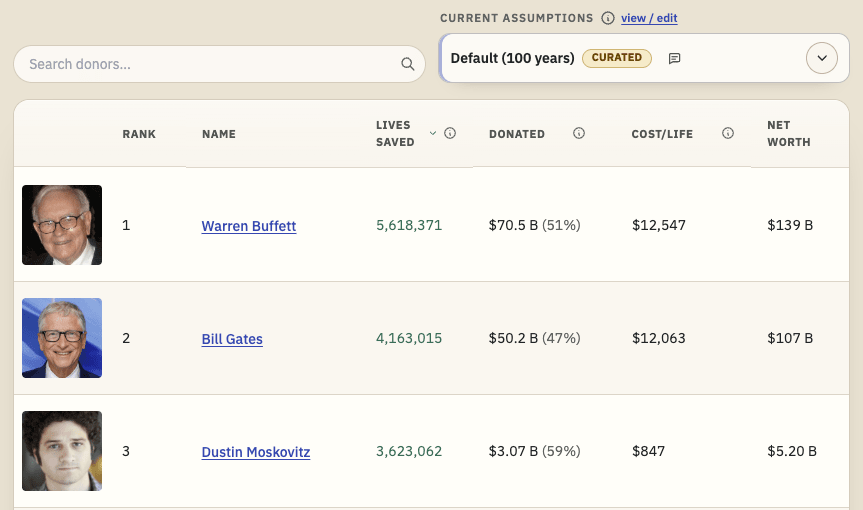
Each donor has their own page showing all their donations (along with the impact of each donation), and aggregate stats by cause area. Users can toggle between 'donations' and 'lives saved' to visualize differences in effectiveness between cause areas. The internal QALY metric is converted into lives saved by defining one life = 80 QALYs.
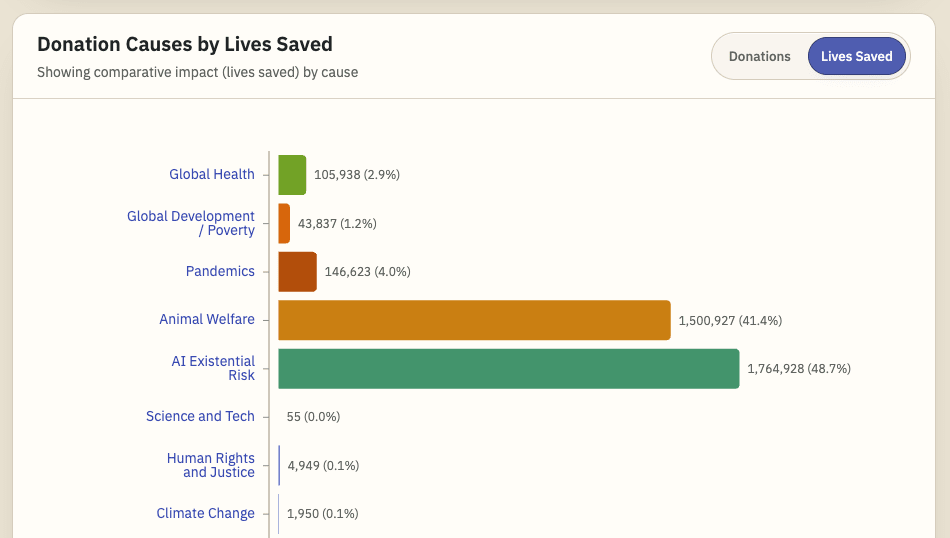
I've split all donations into 28 cause areas, each with their own 'cost to save a life' value.
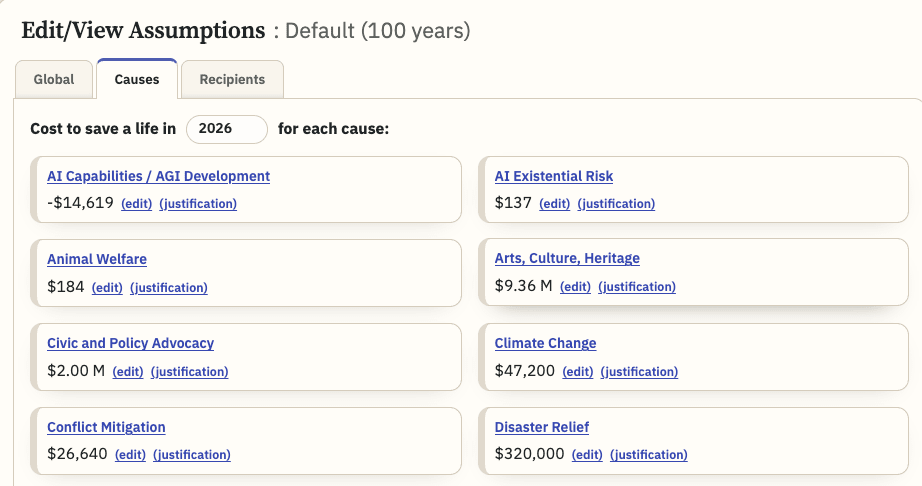
There's also a page for every recipient (charitable organization), which can have its own 'cost per life' value if it's more or less effective than the cause area average. Each cause area and customized recipient has a page with a detailed justification for how the math was done to arrive at the cost per life, and where assumptions are explicitly listed.
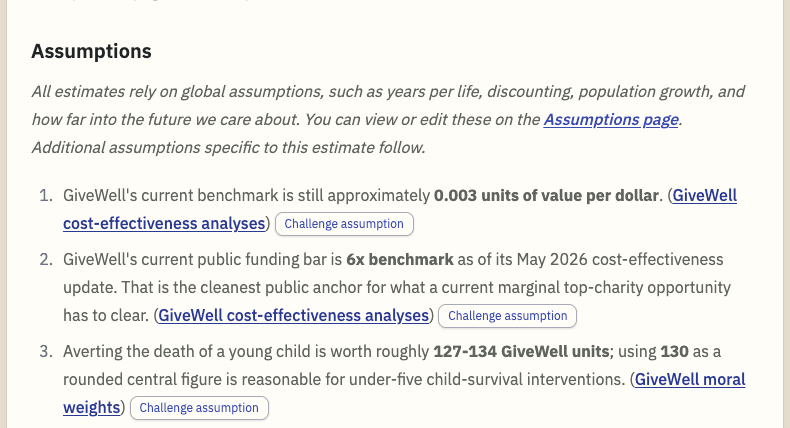
The estimates are of course very approximate, and will be controversial. I make heavy use of LLMs to do this research, encouraging them to synthesize existing (often EA) analysis. Users who disagree with any of the default parameter values can edit them.
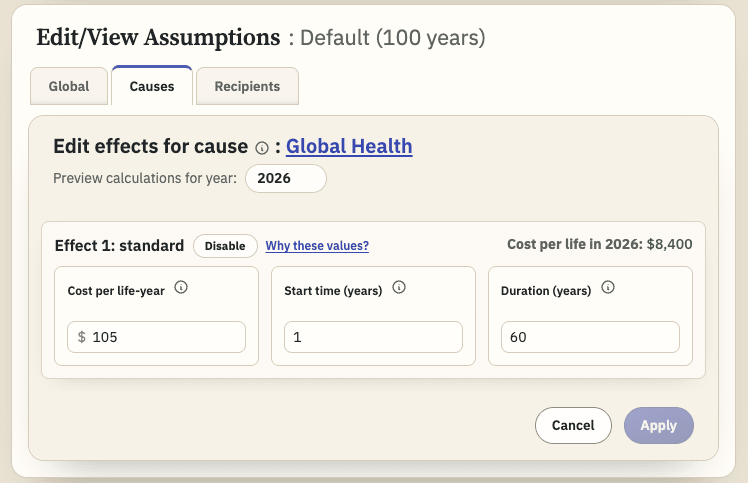
Users can also edit global parameters specifying their time horizon, assumptions about population growth, and the discount rate.
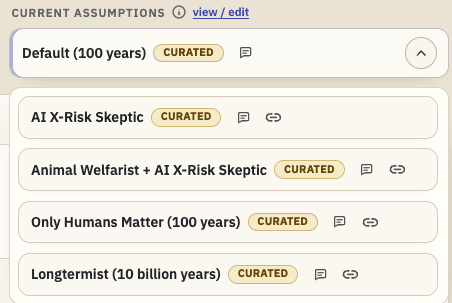
After entering their own assumptions, users can create shareable links. This allows others to see what Impact List would look like given person X's worldview.
I'd eventually like to add worldviews from notable researchers or organizations, but I'm starting with just a handful of worldviews based on simple tweaks to the defaults:
There's also a calculator feature where people can enter their past donations and/or donations they're considering and see where they'd rank on the list, given those donations.
If you see something below that you want to help with, comment on this post, DM me, or join the Discord.
Few people are going to dive into the details of the effectiveness estimates and verify for themselves that the research is high quality. So it's not enough that the estimates be excellent. People need to be able to easily understand and trust the process that leads to the estimates.
The current process is LLM-driven, opaque (users can't see the prompts that lead to the estimates and they can't see how feedback is processed), and dependent on the judgments of someone (me) without any reputation as a researcher. I've tried to partly compensate for this by making the justifications explicit about which assumptions are being made, and tried to make the reasoning as clear as possible, but I expect it'll be very hard to generate enough trust using the existing process.
A few things that could help:
If you have ideas in this area, please share in the comments. I see this as the most important obstacle to the site becoming popular.
The effectiveness estimates for all cause areas are mostly based on research from LLMs (frontier models from Anthropic and OpenAI). I've also done some manual review and back and forth with the LLMs to refine the estimates. The LLMs rely a lot on existing EA research, but the quality of the analysis is pretty uneven and could probably be improved a lot by putting expert human researchers in the loop.
I'd like these estimates to become the best place to look for a synthesis of all effectiveness research that EAs have done (or found).
If you have expertise in cause area effectiveness research, and especially if you're an expert in some particular cause area, it would be great if you'd be willing to help improve the estimates.
I think the site looks OK now, but not great (especially on mobile). If you have UI skills/taste and want to make the site look better, let me know.
As mentioned above, the site allows anyone to make their own customized set of assumptions and create a shareable link to the rankings using these assumptions.
For notable people/orgs, I'd like to add these links as curated options for all users, so people could see Impact List according to Carl Shulman, Rethink Priorities, etc.
If you're a notable researcher or work in a well-respected EA org, and you also want this to happen, please get in touch.
How should we actually make the site popular? In my post introducing this project I talked about some ideas for how to do this, but I'm pretty uncertain about the right path here.
My sense is that the quality of the site should be significantly higher before I try to popularize this beyond EA/rationalist audiences, but it'd be nice to have a distribution plan soon to guide the other site-improvement decisions.
Everyone currently on the list is well known, but that's not a requirement. Feel free to nominate yourself (if your donations can be proven to the satisfaction of a skeptical reader) or someone else I missed.
See Appendix A below for details on how this works. I've tried to strike a balance between simplicity and expressive power, but I'm not sure I've picked the right tradeoff or whether I'm on the Pareto frontier.
A couple of funders have offered to give me grants for this work. I haven't accepted any yet, but if you want to work on Impact List and you want to be paid, these grantors may be willing to make that happen.
The project has a Discord. You can also submit pull requests via GitHub. Feel free to DM me on this forum.
You can keep up with the project on Twitter.
Above I've listed what I think I most need, but I may be wrong. I'm happy for all sorts of help or feedback.
Thanks to Austin Chen, Ryan Kidd, Kim Korte, Nathan Young, plex, and Laszlo Treszkai for discussion and feedback about the site.
The details are on GitHub. This is a simplified overview.
Each cause area or charitable organization has one or more 'effects', which define how money translates into QALYs. There are two types of effects, standard effects and population effects, and each effect has several parameters.
Standard Effects
The most intuitive type. The more money you spend, the more impact you get. The parameters are:
Population Effects
Effects where money donated changes the probability of some event. This is used to model x-risks, pandemics, etc. The parameters are:
Overrides and multipliers
A recipient organization which is part of some cause area can override the parameters of that cause area, to indicate that the recipient is especially effective or ineffective.
Recipient organizations can also have their parameters defined as a multiple of a parameter of the cause area it belongs to. The site's UI currently hides the ability to express parameters in terms of multiples for simplicity, though I'd like to re-add this to the UI at some point.
Time
The model is capable of handling time-based effects, which allows specifying different levels of effectiveness for a cause/recipient depending on when the donation was made. For instance a donation to MIRI today may have a very different impact than a donation to MIRI in 2012. The current version of the site doesn't make use of time-based effects, but they're available and documented on GitHub.
Motivation for these choices
This model gives each effect a 'shape' over time that we can integrate over to get the total value. This allows assumptions about the future population, discount rate, and time horizon to be separated out from cause-specific assumptions.
I could have made these shapes more complex by having options for exponential or linear decay of effects, but I think it's not worth the extra complexity. Every effect-shape in this model is a simple rectangle.
Thanks to Nathan Young for the suggestion and for discussions around this idea.


This is really cool! If I might make one observation, the default assumptions (counting animal lives + assuming that AI is going to destroy the world) are not going to be understandable to most people. I think most people would assume that a list like this would count human lives that have already been saved, not ones that might be saved in the future. If the goal is to appeal to a broad audience, it might make sense to make more standard assumptions by default.
If you want to highlight animal advocacy and existential risk as cause areas, it might be helpful for the main page to show lives saved broken down by human/animal and certain/uncertain or current/expected future.
Also, I think there are huge issues with the way the population cause area is framed:
Hi Ellie -- thanks for the comments.
RE: the default assumptions, for value judgments I agree that I want the defaults to reflect what is common.
For AI existential risk, I think the crux is mostly not about values (at least for the default assumptions, which only consider the next 100 years) but about how the world works. In those cases I'd like the default rankings to present the best estimates possible without trying to skew towards popular beliefs. But there might be some way that I can make it more clear to people what's happening.
Fair point about the "lives saved" terminology. I could maybe call that column "life equivalents".
RE: whether creating a life is equivalent to saving a life, I agree this is something that lots of people will have objections to. Possibly I should make the user's stance on population ethics an explicit global parameter. I think the most typical view can be simulated with custom assumptions by disabling the Population cause area and possibly shortening the time limit. You can even simulate a longtermist with a person-affecting population ethics view by capping the population at close to the current level and setting the time limit very high (along with disabling the Population cause).
I agree that the motivation behind the rich country phrasing is unclear. I've added some clarification to the site. The estimate focuses on rich countries because the type of charity it's trying to compute a cost per life for tends to be a rich country thing. (There's currently only one recipient in that category.)