Comments
The following text presents a summary of “No Place to Hide? Regional Resilience and Vulnerability to Global Catastrophic Risk” by Jehn et al. (2026), published in Global Challenges. The idea of the paper is to collect the sprawling literature on what makes societies more or less resilient against global catastrophic risk in one central space and distill clear policy recommendations. The full paper includes supplementary materials, detailed methodological descriptions, and over 200 references and can be found here (open access): https://doi.org/10.1002/gch2.70146
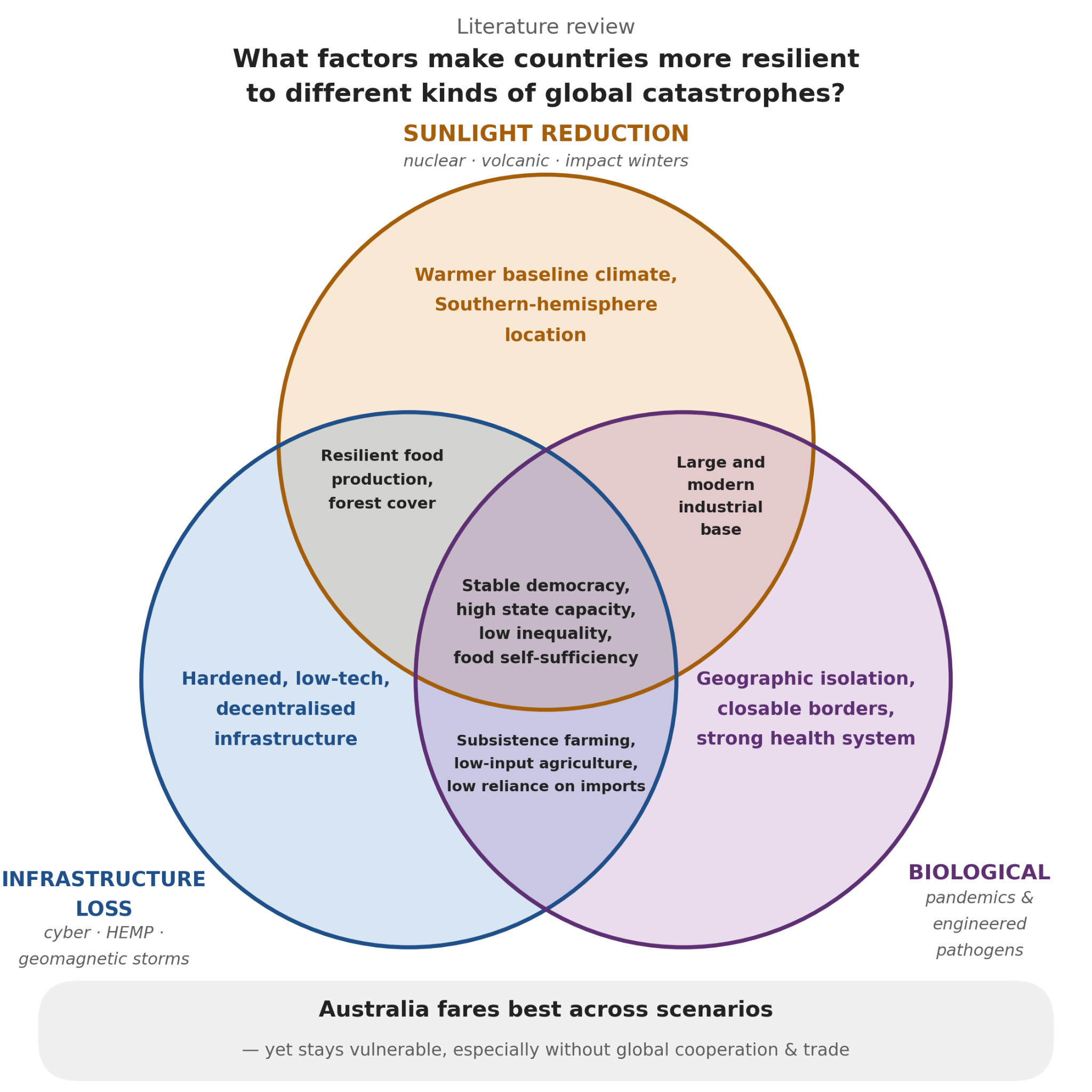
Visual abstract
Introduction
What places on Earth are most resilient to global catastrophic risk (GCR)? This review provides the first study of what locations are more resilient against the impacts of nuclear war, near-Earth objects, large-magnitude volcanic eruptions, large-scale cyberattacks, high altitude electromagnetic pulse, geomagnetic storms and pandemics. We group the hazards into three broad types: Abrupt Sunlight Reduction Scenarios (ASRS), Global Catastrophic Infrastructure Loss (GCIL) and Global Catastrophic Biological Risk (GCBR), and take resilience to be a society’s capacity to maintain critical functions and human welfare over time when faced with severe disruptions, covering robustness, recovery and adaptation.
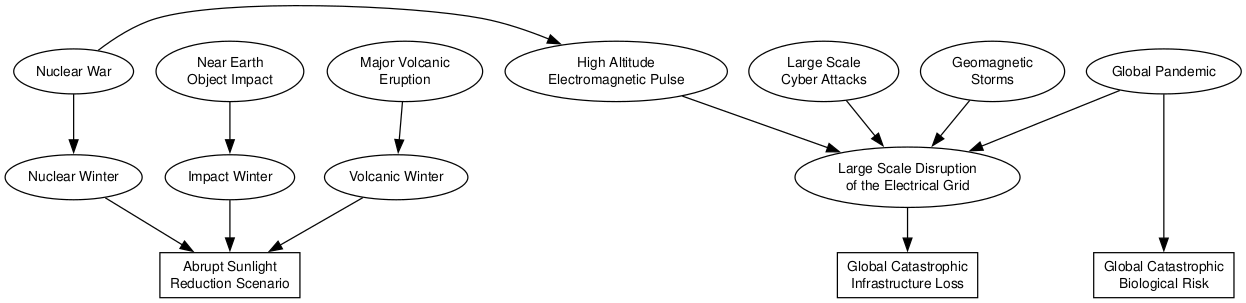
Overview of the different global catastrophic risks considered for this review and how they relate to each other.
Methods
The method combined a structured database search with an expert-driven curation phase, because the relevant literature is highly heterogeneous and much of it is not explicitly framed as GCR research. An OpenAlex query returned 3200 documents, screening reduced these to 551, then to 147 read in full, and finally to 75 that met the eligibility criteria. A further 77 documents were added by subject-matter experts on societal collapse, nuclear winter and food systems, cyber attacks and volcanic eruptions, bringing the final corpus to 152 main documents. Resilience factors were identified inductively: a single mention was enough for inclusion, since the GCR resilience literature is still small and exploratory. Country-level identifications follow a two-step logic, built on a ledger of named country mentions plus inferences made by the authors from the factor list.
Results
Several factors make a society more resilient to all GCR, and they mostly group around the general capabilities and stability of a society. Effective governance came up repeatedly, as all else is downstream from it: without governance structures that work, a society cannot efficiently mobilise or distribute capabilities and resources, even if it has other resilience factors. Democratic processes, decentralised decision-making, social cohesion, trust in government and low inequality recur across hazards, supported both by historical analysis using the Late Antique Little Ice Age as a nuclear winter analogue and by Covid-19 outcomes. Productive capacity matters as a buffer, since a larger industrial base means more paper mills, biorefineries and breweries that could be repurposed for food production, though semiconductor fabs cannot produce vaccines and sectoral transfer is limited. Large islands were often identified as good places for resilience, being climate buffered by the heat capacity of the surrounding water and able to isolate themselves, while many urban areas quickly become death traps once catastrophe strikes. Finally, societies particularly reliant on trade for fertilisers, food or medicine may be more vulnerable, and export bans may be particularly harmful.
For ASRS, Southern Hemisphere islands may be particularly resilient, because there are no nuclear armed states in the Southern Hemisphere, fewer large volcanoes, less endangered drinking water infrastructure (most piped water further north than 25° latitude could be damaged by increased frost depth), and a larger ocean area acting as a temperature buffer. Additional factors include diverse climate zones, a long growing season, low reliance on fisheries, low reliance on wind and solar (both decrease during ASRS), large forested areas, an industrial base able to produce advanced resilient foods, and Pacific coastlines suitable for seaweed farming. For GCIL, the most straightforward way to increase resilience is low reliance on elaborately manufactured technology and complex supply chains. Regions that currently use few agricultural inputs are expected to maintain their food production levels even after infrastructure collapse; older grids can revert to manual control, as Ukraine showed; and decentralisation removes single points of failure. Globally critical infrastructure such as GPS, the Panama Canal or the Svalbard Global Seed Vault is harder to recover because it lies beyond one’s borders. For GCBR, health system financing, capacity and surveillance, universal healthcare, previous experience with biological threats, low corruption and enforceable border control often come up as important. Islands suffered far lower excess mortality than non-islands during Covid-19 (64.8 versus 194.3 deaths per 100 000) despite generally poorer Global Health Security Index scores, and jurisdictions implementing an exclusion or elimination strategy had much lower excess mortality in 2020 to 2021 (−2.1 versus 166.5 deaths per 100 000).
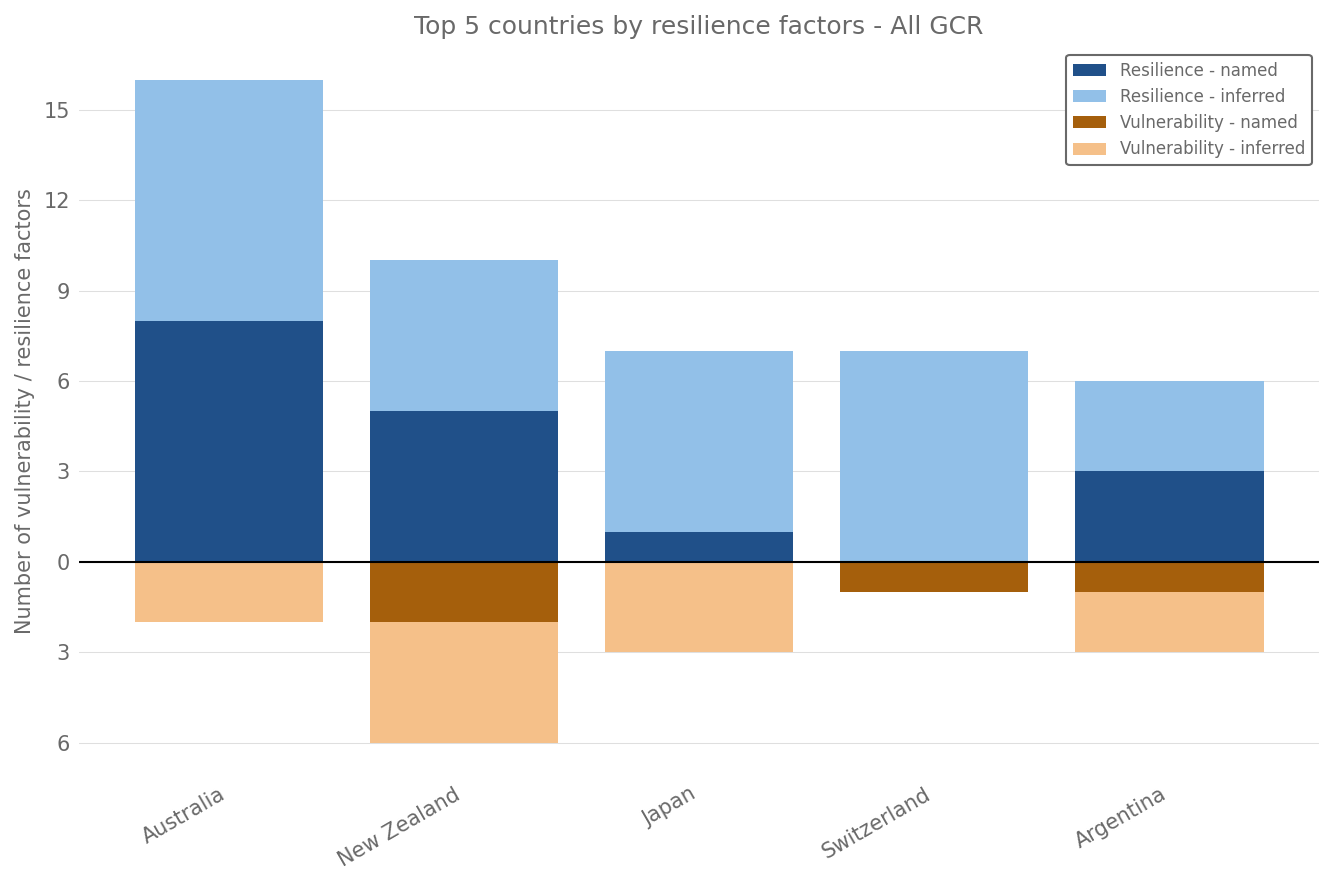
Overview of how often countries were mentioned directly as resilient or vulnerable in cited documents or inferred by the authors of this paper based on factors described in other documents.
Australia is plausibly the most resilient place on Earth when it comes to GCR. It is the country most often mentioned in the documents and has many factors that could enhance its resilience. Australia, New Zealand and Japan are the only countries with resilience evidence across all three GCR categories, while only Australia is directly named across all three. Yet even these countries are weak against certain hazards: long coastlines exposed to tsunamis from a near-Earth object, could be affected by a Tambora-scale eruption in South-East Asia or South America, and all are reliant on trade. There is no place on Earth which is a complete refuge from GCR.
This reflects the trade-offs between resilience factors. Geographic isolation makes it easier to seal a society off during a pandemic, but also means it is far from help during GCIL. A large industrial base offers more opportunities to produce resilient foods during ASRS, but implies greater reliance on digital infrastructure. Factors that prevent a crisis can make recovery harder, and the reverse also holds: smallholder farms are less affected by GCIL but produce less food in the first place. These trade-offs make a simple composite ranking impossible, since it would require answering whether low inequality matters more than domestic fertiliser production, which is partly a values question rather than a technical one.
Policy recommendations and conclusion
Despite these trade-offs, countries can still act. What matters for policy is the distinction between factors that are fixed and those that are modifiable (a list of policy recommendations for all modifiable factors can be found in Table 2 in the paper). A country cannot suddenly become an island or relocate to the Southern Hemisphere, but most of what determines resilience is how a society is structured and how well it has prepared. Governance quality and decentralisation stand out as both modifiable through policy and largely free of cross-GCR trade-offs: investments in democratic institutions, inequality reduction, state capacity and decentralised infrastructure improve resilience to every category of GCR examined while also making societies better places to live. Beyond these, the literature identifies several concrete and currently underutilised interventions: investing in research and deployment of resilient foods, incorporating GCR into national risk assessments and risk registers, establishing trade agreements that address post-catastrophe conditions, maintaining agricultural and genetic diversity, pre-positioning critical resources in the most resilient locations, and establishing pre-catastrophe international cooperation frameworks. Structurally resilient states like Australia and New Zealand could serve as anchor points for such an architecture, hosting stockpiles and seed banks and coordinating international response.
That most modifiable factors are trending the wrong way, with democratic backsliding, rising inequality and increasing supply chain concentration, makes acting on them more urgent. Prevention is always preferable to resilience, but some GCRs cannot currently be prevented, and when they occur the difference between societies that have invested in these factors and those that have not will be measured in lives.