Introduction
The organization of e-commerce—spanning both physical and digital assets—is arguably the defining microeconomic problem of the 21st century. The debates over wealth concentration and taxation that dominate contemporary political economy may, to a significant extent, be macroeconomic symptoms of lax competition policy in the digital sector—a laxity that is perhaps inevitable whenever technological change outpaces regulatory capacity.
This post unfolds in two parts. The first introduces my recent research on shadow subscription, a pricing scheme that sits between flat-rate subscriptions and strict pay-per-item models:
Macias, A. (2026). Shadow subscription for online video rental stores and affine systems. Economics and Business Letters, 15(3), 192–201. https://doi.org/10.17811/ebl.15.3.2026.192-201
The paper documents that shadow subscription can raise total welfare even under monopoly. My own conjecture goes further: this pricing structure may be especially valuable for market challengers seeking to compete against entrenched incumbents.
The second section traces how the early internet's promise of disintermediation gave way to a "walled garden" ecosystem dominated by a handful of platforms. Revisiting Lina Khan's critique of Amazon alongside the Anderson and Bedre-Defolie model of hybrid platforms, I argue that where network effects make sustained inter-platform competition difficult, policymakers should consider mandating "neutral intermediation" within dominant platforms rather than relying solely on external competition to discipline them.
Shadow subscription
A prime consequence of platform intermediation in immaterial e-commerce has been the generalization of subscription payment systems. The classic economic rationale, drawn from Bakos and Brynjolfsson (1999), treats subscriptions as large bundles: when a platform sells access to an entire catalog for a fixed fee, it reduces the variance in willingness-to-pay across consumers, since each subscriber's aggregate valuation for the whole catalog is far more predictable than their valuation for any single item.
By nature, subscription pricing—unlike per-item payment—destroys market information. Inside the gated platform, all products carry the same marginal cost to the consumer, so any given choice reveals less about true willingness to pay. This opacity has structural consequences: subscription pricing tends to raise entry barriers and concentrate markets, since incumbents with large content libraries and installed bases can absorb marginal-cost-free consumption far more efficiently than new entrants lacking scale. Once users adopt a subscription, high perceived switching costs and inertia—cancellation friction, sunk psychological investment, and lock-in—further dull the competitive pressure that price-sensitive, per-item shoppers would otherwise exert. The result is a dynamic that tips markets toward winner-take-most outcomes.
My recently published article on e-commerce pricing proposes "shadow subscription" as an alternative to both flat-rate subscriptions and per-item fees. The idea is best explained by examining the graph, that plots the total number of relevant informational goods consumed (call them "films") on the x-axis, and total cost (the monthly bill) on the y-axis. A subscription is a horizontal line—fixed payment regardless of consumption. Pay-per-item is a straight line—payment proportional to consumption. A shadow subscription is any curve that grows with consumption but asymptotes toward a maximum bill (the green curve), capturing the benefits of both.
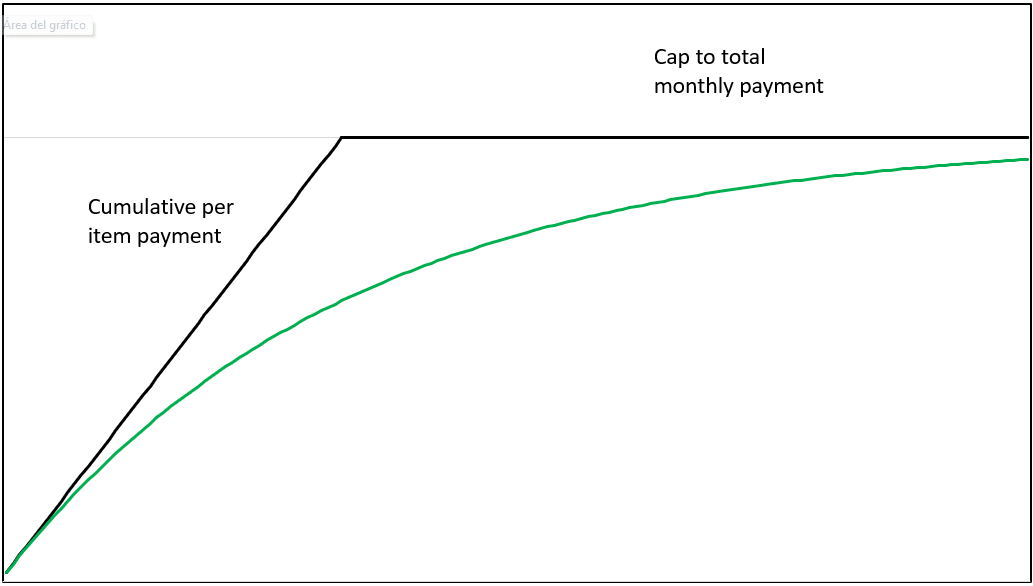
Under the parametric assumptions in the article, shadow subscription emerges as the optimal pricing mechanism even for a monopolist. But in my view, this mechanism is especially valuable for market challengers. In contexts where consumers expect only sporadic use, lowering the artificial entry barrier created by flat-rate subscriptions could accelerate adoption and user acquisition. This remains a conjecture, however: the mechanism has so far been analyzed only in the simplest monopolist case, and its behavior under competition is left for future research.
To fix ideas, consider how a shadow subscription might work for a video platform with a massive base of non-paying users and a comparatively modest number of premium subscribers. The platform could improve its market position by introducing a shadow subscription tier: most content remains free, generating only advertising revenue, but certain free content becomes accessible only to accounts with a registered credit card. Many such accounts will never spend substantially—effectively remaining zero-revenue subscribers—but for them, the real barrier (the absence of a payment method on file) has already been cleared. Any account with an operational card can then purchase additional content under a shadow subscription regime, enjoying the safety of a monthly cap while paying a bill that scales with actual engagement.
This post is published in an open-access forum, reaching a global audience—fitting, given that the marginal cost of distributing information has fallen to zero in the 21st century. Content production still carries costs (though several technologies, including AI most recently, have cut authors' costs), but the early decades of this zero-marginal-cost economy brought a wave of optimism about "liberating" content and monetizing it through revenue schemes other than direct consumer payment. Boldrin and Levine (2012) went furthest, proposing the outright abolition of intellectual property.
Between the generalization of the internet in the mid-1990s and the consolidation of the walled-garden ecology of big platforms in the 2010s, the internet was widely seen as a tool for disintermediation—a technology for direct connectivity between supply and demand that would usher in a Walrasian utopia. For informational goods like newspapers, the phase-out of physical delivery infrastructure was expected to let publishers turn profitable on advertising revenue alone. For e-commerce more broadly, in that first internet age of open protocols rather than closed apps, producers were expected to reach final demand with no intermediary beyond a search engine: a credit card, a webpage, and a delivery service like FedEx were all one needed for national—perhaps even global—reach.
Some of these promises were fulfilled. Google and Meta are highly profitable precisely because they monetize the side of their two-sided platform (Rochet and Tirole, 2003) that is not the general public. The 20-euro CD with nine songs gave way to near-complete access to recorded music for 12 euros a month. Yet content-generating sectors—press and music above all—have suffered, and in many cases we are now seeing a return to consumer-facing payment schemes.
Lina Khan, chair of the Federal Trade Commission under President Biden, began her academic career with a sharp critique of Amazon's conduct, arguing that unchecked behavior by tech gatekeepers in key markets has denatured competition. The original sin, in her account, was Amazon's status as a hybrid platform—one where the platform owner also competes as a participant. The consequences of this hybrid structure are formalized by Anderson and Bedre-Defolie (2024): "We demonstrate the performance shortcomings of the hybrid business model by showing that better platform product quality implies that equilibrium consumer welfare (surprisingly) suffers, and so consumers are better off when the platform product has low market share. This counter-intuitive result follows because of the fall in the aggregate [fringe supply] (determined from the fringe free-entry condition) when the platform raises the equilibrium seller fee in response to higher quality. The mechanism is that better quality motivates the platform to seek a higher market share for its product, which comes at the expense of lower fringe entry for any given aggregate." Khan's intuition, in other words, finds formal rationalization in the Anderson–Bedre-Defolie model.
Beyond hybrid platforms, a natural question follows: even granting scale economies in platform systems, should platform owners be allowed to run their own recommendation systems? Or should such systems be regulated toward an ideal of "neutral intermediation"?
The Digital Markets Act explicitly extends the logic of the Anderson–Bedre-Defolie critique to ranking. It prohibits designated gatekeepers from giving "a better position, in terms of ranking, and related indexing and crawling, for their own offering than that of the products or services of third parties also operating on that core platform service"—precisely a self-preferencing constraint on recommend.
A final conjecture worth considering: could a good definition of neutral intermediation be that each euro of revenue generated on the platform leaves the same marginal profit to the platform manager, regardless of source? The extent to which such a rule would be desirable—or even implementable—remains an open question.