I just updated it (same link) to include a much larger set of papers. The 'other' category now includes papers we may not yet have prioritized, may have deprioritized somewhat (but still found interesting), or may have set aside for other reasons (e.g., slightly outside our scope, not timely for evaluation as part of our model, etc.)
If you see research in the database you would particularly recommend that we focus on, or you want to briefly share some notes about the research, please fill out the relevant fields in our ‘suggest research’ form, flagging this with “[External suggestion]” in the ‘label’ field.
Unjournal: "Research with potential for impact" database
I don't think I posted this here yet and wanted to make sure people are aware of it. Please let me know what you think, how you might use it, how we can make it more useful, etc.
26 Sep 2024 – added 'filter bars'
Why are we sharing our database?
The Unjournal commissions and promotes the public evaluation and rating of research with potential for impact. We mainly cover applied, quantitative social science (see ‘what do we cover’).
Finally, we publish a package of evaluations and ratings on our PubPub page (and in the bibliometric ecosystem)
Because we’re committed to transparency and providing public goods, we’re sharing a live database of “research in our pipeline” below. This may be useful to:
Anyone interested in engaging with The Unjournal (e.g., authors looking to submit their work, researchers and PhD students interested joining our evaluator pool) who wants to get a better sense of our focus
Researchers, students, and professionals exploring research topics, approaches, and paths (e.g., Effective Thesis students), focused on having a measurable impact
Organizations, funders, and policymakers interested in reading and using recent research
Who may want to suggest ‘pivotal questions’ and research relevant to these
(There are some limitations on what columns and rows are shared -- see the link. Remember you need to click to the second page to see the actual database.)
Note: This post was crossposted from the Coefficient Giving Farm Animal Welfare Research Newsletter by the Forum team, with the author's permission. The author may not see or respond to comments on this post.
Subtitle: On vegan advocacy, effective altruism, and FIFA
I turn 40 today. Here are some hot takes.
On factory farming
1. Our biggest challenge is salience. If factory farming led the evening news, it wouldn’t last lo...
On October 22nd starting at 10:00am Pacific Time, Every.org is matching donations to select animal welfare organizations at a 2:1 rate, up to $2,000 per donor per nonprofit (so if you give up to $2,000, they will contribute up to $4,000 and the nonprofit will get up to $6,000). The first donation a donor makes to each eligible nonprofit will be matched, and donors can get the match for multiple $2,000 donations. So, you can get more than $2,000 matched by donating $2,000 one time to multiple...
When speaking to candidates who are considering working with us at 80,000 Hours, I often hear people worry about replaceability.
The familiar version of the worry is about whether the organisation will hire someone else in your place. If it will, then the difference you make by taking the job is only the difference between you and them.
There are a couple of well-known answers to that. The person hired in your place probably cares about the world too, and would go on to do somethi...
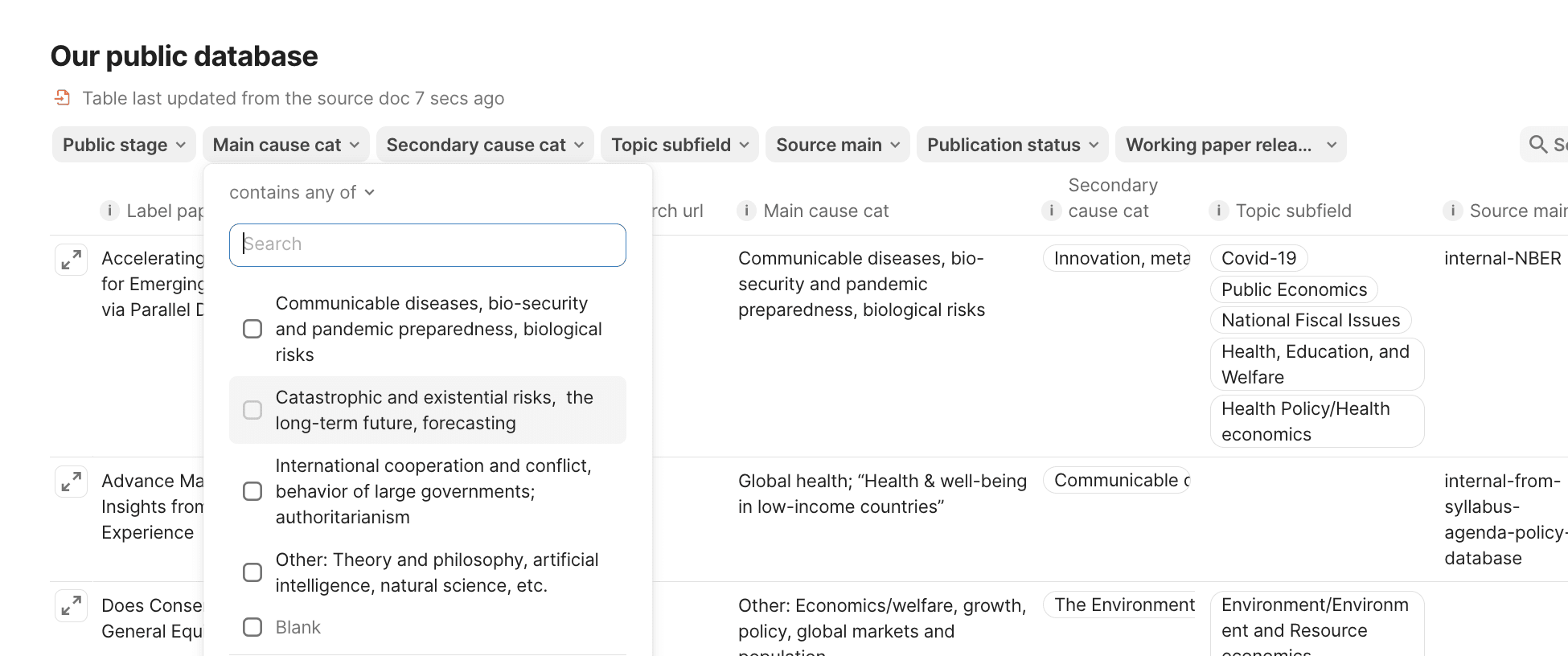
I just updated it (same link) to include a much larger set of papers. The 'other' category now includes papers we may not yet have prioritized, may have deprioritized somewhat (but still found interesting), or may have set aside for other reasons (e.g., slightly outside our scope, not timely for evaluation as part of our model, etc.)
Now grouped by main outcome/cause/field cluster.