On April 17-19, we hosted the fifth annual Midwest EA Next Steps Retreat. 40 students from 7 Midwestern universities were joined by 9 professional guests to spend a weekend in northwest Indiana, where they discussed cause prioritization, career next steps, and generally had a good time. We think this retreat went extremely well, with both strong qualitative feedback and an average likelihood to recommend score of 9.44 and a Net Promoter Score of 86 (n=36). Rather than describe the basic details of the retreat, this post will focus on the things we think went particularly well or poorly so that organizers can run better retreats in the future.
If there’s a broad explanation for why this retreat was successful, it’s that the organizers were experienced and working off of a well-defined template. Having prior retreat experience probably also helped attendees and professionals get more out of the event. If you are planning to run a retreat, feel free to reach out about any questions you might have.
Organizing Structure:
Last year, organizers from every school were involved in planning the retreat. This led to difficulties with coordination and consistent participation. This year, a core group organized the retreat and interacted with points of contact at other universities via text/email. While this was more efficient, it may have resulted in less awareness of the retreat.
Student Outreach
While we generally ran a stronger retreat than last year, we did have slightly fewer students attend. We think this was caused by some combination of weakness in the region’s EA groups and a poor job getting the word out about the retreat. We might be able to improve this in the future by sharing high-quality marketing materials instead of asking group leaders to advertise the retreat while only providing limited information.
While it’s unfortunate to see the headline number decrease, we seem to have had fewer attendees with low context than WCEA, so perhaps there was a silver lining to being relatively more obscure. However, we did notice that attendees were generally less prepared than they could have been. Setting goals and identifying people to talk to are simple ways to get more value from an event, but some attendees had not prepared for the retreat at all until they were prompted to do so. We sent out a retreat preparation document to organizers, but we would like to further encourage its use in the future.
Professional Outreach
We spent a fair amount of time reaching out to potential professional guests in the months leading up to the retreat. While we are broadly happy with our final lineup of professional guests and they were rated highly, we did fail to secure a professional working in global health and development, in an unintentional sign of the times. While our retreat overlapped with the Spring Meetings, we still could have done more to reach out to a greater volume of professionals.
Travel and Logistics
The retreat was less than a 2-hour drive for the majority of attendees, and we had no real trouble in getting people to and from the retreat. We had 2 satellite houses just for sleeping that were a 15-minute drive from the main location. This seemed to work well, and the professionals appreciated the better sleeping experience the houses provided.
Presentations
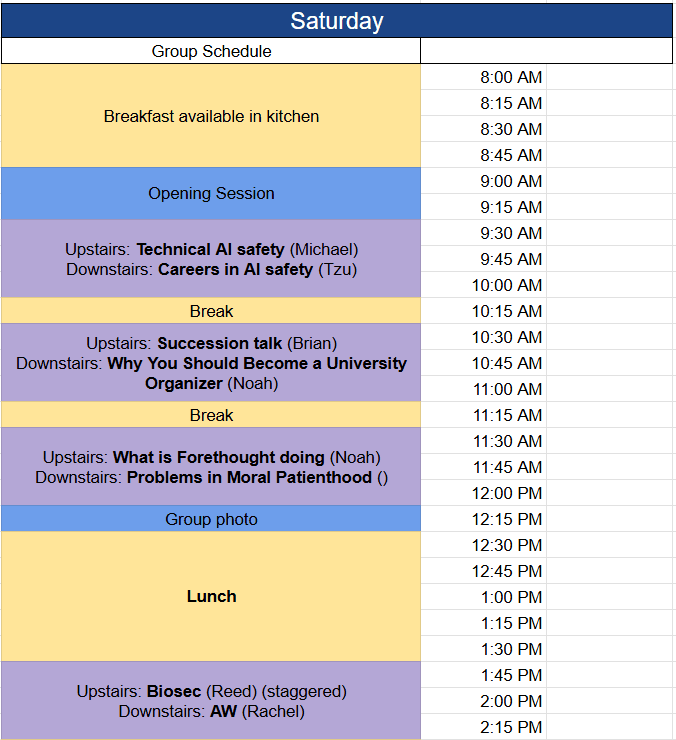
Traditionally, every talk at the retreat has been semi-mandatory, with students strongly encouraged to attend each professional’s talk unless they had a good reason not to. This year, we introduced parallel talks, with the idea being that we could make more out of limited presentation slots by splitting up our audience for presentations with a narrower appeal. Looking back, we believe this was completely wrongheaded, as presentation maximization should not have been the goal.
We now think the best presentations are substantially better than replacement level ones, making the marginal presentation pretty unimportant. We also believe that there should be a very high bar for making something a talk when attendees could be having 1-1s or small group discussions instead.
1-1’s
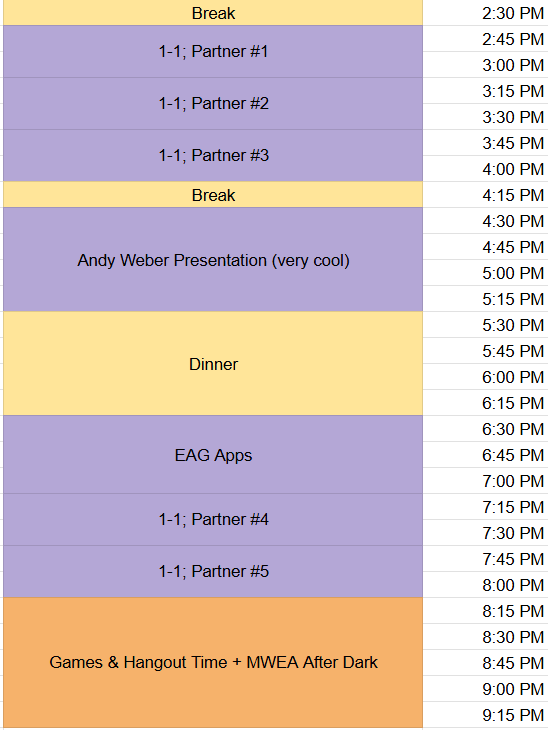
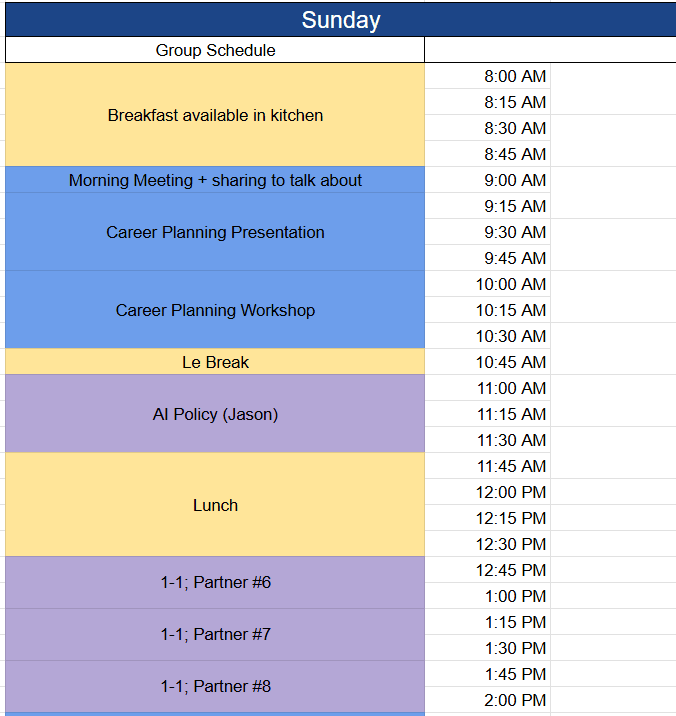
With 1-1’s, we seemed to have performed very well. Our attendees reported having 5.54 useful 1-1s on average (n=36). Much of the credit for this goes to Pairwise, which represents a dramatic improvement on the previous method of scheduling 1-1s in each other’s notebooks. We also allotted 8 slots on the schedule for 1-1s, two more than last year.
Conclusion
In all, we’re pleased with how this retreat went and now focused on questions like how we might reduce the organizer workload, how we can ensure consistently good retreats, and if running two retreats a year would be possible.
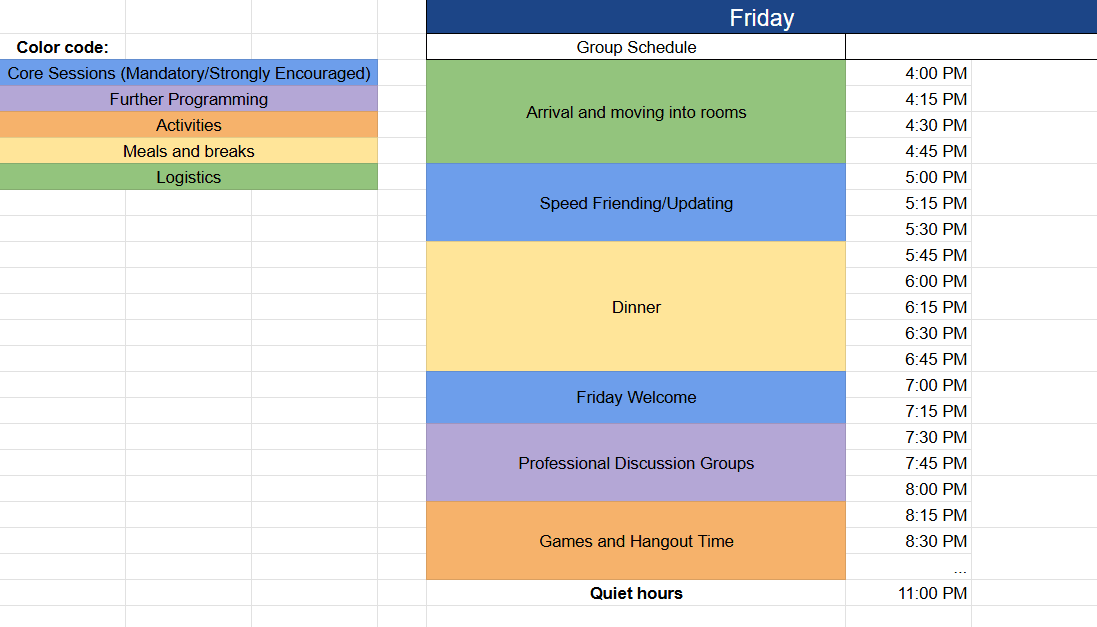
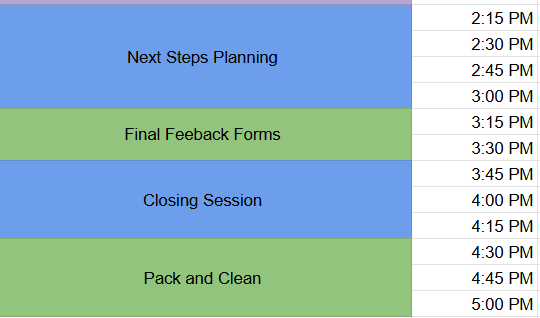
Schedule Used
We kept to the schedule pretty closely, although we did allow a couple presentations to run long so people could ask more questions.

Good stuff! What uni groups were involved?
Sorry, I probably should’ve included this in the post. The groups were UChicago, Purdue, UIUC, Wisconsin, WashU, Northwestern, amd Indiana. There was also a student from UC Berkeley and a student from Yale.