Summary: The NAO will increase our sequencing significantly over the next
few months, funded by a $3M grant from Open
Philanthropy. This will allow us to scale
our pilot early-warning system to where we could flag many engineered pathogens early
enough to mitigate their worst impacts, and also generate large amounts of data
to develop, tune, and evaluate our detection systems.
One of the biological threats the NAO is most concerned with is a
'stealth'
pathogen, such as a virus with the profile of a faster-spreading HIV. This
could cause a devastating pandemic, and early detection would be critical to
mitigate the worst impacts. If such a pathogen were to spread, however, we
wouldn't be able to monitor it with traditional approaches because we wouldn't
know what to look for. Instead, we have invested in metagenomic sequencing for
pathogen-agnostic detection. This doesn't require deciding what sequences to
look for up front: you sequence the nucleic acids (RNA and DNA) and analyze
them computationally for signs of novel pathogens.
We've primarily focused on wastewater because it has such broad population
coverage: a city in a cup of sewage. On the other hand, wastewater is
difficult because the fraction of nucleic acids that come from any given virus
is very
low, and so
you need quite deep sequencing to find something. Fortunately, sequencing has
continued to come down in price, to under $1k per billion read pairs. This is
an impressive reduction, 1/8 of what we estimated two years
ago
when we first attempted to model the cost-effectiveness of detection, and it
makes methods that rely on very deep sequencing practical.
Over the past year, in collaboration with our partners at the University of
Missouri (MU) and the University of California, Irvine (UCI), we started to
sequence in earnest:
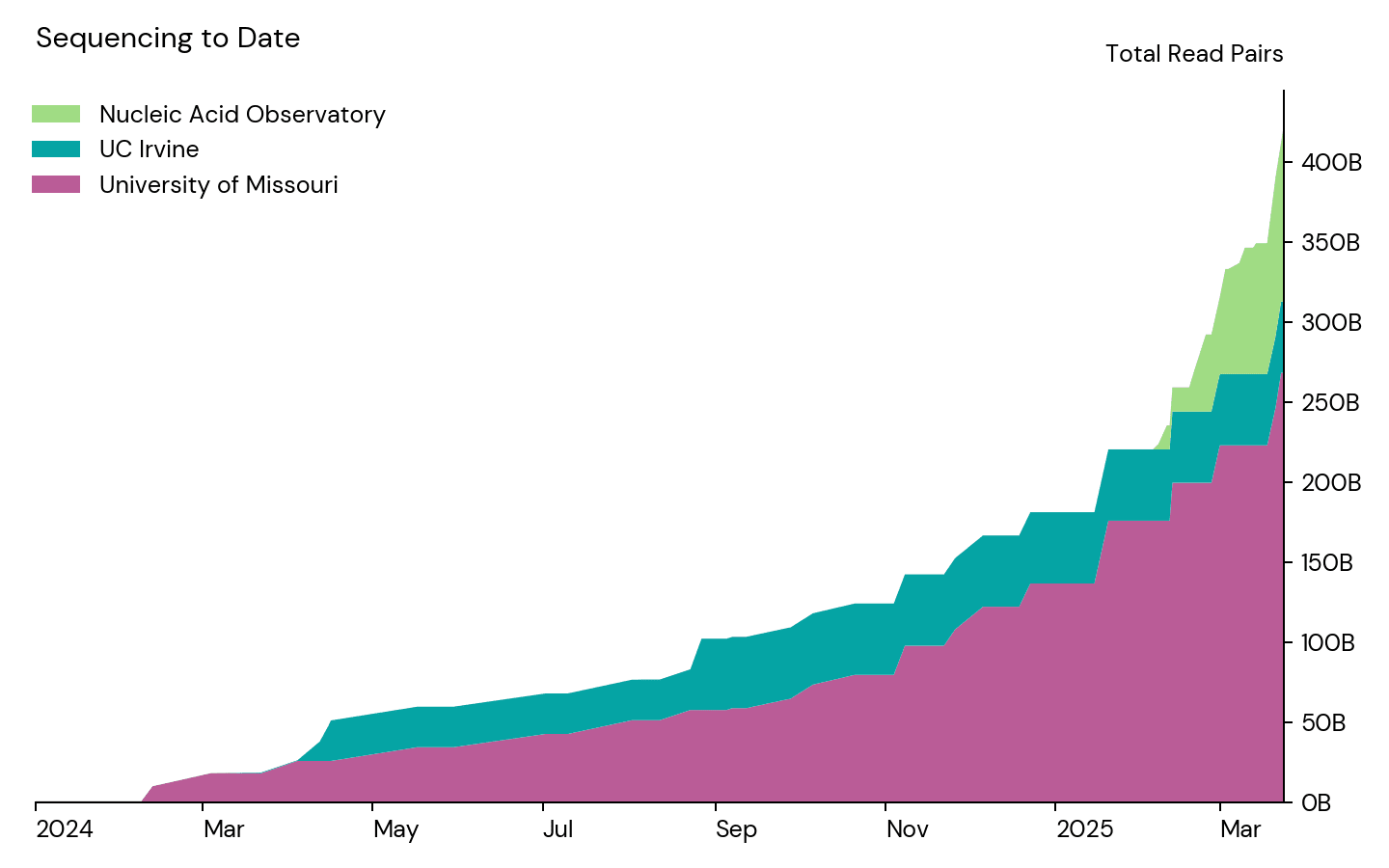
We believe this represents the majority of
metagenomic wastewater sequencing produced in the world to date, and it's an
incredibly rich dataset. It has allowed us to
develop
and test our
algorithms for pathogen identification, and we're eager to
share it with others who are working to
develop their own computational approaches to this problem. This is a valuable
start, and is enough to provide very sensitive coverage of gastrointestinal
viruses. To get a pilot early warning system to where it could usefully flag
other viruses, however, we'll need to ramp up sequencing substantially.
To this end, we're pleased to share that Open
Philanthropy has granted $3M to the NAO
over one year to fund a significant scale-up of our wastewater sequencing,
targeting three NovaSeq X 25B runs weekly. We're planning to deploy these
funds both in-house and at MU:
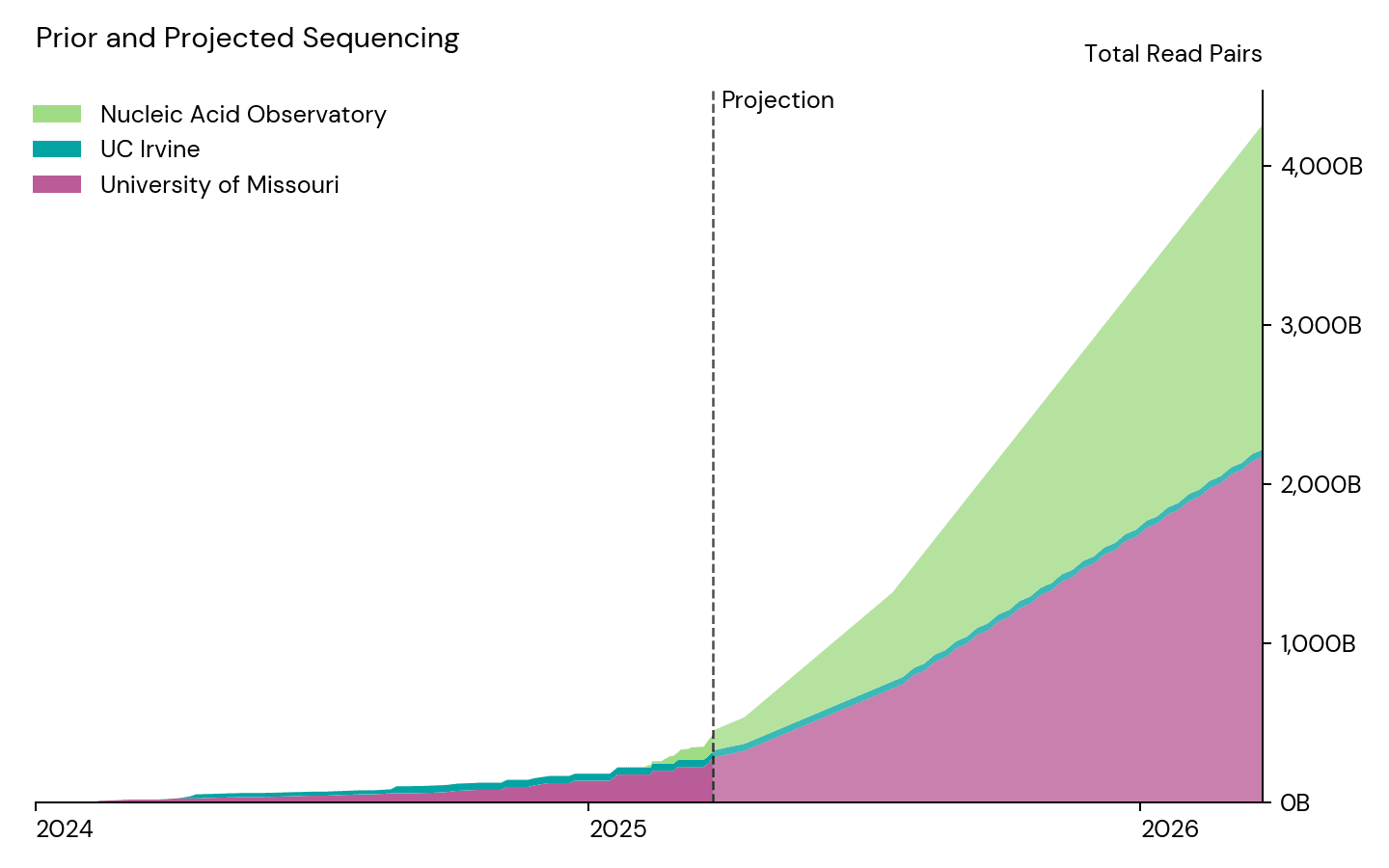
We expect this data to be valuable for a wide range of purposes, including:
-
Using our existing
methods to look for
engineered viruses that might be spreading now. While we think such a virus
is unlikely to be at large now or over the next year, the consequences of one
spreading undetected could be very serious.
-
Developing additional methods, both reference-based and reference-free, to
identify novel pathogens.
-
Providing a more general supplement to traditional PCR-based public health
wastewater surveillance, dramatically expanding the number of pathogens that
can be tracked.
-
Allowing researchers studying the sewer microbiome to better characterize its
enormous complexity.
We are grateful for Open Philanthropy's support, and also to the hard work by
our collaborators at MU. Additionally, this project wouldn't be possible
without our partners around the country, in academic labs and treatment plants,
who are providing wastewater samples. We're very excited about what this
increased scale will allow us to accomplish over the next year, and as always,
we're excited to collaborate with others who are thinking along similar lines.

Perhaps silly question as you've probably written about this before, have you tried getting people to (with you blinded) dump both natural and engineered DNA in wastewater in different quantities at random times to see how good your system is at picking it up?
Not a silly question, and not something where I think we've talked about plans publicly yet. Some sort of red-teaming is something I'd like to see us do in the second half of 2025. Most likely starting with fully computational spike-ins (much cheaper, faster to iterate on) and then real engineered viral particles.