Cross-posted from my Substack.
Epistemic status: I’ve puzzled over this for a long time but I’m not sure I came to the right answers. I'm sharing this partly because it might help others work on resource allocation, but mostly because some smarter reader might tell me how to do it better.
TL;DR:
* I he...
This post is part of the Cross-Cause Fund (CCF) series by Rethink Priorities — a sequence of articles dedicated to effective giving across philanthropic areas.
TL;DR:
There is a seemingly plausible argument that do...
TL;DR: We lack high-quality evidence on what reduces animal product consumption, and I see current academic incentives as part of the reason. Drawing on my experience as a PhD researcher, I describe six ways academic incentives misalign with what animal advocates need:
* 1) research questions follow the literature rather than practitioner decision relevance;
* 2) health- and climate-motivated research leads to disproportional attention to red meat and neglect o...
James Herbert, EA Netherlands. The survey was designed, fielded, weighted and coded by Rethink Priorities. The report was drafted by Claude.
Key takeaways
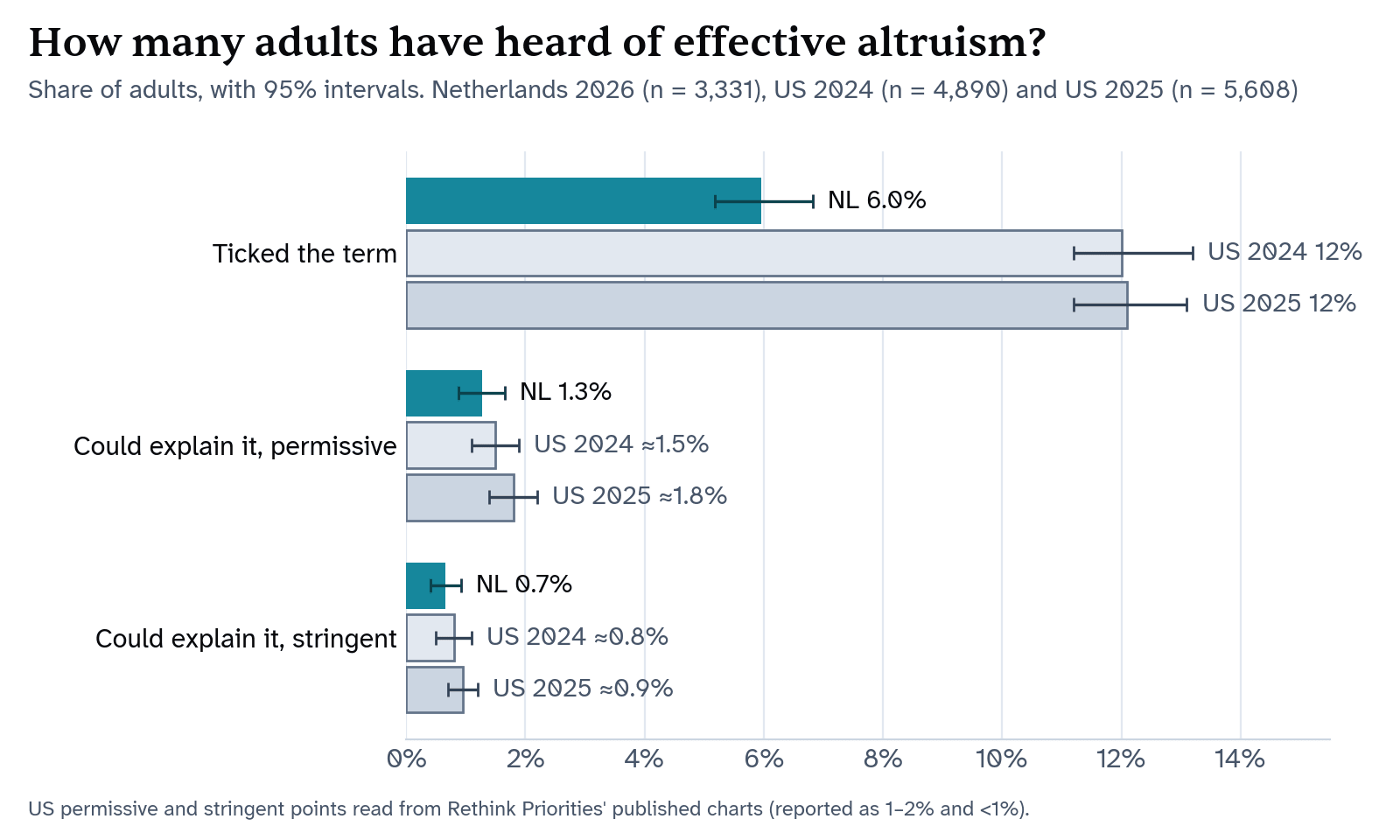
Awareness of effective altruism among Dutch adults is low, and about the same as in the US: 0.7% (95% interval 0.4–0.9%) when assessed stringently and 1.3% (0.9–1.7%) permissively. 6.0% claim to have heard of the term, against 12% in both US waves.
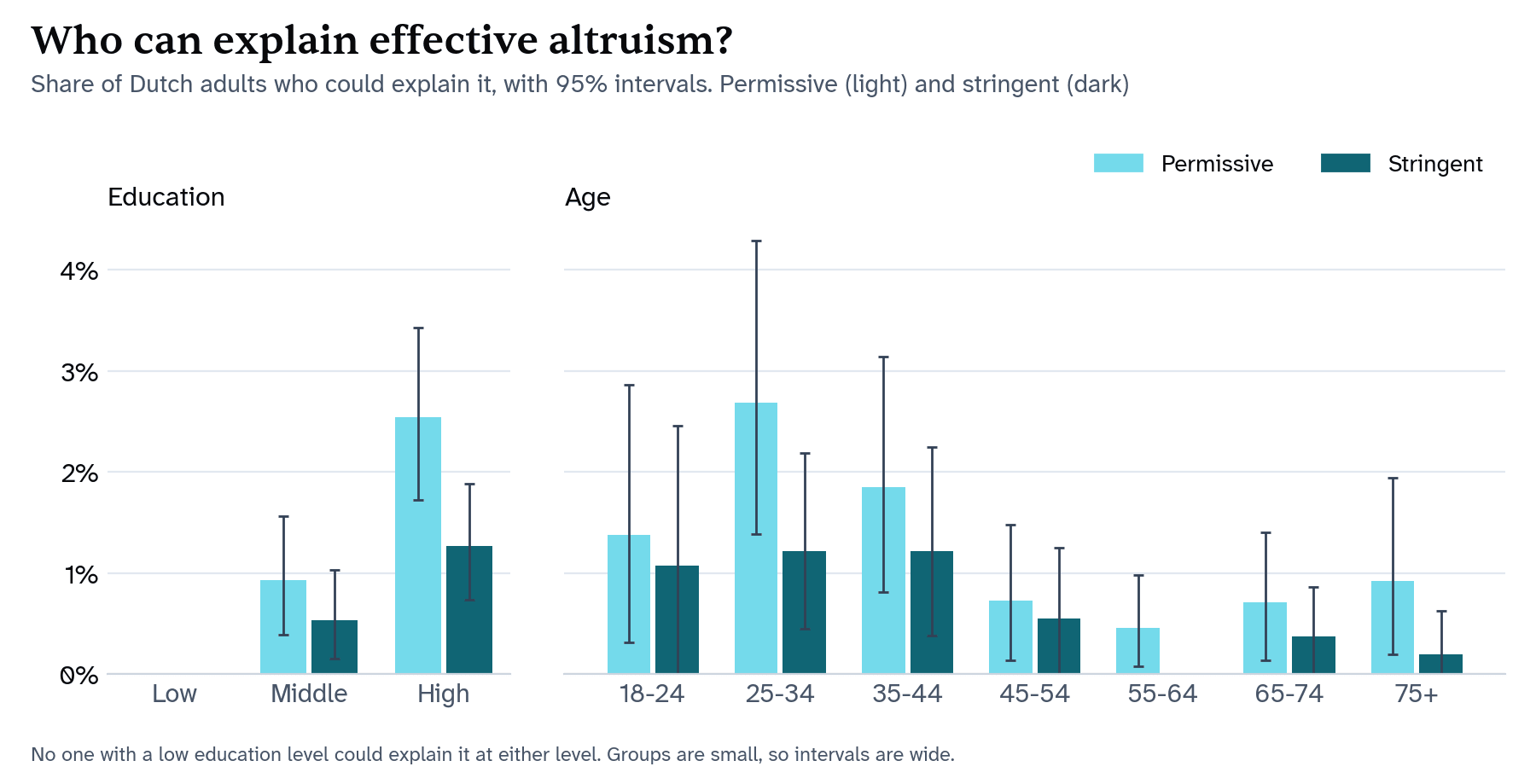
Awareness is concentrated among the highly educated (1.3% stringent, against 0% among people with a low level of education) and people aged 25–44. Unlike in the US, we found no difference between men and women.
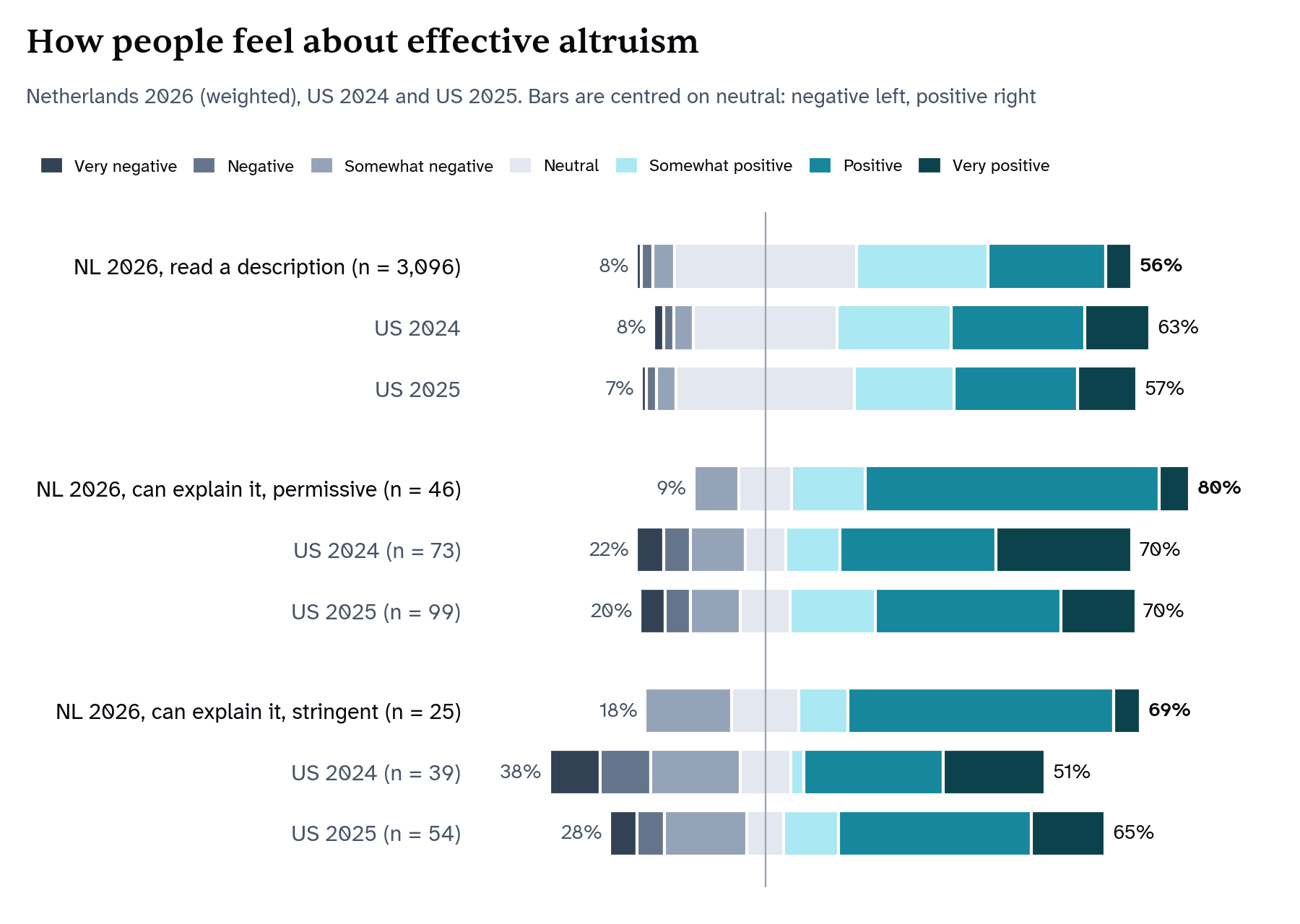
People who know effective altruism are mostly positive about it: 69% positive and 18% negative among the stringently aware (25 people). In the US they were 51% and 38% in 2024, and 65% and 28% in 2025. In both US waves, negative views were linked to FTX. Only 5% of Dutch adults recognise the name FTX.
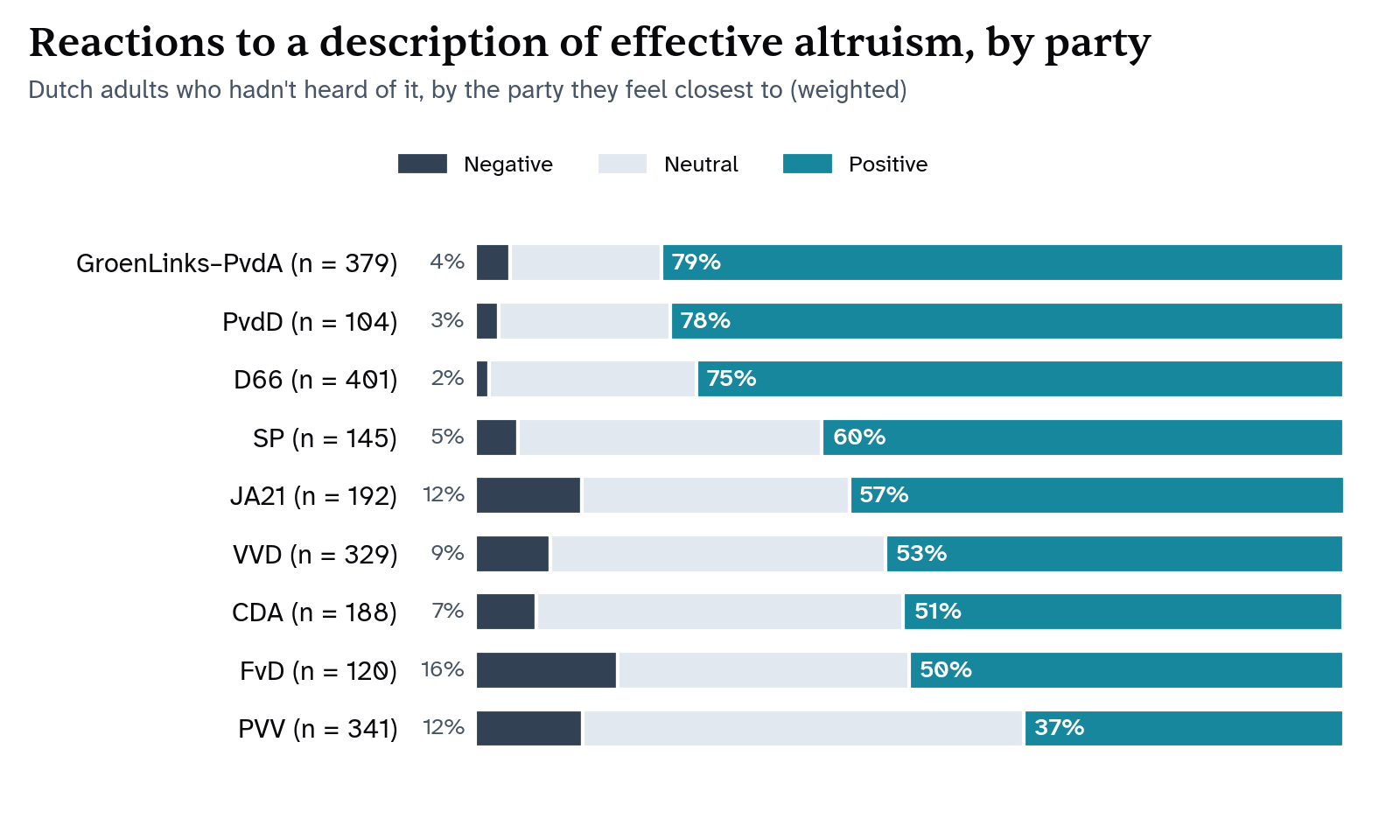
People who hadn't heard of it were also positive after reading a short description: 56% positive, 37% neutral and 8% negative. That's almost identical to the US in 2025 (57%, 36% and 7%), and a little less positive than the US in 2024 (63%, 29% and 8%). Reactions were most positive among the highly educated, younger people and voters for GroenLinks–PvdA, the Partij voor de Dieren and D66. Every party's voters were more positive than negative.
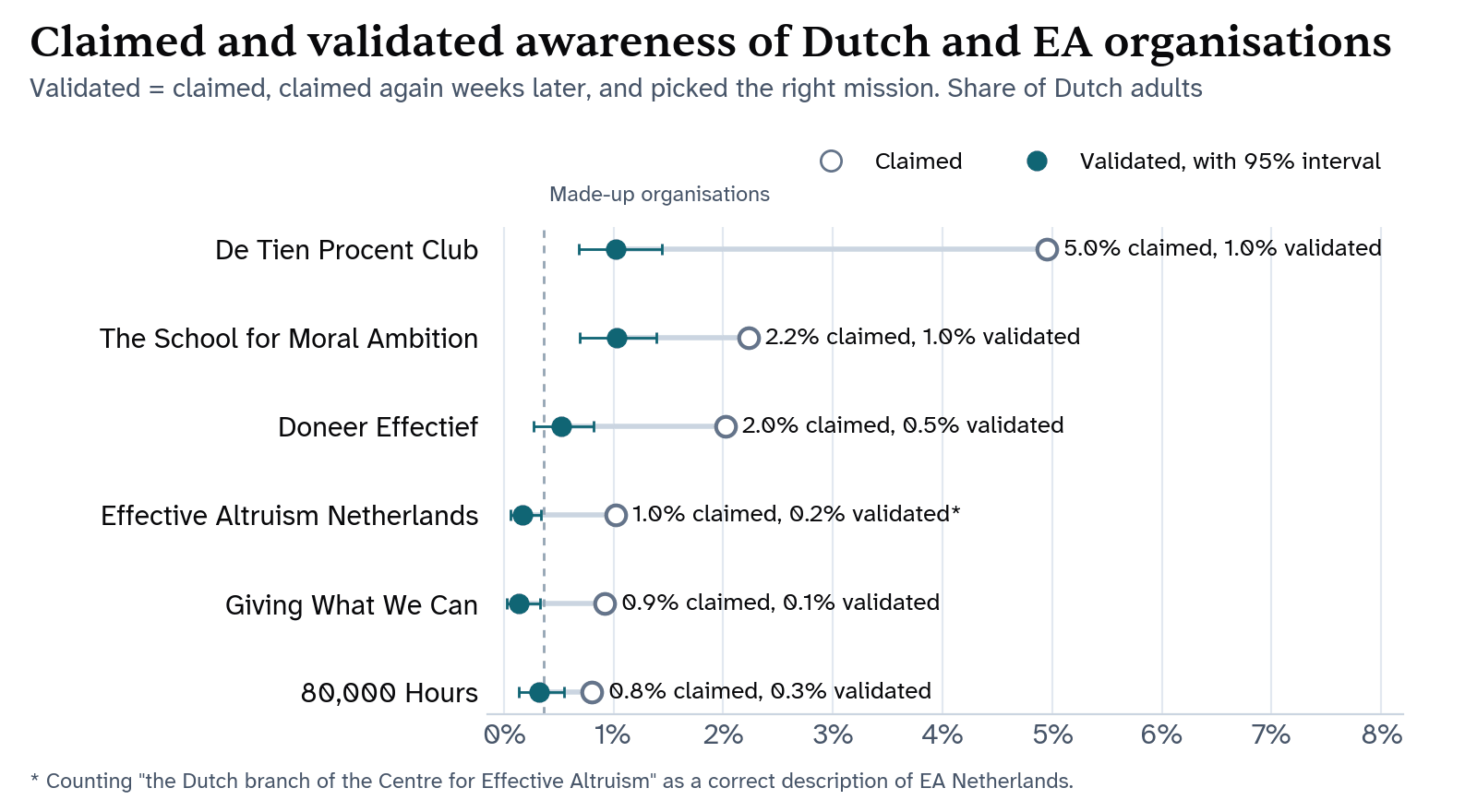
Claimed awareness of EA organisations mostly doesn't survive a knowledge check. Weeks later, we asked people to say again which organisations they knew, and to pick each one's mission. On that test, the School for Moral Ambition and De Tien Procent Club come out at about 1% of adults. Doneer Effectief comes out at 0.5%, 80,000 Hours at 0.3%, EA Netherlands at 0.2% and Giving What We Can at 0.1%.
The results are based on 3,331 Dutch adults who completed the survey in February 2026, weighted to match the population. A follow-up in March 2026 re-tested 257 of them on the organisations they said they knew. The questions mirror Rethink Priorities' US Pulse survey (Pulse 2024: Awareness and perceptions of effective altruism), so most results can be compared directly. Rethink Priorities has since run a second US wave (Wave 2 of Pulse, February–April 2025, about 5,600 adults). We compare with both waves, which also shows how the US moved between them.
Method in brief
Sample. A Dutch online panel, 16–27 February 2026. We excluded people who didn't consent or finish, failed an attention check, or didn't promise not to look terms up, leaving 3,331 respondents.
Weighting. Rethink Priorities weighted the responses to Statistics Netherlands (CBS) figures for sex, age, region and education. The panel over-represents highly educated people, so weighting lowers every awareness figure a little. The effective sample size after weighting is about 2,580.
Awareness questions. Respondents ticked the terms they had heard of from a list that also included made-up terms. Anyone who ticked "effective altruism" and said they had at least a basic understanding was asked to explain it in their own words.
Coding. Rethink Priorities' team coded each explanation using the same thresholds as the US study:
Stringent: the answer clearly refers to a core idea of EA, such as doing the most good, or doing good through careers or giving, or to people associated with it.
Permissive: the answer alludes to these ideas less specifically.
Pasted or paraphrased definitions don't count.
Attitudes. People who said they understood the term rated how they felt about it. Everyone else first read a short description of effective altruism, translated from the US version, and then gave their rating.
The US estimates were produced with a different statistical model (multilevel regression with post-stratification) and come from 2024 and 2025, so treat small differences between the countries with caution.
How many people have heard of effective altruism?
Netherlands 2026
US 2024
US 2025
Ticked "effective altruism"
6.0% (5.2–6.8%)
12% (11.2–13.2%)
12% (11.2–13.1%)
…and claims at least a basic understanding
4.4% (3.8–5.2%)
not reported
not reported
Could explain it, permissive
1.3% (0.9–1.7%)
1% (1.1–1.9%)
2% (1.4–2.2%)
Could explain it, stringent
0.7% (0.4–0.9%)
<1% (0.5–1.1%)
<1% (0.7–1.2%)
Dutch respondents were much less likely than Americans to tick a term they couldn't really know.
Made-up term. 2.0% of Dutch respondents ticked "globally neutral advocacy", against 8% in the US.
All three made-up terms. On average, 1.4% of Dutch respondents ticked them.
Ticking EA itself. Most of the gap at the "ticked the term" level is probably overclaiming. At the stricter levels the two countries look the same: under 1 in 100 adults can explain what effective altruism is. US awareness didn't change reliably between the two waves.
In absolute numbers, the stringent estimate corresponds to roughly 100,000 Dutch adults (0.66% of about 14.6 million). The interval runs from about 60,000 to 135,000.
Who has heard of it?
Education is the clearest divide.
Highly educated (hbo/wo): 2.5% permissive and 1.3% stringent.
Middle education: 0.9% and 0.5%.
Low education: none of the 473 respondents with a low level of education could explain the term at either level.
Age. Awareness peaks among 25–44-year-olds (25–34: 2.7% permissive, 1.2% stringent). It is lowest among people aged 45 and over.
Sex. Unlike in the US, men and women are equally likely to know it (1.2% permissive each).
Region. The West has the highest claimed awareness (7.7% ticked the term). The coded estimates don't differ much between regions; the intervals overlap.
Party. Awareness is highest among voters for the Partij voor de Dieren (5.2% permissive, 3.4% stringent), GroenLinks–PvdA (2.8% and 1.3%) and D66 (2.0% and 1.1%). It is near zero among voters for most other parties. These groups are small, so the intervals are wide.
Attitudes towards effective altruism
Among people who know it
People who said they understood the term rated how they felt about it on a seven-point scale. Among those whose explanation was coded as correct:
Netherlands 2026
US 2024
US 2025
Stringent: positive / neutral / negative
69% / 14% / 18% (n = 25)
51% / 10% / 38% (n = 39)
65% / 7% / 28% (n = 54)
Stringent: mean score (1–7)
5.2
4.5
4.9
Permissive: positive / neutral / negative
80% / 11% / 9% (n = 46)
70% / 8% / 22% (n = 73)
70% / 10% / 20% (n = 99)
Permissive: mean score (1–7)
5.4
5.2
5.0
The Dutch who know effective altruism are at least as positive about it as Americans who do, and fewer of them are negative. The gap depends on which US wave you compare with.
Against 2024 it's large: 18% negative among the stringently aware, against 38%.
Against 2025 it's smaller: 18% against 28% stringent, and 9% against 20% permissive. The share who are positive is about the same.
Within the US, Rethink Priorities found no reliable change in attitudes between the two waves among people who knew EA. So the two US waves are best read together: 20–38% negative, against 9–18% in the Netherlands.
None of the Dutch respondents in either group was "negative" or "very negative"; all their negative answers were "somewhat negative". The groups are small, so read the exact percentages loosely. The consistent pattern is fewer negative views in the Netherlands.
FTX is the obvious candidate explanation. In the 2024 US study, the nine people who mentioned FTX when explaining effective altruism were all negative, and they made up over half of the negative responses. In 2025, Americans who knew of FTX rated effective altruism significantly lower than those who didn't, even as US awareness of FTX fell (from about 19% to 16%). In the Netherlands:
Few people know FTX. Only 5.2% of Dutch adults recognise the name FTX (4.3–6.0%), fewer than recognise Coinbase (19.8%).
It rarely came up in explanations. Two of the 172 Dutch explanations mentioned Sam Bankman-Fried, and both were coded as stringent.
One person said they knew the term from a book about him, and was somewhat positive.
The other called effective altruism "just tax evasion", and was somewhat negative.
Among people who hadn't heard of it
Everyone else read this description (translated into Dutch) and was asked how they felt:
"Effective altruism is a philosophy and a community. Effective altruists use reasoning and evidence to find the most effective ways of doing good, and then act on what they find to try to improve the world. For example, assessing how much impact different charities have for every euro donated, and then promoting the most cost-effective charities. It mostly advocates for supporting charities working on global poverty, factory farming, or risks to the long-term future, such as artificial intelligence."
56% reacted positively, 37% neutrally and 8% negatively (n = 3,096). The mean score was 4.8 on the 1–7 scale. The US figures were 63%, 29% and 8% in 2024, and 57%, 36% and 7% in 2025 (means of 5.0 in both). Rethink Priorities describe that US shift towards neutral as small but detectable. The Dutch look almost exactly like Americans in 2025: the same split between positive and neutral, and just as unlikely to react badly.
Reactions varied by group:
Education:
low: 39% positive, 10% negative;
middle: 54% positive, 9% negative;
high: 71% positive, 5% negative.
Age: 62–65% positive among under-45s, against 49–52% among people aged 45 and over.
Sex and region: almost no difference (53–56% positive across the board).
Party: see the chart below. Voters for GroenLinks–PvdA (79%), the Partij voor de Dieren (78%) and D66 (75%) were the most positive. PVV voters were the least positive (37% positive, 12% negative), but even there more people were positive than negative. The most negative group was Forum voor Democratie voters (16%).
Awareness of terms and organisations
Terms
Term
Type
NL 2026 (weighted)
US 2025
Cultured meat (kweekvlees)
Real
75.3%
25%
Chemical engineering
Real
36.6%
74%
Evidence-based medicine
Real
26.8%
47%
Effective giving (effectief geven)
EA-related
23.9%
21%
Neoconservatism
Real
21.9%
22%
Effective altruism
EA-related
6.0%
12%
Longtermism
EA-related
5.1%
5%
Globally neutral advocacy
Made up
2.0%
8%
Barbizon school
Obscure real
1.7%
15%
Substitutive nomenclature
Made up
1.7%
4%
Conflationary aerobatics
Made up
0.7%
<1%
Chine collé
Obscure real
0.6%
<1%
US figures are from Wave 2 of Pulse (2025), rounded as in Rethink Priorities' charts. Apart from OpenAI (up 7 points) and FTX (down 3), none of the terms or organisations changed reliably from 2024. The US version asked about "cell-based meat".
Dutch respondents ticked fewer terms across the board, including made-up ones (2.0% for "globally neutral advocacy", against 8% in the US). Against that lower baseline, the EA-related terms hold up well here.
Effective giving is claimed about as often as in the US (24% against 21%). That's probably because the words are easy to guess at.
Longtermism is also level (5.1% against 5%). Here that's 2.5 times the made-up term; in the US it's below it. We wouldn't read much into that, because an English loanword may be just as easy to guess at.
Language and culture matter. Cultured meat is an everyday word in Dutch (kweekvlees, 75% against 25% in the US), while the Barbizon school is far better known in the US (15% against 1.7%).
Organisations
Organisation
NL 2026 (weighted)
US 2025
Artsen zonder Grenzen (Médecins Sans Frontières)
88.6%
63%
Google
86.8%
97%
OpenAI
45.5%
62%
The Bill and Melinda Gates Foundation
33.1%
59%
Coinbase
19.8%
59%
FTX
5.2%
16%
The Humane League
5.0%
11%
De Tien Procent Club
5.0%
not asked
The School for Moral Ambition
2.2%
not asked
Doneer Effectief
2.0%
not asked
GiveWell
1.4%
6%
Effective Altruism Netherlands
1.0%
not asked
Giving What We Can
0.9%
3%
80,000 Hours
0.8%
1%
The Centre for Effective Altruism
0.7%
not asked
Charity Navigator
0.6%
5%
Open Philanthropy
not asked
4%
Democratic Architecture (made up)
0.4%
2%
Glamberous Jane LLC (made up)
0.3%
<1%
Astral Codex Ten
0.1%
<1%
The same pattern holds for organisations. Americans were about five times as likely to tick a made-up one (2% against 0.4%).
EA-related organisations are claimed two to four times as often in the US: GiveWell 6% against 1.4%, the Humane League 11% against 5.0%, Giving What We Can 3% against 0.9%. That's a smaller gap than for the made-up names, so differences in guessing could explain most of it.
80,000 Hours and Astral Codex Ten are niche in both countries (about 1% or less).
FTX is much better known in the US (16% against 5.2%), which fits it mattering less to Dutch attitudes.
Does claimed awareness survive a knowledge test?
Like the US study, we checked claims with a question about each organisation's mission. We added a hurdle: people first had to claim the organisation again, weeks later.
Who was invited. A few weeks later, everyone who had ticked at least one of six Dutch or EA organisations was invited back (257 took part).
The task. They saw the six names again, were told not to count anything they only knew from our first survey, and were asked to pick each organisation's mission from a list.
"Validated awareness." Someone counts if they claimed the organisation, claimed it again, and picked the right mission. It is a strict lower bound: knowing a name without knowing what the organisation does doesn't count.
Organisation
Claimed
Validated (95% interval)
The School for Moral Ambition
2.2%
1.0% (0.7–1.4%)
De Tien Procent Club
5.0%
1.0% (0.7–1.4%)
Doneer Effectief
2.0%
0.5% (0.3–0.8%)
80,000 Hours
0.8%
0.3% (0.1–0.6%)
Effective Altruism Netherlands
1.0%
0.2% (0.1–0.3%)*
Giving What We Can
0.9%
0.1% (0.0–0.3%)
* Counting "the Dutch branch of the Centre for Effective Altruism" as a correct description of EA Netherlands. Rethink Priorities' report used a strict answer key that marked it wrong, which gives 0.0% (0.0–0.1%).
The US study checked two of these organisations within the same survey, by asking people who claimed them to pick what they do. Both came out under 1%: Giving What We Can at 0.6–1.1% and 80,000 Hours at 0.2–0.5%. Our figures for the same two (0.1% and 0.3%) are similar or lower, but our extra hurdle would push them down even if real awareness were the same.
Two things stand out:
The newer Dutch brands are ahead. The School for Moral Ambition and De Tien Procent Club are each genuinely known by about 1 in 100 adults. That's several times more than the older EA organisations.
Few people know EA Netherlands by name. About 0.2% of adults, roughly 25,000 people, could identify us. Most of those described us as "the Dutch branch of the Centre for Effective Altruism": 5 of the 8 people who claimed us twice chose that.
We're independent, so strictly that's wrong, and Rethink Priorities' report marked it so.
We count it as correct, because it shows someone knows who we are and roughly what we do.
Under the strict key, no one in the sample could describe us.
The follow-up also showed how easily people "recognise" a name they've just seen. 29 people ticked EA Netherlands in the follow-up without having ticked it the first time. That's a good reason to treat claimed awareness of small organisations with suspicion.
Caveats
Who the sample covers. It's an online panel. Weighting corrects for sex, age, region and education, but not for things like migration background or income, and the sample has fewer people with a migration background.
Small groups. The "aware" groups are small: 25 stringent and 46 permissive respondents. Their attitude figures have wide margins of error.
The US comparison. It spans three surveys over two years (US 2024 and 2025, Netherlands 2026), two languages and two estimation methods. The US permissive and stringent point estimates in our chart are read from Rethink Priorities' published charts; their posts report them as "1%" and "<1%" (2024) and "1–2%" and "<1%" (2025).
The organisation test. The follow-up assumes that people who took part (about 80% of those invited) were no more or less likely to really know the organisations than those who didn't. The answer key involved some judgement calls. We count "the Dutch branch of CEA" as correct for EA Netherlands, which Rethink Priorities' report didn't. For the School for Moral Ambition, we follow their key, which marks the literal reading of the name ("a new school that teaches people to be ambitious and moral") as wrong; 22 people chose it.
Acknowledgements
Thanks to the team at Rethink Priorities, who designed and ran the survey, weighted the data and coded the open-text answers. Any errors in the comparisons with the US are ours.
8
More posts like this
167
From feelings to action: spreadsheets as an act of compassion