I am writing up two charity ideas I’ve wanted to investigate, but haven’t been able to, in the hopes someone will investigate them further. If you end up investigating either, I'd be most interested to see what conclusions you come to!
Vulture preservation as a global health intervention
Since the mid 1990's the vulture population in India has been rapidly declining. The reason is due to a few chemicals which are fed to livestock, which is highly poisonous to vultures.
...
Summary
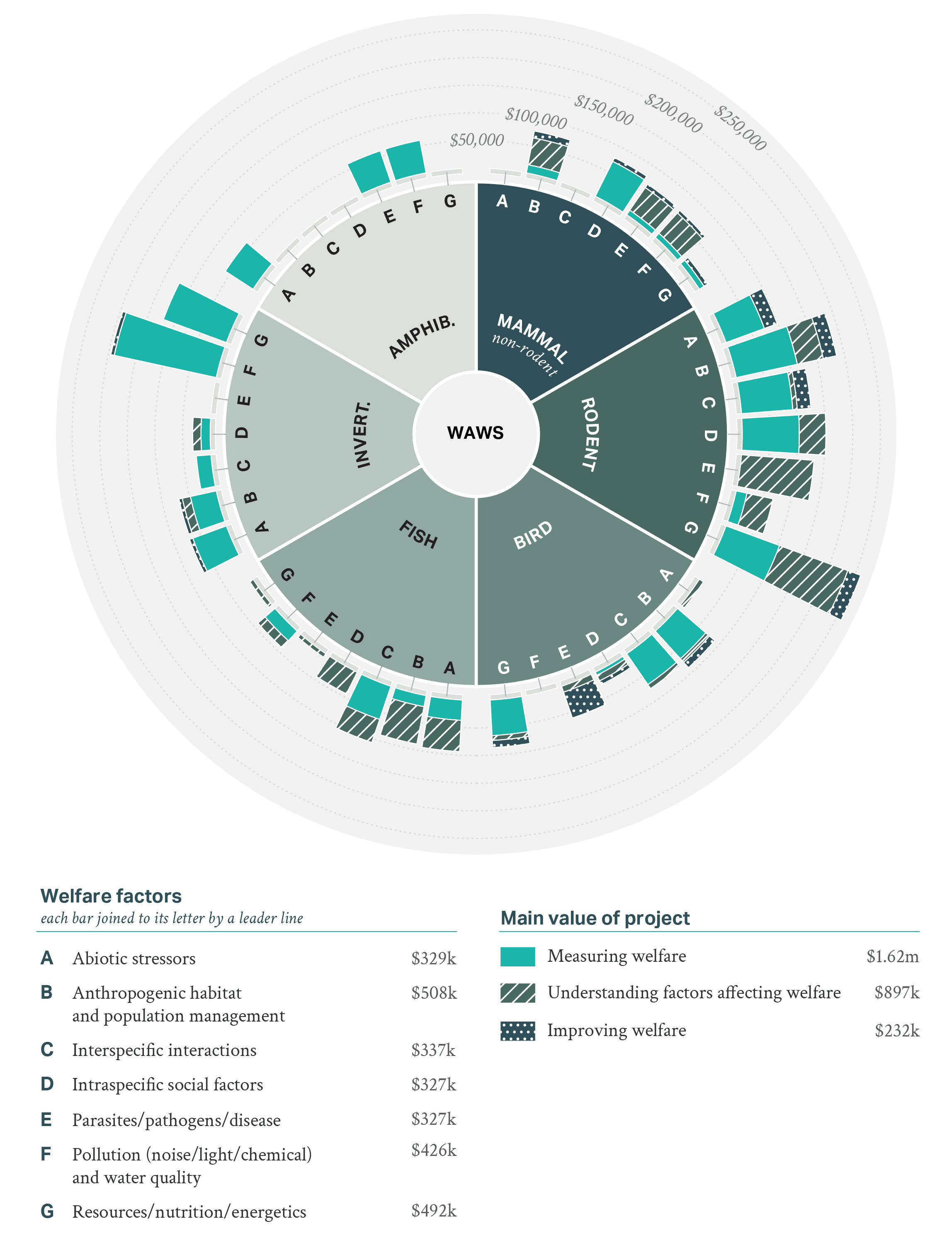
This post will summarize the trajectory of Wild Animal Initiative’s field-building for wild animal welfare science so far, along with patterns and indicators we want to see more of going forward. Beginning with an initial phase focused on establishing credibility and awareness of the field, through a second phase that has placed more emphasis on the distinctiveness and broad priorities of the field, we are now moving into a third phase designed to co...

How might EA-aligned orgs in global health and wellness need to adapt calculations of cost-effective interventions given the slash-and-burn campaign currently underway against US foreign aid? Has anyone tried gaming out what different scenarios of funding loss look like (e.g., one where most of the destruction is reversed by the courts, or where that reversal is partial, or where nothing happens and the days are numbered for things like PEPFAR)? Since US foreign aid is so varied, I imagine that's a tall order, but I've been thinking about this quite a bit lately!
Although it's an interesting question, I'm not sure that gaming out scenarios is that useful in many cases. I think putting energy into responding to the funding reality changes as they appear may be more important. There are just so many scenarios possible in the next few months.
PEPFAR might be the exception to that, as if it gets permanently cut then there just has to be a prompt and thought through response. Other programs might be able to be responded to in the fly, but if The US do pull out of HUV funding there needs to be a contingency plan in place. Maybe gaming scenarios is useful there, but only if whoever is gaming it actually has the influence either to fund scenarios that do arise, or informed those that fund. Maybe the WHO is doing this but they aren't very agile and don't communicate much on the fly so it's hard to know
I think pepfar and malaria tests and treatment donations are among the most important and large scale funding gaps that need to be considered responded to in the short term. Even if stocks remain for the next few months, if they aren't delivered because those organizing their delivery didn't have jobs then that's a big problem.
I do think that governments need to take some responsibility too. If you have the medications you probably can switch manpower to delivering them, even if you hadn't budgeted for it because you expected USAID was going to fund that indefinitely. This is the situation for malaria and HIV commodities which are often there in decent quantities but sometimes aren't being distributed effectively right now.
The vast majority of other USAID programs I don't believe are super cost effective, so as super sad as it is that they are gone and no longer helping people, I don't think it's wise to consider covering their funding in most cases as that money would be better spent on more cost effective charities.