Disclaimer: This blog post focuses on a new piece of research from Rethink Priorities. I was not involved with the funding or execution of this research, and therefore write this piece merely as a consumer. However, I am the Executive Director of Giving Green and a board member of Rethink Priorities, and acknowledge that these affiliations may bias my interpretation of the work.
TL;DR
- New research from Rethink Priorities seeks to compare cost-effectiveness of high-impact giving in climate change mitigation versus global health and development.
- Key research contribution is re-calculating the social cost of carbon using an EA-aligned value framework, which allows direct comparison of climate giving opportunities to Coefficient Giving’s (CG) funding bar
- Conclusion is that donating to high-impact climate funds (such as Giving Green or the Founder’s Pledge Climate Fund) is competitive with Coefficient Giving’s Global Health and Wellbeing Fund, especially given the recent drop in CG’s funding bar
- Many conversations with AI lab employees lead me to believe that climate is not a priority cause area for this group. As opposed to many other EA-aligned cause areas, I think that climate mitigation is unlikely to be saturated by the hypothetical flood of AI-fueled donations. Therefore, it is likely to become relatively even more cost-effective compared to traditional EA causes.
Introduction
Over time, there have been numerous discussions on how climate change mitigation should rank as an EA cause. For instance, in his influential Climate Change and Longtermism, John Halsted writes, “In my view, climate change is one of the most important problems in the world, but other problems, including engineered viruses, advanced artificial intelligence and nuclear war, are more pressing on the margin because they are so neglected.”
That being said, many donors have a near-to-medium term view and therefore may be directly comparing donating to climate mitigation (for instance, through the Giving Green Fund or the Founder’s Pledge Climate Fund) to global health and development (GHD) options such as giving through Coefficient Giving’s Global Health and Wellbeing (GHW) Fund or Givewell’s (GW) Top Charities Fund. Yet until recently (to my knowledge) there was no quantitative work doing this cross-cause comparison.
That’s why I was delighted to see new research from Rethink Priorities (Clare and Vargas 2026) that seeks to quantitatively compare the cost-effectiveness of GHW interventions to climate mitigation, specifically by comparing the benchmark of 1-2 dollars/tCO2e sought by the climate funds to the “funding bar” of Coefficient Giving/Givewell. The crux of this comparison lies in the calculation of the “social cost of carbon” (SCC), or the amount of societal damage caused by a ton of CO2 emissions. The findings: climate donations are competitive with GHD, and are more cost-effective than GHD under certain sets of assumptions. This is particularly true now that Coefficient Giving has lowered their funding bar by roughly half, due to “growing expectations of future giving” (presumably from AI Lab employees).
How to compare climate to GHW: Use SROI
When comparing climate mitigation to GHW, Rethink’s approach is to calculate the social return on investment (SROI) of climate funds, and compare it to CG’s funding bar. For CG, their “funding bar” is expressed explicitly as an SROI. In the Rethink paper, CG’s funding bar is stated as 2000x, but CG recently updated it to 1000x. In other words, they expect that for every dollar granted, they will get (in expectation) 1000 dollars worth of value (which could come from saving lives, improving health, improving livelihoods, etc.) Since CG attempts to fund GW until their funding bars are equal, we can assume 1000x to be a good approximation of GW’s marginal funding SROI.
To calculate the SROI of climate interventions, the authors use two parameters:
- Cost effectiveness of climate philanthropy, expressed as the amount of USD required to reduce a tonne of emissions ($/tCO2e)
- Social Cost of Carbon (SCC), which is the total cost (including lives lost, economic damage, etc), expressed in $/tCO2e
The ratio of (2) to (1) gives the amount of societal benefit from spending a dollar on climate philanthropy. For instance, if philanthropic opportunities can be bought for $1/tonne, and the SCC is $200/tonne, then the SROI of this investment is 200x.
To estimate the cost-effectiveness of climate philanthropy, Rethink takes the approach of drawing from a distribution spanning $.50 and $3.50 (cost per tonne of CO2e avoided). Cost-effectiveness estimates in this space are highly uncertain, but Giving Green’s modeling suggests that opportunities exist at around $1/tonne, and we use this as a rough benchmark when assessing grantmaking opportunities. The prospect of $1/tonne also surfaced in Rethink’s research, as quoted below:
“In our conversations and research, multiple individuals expressed confidence in being able to find interventions at a cost of roughly $1/tonne or even lower. However, because we maintain significant uncertainty about how realistically these opportunities might scale, we wanted to apply a reasonable, perhaps slightly conservative, lean to our abatement costs.”
The Key Parameter: Social Cost of Carbon
The most difficult parameter in making this comparison is the social cost of carbon, which is hotly debated in the climate literature. Therefore, Rethink makes the comparison for different assumptions of SCC.
One issue with using SCCs from the literature is that they rely on assumptions that are standard in the economics literature, such as a modest discount rate. However, these assumptions invalidate a direct comparison to the CG bar. In my mind, the biggest contribution of the Rethink paper is the recalculation of a prominent SCC using “an EA valuation framework” that makes it comparable to the CG bar. This involves changing four main inputs into the SCC:
- Assuming equal valuation of lives/Disability-Avoided-Life Years (DALYs) globally
- Application of a "Social Discount Rate" with a Pure Rate of Time Preference (PRTP) of zero (most mainstream analysis uses a positive PRTP)
- Weighting of damages such that X dollars of loss are weighted higher for poor people than for rich people. (This is based on CG’s assumption of logarithmic utility, explained here.)
- Integrating estimated deaths from air pollution, which are not incorporated into standard climate damage models.
These adjustments, along with some other minor ones, make a meaningful difference. A frequently-cited SCC from Rennert el at (2022) is $185/tonne, which was used by the Biden EPA. However, the adjustments of applying the “EA Evaluation Framework” cause the SCC to rise to over $2000/tonne.
Main Results
The paper’s results explore how the comparison between climate and GHD shifts under a number of assumptions, of which I highlight a couple that I think are most relevant. The first is a simple comparison of the CG bar to the “mainstream” adjusted SCC. This mainstream SCC ($2000/ton, discussed above) accounts for the impact of lives lost, as well as economic impacts from agriculture and sea-level rise. I reproduce this comparison from the Rethink paper below:
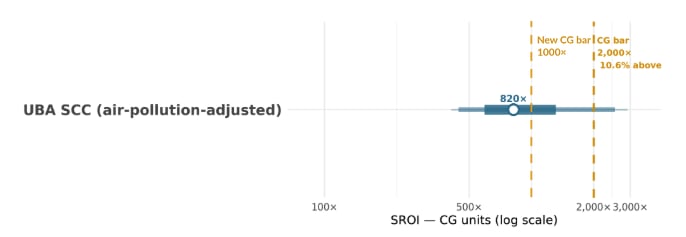
Adopted from Clare and Vargas (2026). New CG Bar added to graph
Under the old CG bar, CG investments were roughly 2.5x more impactful than climate investments, though the error bars overlapped. However, the new CG bar is very close to the climate SROI, well within the estimates’ range of uncertainty.
A primary criticism of “mainstream” approaches to SCC such as Rennert et al. (2022) is that they assume exogenous growth and then model economic damages as a percentage of GDP. In other words, the models allow climate to affect levels of GDP, but not growth. This “levels not growth” assumption of standard models has been strongly criticized by many prominent economists, who find it unbelievable that the major societal shifts brought on by climate change will not affect growth.
If we do assume that climate change affects growth, this massively increases SCC. The Rethink paper surveys the literature on economic growth effects of SCC and finds quite a range of estimates, so they present a few outcomes, shown below. 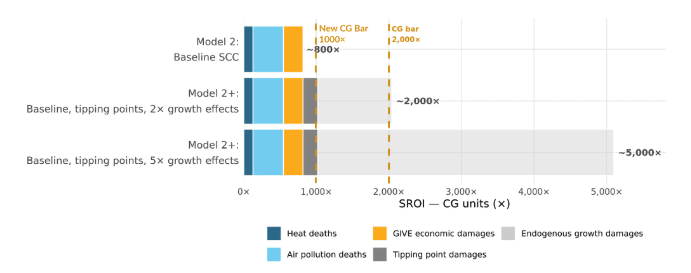 Adopted from Clare and Vargas (2026). New CG Bar added to graph
With economic growth (as well as a modest 25% adjustment for “tipping points”) added to the SCC, climate interventions now easily beat the CG bar. Depending on the assumptions around growth, climate is roughly 2-5x more impactful than CG’s new bar.
Why might this be wrong?
The comparison of climate to GHW is based on quite a few assumptions, which may drive incorrect answers. Critically, both key parameters—cost-effectiveness of climate philanthropy and the social cost of carbon—come with great uncertainty.
At Giving Green, we do a lot of modeling of the cost-effectiveness of climate donation opportunities, and I will be the first to admit that the modeling is very uncertain. Most of the organizations we support have long theories of change involving policy and/or technology change. Therefore, the models come with many assumptions that could be incorrect. However, we have seen many opportunities that pencil out in the $1/tonne range, making us feel more comfortable that this is an achievable threshold.
Additionally, the social cost of carbon is a difficult-to-calculate parameter that comes with substantial uncertainty. Complex systems, such as behavior of ice melt from glaciers, and the earth’s changing reflectivity, could have large human effects that are not incorporated in current damage models. Additionally, it is very hard to predict how human adaptation and technological progress will allow society to adapt to changing temperatures.
Given these fundamental uncertainties in climate philanthropy, donating to climate is definitely more uncertain than donating to GiveWell Top Charities. It is probably more uncertain than donating to GW “all grants” or CG’s GHW fund, but this is less clear because some of the grants made from these funds also rely on uncertain theories of change, such as policy change.
Conclusion
Many in the EA community tend to believe that donations to climate organizations are not competitive with other near- or medium-termist opportunities. This new research shows that is not clearly the case, and that climate appears competitive with EA-aligned GHD options such as Givewell.
In the near term, cause areas traditionally favored by EA (such as GHD) are expecting a flood of money, which will likely saturate grantmakers, and reduce the marginal cost-effectiveness of additional contributions. We see this dynamic already, with CG recently lowering its funding bar by half (from an SROI of 2000x to 1000x).
This dynamic is unlikely to affect climate grantmaking in the same way. Many conversations have led me to believe that climate is not a priority cause area among most early AI lab employees, meaning it is unlikely that the anticipated upcoming wave of philanthropy will saturate climate funds the same way it will other causes. Therefore, I think climate will remain cost-effective on the margin, and over time will become relatively more attractive in comparison with other favored EA causes.
As of now, EA-aligned climate grantmaking is far from saturated. Over at Giving Green, we have built up a 6-person research and grantmaking function, and are on track to make ~34 million in new grants from the Giving Green Fund in 2026. Much of this grantmaking is fueled by a large gift we received in 2025, and we are on track to meet our goal of completely regranting this large gift, as well as all other assets currently in our fund, by the end of 2026. This leaves us with plenty of grantmaking capacity for late 2026 and 2027- we think at our current staffing levels we could make 100M of grants in 2027, and could also increase staffing to create more capacity.



(I manage the FP Climate Fund, so my incentives run counter to my take). I hadn't had the time to examine this paper in detail, but I am quite skeptical of this Rethink Priorities paper. I think it is quite easy to string together assumptions that yield a high social cost of carbon, but I wouldn't treat this as an unbiased estimate.
For example, if I understand this correctly based on your description, they use the Rennert et al (2022) paper to derive the SCC from which they make adjustments.
https://www.nature.com/articles/s41586-022-05224-9/figures/1
The assumptions of that paper are clearly extremely pessimistic, probably by 2022 standards, but definitely by what would now be the consensus view.
For example, they assume close to 20/Gt annual emissions in 2100 as their median scenario and high emissions continue well into the 23rd century. In other words, we are more than a 100 years late in achieving net-zero in their median scenario despite all technological trendlines rendering this quite implausible.
Combining this with a low discount rate will give a high SCC, but I don't think this is close to a reasonable baseline for what a median expectation should be. (Obviously good to have a low discount rate from an EA perspective, but this requires that the modeling of the future is a bit more careful). Essentially, this means that most marginal carbon reduction modeled for the SCC will happen in worlds where this is implausibly valuable thereby inflating the SCC value.
This alone probably leads to an overestimate of the SCC of a factor of 5x or more and this came up from looking at the paper for 5min.
Thanks for the comments.
A couple of quick responses.
It is certainly true that there is high uncertainty around the SCC, and a wide range of estimates. But the Rennert et al (2022) paper is just about as mainstream, “blue-chips” of an estimate as you are going to get, and therefore I think is a reasonable anchor for the Rethink analysis.
A few data points showing how popular the Rennert et al (2022) analysis is (and the underlying GIVE model plus the probabilistic assumptions on emissions pathways that underpin it):
Of course this doesn’t mean the paper or its estimated SCC is “right”, but I do think it’s a highly defensible reference SCC for Rethink’s analysis. As correctly mentioned by Vasco, there are numerous critiques of the Rennert paper, arguing that a lower SCC is more appropriate. But there are also influential critiques in the other direction. In the post I discussed how incorporating effects on economic growth can lead to much higher SCCs. For instance, a recent paper by Bilal and Kanzig (2026) argue for a much higher SCC of $1200 (even assuming a 2% discount rate).
If I understand correctly, Rennert et al (2022) use distributions of future states of emissions based on Rafferty et at (2017), which use historical data to assign probability distributions to the different IPCC emissions scenarios. If historical trends are not good predictors of future ones (for instance, due to rapid technological advancement), these estimates could be off.
Personally I’d agree with Johannes that the Rennert future emissions distributions feel pessimistic, but I would not agree with the modifiers "clearly extremely". I think their mean estimate would fall within one standard deviation from the mean in my personal distribution.
But in any case, one could re-do the analysis with more optimistic distributions. Resources for the Future has a handy calculator that allows one to re-calculate the SCC with different models and different parameters. If we switch from the emissions distribution in Rennert (RFF-SP) and instead move to the more optimistic SSP-2 (which is the closest option to my beliefs, though I’d still be a bit more optimistic), SCC falls by 15%, from 185 to 158. Unfortunately the calculator does not allow us to move the discount rate to zero [edit: actually, we want to move the pure rate of time preference to zero, not the discount rate], which is really what we need to test the sensitivity of the Rethink estimate to different emissions futures. One would need actually re-run the models to calculate exactly, but a 5x wedge feels quite off to me.
Thanks, Dan, for your reply. I think I still disagree pretty strongly and I’ll briefly outline how and why: (1) I don’t think we should give credence on studies based on government usage, (2) 22 century emissions are clearly very implausible, (3) there are reasons for this to really matter and (4) being able to find this in 5min should make us deeply skeptical of the wider paper. (5) As you, I deeply care about effective climate action but I don’t think we should propagate bad evidence to inflate the importance vis-a-vis other causes.
I think the answer is pretty clearly “no”.
As you also mention, SCCs are inherently very uncertain estimates, but they also are clearly political projects; they are often produced or at least amplified to serve political purposes such as justifying more or less ambitious policies.
Given the biases in the climate science community, I think it is upon us to evaluate studies on their merits and to not assume that studies that are well-cited or used by climate hawkish administrations are therefore inherently more credible.
In case that sounds conspiratorial, it’s worth remembering that RCP 8.5 (the most extreme emissions scenario by the IPCC) was essentially abused prominently for 5-10 years as a baseline after it was obvious to all serious observers it was not a baseline but worse than a conceivable worst case scenario.
Given this record of the emissions scenario modeling community, we should always check what they assume.
This is obvious to Dan, but for the wider group. The reason the 22nd emissions are so implausible is because they essentially assume that nothing much changes by the 22nd century, 3-5 investment cycles from now. Yes, decarbonizing the world by 2050 might be hard, but decarbonizing the world by 2100 or 2150 is not hard. It’s simply not plausible to believe in a 22nd century that is both richer than today, a hundred years in the future, exposed to a lot of climate damage, and not able to decarbonize.
This is not about a 15% difference and a 5x over-estimate from this alone is quite plausible. The calculation you run is – as you note – not informative because it ignores the discounting and the implausibility of the Rennert et al paper lies primarily in the 22nd century+ and those will get outsized importance if changing the discounting assumptions.
Yes, by 2100 Rennert looks mildly pessimistic but not widely so, but that’s not the point – once discounting is very low the 22nd century matters and drives most of the result.
The 22nd century is discounted by more than 75% on the RFF explorers lowest discount rate (2%) so this is not a useful tool to explore whether implausible 22nd century assumptions massively inflate the SCC estimate.
And, indeed, we should expect the 22nd century to drive a massive difference when discounting is low. By Rennert et al’s assumption temperature keeps increasing well into the 22nd century, climate damage is non-linear, so on low discounting this will drive a massive amount of the damage and lead to strongly changed estimates.
I am not an economist, but when I Claude the emissions assumptions of the Rennert et al paper and stipulate to make conventional assumptions about climate damage at 0 discount rate, 96% of the damage is after 2100.
https://www.nature.com/articles/s41586-022-05224-9/figures/1
And we can see here why this is. In the Rennert world temperature keeps rising till after Captain Kirk with 25% probability mass above 4.5C. This is very different from what I think we both believe about the future.
This goes beyond this one example I picked this example because it was quick for me to find, having seen this pattern (making deeply implausible assumptions in papers that get a lot of policy traction) so often. But I am sure one could find other instances. The point that it is so easy to find a highly biased assumption cited as mainstream evidence is that one should distrust the broader paper more.
Why I care As you and many readers here, I deeply care about effective climate action and we are together on this project of making the climate response more effective.
But I do think we should not propagate bad evidence to inflate the importance of climate vis-a-vis other causes in the same way that we would also – and correctly – criticize a motivation of AI risk that only relied on Yudkowsky’s p(doom) estimate.
Implausible assumptions rarely come alone and when a paper makes such implausible assumptions (that are not simpler than more reasonable assumptions, i.e. this is not driven by parsimony) then I think we should be quite skeptical of the conclusions of that paper.
Thanks so much for interacting with our work. For broader context around this report, it’s important to note that our approach from the outset was to build a series of models to show what you would need to believe for climate to be competitive with GHD. We therefore aren’t wedded to any particular SCC, and certainly can imagine different ways of approaching the problem.
To your specific points:
Overall, we think our analysis at least supports the re-visiting of climate as a cost-effective cause area within the EA space and we appreciate the various thoughtful comments so far. Thank you for engaging!
Hi Johannes, thank for all the detailed thoughts. I think we're probably reaching diminishing marginal returns in debating point by point. I will say that we agree that the Rennert et al projections are too pessimisitic, and difficult far future projections can matter a lot with low discounting. Though I think we will need to agree to disagree on the magnitudes of these changes.
There is one technical point that I'd like to bring to your attention, though, that I think does critically matter. The Rethink application of a new discount rate is NOT a 0% discount rate. It is a 0% "rate of pure time preference", which is one component of the discount rate. (I'm going to modify my original post to clarify.) Rethink's calculation is built on calculations from the German Environmental Agency, so I will directly reproduce their explanations for how they did discounting:
"we use the social discount rate developed by Frank Ramsey (Ramsey 1928), which combines the two aspects above: expected consumption growth, weighted by its effect on the marginal utility of consumers, and the pure rate of time preference (PRTP).
In the GIVE model the consumption growth rate is a dependent variable. Therefore, it is not possible to specify the exact discount rate used for the climate costs"
I am not familiar enough with these models to get a good intuition for what discount rate would be, and therefore how much weight will be places on the far future. But as a reference, the Stern Review also used Ramsey discounting and a low (.1% PRTP), and resulted in an overall discount rate of 1.4%.
All of this to say, I think a simple mental model of "no discounting", and therefore the vast majority of damages being in the far future, is not a good description of the Rethink analysis.
Hi Johannes.
I agree. Here is a critique of Rennert et al. 2022 by David Friedman.
The values of 17.1 and 36.6 $/t above respect representative concentration pathways (RCPs) 4.5 and 8.5. I think RCP 4.5 is much more plausible trusting the temperature changes below from Wikipedia.