Comments
Dietary Choices: A Multi-objective Optimisation Problem

Note: This post is written in a personal capacity. The views expressed here are my own and do not represent those of any organisation I’m affiliated with. I'm grateful to Elizabeth Crewe, Melanie Joy, Tobias Leenaert, and Felix Werdermann for their valuable input and feedback, which does not imply endorsement of the views presented. The footnotes provide additional context, clarify assumptions, and offer illustrative examples where helpful.
In this post, I explore how we can think more systematically about our dietary choices by making the underlying assumptions and trade-offs explicit. My aim is not to promote a particular diet, but to provide a framework that helps people make choices that align with their own worldviews and individual circumstances, and that also helps identify the sources of disagreement about those choices.
Our dietary choices have profound consequences on both our own lives and the world around us. At the same time, the question of which diet is “best” has no simple answer. Every diet involves trade-offs between competing objectives, and our conclusions about which diet is preferable depend on our normative and empirical assumptions:
For example, how much personal sacrifice we should be willing to make in order to reduce our environmental footprint is a normative question, whereas to what degree a particular diet impacts the environment and requires personal sacrifice are empirical questions.
This distinction between normative and empirical assumptions provides the basis for separating value judgements from factual claims.
The figure below presents one possible model for evaluating dietary trade-offs under a particular set of normative and empirical assumptions. Those assumptions are as follows:
Normative: The objectives are to minimise harm to others, health risk to ourselves, and the effort required to follow the diet. The objectives are intentionally broad so that virtually any consideration relevant to dietary choices can be expressed in terms of one or more of them.[1] Their relative weighting is deliberately left unspecified.
Empirical: Different dietary patterns perform with respect to these objectives according to the displayed curves. The curves represent the expected outcomes of reasonably well-planned implementations of each dietary pattern under conditions typical of high-income countries, rather than their most common or best possible implementations.[2] [3] [4]
The vertical dimension is intended to convey the qualitative rather than quantitative features of the curves. The dietary spectrum is intentionally open-ended in both directions, as any choice of endpoints would be arbitrary.[5] While different assumptions would lead to different curves, I expect a similar pattern to emerge from a wide range of plausible worldviews and individual circumstances.
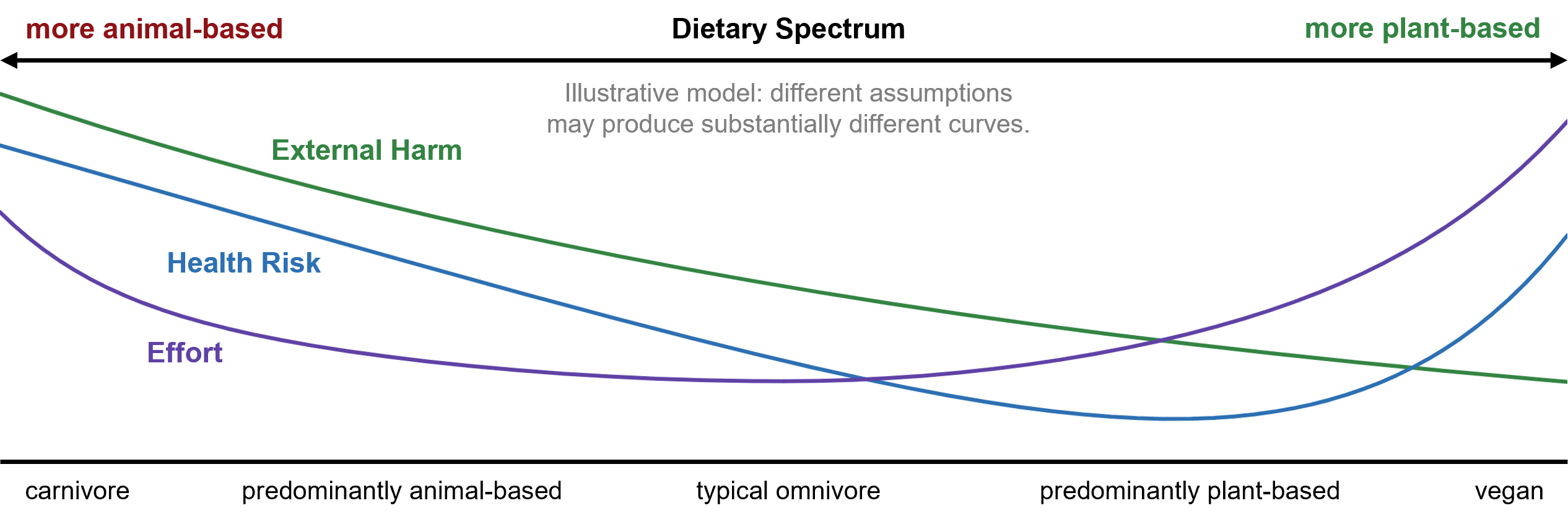
The qualitative features of each curve are based on the following reasoning:
External Harm: As diets become increasingly plant-based, they generally reduce animal suffering, climate change, biodiversity loss, pollution, public health risks, food insecurity, and other harms associated with animal agriculture.[6] [7] This is a broad approximation, since individual foods can deviate substantially from this pattern depending on how sustainably they are produced and, in the case of animal-based foods, their welfare standards.[8] While dietary choices may also indirectly affect external harm by influencing the dietary choices of others, these effects are treated as net neutral given uncertainty about their direction and size.[9]
Health Risk: Moving away from diets high in animal-based foods towards more plant-based diets tends to be associated with better health outcomes. However, as diets approach the vegan range of the spectrum, meeting nutritional needs becomes more challenging because certain nutrients are less abundant or less bioavailable.[10] This is a broad approximation, as nutritionally optimised diets and favourable individual biological predispositions can meaningfully reduce health risk on either side of the spectrum.[11] More generally, there is greater uncertainty about the health outcomes of dietary patterns that substantially restrict or eliminate food groups that have formed part of the human diet throughout evolution, particularly with regard to long-term health and critical life stages such as pregnancy, infancy, childhood, and adolescence. This reflects both the limited evidence base for comparatively novel and rare dietary patterns and the broader methodological limitations of nutrition science.[12] A greater health risk is therefore assigned to dietary patterns at either extreme of the spectrum.
Effort: The more a diet deviates from the norm in a given context, the greater the associated costs tend to be in terms of time, money, attention, as well as psychological and social costs related to factors such as culinary enjoyment, culture, community, or identity. Notably, reducing the consumption of animal-based foods is usually more demanding than increasing it because doing so requires suitable alternatives that may be less accessible.[13] Taken together, this is again a broad approximation, since supportive social and food environments can meaningfully reduce the effort required at any point along the spectrum.
Importantly, these objectives are not entirely independent. For example, health matters not only for our individual well-being but also because it keeps us physically and mentally capable of doing good over the long term. Likewise, effort not only affects our quality of life but also creates opportunity costs, as the resources it requires could often create a greater positive impact if directed elsewhere. Moreover, the health outcomes and perceived effort associated with a dietary pattern influence whether others view it as desirable and feasible, thereby affecting its potential for wider adoption. Accordingly, both objectives have instrumental value insofar as they can contribute to reducing external harm, making it less plausible to assign them negligible weight.
Although the framework has been presented in terms of overall dietary patterns, it can equally be applied to individual meals or even individual foods, as the same trade-offs apply at those levels. After all, dietary patterns are simply the cumulative result of those choices.
It is worth emphasising that the normative and empirical assumptions underlying this model are open to reasonable disagreement. They are also likely to evolve over time. For example, advances in nutrition science, progress in alternative proteins, and improvements to food environments could significantly reduce the health risk and effort associated with vegan dietary patterns in the future. Because different assumptions may lead to substantially different curves, I invite everyone to consider how they would draw the curves based on their own worldviews and individual circumstances.
Making dietary choices requires balancing competing objectives under substantial uncertainty. My hope is that the framework outlined here helps people take a more systematic approach by making the underlying assumptions and trade-offs explicit, so they can make decisions that truly align with their values, beliefs, and circumstances. Beyond that, I hope it also contributes to a more nuanced conversation about dietary choices by helping distinguish disagreements about values from disagreements about facts.
On a more personal note, I think of my own dietary choices as a continuous process of learning, reflecting, and updating my views. Throughout this process, I do my best to remain epistemically humble, impartial, and committed to doing the greatest overall good I can. I recognise that not everyone is able or willing to devote this much time to thinking about their dietary choices, nor do I believe it would be the most effective use of everyone's time. For me, however, this topic has become both a professional focus and a personal passion, making this ongoing exploration a more than worthwhile pursuit.
The three objectives represent one of many possible decompositions of the considerations relevant to dietary choices. For example, external harm could be further decomposed into animal suffering, environmental footprint, and other harms. This can reveal trade-offs between different types of external harm that are hidden when they are aggregated into a single objective. The "small body problem" illustrates this: Pasture-raised beef may involve much less animal suffering than factory-farmed chicken because far fewer animals are needed for the same amount of meat, and those animals generally have better lives. However, it may result in a much larger environmental footprint due to higher greenhouse gas emissions. Notably, this assessment is contingent on the nontrivial empirical assumption that the resulting climate change does not cause sufficiently large amounts of wild animal suffering to outweigh the reduction in farmed animal suffering. In general, a more fine-grained decomposition can be particularly useful when evaluating individual foods, whereas the decomposition into external harm, health risk, and effort provides a higher-level perspective on the trade-offs between overall dietary patterns.
Dietary patterns can be implemented in many different ways and therefore perform substantially better or worse with respect to any given objective. For example, one vegan diet may broadly follow a "grains, greens, and beans" approach, while another relies heavily on ultra-processed foods high in fat, salt, and sugar. Similarly, one omnivorous diet may consist primarily of factory-farmed meat and dairy, while another prioritises sustainably caught fish and eggs from mobile pasture systems. Such differences can significantly affect the external harm, health risk, and effort associated with a dietary pattern. More broadly, greater effort often allows a dietary pattern to perform better with respect to external harm and health risk. For example, spending more time on meal planning or supplementation can reduce health risk, while spending more money on higher-welfare animal-based foods can reduce external harm.
The curves also incorporate assumptions about how uncertainty should be accounted for when evaluating dietary patterns. For example, the health risk curve assumes that greater uncertainty about long-term health outcomes should itself contribute to health risk. Likewise, the external harm curve may assume that more indirect and longer-term harms, such as climate change or biodiversity loss, should be discounted to some degree relative to more direct and immediate harms, such as animal suffering, insofar as they are subject to greater uncertainty. Different ways of accounting for uncertainty would therefore result in differently shaped curves.
Although the curves could be aggregated into a single curve once relative weights have been assigned to the different objectives, this is deliberately omitted because doing so could inadvertently endorse one particular weighting and imply a level of quantitative precision the model is not intended to convey. Accordingly, each curve should be interpreted on its own scale in the vertical dimension, so their relative heights do not imply any particular weighting between the objectives.
Veganism illustrates this well because it is an inherently fuzzy concept. Even foods that contain no animal-derived ingredients still involve harm to animals through indirect effects such as climate change, habitat loss, crop deaths, or the use of animal-derived inputs in production systems and supply chains. For any given implementation of veganism, it is possible to imagine another one that takes additional higher-order impacts into account and thereby further reduces harm to animals. Any choice of an endpoint, such as the common definition of veganism in terms of purity at the level of first-order impacts, therefore involves an arbitrary decision.
More plant-based diets often also include more alternative proteins. Greater demand for these products may help accelerate the transition away from factory farming and thereby indirectly reduce external harm over the long term.
Completely eliminating external harm may be fundamentally impossible. Simply by existing, we compete with other sentient beings for limited resources. Accordingly, the external harm curve has a positive lower bound rather than reaching zero.
For example, some animal-based foods, such as mussels, oysters, or small pelagic fish, often cause less external harm than many plant-based foods, while under a narrower set of conditions the same may be true of backyard eggs. Such cases arise because the direct harms caused to animals represent only the first-order impacts of a dietary choice, which may be outweighed by higher-order impacts, such as climate change, biodiversity loss, or wild animal suffering. This is particularly the case when foods are compared on the basis of nutritional value rather than weight or calorie content. Dietary patterns may therefore result in substantially more or less external harm than suggested by the curve depending on the specific foods they contain.
For example, many people see veganism not merely as a way of eating, but as an ethical principle according to which animals should not be viewed as resources. The resulting identity and strong commitment to this principle can make veganism appear meaningful and aspirational to some, while making it appear isolating and restrictive to others. Whether these influences ultimately encourage or discourage others depends on how they are perceived, which varies substantially across individuals and socio-cultural contexts.
This includes nutrients such as protein, vitamins A, D, B2, and B12, calcium, iron, iodine, zinc, selenium, choline, and the long-chain omega-3 fatty acids EPA and DHA. It also includes bioactive compounds predominantly found in animal-based foods, such as creatine, carnitine, carnosine, taurine, and anserine, which are sometimes referred to as "carninutrients" and whose physiological importance beyond what the body can synthesise remains uncertain. Meeting nutritional needs in increasingly plant-based diets therefore relies more heavily on careful food selection, supplementation, and endogenous conversion and synthesis. Notably, the efficiency of these endogenous processes depends in part on individual biological predispositions, for example in the conversion of beta-carotene to vitamin A or alpha-linolenic acid to EPA and DHA, or in the synthesis of carninutrients from amino acids.
For example, dietary patterns on the animal-based side of the spectrum with a low consumption of processed meats and an emphasis on nutritionally more favourable foods, such as small oily fish and organ meats, would achieve better expected health outcomes than suggested by the curve. Likewise, vegan diets with rigorous supplementation and prioritisation of nutrient-dense foods would reduce, even if not entirely offset, the increase in health risk.
Randomised controlled trials examining the long-term health outcomes of different dietary patterns are generally not feasible. As a result, nutrition science largely relies on observational studies, where factors such as selection bias, measurement error, and confounding limit our ability to distinguish correlation from causation. This makes robust causal inference inherently difficult.
Here, "suitable" refers not only to comparable price, taste, and convenience, but also to comparable nutritional quality. While obtaining sufficient calories is rarely a challenge in high-income countries, reducing the consumption of animal-based foods while still meeting nutritional needs often requires greater knowledge and careful planning.