Hello, thank you for this insightful perspective. I am curious about the alternative you would consider to governance in the absence of institutions centralising authority. There exist many frameworks that seldom have been experimented with, except in small scale, among others: > Direct democratic representation could exist in small city-states, as long as citizens spend a consequential share of their time fulfilling civic duties, thus sacrificing other activities for the sake of being involved in the governance process. > A state of anarchy (with no socio-political hierarchy), where communities/families would be self-governing and autonomous, assuming they would be peaceful enough to maintain the balance.
Are there other options that could stand human psychological biases, and practically cope with modern-time capacities (such as with the internet, complex interdependent global markets, etc.)?
Are there other options that could stand human psychological biases, and practically cope with modern-time capacities (such as with the internet, complex interdependent global markets, etc.)?
No state has genuine authority. But most people think they do. Most think we’re obligated to obey even bad laws. When someone (other than ourselves) breaks the law, we think it appropriate for agents of the state to punish that person, even if we disagree with that particular law. I have heard that it is nearly impossible to get a jury to consider nullification of bad laws, because almost all jurors think they “have to” help enforce the law.
Why? The arguments for government authority are very weak (see here and here). I turn instead to psychological explanations, drawing on social psychology …
1. The Milgram Experiment
1.1. Setup
In the 1960’s, Stanley Milgram collected volunteers for a study “on the effect of punishment on learning.”
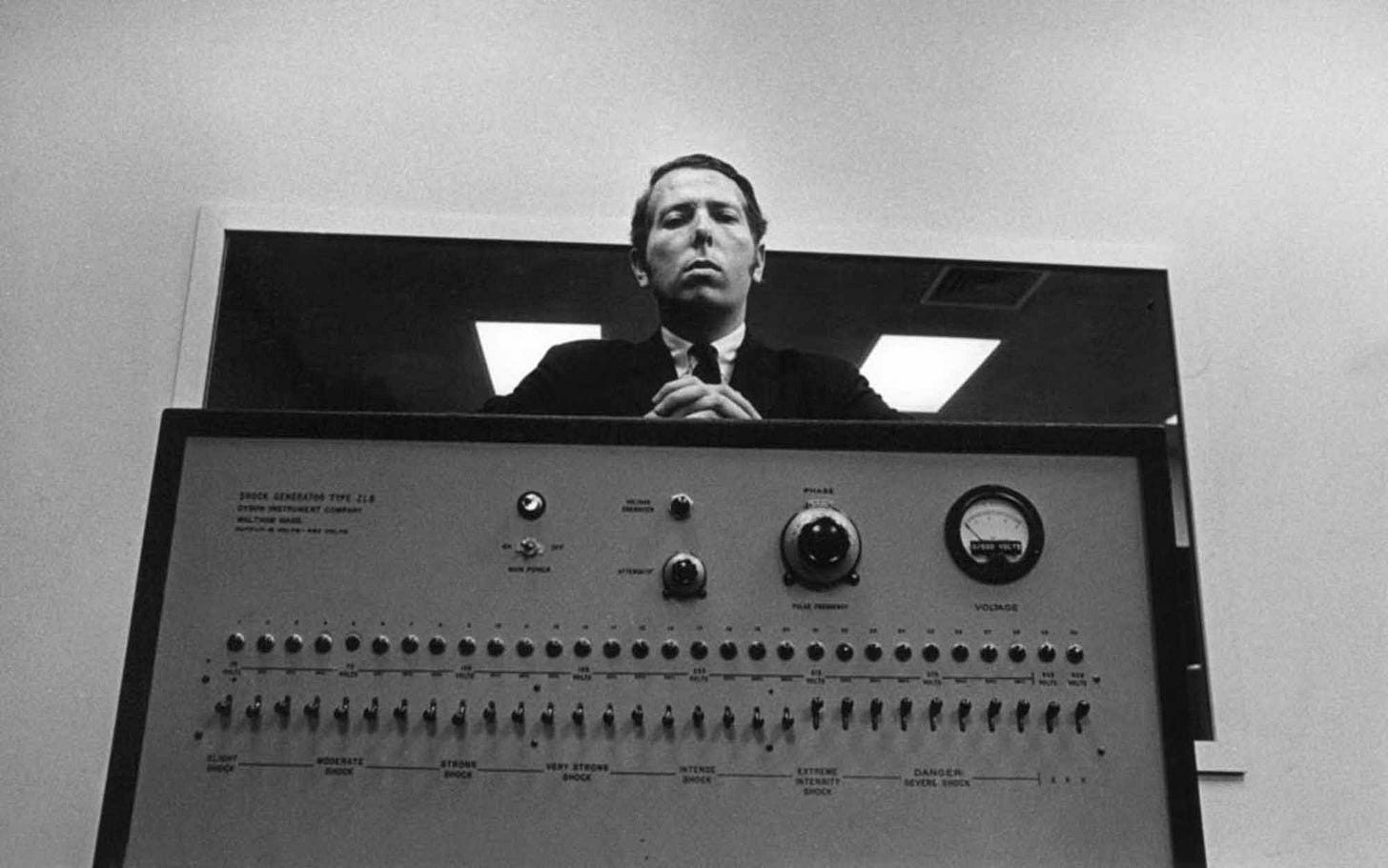
You show up and meet the experimenter and another volunteer. You’re told that you’re going to play the role of “teacher” and the other volunteer the role of “learner”. The experimenter straps the learner into a chair, with electrodes attached to him. You, as the teacher, are to read information to the learner from an adjoining room, then quiz him. When the learner makes a mistake, you are to press a button on a machine to administer an electric shock to the learner. With each mistake, you are to increase the voltage by 15 volts. The machine has settings from 15 to 450 volts, with qualitative labels ranging from “Slight shock” up to “Danger: Severe shock”, followed by “XXX” for the last two settings. The experimenter lets you feel a sample 45-volt shock, so you know the shock-generator is real and what it feels like.
It turns out that the learner is really bad at learning. He keeps making mistakes, and you keep having to increase the voltage. The learner starts to cry out in pain. At some point, he demands to be released. The experimenter insists that you continue. At some point after that, the learner refuses to answer anymore. The experimenter tells you to treat the absence of an answer as a wrong answer and continue with the procedure. Later, the learner goes completely silent. Eventually, you get up to the maximum (450 volt) setting on the machine. The experimenter tells you to keep using that setting.
After you administer three 450-volt shocks, the experimenter tells you the experiment is over. This was actually an experiment on obedience. They wanted to see what a scientist in a white lab coat could get people to do just by insistently ordering them. The learner was actually a paid actor who was not really being shocked and thankfully is fine.
1.2. Results
When told about this setup, most people think the teacher will refuse to continue after the learner demands to be released, and no one thinks that they themselves would continue all the way. In fact, two thirds of people go all the way, administering three 450-volt shocks to a silent and possibly lifeless victim. The subjects protest verbally, but when the experimenter insists that they have no choice but to continue, they go back to following the procedure.
1.3. Lessons
People have a psychological drive to obey authority figures, even when their commands are obviously morally illegitimate. (I assume no philosopher is going to start devising theories about why the experimenter was really entitled to demand that the teacher electrocute the learner.) This drive is activated when you are confronted with the authority figure. When you think about the situation abstractly, you can see that it’s wrong to electrocute the learner, but when actually confronted with the experimenter’s demands, you feel like you “have to” obey.
This resembles how, when confronted by the government, people feel as though they “have to” obey the government. It’s likely that they would feel this way even if (as I claim) the government is illegitimate.
Milgram explicitly draws the parallel to Nazi Germany, where people followed the government’s commands to the point of murdering millions of helpless others.
Not only dictatorial governments can have this problem. We see something similar in incidents such as the My Lai Massacre during the Vietnam war. There, American soldiers followed orders to massacre a village of Vietnamese civilians. Some soldiers, who didn’t want to participate, avoided the area of the massacre, but hardly anyone actually tried to help the villagers. One helicopter team helped by protecting some villagers from the other soldiers and flying the villagers to safety. In the U.S. at the time, the captain of the helicopter team, Hugh Thompson, was reviled as a traitor for interfering with the massacre. Decades later, he was honored as a hero.
One of the lessons is the extreme dangerousness of the belief in authority, which can be used to get people to commit horrible crimes, up to and including genocide.
2. Stockholm Syndrome
2.1. The phenomenon
In a famous bank robbery in Stockholm, Sweden, in 1973, two robbers took four bank employees hostage in the bank vault for several days. During the siege, the victims developed an emotional bond with their captors and started to share the robbers’ perspective. At one point, they thought the robbers were protecting them from the police; at the end, they refused to leave the vault without the robbers, for fear that the police would shoot the robbers. At one point, one of the robbers threatened to shoot a hostage in the leg; the hostage later recalled thinking that the robber was kind for only wanting to shoot him in the leg, rather than kill him.
This sort of emotional bond between kidnapers and their victims, or “Stockholm Syndrome,” has been observed in many cases. FBI training informs hostage negotiators of this and recommends encouraging such bonds, as they reduce the chances of the hostages’ being killed.
2.2. Why?
It may seem odd that you can form an emotional bond with someone who kidnaps you. But this is probably a survival mechanism. Perhaps, over our evolutionary history, humans developed a tendency to bond with and share the perspectives of those who hold great power over us. Through most of our species’ history, there were no modern states, but there were tribal chiefs, warlords, and such. If you disagreed with or disobeyed the chief, and the chief found out about this, bad things were likely to happen to you. So there was selection for something like Stockholm Syndrome.
2.3. Lesson
Perhaps ordinary citizens experience something like Stockholm Syndrome with respect to their governments. Since the government holds great power over us and we have no realistic way of escaping, the government may trigger the ancient mechanism that caused humans to bond with and obey tribal chiefs. Most people don’t exactly form emotional bonds with the state (that would hardly be possible), but they have a tendency to take up the government’s perspective, to side with the government, to obey the government. Hence the extreme difficulty (until recently) of holding police or other government officials accountable for abuse of power.
This may be part of why people are instinctively sympathetic to the government’s claims to authority.
3. Cognitive Dissonance
The theory of “cognitive dissonance” says that people experience an unpleasant state, “cognitive dissonance,” when there is a conflict between their values and their behavior, or their self-image and their behavior, and that as a result, they will sometimes modify their beliefs or other attitudes to reduce that dissonance. It is particularly common to modify our beliefs to make ourselves look better.
Example: you participate in an experiment in which you perform some boring task. The experimenter asks you to tell incoming participants that the task was pleasant. If you do this, you will then experience psychological pressure to convince yourself that the task really was pleasant, so you won’t have to believe that you’re a liar.
Application to government: citizens in modern societies obey government laws all the time, including some that are very onerous and some that we don’t agree with. The main actual reasons for this are (a) fear of punishment, and (b) the sort of blind instinct to obey the powerful discussed above. But those are not very pleasant things to think about ourselves. So we devise a more pleasant account: we obey out of morality. But to sustain this explanation, we have to adopt the belief that the government has a special sort of authority that entitles it to our obedience.
4. Social Proof & Status Quo Bias
“Social proof” is an ironic phrase referring to the tendency of people to believe something because other people believe it. This is related to status quo bias, the widespread tendency to assume that however things are done in your society is the way they ought to be. This is why, across some extremely different cultures, people generally think that the way things are done in their own culture is the right way of doing things.
In the famous Asch conformity experiment, subjects are asked to judge the comparative lengths of lines shown on a screen. In the control condition, they are 99% accurate. But when placed in a room full of people who give the wrong answer out loud, most people will at least sometimes give the same wrong answer as the people around them. In exit interviews, some subjects report that they were just lying to avoid being out of step with other people. Most subjects say they perceived (what was in fact) the correct answer, but they assumed that their perception must be wrong, since so many other people disagreed with them.
In our society, the power and authority of the state is taken for granted. Following the state’s commands and having them tell us all what to do are a huge part of our society’s traditions. So we have a bias toward assuming that that is the right way of doing things. Once enough people think this, or at least act like they think it, there is “social proof” pressure for individuals not to question it.
5. Political Aesthetics
The state uses aesthetics to manipulate our feelings. E.g., they put up statues showing past leaders on pedestals; they have imposing buildings with vaulted ceilings; they have courtrooms that place the judge at the front, on a pedestal; they have uniforms and badges for their agents. They perform rituals such as the President’s “oath of office”, and they have a particular, authoritative way of using language. All of this is designed to give us a general feeling of the great power and authority of the state.
6. Conclusion
Why is all this important? Besides the general interestingness of this aspect of human psychology, this helps in evaluating the arguments for and against political authority. I claim that no state has authority. But most people, including most of the experts on the subjects (which I guess is what political philosophers are) believe in political authority. That is at least some evidence that I’m wrong. It would help to know why other people believe in authority, so we can evaluate who is more likely to be wrong.
The above explanations, I claim, debunk pro-authority intuitions. They show that it would be likely that people would act as though the state has authority even if in fact the state was illegitimate, as long as they had power. The tendency to accept the authority of those in power is caused by non-rational mechanisms that are unlikely to track moral truth.
Note: This post was crossposted from the Coefficient Giving Farm Animal Welfare Research Newsletter by the Forum team, with the author's permission. The author may not see or respond to comments on this post.
Subtitle: On vegan advocacy, effective altruism, and FIFA
I turn 40 today. Here are some hot takes.
On factory farming
1. Our biggest challenge is salience. If factory farming led the evening news, it wouldn’t last lo...
Impressions from the 21st Annual U.S. Cluster Headache Patient Conference, organized by Clusterbusters.
On the morning of the last day of the conference, E. was hanging out with other “clusterheads” outside the conference hotel when he started having a cluster headache attack. Before he could go back to his hotel room, J. offered E. his DMT v...
TL;DR:
The movement has an evidence problem. To solve it, for each intervention we need to know:
* What types of evidence that intervention needs
* What types of evidence different sources can give us
In this post, we outline a framework for evidencing an intervention through five stages:
...




Could you clarify what you mean when you say "no state has genuine authority"? Is this a normative preference, or a falsifiable claim?
Hi Zwibel. Welcome to the EA Forum.
The post was written by Michael Huemer, not me. However, here is context about the quote you mentioned.