I read the Africa Jobs Fund launch with genuine excitement.
I am a public health professional from Lesotho, a small, landlocked LMIC with a GDP per capita of around $1,000. I hold an Audiology degree and MPH and yet, like many educated young Basotho, I cannot be fully absorbed by my country's health system, not because there is no need for my skills, but because the system does not yet have the financing or structural capacity to employ and compensate professionals like me appropriately.
About brain drain-the fear that sending Africa's best people abroad hollows out the continent. To me, this framing assumes those people are currently contributing productively at home. Many of us are not, though we really want to.Take Lesotho's audiology profession. There is genuine need. There are trained professionals. But the system cannot pay them, so they seek opportunities elsewhere or remain unemployed. The question is not "should we keep them home?" The question is "what do we do with talent that the local system cannot yet absorb?"
The answer the Fund proposes- deploy them into high-productivity roles abroad, let them earn, let them send remittances, let them build skills, and trust that many will return - matches what I have observed on the ground. I know health professionals who left Lesotho, worked abroad for years, and came back, not because they were forced to, but because home is home. And they came back better: with experience, savings, networks, and confidence that made them more effective than if they had stayed and struggled.
I am not naive about the risks of labour mobility done badly-exploitative recruitment, workers stranded abroad without support, destination countries benefiting while origin countries bear the cost. The Fund's emphasis on building ethical recruitment infrastructure sounds exactly right.
I am currently in an early stage of building my own career toward global health operations and development. The Africa Jobs Fund represents the kind of structural, systems-level thinking I want to be part of. I'll be watching closely, and hoping to contribute.
Very cool and potentially impactful project! Your team and advisory board seems to be outstanding, and I think that working on building companies to further African industrial capacities is possibly the most important thing to do for the development of the region.
One thing I am wondering though is what differentiates your org that will make it successful at scoping out and building sustainable businesses? I am not doubting that you could succeed, it's more that I am interested. Is success based on the sheer neglectfulness and capital constraint in field now? I'm guessing multinationals and banks see it as too risky and unnecessary to invest in African industry, and therefore there is a real capital constraint. I can also imagine that there is not that much talent going towards working on this either, and "boring" industrial businesses seem to be out of fashion, even though they are highly needed for the development of the continent.
There is support and capital at the scale-up stage for businesses in these spaces and interest from DFIs etc., but there is very little going on at the early stage.
Also, a big part of our impact will be mobilising talented people to work on this in the first place and help take it from 0 -> 1. Investments at this stage are not necessarily commercially viable, particularly if you have to overcome the first-mover costs of proving a new model, this is where we coming in!
As someone ignorant about development and the African context, but enthusiastic about pursuing development for all the reasons you listed: My perception is that the bottlenecks are cultural, not economic. This might be a stupid question, but are corruption and kinship culture serious problems that might undermine your efforts where you are operating?
Thanks Tandena. I don't think the David Oks article is very good diagnosis of why Africa is not rich. Many rich countries, e.g. in East Asia, also show many similar forms of kinship and communitarianism which does not seem to have held them back.
I'm curious as to your reasoning behind this example:
Let’s assume we take a talented Malawian worker earning $2000 a year (4x the national average) and help them to move to Germany:
Not only does their personal income increase by 25x, but if they send 10% of their income home in remittances ($5,500), they can double the incomes of ten of their family members.
My understanding is the sub-Saharan immigrants to Germany typically earn well below average German incomes; is your plan that you will be much more selective?
Average migrants I'm sure do earn less than average. We are specifically selecting people to place them into jobs so they will definitely earn above the average for Africans in Germany and some will earn above average German salaries.
I picked the Malawi to Germany opportunity to illustrate the scale of possibility. We are actually considering backing a company that helps Malawians move to work as nurses in Germany and who would be earning at this salary level.
Fantastic approach to making a huge impact in Africa and for humanity. This is worth supporting in many ways. Kudos to this great team for setting this up.
One of the main challenges in manufacturing and export in Africa is the fact that we haven't been able to streamline and regulate agricultural labor to be efficient (whether with technology, mechanization, or human labor). This makes it really difficult to achieve productivity goals and targets at the farm or primary production level, even when all other factors of production are available. There are often huge gaps between export demand and the ability to supply consistently and reliably to power manufacturing. Ultimately, there is a significant supply deficit of raw materials, which increases the idle time of industrial plants and expensive manufacturing systems, sometimes to the extent of rendering them redundant.
Labor, whether in the form of technology, mechanization, or human labor, remains extremely critical to achieve success in manufacturing and export.
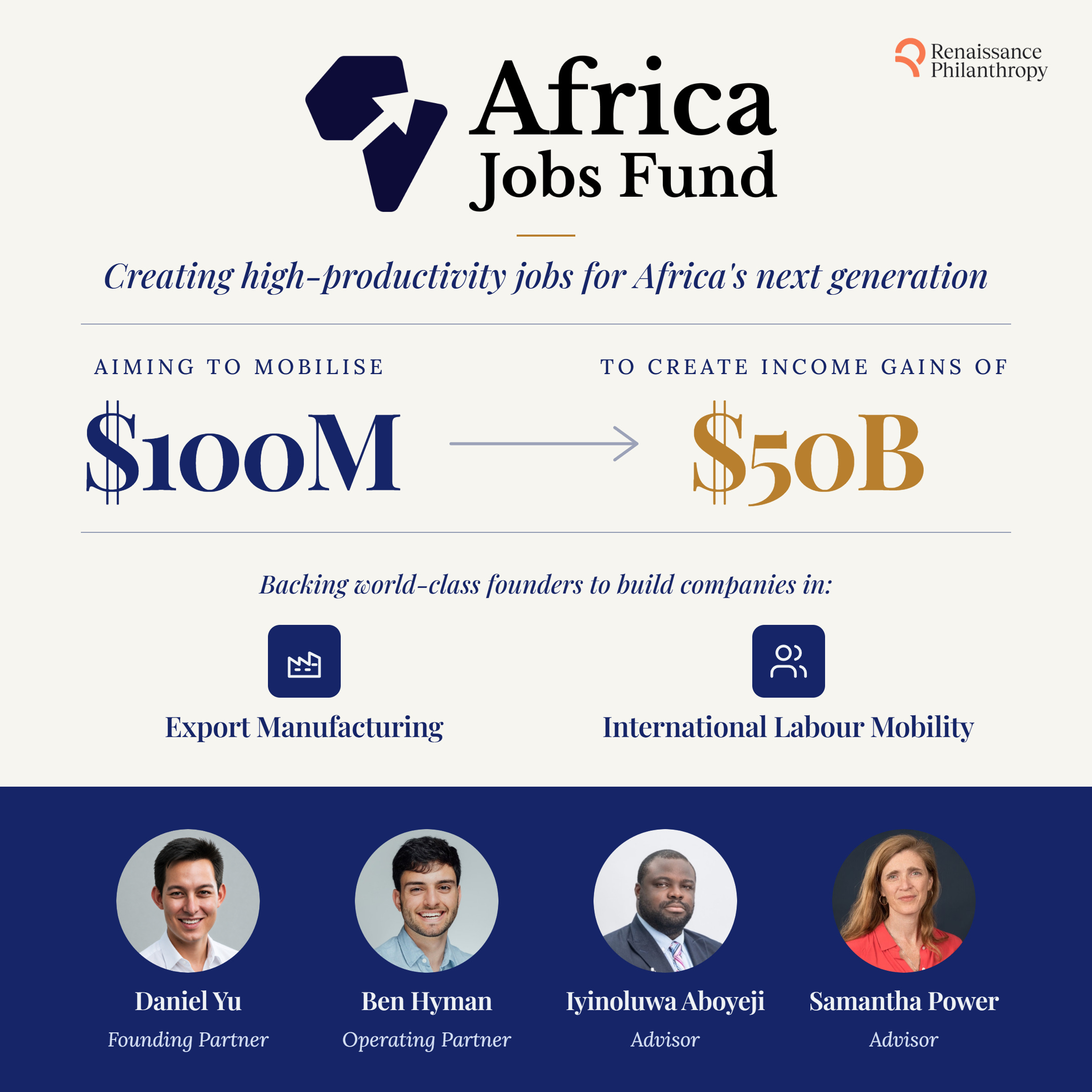
We intend to mobilise $100m of philanthropic capital towards export manufacturing and international labour mobility to double the lifetime incomes of 250,000 low-income people in Africa (creating 10m DCYs).
(This launch article is cross-posted, with some edits, from our Substack.)
We are launching the Africa Jobs Fund to dramatically boost incomes for low-income Africans through access to high-productivity jobs. We will catalyse world-class entrepreneurs to build high-impact, scalable companies in two sectors: export manufacturing and international labour mobility.
We intend to mobilise $100 million towards international labour mobility and export manufacturing. Based on our cost-effectiveness analysis, this funding should enable us to double the lifetime incomes of at least 250,000 low-income people in Africa. To start, we are raising $15m of philanthropic funding to build at least 20 high-impact companies. We also hope to shift global development work towards focusing on what really matters in the long run: increasing incomes through high-productivity jobs.
The fund is housed within Renaissance Philanthropy; a nonprofit organization building a brighter future for all through the time-bound, thesis-driven philanthropic funds. We are already working on venture-building our first set of companies.
In some respects, the model is quite similar to Ambitious Impact, but focused on two specific for-profit sectors in Africa which have a significant direct impact and taking a more hands-on role in the business-building and seed-funding to get these organisations off the ground.
This piece sets out why creating jobs for Africa’s next generation is of paramount importance, why building companies in export manufacturing and international labour mobility is the solution, and how you can help.
Why?
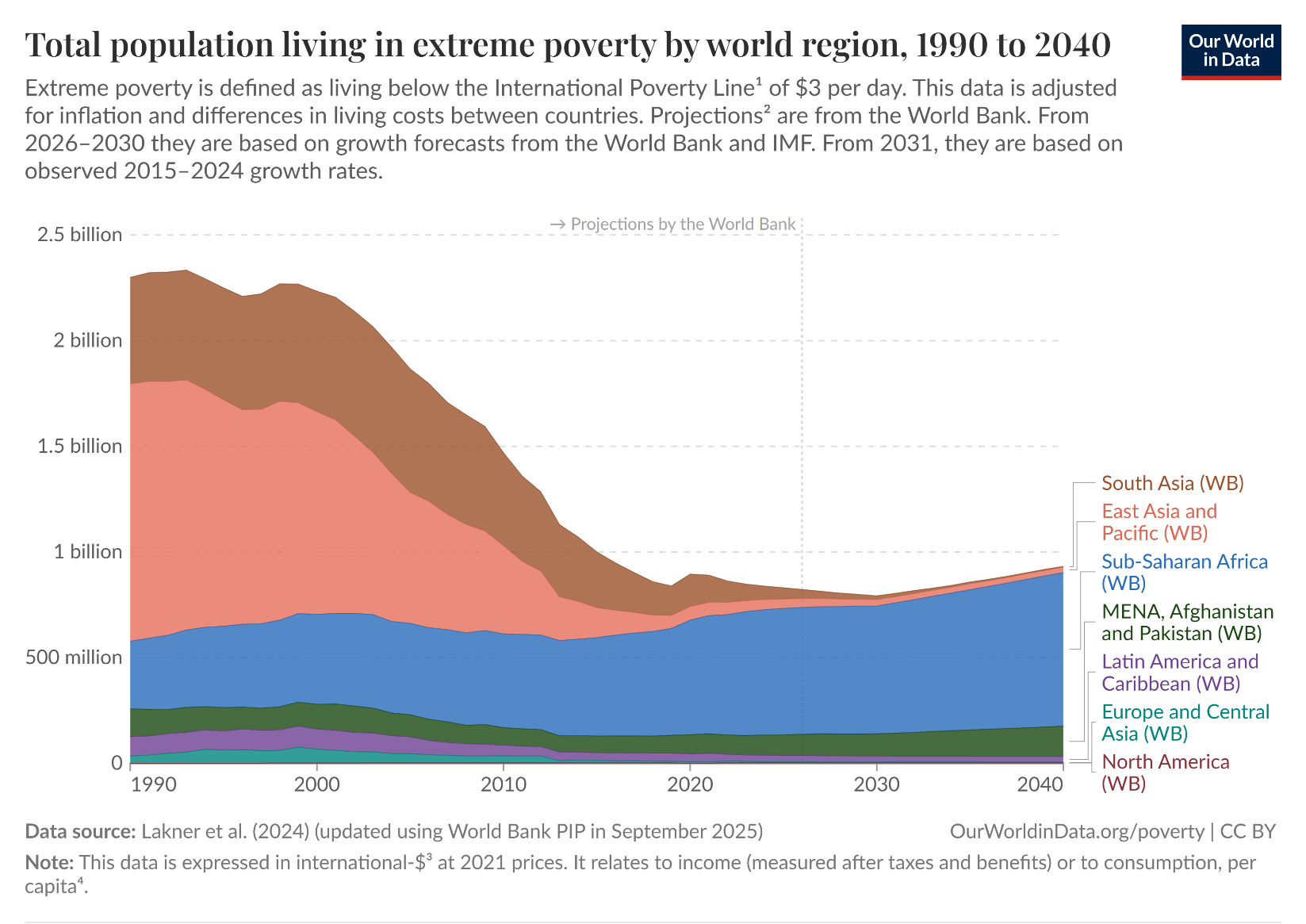
Poverty in Africa is a huge challenge
By 2040, around 24% of the world’s population will live in Africa.
By 2040, around 80% of people living in extreme poverty globally will be in Africa (~600m people).
Most of these people will lack access to basic sanitation, proper healthcare, and quality education.
Extreme poverty by world region, 1990 to 2040, World Bank
Higher incomes solve (almost) everything
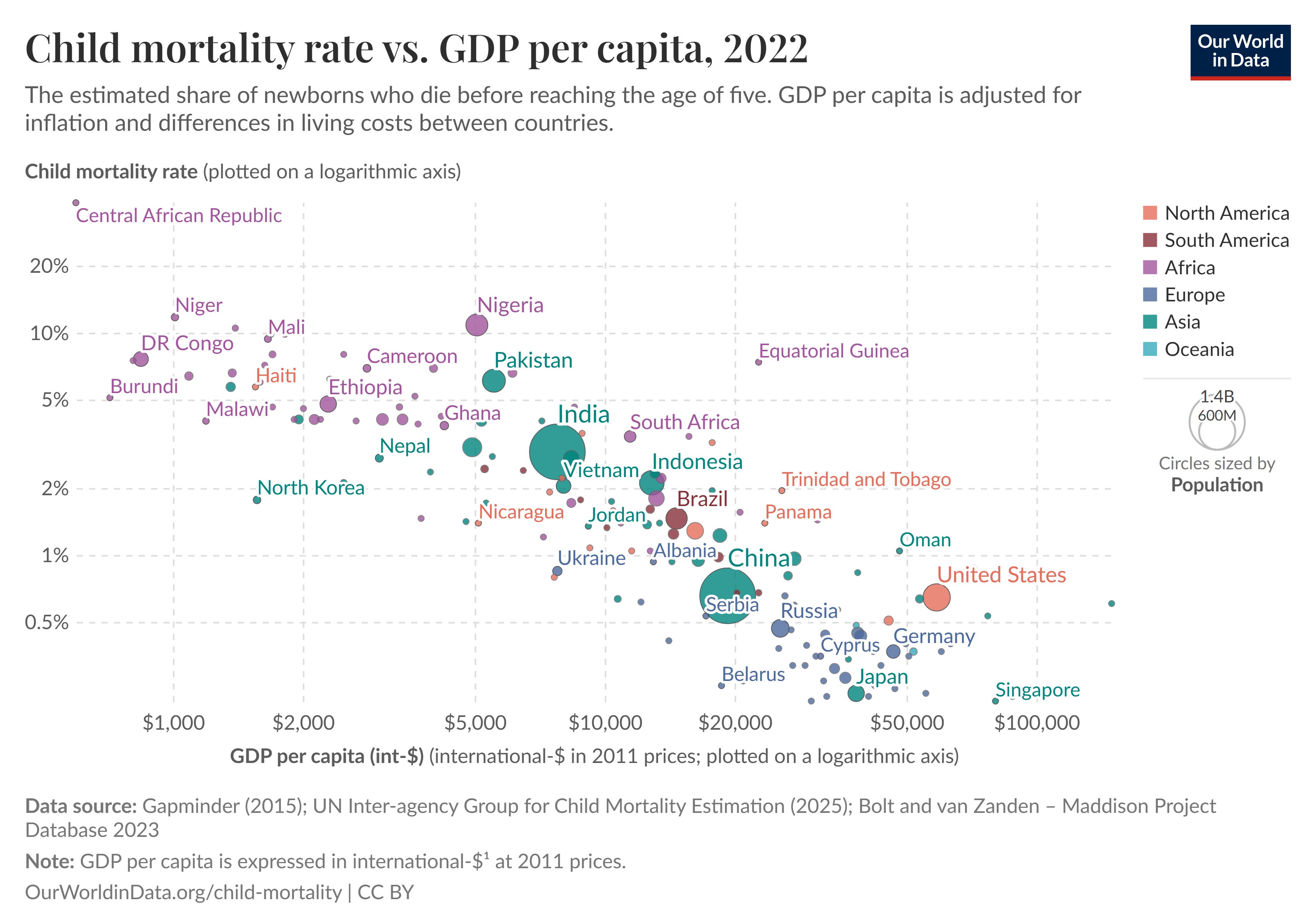
Across countries and across time, income per person accounts for almost all of the variation in the metrics that matter for human welfare: child mortality, life expectancy, education, self-reported happiness, etc.
For example, no country with income per person below $7,000 has been able to reduce the share of newborn children dying before the age of 5 below 1%.
On the flipside, no country has ever become rich without seeing dramatic improvements in quality of life for their population.*
Raising incomes is the best and most durable way to dramatically improve quality of life for the world’s poor.
Child mortality vs GDP per capita, 2022, Our World in Data
The two pillars
The only durable path to high incomes is through high-productivity jobs. We’ve investigated the options and two pathways stand out by a wide margin in creating these jobs: international labour mobility and export manufacturing. Both are well-evidenced and hugely under-funded relative to their potential impact.
International labour mobility
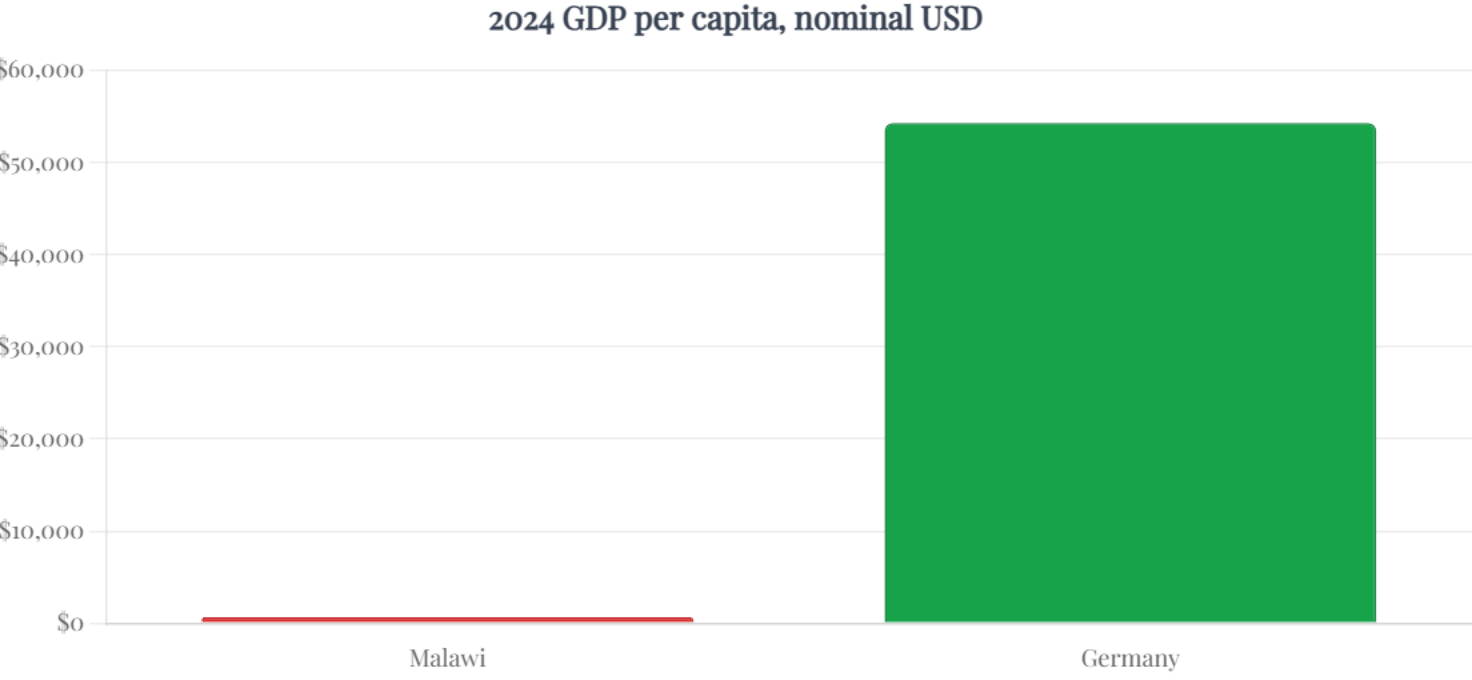
GDP per capita in Malawi is roughly $550 and in Germany it’s over $55,000, a 100x gap.
GDP per capita in nominal USD, Malawi vs Germany, 2024, IMF
Germany, like most OECD countries, has a rapidly ageing population and acute shortages in many sectors, such as elderly care, nursing, manufacturing, logistics and more. These shortages are only getting worse.
Let’s assume we take a talented Malawian worker earning $2000 a year (4x the national average) and help them to move to Germany:
Not only does their personal income increase by 25x, but if they send 10% of their income home in remittances ($5,500), they can double the incomes of ten of their family members.
And the benefits don’t stop there:
That $5500 in remittances stimulates demand in the Malawian economy and enables business growth and new economic activity
Many migrants return home later in life, bringing capital and skills, to build back home
Diaspora populations create new economic linkages and export opportunities from their origin country
One great example of the benefits of these spillover effects is India’s now booming tech sector, which was built in large part by returnees from Silicon Valley using their newfound connections & skill to build outsourcing businesses, staffed by local workers many of whom had invested in tech skills in the hope of accessing jobs in America.
International labour mobility is a huge opportunity and growing. The OECD absorbs around 6.5 million permanent and 4.5 million temporary migrants each year, with a further 4 million temporary workers going to the Gulf.
But the system is broken. Workers from the lowest-income countries often can’t access these opportunities due to a lack of proper infrastructure; there are too few ethical recruitment agencies, language schools, financing partners, etc., and would-be migrants instead face confusing bureaucracy, prohibitive up-front fees, and temptations to consider illegal pathways. Meanwhile, destination country employers struggle to find ethical recruiters who can consistently provide them with workers that have the right training, qualifications and language skills.
There is a huge market failure here, but it can be fixed by building a new generation of companies that make international labour mobility work for everyone. This doesn’t just benefit the migrants themselves, but also their families, their origin countries, their new employers and their destination countries.
We’ll be sharing a deeper dive on labour mobility next week, so make sure to subscribe to our Substack. In the meantime, you can read more on international labour mobility here, here, and here.
Export manufacturing
Almost every country that has become rich did so by industrialising: Britain, Germany, the United States, Japan, China, Poland, Turkey, Mauritius, etc.
More specifically, this growth was driven by manufacturing labour-intensive value-added goods for export.
There are important reasons why export manufacturing is uniquely well-suited to driving development:
Productivity: International competition forces export businesses to converge to global productivity standards. Workers in export manufacturing exhibit productivity levels around 5x higher than in subsistence agriculture.
Scale: The global market is vast, so growth isn’t bottlenecked by limited local demand and there is plenty of space to move up the productivity ladder into higher value-add sectors.
Additive earnings: Overseas earnings are purely additive to the economy. Exporters aren’t taking market share from local firms, so there is a much larger boost to local incomes with significant multiplier effects, less political resistance, and inbound flows of valuable foreign currency.
Labour absorption: Unlike tradeable services, manufacturing employs large numbers of people who have a relatively low level of education and boosts their incomes significantly.
Over the past decades, Africa has undergone ‘premature deindustrialisation’ and the manufacturing share of the economy has dropped to 10%, while at the same time it has risen to 25% in China.
However, as China and other manufacturing hubs continue to get richer, their wages are rising and new opportunities are opening up to compete in low-cost manufacturing. Combine this with Africa’s favourable tariff access to the US, EU, GCC and China and the continent is well-placed for a manufacturing boom.
One common objection is that automation makes this impossible. However, there are still plenty of areas of manufacturing, like garments, that require complex motor skills and where human workers are unlikely to be replaced anytime soon. As Joe Studwell argues in How Asia Works, the economics of labour-intensive assembly still favour workers in low-wage economies over the machines that would otherwise replace them.
There are already businesses doing this in Africa. For example, Tooku Garments in Tanzania employs close to 10,000 workers making jeans for Levi’s and other global brands. Why can’t there be thousands more of these businesses?
The challenge is that first-mover businesses in a new export sector face significant setup and learning costs that they must overcome. Things like training workers, building supply chains, and landing anchor customers, which then de-risk the model for copy-cat businesses to follow. But, someone has to go first and that requires a talented entrepreneur, backed by risk-tolerant, catalytic capital - which is where the Africa Jobs Fund comes in.
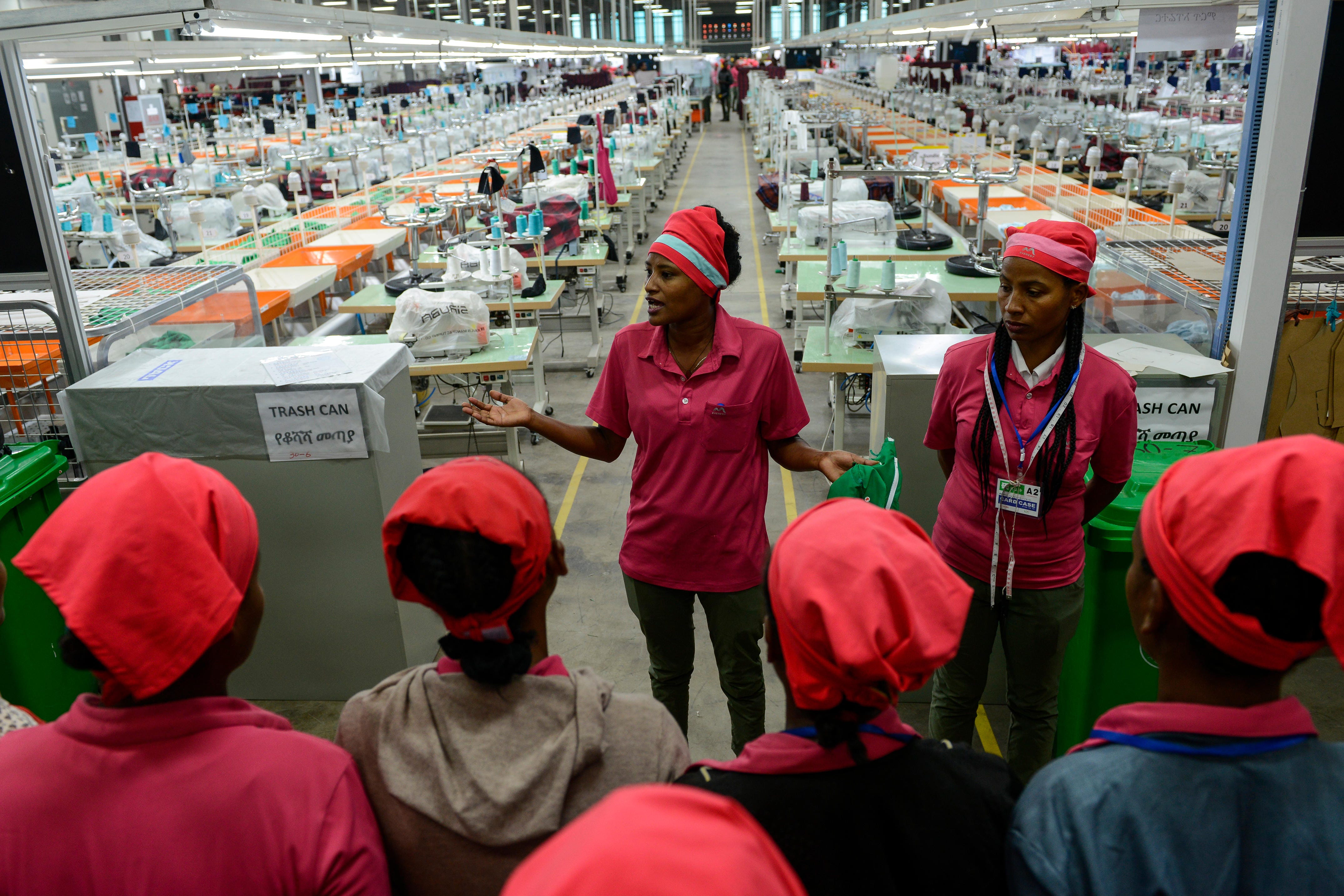
Photo of a garment factory floor in Ethiopia
Our model
We think there should be more international labour mobility and export manufacturing in Africa. So we’re going to build the companies that actually do it.
We take two approaches to making that happen:
Venture building. We identify specific gaps for pioneer firms, scope the opportunity, recruit an exceptional founder, and then provide seed capital, operational support and network.
Catalytic capital. We make investments into existing businesses that are expanding into new verticals or geographies that are particularly high-impact and in need of concessional funding that commercial markets cannot provide.
We are raising grant money but primarily deploying it as investments. We are backing early-stage, high-risk, pioneer ventures. These companies would not necessarily be compelling commercial investments at the stage when we invest, but if they succeed they can deliver a huge direct impact alongside proving the business model for copy-cat companies that serve to multiply the total impact.
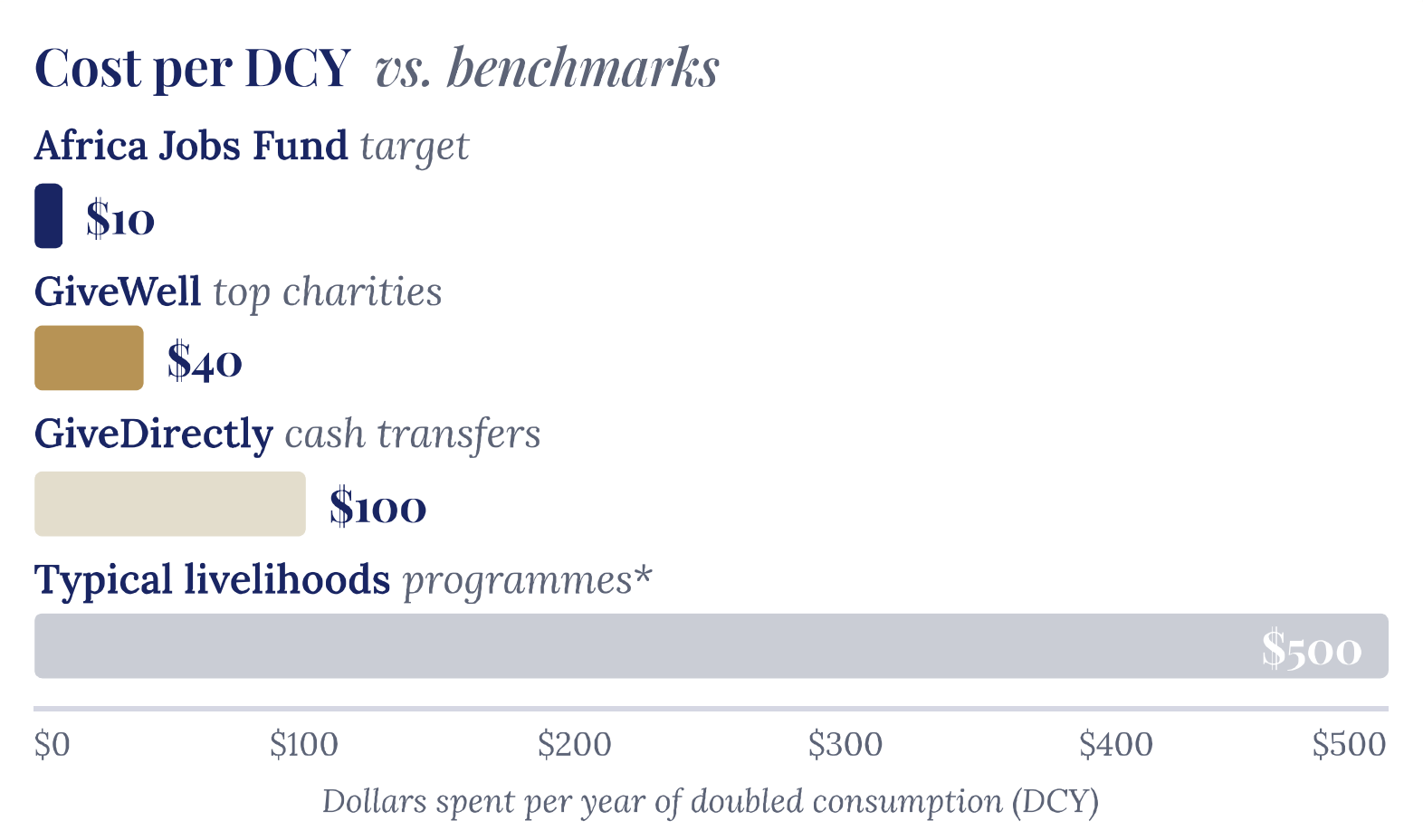
All of our spending is benchmarked against a cost-effectiveness bar of less than $10 philanthropic subsidy per year of doubled consumption(/income). That means $100 million of funding will be enough to double the lifetime incomes of 250,000 low-income people in Africa.
Or, if you’re looking at it from the perspective of income gains, our analysis suggests that we can increase incomes by at least $500 for every $1 in philanthropic subsidy.
We also want to convince the startup ecosystem, the global development community, and all those who care about creating impact in Africa to focus more attention and resources on these two sectors. Partly by leading by example and showing what can be built, and partly by publicly making our case.
Why not the existing models?
Why not build VC startups?
African tech has been a fantastic growth story over the past few years. Flutterwave, Wasoko, Paystack, and many others. We are products of that ecosystem and are excited to see it continue to grow.
But venture-scale returns are only possible in a small subset of business-models, and these are often not the same models that create the biggest positive impact on the economy.
Hyper-scaling a business necessarily means a finding way to avoid tackling some of the thornier operational problems in the economy as this would slow down growth too much. The sectors most suited to the venture approach, such as fintech, SaaS, and micro-lending tend to involve small teams (fewer jobs) and focus on tech-enabled efficiency gains at the margin, rather than directly increasing production capacity in the economy.
We think many talented entrepreneurs could have an even bigger impact by focusing on ‘un-sexy’ sectors like export manufacturing and international labour mobility. These companies may not deliver venture returns but they are also much more likely to succeed. And, relative to the size of the company they have much larger positive spillovers for workers and for the broader economy. For example, per worker placed a labour migration firm might only make a profit of $2,000, but they might enable the worker to earn an extra $2,000,000 over the course of their lifetime.
Finally, sectors like exports and labour-mobility serve paying customers overseas and thereby bring foreign earnings into African economies. These revenues are purely additive to the economy, thereby growing the size of the pie, whereas domestic companies are generally competing against other local companies for the same (relatively small) market which does not grow the economy as fast.
Why not build ‘highly-effective’ non-profit programmes?
GiveWell is the standard-setter for cost-effectiveness in global development philanthropy. They evaluate global-health interventions on cost per life saved or cost per DALY averted, and their top charities (AMF, Malaria Consortium, Helen Keller, New Incentives) are among the most effective ways anyone has found to improve human welfare per dollar. They have pioneered massive improvements in global development. We have both contributed to their recommended charities personally and are supporters of their work.
In fact, we use GiveWell’s benchmarks as the gold standard to beat, and we’re confident that we can.* Their top charities achieve the equivalent of one year of doubled consumption for a low-income person at a cost of $40 of philanthropic funding and our analysis leads us to believe we can achieve this same outcome for less than $10.
GiveWell, J-PAL and other evidence driven development organisations do great work precisely because they are rigorous. They can be certain about the cost-effectiveness because they tightly measure the effects of interventions with randomised control trials. But, that discipline means they underinvest in interventions where the expected value is high but the impact is unmeasurable or uncertain for some reason. For example, the structural transformation of whole economies, or even just programmes with large and widely distributed spillover effects, cannot usually be measured by field experiments and therefore end up being overlooked.
Additionally, non-profits often ignore the power of the private sector. Countries have only ever become rich through the creation of large private businesses. Catalysing new companies can be far more cost-effective than backing non-profits from a grant perspective because once they get going then companies can pay for themselves!
These two dynamics are core to why we think this approach can outperform Givewell. Our focus sectors have been overlooked by the EA community because they do not offer tightly measurable results that fit in the conventional global health paradigm. (Although GiveWell/OpenPhil have funded some migration work previously). And, by catalysing new private sector companies with concessional capital, we are creating new organisations that will have large impact at scale (without needing much further philanthropic support) while also getting our money back in most cases because our funding is structured as an investment.
You can view our cost-effectiveness analysis here. Please let us know if you have any feedback, suggested changes, etc.
GiveWell and global health interventions are excellent, and we hope people keep funding them! We just think that private sector businesses in export manufacturing and international labour mobility can be even more cost-effective, even if it is a little harder to measure with complete certainty.
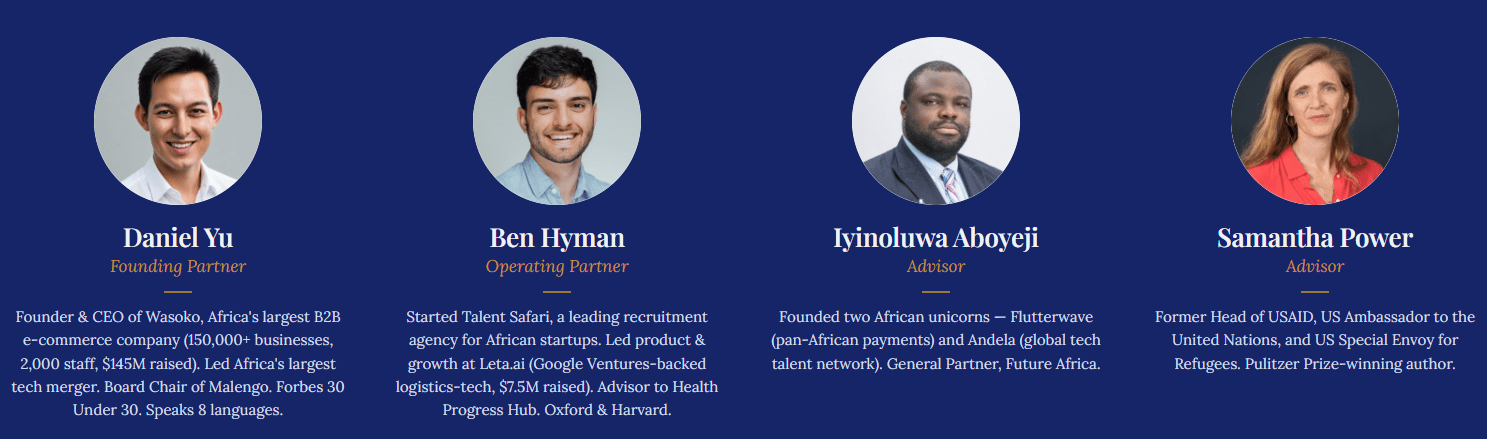
Our team (and our advisors) have deep experience building businesses in Africa and are well-placed to make this vision a reality:
Daniel Yu, Founding Partner. Founder of Wasoko, Africa’s largest B2B e-commerce company, serving 150,000+ businesses, having raised $145 million, with 2,500 staff at peak. Board Chair of Malengo, a leading (Givewell-funded) migration non-profit enabling low-income East-Africans to study/work in Germany. Forbes 30 under 30. Speaks 8 languages.
Ben Hyman, Operating Partner. Started Talent Safari, a recruitment company for startups in Africa. Previously product and growth at Leta.ai, a Google Ventures-backed African logistics startup. Advisor to Health Progress Hub. Oxford & Harvard.
We are building our first companies in international labour mobility right now and looking for exceptional founders, apply to build with through our website.
We are are working on our initial fundraise of $15m in philanthropic capital with an ultimate ambition to direct $100m towards these two sectors over the coming years. We are currently progressing quickly on several high-impact projects and funding constraints are likely to slow our speed of movement. If you’re a funder who's excited about backing early-stage projects with huge impact potential then please get in touch.
We expect to hire two people this year. If you’re exceptionally talented, high-agency, excited about our mission, and working in Africa then we would love to hear from you.
And if you’re just interested in following along then please subscribe to our Substack and reshare this launch piece! We’ll be posting long-form pieces regularly, including guest essays from leading experts.
The two best ways to raise African incomes at scale are under-funded by an order of magnitude. We intend to fix that, and to dramatically increase the incomes of millions of people. Join us on our mission!
All countries except for Equatorial Guinea that high have high GDP per capita have high standards of living. This is because the bulk of the population continues to live on low-incomes and the per capita stats are skewed by the countries extreme wealth inequality. World Bank data shows that 58.1% of the population still live on less than $8.30/day (2021 PPP).
Givewell’s benchmark is $100 per Disability Adjusted Life Year. They use a standard conversion of 2.5 doubled consumption years (DCYs) per one DALY, thereby yielding a cost per DCY benchmark of $40.
TL;DR
* GOAL 3 is a social enterprise that created IMPALA, a patient monitoring and digital platform system for low-resource settings. There is also a GOAL 3 foundation that raises funds to ensure underserved communities will be reached.
* A recently completed report from Rethink Priorities calculated IMPALA to have a cost per DALY averted of $7–17 in paediatr...
This month effective altruism has gotten lots of attention, including a cover story in The Economist. It feels pretty surreal to be on the receiving end of it. But I feel grateful these ideas have caught on, and even more grateful for the drive, earnestness, and compassion of so many people who took strange but well-argued ideas seriously and then actually acted on them....
Note: This post was crossposted from the Coefficient Giving Farm Animal Welfare Research Newsletter by the Forum team, with the author's permission. The author may not see or respond to comments on this post.
Subtitle: On vegan advocacy, effective altruism, and FIFA
I turn 40 today. Here are some hot takes.
On factory farming
1. Our biggest challenge is salience. If factory farming led the evening news, it wouldn’t last lo...

I read the Africa Jobs Fund launch with genuine excitement.
I am a public health professional from Lesotho, a small, landlocked LMIC with a GDP per capita of around $1,000. I hold an Audiology degree and MPH and yet, like many educated young Basotho, I cannot be fully absorbed by my country's health system, not because there is no need for my skills, but because the system does not yet have the financing or structural capacity to employ and compensate professionals like me appropriately.
About brain drain-the fear that sending Africa's best people abroad hollows out the continent. To me, this framing assumes those people are currently contributing productively at home. Many of us are not, though we really want to.Take Lesotho's audiology profession. There is genuine need. There are trained professionals. But the system cannot pay them, so they seek opportunities elsewhere or remain unemployed. The question is not "should we keep them home?" The question is "what do we do with talent that the local system cannot yet absorb?"
The answer the Fund proposes- deploy them into high-productivity roles abroad, let them earn, let them send remittances, let them build skills, and trust that many will return - matches what I have observed on the ground. I know health professionals who left Lesotho, worked abroad for years, and came back, not because they were forced to, but because home is home. And they came back better: with experience, savings, networks, and confidence that made them more effective than if they had stayed and struggled.
I am not naive about the risks of labour mobility done badly-exploitative recruitment, workers stranded abroad without support, destination countries benefiting while origin countries bear the cost. The Fund's emphasis on building ethical recruitment infrastructure sounds exactly right.
I am currently in an early stage of building my own career toward global health operations and development. The Africa Jobs Fund represents the kind of structural, systems-level thinking I want to be part of. I'll be watching closely, and hoping to contribute.