By Simon Knutsson and Magnus Vinding
This text is a general introduction to suffering-focused ethics. We describe different types of suffering-focused ethical views and explain some of the reasons why we find suffering-focused views reasonable. We also bring up and discuss some common misunderstandings and objections, and briefly cover some practical implications.
1. The core of suffering-focused ethical views
In essence, suffering-focused ethical views give a foremost priority to the reduction of suffering. According to such views, there is something especially important or urgent about alleviating and preventing suffering. Usually, the primary concern is severe suffering rather than discomforts.
A simple example of a clearly suffering-focused view is the view that our only moral obligation is to reduce suffering as much as we can. Yet there are many types of suffering-focused views, as we will see in the next section. For instance, there can be differences in how strongly suffering is prioritised, as well as differences in terms of which considerations besides suffering are taken into account.
Which views count as being suffering-focused? There is no sharp line that delineates exactly when a view is suffering-focused or not; it is a matter of degree. Still, it is useful to observe that there is a diverse group of ethical views according to which the reduction of suffering has a foremost priority.
2. Different types of suffering-focused views
Suffering-focused views can come in all the shapes and sizes that moral views come in. Some say that all that matters is the consequences of our actions. Others talk about character and virtues such as compassion, or about separate moral principles that need to be balanced against one another (for example, one principle about reducing suffering and another principle about respecting individual autonomy). Still others are less theoretical and leave more to moral judgement given the particulars of a situation.
There are many examples of suffering-focused views in both historical and contemporary ethical traditions. We are most familiar with Western sources and talk mostly about those, but there are also Eastern traditions that are suffering-focused. For instance, some of the main strands of Buddhist ethics give special priority to the reduction of suffering. This includes the Mahayana tradition of Buddhism, in which 8th-century philosopher Shantideva argued that we should “dispel the pains of all”.
Below, we describe some examples of suffering-focused ethical views. We try to convey the diversity that exists and we focus on views that can be found in the literature (as opposed to merely possible views).
2.1 Consequentialist views
When a suffering-focused view is impartial and only concerned with minimising suffering or ill-being, it is a form of (strong) negative utilitarianism. The most popular version of that view is probably the view that one should minimise the total amount of suffering, or especially minimise the amount of extreme suffering. Negative utilitarian views, like the one just mentioned, are members of the large family of consequentialist views, but there are other suffering-focused consequentialist views besides negative utilitarianism. For example, a view according to which one should reduce other bad things besides suffering, such as injustice, would be another variant of (strong) negative consequentialism.
There are also suffering-focused consequentialist views that give a moral role to positive well-being or positive final value (the positive value something has for its own sake). According to these views, consequences for positive well-being or positive value matter morally, but reducing suffering is generally most important. We call such views ‘weak negative’ forms of utilitarianism or consequentialism, although others might prefer different labels such as ‘negative-leaning’, ‘partially asymmetric’, or ‘partially suffering-focused’.
2.2 Views focused on consequences along with other considerations
Some authors have similar views but include other considerations besides consequences. For example, there are moral views that put a duty to minimise suffering front and centre, while also including other moral duties and rights that, among other things, protect the life and autonomy of individuals. Similarly, there are suffering-focused views that give great importance to consequences as well as to personal qualities such as being considerate, incorruptible, and patient.
2.3 Views based on categorical norms
There are traditions in ethics in which authors use different approaches and vocabularies from those we have mentioned so far. In these other traditions, people seem to think about morality differently and use other building blocks when they formulate their ethical views. For example, some authors propose categorical norms or prohibitions. A suffering-focused example is Ohlsson (1979). According to him, it is unacceptable to purchase positive consequences for those with acceptable lives if it happens at the expense of someone else’s death or unbearable suffering or degradation. In Ohlsson’s ethical system, this Principle of Unacceptable Tradeoffs is a categorically binding norm, which is always to be given precedence.
2.4 Prioritising the reduction of suffering in certain domains, such as politics
Some views give a special or even overriding priority to the reduction of suffering in certain domains, while being more permissive of different priorities in other domains. For instance, some views hold that the reduction of suffering should generally be the primary aim in politics and public policy, while allowing more room for other aims in people’s private conduct.
2.5 Ideas that tend toward a focus on suffering
The views we have mentioned so far are explicitly about the moral importance of suffering. But one can also arrive at a suffering-focused moral view more indirectly, such as through complementary ideas about population ethics, well-being, and value. For example, if someone holds that it does not make things better to increase the number of beings, then that doesn’t directly imply an ethical focus on reducing suffering. It is possible to hold that the highest moral priority is to preserve certain paintings. Still, one can see how this idea about the value of creating new beings, when combined with other ethical ideas that people generally find reasonable, would tend to result in a focus on reducing suffering. The same applies to the idea that well-being consists in the absence of certain bads, such as experiential disturbances or frustrated preferences.
3. Why we find suffering-focused views reasonable
To understand a given view and its appeal, it may be helpful to understand why proponents of that view find it sensible. In that spirit, we will here outline some of the reasons why we find suffering-focused views to be reasonable. To be clear, we will not here seek to defend suffering-focused views, since that would require more space and going into more detail than what we find suitable in this introductory text. Instead, we will just present some of the main reasons why we find suffering-focused views compelling, while referring readers to other sources for more information and arguments.
3.1 The importance of severe suffering
Our main concern is severe suffering. An example of what we have in mind is the suffering of someone whose entire family has just been murdered. This is not among the most gruesome scenarios that happen or that one can imagine. As another example, one can think about the most horrendous torture methods and deaths throughout history and in the world today, as well as what the future might bring in terms of similar or even worse atrocities. Why would the prevention or alleviation of such severe suffering be so important?
One reason is simply that the victim feels horrible. Although it might be impossible to grasp exactly what the victim experiences, we can still have a rough idea that it feels awful and much worse than any ordinary unpleasantness that we are familiar with.
Second, the victim’s judgement, involuntariness, and lack of consent matter morally. We can broadly distinguish two kinds of situations involving severe suffering:
(a) The victim actively disapproves. For example, the victim judges that their suffering cannot be counterbalanced by purported goods, they find their situation unbearable, or they reject the notion that they consent. In such situations, we find it morally appropriate to respect the victim’s judgement.
(b) The victim does not approve. There is, for instance, no consent, voluntariness, or judgement that their suffering is worth it. The victim might be unable to judge or consent because they belong to a species that cannot formulate those kinds of thoughts or attitudes, or because they are in such distress that they cannot think in those terms. In this kind of situation, it is a serious moral problem that there is severe suffering that is not accepted by the victim.
As a final point, we mention some other aspects that can accompany the devastating situations we have in mind. These aspects are plausibly worth preventing for their own sake and add to the moral gravity of the victim’s fate: someone having their life destroyed, losing what they cherish the most, being brutally violated, getting their dreams and projects crushed, and not being compensated in any way.
3.2 The importance of severe suffering compared to purported goods
Why is severe suffering so important compared to other things, particularly compared to the creation of purported goods? What we have already said about the moral importance of severe suffering helps inform our answer to that question. In addition to those points, we can explore this comparative question more directly, by looking at comparisons between the moral importance of severe suffering and the creation of purported goods.
As a general matter, we find it reasonable to conclude that the alleviation and prevention of extreme suffering is morally important in a way that the creation of purported goods is not. The relief and prevention of extreme suffering has a unique moral urgency and importance, whereas the creation of purported goods seems to have no similar moral urgency or importance, if indeed it has any at all.
To say more about the urgency aspect: Consider ongoing cases of severe suffering due to starvation or violent oppression. Alleviating such suffering is urgent, of course (even if we only alleviate that suffering without increasing positive welfare). Consider then the opportunity to enable someone with a problem-free life to experience more intense pleasure (in a way that does not also reduce suffering) and the opportunity to create more beings with purportedly positive welfare (who would not also reduce suffering for others). It seems to us that it is not urgent to increase the pleasure and positive welfare, and especially not as urgent as alleviating the misery. After all, to not increase pleasure and positive welfare seems wholly fine and unproblematic, whereas any failure to prevent extreme suffering is just the opposite: it is an excruciatingly felt moral problem.
In addition to this consideration of cases, we note that there are common notions such as emergencies and someone being in desperate need of help that are generally not about increasing pleasure or other purported goods. Rather, these seem to be about reducing suffering and other bads. This makes sense to us. If we reflect on what should be labelled an ‘emergency’ and the like, we find that it concerns the alleviation and prevention of severe suffering and other major harms — not increasing positive value.
Furthermore, causing or failing to prevent severe suffering is generally a grave moral failure (it can even amount to the worst, extreme immorality), whereas this does not seem to be the case for failing to create purported goods (that nobody needs and whose absence causes no problem). Some speak of moral monsters and evil actions and persons, but these are seemingly about matters such as serious harms, suffering, and malice, and hardly about failing to create positive value.
The existence of a victim is also morally relevant. Generally speaking, causing or failing to prevent severe suffering implies a harmed and morally wronged victim. By contrast, the failure to create purported goods does not involve any victims, and no one is harmed or wronged, in our view. This is one reason why a failure to create purported goods does not seem to be a moral failure of a comparable kind (and not a moral failure of any kind).
Moreover, if we look at different kinds of outcomes, it seems reasonable to us that adding severe suffering to a given outcome would make that outcome overall bad and morally worth preventing, even if it contains vast amounts of purported goods. For example, consider a state of unbearable suffering that a tormented victim does not consent to, and which the victim judges to be impossible to outweigh by purported goods. That would give that victim a plausible claim to the outcome being unacceptable and worth preventing. The victim could legitimately raise a complaint and reject any alleged desirability of the outcome. Conversely, we fail to see how or why adding purported goods to an outcome that contains such unbearable suffering could ever make the outcome overall good, acceptable, or morally worth creating. In particular, we fail to see how purported goods are supposed to be able to counterbalance or make up for such extreme suffering. That notion seems quite mysterious and unmotivated to us.
All in all, even if we grant that there is such a thing as positive final value, we find that it is always more important to prevent severe suffering than to create positive final value.
3.3 The non-existence of positive final value
We find it plausible that nothing has positive value for its own sake. In other words, there is no positive final value. This idea is controversial and it is not a necessary ingredient in a suffering-focused view. Moreover, it is not a standard reason for holding a suffering-focused view, and our views do not hinge on it. Still, we mention it because it can lead to a suffering-focused view, we find it reasonable, and it probably needs some explanation.
More precisely, this section is about the non-existence of all of the following: positive final value, positive well-being, and experiences that are a positive counterpart to suffering. We will briefly try to convey how this makes sense to us.
Let us start with the issue of final value and picture empty space. We disagree with the view that something is missing, that there is a waste and an unrealised potential, and that it would be better in itself if things were added. In contrast, we see empty space as unproblematic, flawless, and peaceful. Morally speaking, there is no need to change anything. You cannot make it better by adding things, and there is no moral imperative to do so.
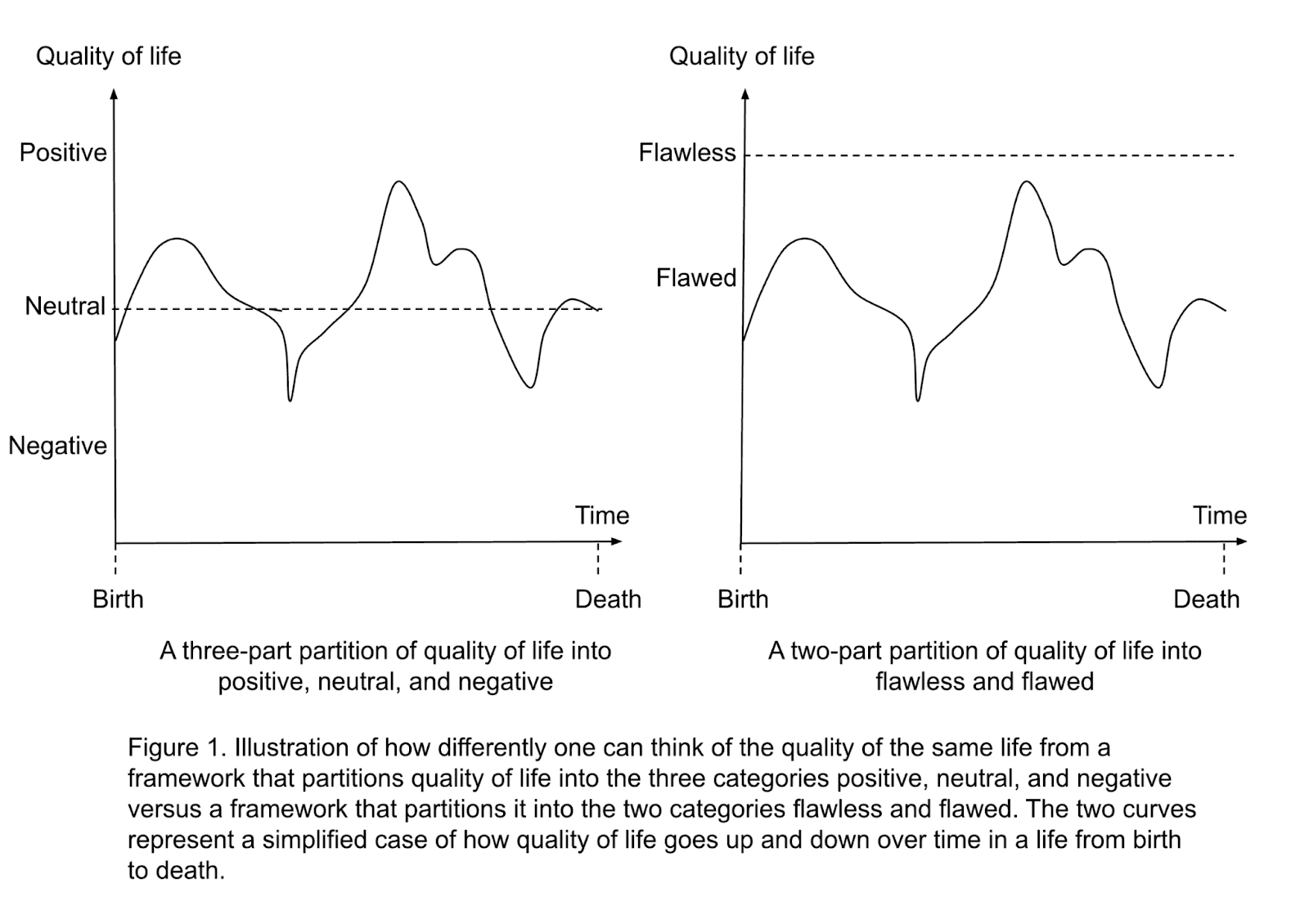
We can also use this framework of flawless versus flawed when thinking about quality of life, happiness, and experiences. For example, we reject the idea that there is a neutral quality of life above which quality of life is positive. Instead, we would say that lives can be flawless or flawed, and one cannot do better than complete flawlessness. Flawlessness is not good or positive in itself; it simply occurs when there are no flaws of any kind.
We illustrate these two different ways of thinking about quality of life in Figure 1 below. The figure shows two different perspectives on the same individual life. Both perspectives agree that life can get better and worse, and both grant the existence of peak periods in life. The difference between the two perspectives is that the first divides quality of life into three categories: positive, negative, and neutral. In contrast, the second perspective (our view) divides quality of life into two categories: flawless and flawed. In the figure, the individual never reaches the flawless level, which makes sense because in real life, we might rarely or never reach a perfect or completely flawless quality of life (e.g. a state with absolutely no experiential disturbances or frustrated preferences).
It is worth clarifying how the non-existence of positive final value and the like is compatible with some common ways of speaking. In our view, it can still be useful in daily life to informally speak in terms such as “this feels great”, “that’s good”, and “I’m very well”. Such statements can be considered shorthands for more complicated statements, such as “I’m much better off than many other people” or “I’m much better off than I could have been or used to be”. Our point is not to oppose such informal ways of speaking in daily life, but rather to explain the position that when making moral decisions, there is actually no positive final value or positive quality of life that one could increase, so efforts to improve things should instead be about reducing problems.
Another clarification is that our view does not entail that experiential states of excitement, amusement, gladness, and so on do not exist. Of course, such states do exist, and we also have such experiences. Our view is rather that no such experiences (nor any other experiences) are a positive counterpart to suffering, none of them can bring us above a flawless quality of life, and none of them have positive final value.
4. Misunderstandings about suffering-focused ethics
4.1 World destruction
The perhaps most common allegation against some suffering-focused views is that they support destroying the world or killing everyone. The allegation can be an argument that one can direct against certain suffering-focused views (as well as non-suffering-focused views), and we will talk about that in Section 5. Here we merely note that the allegation sometimes involves basic misunderstandings.
We focus on the misunderstanding of directing the allegation against more types of suffering-focused views or ideas than is warranted. For example, the idea that there are no goods does not in itself imply anything about what is morally right or what should be done. These are different topics. One can hold that there are no goods and that it is morally wrong to destroy anything, and then destruction would, obviously, be wrong.
Even if we only talk about which scenario would be best (a matter of axiology), as opposed to what anyone should do, it is still not the case that destruction must be the best scenario if there are no goods. For instance, one can hold that being destroyed is bad for those who are destroyed, or that the act of destroying (or an associated motive or trait) has final disvalue. On such views, it could be better to peacefully and voluntarily get rid of suffering and other bads without any destruction.
As a final example, moral views of the kinds we mentioned above that include other moral considerations besides consequences can include rules and rights that speak against or prohibit destruction.
4.2 Pro-death
A related misunderstanding about suffering-focused views is that they must favour the death of individuals. There are several reasons why this is generally not the case.
First, even if we assume that there is no positive final value and assume a strong negative utilitarian view focused only on minimising experiential suffering, death would make things overall worse when an individual life has sufficiently beneficial effects in terms of reducing suffering for others. In this way, staying alive would be supported by the positive roles we serve for others.
Second, suffering-focused views that contain theories of welfare that go beyond experiences may imply that death is bad for an individual, even if the views hold that nothing can be good for individuals. For example, a theory of welfare that takes preferences into account may imply that death is bad for an individual, provided that the individual prefers to stay alive. Similarly, one may hold that death harms us because it violates a fundamental interest in continuing to live, or because it curtails our life projects, or simply because death is a harm in itself.
Third, various suffering-focused views that grant the existence of positive welfare can favour continued existence for the being’s own sake because of the positive welfare they would enjoy in the remainder of their life.
Of course, there can be circumstances in which death would be less bad than the alternatives according to suffering-focused views. For example, many suffering-focused views would see death as less bad than continued existence when a person has an agonising terminal illness and wants to die, and their death would not harm others. Yet conclusions of this kind are not unique to suffering-focused views, and it seems reasonable to hold that there are some circumstances in which death is the lesser evil. To be sure, compared to other views, some suffering-focused views may be more inclined to see death as the lesser evil in particular situations. However, a lot will depend on the details, both of the specific view and the specific circumstances under consideration.
5. On objections to suffering-focused views
The following are two ways of looking at debates and objections in ethics. First, ethics has similarities with politics in that both concern values, and people care about the issues and often want to influence things. In this vein, one can pay attention to advocacy, misinformation, money, power, rhetoric, talking points, and so on. That is interesting and something to be aware of, but we will set it aside here. Second, one can pay attention only to the content of ideas, arguments, and the like, and how to think about that content. That is the topic of the rest of this section.
There is a large web of objections and replies related to suffering-focused ethics. This should be unsurprising given the diversity of views and ideas. Additionally, there can be several objections against a single view or idea, and then replies to those objections, and so on.
How are we to approach such a system of objections and replies? It can be laboursome to wade through it all, but there is seemingly no shortcut that replaces thinking through objections and replies. A critical attitude is key. One can ask oneself: Is that convincing? Does that seem reasonable?
In our experience, when one is beginning to think about a field, or if one is pressed for time, it can happen that one just takes whatever is said by experts at face value. Of course, it is often appropriate to defer to the views of experts. Yet it is worth being aware of how individual intuitions and judgements about values tend to play a large role in moral philosophy, which means that one cannot simply trust expert judgements as though they will necessarily reflect one’s own considered judgements. Thinking things through for oneself with a critical attitude may thus be especially important in ethics compared to other fields.
To avoid going into too much detail here, we limit ourselves to a brief discussion of two kinds of objections that tend to recur in different variants. Both kinds of objections have a structure that is very common in moral philosophy, namely to allege that the target view has a problematic implication.
5.1 Placing too much importance on suffering when choosing outcomes
The first common kind of objection is to present a choice between two outcomes or worlds, and claim that the suffering-focused view under consideration prescribes the wrong choice. Here is an example from Hurka (2010, p. 200):
negative utilitarianism implies that if we could either bring about a world in which billions of people are ecstatically happy but one person suffers a brief toothache or bring about nothing, we should bring about nothing.
Hurka calls this implication “absurd”. He talks about a specific form of strong negative utilitarianism and a brief toothache, but there are different versions of the objection. For example, another version might be that in one of two new worlds that could be created, there are five people with positive welfare for each miserable person, and in the other there are no people. The objection would then allege that the suffering-focused view prescribes the wrong choice, namely creating the world with no people in it.
We do not find these kinds of objections to be compelling and there is a lot to say about them, but here we will merely make a couple of points to indicate some directions in which the reasoning can go.
First, a key issue is, of course, which of the outcomes should be chosen. For example, one can argue that the outcome with suffering should not be chosen for the reasons we mentioned in Section 3. In addition, one can question the judgements about which outcome should be chosen by arguing that the judgements are biased or too uninformed (of course, such arguments can be made in both directions).
Second, one can argue that competing theories have worse implications in such abstract choice situations, and that the balance of arguments (of this kind) therefore overall supports suffering-focused views.
Third, one can question what such abstract, hypothetical choice situations tell us about morality and what our priorities should be in the real world. In reality, we cannot readily create worlds like that, and real-world efforts to create populations with such surpluses of purportedly good lives would involve serious risks and opportunity costs (e.g. we could instead try to reduce extreme suffering and prevent much worse outcomes). Those making the objections might say that such hypothetical choice situations are still an important test of moral theories, but that is debatable.
An informed evaluation of this kind of objection would ideally take many considerations like these into account, and would involve going through such considerations and arguments in a fair-minded way back and forth.
5.2 World destruction
Another objection (or group of objections) concerns world destruction, and it is often directed against stronger forms of negative utilitarianism. We earlier dealt with world destruction as a basic misunderstanding of suffering-focused views and ideas more broadly, and we now deal with it as an objection that one could coherently raise against certain suffering-focused views. In the literature, the objection is rarely as precisely formulated as one would wish. But let us assume that the target is the following version of negative utilitarianism:
Strong negative total act-utilitarianism: An act is right if and only if it results in a sum of negative well-being that is at least as small as that resulting from any other available act.
And let us assume the following brief version of the objection:
Suppose that someone could kill all sentient beings on Earth painlessly. Strong negative total act-utilitarianism implies that it would be right to do so. But doing so would not be right, so strong negative total act-utilitarianism is false.
We can immediately note that the objection has several parts that can all be analysed and debated. Does strong negative total act-utilitarianism really imply that carrying out this act would be right? In particular, does the act result in a sum of negative well-being that is at least as small as that resulting from any other available act? Would the act not be right? Even if the theory has this implication and it would not be right, what should we make of that? Does that mean that we should reject the theory, or is it merely a disadvantage of the theory, although the theory can still, all things considered, be better than competing theories?
Likewise, even if the objection succeeds in establishing that the theory is incorrect or implausible, what would that say about which alternative theories or views to favour instead? For example, it would not imply that positive value exists and can outweigh extreme suffering, and it would not be a blow to the whole group of suffering-focused views. After all, there are many other suffering-focused views, including strong ones, that would not prescribe destruction. Rather, if the objection showed that strong negative total act-utilitarianism is implausible, that would merely demonstrate that this particular theory does not belong on the list of plausible suffering-focused views.
In addition, if the world destruction objection succeeds against a given form of negative utilitarianism, this would bode poorly for similar views that are not suffering-focused. For instance, traditional total utilitarian views (which prescribe maximising the sum of positive minus negative welfare) seem at least as vulnerable to this type of objection. Indeed, such views would arguably have worse corresponding (alleged) implications, such as killing everyone in ways that cause extreme suffering for the sake of creating greater positive welfare. It is therefore questionable to argue that the world destruction objection against negative utilitarianism is a reason to favour similar views that are not suffering-focused, such as traditional utilitarian views.
6. Priorities from a suffering-focused perspective
Different suffering-focused views may imply different priorities. For example, some suffering-focused views might imply that we should mostly reduce suffering in our immediate vicinity, such as in our closest relations and community. However, in this brief section, we will focus on priorities that tend to follow from suffering-focused views that are more impartial (the categories we present below sometimes overlap).
6.1 Reducing risks of worst-case outcomes
If a suffering-focused view is sensitive to the scale of suffering, and if it is combined with the empirical belief that risks of astronomical suffering (s-risks) are the largest source of suffering in expectation, reducing these risks will tend to be a key priority. This might in turn imply efforts to raise attention about these risks, as well as pursuing concrete policies that are likely to reduce s-risks.
6.2 Reducing the suffering of non-human animals
Billions of non-human animals suffer severely in factory farms and slaughterhouses, and many more suffer in the wild. Views that are sensitive to the number of suffering beings will therefore generally give a high priority to reducing the suffering of non-human animals. In particular, such views will tend to support efforts to reduce and ultimately eliminate humanity’s exploitation of non-human animals, along with efforts to reduce the suffering of wild animals.
6.3 Reducing the suffering of the worst-off humans
When it comes to human suffering, many suffering-focused views would direct our focus to the people who endure the worst kinds of suffering. For example, in our view, society should be more dedicated to alleviating and preventing the most extreme forms of human suffering due to, for instance, the worst violence, accidents, and health conditions.
6.4 Reducing suffering in everyday life
Another implication of many suffering-focused views is to try to reduce suffering in everyday life. This might include helping people around us who are in distress; trying to cause less harm to small beings, such as insects; and making consumption choices aimed at causing less suffering, such as by avoiding animal-derived products. These practices may have a consequentialist justification based on, for example, the broader consequences of reinforcing certain norms and consistently being the kind of person who tries to reduce suffering. Alternatively, or in addition, these practices may rest on non-consequentialist ideas about, for example, which actions are called for and the kind of person one should be.
A final remark on priorities is that one need not choose between reducing s-risks, suffering among non-human animals, and suffering among humans. We have presented those priorities separately, but some changes could benefit all of these areas simultaneously. For example, if society had closer to what we consider to be the appropriate concern for severe suffering, then that could broadly benefit suffering humans, non-human animals, and future beings.
7. Conclusion
As we have seen, there is a broad range of suffering-focused views, as well as a variety of ideas and arguments that pertain to such views. While suffering-focused views differ in many respects, they all agree that the reduction of suffering is of key importance. In that regard, they tend to provide substantive and, in our view, reasonable practical directions.
References
Ajantaival, T. (2021a). Positive roles of life and experience in suffering-focused ethics. Ungated
Ajantaival, T. (2021b). Minimalist axiologies and positive lives. Ungated
Ajantaival, T. (2022a). Peacefulness, nonviolence, and experientialist minimalism. Ungated
Ajantaival, T. (2022b). Minimalist extended very repugnant conclusions are the least repugnant. Ungated
Ajantaival, T. (2023a). Minimalist views of wellbeing. Ungated
Ajantaival, T. (2023b). Varieties of minimalist moral views: Against absurd acts. Ungated
Althaus, D. & Gloor, L. (2016) Reducing Risks of Astronomical Suffering: A Neglected Priority. Ungated
Anonymous. (2015). Negative Utilitarianism FAQ. Ungated
Arrhenius, G. & Bykvist, K. (1995). Future Generations and Interpersonal Compensations Moral Aspects of Energy Use. Uppsala Prints and Preprints in Philosophy, 21. Ungated
Baumann, T. (2017). S-risks: An introduction. Ungated
Baumann, T. (2022a). Avoiding the Worst: How to Avoid a Moral Catastrophe. Ungated
Baumann, T. (2022b). Career advice for reducing suffering. Ungated
Benatar, D. (2006). Better Never to Have Been: The Harm of Coming into Existence. Oxford University Press.
Bergström, L. (1978/2022). The consequences of pessimism. Ungated
Bommarito, N. (n.d.). Tibetan Philosophy. Internet Encyclopedia of Philosophy. Ungated
Breyer, D. (2015). The Cessation of Suffering and Buddhist Axiology. Journal of Buddhist Ethics, 22: 533–560. Ungated
Calder, T. (2022). The Concept of Evil. The Stanford Encyclopedia of Philosophy (Winter 2022 Edition). Ungated
Chao, R. (2012). Negative Average Preference Utilitarianism. Journal of Philosophy of Life, 2(1): 55–66. Ungated
Crisp, R. (2022). Pessimism about the Future. Midwest Studies in Philosophy, 46: 373–385. Ungated.
DiGiovanni, A. (2023). Beginner’s guide to reducing s-risks. Ungated
Edelglass, W. (2009). The Bodhisattva Path: Śāntideva’s Bodhicaryāvatāra. In Edelglass, W. & Garfield, J. (eds.), Buddhist Philosophy: Essential Readings. Oxford University Press. Ungated
Elster, J. (2011). How Outlandish Can Imaginary Cases Be? Journal of Applied Philosophy, 28(3): 241–258. Ungated
Enoch, D. (forthcoming). Politics and suffering. Analytic Philosophy. Ungated
Faria, C. (2022). Animal Ethics in the Wild: Wild Animal Suffering and Intervention in Nature. Cambridge University Press.
Fehige, C. (1998). A pareto principle for possible people. In Fehige, C. & Wessels U. (eds.), Preferences. Walter de Gruyter. Ungated
Geinster, D. (1998). Negative Utilitarianism - A Manifesto. Ungated
Gómez-Emilsson, A. & Thisdell, R. (2021). A Conversation with Roger Thisdell about Classical Enlightenment and Valence Structuralism. Ungated
Griffin, J. (1979). Is Unhappiness Morally More Important Than Happiness? Philosophical Quarterly, 29: 47–55.
Gustafsson, J. (2023). Against Negative Utilitarianism (draft). Ungated
Häyry, M. (2024). Exit Duty Generator. Cambridge Quarterly of Healthcare Ethics, 33(2): 217–231. Ungated
Hedenius, I. (1955). Fyra Dygder. Albert Bonniers Förlag. [In Swedish.]
Horta, O. (2022). Making a Stand for Animals. Routledge.
Horta, O. & Teran, D. (2023). Reducing Wild Animal Suffering Effectively: Why Impracticability and Normative Objections Fail Against the Most Promising Ways of Helping Wild Animals. Ethics, Policy & Environment, 26(1): 1–14. Ungated
Hurka, T. (2010). Asymmetries in Value. Noûs, 44(2): 199–223.
John, T. & Sebo, J. (2020). Consequentialism and Nonhuman Animals. In Portmore, D. (ed.), The Oxford Handbook of Consequentialism. Oxford University Press. Ungated
Khyentse, D. (2007). The Heart of Compassion: The Thirty-seven Verses on the Practice of a Bodhisattva. Shambhala.
Knutsson, S. (2015a). The ‘Asymmetry’ and extinction thought experiments. Ungated
Knutsson, S. (2015b). The Seriousness of Suffering: Supplement. Ungated
Knutsson, S. (2016). What is the difference between weak negative and non-negative ethical views? Ungated
Knutsson, S. (2017). Reply to Shulman’s “Are Pain and Pleasure Equally Energy-Efficient?” Ungated
Knutsson, S. (2019). Lars Bergström on pessimism, ethics, consequentialism, Ingemar Hedenius, and quantifying well-being. Ungated
Knutsson, S. (2021). The world destruction argument. Inquiry, 64(10): 1004–1023. Ungated
Knutsson, S. (2022a). Undisturbedness as the hedonic ceiling (draft). Ungated
Knutsson, S. (2022b). Pessimism about the value of the future and the welfare of present and future beings based on their acts and traits (draft). Ungated
Knutsson, S. (2023). My moral view: Reducing suffering, ‘how to be’ as fundamental to morality, no positive value, cons of grand theory, and more. Ungated
Knutsson, S. (2024). Answers in population ethics were published long ago (draft). Ungated
Knutsson, S. & Munthe, C. (2017). A Virtue of Precaution Regarding the Moral Status of Animals with Uncertain Sentience. Journal of Agricultural and Environmental Ethics, 30(2): 213–224. Ungated
Knutsson, S. & Thisdell, R. (2023). Roger Thisdell on undisturbedness, positive experiences, and the hedonic peak. Ungated
Kupfer, J. (2011). When the Badness of Vice Outweighs the Goodness of Virtue: A Moral Asymmetry. Journal of Value Inquiry, 45(4): 433–441.
Leighton, J. (2018). Ending the Agony: Access to Morphine As an Ethical and Human Rights Imperative. Ungated
Leighton, J. (2020). Legalising Access to Psilocybin to End the Agony of Cluster Headaches. Ungated
Leighton, J. (2023a). The Tango of Ethics: Intuition, Rationality and the Prevention of Suffering. Imprint Academic.
Leighton, J. (2023b). Unexpected Value: Prioritising the Urgency of Suffering. Ungated.
Leslie, J. (1983). Why Not Let Life Become Extinct? Philosophy, 58(225): 329–338.
Mayerfeld, J. (1996). The Moral Asymmetry of Happiness and Suffering. Southern Journal of Philosophy, 34(3): 317–338.
Mayerfeld, J. (1999). Suffering and Moral Responsibility. Oxford University Press.
Mayerfeld, J. (2016). The Promise of Human Rights: Constitutional Government, Democratic Legitimacy, and International Law. University of Pennsylvania Press.
Mendola, J. (2006). Goodness and Justice: A Consequentialist Moral Theory. Cambridge University Press.
Nobis, N. (2002). Vegetarianism and Virtue: Does Consequentialism Demand Too Little? Social Theory and Practice, 28(1): 135–156. Ungated
O’Brien, G. (2022). Directed Panspermia, Wild Animal Suffering, and the Ethics of World-Creation. Journal of Applied Philosophy, 39(1): 87–102.
Ohlsson, R. (1979). The Moral Import of Evil: On Counterbalancing Death, Suffering, and Degradation. PhD diss., Stockholm University.
Pearce, D. (1995). The Hedonistic Imperative. Ungated
Popper, K. (1945/2020). The Open Society and Its Enemies. Princeton University Press.
Popper, K. (1963/2002). Conjectures and Refutations: The Growth of Scientific Knowledge. Routledge.
Rabinowicz, W. & Rønnow-Rasmussen, T. (2000). A Distinction in Value: Intrinsic and for its Own Sake. Proceedings of the Aristotelian Society, 100(1): 33–51. Ungated
Ryder, R. (2001). Painism: A Modern Morality. Centaur.
Ryder, R. (2023). Speciesism and Painism: Some Further Thoughts. Etyka. Ungated
Shantideva. (ca. 700/2006). The Way of the Bodhisattva. Shambhala. Ungated
Sharma, A. (1999). The Purusārthas: An Axiological Exploration of Hinduism. Journal of Religious Ethics, 27(2): 223–256.
Sherman, T. (2017). Epicureanism: An Ancient Guide to Modern Wellbeing. MPhil diss., University of Exeter. Ungated
Shulman, C. (2012). Are pain and pleasure equally energy-efficient? Ungated
Smart, R. N. (1958). Negative Utilitarianism. Mind, 67(268): 542–543. Ungated
Tännsjö, T. (2015). Utilitarianism or Prioritarianism? Utilitas, 27(2): 240–250.
Tomasik, B. (2006). On the Seriousness of Suffering. Ungated
Tomasik, B. (2011). Risks of Astronomical Future Suffering. Ungated
Tomasik, B. (2013a). Three Types of Negative Utilitarianism. Ungated
Tomasik, B. (2013b). Applied Welfare Biology and Why Wild-Animal Advocates Should Focus on Not Spreading Nature. Ungated
Tomasik, B. (2013c). Omelas and Space Colonization. Ungated
Tomasik, B. (2015a). Are Happiness and Suffering Symmetric? Ungated
Tomasik, B. (2015b). The Importance of Wild-Animal Suffering. Relations. Beyond Anthropocentrism, 3(2): 133–152. Ungated
Tomasik, B. (2016). Preventing Extreme Suffering Has Moral Priority. Ungated
Tranöy, K. (1967). Asymmetries in ethics: On the structure of a general theory of ethics. Inquiry, 10: 351–372.
van den Berg, F. (2018). Victims as the central focus of ethics: The priority of ameliorating suffering over maximizing happiness. Think, 17(49): 81–85. Ungated
Vinding, M. (2020a). Suffering-Focused Ethics: Defense and Implications. Ratio Ethica. Ungated
Vinding, M. (2020b). On purported positive goods “outweighing” suffering. Ungated
Vinding, M. (2020c). Suffering and happiness: Morally symmetric or orthogonal? Ungated
Vinding, M. (2020d). Underappreciated consequentialist reasons to avoid consuming animal products. Ungated
Vinding, M. (2021). Comparing repugnant conclusions: Response to the “near-perfect paradise vs. small hell” objection. Ungated
Vinding, M. (2022a). Reasoned Politics. Ratio Ethica. Ungated
Vinding, M. (2022b). Some pitfalls of utilitarianism. Ungated
Vinding, M. (2022c). Four reasons to help nearby insects even if your main priority is to reduce s-risks. Ungated
Vinding, M. (2022d). Comments on Mogensen’s “The weight of suffering”. Ungated
Vinding, M. (2022e). Reply to the “evolutionary asymmetry objection” against suffering-focused ethics. Ungated
Vinding, M. (2022f). A thought experiment that questions the moral importance of creating happy lives. Ungated
Vinding, M. (2022g). Reply to Chappell’s “Rethinking the Asymmetry”. Ungated
Vinding, M. (2022h). Point-by-point critique of Ord’s “Why I’m Not a Negative Utilitarian”. Ungated
Vinding, M. (2022i). Reply to Gustafsson’s “Against Negative Utilitarianism”. Ungated
Vinding, M. (2022j). A phenomenological argument against a positive counterpart to suffering. Ungated
Vinding, M. (2023). A Gödelesque argument against being a pure consequentialist. Ungated
Vinding, M. (forthcoming). Compassionate Purpose: Personal Inspiration for a Better World. Ungated draft chapters
Wolf, C. (1996). Social Choice and Normative Population Theory: A Person Affecting Solution to Parfit’s Mere Addition Paradox. Philosophical Studies, 81: 263–282. Ungated
Wolf, C. (1997). Person-Affecting Utilitarianism and Population Policy. In Heller, J. & Fotion, N. (eds.), Contingent Future Persons. Kluwer Academic Publishers. Ungated
Wolf, C. (2004). O Repugnance, Where Is Thy Sting? In Tännsjö, T. & Ryberg, J. (eds.), The Repugnant Conclusion. Kluwer Academic Publishers. Ungated


I appreciate the depth and seriousness with which suffering-focused ethics addresses the profound impact of extreme negative experiences. I’m sympathetic to the idea that such suffering often carries more moral weight than extreme positive experiences. For example, being tortured is not merely "worse" than having a pleasurable experience, but it is disproportionately more severe. The extreme nature of certain sufferings makes it challenging, if not impossible, to identify positive experiences that one would reasonably trade off to endure them.
However, I maintain a classical utilitarian framework, which, while recognizing the disproportionate severity of certain forms of suffering, also acknowledges the significant value of positive experiences. The example involving a toothache and heaven illustrates why positive experiences cannot be dismissed. Ending a state of eternal bliss (or preventing it from ever occurring) simply to avoid a trivial negative experience like a stubbed toe is both absurd and morally troubling. It suggests a kind of ethical myopia that undervalues the richness and depth of joy, love, and fulfillment that life can offer.
Imagine individuals behind a veil of ignorance, choosing between two potential lives: one filled with immense joy but punctuated by occasional bad days, versus a life that is consistently mediocre, without significant pain but also devoid of substantial positive experiences. It seems intuitive that most would choose the former. The prospect of immense joy outweighs the temporary pain that accompanies it, suggesting that the value of positive experiences should not be discounted but rather carefully weighed alongside the potential for suffering.
The sensible approach, in my view, is not to eliminate or devalue the significance of joy and positive experiences, but to acknowledge the depth and intensity of potential suffering. By doing so, we can ensure that our ethical frameworks remain balanced, appropriately weighting the full spectrum of the experiences of conscious beings without overcorrecting in a way that leads to counterintuitive and undesirable outcomes.
In summary, while suffering-focused ethics rightly highlights the importance of alleviating extreme suffering, we must also recognize and value the profound positive experiences that give life its richness and meaning. Both extremes of the human condition (and those of other conscious beings)—intense suffering and intense joy—deserve our moral attention and appropriate weighting in our ethical considerations.