This is a linkpost for Subjective Probabilities should be Sharp by Adam Elga, which was originally published in Philosophers' Imprint in May 2010. Here is an errata for it. Below is a summary from Claude Opus 4.8 High. Adam said "I took a quick look and at first glance I saw nothing wrong with the summary". I also think the summary is accurate based on my read of the article. I used the following prompt. "Hi. Make an in-depth summary of the paper "Subjective Probabilities should be Sharp", which I send attached".
I very much agree subjective probabilities should be sharp. So I am not concerned about the unawareness argument for "no impartial altruistic justification for preferring any action over another", which relies on unsharp probabilities.
The target debate
Elga takes aim at a popular view in formal epistemology about how to respond to weak or unspecific evidence. He opens with a contrast between three kinds of evidential situations. Sometimes evidence is sharp (you've watched a biased coin land heads 83% of thousands of tosses, so your credence should be ~83%). Sometimes it's sparse but with a clear upshot (you have almost no evidence about whether the number of humans born in 1984 was even, but symmetry still pushes you to ~50%). And sometimes it's sparse and unspecific—his memorable example is a stranger pulling objects from a bag (a regular tube of toothpaste, a live jellyfish, a travel-sized tube of toothpaste), where there's no obvious basis for any particular credence that the next object is toothpaste.
In that third kind of case, many philosophers find it natural to say your degree of belief shouldn't be any single precise number but rather should be indeterminate, vague, or interval-valued—represented by a range like [10%, 80%] (or, more powerfully, by a set of probability functions rather than one). Elga cites Joyce, Levi, Sturgeon, and Walley as defenders of this idea. Their shared claim is not that some computational or representational limitation stops you from forming a precise credence; it's that the evidence itself makes a precise credence unwarranted, no matter how idealized the agent is.
Elga distills the view into a deliberately cautious thesis:
- UNSHARP: It is consistent with perfect rationality to have unsharp degrees of belief.
His own position is the negation:
- SHARP: Perfect rationality requires sharp degrees of belief.
An important clarification
Before arguing, Elga separates SHARP from a stronger doctrine called Uniqueness (the idea that each body of evidence permits exactly one rational credence function). SHARP does not say there's only one permissible function per evidential situation; it allows that several functions might be permissible. It just insists that whichever one(s) you adopt must each be perfectly precise. So this is not a defense of a uniquely rational credence—only of precision.
The strategy: demand a decision rule
Elga's whole case rests on a challenge. On the standard story (expected utility theory), a rational agent's beliefs are a probability function, and she acts to maximize expected utility—and the paper simplifies by assuming utility is linear in dollars. Anyone who says rational agents can have unsharp credences owes a corresponding account of how unsharp probabilities constrain rational action. Elga argues that no acceptable such account exists. If there's no good answer to "how do unsharp credences guide choice?", then the view collapses.
The "great series of bets"
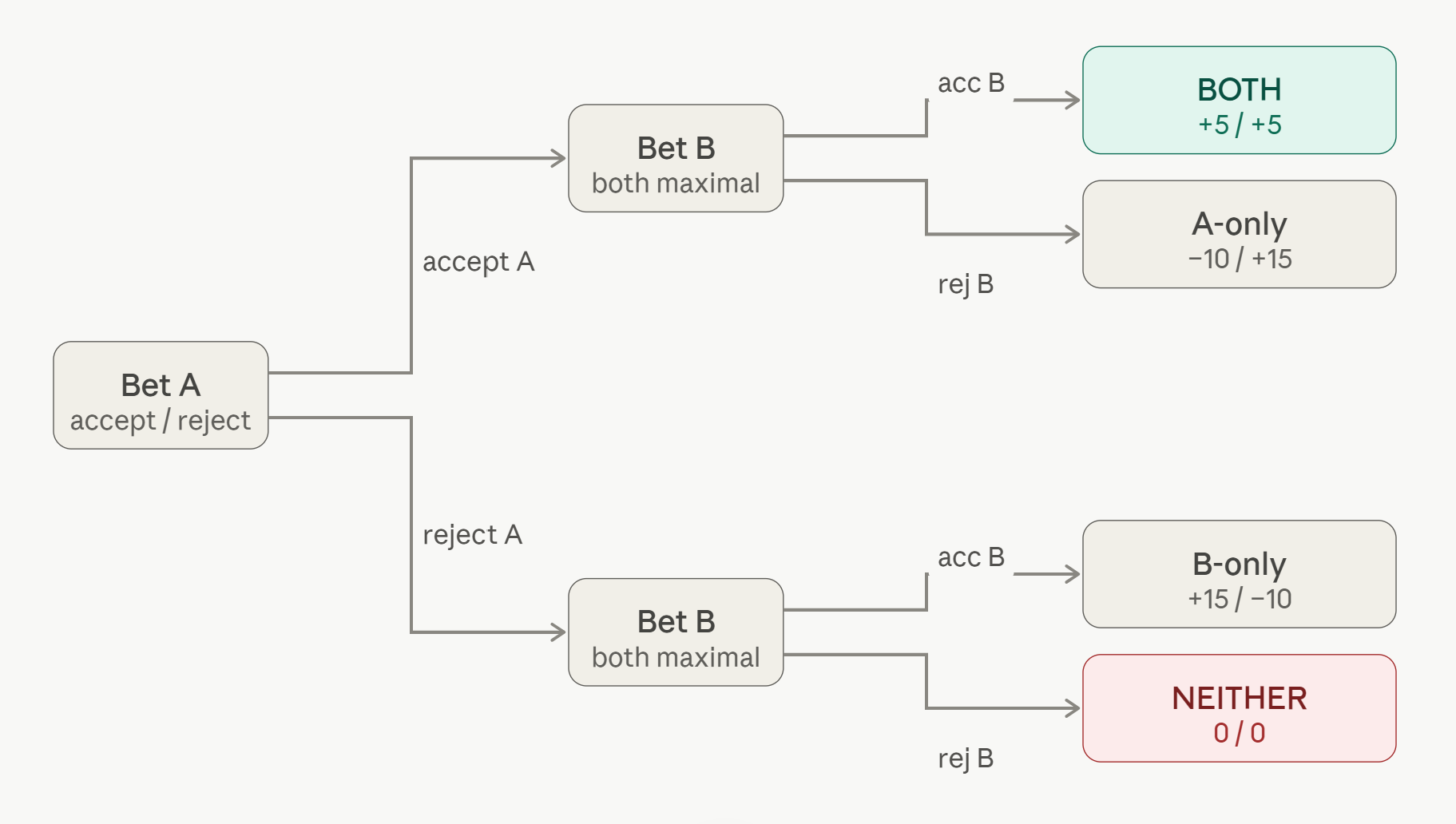
The engine of the argument is a sequential betting setup on some proposition H (say, that it rains tomorrow):
- Bet A: If H is true you lose $10; otherwise you win $15.
- Bet B: If H is true you win $15; otherwise you lose $10.
You're told the full setup in advance, Bet A is offered first and Bet B immediately after, and crucially your opinion about H won't change during the process (no new evidence, no reinterpretation, just the passage of time). The bets are mirror images, so accepting both guarantees a net $5 gain no matter how H turns out.
Elga grants you're not required to accept both (a very confident or very doubtful agent might prefer just one). But he insists on the key premise: a rational agent must accept at least one of the two bets, because rejecting both is dominated—it's worse than accepting both in every outcome, and you can see this in advance. This premise is easy for a sharp-credence theorist to honor. The rest of the paper argues that no version of the unsharp view can.
To set up the problem: suppose your credence is the wide interval P(H) = [10%, 80%]. A sharp agent evaluates Bet A by a clean threshold—accept if P(H) < 60%, reject if P(H) > 60%, optional at exactly 60%. (Bet A's expected value is positive precisely when P(H) is below 60%.) Your interval straddles 60%, and that's where the trouble starts.
Permissive rules are too permissive
The first and most natural family of rules: since your interval spans the 60% threshold, neither accepting nor rejecting Bet A is mandatory—the bet is optional. By the same reasoning Bet B is optional too. But then it's permissible to reject both. Elga says this is plainly absurd: a money-loving agent who knowingly walks away from a guaranteed $5 has departed from perfect rationality. He notes that a wide swath of decision rules in the literature (Levi, Walley, Good, Seidenfeld, Gärdenfors–Sahlin, Gilboa–Schmeidler) deliver exactly this verdict, and so are unacceptable as accounts of ideal rationality. (He's careful to flag that some of these authors—e.g. Gilboa–Schmeidler—may only be theorizing about non-ideal agents, in which case his critique doesn't touch them; and that Levi explicitly embraces the reject-both consequence.)
Strict rules are too strict
At the opposite extreme is the midpoint rule: evaluate bets using the midpoint of your interval, so [10%, 80%] behaves like a precise 45%. This does yield the correct verdict (you'd never reject both bets, since no sharp agent does). But Elga argues it's self-defeating for the unsharp camp. The original motivation for unsharp credences was that the evidence fails to "nail down" any exact probability. Yet the midpoint rule lets the evidence nail down a completely precise pattern of betting odds: an H-ticket worth $100 if true gets valued at exactly $45.000…. If it's fishy for rationality to require an exact credence of 45%, it's equally fishy to require valuing the ticket at exactly $45. So strict rules buy the right behavior only by smuggling precise constraints back in—which removes any reason to have rejected precise credences in the first place. The midpoint rule (and its strict relatives) thus robs unsharpness of its point.
What's needed, and the three "global" attempts
So the unsharp theorist needs a rule that is strict enough to forbid rejecting both bets, yet permissive enough to leave a range of options open when, say, Bet B is offered alone—and that motivates both verdicts naturally. Elga sees only three candidate strategies, all "global" in that they assess choices in light of other (past or future) choices.
1. NARROW — Acting sharpens your interval. Reject Bet A and your P(H) narrows (e.g. to [60%, 80%]), which then disposes you to accept Bet B; in general your intervals contract so as to block predictably inferior sequences. This delivers the right strictness/permissiveness mix. Elga's objection: it forces a rational agent to change her opinion without any change in relevant evidence. His illustration: if your credence about rain is unsharp enough that wearing either a rain-poncho or a non-water-resistant suede jacket is permissible, NARROW says choosing the poncho makes you confident it'll rain and choosing the jacket makes you confident it won't—even though your choice of jacket carries no evidence about the weather (you have no rain-sensing powers, and your clothing doesn't control the sky). Rationality never requires revising an opinion when relevant evidence is unchanged, so NARROW fails.
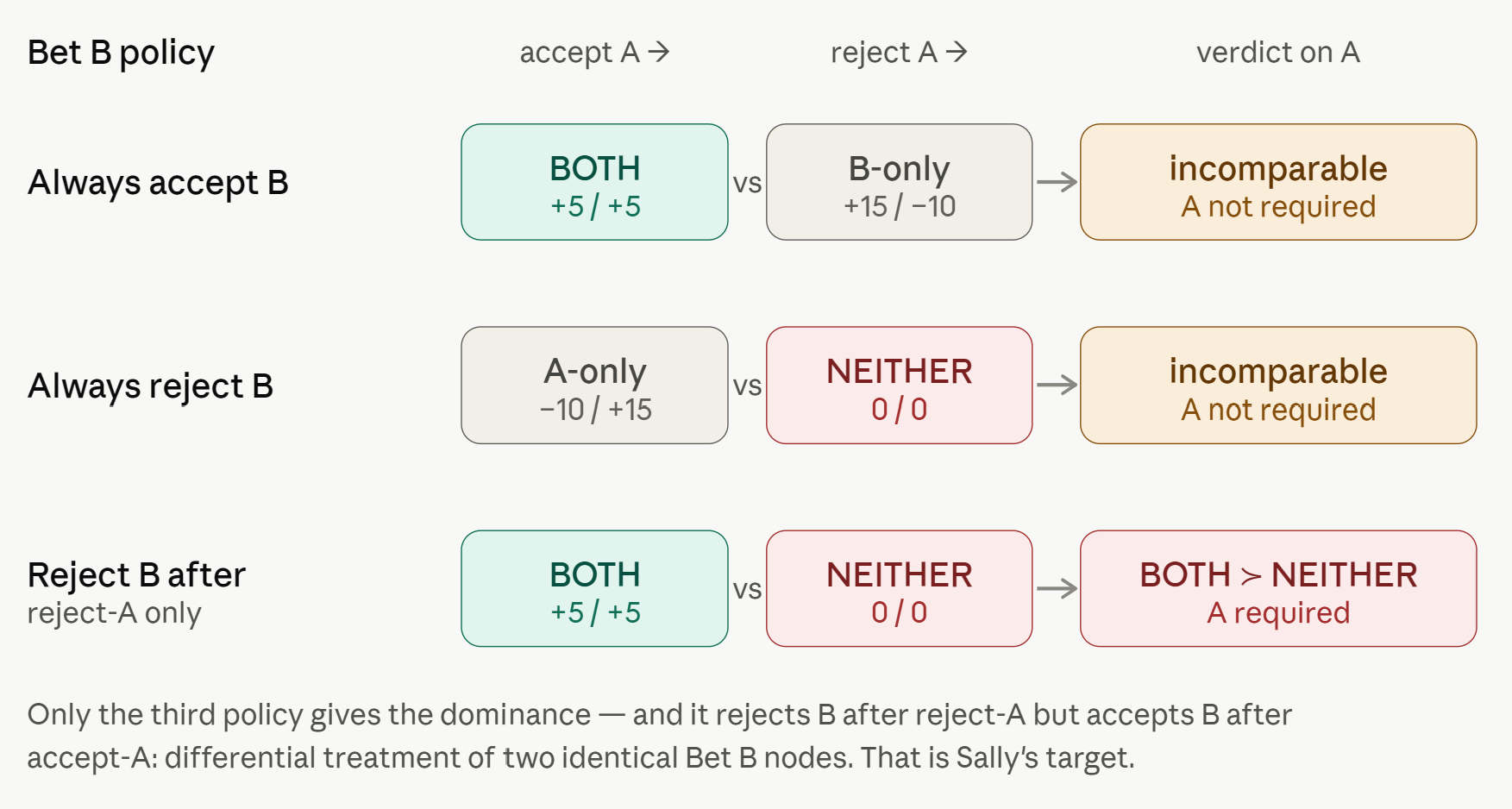
2. PLAN — When you act, you simultaneously form a plan binding your later choices to cohere with it (reject Bet A → plan to accept Bet B → follow through), but without changing any beliefs. Elga refutes this with the case of Sally, who cares only about money and has a highly unsharp credence about rain. Compare two scenarios: in the first she rejected Bet A and is now offered Bet B; in the second she's offered Bet B alone. PLAN permits rejecting Bet B in the second but not the first. Yet the monetary consequences of accepting and of rejecting Bet B are identical across the two scenarios, and her beliefs are identical, and money is all she cares about—so the situations are alike in every respect she cares about. Rationality can't impose different requirements on choices that are identical in all relevant respects. To the rejoinder "but rejecting Bet B would break her plan," Elga replies that either plan-breaking is something Sally finds costly (contradicting the stipulation that it's costless for her), or it isn't—in which case "Don't break plans!" is as groundless a constraint as "Don't break mirrors!" He flags but sets aside the resolute-choice tradition (Gauthier, McClennen) that would defend plan-following.
3. SEQUENCE — Sequences of actions can be assessed for rationality independently of their parts: each of "reject A" and "reject B" can be individually permissible while the sequence "reject-A-then-reject-B" is impermissible. Elga turns the same Sally argument on it. SEQUENCE makes rejecting Bet B fine when no Bet A preceded it but irrational when it would complete the bad sequence—so it, too, imposes different requirements across two situations Sally can see are identical in everything she cares about. Hence SEQUENCE fails.
Conclusion
Every candidate account of how unsharp probabilities guide action falls into one of the traps: permissive rules wrongly license rejecting both bets; strict rules pin down precise betting odds and thereby destroy the motivation for unsharpness; and the global rules (NARROW, PLAN, SEQUENCE) either demand belief change without evidence change or treat choice-identical situations differently. Since there's no good answer to how unsharp credences constrain rational action, UNSHARP is false—and so perfect rationality requires perfectly sharp probabilities.


This seems to be a breakdown with the consideration of actions in complete isolation rather than with having coarse probability estimates.
At least in practice, there's a clear difference between considering bet A in isolation and considering bet A when you know bet B is coming. If you told me about a sports game between the Snofuls and the Fleertis and offered me 2:1 odds on the Snofuls to win, I wouldn't take it. But if you told me you would also give me 2:1 odds on the Fleertis to win, I would take both bets, guaranteeing a profit.
As a rational actor with no useful information, I have a very broad range of potential probabilities for this bet, and it is permissible to do neither bet in isolation. However, when we consider our options simultaneously, that changes the calculus.
To apply this to altruistic action, there might be actions that we are uncertain about in isolation, but we are willing to pursue as a part of a portfolio approach.
mood
You guys get to be rational actors??
Funny, and relatable.
Hello Evan.
Accepting the 1st bet if you were confident Snofuls would win, accepting the 2nd if you were confident Fleertis would win, and accepting both if you thought the probability of any of the teams winning was close to 50 % would be in agreement with sharp probabilities.
Which of the 3 strategies described by Adam would you use to justify accepting or rejecting each bet in isolation, but rejecting both bets together?
This is not an argument for unsharp probabilities? Supporting a portfolio of interventions makes sense even with sharp probabilities. Marginal cost-effectiveness tends to decrease with spending. For example, if the Animal Welfare Fund (AWF) had granted 2 times as much to all the grantees they supported in 2025, I expect the impact of the grants would have been larger, but less than 2 times as large.
I agree that accepting both bets is consistent with a sharp probability at 50%, though I'm just trying to give an example of a case where I would have an unsharp probability range where I would reject both bets in isolation but take them when they arrive together.
I don't employ any of the 3 strategies. My argument is that you don't need a fancy strategy because, in the example, you know that bet B is coming when you're asked about bet A. I think it's reasonable for a rational actor to reject bet A and reject bet B if the two are presented separately but accept them both if they are presented together. My example is intended to demonstrate that. A rational actor doesn't need NARROW, PLAN, or SEQUENCE. They need to consider the future: "Bet B is coming, so there's an arbitrage opportunity regardless of the probability." The article seems to disagree, treating every action in isolation and requiring that we make the right decision without global thinking.
My recommendation for portfolios is not an argument for, but an implication of, unsharp probabilities. A lot of cause prioritization is about the core philosophical positions you hold underpinning it. If you have a sharp probability, you might be comfortable investing all in one cause. If you have an unsharp one, you might not be convinced that investing in any one cause is net positive. However, you might find a combination of causes that seems robustly better than no action.
For example, you might be concerned about climate policy's constraints on growth as well as growth's effect on the climate. If you believe that the second order effects of investing in growth on the climate are smaller than the direct benefits of donating to climate policy (and vice versa), it is strictly better to donate to both in some combination than to do nothing. Someone with a sharp probability might be comfortable donating to just one in a way someone with unsharp probabilities would not.
As a result, portfolios are better (i.e. are more often optimal) in a world where UNSHARP is true.
I see and agree with your point about marginal returns. Depending on how strong that effect is, portfolios are also good in a world with sharp probabilities only.
I do not seem to understand. If one knew "Bet B is coming", one would know about the full set up in advance as in the post ("You're told the full setup in advance"). So rejecting both A and B would not make sense?
I agree that rejecting both A and B would not make sense, if you are informed of both. I think the author is wrong to treat A and B as separate decisions, when the agent knows about both in advance.
Knowing that you have the option to take bet B later fundamentally changes the considerations for bet A. As a result, we are not making 2 independent decisions (A: yes or no, and B: yes or no). We are making 4 (A, B, BOTH, NEITHER).
When considering that list, we can see that BOTH is strictly greater than NEITHER in all worlds and rule out NEITHER. We are left with A, B, and BOTH to choose from, all of which might make sense depending on the agent's choices.
At no point did I need to employ NARROW, PLAN, or SEQUENCE. I didn't even consider the probability of H, let alone whether that probability is sharp. I just considered the available options differently.
EDIT: I think this is close in effect to SEQUENCE. As a result, there might be the objection, "What if, of the 4 options, you choose B? Could you change your mind after rejecting A and then reject B as well?" To this I would say that a rational actor does not change their mind without new information. They would only choose B if they believe B > BOTH > NEITHER. Any rational actor who believes B > NEITHER would end up betting B. They would never bet NEITHER.
What might have muddied the waters:
I separately considered how I might deal with these probabilities separately, WITHOUT knowledge that one will follow the other. This is a distinct problem from the original dilemma. However, I think it's the only situation where a rational actor who follows UNSHARP might behave differently.
Without knowledge beforehand, if you hold UNSHARP, the following can happen:
You receive A, evaluate it, conclude it's optional due to UNSHARP probabilities, and reject it. Then, you are offered B, evaluate it, conclude it's optional, and reject it. You look back and think "I wish I would have known beforehand. I would have taken advantage of the arbitrage. Oh well. I guess rational actors with less information make worse decisions."
I think it is rational for an actor to hold unsharp probabilities for some hypotheses.[1] I think it's rational to not engage in sports gambling when no arbitrage exists. My initial example was designed to connect the two.
I haven't made my mind up on whether it's necessary to hold unsharp probabilities in theory but I'm much more confident in practice.
When you see a new opportunity that you know very little about that might be massively valuable, using your minimally informed baseline model to direct action seems irresponsible. Upon further investigation, everything regresses to the mean.
In the sports gambling example I gave, you should reject unless you see arbitrage because ~all available information is priced in. In the case of impact, new opportunities look more exciting than reality due to (e.g.) selection effects and stable equilibria.
This discussion of whether or not we should have unsharp probabilities is beside the point. My argument is about whether we can have unsharp probabilities without sacrificing rationality. I believe we can.
I see. Thanks for clarifying. Below is how Claude thinks Adam (the author of the article) would object to your comments. The objections make sense to me. Any reactions?
The unifying objection: the four-option reframe is one of the three rules
Evan's central claim is that he can dissolve the puzzle without NARROW, PLAN, or SEQUENCE: treat the situation not as two decisions (A yes/no, B yes/no) but as one choice among four policies — {A-only, B-only, BOTH, NEITHER} — notice BOTH statewise-dominates NEITHER, delete NEITHER, and you're done. He stresses "I didn't even consider the probability of H."
Elga's first reply is that this is exactly SEQUENCE (or PLAN) wearing plain clothes — and Evan concedes it in his own EDIT ("I think this is close in effect to SEQUENCE"). Evaluating the pair of choices as a single ex-ante object over sequences is the defining move of the global rules. So "I don't need any of the three" is false: he's using the third. And that matters, because Sally is aimed precisely here. Take Evan's B-only policy: it requires rejecting A and then accepting B. Compare the agent at the B-node in two situations — one where she reached it by rejecting A, one where B is offered alone. For a money-only agent these are identical in everything she cares about, yet the reframe must call rejecting-B impermissible in the first (it would complete NEITHER) and permissible in the second. That is the SEQUENCE verdict, and it fails for the SEQUENCE reason.
Why "consider them simultaneously" doesn't reach the actual problem
Evan's sports example — decline each of the Snofuls/Fleertis bets in isolation, take both together for a sure profit — leans on "when we consider our options simultaneously, that changes the calculus." Elga's rejoinder: in his setup the bets are not simultaneous. You settle A, and only then face B. So the live question is what binds you at the B-node, where A is already done and the only comparison is accept-B (+15/−10) versus reject-B (0). With an interval straddling 40%, maximality rules both permissible. The ex-ante fact "BOTH dominates NEITHER" is true but does not, by itself, reach into the B-node and make accepting B required there. Supplying that reach is the whole job of PLAN/SEQUENCE — which is why Evan can't actually skip them.
And the boast "I didn't even need to consider P(H)" is the tell, not the triumph. Dominance eliminates NEITHER for any credence — a sharp agent excludes it too. So the four-option elimination is entirely neutral between SHARP and UNSHARP; it was never the point in dispute. The dispute is about the sequential assembly of a dominated outcome from two individually-licensed choices, and the reframe simply doesn't engage it.
The EDIT smuggles in comparability — i.e. sharpness
Evan tries to close the "what if you plan B, reject A, then reject B?" gap thus: "a rational actor does not change their mind without new information. They would only choose B if they believe B > BOTH > NEITHER. Any rational actor who believes B > NEITHER would end up betting B."
This quietly assumes a complete ordering over the options — exactly what UNSHARP denies. B-only beats BOTH only when P(H) > 60%; with the interval [10%, 80%], B-only and BOTH are incomparable under maximality, as are A-only and BOTH. So "they would only choose B if B > BOTH" presupposes the agent can rank options the way a sharp credence lets her. Grant that comparability and of course she never lands on a dominated outcome — but you've then imported enough structure that she behaves like a sharp agent, which is Elga's strict-rules horn: you buy the right behavior only by reintroducing precision and thereby forfeiting the motivation for going unsharp in the first place.
"Rational actors with less information make worse decisions" gives the game away
Evan concedes that without foreknowledge an UNSHARP agent can reject A as optional, reject B as optional, land on NEITHER, and shrug it off as an information deficit. Two problems. First, Elga's case stipulates full foreknowledge, so the no-foreknowledge scenario isn't the one under discussion. Second, and more damaging, the diagnosis "less information" is wrong. A sharp agent — even with a diffuse-but-precise prior, and even with no foreknowledge — never rejects both, because her node-by-node expected-value verdicts are automatically time-coherent (reject A only if P(H) > 60%, accept B only if P(H) > 40%, and these can't jointly fail). The unsharp agent's node verdicts are not automatically coherent: both nodes say "optional," which is what lets her assemble NEITHER. So the pathology is produced by the unsharpness, not by any information gap. Evan's concession thus admits precisely the foreseeable-domination Elga is prosecuting, and mislabels its source.
The portfolio point isn't an argument for UNSHARP
Vasco already made the core objection and Evan half-conceded it: diversification falls straight out of sharp EV reasoning with diminishing marginal returns and cross-correlations. Elga would add the sharper version: where the portfolio reasoning gives sensible verdicts ("this combination statewise-beats doing nothing"), it's dominance reasoning a sharp agent honors equally; where it gives distinctively unsharp verdicts, it does so by licensing inaction — declining each option in isolation — which is just the reject-both pathology relocated to altruistic choice. (This is the "clueless agent whose intervals stay wide because it never acts" failure mode, which is live in your own work.)
"Can vs. should" is not a dodge — it's Elga's exact target
Evan's sign-off — "whether we should have unsharp probabilities is beside the point; my argument is about whether we can have them without sacrificing rationality, and I believe we can" — doesn't sidestep Elga. UNSHARP just is the "can" claim: it is consistent with perfect rationality to be unsharp. SHARP denies that. So Evan is engaging the thesis head-on, and Elga's reply is that the "can" fails for the reasons above: every route Evan takes either collapses into SEQUENCE (Sally sinks it) or into sharp-style comparability (motivation lost).
The honest crux
Where Evan has a real point — shared with DiGiovanni and Michael St Jules — is the suspicion that node-by-node "local" evaluation is the wrong model, and that a look-ahead agent who plans the whole tree does fine with wide intervals. Elga's whole case does assume that a theory of rational credence must deliver correct verdicts at each actual choice node, not merely over ex-ante policies. Evan is, in effect, denying that assumption. But he hasn't defeated Sally independently; he's relocated to ex-ante policy choice, which Elga classifies as SEQUENCE/PLAN and which Evan himself admits is "close in effect to SEQUENCE." So the disagreement bottoms out exactly where it did in the DiGiovanni thread [this one]: whether an idealized agent is entitled to bind her future choices (resolute/sophisticated look-ahead), or whether rationality must already be satisfiable choice-by-choice. Elga bets on the latter; Evan (like DiGiovanni) needs the former — and that is the genuine open question, not something Evan's four-option reframe settles.