Crossposted to Less Wrong
‘Like most of life’s dangers, the dangers of artificial intelligence are not easily identified from the armchair.’
J Dmitri Gallow
Epistemic status
I’m not an expert in this field, and herein I make some sweeping generalisations educated guesses about the overall...
Note: This post was crossposted from Planned Obsolescence by the Forum team, with the author's permission. The author may not see or respond to comments on this post.
Subtitle: If acceleration compounds, the naive extrapolation implies superintelligence within a year
This post discusses a public METR report on AI R&D acceler...
This post is part of the Rethink Priorities Cross-Cause Fund (CCF) series on how to allocate funding across causes when it is uncertain what matters most.
...
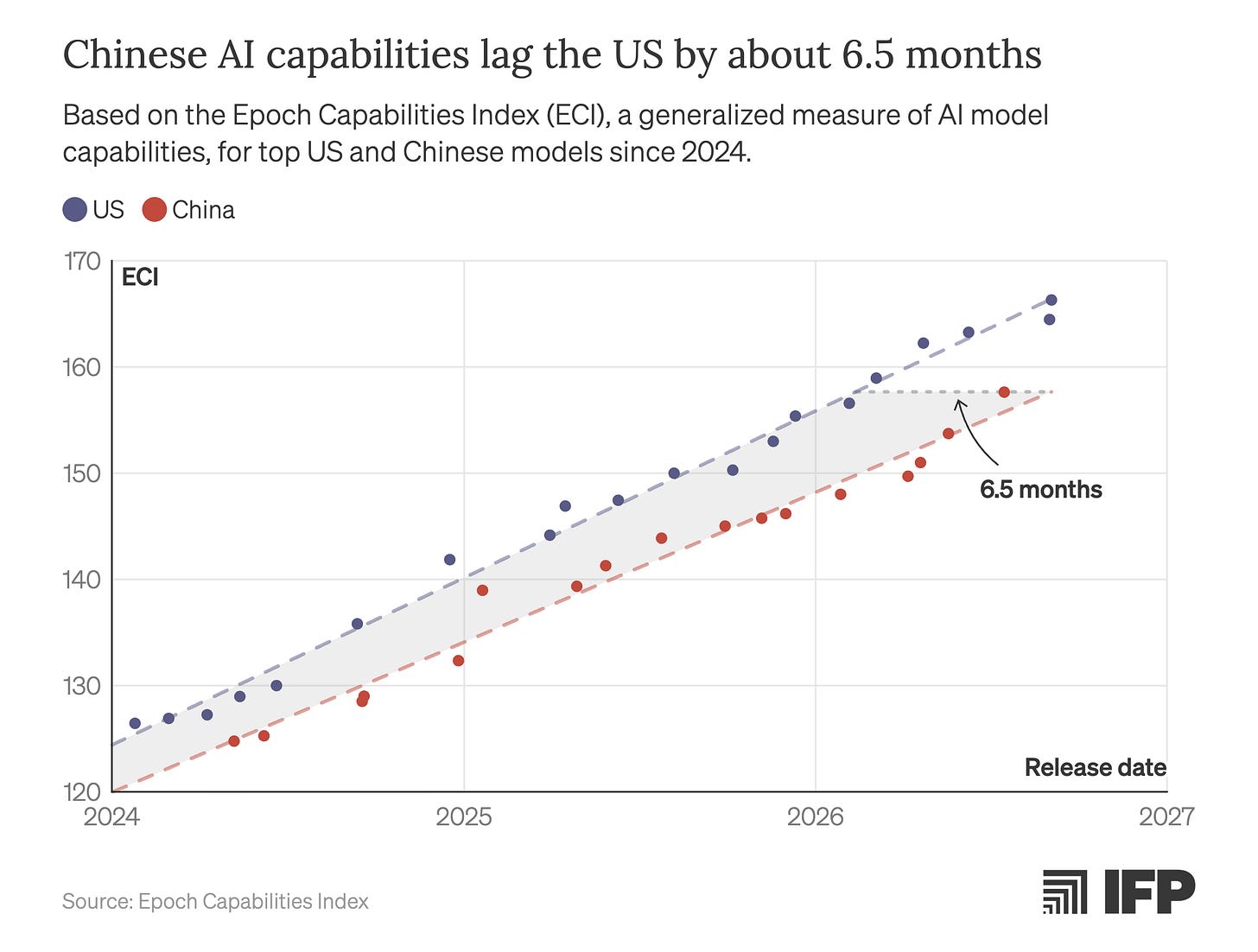
China’s best models are only six months behind America’s, despite having far less computing power. How is that possible?
Luisa Rodriguez investigates, and finds that much of China’s progress is made by using American chips and copying American models:
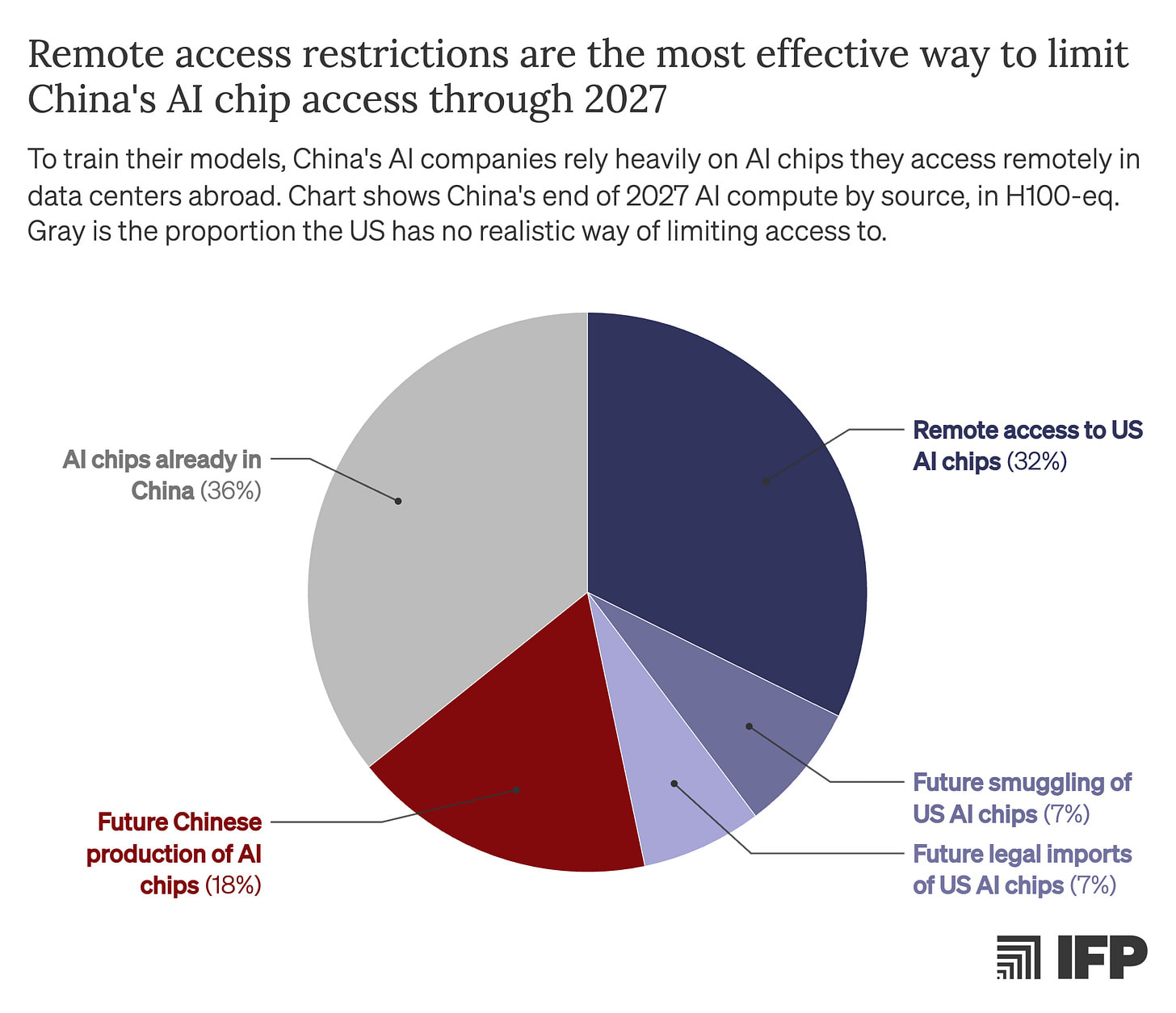
US rules stop NVIDIA selling its best chips to China. But Chinese companies can still rent those same chips in data centres abroad.
Smugglers go to extreme lengths to sneak chips into China.
Chinese AI companies copy America’s best models on an industrial scale.
Today’s most powerful technological secrets are protected by alarmingly inadequate security.
The US could tackle these gaps with powers it already has. So the current situation, with China only months behind, is largely a policy choice.
If the main argument against slowing down is that China might catch up, none of this quite adds up.
Four days after recording this, NVIDIA’s CEO Jensen Huang — who features in the video as one of the loudest voices against restricting China’s access to chips — admitted to having an affair with an alleged Chinese spy. This shows just how badly China wants American chips.
Closing these gaps in US AI policy could buy time to test new models and hold back those that aren’t safe. Before we accept that the US has to race ahead, it’s worth asking who benefits from racing, and what’s currently being given away.
This episode was recorded on November 4, 2026.
Our production team includes:
Video editors: Josh Alward, Dominic Armstrong, Jasper Luithlen, Milo McGuire, Luke Monsour, Simon Monsour, Ollie Bignell, and Andrés Escobar
Producers: Elizabeth Cox and Nick Stockton
Coordination and support: Katy Moore and Lou Moran
Camera operator: Dominic Armstrong
Subtitle: Washington could close most of China’s access with powers it already has.
This is a cross-post of one of our recent podcast episodes hosted by Luisa Rodriguez, lightly edited for readability.
Transcript
Four days after writing this, NVIDIA’s CEO Jensen Huang admitted to an affair with a woman US intelligence reportedly believes is a Chinese spy.
According to The New York Times, US officials believe she was recruited to gather information and potentially push for NVIDIA’s best chips to be sold to China.
This news shows just how much China wants American chips.
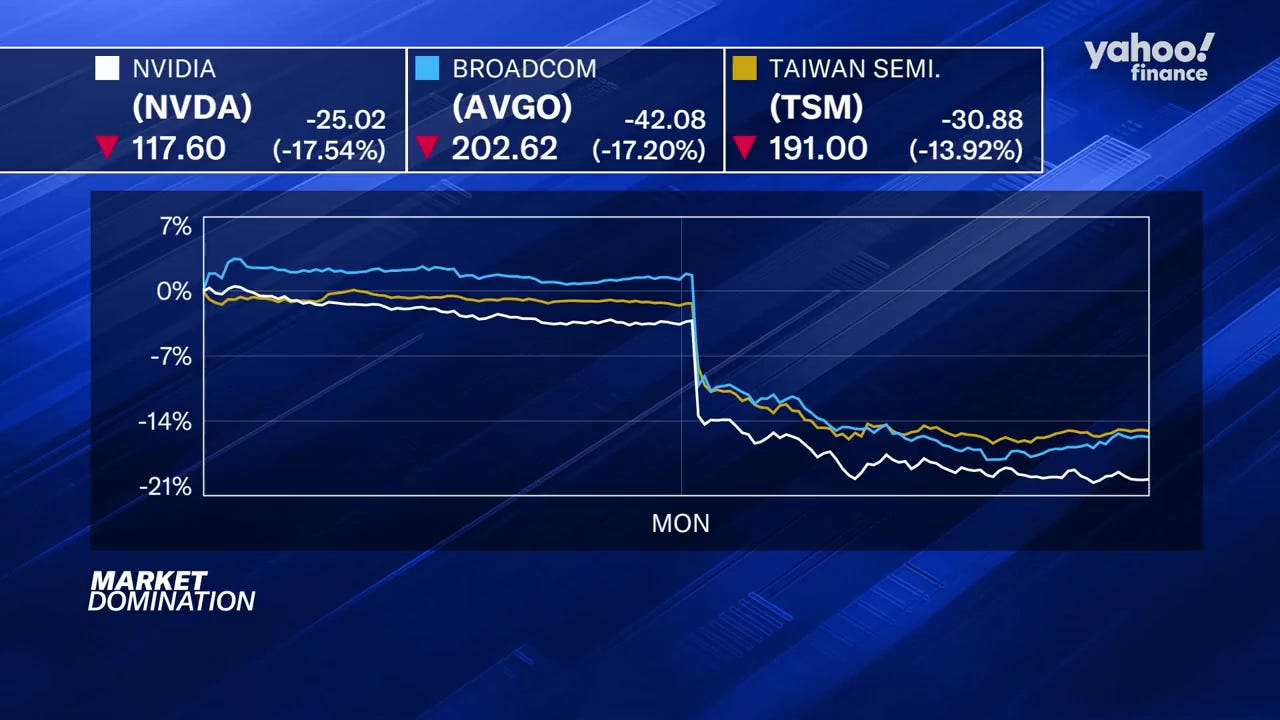
Suddenly, everyone was saying: China had caught up.
They were only half right. Almost two years later, its models are still about six months behind the best American ones. Still, six months isn’t that long — especially when you consider that the US has roughly 16 times China’s AI computing power.
If you think the US can’t slow AI down because China will catch up, this might change your mind. Because China is keeping up. But it couldn’t do that without American help.
Who’s building China’s AI?
To understand how, it helps to start with who’s actually building China’s AI.
There are two kinds of players: tech giants like Alibaba, Tencent, and ByteDance, the company behind TikTok; and a handful of startups, like DeepSeek and Zhipu.
These companies are inventive. DeepSeek’s model was revolutionary for squeezing more out of fewer chips.
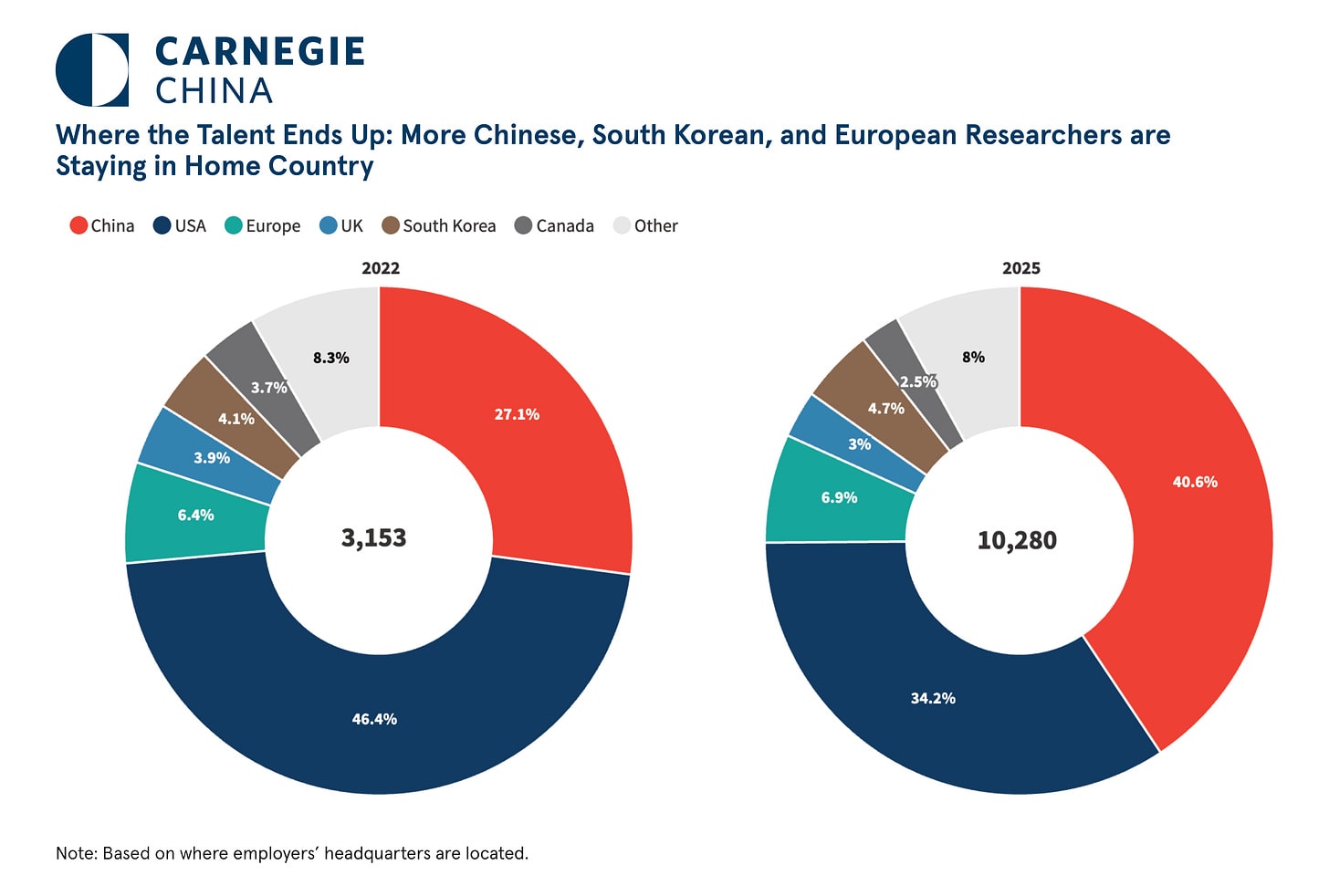
They’re also talented. More than half of the world’s top AI researchers did their undergraduate degrees in China. And more and more of them are staying there to work.
So China’s AI industry is inventive and talented, but also comparatively small, poor, and starved for chips. And yet, its best models are surprisingly good.
How far behind is China?
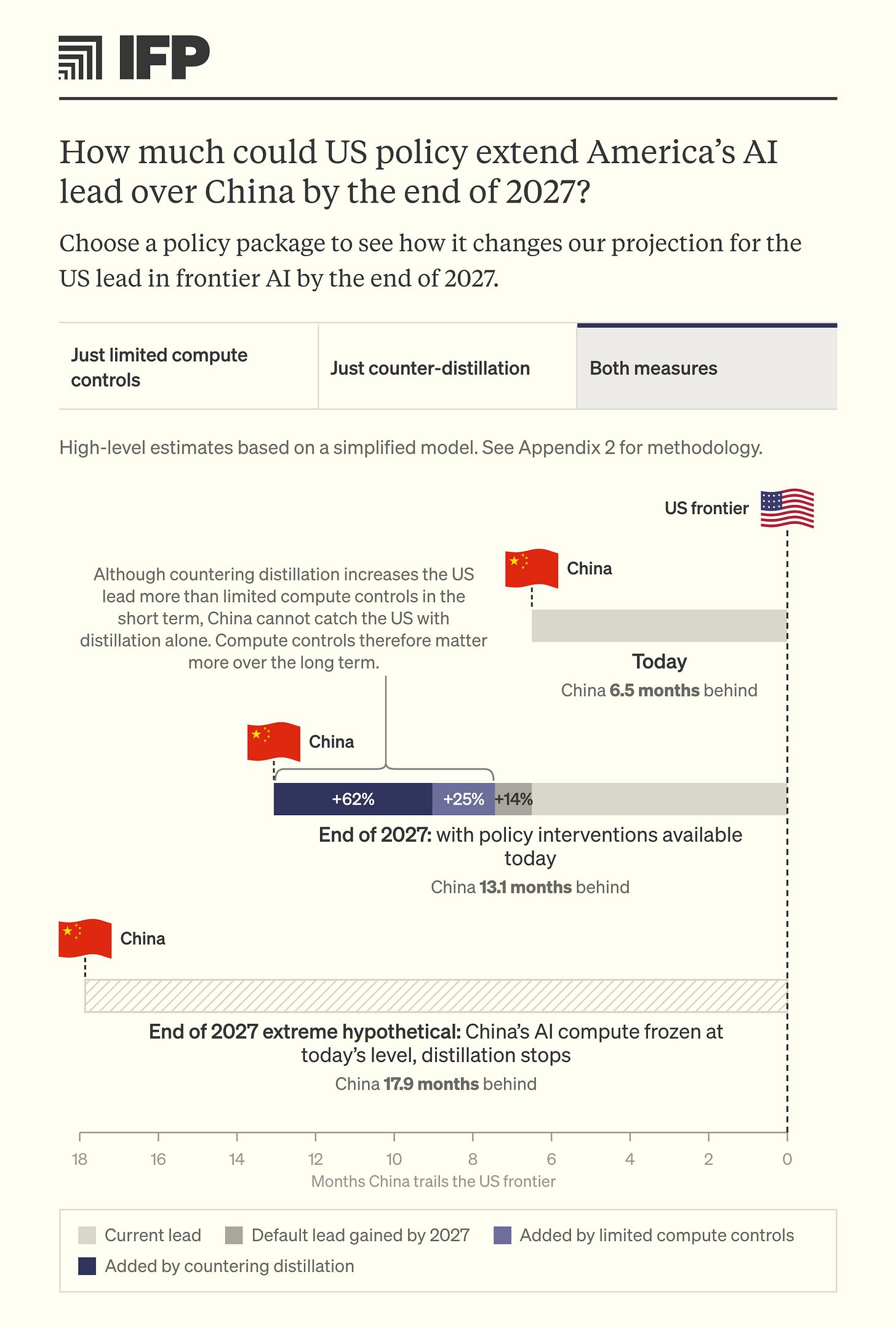
Across dozens of AI tests, China’s best models score about as well as American models scored six and a half months ago.
Earlier this year, Anthropic built Claude Mythos, the first AI model to raise serious national security concerns. China is expected to have a model just as good within months. So whatever worries you have about the most powerful American AI today, expect it from China about six months later.
A lot of people, myself included, think we need to make sure these systems are safe before we build even more powerful ones — even if that means slowing down.
If every month counts, it’s worth understanding what’s causing this gap: what’s holding China back, and what’s letting it build such good models anyways.
Why can’t China make its own chips?
Let’s start with what holds China back. A lot of it comes down to chips.
AI runs on lots of specialised computer chips. Companies need them to build better models, and then to run those models for millions of users. More chips means you can do more of both.
The best AI chips need two things China struggles to get.
The second thing China struggles to get is memory. AI chips need a special kind of very fast memory, and China can’t make enough of it. And since December 2024, US rules have banned selling it to China too.
So even Huawei, China’s leading chip designer, only used Chinese-made memory in about 16% of this year’s AI chips. The rest rely on stockpiles, smuggling, or slower substitutes.
Add it all up, and the US makes about 50 times as much AI computing power as China. That’s largely because of American export controls.
After DeepSeek, plenty of people said the export controls had failed, including NVIDIA CEO Jensen Huang.
Some are bought legally. In January, the US approved sales of one of NVIDIA’s top chips, the H200, to China — though Beijing told its AI companies to hold off, to protect its own chip industry.
Chinese firms still needed chips, though. So they found another route. This year, they bought more than a million NVIDIA graphics cards — the kind that are normally used for gaming and design, which fall just under the export rules’ limits — to use on AI.
Some chips are smuggled. In one case, smugglers peeled the NVIDIA labels off top AI chips and replaced them with a made-up brand. Altogether, the smuggling network moved, or tried to move, at least $160 million worth of chips.
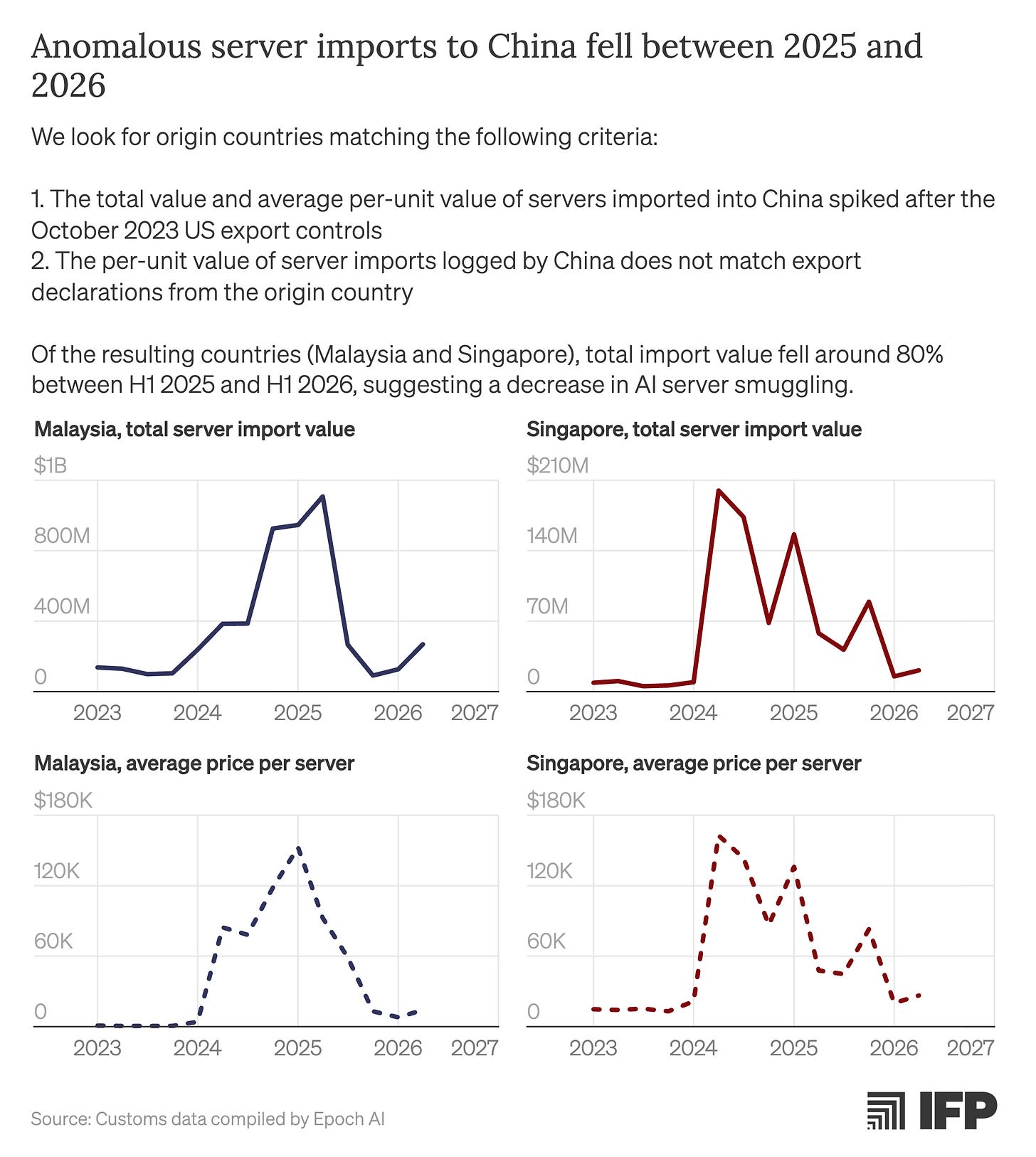
But here too, enforcement can help, if it’s done right. When Washington threatened to restrict AI chip shipments to Malaysia, Malaysia started requiring permits to export them. Chinese imports of servers from Malaysia and Singapore then fell by about 80%.
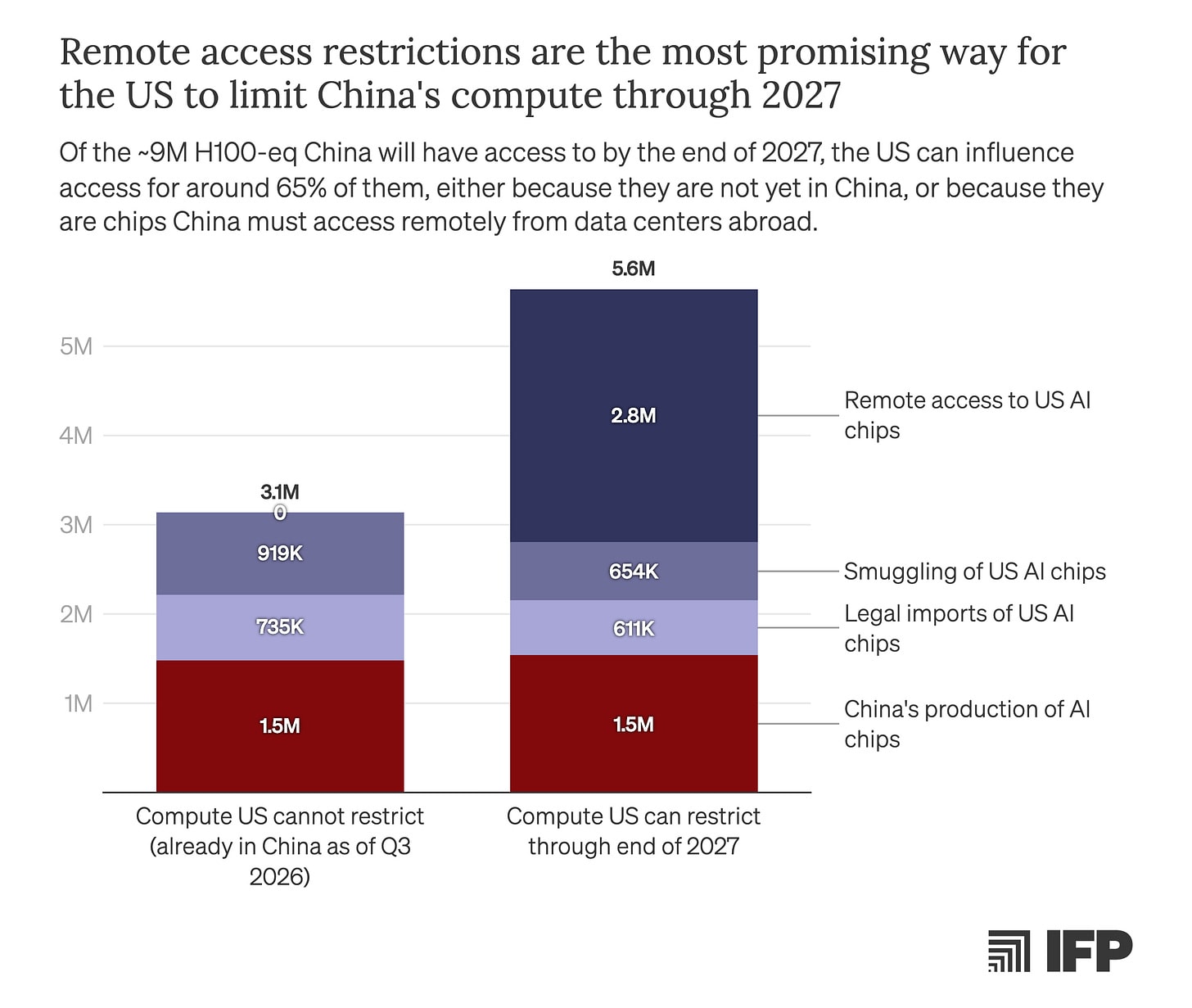
But the biggest channel is renting. And if you see China as a threat, this one feels particularly ridiculous.
You don’t need physical access to AI chips to use them. You can rent time on them in a data centre anywhere in the world.
US rules prevent NVIDIA from selling its best chips to Chinese companies. But they don’t stop Chinese companies from renting those same chips in a data centre abroad. So that’s what they do.
The Chinese AI company Tencent has a deal to rent top chips from the American company Oracle. ByteDance runs a cluster of NVIDIA’s best chips in Norway. But the majority of the computing power being rented sits in Southeast Asia, mostly Malaysia and Singapore.
Here’s what that looks like.
In 2025, four Chinese engineers flew from Beijing to Malaysia, where they’d rented about 300 servers full of NVIDIA chips. Sending that much data over the internet could have taken months, so they carried it in suitcases, each packed with 15 hard drives of training data. The plan was to train their model in Malaysia, and then just fly back with it.
Meanwhile, American companies don’t have enough chips. Amazon runs one of the world’s biggest cloud businesses, and they say they won’t have enough computing power to meet customer demand this year or next. So a chip that doesn’t go to China doesn’t go to waste. Someone else buys it — mostly American customers.
And this is where, for me, the race argument starts to fall apart. You’d expect the people making it to want these channels closed. Instead, some of its loudest voices have pushed to sell China more chips.
He’s also said export controls cost NVIDIA its Chinese market. His solution is to sell China more NVIDIA chips, to keep Chinese developers using American technology. But notice how neatly that fits his business.
David Sacks said every month counts. But as White House AI czar, he pushed to loosen restrictions on NVIDIA’s sales abroad. The New York Times found he held stakes in 449 AI-related companies while shaping AI policy.
Sacks says ethics officials signed off. But his ethics waivers were issued by the White House’s own lawyers, a month after Trump fired the head of the government’s independent ethics office. Either way, I think the incentives are worth noticing.
How do you copy an AI?
Okay, but even with all those chips, the numbers don’t add up.
On computing power alone, researchers estimate China should be about 13 months behind. So what’s making up that difference?
The answer is something called “distillation.” You ask a stronger AI model millions of questions. You record its answers, and its reasoning. Then you train your own model to imitate it. It’s like copying a top student’s worked solutions. But you don’t just get the answers. You also learn how they think, for a fraction of the effort.
Chinese labs do this at an enormous scale.
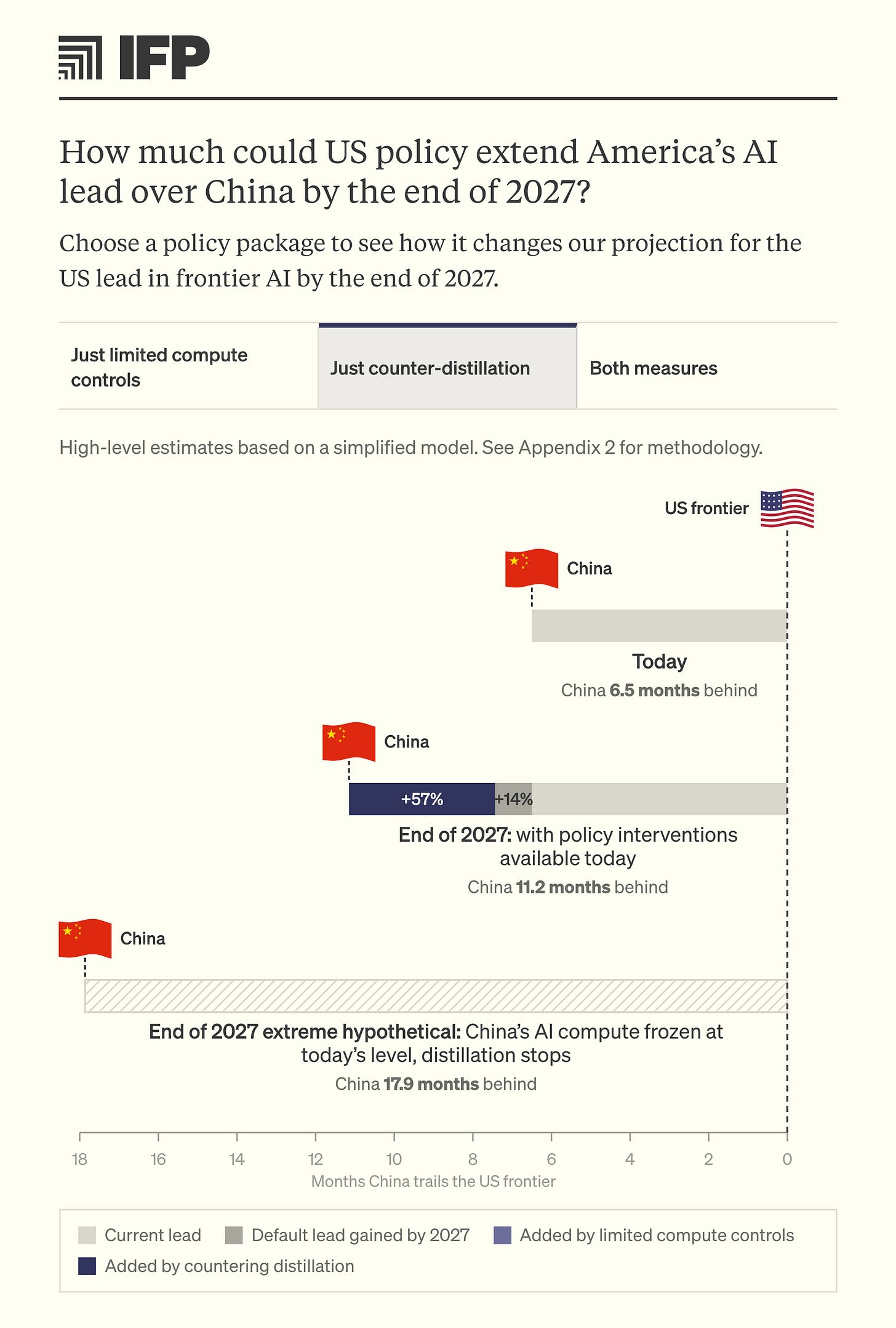
Anthropic says Alibaba alone exchanged more than 151 million messages with Claude in just three months. The Institute for Progress estimated distillation closes roughly half the gap between American models and Chinese ones. That’s like giving Chinese AI companies four times as many chips.
So why don’t American AI companies stop the Chinese ones from copying? To do that, companies have to catch huge numbers of fake accounts. In one campaign, DeepSeek, Moonshot, and MiniMax used roughly 24,000 of them.
But it can be done. Anthropic says it cut the data that copiers can harvest from its models by between 90 and 99%.
The catch is that copiers just go wherever the defences are weakest. Zhipu tried to copy the hacking skills of Anthropic’s top public model, got blocked, but then switched to models with weaker safeguards. Its next model was rated the most capable hacking model anyone has ever released for free.
And there’s an awkward incentive. Copiers pay to use these models, just like any other customer. So every company that blocks them loses money to the ones that don’t.
China is running a different race
So China is buying, smuggling, and renting American computing power, and copying American frontier models. Does that mean they’re losing the AI race?
Ask China’s own AI leaders, and they’re surprisingly frank: in the race to build the smartest AI, yes, they’re behind.
At a conference in Beijing in January, Lin Junyang, who was at that point a technical lead on Alibaba’s Qwen models, put China’s chance of overtaking top American AI companies at less than 20% in the next three to five years. And he called that “highly optimistic.” His reason was computing power.
On the same panel, Zhipu’s chief AI scientist, Tang Jie, went further. He said “the gap may in fact be widening,” because many of the US’s best models aren’t public.
But building the smartest AI models is only one way to win at AI.
Beijing seems to be running a different race altogether: using it everywhere. Its goal isn’t to make the best chatbot. It’s AI in every factory, hospital, and government office. And in that race, China has real advantages.
For one, it has power. AI data centres need enormous amounts of electricity, and in the US, that’s becoming a real problem. American data centres could face a 44-gigawatt shortfall by 2028. That’s like needing to add another California to the US power grid in just over a year from now.
China does not have that problem. It’s expected to add almost six times as much generating capacity as the US over the next five years. So right now, China’s bottleneck is chips. Which means if China ever solves its chip problem, it won’t hit the wall the US is running into. It’ll already have the power to run them.
China also has factories and robots. Last year, China installed about 354,000 industrial robots, which is 59% of the world’s total. The US installed about a tenth as many.
And in the first half of this year, 97% of the humanoid robots sold anywhere in the world were made by Chinese companies. It also controls most of the supply chain behind them, from the minerals to the batteries to the powerful magnets that drive robot joints.
So the picture is more complicated than one race with one finish line. In the race the US is running — the one to build the smartest AI — China is still behind. But again, not by that much — which puts the US in a tricky position.
Why a bigger lead matters
I don’t love the US–China AI “race” framing. Treating AI like an arms race is exactly the kind of thinking that pushes everyone to cut corners on safety. But there are a few reasons to want a bigger gap.
For one, it would help the US capture more of AI’s economic gains. And it would let the US shore up its cyber defences before anyone else can attack them.
But the reason I personally care about most is breathing room. I’m extremely worried that we’re building AI faster than we can make it safe or secure. A bigger gap means time to slow down: to test new models properly, and hold back the ones that aren’t ready yet.
And here’s the thing: the US might already have that time. Six months is actually a pretty long time in AI. And because so much of China’s progress comes from distillation — basically copying US models — the real gap is bigger than it looks.
Matt Sheehan, who studies Chinese AI policy, compares China to a wakesurfer riding the wave behind a boat. It keeps up partly because the boat is doing a lot of the work. If the boat slows down, the wave shrinks. China doesn’t suddenly shoot ahead. It would then have to rely on its own engine, which is much smaller.
First, there’s renting, which lets Chinese companies use huge numbers of American chips abroad. Neither party has stopped it: Biden-era regulators chose not to restrict it, and a later attempt was scrapped by the Trump administration.
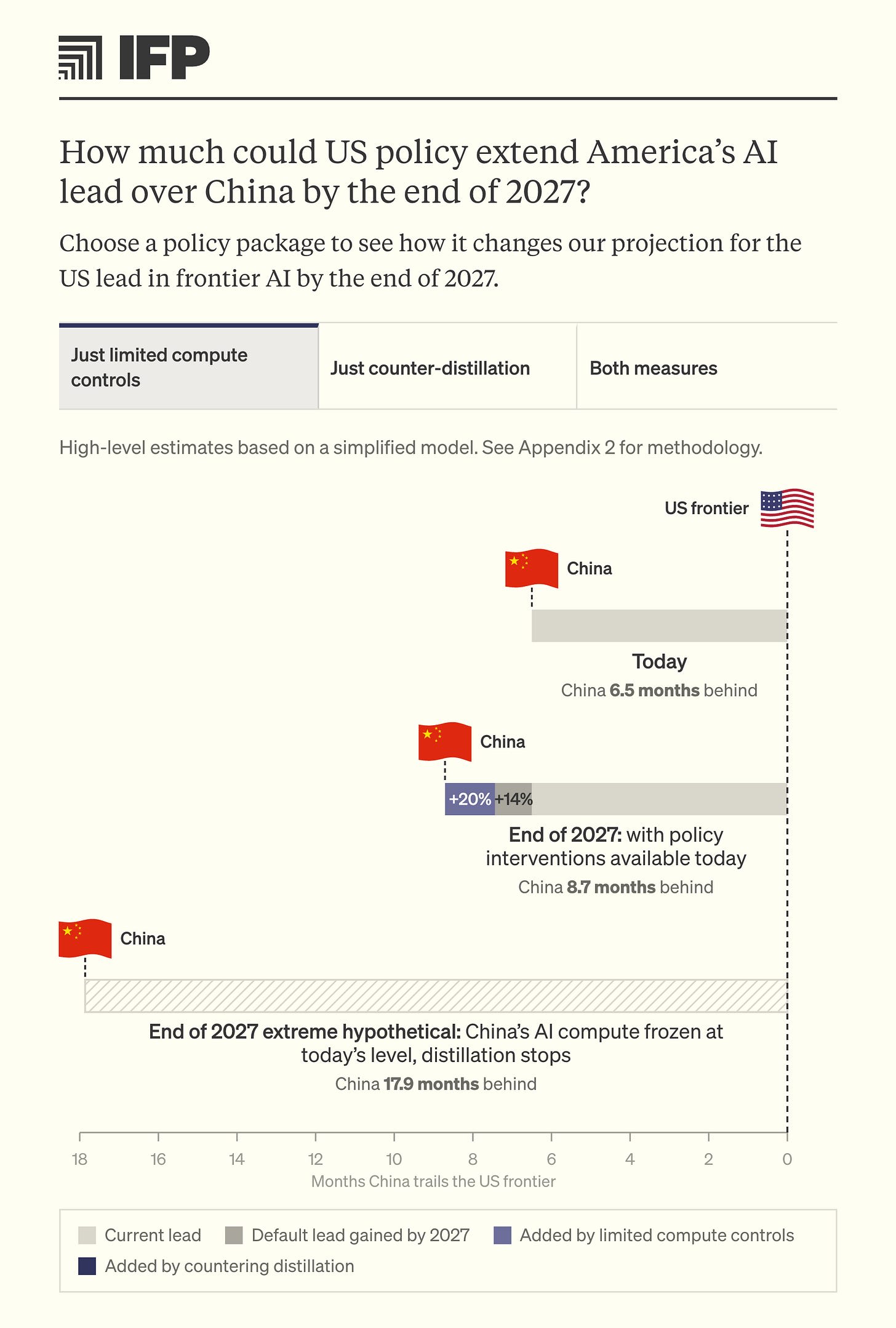
And regulators don’t even need to wait for the bill. They could already require that chips sold abroad can’t be rented out to Chinese companies at scale — ideally alongside a crackdown on smuggling, so the demand doesn’t just go underground.
The government could also stop approving sales of chips like the H200, and limit the gaming cards being used for AI.
And in the long run, the biggest lever might be the older chipmaking machines China still buys from ASML, and the maintenance ASML provides for them. Some analysts argue that cutting off both could lock in the US advantage for at least a decade.
Put together, the Institute for Progress estimates these steps could add several months to the US lead by the end of the year, and maybe even double it. The exact number is rough. But the direction is clear: the size of the lead is in large part a policy choice.
So why hasn’t the US done all this?
Partly, it’s incentives. NVIDIA wants the sales, and copiers are paying customers. But there’s also an argument on the other side — the one David Sacks and Jensen Huang made: cutting China off just pushes it to build its own chips, and reduce its dependence on the US.
Now, Huang runs the company that would lose those sales, so it is tempting to write him off. But researchers with nothing to sell make versions of the same argument.
Analysts at the Center for Strategic and International Studies concluded that broad US controls have sped up China’s push to stop relying on American technology. So maybe if you cut China off, you give it every reason to build its own technology instead. Once it can, the US would lose that leverage for good.
There’s a second worry too: controls make cooperation harder. Matt Sheehan says Beijing’s first read of American AI policy is that the US wants to hold China down. That makes any deal between the two countries harder to reach, including one to slow down together.
So should the US hold off on closing these gaps? I don’t think so.
Selling China chips doesn’t stop it building its own. Remember when the US approved sales of NVIDIA’s H200 this year, Beijing told its companies to hold off, to protect China’s own chip industry. So Beijing will build its own chips either way. The question is whether it also gets American chips in the meantime.
Then there’s timing. Building a whole chip industry from scratch takes years — maybe even decades. ASML started working on its most advanced machines in the 1990s. They cost billions of dollars and took two decades, and only entered mass production in 2019.
If powerful AI is coming in the next five years, as many experts in the industry believe, China’s own chips won’t be ready in time. What matters is how close its best models are now. And right now, that depends a lot on American chips and American models.
But there’s one more risk, and it could undermine the lead the US already has — even if it does manage to widen the gap.
So a nuclear power plant has to meet strict federal security rules, but the companies building what might be the most powerful technology in history don’t.
And China is already going after American AI secrets. In January, Linwei Ding, a former Google engineer, was convicted of stealing thousands of pages of Google’s AI secrets while secretly working for two Chinese tech companies. Those pages showed how Google builds the supercomputers it uses to train its AI — which is exactly the kind of computing power China has struggled to build.
No theft of a top model has been publicly confirmed yet. But the techniques behind them are clearly a target.
So how bad would it be if these things were stolen?
I’ll start with the model itself. Once stolen, China gets everything it can do, including the dangerous stuff.
Then there are breakthroughs. A stolen model pretty quickly becomes obsolete. But stolen breakthroughs in how to design or train AI could help China build better models long after they’ve stolen them. That could give China a lasting boost, even with less computing power.
For me, that’s the scariest part, because it could eat into the room the US has to slow down. If the US slows down, China has to make progress on their own, without copying, and with far fewer chips. Stolen breakthroughs could let it close the gap in a lasting way.
But unlike China’s chips, security is entirely in the US’s hands. And security at American AI companies could be much, much better than it is right now. It’s honestly kind of crazy that it isn’t better already. But that’s fixable.
So can the US slow down?
China buys, smuggles, and rents American chips. It trains on answers from American models. And with security as weak as it is, China could steal the models themselves, or the techniques behind them.
All of which puts some serious holes in the argument that the US can’t slow down because China will catch up.
So if you care about competing with China, the first step isn’t going faster. It’s to stop giving so much away.
In fact, slowing down might not be as costly as it sounds. A researcher at Forethought estimates that a top American company’s computing edge could let it do research almost twice as fast as its Chinese counterpart. So the US could put some of that speed into safety and security, and still keep pace.
But a bigger lead only helps if the US actually uses it to make models safer and more secure.
I’m not certain about all of this. But I am confident of one thing. If the race with China is the reason the US can’t slow down, it should at least be doing the things that would actually keep it ahead.
Because right now, China is renting American chips.
6
More posts like this
400
The Game Board has been Flipped: Now is a good time to rethink what you’re doing